Search

Super Library Marketing: Practical Tips and Ideas for Library Promotion

Tag

library emails

The Tiny Little Mistakes That Ruin Your Library Marketing Emails AND How to Fix Them!

NEW LIVE LIBRARY MARKETING SHOW ON INSTAGRAM! I’ve decided to try a new thing! I’ll be doing a live Instagram Q&A and discussion about Library Marketing. The sessions will be every Tuesday at noon ET (10 a.m. Central and 9 a.m. Pacific) beginning Tuesday, June 25. Join me to talk about library marketing topics for about 20 minutes each week. My handle is Webmastergirl. You can email questions and topic suggestions ahead of time. Just fill out this form below. See you there!

Go back

Your message has been sent

Warning
Warning
Warning
Warning
Warning

Warning.

I get a lot of library marketing emails. I love to see what other systems are doing. So, I go to their websites and I see if I can get on their mailing lists! It’s fun and it helps me to find new things to promote and new ways to communicate with my audience.

I also get a first-hand look at some of the small boo-boos that other library marketers make in their emails. Email is hard. I’ve been doing email marketing for so long (feels like forever!) that I have made all of these mistakes myself! And I love email marketing, so I’m weirdly obsessed with learning about it. Some of the positive text and design choices that work for library marketing in other promotional pieces, like posters, flyers, websites, and blogs, do not work in email marketing.

The good news is that these little problems are easily fixed! Tiny adjustments in the text and design of your email can improve your click-through rates and effectiveness. Check this list against what you’re doing now and start reaping the benefits of improved email design!

Problem: too many images: A clean design is crucial to engagement. Too many images or too much text is off-putting to your email recipient.

The most common email programs like Yahoo and Outlook will NOT automatically download images. In fact, only Gmail downloads images automatically. With all other providers, the email recipient receiver must consciously click a prompt in order to download an image. That means if your image is conveying most of the key message in your email, your receiver likely won’t see it.  They will miss the information and the call to action, and your email is useless.

Solution: Create an email that is mainly text-based. I have found an 80-20 mix works best: 80 percent of my email is text, 20 percent is image-based. The image I use compliments the text. Its purpose is to create emotion or set the mood of the email. It’s there to inspire. It doesn’t convey key messages and it doesn’t contain the call to action.

Problem: too much text. An email that contains several long paragraphs of information is off-putting to recipients. It gives the impression that your email will take a long time to read.

The email scheduling platform Boomerang studied results of about 20 million emails sent using their software. They found that the optimal length of a marketing email is between 50 and 125 words. A study by Constant Contact of more than 2.1 million customers found emails with approximately 20 lines of text or 200 or so words had the highest click-through rates.

Excessive text can also send negative signals to spam filters. Too much text added to excessive punctuation or large images could keep your emails from ever arriving in an inbox.

Solution: Limit your email text to 200 words or less. The recipient should be able to read all the information in your email in about 15 seconds. If you have more information to share, use your call to action to indicate that there’s more to know about your subject. Then send your recipient to a landing page where they can get all the information they need.

Problem: Text that is too small. Keep in mind the growing number of people who will read your email on a mobile device. You want to make sure they can actually see your words. An 11 or 12 point font size is too small to be seen clearly on a screen.

Solution: Increase your text size.  Email font should never be below 18 point in size.  You should also use the bold option to make the most important information stand out.

Problem: Wishy-washy calls to action.  A compelling call to action is one of the best ways to increase the click-through rates of your library marketing. Some library marketing emails also contain too many CTAs.

Solution: Use positive, active language in your CTA. “Register” “Read This Book”, “Learn More”, “Join Us”, “Donate”, and “Get Started” are some of my favorites. I put my CTAs in a square red box that looks like a button to compel my recipients to click on them. I embed the CTA in my image as well and use the “alt text” to convey the CTA in case someone’s eye skims the email. I try to keep my CTAs to one per email.
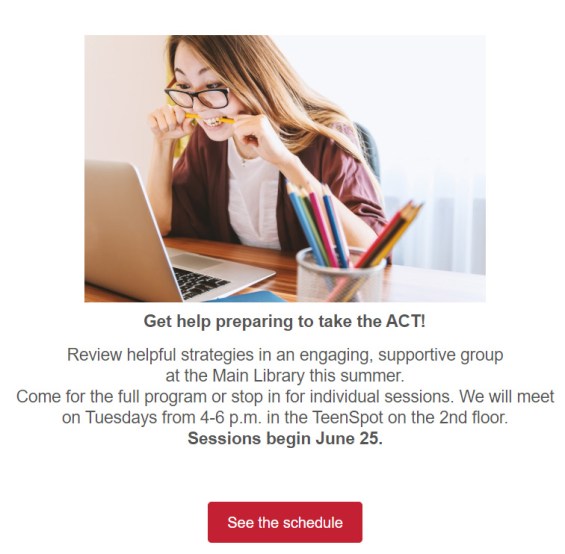
One image, with the main text in bold at 18 point found. A few sentences and a clear call to action.

Problem: Ignoring mobile responsiveness.  Mobile opens accounted for 46 percent of all email opens according to the latest research from Litmus. If your emails aren’t optimized for mobile, you are missing a huge potential audience, particularly women and young people.

Solution: Optimize your emails for mobile to make them responsive. Most email marketing programs offer mobile responsive templates. My library uses Savannah by OrangeBoy. We switched to all responsive templates in January of this year. I’ve seen a nine percent increase in click-through rates. I count that as a win!

Problem: No system for proofing your emails in different kinds of email boxes. Your email design might look great in your creation software. But if you send it without testing it, you may find that your email becomes a kind of monster creature! It may show up a a jumbled mess of images and text. This happens because every email inbox will convert your email differently.

Solution: Test your email to make sure your message displays correctly for your recipients. Find people that you trust you have different providers… someone with Gmail, someone on Outlook, someone on Yahoo, and so on. Send them the message and ask them to check for warped images, font problems, and extra spaces.

Subscribe to this blog and you’ll receive an email every time I post. To do that, click on “Follow” button in the bottom left-hand corner of the page. Connect with me on Twitter, Instagram, and LinkedIn.  

This Advice Will Boost Your Library Marketing Email Click-Thru Rates

A few months ago, I wrote a post about email vanity metrics. Those are the statistics like open rates that make us feel good. But if we’re being honest, they’re relatively meaningless.

The meaningful metrics like click-thru and conversion rates are harder to obtain and must be tied to your library’s overall strategy to provide any meaning. Humans naturally like doing the easy stuff! But it’s the hard metrics that make our work valuable and worthwhile.

So, I want to spend the next two posts sharing some of my strategies for improving your library email click-thru and conversion rates. I learned most of these tips through trial and error and a lot of failures. Remember that failure is okay! It teaches us lessons that lead to success.

This week we’ll focus on improving your click-thru rates. The click-thru rate is the percentage of people who, after opening your email, will click on a link. Here’s what I’ve learned about how to improve that rate.

Promote the best possible content. Don’t send an email to promote every program or service your library carries. Choose your promotions strategically. Put the best content into your emails to make it more likely that your cardholders will click on your links.

For collection-based marketing, make sure the books you choose to promote in your email are buzz-worthy, newer, have a great cover (you’d be surprised how much the cover art affects click-thru rates!). For program promotions, of course you’ll choose events that are fun and interesting. But the programs you promote through email should either in demand by your cardholders or unavailable at any other organization or community group in your area. If you are asked to promote new or existing services like databases, movie streaming platforms, or reading recommendation services, pick the best of parts of those services to promote. For example, I recently did a three-month series of emails promoting the Great Courses section of the Kanopy video platform. Instead of trying to promote the entire Great Courses section, I promoted three specific video series–yoga, family history research, and weight loss. Promoting parts of a service makes it easier to target your message. Speaking of which…

Target your message. Click-thru rates skyrocket when the message you send is targeted to the audience most likely to be interested in it. Sounds like common sense, yes? But I still hear from lots of libraries who are afraid to stop sending emails to all their cardholders. If you have the technology to segment your audience, you should do so. Try to target your email messages to about ten percent or less of your existing email list. Don’t worry if that number seems small. If that audience is getting an email about something they’re interested in. you’ll see results in big click thru rates and engagement.

Here’s my strongest example. A few months ago, my library started a short, monthly eNewsletter targeted specifically at young professionals. This newsletter goes to about 300 people once a month. For my library, an email sent to just 300 people is really tiny… that’s only about .10 percent of our total email list. But it pays off! This email gets huge engagement numbers because those 300 people are really, really interested in the contents of the email. In October, the click-thru rate was 37 percent. I wish all my emails were that successful.

Give yourself time to create and revise your emails. This is the maybe the most important step. Plan your email schedule as far in advance as possible. Set aside time to write the copy. Then, walk away.  Come back later-preferably another day-and look over your work. Revise it. Walk away again. Repeat this process until the copy and structure of your email is as good as it possibly can be. Too many of us (myself included) rush through the creative process.

If you recognize that you are the kind of creative person who feels like he or she can never release anything into the word because it’s never perfect enough, set some boundaries. Give yourself a deadline for when you’ll send the email up the chain for approval and tell your supervisor when to expect it so he or she can hold you accountable. That will help you break the endless cycle of revision!

Write like a Buzzfeed blogger, not like a librarian. Write to entice. Make the text interesting. Use conversational language within your emails. Write short sentences. And don’t write too much! Less copy is better. Make your cardholders curious to find out more and then give them the means to do it by doing this next step, which is…

Embed clickable links in more than one location within the email. My personal rule of thumb is to include a link to the book, program, or service about three times in varying places within the email. This gives your cardholder the chance to act at various points as their eyes or mouse or thumbs roam your message. It also increases the chance that they’ll be able to act, if they so choose, by making it super easy for them.

Next read: How to improve your library email marketing conversion rate!

Finally, would you be so kind as to answer a question for me?

Subscribe to this blog and you’ll receive an email every time I post. To do that, click on the “Follow” button in the bottom left-hand corner of the page.  

Avoid Email Vanity! Here Are the Results You Should Measure

I love email marketing. It’s one of the most effective tools in the modern library marketer’s toolbox. Emails are a direct way to interact with your cardholders and your community. They are easy to create. You can share stories, collection items, explain new services, and promote events directly with your audience. And library cardholders love getting emails from us. We don’t have to worry about unsubscribe rates the way other industries do.

Many libraries are now emailing their cardholders. And they’re reporting success with those campaigns. I’m so happy! But I’m also worried about something I hear often in conversation with other library marketers. I’m worried that we’re focused on the wrong measure of success–open rates. I’ve attended two events with other library marketers this summer. At both, there were deep and interesting discussions about success in email marketing. But at both events, the conversation about success centered on how to raise open rates.

Now, I have a confession to make. When I started targeted email marketing back in January of 2015, I was obsessed with my email open rates. And so were thousands of marketers in industries across the world. During my first trip to Content Marketing World, I attended several sessions on email marketing and every speaker mentioned open rates as a measure of success.

Open rates do mean something. They are a sign of customer loyalty. A high open rate means that your cardholders are eager to see what you’ve sent them. And that’s good. But it’s kind of like buying a house because it’s got a beautiful exterior. You may sign all the paperwork, open the front door and find all the walls are unfinished! Open rate is a vanity metric. It makes you feel good. But it’s what happens AFTER your cardholders open your email that counts.

I’m not suggesting you ignore open rates. They do give you information you can use to improve your emails. If your open rates are high, and your click-thru rates are low, you can be certain that you are writing compelling email subject lines (Good job, you!). You have a loyal and eager audience. But the content you are sending to your cardholders isn’t what they want. Now you can fix that problem!

Keep tabs on your open rate. But you should focus on two other valuable ways to really measure the success of your emails.

Click-through rates: The higher this number is, the more excited I get. It means that my cardholders opened an email, saw something they liked, and took an action! Most of the time, my library emails direct cardholders to do one of two things: click a link for a specific item in our collection or go to the event calendar where they can register or put an upcoming event on their calendar. Convincing a cardholder to take one of those actions is a huge victory. It also gives me data about what that particular cardholder is interested in. And I can use that information to craft future emails that are also compelling for that cardholder.

Conversion rates: A conversion rate is the most accurate way to measure email effectiveness. It is the percentage of people who take an action after clicking through an email. For example, let’s say 100 people click-through to look at a book I’ve promoted by email. If 50 of those 100 people put the book on hold, my conversion rate is 50 percent. Once I know what my average conversion rate is for a certain type of email, I can set goals to raise that conversion rate. I can  accurately compare my emails to one another.  I might see a high conversion rate for a certain genre of book and look for similar books to market to that cardholder. I might notice a spike in registration rates for a particular kind of program coming from an email and look for similar kinds of programs to market to my cardholders. Conversion rate is the most accurate measurement for determining the likes and dislikes of your cardholders.

For more on tracking the success of your email marketing, you can also read this article. And if you want to learn more about targeted email marketing and get more secrets for library email success, don’t forget the free webinar 

Subscribe to this blog and you’ll receive an email every time I post. To do that, click on “Follow” button in the bottom left-hand corner of the page. Connect with me on Twitter, Snapchat, and LinkedIn. I talk about library marketing on all those platforms!

The Million-Dollar Reason You Need to Market Your Library’s Collection

THE (1)

$250,000 vs. $8 million.

That’s the spread between the amount my library spends on programming and the amount they spend on collections.

I bet if you checked your library, you’d find a similar story. So why, my dear friends, do library marketers spend the majority of their time and effort promoting programs?

$275,000

Please understand me. I’m not saying that library programming isn’t important or worth promoting. Library programs nourish the soul of our community and offer cultural and educational opportunities for those who might not otherwise have access to them. Most library programs are a valuable and important part of the library’s mission to serve the community. And they deserve to be marketed!

But most library marketing teams spend their energy and resources promoting those programs. And they miss an undeniably important fact about library usage. Library cardholders want the books. They’re checking out books. That’s why they signed up for a library card!

A study by the Pew Research Center published in September 2015 shows 66 percent of library cardholders use their card to borrow books. Only 17 percent attend a library program, class, or lecture. Think about what people say when they sign up a library card. Most are going to tell you they are excited to check stuff out! We take it for granted that people know we have circulation items–books, magazines, music, and more. We need to stop that.

If we want to compete with Amazon and other bookstores, we have to promote our main asset–the collection. People are hungry for information about new stuff in the collection. And every time I talk to someone about the library and I mention that we loan eBooks, eAudiobooks and downloadable music, they look at me like I have two heads. We’re spending a ton of money to build our collection and our customers don’t really know it’s there. When they want a newly released book, who do your cardholders think of first–you or Amazon?

Before I was a library marketer, I worked as a television news producer. That means I put together each night’s newscast, decided which stories were told, in what order, and how they were told. Every year, our news director would bring in a consulting firm whose job it was to help us improve our shows and increase our viewership. I was proud of my work as a journalist. But when I was presented with the feedback from focus groups, it was clear that most viewers were watching my show for the weather. Hearing what was going on in the world was nice, but what they really wanted to know was whether it would rain the next day.

In television news, weather is king. In libraries, the collection is king. Collection marketing is a valuable investment for every library. The best way to market the collection is through targeted emails. In the next few blog posts, I’ll be sharing some secrets for targeted email messaging–things I’ve learned in the 18 months that we’ve done so at my library.

But you can start collections marketing right now through social media–especially Twitter and Pinterest– and by featuring books on the front page of your website.  Create themed book lists–you can enlist your collections development department for help with that task. Talk about new books and popular books in your podcast or on your blog.

For a few minutes every day, spend some time marketing your collection. It will increase circulation and will help reinforce the image of your library as a place of vast resources in the eyes of your cardholders.

Subscribe to this blog and you’ll receive an email every time I post. To do that, click on “Follow” button on the bottom left-hand corner of the page. Connect with me on Twitter and Snapchat–it’s where I talk about library marketing! I’m @Webmastergirl. I’m also on LinkedIn, Slideshare,  Instagram and Pinterest. Views in this post are my own and do not represent those of my employer.

A WordPress.com Website.

Up ↑