Sometimes it can be very difficult to get your library leaders on board with your marketing ideas. I’ve got five tips that I’ve used to persuade senior leaders and supervisors, and I’m going to share them with you in this episode of The Library Marketing Show.
Plus we’ll give kudos to a library that received press coverage for a new outreach initiative at their local airport!
Do you have a suggestion for a topic for a future episode? Do you want to nominate someone for kudos? Let me know here. Thanks for watching!
Subscribe to this blog and you’ll receive an email whenever I post. To do that, enter your email address. Then click on the “Follow” button in the lower left-hand corner of the page. You can also follow me on the following social media platforms:
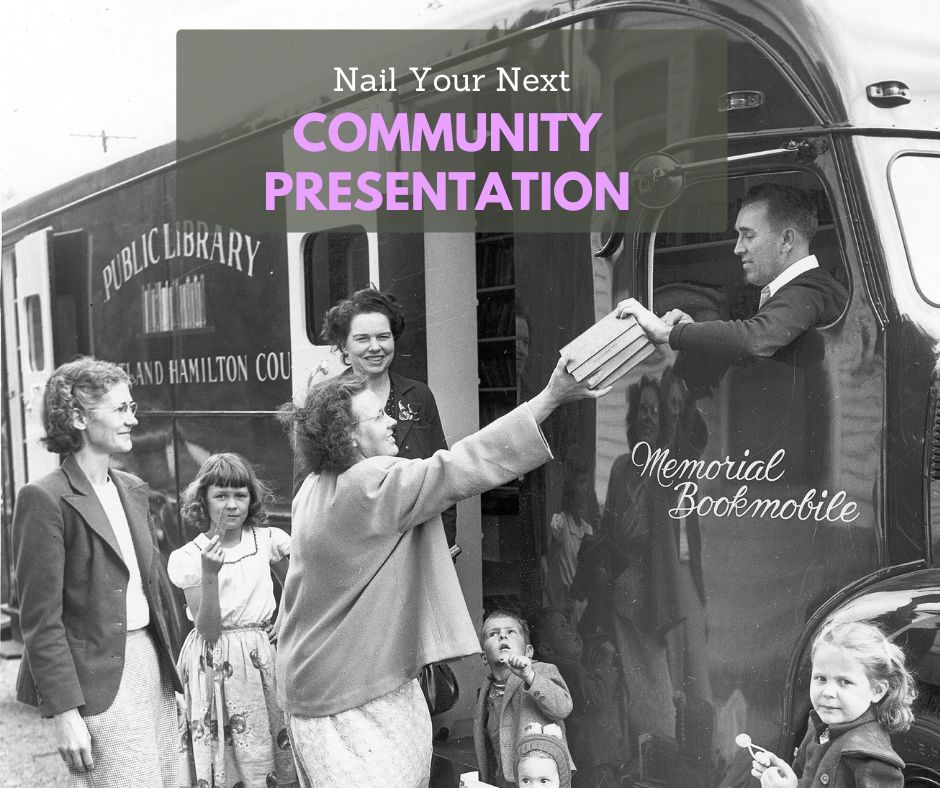
Photo courtesy Cincinnati and Hamilton County Public Library
I’ll never forget the first time I spoke in front of a community group on behalf of the library.
I was a nervous mess. The pressure was high. So much was riding on my five minutes in front of this group. I wanted to connect with my audience, transfer some of my passion for the library to their souls, and inspire them to action.
A community presentation is a unique opportunity to talk directly about the value of your library. What you say in those moments will stick with people longer than any flyer or sign ever will. But for maximum impact, you must take a strategic approach to your presentation.
And, although I know that five minutes doesn’t seem like a lot of time, it is! If you don’t believe me, stop reading this blog, set a five-minute timer, and just sit there with your eyes closed trying to predict when the timer will ring.
Five minutes is a LOT of time. And you can do a lot in five minutes!
Here are seven tips to make any presentation engaging and impactful. Scroll down to see a sample outline I’ve created to walk you through creating a presentation that hits the mark, even when you only have five minutes to share.
Refer to the library as “your library.”
Many people in your audience may haven’t visited or used the library in a long time. They may not think of the library as belonging to the community, and they certainly won’t think of the library as belonging to them personally.
So, in your presentation, refer to “your library” as many times as makes sense. This is a subtle way to let your audience know that the success of the library affects everyone in the room.
Start with a hook.
You want your audience to be interested and attentive, and the best way to do that is to start right off, not by introducing yourself, but with a surprising fact or statistic about your library.
For example, “Your library sees about 20,000 people who come into the physical building every year—that’s enough to fill our high school football stadium four times over! I’m Jane Doe, and I’m here to show you how your support of the library impacts those 20,000 people.”
You could also begin with a short, compelling story about how the library positively impacted someone in the community.
For example, “I want to begin by introducing you to Susan. Susan was laid off about 6 months ago, after spending more than 20 years at her company. She came to your library for help finding a new job. We spent time updating her resume, searching for jobs that fit her experience, and practicing interview techniques. Susan landed a new job and is now making more money than she was at her former position, all thanks to the staff at your library.”
Choose one main message and repeat it throughout the presentation.
It will be tempting to try and talk about everything the library has to offer during your five minutes. However, listing all library services will overwhelm and confuse your audience. Instead, focus on one message you want this audience to remember.
For example, if you are speaking to the school PTA, you will want to focus your message on resources available to students and parents to help with schoolwork. Your main message would be: “Your public library takes the stress out of schoolwork.”
Or, if your library is getting ready for a major construction project, you’ll want to talk about how the renovations or new construction will provide better service to the community. Your main message would be: “These new library spaces will be vibrant, accessible places where everyone in our community can thrive.”
Whatever your main message is, try to work that into your presentation at least three times. Repeating it will help it stick in the minds of your audience.
Use visual aids.
You can put together a short slide deck to help drive home your key message. Be sure to keep your slide text short. Add infographics, photos, or short video clips that reinforce your message.
If the room setup does not include a screen for a slideshow, bring handouts with you! Add your key message points to the top of the handout, and then some visuals like charts, photos, or infographics.
Add an interactive element.
You may be tempted to talk for your entire five-minute slot. But your audience is more likely to remember what you say if you involve them in the presentation in some way.
Launch a poll. Several free sites like Slido and Mentimeter let you embed a poll question in your slide deck with a QR code. Or just ask for a show of hands.
You could also ask a question of your audience, like, “How many of you have visited our library in the past month? What is the first thing you remember seeing when you walked into the building?”
Or try a mini-activity. For example, you could ask everyone to take out a piece of paper and write down as many library services as they can think of in 30 seconds.
End with a call to action.
Give your audience something to do after your presentation. You can invite them to visit the library for a special prize. You can ask for volunteers or donations. One library staff member I’ve spoken with did a presentation on intellectual freedom and handed out talking points, encouraging the audience to use them in conversation with friends at family.
Practice your speech.
A practice session or two can help identify parts of your speech that are less engaging and can ensure you stay within your time limit.
Ask a few coworkers to play the audience and then ask them for feedback on your presentation. Or record yourself giving your speech so that you can evaluate the timing, pace, and content.
Sample Outline for a Five-Minute Presentation
To help get you started, I’ve created this outline template for a community presentation. By following this structure, you can deliver an engaging and persuasive message about the benefits of the library within a short time frame.
Introduction (30 seconds)
Start with a hook: Share a surprising fact about your library or a testimonial or patron story.
Main Message (3 minutes)
State the main message you want this audience to remember.
Talk about the service you are highlighting.
Share how this service impacts your community, and how the community would be impacted if the service were NOT available.
Engagement (1 minute)
Ask rhetorical questions.
Insert an interactive element.
Conclusion (30 seconds)
Call to action: Leave your audience with a task that reinforces your key message.
Subscribe to this blog and you’ll receive an email whenever I post. To do that, enter your email address and click on the “Follow” button in the lower left-hand corner of the page. You can also follow me on the following social media platforms:
A viewer says they’re getting a lot of requests from library staff for signage. But, they’re a little worried about walking that line between good customer service and too many signs.
I know this issue well, and in this episode of The Library Marketing Show, I have some tips to help you achieve that balance.
We’ll also give kudos to a library that clearly and beautifully communicated the value and impact of its summer reading program.
Do you have a suggestion for a topic for a future episode? Do you want to nominate someone for kudos? Let me know here. Thanks for watching!
Subscribe to this blog and you’ll receive an email whenever I post. To do that, enter your email address. Then click on the “Follow” button in the lower left-hand corner of the page. You can also follow me on the following social media platforms:
There’s one teeny, tiny thing that you can do to make sure your library’s emails not only make it into the inbox of your recipients but also build a connection with the people who sign up for your emails. And it only takes you five seconds to take this step! I’m going to share that tip in this episode of the Library Marketing Show.
Plus we’ll give kudos to a library that gave us a master class in crisis communication.
Do you have a suggestion for a topic for a future episode? Want to nominate someone for kudos? Let me know here. And thanks for watching!
Subscribe to this blog and you’ll receive an email whenever I post. To do that, enter your email address. Then click on the “Follow” button in the lower left-hand corner of the page. You can also follow me on the following social media platforms:
Photo courtesy Cincinnati and Hamilton County Public Library
A few weeks ago, I received a question from a reader.
The email read, “My library has recently dealt with many unexpected closures and disruptions in service. Our AC went down during a heatwave, our drive-thru will be closed for three days due to road repair, our parking lot was closed for resealing, our meeting rooms are short on tables due to some faulty wheels, our entrance was temporarily closed due to construction, our catalog will be down due to a migration, our elevator is on the fritz… and the list goes on!”
“Our staff always want to make sure that patrons are informed and prepared for what to expect when they arrive, but I’ve been concerned about balancing our messaging.”
Ensuring your community has updates on broken equipment or services that are unavailable while continuing your normal promotions highlighting the library’s value is a common challenge. For my library marketing friends who are dealing with hurricanes, construction projects, unexpected power outages, and more, I’ve created this guide with recommendations on how to manage these situations.
Tip #1: Prioritize critical messages.
If your library is facing significant disruptions that impact a large number of patrons (e.g., catalog downtime, major entrance closures,), use all your available channels (website, social media, emails, texts, signs, etc.) to inform your patrons.
As you craft your messaging, be certain to use clear, conversational text. Give easy, step-by-step instructions for navigating these disruptions. And, always be sure to include a phone number or email where community members can ask further questions.
Let your community know how long the disruption will last. And promise to provide further updates. Your goal is to minimize situations where unexpected surprises could cause frustration or inconvenience.
Here’s a great example from Delaware County District Library, which sent an email to let people know its locations will close for a staff training day.
Tip #2: Use targeted messaging for less critical issues.
For less critical issues (like broken equipment or minor repairs), an “Out of Order” sign on the affected item may be sufficient. If it’s a piece of equipment in your MakerSpace, and you have emails for community members who have reserved the equipment, a quick email letting them know it’s unavailable is warranted.
You could also use your website or digital signage within the library to let patrons know about the disruption as they arrive at the branch.
Tip #3: Have lots of disruptions? Consider bundling your messages.
If you’re facing a situation like my reader where you have multiple outages, consider bundling updates. A weekly update post on social media or an email summarizing all current disruptions will inform your community without inundating them with multiple messages.
Tip #4: Create a “Service Alerts” section on your website.
A landing page where notifications about all service alerts are located makes it easy to keep all information about potential disruptions in one place. Like Vancouver Public Library, you can train your community members to look there for updates and point to this section when creating email or social media messages about new disruptions.
Tip #5: Ensure staff have messaging for in-person interactions.
Make sure you take the time to give your library’s front-line staff up-to-date information so they can proactively inform patrons and suggest alternatives when disruptions affect a visit. This helps staff manage patron expectations. It also empowers staff and makes them feel more confident as they interact with community members.
Tip #6: Consider adding humor to your messaging.
Humor can be an effective way to soften the impact of negative news, like service disruptions, without downplaying their importance. It can also make your messaging feel more approachable and lessen frustration.
For example, instead of a straightforward “The elevator is out of order,” try: “Our elevator decided to take a break—stairs are getting their time to shine!” Or, if your catalog is down, you could say “Our catalog is taking a nap for maintenance. It’ll wake up refreshed and ready soon!”
You can also use funny visuals, as Orkney Library did when they were forced to close an hour early for a whole week.
Finally, try pairing your disruption message with a positive point. For example, “Our entrance is blocked due to construction, but we’ve still got an open door to great reads.”
Tip #7: Pay attention to your community’s response to the disruption.
As with any library communications situation, pay attention to feedback from your community members regarding your communication strategy. You’re striking the right balance if patrons feel well-informed without being overwhelmed. If they complain that they’re getting too many or insufficient messages, adjust accordingly.
Although disruptions are not ideal for your community and your marketing, you will learn things about your audience! For example:
How do patrons use the library? Disruptions can reveal patterns of library use. For example, if many patrons express frustration over catalog downtime, it indicates that digital access is a high priority. Alternatively, if they’re more concerned about space (like meeting room availability), it shows how much they rely on physical spaces. You can use this information to inform future marketing.
Which channels work best for communication? Analyze how patrons respond to disruption notices. Do they respond more to messages sent via social media, emails, or to messages delivered in person? This can tell you which communication channels are most effective for your library’s audience.
Subscribe to this blog and you’ll receive an email whenever I post. To do that, enter your email address and click on the “Follow” button in the lower left-hand corner of the page. You can also follow me on the following social media platforms:
Does it make sense for your library to have separate logos for your main services? It’s a fascinating question sent in by a viewer. I will give you some things to think about before you create a new logo in this episode of the Library Marketing Show.
Plus we’ll give kudos to a library doing something exciting, educational, and informative this election cycle.
Do you have a suggestion for a topic for a future episode? Want to nominate someone for kudos? Let me know here. And thanks for watching!
Subscribe to this blog and you’ll receive an email whenever I post. To do that, enter your email address. Then click on the “Follow” button in the lower left-hand corner of the page. You can also follow me on the following social media platforms:
A fascinating new report may help your library decide which social media platforms you should use to post content specifically aimed at your youngest readers! We’ll break down the topline results and talk about how to take advantage of this new data in this episode of The Library Marketing Show.
Plus we’ll give kudos to a library mentioned on a major national comedy show… and they didn’t even plan this press!
Do you have a suggestion for a topic for a future episode? Want to nominate someone for kudos? Let me know here. And thanks for watching!
Subscribe to this blog and you’ll receive an email whenever I post. To do that, enter your email address. Then click on the “Follow” button in the lower left-hand corner of the page. You can also follow me on the following social media platforms:
Photo courtesy Cincinnati and Hamilton County Public Library
When Jennifer Fermino graduated from college with a B.A. in English, she needed help figuring out how to put together a resume that would land her a job in communications. She found that help at what was then the New York Public Library’s Mid-Manhattan Library (now the Stavros Niarchos Foundation Library).
“It was an invaluable resource for a young person who really didn’t know what she was doing or how to translate any of her job skills, which was then primarily waitressing and nannying, into the career path I was aiming for,” recalls Jennifer. “I would also add I am in good company: President Obama also credits the Stavros Niarchos Foundation Library with helping him get his first job.”
And now, 20 years later, after stints as a reporter for the New York Post and the New York Daily News, as well as PR agencies and as Communications Director for the New York City Council, Jennifer works for NYPL as Vice President for Communications and Marketing. She’s been at her dream job for about a year and a half.
“It’s amazing to work for a system that serves three boroughs in the greatest city in the world (Manhattan, the Bronx, and Staten Island),” enthuses Jennifer. “We have 92 locations and there is never a dull day.”
Jennifer and a team of nearly 30 people run all marketing and promotions for the library. And her first 18 months on the job were, shall we say, a trial by fire.
New York City Mayor Eric Adams proposed huge cuts to the library’s budget earlier this year… $58.3 million to be exact… that would have forced NYPL to dramatically reduce hours. The budget cuts also threatened the library’s budget for books, programs, and maintenance. Prior cuts, enacted in late 2023, forced all NYPL branches to close on Sundays.
Soon after these new cuts were announced, NYPL, along with the Brooklyn and Queens Public Libraries, launched a massive campaign to show the importance of the city’s three libraries. And New Yorkers, as well as library lovers from across the country (myself included) jumped in to show their support.
For months, I was served a social media post from NYPL every time I went online, on all channels. It felt like a coordinated, consistent effort to keep reminding people of the threat of the cuts. And that’s why I reached out to Jennifer. I wanted to know how her team managed the campaign.
“It was a sustained effort to tap into the goodwill that people have for libraries and keep the cuts front and center,” says Jennifer. “I give huge credit to Victoria Reis, our social media manager, who is creative and has an understanding of both online culture and our audience.”
“We began repurposing the famous “This is fine’ meme with our mascot Patience and it was an immediate hit with our followers. People really connected to the campaign, and the message – that we already lost Sunday service and were in danger of losing more – resonated.”
“The reaction kept growing and growing. Towards the end of the campaign, one of our memes – again a repurposing, this time of the “girl explaining” meme, went over the top viral. Last I looked it had over 7M views on X (Twitter).”
The team included messaging on other channels as well and worked hard to stay coordinated.
“Special shoutout to our talented Managing Editor Katherine Ward, whose job was to keep it all together for us,” declares Jennifer.
The team coordinated messaging using four main tactics:
Their NYPL Connect newsletter, which I encourage any library or NYC lover to sign up for, as well as regular reminders of the cuts on our home page.
Letter writing stations in branches in which patrons could easily write city leaders to support libraries.
Rallies of supporters at City Hall that the press was invited to cover.
And, as mentioned, a fun, creative social strategy.
“We honestly didn’t know what was going to happen – everyone was hopeful but on pins and needles,” remembers Jennifer. “Reporters started calling me saying they had sources saying we would be saved, but I refused to believe it until it was official. People were congratulating us, but I felt like it was jinxing us. It took a bit for me to finally accept that it was over.”
“Thankfully, the Mayor has a history of supporting libraries, and we are grateful that he funded us. We also had the City Council, including Speaker Adrienne Adams, firmly in our corner throughout.”
“But I can say that our campaign engaged New Yorkers and showed how much people love their libraries, which is so important in the budget process.”
While they fought the budget cuts, NYPL’s marketing team had other promotions to balance.
“We had launched our “Books for All” campaign celebrating the freedom to read and standing against book bans right before the cuts were enacted,” explains Jennifer. “We continued that campaign all year long because the issue is of such importance to us.”
“We also just finished our ‘Summer at the Library’ campaign with Brooklyn and Queens to promote reading and education city-wide during the summer break for schools. Although not technically part of the advocacy campaign, efforts like this help show why funding libraries is so important.”
“We are always exchanging ideas and talking about how to engage New Yorkers,” says Jennifer. “It is a great relationship. We are partners throughout the advocacy campaign and continue to do great work together.”
“In fact, we are planning a national Freedom To Read Day of Action on Oct. 19 with Brooklyn and Queens, as well as the American Library Association, Unite Against Book Bans, and the Association for Rural and Small Libraries to stand against censorship. We have many libraries already signed up and invite everyone to join us.”
Subscribe to this blog and you’ll receive an email whenever I post. To do that, enter your email address and click on the “Follow” button in the lower left-hand corner of the page. You can also follow me on the following social media platforms:
Subscribe to this blog and you’ll receive an email whenever I post. To do that, enter your email address. Then click on the “Follow” button in the lower left-hand corner of the page. You can also follow me on the following social media platforms:


 Super Library Marketing: Practical Tips and Ideas for Library Promotion