Search

Super Library Marketing: Practical Tips and Ideas for Library Promotion

Tag

library marketing advice

Ensure Your Digital Library Marketing Passes Accessibility Tests: Expertโ€™s Urgent Advice

Photo courtesy Cincinnati and Hamilton County Public Library

Laura Solomon grew up in upstate New York with a mother who was an avid reader. She took Laura and her brother to the local library about once per week.

โ€œMy favorite memory about a library wasnโ€™t directly in a library,โ€ recalls Laura. โ€œWhen I got the chicken pox and was out of school for days, my mother asked the childrenโ€™s librarian for books I would like. The librarian sent her home with a huge stack. I loved every book!”

Now, Laura helps libraries with digital marketing and website design for the Ohio Public Library Information Network. I reached out to Laura after the company I work for, NoveList, began work on digital accessibility. And, of course, that made me think of my library friends and their commitment to accessibility.

So, I asked Laura to share her expertise and tips. But first, Laura wants to clear up one misconception. I thought that the push for full compliance was the result of a new law. I was wrong.

Laura says there are no new legal risks, but there is likely to be much more scrutiny and even fewer accepted excuses for not meeting legal obligations after the deadlines.

โ€œThere are no changes to the Americans with Disabilities Act (ADA) regarding web accessibility,โ€ declares Laura. โ€œWebsites have had the legal requirement of being accessible to people with disabilities for many years. The Department of Justice has long stated this clearly.โ€

Laura says that, in April 2024, ย the Department of Justice added two new rulings that impact your library.

There is now an official deadline for compliance for state and local government entities. The specific deadline depends on the population of your libraryโ€™s community, which is not the same thing as your libraryโ€™s service area.

โ€œThe Department of Justice has drawn a line in the sand because too many government entities (including libraries) have been ignoring the legal requirement.”

Laura Solomon

In addition, there is now an official standard for compliance. WCAG 2.1 AA is a set of internationally recognized guidelines developed by theย World Wide Web Consortium (W3C)ย to ensure web content accessibility, particularly for people with disabilities. This is the standard your library must meet in order to be compliant.

So, itโ€™s time for your library to get serious about compliance. Where should you start?

ย โ€œI would recommend starting with automated testing, using a tool like Webaimโ€™s WAVE tool,โ€ advises Laura. โ€œHowever, I always recommend testing with more than one tool. They will usually catch slightly different errors.”

“Most tools (including WAVE) only check one page at a time, not an entire site at once. It takes manual testing to really dig into things correctly. However, itโ€™s a good starting point for most laypersons.โ€

โ€œItโ€™s important to understand that the WCAG standard is a technical standard. Itโ€™s used to evaluate the code that creates the website, not what you see on the screen.ย That means it often requires someone with both web development and web accessibility expertise to completely remediate issues.โ€

โ€œWebAIM also has a great introduction to web accessibility. The best thing a library can do right now is to add accessibility checks into content workflows.โ€

That means, for every piece of content your library creates, a library will need to check for accessibility, including color contrast, alt text, keyboard navigation, and structured content.

Laura says the most common accessibility mistake she encounters on library websites is a lack of alt text or poorly written alt text.

โ€œAs the web has become increasingly visual, much of that content has become completely unavailable to people using assistive technology,โ€ explains Laura. โ€œAlternative text is mission-critical and not just a nicety.โ€

โ€œAnother thing that many libraries do is to pack images with tons of text. This isnโ€™t just problematic for web accessibility, but itโ€™s also poor design.โ€

Laura says another problem that’s become increasingly pervasive is the use of accessibility overlays, which are third-party products that usually have some kind of button that provides additional accessibility features when activated.ย 

“Accessibility advocates have long begged site owners to stop purchasing these,” says Laura. “They can often interfere with the technology that people with disabilities already use to make their online experiences accessible. Also, they donโ€™t protect libraries from lawsuits. If your library has purchased one of these, I strongly recommend removing it and focusing on making your website accessible from the ground up.โ€

Your library may feel overwhelmed by both the scope of this work and the cost.

โ€œTo be honest, retrofitting a website for accessibility can be more time-consuming and expensive than starting with a framework that already provides accessibility as part of its core functioning,โ€ says Laura. โ€œSadly, a lot of popular content management systems donโ€™t do this or only provide some accessibility features.โ€

Your libraryโ€™s website isnโ€™t the only thing you need to review to be compliant. PDFs, e-newsletters, and social media graphics should also be considered. Laura says itโ€™s difficult to make PDFs compliant. The best advice is to not use PDFs. As for e-newsletters, they have the same requirements as any regular web page. Social media graphics require alt text.

โ€œItโ€™s important to understand that web accessibility includes everything,โ€ shares Laura. โ€œIt includes databases, apps, and anything else that connects to the internet. It also includes a lot more than just the blind or visually impaired.”

“People with disabilities are not a small part of our communities; statistically, they represent at least 1 in 4 people. Libraries are about serving their communities, and this is an especially important way in which they can do that, regardless of legal requirements.โ€

Laura Solomon

Need more inspiration?

10 New Infographic Ideas To Prove the Value and Power of Yourย Library

Subscribe to this blog, and youโ€™ll receive an email whenever I post. To do that, enter your email address and click on the โ€œFollowโ€ button in the lower left-hand corner of the page. You can also follow me on the following social media platforms:

5 Time-Saving Tips To Save Your Sanity While Marketing Your Library

Watch this video now

#LibraryMarketingShow, episode 284

Are you marketing and promoting your library by yourself or with a very small team? Do you feel overwhelmed and stressed, like there’s never enough time in the day to do everything that needs to be done?

I have five tips to help you make the most of your time and be efficient with your library marketing without getting stressed. We’re going to talk about it in this episode of The Library Marketing Show.

Plus, kudos goes to a library that managed to work a talking point about the value of libraries into a story about a book returned decades after its due date.

Do you have a suggestion for a topic for a future episode? Do you want to nominate someone for kudos? Let me know here. Thanks for watching!โ€‚

P.S.: If you wish, you may download a transcript of this episode.


Miss the last episode? No worries!

Will I see you soon?

Subscribe to this blog, and youโ€™ll receive an email whenever I post. To do that, enter your email address. Then, click the โ€œFollowโ€ button in the lower left-hand corner of the page. You can also follow me on the following social media platforms:

Facing the Hard Truth About Organic Reach on Facebook: Is It Worth Your Energy?

Watch this video now

#LibraryMarketingShow, episode 283

I’m not sure this is healthy for me. Still, I’ve been thinking about Facebook organic reach a lot lately. I’ve been wondering: Does it make any sense for libraries to post organically to Facebook anymore?

I think there are some hard truths about Facebook that we need to work through. We’re going to do it in this episode of the Library Marketing Show.

Do you have a suggestion for a topic for a future episode? Do you want to nominate someone for kudos? Let me know here. Thanks for watching!โ€‚

P.S.: If you wish, you may download a transcript of this episode.


Miss the last episode? No worries!

Will I see you soon?

Subscribe to this blog, and youโ€™ll receive an email whenever I post. To do that, enter your email address. Then, click the โ€œFollowโ€ button in the lower left-hand corner of the page. You can also follow me on the following social media platforms:

Protect Your Library Marketing: 6 Smart Strategies for Turbulent Times

Photo courtesy Cincinnati and Hamilton County Public Library

I will confess to you that I am worried about the future of libraries.

The news that the current United States Presidential administration intends to eliminate the Institute of Museum and Library services is devastating. For some libraries, the funding from IMLS accounts for a huge percentage of their annual budget. In my day job with NoveList, Iโ€™ve heard that some U.S. libraries are worried they won’t have enough money to buy books, let alone pay staff and keep buildings open.

Libraries in other parts of the world are facing threats, too. Canadian libraries are beating back book censorship challenges. In the United Kingdom, Australia, and New Zealand, funding cuts continue to threaten libraries. Itโ€™s a scary and infuriating time to be a library marketer.

Iโ€™ve been compiling a list of things that library marketers can do to protect their jobs and prove the value of their promotions and their libraries. Putting a plan in place and acting on that plan makes me feel less helpless and hopeless. So, hereโ€™s what I want you to do.

Stay focused: Set goals and center your energy there

Focus is critical during turbulent times. You may be tempted to think that you must promote everything the library offers to fight back against budget cuts. But I can say from experience that this method is ineffective and exhausting for you and your audience.

This is where goal setting can be critical. Pick the three biggest goals for your library for the next six months. For example, you might say Summer Reading, opening a new branch, and increasing the circulation of print items.

Next, you set goals for each of those three items. Use numbers, active verbs, and decide on a timeline for when that goal will be completed. Do not set a goal of โ€œWe hope to get more people to participate in Summer Reading.โ€ Instead, say, โ€œBy August 15, we will increase participation in Summer Reading across all age groups by 10 percent.โ€ ย 

Next, use the divide and conquer method to focus your promotions on those goals. Youโ€™ll want to spend about 75 percent of your promotional time on these three key areas. What will you do with the other 25 percent?

Incorporate value-driven messages into your calendar

With the remaining 25 percent of your energy, youโ€™ll focus on repeated messaging that conveys core library values. Use messaging that focuses on the library as a welcoming place where privacy is protected and where community members can pursue learning, creativity, and connection. Here are 4 ideas for how to do that.

1. Use positive storytelling

      Share real-life stories of how the library is a refuge for students, job seekers, new residents, and others who need a safe, quiet, or supportive environment. Give your patrons opportunities to share why the library feels like a safe and welcoming place for them through video clips, quotes, or social media posts. Need inspiration? Hereโ€™s how one library marketer does it.

      2. Feature library services that center on safety and comfort

      Promote meeting spaces, quiet study areas, free Wi-Fi, literacy programs, or social services partnerships that help patrons feel secure and supported.

      3. Celebrate the joy of reading

       A Scottish librarian once told me, โ€œReading for pleasure is fairy dust.โ€ Itโ€™s magic. It transports you, teaches you, and inspires you.

      One way to connect with the readers in your community is to do more collection promotion, focused on the joy that the reading experience brings. Your readers are fierce library supporters, and theyโ€™ll be the first to defend you from attacks. Engage them with more reading recommendations!

      4. Use visual cues in the library

      Display signage that communicates safety and inclusivity, such as “All Are Welcome Here”, โ€œYour Library, Your Spaceโ€, and โ€œCome as you are. Stay as long as you like.โ€ You can use AI to help you come up with short, non-political phrases that will convey the message of welcoming.  

      Build your email lists

      Social media platforms are more divisive, and many people are leaving them. You need a way to directly communicate with your community without algorithms! Right now, start working on building your subscriber list for emails. Here is a step-by-step guide for doing that.

      Track metrics to prove your value

      I know itโ€™s time-consuming. But tracking marketing metrics helps you prove the value of your work by providing data-driven evidence of your impact on the community.  

      Metrics like email open rates, social media engagement, and website traffic show how well your library is connected with patrons. Compare your metrics to the industry averages to show the value of email marketing.

      You should also track event registrations, program attendance, and resource usage tied to promotions. These numbers will allow you to show how marketing drives participation. For example, if you track metrics, you can tell your supervisor and your board of trustees that the rise in participation in summer reading was the direct result of your promotional campaign. when requesting funding or staffing.

      Hard data will help protect the funding and staff you may have to work on marketing. If you donโ€™t believe it, this libraryโ€™s experience with metrics may cause you to change your mind.

      Remind yourself of your successes

      Library marketing always comes with setbacks, but remembering your past successes reminds you that you’ve overcome challenges before and can do so again. I have two ways that I practice this concept.

      Every two weeks, I write a post for our company Teams channel about the content and emails weโ€™ve released and their results (if I have them already!). I also give shout-outs to the coworkers who helped us with different pieces of marketing. I don’t ever want to take it for granted that everyone I work with knows what my team does and why our work is valuable.

      At the end of every day, I take just a second to acknowledge everything I have done that day. Itโ€™s a simple but effective way to remind yourself that you are working hard and making progressโ€ฆ because progress in marketing sometimes seems very slow!

      Network with others

      This is the perfect time to join groups that relate to your work. You may need those connections if your job is threatened. And itโ€™s always a positive boost to have people who understand library marketing in your circle.

      The Library Marketing Book Club is a great option! We meet every two months to discuss a marketing book and to share ideas about marketing. In between meetings, we celebrate successes and ask for help with projects on our Facebook and LinkedIn pages. You can sign up for the club here.


      Need more inspiration?

      How To Persuade Library Leaders To Take Your Marketing Advice

      Subscribe to this blog, and youโ€™ll receive an email whenever I post. To do that, enter your email address and click on the โ€œFollowโ€ button in the lower left-hand corner of the page. You can also follow me on the following social media platforms:

      5 Tips To Make the Approval Process for Your Library Promotions Pain-Free

      Watch this video now

      #LibraryMarketingShow, episode 282

      One of the hardest parts about working in a library is the bureaucracy! It can slow everything down, including approval for your marketing materials.

      I’ve been there. I might not be able to fix it completely, but I have five things you can do to help make that approval process a little less painful, and that’s in this episode of The Library Marketing Show.

      We’ll also give kudos to a library that got an unusual and exciting patron testimonial during Library Lovers Month.

      Do you have a suggestion for a topic for a future episode? Do you want to nominate someone for kudos? Let me know here. Thanks for watching!โ€‚

      P.S.: If you wish, you may download a transcript of this episode.


      Miss the last episode? No worries!

      Will I see you soon?

      Subscribe to this blog, and youโ€™ll receive an email whenever I post. To do that, enter your email address. Then, click the โ€œFollowโ€ button in the lower left-hand corner of the page. You can also follow me on the following social media platforms:

      The Surprising Way To Learn How To Create a Better Library Survey

      Watch this video now

      #LibraryMarketingShow, episode 281

      Did you know there are seven things that you can learn by taking a marketing survey? I believe library marketers should be taking surveys from brands and companies because you can learn a lot about how to survey!

      I’m going to share some tips with you and why I think it’s really important to take those surveys in this episode of The Library Marketing Show.

      Plus, we’ll give kudos to a library that received press attention for a unique outreach program.

      Do you have a suggestion for a topic for a future episode? Do you want to nominate someone for kudos? Let me know here. Thanks for watching!โ€‚

      P.S.: If you wish, you may download a transcript of this episode.


      Miss the last episode? No worries!

      Will I see you soon?

      Subscribe to this blog, and youโ€™ll receive an email whenever I post. To do that, enter your email address. Then, click the โ€œFollowโ€ button in the lower left-hand corner of the page. You can also follow me on the following social media platforms:

      Discover Why Sending Library Emails on the Weekend Could Skyrocket Your Engagement!

      Watch this video now

      #LibraryMarketingShow, episode 280

      It goes against conventional wisdom, but your library’s newsletter might perform better if you send it on a weekend!

      In this episode of The Library Marketing Show, we’ll discuss this, and I’ll give you three reasons why I think you should experiment with weekend emails.

      Plus, we’ll give kudos to an individual library marketer profiled in their local newspaper.

      And I have a favor to ask:

      NoveList is doing a market survey on how libraries handle professional development training. Would you be willing to take the survey? It should take five minutes or less. Thank you!!

      Do you have a suggestion for a topic for a future episode? Do you want to nominate someone for kudos? Let me know here. Thanks for watching!โ€‚

      P.S.: If you wish, you may download a transcript of this episode.


      Miss the last episode? No worries!

      Will I see you soon?

      Subscribe to this blog and youโ€™ll receive an email whenever I post. To do that, enter your email address. Then click on the โ€œFollowโ€ button in the lower left-hand corner of the page. You can also follow me on the following social media platforms:

      2 Easy and Extremely Important Steps To Take Every Time Your Library Uploads a YouTube Video!

      Watch this video now

      #LibraryMarketingShow, episode 279

      Every time I upload one of these videos to YouTube, there are two major things that I am sure to do. Both of them helped me build my channel. One of them annoys some of my viewers!

      In this episode of The Library Marketing Show, I will explain why I will keep doing these things and why you should follow my lead.

      Plus, we’ll give kudos to a library with a spooky service that allows people to explore the library looking for ghosts!

      And I have a favor to ask!

      NoveList is doing a market survey on how libraries handle professional development training. Would you be willing to take the survey? It should take five minutes or less. Thank you!!

      Do you have a suggestion for a topic for a future episode? Do you want to nominate someone for kudos? Let me know here. Thanks for watching!โ€‚

      P.S.: If you wish, you may download a transcript of this episode.


      Miss the last episode? No worries!

      Will I see you soon?

      Subscribe to this blog and youโ€™ll receive an email whenever I post. To do that, enter your email address. Then click on the โ€œFollowโ€ button in the lower left-hand corner of the page. You can also follow me on the following social media platforms:

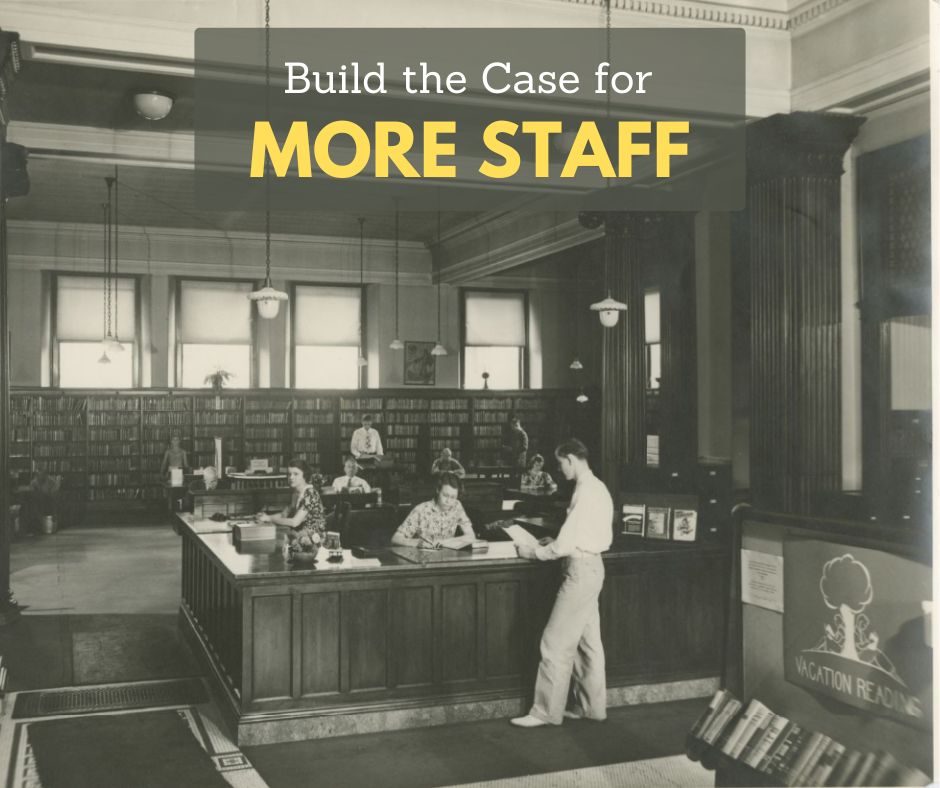
      How One Library Marketer Advocated for (and Got) an Additional Promotional Staff Member

      Photo courtesy Cincinnati and Hamilton County Public Library

      Have you ever wondered what you could do for your library if you had more people working on promotions?

      Staffing up in library marketing is very uncommon. I believe this is a huge mistake that many libraries make. Leaders and board members donโ€™t understand the essential connection between smart, strategic library marketing and the organization’s success.

      So when I learned that Nicole Fowles of the Delaware County District Library successfully advocated for and got an extra library marketing staff member, I had to ask her how she did it! Nicole grew up in New Philadelphia, Ohio, and was a regular visitor to the Tuscarawas County Public Library Main Branch.

      โ€œI have fond memories of storytime with Mrs. Pittman,” remembers Nicole. “Weโ€™re Going on a Bear Hunt was a classic! But even more special was bringing my own children back to that library when we visited the grandparents for them to get to enjoy a storytime.โ€

      Nicole is now the Communications Coordinator for the Delaware County District Library, a five-branch system with a bookmobile and other outreach services. DCDL serves a population of nearly 166,000 people.

      Nicole came to the library in 2012. She had one Communication Specialist but was certain she needed more help.

      โ€œAs the Library grew, the strain on our department of two grew, as well,โ€ explains Nicole. โ€œIn 2018, the Library passed a levy with the promise to build a new branch. Feelings of overwhelm were setting in, and we knew it was time to really look at what jobs we accomplished for the system, what was being asked of us, and what we could realistically provide to the best of our abilities.โ€

      โ€œThe first thing I did was sit down with my Communications Specialist and perform a job task audit. We each took a stack of colored Post-it notes and in about 30 minutes wrote down every job that we do or anticipate doing with the construction of the new branch.”

      Nicole says it became clear their job responsibilities were unbalanced and not always aligned with the libraryโ€™s priorities. So, she decided to use a graphing technique she had learned from business books.

      She created a chart. At the top, she put two columns: Library needs and Library doesnโ€™t need. Then, on the side, Nicole made two rows, one labeled I like, and one labeled I donโ€™t like.

      โ€œTake your tasks and put them into those squares,โ€ directs Nicole. โ€œWhat do you like doing, but the library doesnโ€™t need? What do you not like doing but the library needs? This gives a clear, hard-truth picture of tasks that might need to be eliminated or that could be given to a different person.”

      โ€œWe took the Post-its that remained and looked at the common themes. Much of the work that was overwhelming me had to do with maintaining the website and managing email communications. I liked those tasks, and the library needed those, but I was doing both jobs poorly because I was not giving them the time or investment of education they deserved.โ€

      โ€œI knew the potential we could reach with email segmentation, but I had no desire to even begin to creep into that world because I was already overwhelmed with the basics of simple bulletin communications.”

      “Our patrons were not being served in the best way that they could be. We knew a second Communications Specialist was needed to focus on the website and email communications.โ€

      -Nicole Fowles

      Nicole says the next step was to approach her director. But before that meeting, she did some additional prep work.

      โ€œI looked at the job description and had to decide if weโ€™d keep the same job description or if it would need to be a new title,โ€ remembers Nicole. โ€œWe decided to keep it the same, as this person would still have much cross-over with general communications duties. Weโ€™d post it with clarity that we were focusing on digital comms. I also needed to be sure that the organizationโ€™s pay scale for the title was appropriate for the job we wanted to accomplish.โ€

      โ€œWhen I had title, job description, and overall benefits and pay impact figured out, I listed the things I wanted to do and the cost if I simply contracted them out. I got various quotes for full-scale website management from other companies. I also got quotes for contract email support or PR for-hire agencies.โ€

      โ€œIn the end, the benefit of hiring someone who would do the work of those two contracts (web and PR agency), in addition to being a DCDL employee and helping as needed with other Communications Department duties (campaigns, community events, etc.) outweighed the cost of hiring external contract help.โ€

      Armed with that pitch, Nicole was ready to make her case to the director.

      “The Director was sympathetic to our anecdotal evidence,โ€ recalls Nicole. โ€œHe was also receptive to the financial analysis of what those things would cost if we used outside contractors as opposed to an internal employee.โ€

      Nicole had to get approval for the potential staff memberโ€™s salary and benefits from the Board of Trustees. She knew the board liked to be on track or ahead of similar libraries, so she made sure to provide that information.

      โ€œTake a close look at your Board of Trustees and attend a Board meeting, if you arenโ€™t already,โ€ advises Nicole. โ€œItโ€™s wise to know where they dig in and where they relinquish control to their Directors.”

      “I had already learned after many years of attending Board meetings that they were big on the numbers side and slightly competitive, and those would be the angles Iโ€™d need to use to approach them.โ€

      -Nicole Fowles

      As you know from the title of this post, Nicole was granted an extra staff member! That meant her original Communications Specialist could focus on print communications and social media. Nicole says the work she put into advocating for a second Communications Specialist focused on digital marketing was well worth it.

      โ€œOur website was not showing up on Google searches well, but she cleaned up our Search Engine Optimization,โ€ says Nicole. โ€œWe did not have a great place to utilize news. We now effectively have a blog. A widget that I constantly broke but desperately wanted to use was something she took and ran with and used on several other pages that needed it! Our website needed a drastic facelift, specifically regarding organizational hierarchy; she led the charge.โ€

      And Nicoleโ€™s second staff member also took the library from sporadic monthly emails to email marketing success.

      โ€œOur new employee was able to build many segments and help us reach our cardholders more appropriately for targeted messages,โ€ shares Nicole. โ€œShe helped create a brand-new Mature Reader newsletter that specifically reaches our 55+ community, a Pre-K newsletter utilizing our mascot, and an A-Z newsletter specifically for children going into kindergarten. Our reach has grown leaps and bounds.โ€

      Whatโ€™s next for Nicole and her staff? Sheโ€™s now building the case for an internal communications specialist after seeing an inspiring presentation by the Spokane Public Library at the 2024 Library Marketing and Communications Conference.

      Nicole has one final piece of advice for her fellow library marketers.

      โ€œRead the business books!” she implores. “Most of what inspired me to do our task analysis came from a book called Do More Great Work by Michael Bungay Stanier. There are many more out there!โ€

      One way to get more business books into your TBR is to join The Library Marketing Book Club! Iโ€™m now the co-host of the club with Anna Lowry of the Central Rappahannock Regional Library. Want to join? Contact me here.


      Need more help?

      How One Library Got All the Stock Photos It Needed for Promotions in Just One Day!

      Subscribe to this blog, and youโ€™ll receive an email whenever I post. To do that, enter your email address and click on the โ€œFollowโ€ button in the lower left-hand corner of the page. You can also follow me on the following social media platforms:

      A WordPress.com Website.

      Up ↑