Search

Super Library Marketing: Practical Tips and Ideas for Library Promotion

Tag

library marketing

Take Your Library Email Newsletter to the Next Level with These Eight New Topic Ideas!

Photo courtesy Public Library of Cincinnati and Hamilton County

This week, I heard a truism about email marketing.

Marketing expert Ann Handley said, โ€œEmail is the only place where people, not algorithms, are in control.โ€

When the pandemic struck, email became the only reliable way libraries had to communicate with their patrons. More libraries are sending email newsletters. And theyโ€™ve gotten good at the basics.

So, itโ€™s time to take the power of email newsletters to the next level.

Focus less on the news, more on the letter

Handley has one of the best newsletters Iโ€™ve ever seen. It stands out because she focuses less on the news partโ€ฆ and more on the letter. Sign up, and you’ll see what I mean.

What I’ve learned from Handley is that your newsletter is your opportunity to directly connect with cardholders in their inbox. What does your community need? What can you provide for them? And most importantly, how can your library demonstrate the way it is different than any other organization?

Ann recommends you lose the marketing voice for your newsletter. Instead, write as you would if you were trying to convince a friend or family member to use the library. Be personable and relatable. Your authentic voice will connect to your readers.

New topic ideas for your library email newsletter

Your library newsletter can and should contain more than book recommendations and announcements about programs and services. Here is a list of ideas that go beyond the typical library information.

Send simple how-to instructions for using your library.

There are all kinds of opportunities to share instructions. Write simple steps for using one of your services. Or share instructions on how to complete a task outside of your library, like fill out an absentee ballot form or make a COVID-19 vaccination appointment.

Step-by-by-step instructions shared in your newsletter will help you build a relationship and form trust with your community. It demonstrates your libraryโ€™s ability to find solutions to your communityโ€™s most pressing problems.

Answer frequently asked questions.

Ask your front line staff, your chat service operator, or the person who handles your library’s main email inbox to share the questions they get most frequently from the public. Then, answer them in your newsletter!

Your email audience will learn new things about your library. Youโ€™ll make your library more accessible. And you’ll build trust with your community by proving your library is a place where answers are found.

Promote blog posts.

Use your newsletter to promote your blog and get more views.

Take the first few lines of your post and use them to tease your newsletter audience. Include a photo or graphic from the post to tie your newsletter into your blog. If you send one newsletter a month but post several blogs, tease each post and include a link. 

Your newsletter audience will be introduced to a new way to interact with and get news from your library. It will also give you valuable information about which blog posts your newsletter audience is interested in.

For instance, if you see that your newsletter audience always click on links for blog posts about genealogy and history, then youโ€™ll know to write more posts on that topic and include them your next newsletter.

Promote your videos.

If your library is creating and posting videos on YouTube, Facebook, Vimeo, or another platform, your newsletter is the perfect place to give those videos an extra boost. As with the blog posts, share a sentence or two to entice your audience to click on a link to the video.

One note: Include a link to the video on the original platform to which you published. Donโ€™t embed the video in your newsletter. Many email services view embedded video code as suspicious, and will mark your email as spam.

Create lists.

Thereโ€™s a reason Buzzfeed articles are so popularโ€ฆ they contain listicles, which are articles that feature a numbered list (Hey, this post is a listicle of sorts!) A list is easy for your audience to digest and remember.

Create a top ten list of anything: your staffโ€™s book picks, the ten things a patron can create in your Makerspace, the best albums to download from the libraryโ€ฆ the possibilities are endless. Your email readers will love it. You can even ask your readers to suggest a topic for a list in your next email newsletter!

Share social media content in your newsletter.

If you library had a popular social media post, you can replicate it by adding it to your newsletter.

For instance, if your library posted a book review that got a lot of comments, likes, and shares, put that post into your newsletter, along with a link so your patrons can visit the social media platform, see the original post, and interact with it.

Likewise, when your library gets a great piece of user-generated content, share it in your newsletter as well as on your social media audience. 

Share testimonials and reviews.

We know that trust is built between your community and your library through social proof: namely, other community members talking about how theyโ€™ve used and loved your library. So, when you get those reviews and testimonials, insert them into your newsletter.

You should also ask your email readers to share reviews and testimonials of your library. Include an easy way for them to send you feedback on what they love about your library. Then share those in your next newsletter and on social media.

Advocate your library.

As a library staffer, you likely know about all the good work your library is doing. But your community has a very limited understanding of the value of your work.

Your newsletter is a great way to begin to share examples and stories of how your library works to make your community a better place. Share short tidbits or an infographic to explain your library’s value.

You Might Also Like These Posts

There is NO SUCH THING as Too Many Library Marketing Emails! Why Libraries are the Exception to the Rule.

Are My Library Email Metrics Goodโ€ฆ. or Bad?! Here Are the Latest Stats to Help You Figure It Out.

Latest Book Reviews

The Kitchen Front by Jennifer Ryan

The Wife Upstairs by Rachel Hawkins

Subscribe to this blog and youโ€™ll receive an email every time I post. To do that, click on the โ€œFollowโ€ button in the bottom left-hand corner of the page. Connect with me on YouTubeTwitter, InstagramGoodreadsand LinkedIn.

Monkeys on the Loose… and How To Decide if Your Library Should Use Newsjacking for Promotion!

Watch Now

The Library Marketingโ€‹โ€‹โ€‹โ€‹ Show, Episode 90

In this episode, โ€‹I talk about a crazy story of monkeys on the loose in Cincinnati and introduce the concept of newsjacking. I share the four questions you should ask yourself before you use newsjacking to promote your library.

Kudos in this episode go to Patchogue-Medford Library for their baby chick cam!

Do you have a suggestion for a topic for a future episode? Want to nominate someone for kudos? Let me know in the comments. And subscribe to this series to get a new video tip for libraries each week.

Thanks for watching!

What a New Study Says About Books, Reading, and Libraries!

Watch Now

The Library Marketingโ€‹โ€‹โ€‹ Show, Episode 89

In this episode, โ€‹we’ll talk about the top line results of the Immersive Media & Books Research Project 2020.

Kudos in this episode go to Richmond Public Library for their Binge Bundles Bags. They were nominated by Chris Boivin of the Jacksonville Public Library.

Do you have a suggestion for a topic for a future episode? Want to nominate someone for kudos? Let me know in the comments. And subscribe to this series to get a new video tip for libraries each week.

Thanks for watching!

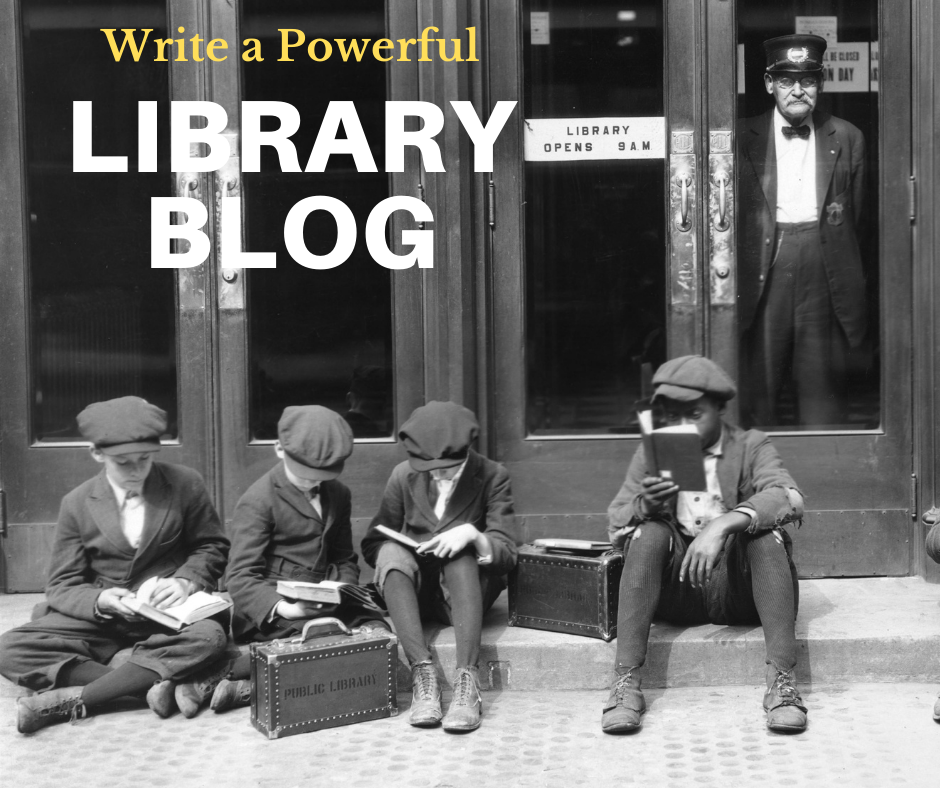
Library Blogs are the Best! How to Use Your Website to Amplify Your Library Marketing Message on Your Own Terms

Photo courtesy Public Library of Cincinnati and Hamilton County

One of the hardest and most rewarding things I ever did while working for the Public Library of Cincinnati and Hamilton County was to start a blog. It took me five years to get it off the ground. I wrote about that experience in this blog post.

I worked hard to get a library blog because I knew it would be a transformative and powerful communication asset.

A blog allows your library to tell your own story, create brand awareness, and promote your library to your own audience for free, without having to deal with the rules of someone else’s platform.

If your library has a blog, you will want to make sure you are doing everything in your power to grow your audience. In this post, I want to share the best practices Iโ€™ve learned from years of blogging.

Before you post

Create an editorial calendar for your library promotions that includes your blog post ideas. I wrote a two-part guide to help you through this step.

A calendar will let you see all the promotions your library is doing in one glance. It will help you schedule posts that amplify your other marketing messages.

You can use your calendar to formulate due dates and publication dates for blog posts. You can also plan the promotion of your library blog posts on other channels, like your email newsletters and social media platforms.

The three main genres of library blog posts

The best blogs are a mix of these three types of blog posts.

Promotional posts: Most library blog posts are promotional. They focus on telling readers about an event, service, or collection item available at the library.

Promotional posts tend to be shorter. They also need to be frequently updated as services and collection items change.

Example: Jacksonville Public Library uses their blog to help their community find information on their website without having to create special landing pages for events and services.

Opinion posts: These posts demonstrate what the library stands for. They center on questions people have about libraries but are afraid to ask. Opinion posts also celebrate the strengths of libraries and the opportunities for improvement.

Opinion posts are compelling and allow your library to cement your voice and your position in a way that your readers and cardholders will remember. Itโ€™s great when a library takes a stand. People will respect you for it.  

Example: The Stark Library CEO and Executive Director took a clear stand against racism in this recent blog post.

Authoritative posts: These posts demonstrate your libraryโ€™s expertise in a subject. For instance, a post that highlights your library’s award-winning family history department is an authoritative post.

Example: Check out the My Librarian(s) Favorite Resources series on the Chapman University: Leatherby Libraries blog.

The Ugly First Draft

If youโ€™ve been asked to write a post on your libraryโ€™s blog, your journey begins with what my favorite marketer Ann Handley calls The Ugly First Draft (UFD).

Your first job is to get all your ideas down in whatever format they escape from your brain. Write your draft without worrying about spelling, grammar, punctuation, or phrasing.

Open a Word document and try to keep typing until you canโ€™t think of anything else to say on a subject. If you are a skilled typist, look away from the screen so you’re not tempted to focus on spelling or grammatical errors.

Revise to create the perfect library blog post

Write short paragraphs, not short posts. Itโ€™s a myth that short blog posts will attract more readers. If your blog post is long but compelling, youโ€™ll have no problem holding the attention of your readers. A longer post that is well written and contains keywords will do better in Google search than a shorter post.

However, you should break up your blog post into shorter paragraphs. Short paragraphs are easier to read and understand. They open white space on your blog, which makes your post more inviting.

Writing experts recommend paragraphs of no more than 150 words. I started writing shorter paragraphs about two years ago and saw a big boost in my metrics.

Be deliberate with your keywords. In the blog text, you need to include keywords for search.

Youโ€™ll notice I use the phrase โ€œlibrary marketingโ€ and โ€œlibrary promotionโ€ frequently in this blog. Thatโ€™s because people searching for help with library marketing use those two phrases most often. Try Keywordtool.io. It does an amazing job of helping you to narrow your target phrase.

Put your keyword phrase in title, header, and body of blog post at least two times but more often if it makes sense.

Include images. Images can help you craft your message and tell your story. They also help to break up the text of your blog posts.

Use images to explain concepts or enforce the emotion you are trying to create.

Link to other content from your library. Your blog post can funnel your readers into engaging with your library. If you are talking about a specific service or a part of your libraryโ€™s collection, include links embedded in your text to help readers find more information.

Make sure your links open in a new tab. Thereโ€™s nothing more annoying that clicking on an embedded blog post link in the middle of a post and then having to tab backwards to read the rest of a blog post.

Create engagement opportunities for your reader. Use your blog posts to start a conversation with your readers. Ask a question and invite readers to post their answers in the comment.

Your library can also embed a social media post in your blog so readers can post a key point to their social media. This gives your post the potential to reach new readers.

Spend a lot of time on your headline.  A good headline should give your readers a hint at the copy that lies ahead without giving away the whole story. It should trigger an emotional response that includes an irresistible urge to read more.

You can get lots of tips for headline writing in this blog post.  

Incorporate several rounds of edits for spelling, grammatical, and punctuation errors. Run your blog posts through an online editor to catch errors. Ask your co-workers to edit your blog as well.

Print your blog post out and read through it, word for word, out loud. Doing this will force your brain to pay attention to the extra attention to what you’ve written. Your brain will often fill in or gloss over errors when you silently read. But if you read your post out loud, those errors become obvious and can be fixed before publication.

Four more tips for library blog success

Use your blog as a networking tool. Ask community leaders to write guest posts. Reach out to school administrators, policy makers, influencers, and other nonprofit organizations. Or use your blog to interview someone.

Once you publish, send a link to the contributors or interviewees. Ask them to share your post with their audience. This will amplify your message and expose your blog to a new audience of readers.

Example: The National Library of Australia interviewed fashion designer Nicky Zimmermann in this blog post that led to lots of media exposure for the library.ย 

Post consistently. The best way to maintain web traffic to your blog is to make sure people are always waiting for an article to go live.

Decide how many posts you can create a week and which days youโ€™ll post on. Then stick to your schedule.

Promote your blog posts on other platforms. Most of your readers will not just stumble upon your post by accident. You need to make sure they know that your library has published a post.

Promote your posts on your social media platforms, in your emails, and in patron interactions.

Your blog can also be used instead of a press release to pitch a story to a member of the media.

Evaluate your post metrics. Check in once a month and enter your metrics on a spreadsheet so you can track results over time.

Compare views, watch time, and bounce rate for your posts. You can also compare post length.

Your metrics will help you to continue to improve and update your blog based on your audienceโ€™s needs and wants.


Does your library have a blog? I’d love to see it! Share a link in the comments!

Subscribe to this blog and youโ€™ll receive an email every time I post. To do that, click on the โ€œFollowโ€ button in the bottom left-hand corner of the page. Connect with me on YouTube, Twitter, Instagram, Goodreads, and LinkedIn.
Library Promotion Updates for Instagram, YouTube, and Facebook That You Need To Know!

Watch Now

The Library Marketingโ€‹โ€‹ Show, Episode 88

It’s time for our social media updates for Library Marketing! In this episode, find out about updates to Instagram Stories, YouTube shorts, and Facebook.

Kudos in this episode go to Illinois Prairie District Library for their purchase of a Short Story Cube.

Do you have a suggestion for a topic for a future episode? Want to nominate someone for kudos? Let me know in the comments. And subscribe to this series to get a new video tip for libraries each week.

Thanks for watching!

Which is the Best Platform for My Library’s Virtual Storytime Videos? Viewer Question Answered!

Watch Now

The Library Marketingโ€‹ Show, Episode 87

In this episode, I’ll answer a question from Jennifer from Lexington County Public Libraries. She writes, “Keeping in mind fair use guidelines, would it be better to post our virtual pre-recorded story times to our Facebook story rather than to our timeline. My understanding is that stories only appear for 24 hours and can be tailored somehow to only reach certain audiences. Do you have any suggestions?”

Kudos in this episode go to Pottsboro Area Library for hosting telehealth appointments at their library.

Do you have a suggestion for a topic for a future episode? Want to nominate someone for kudos? Let me know in the comments. And subscribe to this series to get a new video tip for libraries each week.

Thanks for watching!

The Quest for Perfection May Spoil Your Library Promotions! How To Walk the Line During the Revision Process and Still Create Authentic Messages

I learned a skill as a journalist which has been invaluable to me as a marketer.

As a journalist, I was an expert at knowingย when to let go of a piece of contentย and send it out into space, even though it was imperfect.

It’s the nature of the news business. You have a deadline and when the deadline arrives, you go to air or to print with as much information as you have. You know that youย can revisit the story later to add new details. And that must be enough.

One of the hardest adjustments I had to make when I left the newsroom and went to the library was the constant reshaping of promotional messages and campaigns.

The good and bad of the revision process

When I worked in a library, each blog post, print piece, email, social media post, or video would go through rounds of review by several departments. The record was held by our content marketing magazine, which sometimes went through upwards of 15 edits per issue.

All the scrutiny had its advantages. More edits meant grammatical, punctuation, and spelling errors were found and fixed. The revision process also gave me the chance to see how each message was perceived by different people with different perspectives.

I purposefully chose reviewers who worked with different target cardholder audiences. They told me whether they thought their patron base would respond to the message. I trusted their opinions and took their advice when they told me a phrasing or image change would increase my message’s effectiveness.

But there were also pitfalls to revision process. The message was sometimes reshaped by people who pressured me to add words or phrases that weren’t customer friendly. They might also wish to dilute or change the message altogether, depending on their department’s own goals or agenda.ย 

The point at which your library’s revision process goes from helpful to over-examined is the space I want to focus on in this post.

It’s very easy to start over-thinking text, images, and graphics. The message you’ve carefully crafted may not connect with your audience because it disappears in the search for perfection. It can be crippling.

There is a very thin line between authenticity and perfection. It takes practice to walk that line. Here’s the advice I have for you.

Constant improvement is better than perfection

The best content isn’t perfect. That is what makes it good.

Imperfection shows your library’s human side. When you write from the heart, your message feels more authentic. 

Don’t sabotage your own marketing efforts by waiting for the moment when every single detail is right.ย Give yourself permission to release a piece of marketing content when the time is right, not when it’s perfect.

Creative, honest messaging will be the doorway for your library to connect with consumers in the moment when they are genuinely searching for answers from your library.

I’m a fan of author, speaker, and showrunner Jay Acunzo. I highly recommend his newsletter. His niche is creativity. He inspires others by talking about how creativity intersects with work in the real world.

In this blog post, Jay makes a great point that I think about all the time. He says, “How can we aspire to perfection (even if it’s never something we reach) while still moving forward without delay (even if we aren’t creating amazing work yet)? Well, I think the key is to place perfection where it belongs: away in the distance. Then, we can busy ourselves with marching towards it.”

In the library, that means we must do the work and ship it when it needs to be shipped. But we also must commit to revising it, molding it, and realizing that it is a work in progress.

In your library promotional work, your goal must not be perfection. It must be constant improvement.

But I have a deadline!

You work in a real library with real goals and strategies. And the quest for perfection will sometimes seem like a lofty goal that you don’t have the luxury of achieving.

So how do you know when a piece of content is ready for release, even if it’s not perfect? Ask yourself these three questions.

1. Is your promotion as compelling and authentic as it can be in this moment?

2. Is your promotional piece free of grammatical, punctuation, and spelling errors?

3. Is the information in your promotional piece correct?

If the answer is yet to these three questions, it’s time to let go.

Marketing is one giant experiment. Even when you release a promotion that isn’t perfect, you will still learn plenty from it. Measure and record the results of your promotion. Then use that data to adjust and reconfigure your attempts on the next go-around.

Don’t get bogged down in the quest for perfection. Be human. Be authentic. Be true to your library voice.

And get the message out there! Your imperfect message may lead to some perfect insight into your community.


Do you have an example of a time when an imperfect message brought you some perfect insight into your customers? Share your thoughts in the comments!

You may also like these posts

Hereโ€™s When Itโ€™s Okay for Your Library To Forget Perfection and Just Push Send!

You Donโ€™t Have To Be Cool To Promote Your Library to Teens! Here Are Seven Seriously Easy Ways To Connect With Gen Z

Latest Book Review

The Only Good Indians by Stephen Graham Jones

Subscribe to this blog and youโ€™ll receive an email every time I post. To do that, click on the โ€œFollowโ€ button in the bottom left-hand corner of the page. Connect with me on YouTube, Twitter, Instagram, Goodreads, and LinkedIn.
How to Celebrate and Promote National Library Week….in a Pandemic!

Watch Now

The Library Marketing Show, Episode 86

In this episode, I’ll share some ideas for promoting the work of your library during National Library Week (April 4-10). These are suggestions you can use even though we’re in the middle of a pandemic.

Kudos in this episode go to the Jackson County Library System for their new animated series, “Lost in a Book.”

Do you have a suggestion for a topic for a future episode? Want to nominate someone for kudos? Let me know in the comments. And subscribe to this series to get a new video tip for libraries each week.

Thanks for watching!

How to Reboot AND Optimize Your Library’s YouTube Channel for Marketing Success!

Watch Now

The Library Marketing Show, Episode 84

In this episode, I’ll answer a question from Jennifer of the Park Ridge Public Library. She asked, “What advice would you give to a library needing to reboot the way they use YouTube? We have a YouTube account but only used it sporadically in the past. How can we effectively use it to promote programs, host book talks, share big library news?”

Kudos in this episode go to the Sierra Madre Public Library for their amazing work on TikTok!

Do you have a suggestion for a topic for a future episode? Want to nominate someone for kudos? Let me know in the comments. And subscribe to this series to get a new video tip for libraries each week. Thanks for watching!

A WordPress.com Website.

Up ↑