Did you know there are seven things that you can learn by taking a marketing survey? I believe library marketers should be taking surveys from brands and companies because you can learn a lot about how to survey!
I’m going to share some tips with you and why I think it’s really important to take those surveys in this episode of The Library Marketing Show.
Plus, we’ll give kudos to a library that received press attention for a unique outreach program.
Do you have a suggestion for a topic for a future episode? Do you want to nominate someone for kudos? Let me know here. Thanks for watching!
Subscribe to this blog, and you’ll receive an email whenever I post. To do that, enter your email address. Then, click the “Follow” button in the lower left-hand corner of the page. You can also follow me on the following social media platforms:
Photo courtesy Cincinnati and Hamilton County Public Library
Jenie Lahmann’s parents were DIYers before it was in style.
Growing up in Richmond, Indiana—”a fun midwestern town with rich history and endless green spaces to explore”, her family made weekly visits to Morrisson-Reeves Library (MRL) to indulge their need to craft and create.
“Dad would go to the Do-It-Yourself section and Mom would get cookbooks and the latest Erma Bombeck writings,” recalls Jenie. “My brother Pat and I were off to explore the shelves in the Children’s Department. We always left the library with an armful of books.”
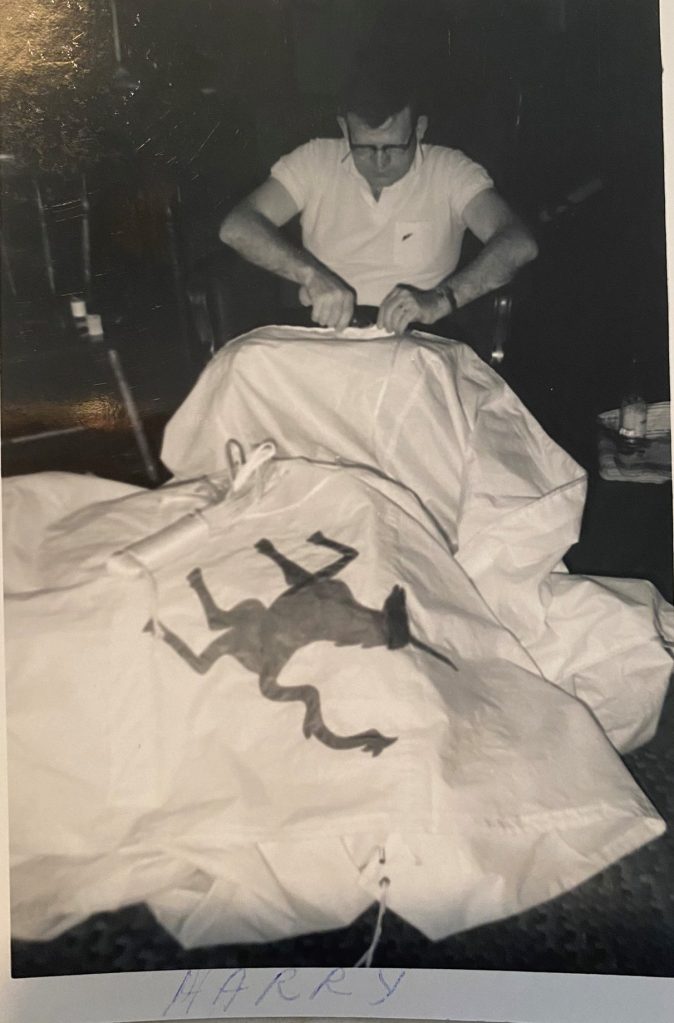
“My father was a self-taught craftsman and could build anything. He drew plans for making a sailboat from library books and reference librarian’s tips. From concept to completion, he used the library every step of the way. He even sewed the sails with help from Mom’s sewing talents. It’s incredible what you can learn from the library!”
The infamous sailboat
Jenie’s dad making sails
Jenie started working at the library in high school, following in her big brother’s footsteps. She spent a year as a shelver. Then a manager started to mentor her on print promotion. “We created bookmarks, booklets, and other helpful printed tools for patrons before the age of library digitization,” explains Jenie.
“The first day, I was so nervous I fainted in her office, and we formed a strong friendship after that. She trained me in using all the printing machines and developed a trained eye for layout and design.”
Jenie now works as Marketing and Communications Manager for the library. This year, she co-led a team of five people during a major project: a survey of their community.
MRL was looking for data to help the library create a five-year strategic plan. They included lots of questions that are standard for libraries. But Jenie says they really wanted to get to the root of what motives their community members.
“We dug deeper and asked what services they enjoyed, and how their experience was when they walked through the door,” elaborates Jenie. “We want to see how we can improve our services to best meet our changing community’s needs and to help enrich their lives.”
“We asked them to prioritize a list of eight services we are thinking of adding or expanding upon. We asked them to rate what type of programs they wanted to see, what made them happy to use the library, and what didn’t work for them.”
MRL partnered with a local business consulting company to help them formulate the survey. Library staff met over the course of 6 weeks and looked at previous library surveys to determine which questions to ask. They added specific questions based on how often the community members used the library.
“It was difficult to formulate the questions while keeping in mind the end goal of having data we could use to formulate the BIG Strategic Plan,” confesses Jenie.
Jenie was kind enough to share the final survey with us.
The library released the survey into the world for a three-week stretch, accompanied by a carefully orchestrated plan to ensure they got the survey in front of as many community members as possible.
“First, we created a landing page on the library’s website,” explains Jenie. “It was the hub for all the content and links. Consistent graphics and wording were used.”
“We talked on radio programs, developed videos, e-newsletters, postcards with QR codes, and social media campaigns. We had staffers reach out to their contacts to ask them to fill out the survey personally.”
“The survey was also offered in Spanish. We canvased apartments, churches, and social groups too.”
MRL had a goal of 500 responses. But get this: they more than doubled their response rate goal, gathering 1,104 survey responses! About 11 percent of responses came from paper copies. The rest were filed online through a Survey Monkey page.
However, the survey wasn’t the only tactic MRL used to make decisions for their strategic plan. Along with their business consulting firm partner, MRL conducted focus groups. They gathered teens, parents of teens, preschooler parents, senior citizens, community influencers, community partners, and potential community partners.
These small groups gave robust input that was combined with the survey data to give the library an overarching sense of what their community wants and needs from the library.
“It was enlightening news that our regular library users love us,” exclaims Jenie. “We heard from many people who said they don’t know about library services beyond books and storytimes.”
“We heard that many people get their library info from e-mailed newsletters. Many people suggested that we needed to improve our message through marketing. Tough news to hear for me, but we see it as an opportunity to grow and reach people in new ways.”
“The main interests in the library were gathering spaces, a small business resource center, performing arts, and DIY maker spaces. People may not have access to these free services elsewhere and seek the library for these things.”
“A big surprise was about weeding. Many patrons don’t know how or why we weed books from the library. We use library standards for weeding, but we’ll need to do a better job of explaining that to our patrons.”
Jenie says if she could do anything differently, it would be to make the survey shorter. MRL’s questions took 15 minutes to complete.
Her advice for any library looking to conduct a community-wide survey such as this is to define your end goal. “Spend time formulating your questions for the outcome data you are seeking,” advises Jenie.
“Having a few narrative data entry questions and the rest with a rating scale can prove to make the data processing task easily graphed or charted to show trends and outcomes. Test the digital survey on mobile, desktop, and other digital devices.”
Jenie and the folks at MRL are now discussing a campaign idea they got from the survey, as well as an origin story campaign, asking library users to explain why they use the library, with a superhero theme.
Subscribe to this blog and you’ll receive an email whenever I post. To do that, enter your email address and click on the “Follow” button in the lower left-hand corner of the page. You can also follow me on the following social media platforms:
If there was ever a time when your library would need to survey your community and cardholders, it’s now.
This year has been wildly difficult for libraries and their communities. And the pandemic will be a factor in the lives of our cardholders into 2021.
To prepare our services, collection, and programs, we need to know exactly who is using the library and how they are using it. We must also anticipate our community needs going into the next year.
A customer feedback survey is the best way to gather this data. Here’s how to put one together.
Before you start
The first step in the survey process is to come up with a plan and answer some important questions.
Why are we doing the survey? You may use a survey to determine how people use your library. You may be testing to see whether there is a tangible need for a particular service before you invest in it.
Perhaps you are looking to gather demographic information about your service population. You might also want to ask questions to get at the psychographic makeup of your cardholders so you can better segment your marketing audiences.
Write down your reasons for creating a survey. You’ll also want to write down what you hope to learn from your community’s answers.
It’s important to put the answers to these two questions in writing to keep yourself accountable. The written answers will remind you of your goals as you write the questions, distribute the survey, and evaluate the results.
How will you distribute the survey? Distribution of surveys can be tricky for libraries because our populations are so diverse.
How do you make sure that people from all communities and demographic populations are represented? What about cardholders who don’t have digital access? Do you hope to have answers from non-cardholders? Create a plan for addressing these points.
What will we do with the results? The final step of this first phase is to plan for how you will work with the results of your survey.
Who will look at the results and aggregate them? Who gets to see the results? And who will be responsible for implementing changes to library services based on the results?
How many questions can you ask?
Survey Monkey analyzed more than 10,000 surveys to make their recommendations. And they found that fewer questions get better results. The more questions you add to your survey, the less time people spend answering each question.
To gather more thoughtful responses, you’ll want to use as few questions as possible. SurveyMonkey says an effective survey will take no more than 7 minutes to complete. Their data shows people will abandon surveys that take longer than that.
A 7-minute survey will be about 10-15 questions long, depending on the type of questions you ask. If you find that you need more than 15 questions, consider doing more than one survey.
Writing the questions
Writing your survey questions is like writing a blog post. For the final product, you’ll want a tightly written and concise set of questions. But to get there, you’ll need to get a little messy.
You should approach the first draft of your questions with no limits. Write down everything you want to ask your community about the library. Use whatever format of question first comes to mind.
This exercise will create an ugly but important first draft which you can mold into an amazing survey. Once you have that draft, go back through, and highlight the questions you absolutely must ask.
Be sure your questions don’t ask two questions at once. Doing so will confuse your respondents and lead to less reliable survey results.
For example, don’t ask “How would you rate our branch cleanliness and the wait time at the checkout counter?” Split those questions to get a more accurate picture of your community needs.
Consolidate questions that are repetitive. You may find you asked the same thing, or very similar things, but in a different way.
Once you have a final list of questions, mix the formats to create the best results. Data suggests that most of your survey questions should be multiple choice or matrix-scale.
Try to ask no more than two open-ended questions in a 10-15 question survey. The more time your respondents must spend composing their answers to open-ended questions, the more likely it is that they won’t complete the survey. While open-ended questions can be very insightful, use great intention when adding them to your survey.
Where to create your survey
With limited budgets, most libraries cannot afford to pay big money for a survey maker.
There are many free options, but most have limitations for how many surveys you can create and how many responses you can collect. Here are a few that have no such limitations.
Google Forms: Google Forms is my preferred free survey tool. You can create surveys and collect unlimited responses. It’s easy to create the survey and easy to export the data as a Google Sheet.
SurveyPlanet: Their free version allows for unlimited surveys, questions, and responses. They also have templates to get you started. Also, you can easily duplicate a survey. You cannot export your response data on their free plan, but you can look at it in a dashboard and use that data to create infographics, graphs, and other reports to communicate the results.
Free Online Surveys: This site has a limited free plan. I’m including it because they offer a substantial discount on their paid plan for non-profits. The paid plan unlocks some great features including unlimited responses and support. Their survey maker also has artificial intelligence to help you build an effective survey.
Launching your survey
Before you send your survey out to the world, be sure to thoroughly test it. You’ll want testers to look for spelling errors, confusing questions, and to make sure the order in which you ask your questions makes sense.
Send your survey to staffers outside of your department and to friends and family. Get as many people to test it as you can before you launch.
Once you’re sure your survey is ready, it’s time to send it out into the world. Email the survey to all cardholders. Place printed versions of the survey at the checkout desk for people who don’t have digital access.
For the duration of the survey, prompt patrons to fill out the survey in every interaction, including at curbside pickup, during virtual programs, and in reference emails and phone calls.
The amount of time you’ll leave your survey open for responses really depends on your community. You’ll need to monitor the results and be flexible.
In initial launch round, be vague with your respondents about how long they have to complete the survey. You might say “Take a few moments now to give us your feedback.” Then watch to see how well your community responds.
Once you start to notice a lag in responses, you may do another round of promotions that sound more urgent. “Complete this survey before Friday to make sure your voice is heard” or “We’re closing this survey in two days so be sure to give us your thoughts!”
In general, don’t leave your survey open for answers for longer than two weeks.
Have you done a library survey? Do you have other tips and suggestions for creating a survey? Share your thoughts in the comments below.
Subscribe to this blog and you’ll receive an email every time I post. To do that, click on the “Follow” button in the bottom left-hand corner of the page. Connect with me on YouTube, Twitter, Instagram, and LinkedIn.



 Super Library Marketing: Practical Tips and Ideas for Library Promotion