Subscribe to this blog and you’ll receive an email whenever I post. To do that, enter youremail address and click on the “Follow” button in the lower left-hand corner of the page. You can also follow me on the following social media platforms:
Photo courtesy Cincinnati and Hamilton County Public Library
A few weeks ago, I walked through my neighborhood listening to the Library Marketing for Library Marketers podcast. Katie Rothley was interviewing a woman named Sarah Tolle, who manages content for a large Canadian agency. And Sarah said something that literally stopped me in my tracks.
“People take comfort in hearing the same story repeatedly. They like knowing that they know the story and that they understand you. And they anticipate the ending. “
-Sarah Tolle, content director for Black and White Zebra.
I was standing there on the sidewalk, staring at a squirrel gathering nuts from the front yard of an indiscriminate house, and I thought, HOLY SMOKES, this woman is dropping some truth bombs.
Sarah was talking about the value of a consistent message. The timing of this episode could not have been more perfect. In my day job, I’ve been spending a lot of time thinking about how library marketers can get the most bang for their buck.
Many of the libraries I work with are struggling to figure out how to do three big things:
Drive more visitors to their buildings
Get higher attendance at their programs
Get their cardholders to use their cards more often.
They’re working alone or with a small team, with very little money, and very little time. It’s an impossible formula.
Except, as Audrey Hepburn once said, “Nothing is impossible. Even the word itself says, ‘I’m possible.'”
And the secret to success may be found in the form of a marketing axiom that’s nearly 100 years old.
The Marketing Rule of 7
The Marketing Rule of 7 was developed by the movie industry in the 1930s. Studio bosses discovered that a certain amount of advertising and promotion was required to compel someone to see a movie.
It takes time and consistent marketing to make people aware of your library. One message, delivered on one platform, one time, is not going to be enough. We must work to make sure people are familiar with our library.
Now, I know what you are thinking. The Marketing Rule of 7 makes sense. But it’s also in complete contradiction to another marketing fact that is entirely a product of the digital age.
The Reality of Content Shock
Marketing expert Mark Shaffer, author of more than 12 books on marketing, defines Content Shock as “the phenomenon when exponentially increasing amounts of content intersect with our limited human capacity to consume it.”
In other words, there’s too much stuff to read and not enough time to read it. (Are we talking about my inbox or my TBR? Or both?)
So how do we square both marketing truths? And how do we figure out a way forward so we can reach the goals of our library marketing?
First, the number 7 in the Marketing Rule of 7 is an arbitrary number. It could take somebody more than seven times the exposure before they become a loyal library user. Or maybe it will only take five times. Or two times.
Don’t focus so much on the number. Focus on the consistent message.
Because when your audience is overloaded with content, sharing one, consistent message, repeatedly, will break through.
Political candidates know this is true. When they’re trying to get elected or whip up support for a bill, they come up with a main message. They repeat it everywhere: on fliers, social media, in interviews with the press, in speeches, etc. They do this because they know they must repeat the message to make sure their constituents hear and understand it.
How to Create a Consistent Message
Let’s say you work for a high school library and your goal is to get more kids to check out books to read for pleasure (because, let’s be honest, most kids do not find reading Catcher in the Rye all that pleasurable).
First, write a few lines that succinctly encapsulate the message you want to get across.
Read something for once just for fun! The library is filled with books that won’t give you class credit but will take you on an adventure you’ll never forget.
Now, use those two lines across your promotions: on bookmarks, posters, displays, and in morning announcements. Repeat it to kids who wander into the library looking for something to read. Do it all year long. By the end of the year (and probably sooner), the message will have sunk into the kids. That’s consistent messaging.
Next week: I’ll give you a four-step plan for repurposing any piece of content you create across multiple channels without losing your consistent, core message. (Yes, it can be done!)
Subscribe to this blog and you’ll receive an email whenever I post. To do that, enter your email address and click on the “Follow” button in the lower left-hand corner of the page. You can also follow me on the following social media platforms:
“If you build it, they will come” applies not only to baseball. It works for email marketing for libraries too!
A reader asked: How do you get people to sign up for your email newsletter? It’s easier than you think. But you have to think of it holistically. I’ll share my four-step strategy in this episode.
One note: I mention an opt-in page in this episode. I think major library announcements, like changes in service, the opening of new locations, and all-system programs like Winter Reading, Summer at the Library, and Back to School, should be opt-out. In other words, send those emails to everyone, and let them opt out if they like (most won’t!)
Do you have a suggestion for a topic for a future episode? Want to nominate someone for kudos? Let me know here.
Subscribe to this blog and you’ll receive an email whenever I post. To do that, enter youremail address and click on the “Follow” button in the lower left-hand corner of the page. You can also follow me on the following social media platforms:
Photo courtesy Cincinnati and Hamilton County Public Library
Jenie Lahmann’s parents were DIYers before it was in style.
Growing up in Richmond, Indiana—”a fun midwestern town with rich history and endless green spaces to explore”, her family made weekly visits to Morrisson-Reeves Library (MRL) to indulge their need to craft and create.
“Dad would go to the Do-It-Yourself section and Mom would get cookbooks and the latest Erma Bombeck writings,” recalls Jenie. “My brother Pat and I were off to explore the shelves in the Children’s Department. We always left the library with an armful of books.”
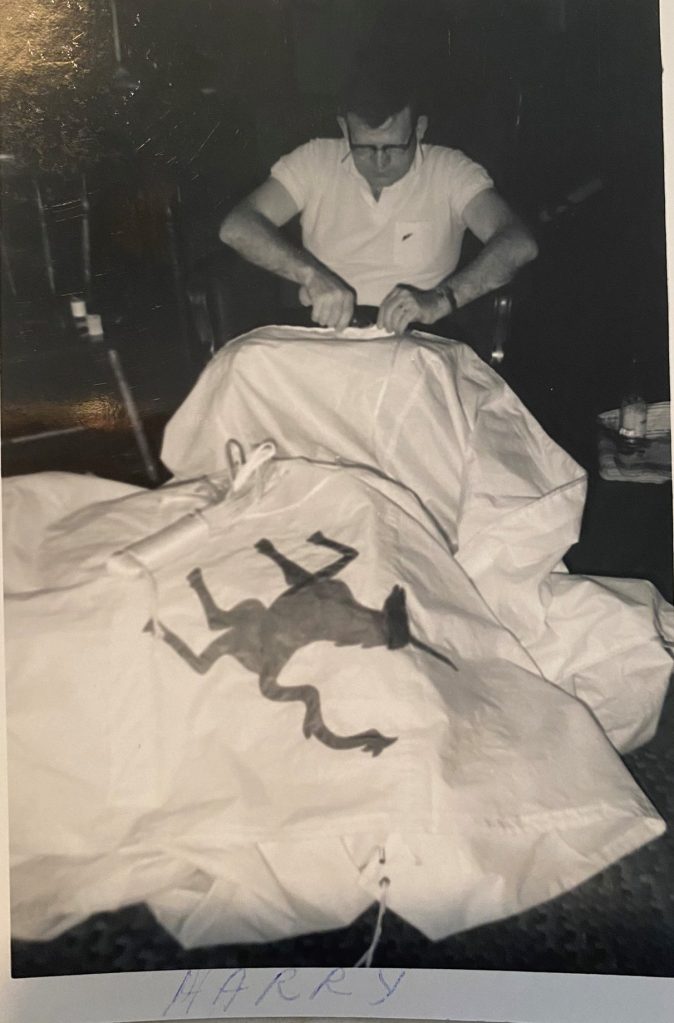
“My father was a self-taught craftsman and could build anything. He drew plans for making a sailboat from library books and reference librarian’s tips. From concept to completion, he used the library every step of the way. He even sewed the sails with help from Mom’s sewing talents. It’s incredible what you can learn from the library!”
The infamous sailboat
Jenie’s dad making sails
Jenie started working at the library in high school, following in her big brother’s footsteps. She spent a year as a shelver. Then a manager started to mentor her on print promotion. “We created bookmarks, booklets, and other helpful printed tools for patrons before the age of library digitization,” explains Jenie.
“The first day, I was so nervous I fainted in her office, and we formed a strong friendship after that. She trained me in using all the printing machines and developed a trained eye for layout and design.”
Jenie now works as Marketing and Communications Manager for the library. This year, she co-led a team of five people during a major project: a survey of their community.
MRL was looking for data to help the library create a five-year strategic plan. They included lots of questions that are standard for libraries. But Jenie says they really wanted to get to the root of what motives their community members.
“We dug deeper and asked what services they enjoyed, and how their experience was when they walked through the door,” elaborates Jenie. “We want to see how we can improve our services to best meet our changing community’s needs and to help enrich their lives.”
“We asked them to prioritize a list of eight services we are thinking of adding or expanding upon. We asked them to rate what type of programs they wanted to see, what made them happy to use the library, and what didn’t work for them.”
MRL partnered with a local business consulting company to help them formulate the survey. Library staff met over the course of 6 weeks and looked at previous library surveys to determine which questions to ask. They added specific questions based on how often the community members used the library.
“It was difficult to formulate the questions while keeping in mind the end goal of having data we could use to formulate the BIG Strategic Plan,” confesses Jenie.
Jenie was kind enough to share the final survey with us.
The library released the survey into the world for a three-week stretch, accompanied by a carefully orchestrated plan to ensure they got the survey in front of as many community members as possible.
“First, we created a landing page on the library’s website,” explains Jenie. “It was the hub for all the content and links. Consistent graphics and wording were used.”
“We talked on radio programs, developed videos, e-newsletters, postcards with QR codes, and social media campaigns. We had staffers reach out to their contacts to ask them to fill out the survey personally.”
“The survey was also offered in Spanish. We canvased apartments, churches, and social groups too.”
MRL had a goal of 500 responses. But get this: they more than doubled their response rate goal, gathering 1,104 survey responses! About 11 percent of responses came from paper copies. The rest were filed online through a Survey Monkey page.
However, the survey wasn’t the only tactic MRL used to make decisions for their strategic plan. Along with their business consulting firm partner, MRL conducted focus groups. They gathered teens, parents of teens, preschooler parents, senior citizens, community influencers, community partners, and potential community partners.
These small groups gave robust input that was combined with the survey data to give the library an overarching sense of what their community wants and needs from the library.
“It was enlightening news that our regular library users love us,” exclaims Jenie. “We heard from many people who said they don’t know about library services beyond books and storytimes.”
“We heard that many people get their library info from e-mailed newsletters. Many people suggested that we needed to improve our message through marketing. Tough news to hear for me, but we see it as an opportunity to grow and reach people in new ways.”
“The main interests in the library were gathering spaces, a small business resource center, performing arts, and DIY maker spaces. People may not have access to these free services elsewhere and seek the library for these things.”
“A big surprise was about weeding. Many patrons don’t know how or why we weed books from the library. We use library standards for weeding, but we’ll need to do a better job of explaining that to our patrons.”
Jenie says if she could do anything differently, it would be to make the survey shorter. MRL’s questions took 15 minutes to complete.
Her advice for any library looking to conduct a community-wide survey such as this is to define your end goal. “Spend time formulating your questions for the outcome data you are seeking,” advises Jenie.
“Having a few narrative data entry questions and the rest with a rating scale can prove to make the data processing task easily graphed or charted to show trends and outcomes. Test the digital survey on mobile, desktop, and other digital devices.”
Jenie and the folks at MRL are now discussing a campaign idea they got from the survey, as well as an origin story campaign, asking library users to explain why they use the library, with a superhero theme.
Subscribe to this blog and you’ll receive an email whenever I post. To do that, enter your email address and click on the “Follow” button in the lower left-hand corner of the page. You can also follow me on the following social media platforms:
We’ve already established that your open rate is not necessarily the best way to measure the effectiveness of your library’s email marketing. It’s your click rate. But…
What is a good click rate? And when are you supposed to send your library’s emails? You’ll find expert advice on both of those important points in this episode.
Plus a wonderful library video earns this week’s Kudos award!
Do you have a suggestion for a topic for a future episode? Want to nominate someone for kudos? Let me know here.
Subscribe to this blog and you’ll receive an email whenever I post. To do that, enter youremail address and click on the “Follow” button in the lower left-hand corner of the page. You can also follow me on the following social media platforms:
Subscribe to this blog and you’ll receive an email whenever I post. To do that, enter youremail address and click on the “Follow” button in the lower left-hand corner of the page. You can also follow me on the following social media platforms:
Photo courtesy Cincinnati and Hamilton County Public Library
I live with two members of Gen Z. Thanks to them, I know about trending TikTok audio, Temu, and K-pop. They’ve given me skincare and makeup advice.
And they use the library… not because I’m their mom, but because it has books and videos and music for free. One is working part-time while dealing with health issues, and the other is working two jobs to save for a house.
Like many young adults, they worry about their financial future. And they value institutions that build community.
Millennials and Gen Z combine to make up 53 percent of the world’s population. Born between 1981 and 2009, they’re the largest adult demographic.
And while I generally think it’s foolish to lump an entire group of people together for marketing purposes based on their birth year, there are some things we can say, based on research, that these two groups share.
They love BookTok, the special subsection of TikTok dedicated to readers.
They are more educated than previous generations.
They value experiences, like travel and entertainment.
They prefer shopping online to going to a store.
They do their research before buying products.
Now, more research suggests your library can promote books and reading recommendations to teens and young adults using one main promotional tactic.
Email.
I know what you’re thinking: “Young people today don’t read email.”
Have I got some statistics for you!
Millennials and email
According to Pew Research Center, Millennials encompass anyone between the ages of 27 and 42.
1 in 3 millennials check their email as soon as they wake up.
73 percent of millennials prefer that companies communicate with them through email.
Nearly 51 percent of millennials say email influences their purchasing decision.
Now, of course, your library is not selling anything.
Or is it?
Most of the libraries I work with have two overarching goals: increase circulation and increase visitors.
And while library users do not have to pay to participate in those activities, it makes sense for libraries to use the same strategies that brands do for selling products.
So here are four ways to finesse your email to appeal to millennials.
Design is important.
Millennials have a sophisticated eye for visual content. Whatever email marketing platform you use, be sure you follow the best practices for email design. That includes templates with beautifully designed graphics or photos, particularly of faces showing emotion.
Use as little text as possible, in a font of at least 14 points.
Keep your color choices within your brand… no glowing neon blue fonts!
Promote no more than 4 things in your email and add plenty of white space between the email blocks for a clean look.
If your email provider allows you to personalize your emails with a first name, do so. That’s a great way to capture the recipient’s attention in the inbox.
But for true personalization, focus on the content. Spend time thinking about what they want and need from your library. Then, create interest groups based on those wants and needs.
Follow Delafield Public Library’s example. Their newsletter signup is on their homepage.
That link leads to an opt-in page with Hobbies and Interests choices right at the top.
How are you supposed to know the wants and needs of your Millennial audience? Well, if your library does an annual survey, segment your results based on age. What are the aspirations and motivations of this group? For example, if they say they are looking for a place to network and find community, your email messages should focus on the services you provide that meet those needs.
If your library doesn’t do an annual survey, look at the statistics you have on hand, such as circulation or program attendance. You can get a sense of what your patrons in this age group want and need from your library.
You can also reach out to partner organizations that work with this age group for their input on how your library can serve and market to millennials.
Finally, you can use Google Analytics to see what users in this age group do when they come to your website. Use your promotional tactics to market those sections of your website.
Watch your language.
Remember how your high school and college English professors praised you for using big words and complicated sentence structures? They did you a disservice.
The most effective text in email for Millennials is conversational and casual. For your library emails, move away from formal language. Instead, talk to this audience as if they were real people, standing in front of you at the desk.
After you write your email, read it through slowly and check to see if there are any sentences or phrases that you could say more simply. Read it out loud. If your email sounds professorial, try re-phrasing your text to be more conversational.
Share stories of other Millennials using the library.
Millennials love social proof. They want to see people their age using the library.
I know you’ve been gathering stories to share in your marketing campaigns. You can share those stories in your emails as well.
Use a few lines from a story, with a photo in your emails. If you have a longer version of the story on your blog or in video form, add a call-to-action button that allows readers to see the full version.
Gen Z and email
According to the Pew Research Center, Gen Z encompasses anyone ages 14 to 26.
I’m just going to say this again because I know it’s hard for you to believe. But Gen Z does read email. In fact:
58 percent check their inbox more than once a day.
57.5 percent say they don’t mind if a brand sends them emails several times a week.
But here is the biggest statistic I want you to remember: According to Campaign Monitor, the average member of Gen Z gets only 20 emails a day.
That’s an advantage for your library because you don’t have to compete for attention in the inbox. Don’t make the mistake of most brands, who assume this audience doesn’t read email!
Here are three ways to create emails that appeal to this important age group.
Keep it short.
Gen Z members have spent their whole lives scrolling Instagram and TikTok. They are accustomed to short digital content, especially from brands (Yes, they do read and enjoy long books and movies). But their expectation from brands, including your library, is for shorter content.
Send more emails that contain fewer pieces of information.
Gen Z members love a good visual. Graphics work really well with this audience to convey information in a simple way that is accessible to many audiences.
And Gen Z brains are hard-wired for visuals. They’re used to glancing at a graphic and processing the information quickly. So try an email with a graphic to see if you get better engagement than with plain text.
Make it interactive.
Gen Z likes to have fun online. And that’s great for you because it means you get to have some fun creating your emails!
There are four ways to incorporate interactivity into your emails.
Create quizzes using free quiz creators like Slido or Quizmaker.
Add a GIF.
Add a poll or survey to your emails. Google Forms is my go-to for these and it’s free.
Subscribe to this blog and you’ll receive an email whenever I post. To do that, enter your email address and click on the “Follow” button in the lower left-hand corner of the page. You can also follow me on the following social media platforms:
There is one very simple tip that you can use to increase the organic reach of your library’s posts on LinkedIn, YouTube, and Facebook (and X, if you still use that). And honestly, when I heard about this tip, I felt like smacking myself. How did I miss this? It’s so easy. I’m going to share it with you.
Plus we’ll give kudos to someone doing great work in library marketing.
Do you have a suggestion for a topic for a future episode? Want to nominate someone for kudos? Let me know here.
Subscribe to this blog and you’ll receive an email whenever I post. To do that, enter youremail address and click on the “Follow” button in the lower left-hand corner of the page. You can also follow me on the following social media platforms:
Photo courtesy Cincinnati and Hamilton County Public Library
One of Paul Wellington’s first library experiences was not a pleasant one.
Growing up in Milwaukee, Wisconsin, his parents occasionally took him to the Milwaukee Public Library, but it wasn’t a big part of his life.
“In high school, I distinctly remember visiting a branch after school,” recalls Paul. “I was not allowed to use a computer since I didn’t have a library card. I felt very unwelcomed, with little interest in returning. But little did I know libraries would become a big part of my life just a few years later!”
If you pay attention to library social media, you have seen Paul’s work. He is currently the social media specialist for the Cincinnati and Hamilton County Public Library (CHPL), working on the team I used to lead!
Paul’s work received national attention earlier this year when he posted this now-famous TikTok showing how holds are gathered at the library. The post has, as of this publication, a whopping 3.7 million views, 599,000 likes, and has been shared nearly 25,000 times.😮
“I came across the idea when I saw a duet of a woman mimicking the person in the original video on TikTok,” explains Paul. “The next week, I proposed the idea to staff at a branch, with the realization that finding a volunteer was a long shot. Surprisingly, Kelwin (the Cincinnati Library staff member in the TikTok), agreed to mimic the person in the video. Cue the hilarity!”
“I thought the clip would receive a few thousand views, and I was really shocked at how quickly it went viral, including on other social media platforms.”
Paul Wellington
“Some other posts that have performed well are the Taylor Swift visit and Pedro Pascal as libraries posts. I shared the Taylor Swift TikTok a few days before she visited Cincinnati, and I hopped on the Pedro Pascal trend after seeing a post from Vancouver Public Library.”
Working for a library was not Paul’s first career choice. He originally pursued a degree in architecture at the University of Wisconsin – Milwaukee. During the spring of his first year, he got a job as a circulation aide at the Milwaukee Public Library.
“I was promoted to Circulation Supervisor at a branch in 2016,” says Paul. “During the height of Covid in 2020, physical circulation was slow, and I asked to assist the Marketing department with Facebook and Instagram. I loved managing social media, which eventually led to my current position as the Social Media Specialist with CHPL.
“My favorite part of managing social media for CHPL is thinking of creative ways to promote the library, whether it’s through humorous text, videos, or memes,” shares Paul. “My least favorite part, and this is something I’ve started recently, is editing captions for our YouTube videos. While very tedious, it’s important that CHPL makes its content accessible to everyone!”
I can say from experience it is difficult to manage social media for a library like CHPL, which has 41 locations and serves a population of 800,000 residents county-wide. Paul has the library’s five strategic priorities, which are guiding principles for deciding what he posts on social media.
“Within these priorities, I focus on promoting the library’s events, services, and resources,” explains Paul. “Each day I share 4-6 posts on Facebook and Twitter, and 1-2 posts on other platforms (Instagram, LinkedIn, Threads), so there are plenty of opportunities to promote the library offerings.”
“I would say one key to success is capitalizing on social media trends and events in your local community. If you’re able to incorporate the library into this type of content, you’re setting yourself up for success.”
How does Paul resist the urge or the demand to post about every program or service the library provides?
“The most common requests for social media posts are events, and the library has hundreds of them each month,” says Paul. “A large number of our events are recurring storytimes and book clubs, so I tend to promote other unique events. Library staff understands this process, and I rarely have to deny a requested event promotion.”
Paul spends a lot of time on social media, (go figure!) looking for inspiration. His top four favorite libraries to watch are:
And Paul has one big piece of advice for anyone working on social media for a library.
“It is important to understand the demographics for each platform. For example, CHPL’s Facebook followers have an older demographic, while Instagram consists of a large number of Millennials.”
“Content that works on one platform may not work on another. You can still share the same event, service, or resource across all library platforms, but consider the text and the way it’s presented (photo, graphic, meme, or video).”
Subscribe to this blog and you’ll receive an email whenever I post. To do that, enter your email address and click on the “Follow” button in the lower left-hand corner of the page. You can also follow me on the following social media platforms:



 Super Library Marketing: Practical Tips and Ideas for Library Promotion