Search

Super Library Marketing: Practical Tips and Ideas for Library Promotion

Tag

marketing libraries

Five Totally Doable Things That Make Your Library Content More Shareable

Every content creator fears no one will read their work. By contrast, the most exhilarating thing you can do in marketing is to write something that people read, share, and comment on. I speak from experience. There is no better compliment.

Last week, I told you about the upcoming keynote I’m giving on content marketing and shared some reasons why your library should be creating content. The more I write for this blog, the more I learn about the kinds of content my audience will read AND share. That second part is important. You want to reach new people and make them library fans. But what makes your content shareable?

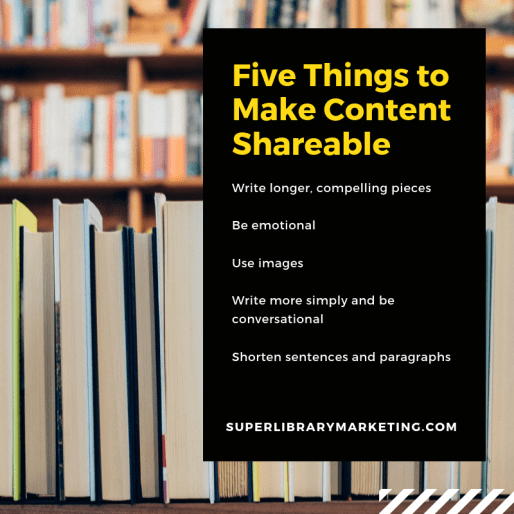
I have five simple ideas for you. Each of these increase the likelihood that your content gets shared.

Write longer, compelling pieces. Seriously, the whole thing about how your audience only has the attention of a goldfish is bunk. They will read a 2,000-word post from you if it’s compelling.  People read whole books with 50,000 plus words! I don’t know why this myth of the “too-long content piece” exists when there is literally hundreds of years’ worth of proof that it’s not true.

If you tell a story in long form, with authentic quotes, an emotional arch with conflict and resolution, and a clear beginning, middle, and end, it will not feel like a long read. And a piece of content with all of those characteristics is also likely to be memorable. Great stories stick in our minds long after we read them. And memorable posts get shared!

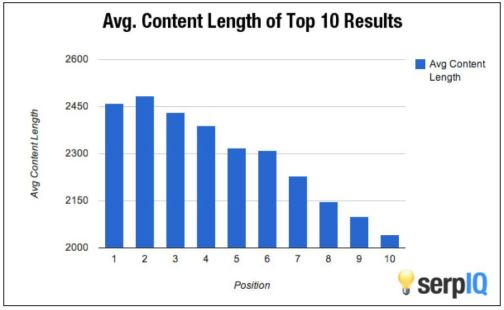
Long form content is also better for your library’s search results. Back in 2012, serpIQ conducted a study involving more than 20,000 keywords. The results showed that the average content length of the top 10 search results was more than 2,000 words.

I have some evidence that this works personally. In 2018, I purposefully started writing longer blog posts here. Most of my posts land at around 1,000 words… not quite up to serpIQ’s standards but about 200-300 more words per post than I wrote in 2017. And guess what happened? My engagement stats increased by nearly 215 percent over 2017!

My library just started a blog two weeks ago. We will experiment with post length. And you can bet that I’ll push our writers to put out longer and more compelling stories, even if that means we have to publish fewer total posts. Write longer, more interesting posts and people will respond.

Be emotional. According to research from the journal Psychological Science, our emotional responses to content play a huge role in our decision to share that content. But all emotions are not created equal. The study shows people will share content that makes them feel fearful, angry, or amused. There is also a ton of evidence to suggest that people like to share content that inspires or contains a surprise.

Conversely, you should avoid creating content with negative emotions like sadness or even contentment, which tend to cause inaction. We don’t want that!

Insert images in your content. You may have noticed I’ve started inserting more images into my posts on this blog. That’s because adding images to your content is proven to increase the likelihood that it is seen and shared. My post popular post ever is this one, which contains three images. Those three images are strategically placed to emphasis the meaning of the words. They also break up the text for a visually pleasing read.

You must also use images on social media when promoting your content. This rule applies to all platforms. Your audience is visual and they want to see images in addition to your important words. The right image–one that evokes emotions or really serves to succinctly illustrate whatever you are saying in your content–will also make your content more shareable.

Write simply and conversationally. The more your audience understands what you’re trying to say, the most likely they are to share your posts. Define unfamiliar or difficult words, titles, or services. Go through the draft of your material and highlight words or terms that may confuse your audience. Then, find a better way to say or explain those words.

Never take it for granted that your reader has been a lifelong user or follower of the library. Words used by librarians to describe services, programs, catalogs, and databases may seem common to you and your staff. They are not common to your reader. Always explain. Then, ask a non-library employee to read your work. I often take my stuff home and ask my husband or my teenage daughter to read it. If they find anything to be confusing or convoluted, I know I need to change it.

Shorten your sentences and paragraphs. Shorter sentences will make it easier for your reader to understand and absorb what you are saying. The same is true with paragraphs. A piece of material with lots of long paragraphs looks thick and off-putting. Readers will skip lengthy paragraphs, according to British grammarian H. W. Fowler. In addition, the Poynter Institute’s Eyetrack Study shows people are more likely to read an entire web page when the paragraphs are short. And if you can get the reader to look at the entire post, it’s more likely that they’ll share the content.

Subscribe to this blog and you’ll receive an email every time I post. To do that, click on “Follow” button in the bottom left-hand corner of the page. Connect with me on Twitter, Snapchat, and LinkedIn. I talk about library marketing on all those platforms!

Eight Major Reasons To Add Content To Your Library Marketing {Infographic}

I’m so excited to be the keynote speaker for the Illinois Library Association Marketing Forum Mini-Conference in Chicago in a few weeks. My brain is entirely engulfed in content marketing as I formulate the talk. There are also some big content changes afoot at my library. I’ll talk more about those when we have our campaigns up and running. But, let’s just say that most of my marketing focus in my professional life is on content–why we should do it, how to make it work better, and how to be efficient in our content creation.

The most important part of the speech I’ll give next month is the “why.” Why is content marketing important to libraries? This was actually the focus of one of my early posts here on blog. The argument for content marketing hasn’t changed. You can make all the posters and fliers you want. People don’t pay attention to those push promotional tactics. That’s why marketing seems frustrating.

You want desperately to break through the noise of life and become a subconscious part of your cardholders’ thought process. You want them to think of you every time they face a problem. You want them to remember they can come to you for pretty much anything they need. This is the common struggle for libraries everywhere, no matter their size, staffing, or service area. Honest to goodness, the only way to achieve that is through content marketing. I know this from experience.

There is now a lot of data to back up the assertion that content works. I want to share some of that with you. I’m hoping that, if you are hesitant or nervous about working content marketing into your overall library marketing strategy, these stats will convince you. I truly believe this is an opportunity for libraries that cannot be missed. If we are to survive and thrive as an industry, we need to do more content marketing.

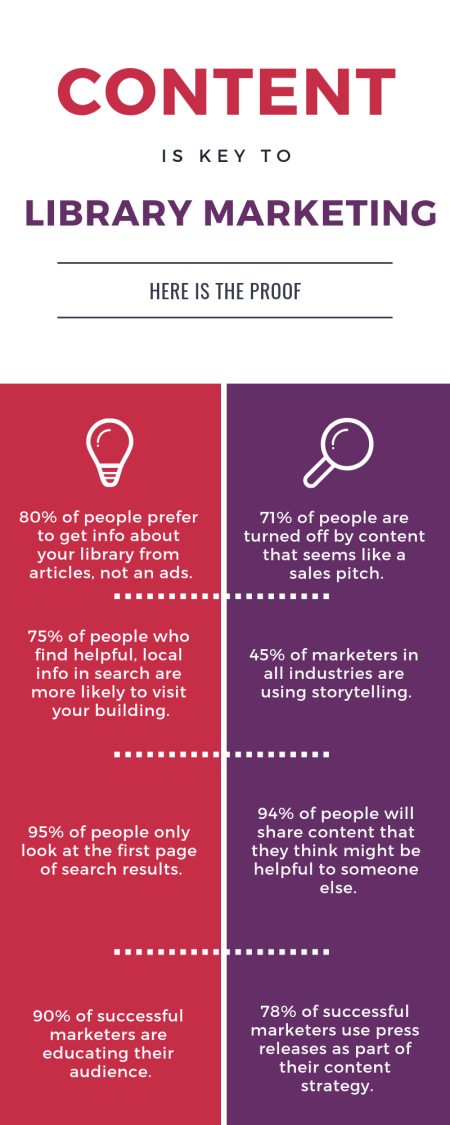
Here are the facts for why content is key to library marketing.

Why Content is Key to Library Marketing

80 percent of people prefer to get information about your library from a series of articles versus an advertisement.

71 percent of people are turned off by content that seems like a sales pitch. Which means, if you are doing mostly traditional promotional marketing, it’s not working.

75 percent of people who find local, helpful information in search results are more likely to visit a physical building. We want to get more bodies inside our libraries. Content is the key.

Only 45 percent of marketers are using storytelling to create a relationship with their audience. Most big brands are still running ads and push promotion. This is our open door. It’s a huge opportunity for libraries. This is how we sneak in and take away audience share… by telling stories. And who doesn’t love a good positive story about a library?

95 percent of people only look at the first page of search results. Optimized content (that’s content that uses keywords that are likely to be picked up by Google and other search engines) is incredibly helpful. If your library’s content appears on the second page or later, people won’t see it.

Blog posts are the content that get the most shares. And if your post is helpful to others, it’s more likely to be shared. 94 percent of readers share a blog post because they think it can be useful to someone they know. And the more often you publish blog content, the more often your content will show up in search, which increases the likelihood that people will find your library while doing a search. Amazing, right?

90 percent of the most successful marketers prioritize educating their audience over promotion their company’s promotional messages. Education is our main industry. Libraries are perfectly aligned to make this work for us.

But here’s a stat that really surprised me. 78 percent of effective content marketers use press releases as part of their strategy. Yep, press releases can be content marketing too. Use your releases to be informative but to really pitch amazing story ideas to the media. If you have a great story and you can make all the elements available to the media, you can let them tell it and take advantage of their built-in audience to spread the word about your library.

These stats come from a variety of great blogs including Impact, Marketing Profs, OptinMonster, Elite Copywriter, Cision, and Forbes. I hope they’ve convinced you to do content marketing at your library.

Subscribe to this blog and you’ll receive an email every time I post. To do that, click on “Follow” button in the bottom left-hand corner of the page. Connect with me on Twitter, Snapchat, and LinkedIn. I talk about library marketing on all those platforms!

Seven Podcasts that Will Make You a Better Library Marketer

An exciting thing happened this week! The library marketing profession is now the subject of a podcast. It’s called Library Figures. It’s produced by Piola, a company which designs library websites.

Many smart and strategic library marketing professionals including Kimberly Crowder of the Indianapolis Public Library (featured in this Super Library Marketing post last year) are guests on the pod. Each episode focuses on a successful library marketing strategy. The host and guest dissect the implementation, tools, success measurements, and results. I amhonored to be featured on episodes one and four. Maybe it’s silly, but I’m just beyond thrilled that we’ve got our own podcast corner where we can share and learn.

I’m a huge podcast fan. My podcast player is overflowing with episodes. I’d love to share my list with you and explain a bit about why listening to these shows will make you a better library marketer.

The Science of Social Media

This is a new discovery for me. This show, produced by Buffer, focuses on data, insight, trends, tips, and more. Anyone who works on social media for any library will find value in listening to these episodes, which cover subjects for everyone from beginners to those with advanced social media skills.

Marketing School

I just discovered this podcast last month and I’m catching up on back episodes (there are more than 900!) but I really love it. The creators release one ten-minute episode every day focused on one nugget of great marketing wisdom. Past subjects include blogs, event marketing, crisis communications, and generating great content ideas.

Brand Newsroom

This show, produced by a content marketing agency in Australia, bills itself as “the show for anyone who has a say in how companies are communicating.” The hosts use a round-table discussion format to dissect topics like crisis communications, branding, and networking.  The most interesting episodes involve disagreement between the hosts. They all have a different perceptive on marketing, and I find that they help me to consider issues from different angles. They also have a fun segment at the end of each episode called “On my Desk” where they share something they’re really excited about, from apps to software to new books.

Marketing over Coffee

As its name implies, each weekly show is recorded in a coffee shop. The two hosts talk casually about all kinds of marketing topics including writing, influencer marketing, SEO, and other relevant marketing problems and solutions. They also take listener questions, which I really love. And the episodes are short, so they’re easy to listen to during a typical 20-minute commute.

Social Media Marketing Podcast

Michael Stelzner, who runs the Social Media Examiner website, is the host of this show. His guests have a range of backgrounds and answer questions about all kinds of social media topics and tactics. Mike is really good about digging down and getting the basics about each topic. He also shares a new app at the beginning of each show. Most of his discoveries are free or very inexpensive and they’re all designed to help make marketing easier and more fun.

Unpodcast

I’m going to end in an unconventional spot by recommending this podcast, hosted by husband and wife team Scott Stratten and Alison Kramer. I have seen Scott speak at Content Marketing World several times. He’s hilarious and brutally honest about the faults and triumphs of marketing. Alison is his partner in crime and besides being the cutest couple in marketing,  their observations are always spot on. Some episodes dissect customer service, some talk about marketing mistakes, and sometimes they talk about innovation and entrepreneurship. They really make me think. Just trust me and subscribe.

And of course, we support our fellow library marketers producing podcasts. Read the back stories about how those shows are produced and then subscribe to the library podcasts on this list.

And if you have a podcast you want to recommend, please let me know in the comments!

Subscribe to this blog and you’ll receive an email every time I post. To do that, click on “Follow” button in the bottom left-hand corner of the page. Connect with me on Twitter, Snapchat, and LinkedIn. I talk about library marketing on all those platforms!

How to Hook New Cardholders and Make Them Loyal with Email

We talk a lot about emailing our cardholders with information about new products, services, and collection items. But you can also use your email list in a powerful way to reach people who have just signed up for a library card.

Most libraries take a minimalist approach to “on-boarding” a new cardholder.  Once a person fills out a library card application, we hand them a card, a welcome brochure, and send them on their way. We’re friendly and we’re genuinely excited to welcome them to our system. But we make a mistake that’s common for a lot of businesses and organizations. We know our system inside and out and we often forget that our new cardholders know nothing about what we offer. We assume they can find their way to the things they need.

It’s important to help those cardholders learn to navigate the behemoth number of resources and items available at the library. A solid on-boarding campaign retains new cardholders and turns them into lifelong loyal users of the library. The first 90 days of a new library cardholder’s experience is crucial to determining their feelings of connection and loyalty to the library.

It also makes good business sense. Studies show it costs five times as much to gain a new customer than it does to retain them. A library marketer practicing good stewardship will want to do their best to keep new cardholders coming back to use the library.

The most effective way to on-board a new cardholder is through email marketing. Many libraries create a campaign with specific emails sent to new cardholders at a pre-determined pace. Those emails slowly introduce them to new features and inspire them to try out all the library has to offer. It’s easy to do this using some mail systems, like OrangeBoy and MailChimp.

My library has a 90 day on-boarding campaign set to run automatically through OrangeBoy. Creating it was a bit of process. But the effort was worth it. In addition to retaining customers, the on-boarding emails reduce unsubscribes for future targeted promotional emails. Here’s how we did it and what we learned about doing it well.

First, make a list of the services, events, and collection types that get the most use at your library. You’ll want to include information about the most popular features you offer in your emails to new cardholders.

Then, make a list of the services, events, and collection types that are interesting or unique to your library but don’t get a lot of use. These are the gold nuggets of your on-boarding campaign. You’ll have the attention of your new cardholder. The relationship is fresh. Why not use that to showcase the hidden treasures at your library.

Finally, create an outline of your campaign, mapping out each message, when it will be sent, and what it will say. Look at the two lists you’ve created and narrow your focus. Try to promote no more than four things per on-boarding message. You don’t want to overwhelm your new cardholder. Rather, you’ll want to introduce people to the library in small doses. Pick a theme for each message with a specific call to action. Keep the language simple, conversational, and free of industry jargon.

Create, test, and release the messages. This part took me nearly as long as creating the plan did! But you’re almost there.

Track results. Of course, you’ll want to use a Google URL tracker or Bitly link to see which services and items get the most interest from your new cardholders. You can also track unsubscribe rates, and if you have the ability to divide cardholders into clusters, you can see where your new cardholders land after they finish the on-boarding process.

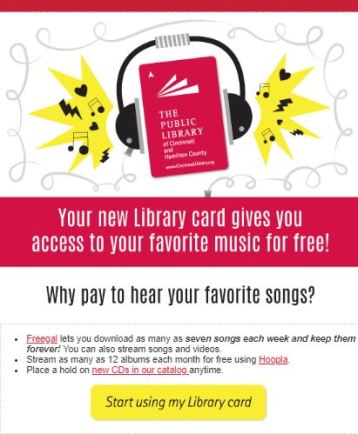
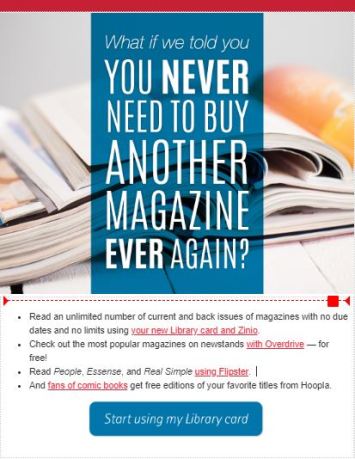
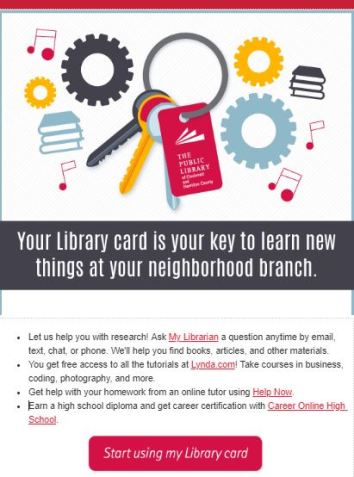
Here are a couple of examples of my library’s on-boarding emails so you can see what we do.

How do new cardholders react to these messages? They definitely don’t hate them. Our unsubscribe rate is 0%. We’re a large system and we’ve sent these for several years to thousands of new cardholders. Over the course of our campaign, we’ve had a couple of hundred people unsubscribe.

We send six emails over 90 days. The first email gets a lot of engagement, which is not a surprise.  The fifth email about using your neighborhood branch (see the image above) is the second most engaging email for us. Overall, about half of the new cardholders we sign up end up becoming loyal library customers. Most use our computers but the rest are checking out physical and digital items or using our MakerSpace.

If your library is doing something to on-board cardholders, I’d love to hear about it. Please take this poll and tell me about what you are doing in the comments.

Subscribe to this blog and you’ll receive an email every time I post. To do that, click on “Follow” button in the bottom left-hand corner of the page. Connect with me on Twitter, Snapchat, and LinkedIn. I talk about library marketing on all those platforms!


How to Manage Your Marketing Without Losing Your Ever-Loving Mind

A library marketer is really a project manager.

That phrase is the best description of our job. We are all planning and managing projects. We are scheduling and executing campaigns. We’re delegating. We manage multiple people who contribute to blog and social media posts. And unless you’re a super organized genius, all that coordination can cause you to lose your sanity.

I sometimes walk into my office in the morning feeling fantastic, and by the time I open my email and see a 30-message thread between departments about a piece of content I need for marketing, I can feel the steam rolling out of my ears.

Project management is like waiting tables. You have multiple customers who all want different things from you. They order at different times and their food comes out at unpredictable intervals. In the meantime, you must keep checking back and making sure they have everything they need for the moment. You must also keep them informed about how their meal is progressing.

It’s the same when for library marketing. We are working on multiple campaigns and we have lots of different customers, internally and externally. So how do you make sure you get all your work done without losing track of projects, content, and posts? It’s not easy.

Many of you have said that project management causes you grief and stress. Many of you don’t have a staff. You are doing this job solo. You’re doing branch work in addition to marketing. Your job is hard.

I have a system, developed over five years of trial and error. I thought I’d share it with you. I hope my tips relieve you of some stress.

Train other library staff to plan. I make it a point to stop by once every month or two to talk to all the departments that contribute to my marketing schedule. I ask them to tell me what is coming up in the next one to three months. At the end of each of those meetings, I make it a point to tell them to let me know if they start planning anything at any point. These “touch-base meetings” sometimes only last 15 minutes but they are incredibly valuable.

To be honest, it took me about a year of doing this to get my coworkers trained to let me in on their plans early. I realized later that most of them thought it best to wait to tell me about an event until they had all the details worked out. Now, they’ll give me a heads-up even if they only know the general subject of the event and the date. That way, I can work it into my schedule ahead of time and plan.

Share your schedule. I noticed that when I shared my promotional schedule with my coworkers, they got a good sense of the kind of work involved in creating a campaign. They started sharing more info with me because they could see the work involved. Don’t be precious with your schedule. Share it… and let everyone see how much work and planning goes into each piece.

Set deadlines and enforce them. I do this for lots of my content, but especially when it comes time for our summer reading program. It’s a massive marketing campaign, the biggest we do all year. I create a schedule by the first week of February. In it, I share the deadlines for each piece of the marketing with everyone involved. This sets clear expectations. I also do this for those who contribute to our quarterly content marketing magazine. I send reminders one month and one week before the submission deadline so it’s clear what I need and when I need it.

Use your calendar. I  put appointment reminders in my Outlook calendar to check on the status of certain projects.  I can look at my calendar each day and remember that I need to check up on certain things. I even put calendar reminders in for things like changing signs or updating content.

Don’t respond immediately to requests. This habit was hard to form but it’s the best discipline I’ve set for myself. When someone comes to be to tell me they need marketing for an event or service, I generally do not drop everything to plan out the marketing. I will put it on my to-do list for the next day, or even the next week. That gives me time to think about the best way to market each request.

Set aside time each week for planning. I have a designated planning day. I set aside a couple of hours on that day to purposefully think through my marketing. I make lists and set deadlines. It makes me more focused and helps me to know I have that time to think about what’s coming down the road.

Say no sometimes. Listen, I know it’s an uncomfortable conversation. I know you want to help everyone. You may feel pressured to do it all. I hate saying no. But sometimes, it is necessary. If the request doesn’t align with the library’s overall strategy, I say no.

Your time is limited. If you try to do everything for everyone, you won’t do anything well. Sometimes, you must say no. It may not make your friends, but it will make you better at your job. You were hired to do what’s best for the library.

Subscribe to this blog and you’ll receive an email every time I post. To do that, click on “Follow” button in the bottom left-hand corner of the page. Connect with me on Twitter, Snapchat, and LinkedIn. I talk about library marketing on all those platforms!

Powerful Things You Can Do to Convert Cardholders

This is the second in a two-part series on how to improve the metrics that really matter for library marketing emails. To read the first part on how to improve your library email click-thru rate, click here.

The other important metric to measure for email library marketing is the conversion rate. Conversion rate refers to the percentage of people who received the email AND end up taking an action, such as checking out an item, registering for or attending a program, or using an online service.

Conversion rate really is the gold standard for the success of any email campaign. Your goal should always be to get people to act!  For every email you send, you should be able to state in one sentence what it is you want email receivers to do when they read your email. Then you need to follow-up and track the results to see if your email led to the desired action. If it doesn’t, you need to adjust your email strategy.

Here are the tips I’ve discovered, through years of email marketing success and failure, that work to drive up the conversion rate.

Do deep research to find the right target audience. Sometimes it’s hard to pinpoint the best audience for your email. It takes a lot of research. But this is an incredibly important step.

My library recently sent an email to promote a service we’ve had for many years called Career Online High School. COHS is a course that helps people who never finished high school to get their diploma and career certification. Finding the right target audience for this message is problematic. My library doesn’t ask cardholders if they also have a high school diploma, a job, or any kind of career skills. My library also doesn’t keep anything more than superficial demographic statistics on the people who already graduated from the COHS program. I don’t really know who my prime audience would be. I can’t say with accuracy what motivates a person to take this 18-month course. So, I had to do some deeper research.

I found some local studies that laid out the high school diploma concentration in geographic regions inside my library’s service area. This helped me narrow the email audience down to a few neighborhoods within my county. I also asked staff to help me create a subjective profile of past COHS students. I asked the staff to guess at the COHS program applicants ages. I asked if the applicants identified the part of the city they live in. I asked if the applicants typically have a library card when they sign up, or if they have to get one (the service requires you to be a cardholder). Finally, I asked staff if the applicants ever talked about how they first heard about COHS. The staff helped me craft a cluster that I thought *might* work.

We sent this message to about 18 percent of our cardholder base. That’s a wide net. But it worked in this instance. Five percent of the people who opened and clicked on the message are now in the process of filling out applications and completing paperwork to join the class. I consider that a huge success! The staff who run the COHS program told me they were incredibly pleased with the number of new applicants.

Sometimes, your targeted email audience will be obvious. And sometimes you’ll have to ask some questions and dig around to determine your audience. Try not to guess. Base your decisions on the information available and you’ll find success.

Experiment to determine your goal conversion rate. When I started sending emails to my cardholders, I had no idea what success looked like. Through experimentation, I set a goal. Each email must create a ten percent or higher bump in circulation, program attendance, or usage. If the email falls short of these goals, it’s not worth my time or my cardholders’ time.

This isn’t an arbitrary number. It’s a number I’ve landed on after many emails and lots of calculations. For my library system, a ten percent increase in any one of these numbers is significant enough to warrant the effort it takes to create and send an eblast.

You’ll set your own optimum conversion rate. Your optimum rate will depend on the size of your cardholder base, your staff’s capacity to handle increased circulation, program attendance, and library visits, and your overall library goals. But you must have a goal.

Make your call to action clear and persuasive. You’ll notice the call to action on the Career Online High School email is very direct. When you create a call to action (CTA), say the words “I want to…” before the CTA. In the COHS email above, that sentence ends up being, “I want to apply to Career Online High School.”  If that sentence is short, direct, and easy to follow through on, you’ve got a good call to action. Some other good CTA’s are:

Register for this program.

Put this event on my calendar.

Place a hold on this book.

Get reading recommendations.

I think you get the picture. In my emails, I put the CTA inside a button or box so it draws the eye and is intuitive for clicking.

Change focus of your email from the library to your cardholder. To persuade cardholders to act on your emails, stop talking about how great the library service is and to instead talk about how it will change or improve the life of your customer. You can do this even with a simple collection-based email.

We do this with our book recommendation service. We might be tempted to say, “Our Librarians are book experts. We give the best reading recommendations anywhere!” And we do! But by slightly pivoting our message, we show how this service helps our cardholders. Our re-focused sentence is: “You’ve got a lot to do. Let us help you pick out a good book to read.”

See how subtle it is? But it really works. You’re just changing all the “we’s” in your copy to “you’s.” By pivoting the focus of the message from how great your library is to how much you can help the cardholders, you increase the chances that cardholder will take an action.

Include humans in your emails. When you create your email, using a photo that includes a human face or faces expressing an emotion. Your cardholders will look at the faces and identify with one. That face will humanize your message. They’ll be more likely to take an action. We use one or two human faces in most of our email marketing campaigns.

Now, there is some science to suggest that human faces negatively affect conversion rates, particularly if the faces don’t align with the email’s target audience. So, you must choose the photos carefully. For instance, this email promoting our Memory Cafe accurately represents the audience and the activities at the cafe (there is often dancing!). And it worked to drive people to this recurring program. If you make a thoughtful photo choice, you’ll see good results.

Subscribe to this blog and you’ll receive an email every time I post. To do that, click on “Follow” button in the bottom left-hand corner of the page. Connect with me on Twitter, Snapchat, and LinkedIn. I talk about library marketing on all those platforms!

Make #GivingTuesday Work and Raise Big Money for Your Library!

Boy, library marketers sure have a lot of responsibilities. We’re expected to drive attendance to programs, increase circulation, plan big events, provide outreach support, and make sure everyone in our community knows about all the services we provide. In addition, most of us are also expected to help market fundraising efforts for our library friends or foundation groups. Our libraries need money. That fact arguably makes this directive the most important of all our jobs.

The fundraising portion of library marketing has always been difficult for me, if I’m being honest. I think most of us feel queasy about asking people for money, even for something as important as the work of the library. I get the same feeling in the pit of my stomach when it comes time to market my church’s stewardship campaign. It’s hard to put into words why it feels weird to me to ask people to give to either organization, though both are incredibly worthy.

But worldwide giving campaigns like #GivingTuesday help. This global movement happens every year on the Tuesday after the American Thanksgiving holiday. It’s meant to motivate people to donate after the excess of spending that happens when the traditional Christmas shopping season kicks off.

The website for the movement has all kinds of ideas for fundraising organizations. The “holiday” is a prime opportunity to reach your library’s fundraising goals. According to NonProfit Pro, in 2017, #GivingTuesday campaigns raised over $300 million online for charities with an average gift exceeding $120. That’s a 64 percent increase in the amount of money raised in 2016. And NonProfit Pro also says that nonprofits raise 14 times more in their end-of-year campaigns when they take part in #GivingTuesday. And if that doesn’t convince you, the most recent study of #GivingTuesday donations conducted by DataKind shows that educational causes received nearly 40 percent of all donations made. Cultural organizations saw the greatest increase in donations, in some cases receiving nearly 20 percent of their annual donations from this single day. Libraries can be considered both education and cultural organizations. We’ve got so much to gain!

My library started doing campaigns around #GivingTuesday about three years ago. We’ve seen trends in giving that match NonProfit Pro’s numbers. Even better, we grow our donor lists. That gives us a new audience to market to throughout the entire calendar year.

Your library should participate, and you should plan your promotions ahead of time. Don’t just send out an email and put up a couple of social media posts on #GivingTuesday.  Start promoting #GivingTuesday with content marketing at least a week ahead of the actual holiday, sooner if you are able. You’ve got to prove your library’s worth and get the idea of giving into your potential donor’s head space before the event. I start about three weeks before the “holiday” with motivational content like quotes from customers, brand-awareness videos, and motivational photos with clear donation calls to action. I like to tell our cardholders and community that #GivingTuesday is part of a busy time of year and I work to get them to donate early. This method increases the chance that our campaign is successful.

Of course, incentives always help with donations, and it doesn’t have to be something that costs your organization. This year, we’ll be emailing a graphic to anyone who donates early. Donors can use it on their social media profiles to show that they’ve given to the library. They can have the pride of saying they’ve participated when the day arrives and use their influence to encourage others to do the same. Early promotion creates momentum.

Of course, we use email as part of our campaign along with social media and our website. Here’s the message we sent last year about a week before #GivingTuesday. It’s clear and easy to understand.

We did a similar message to members of the Friends organization. The audience for that group is different. But you’ll see we integrated the heart from our Foundation message into this message, to draw a subconscious message to our audiences about their love for the library. This one also has a clear call-to-action.


You can increase the effectiveness by extending the fundraising campaign through the end of the year. We create campaigns that run every two weeks beginning in November through the end of the year. Appealing to the tax deduction incentive is a major point of the campaign as we near the end of the calendar year. This is the email we sent last year about mid-December. Again, it’s clear, it concise, and it has a major call-to-action.


I’d love to hear about your successful library marketing fundraising efforts and campaigns. Please let me know what you’ve done right (and wrong!) in the comment box. We can all learn from each other. When one library is strong, it makes the whole industry stronger.

Subscribe to this blog and you’ll receive an email every time I post. To do that, click on “Follow” button in the bottom left-hand corner of the page. Connect with me on Twitter, Snapchat, and LinkedIn. I talk about library marketing on all those platforms!


Five Insider Tricks To Improve Your Library’s Voice Search Ranking

One of my most vivid class memories from college happened during my freshman year. A woman visited our communications class to talk about this new thing sweeping the nation: the internet. She said that someday companies would be able to send us information on any product or service we could ever want or need, based on our previous purchases or on search.

Was she psychic? Nope. She was forward-thinking. The internet, and later the introduction of smartphones, caused a huge shift in the way libraries interact with cardholders. And now, we’re about to enter another era of technology change. We’ll need to re-evaluate how we interact with cardholders. Because voice search is going to change everything.

My library is now dabbling in this technology. We created an Alexa skill that allows cardholders to do some very basic things: find out what’s going on at a branch or ask about our hours of operation. But that’s only the tip of the iceberg when it comes to voice search.

At Content Marketing World 2018, I attended a session led by Courtney Cox, who is manager of Digital Marketing at Children’s Health. She talked with us about the Google Search box. You’re probably familiar with it. It looks like this:

The answer box is text-based but it’s an important key to getting your library information in front of cardholders doing keyboard-based search inquires AND those using voice search options like Alexa or Suri. How is the answer box connected to voice search? Cox explains that voice search technology reads whatever answer appears first in the Google search. So, if you’re in the answer box, you are in first position and you get read by the voice search technology. That means if you live in the second or third results on Google, you won’t get read out. EVERYTHING ELSE underneath the answer box is ignored. There’s no glory in second place.

Wow. That’s depressing.

Comscore estimates that by 2020, half of all web browsing sessions will be done without a screen. So, what’s a library to do? Here are five steps to take now to move your library into the first position on Google search. These tips will increase the chances that your library will appear in the answer box and connect with more users.

Keyword research: Cox says you need to do real-world keyword research. That means you can use online tools like those I talked about in this post. But you must also talk to customers, face-to-face. Talk to front-line staff. Talk to the call center staff. Find out what customers are saying when they ask questions. What specific words or phrases do they use? Then start incorporating that language into your web content, social content, and all your marketing messages.

Competitor research: Cox suggests you do periodic searches for competing services offered by Amazon, your local bookstore, and online databases. What phrases and words do they use? How long, in words and characters, are their answers? Do they use bulleted lists, tables, or graphics to convey information to their customers?  What aren’t they doing well? All of these questions will inform you as you write searchable text for your website. You should feel free to copy what others are doing well. You can improve on what your competitors are doing poorly! You don’t need a big budget to write more searchable content.

Stop dictating your own content. Cox says we all need to stop brainstorming internally about what you want to write about. Start focusing on what your customers want. We must be answering the questions our customers have.

Create a FAQ page on your library website. Make the page easy to find and promote it throughout the web with blog posts, social media, emails… every marketing method at your disposal. The more people who go to the FAQ page, the higher the search ranking for that page will be, and the more quickly you’ll get into the answer box.

Re-purpose your content–with a purpose. Many libraries are creating videos for marketing purposes (HOORAY!). Now it’s time to take those videos and make them work to improve your search position. Take each of your videos and turn it into text. Post the text on your library blog and promote it in other ways. The more eyes that read the content in its written form, the more likely it is that the content will make its way into the answer box!

We’ve got our work laid out for us. After the conference, I started doing random searches to see where my library shows up in the answer box–and when it doesn’t. In some ways, we’re doing okay.

And in some ways, we have a lot of work to do.

So I’ll be looking for ways to make these five pieces of advice work in my content. And I’ll be paying more attention to the words we use on the website, making them local and specific. I’ll start thinking about what people will say when they use voice search to ask questions about my library. I’ll check these searches again in a few months to see how I’m doing. I urge you to do the same!

Subscribe to this blog and you’ll receive an email every time I post. To do that, click on “Follow” button in the bottom left-hand corner of the page. Connect with me on Twitter, Snapchat, and LinkedIn. I talk about library marketing on all those platforms!

Call It What It Is: Toledo Public Library Explains Their New Brand Strategy

A couple of weeks ago, a Tweet from the deputy director of the Toledo Public Library caught my eye.

Our marketing manager here at the library is leading a charge to “call things what they are” to reduce confusion for customers. We should be doing more of this in libraries and resist the urge for cutesy branding.

https://platform.twitter.com/widgets.js

Jason went on to explain, “When I joined the library three plus years ago, we had just launched a kind of umbrella branding for all of our making activities at the library. We called it Make U. It was clever, had a nice logo, and generally served a purpose… for us. Three years later, it’s still a confusing ‘second brand’ for our library (one of many tertiary brands, actually). Terri Carroll (our marketing manager) is working really hard to make the library’s brand the key identifier for all things library. Every time we roll out a new program or service, we have the urge to give it cute or clever branding. It’s just more education we have to do with our customers. So rather than trying to constantly educate people about our new brands, services, and programs, we focus on the library’s brand: a welcoming and accessible space where anyone has access to resources they need to make their lives, their communities, and their futures better. Now we call Make U what it is…tech tools. I’ve learned a tremendous amount from Terri in the short time she’s been with us about how we cut through a very noisy marketplace to reach people where they are when they need us.”

This is a major hurdle for my team and library marketer’s across the country! At my Library, I’ve counted no less than TEN branded services. And each one requires education for the staff and public. The names are cute but their meaning is obtuse.

Library marketers struggle with branding. We need to do a better job of defining who we are. We must create a consistent emotional connection with our cardholders if we’re going to compete with the likes of Amazon, Barnes and Noble, Netflix, and Google.

Jason’s co-worker, Toledo Public Library Marketing Manager Terri Carroll, graciously agreed to share her insights on the process.

So many libraries have a set of tertiary brands for their various programs and services. Why is that a problem? Each day, our current and potential customers are bombarded with media messages from well-funded and sophisticated retail, fast food, snack food, entertainment, sports, news, and service companies. While these organizations aren’t competing with us to provide library services, they are competing with libraries for people’s time and attention. If libraries hope to have people notice our message in a noisy marketplace, it is imperative we have one clear brand that makes it easy for people to know who we are and what value we provide. Tertiary brands dilute our message and make it more challenging to connect with customers.

Before the redesign, the Toledo Public Library struggled to bring a host of tertiary brands together to create one cohesive brand.

What prompted you to decide to focus less on giving everything a cutesy name and instead develop and nurture an umbrella brand? I started working at the Library in November and was struck by the fact that each program had its own look and message. The emphasis was on program names and unique graphics, rather than the Library as a whole. For example, a great deal of energy was spent on “logos” for programs such as Kindergarten Kickstart, Ready to Read, and Make U instead of thinking about messaging that clearly connects a valuable service (early literacy or access to technology) with the Library. This approach puts the burden of connecting the dots about the Library’s value and relevance on our customers. It also keeps the Marketing team from thinking strategically as they instead spend energy making everything look different. This is an unfortunate use of resources. Having things look similar within a brand compliance strategy makes it easier for customers to identify Library materials and messaging.

Terri laid out brand elements to create a clear and consistent message that can be understood by staff and library cardholders.

Have you seen positive results from this type of strategy yet?  We’ve been working on implementing this strategy since December, so it is tough to extrapolate data yet. For now, positive anecdotal comments to Library staff and leadership such as, “The Library is doing so much,” (when in fact we are doing a similar amount of work) and increased earned media attention are indicators of success. Ultimately, we should realize increases in circulation, door count, and program attendance as well as community and regional stakeholder invitations to be at the table on important issues, speaking opportunities, organizational partnership creations, and election results.

How can other library marketers make the case to their stakeholders, like their board of trustees, the senior leaders, and their staff, that developing a strong brand sense is more productive than creating brands individually as services are unveiled? Stakeholders repeatedly express interest in making sure the community knows about everything the Library does. I have invested a lot of time meeting with all of our internal stakeholders to show them how strong brand management is necessary to meet that goal.

My staff and I also work to keep a focus on making sure all materials and messages are customer-focused. We ask ourselves and our colleagues if our materials and messaging are giving customers all the information they need to engage with the Library. Focusing on how customers understand our Marketing keeps everyone externally (brand) focused and not internally (tertiary brand) focused.

A clear, consistent look helps Toledo Public Library create a connection and makes it easier for their cardholders to recognize their messages.

Do you have any other advice for library marketers looking to strengthen their own brands? It is essential to have senior leadership support for strong brand management. If people are used to the tertiary brands and have enjoyed the creative process (either working with Marketing and/or doing their own design work at the department or branch level), moving to brand compliance can be painful. If those concerns/complaints are taken to senior leadership and exceptions are granted, then the entire brand strategy is compromised.

It is also important to expect some resistance and be willing to talk with people about their questions and concerns. In these conversations, something that seems to really resonate is when I say that we don’t want to re-educate people every time they see something from the Library. We want people to immediately identify a Library program or service. And while staff sees all the materials and, may in fact get a bit tired of the same colors and fonts, this easy identification and brand recognition is essential for customers who are wading through a marketplace of messages and materials.

Subscribe to this blog and you’ll receive an email every time I post. To do that, click on “Follow” button in the bottom left-hand corner of the page. Connect with me on Twitter, Snapchat, and LinkedIn. I talk about library marketing on all those platforms!

A WordPress.com Website.

Up ↑