Search

Super Library Marketing: Practical Tips and Ideas for Library Promotion

Tag

marketing libraries

The Library Marketing Show Episode 8: Fighting Back Against the Endless Poster-Flyer-Bookmark Cycle!

Alright my friends, you asked for it and I’ve delivered. The Library Marketing Show is now pre-recorded and posted on YouTube! This week’s episode comes to you from the vintage newspaper stacks of my library.

Watch Now

Please subscribe, comment, and share the video. I’d love to be able to grow my channel from nothing to something. This is a great exercise for me. I’m going to learn a ton about YouTube! And there are lots of features I can add if I get a certain amount of views and watch time, as you likely know. Thank you in advance!

What We Talked About

Library news: I discussed the recent decision by four publishing companies to change the lending models for eBook and eAudiobook leases to public libraries. It’s going to affect the way libraries market their collection and cause customer service complaints at libraries to rise. And that makes me angry.

Reader question: Babette from the Licking County Library wrote in to ask me to discuss this: “How to help your ‘traditional’ staff understand and EMBRACE new ways to market. They are so disappointed that we are not doing tons of paper flyers, promoting every program on FB, press releases not being in the newspaper, etc. Staff struggling with the change. Sigh….”

Great question, and thanks Babette! I tried to share how I’ve handled this ongoing issue by explaining (over and over again) to staff that embracing new marketing tactics, particularly digital tactics, is not doing “less” marketing but actually doing more. It’s more efficient, it reaches customers where they are, and it allows us to get our message in front of new customers. I also love to share the marketing statistic that says we have to “touch” our customers 4-7 times with a marketing message before they will “convert” or take an action on any marketing message. If a person doesn’t come into your physical branch, they’ll never see your print marketing materials! I also tried to explain why I’m not ever super worried about press coverage of my library, particularly by newspapers. There are better ways to communicate your message, like a customer-facing blog. And when you’re doing the messaging, you get to control the narrative. For more on that subject, read How to Get Media Coverage Without a Press Release.

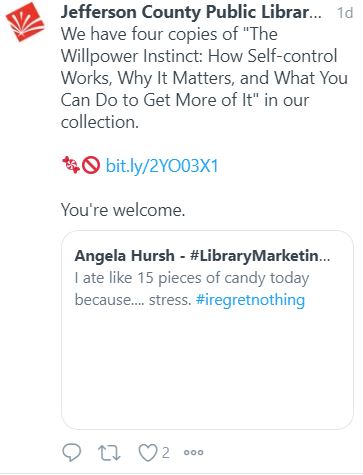
Kudos: Finally, I gave a shout-out to my friends at the Jefferson County Public Library for this hilarious and clever response to my stress-related tweet on Tuesday! I laughed all night!

Stay in Touch

I’m speaking at two conferences this fall and you can register for both on the Upcoming Events page. If you come to OLC, you’ll be able to tour the Downtown Main Library where I work! I’m getting ready to add new events soon so check back.

Have an idea for the next Library Marketing Live Show? Submit it now.

Subscribe to this blog and you’ll receive an email every time I post. To do that, click on “Follow” button in the bottom left-hand corner of the page. Connect with me on Twitter, Instagram, and LinkedIn.  
The Secret of the 60-Minute Meeting: Six Tips to Keep Your Library Marketing Team On Track and Stay Productive!

I dread Wednesdays.

On that day of the week, I usually have between five and seven meetings. I basically spend the day hopping from one conference room to another.

Not so long ago, most of those meetings would last beyond 60 minutes. Tangents were pursued. Ideas were dissected in great detail. My team and I were often blind-sided by requests to come up with an entire marketing campaign for an idea we’d only learned of moments before. It was unproductive.

As a marketing manager responsible for proving the bottom-line benefits of your marketing, it can be tempting to rely on recurring team meetings and regular check-ins to make sure you know exactly what’s going on with your team. But when long meetings evolve into habit, their value tends to plummet.

No meeting should ever last beyond 60 minutes. There are a couple of reasons for this. After 60 minutes of intense discussion, participants begin to lose interest. Their creativity and energy wanes. And the more time you spend in meetings, the less time you and your team have to do ACTUAL work.

Obviously you can’t control every meeting. But when you’re running the agenda, you can create an atmosphere of productivity and creativity while setting an example of efficiency for the rest of the library staff.

I don’t remember how it started but someone in my library’s senior leadership team took the initiative to institute a more efficient meeting structure. Suddenly, everyone was following this person’s lead. It was amazing and liberating.

I started instituting the 60-minute or less meeting rule about a year ago in my department and it’s worked so well that I recently introduced it in another setting.

I’m the chair of my school district’s bond issue campaign and our core committee meetings are 60 minutes or less. It was funny how many people from that group have commented about my 60-minute meeting pledge! It had never occurred to them that meetings, even ones where important decisions are made, could last less than an hour.

If you want to increase productivity in your library, here’s how to execute a 60-minute meeting.

Super prioritize your agenda.  For my library team, I divide action items into categories: the weekly schedule, immediate concerns, future concerns, and individual tasks. These four categories appear on the agenda every single week. Under each category, I list the items that need to be discussed in order of their priority. Next to each item, I list the name of the person in charge of that item or project. For the bond issue committee meetings, I simply list items in order of their priority without categories.

Time it out ahead of time. Try to estimate how much time you’ll need to discuss each item. If your total discussion time is more than 60 minutes, do some more prioritizing with your agenda. Once your agenda is set, make sure everyone attending the meeting has a copy so they can follow along and stay focused.

Set expectations at the beginning of the meeting. As the leader, set the example and start on time. Remind the team that the meeting will last 60 minutes and that you’ll be working to keep discussions on track. Assure them that if further discussions are needed on a particular item, you will schedule a side meeting. Off-topic discussions will be tackled outside of the formal meeting time.

The first time I made this announcement at the bond issue meeting, everyone looked shocked. I was worried that people would start watching the clock and timing me, thus cutting the productivity. But because I set firm expectations, the group trusts me to stick to them. They end up focusing more on the items we need to discuss. It’s funny how that works!

Watch your agenda word choices. Use words like “update” rather than “discussion” to help frame the conversation and give mental cues to attendees that work for the meeting will need to be done before the meeting actually happens. If a key decision needs to be made in the meeting, use the word “decision” in your action item to cue the attendees that you plan to come to a consensus at this meeting.

Take notes. Make note of who is assigned to each project. Give clear deadlines and expectations for each action item and include those in the notes. After the meeting, send out a copy of the meeting notes so everyone is clear about what they’re responsible for and when it’s due.

Continue to give time updates throughout the meeting. It’s OK to say, “We have 15 minutes left so we’re going to discuss one more item that is a priority to us. The rest of the items on this agenda will be discussed at a later meeting.” This will help keep discussions on track.

The LIVE LIBRARY MARKETING TALK ON INSTAGRAM is changing format. I have decided to pre-record my segments and post them to YouTube! I still want your email questions and topic suggestions ahead of time. Just fill out this form. If I pick your topic, I’ll send you a personal link to the video after it’s posted. I’m going to start posting my video segments on Thursdays so watch your email for that. Thank you to everyone who weighed in on the video decision!

And check out these upcoming events and webinars where we can connect and discuss library marketing. Registration links included.

Subscribe to this blog and you’ll receive an email every time I post. To do that, click on “Follow” button in the bottom left-hand corner of the page. Connect with me on Twitter, Instagram, and LinkedIn.  

The Library Marketing Live Show Episode 6: Figuring out Evergreen Content for a Library Blog

Watch Now

What We Talked About

Shandi from the Illinios Heartland Library System sent me this question:  I just read your blog article “How to Launch a Library Blog.” I would love to hear more about this! Specific question: Our new website won’t be ready for maybe 8 months (at our current rate). I want to add a blog with the introduction of our new site. When do you suggest beginning to curate articles? I’m thinking I could start now with evergreen pieces, right? Thanks!

So I talked through my answer to that question and gave some advice for creating evergreen content for a library marketing blog. I’m excited to see what Shandi’s blog looks like and to read the content she curates.

If you’ve got a library blog that you really love, please let me know in the comments. I’m curating a list of great library blogs to share in a future post so get your nominations in! Thanks for the question, Shandi.

Stay in Touch

Thanks to everyone who attended the webinar with Library Journal and Recorded Books on July 25. I am going to answer all the questions either on the live show, on my blog, or via email so be watching for that!

I’m speaking at two conferences this fall and you can register for both on the Upcoming Events page. The OLC released their full agenda this week and it looks like a great conference. Plus, you’ll be able to tour my library!

Have an idea for the next Library Marketing Live Show? Submit it now.

We’ll chat on Instagram on Tuesday at noon EST for about 15 minutes. My handle is @Webmastergirl so follow me to see the show live!

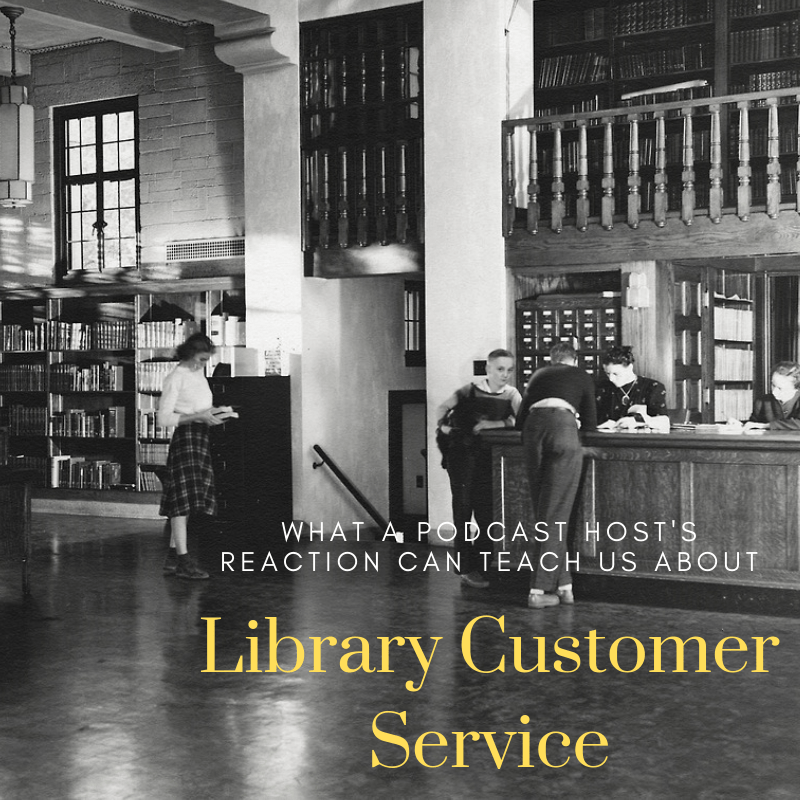
I Asked a Podcast Host to Stop Interrupting His Guests. 😠 What His Reaction Can Teach Us About Library Customer Service.

A few weeks ago, I had an incredibly disappointing interaction with a man I’ve looked up to for ages. I’m not going to name him or his website in this post. But I’ve been listening to his podcasts for more than five years. I’ve sent staff to his conference. I’ve recommended his website and his materials here on the blog. I’ve met him in person. He was lovely to me.

But about a year ago, he started doing something that really upset me. He got into the habit of interrupting guests on his podcast. All. The. Time.

I’m a manager. I’ve been trying to foster better listening skills in myself and my staff.

It irked me that this person never let anyone finish a thought. It got so bad that he started cutting people off as they were explaining concepts and giving specific instructions on marketing tactics.

I decided to email him to ask him to stop interrupting his guests. I was as polite. I told him I loved his show and website. I said that I wished he would just let people finish their thoughts.

Here was his response:

Thanks for the feedback Angela. I pre-discuss with all of my guests that I often have questions and will likely stop people who are fast talkers and dig deeper. They all know I will do it. Indeed many of my listeners love that I do this. For example: ” I have to say that you have a special gift for asking great questions and making sure the audience can actually visualize the process & pin down your guest to clarify so we fully understand the material presented. It’s like you have a second sense for what we are thinking. I think of a question, and BAM!…you come in with the perfect question that was on my mind. (I don’t even know if I’m saying this right but I bet you know what I mean). I listen every day and look forward to the incredible, valuable and TIMELY nature of what you share. I’ve been a long-term fan of your blog for years and if anyone is seeking to stay current in what’s going on with everything related to social media marketing, you’d be crazy not to take advantage of this invaluable podcast. Thank you, for your gift of putting yourself in your audiences shoes and knowing how to get clarity from your guests. It’s truly an awareness most podcasters lack. Truly inspiring!”

So yes I understand that sometimes I interrupt guests but it really is by design to help make the show better AND the guests are fully in agreement that it’s okay for me to do it.

I NEVER intend for it to be rude EVER. I am actually friends with most of the guests that get on my show so I will reach out to them and see what they say. Thanks again for your perspective. 

There’s a lot to unpack here. In a nutshell, this was a defensive response. I didn’t feel heard. I didn’t feel acknowledged. I didn’t feel that this person was willing to do anything to address my complaint. The unattributed customer testimonial is self-important.

I ended up unsubscribing from the podcast.

And because I always try to learn from my experiences, I decided to use this exchange as a catalyst to think about the best way to respond to negative comments from library customers.

Libraries have it pretty easy. Most of our cardholders love us and rave about everything we do. It’s good to be loved.

But we do have our critics. They may post their comments online or in email. They may express their complaints to you in person at the front desk or at events.

Like this podcaster, your immediate reaction may be to go to defensive mode. You may feel the need to defend your library, its services, and practices. That’s a totally natural response.

But I want you to take a step back (and a big, deep breath) and find the opportunity in that negative comment. There are ways to response to customer feedback, even negative feedback, that acknowledge the complaint without damaging the relationship between your customer and your library.


Your response to complaints can also build credibility for your organization. And, because emotions are involved, it’s best to have a process in place beforehand so you can handle complaints professionally and swiftly. Here are your new best practices.

Don’t censor online comments. Unless the comment violates your social media or website standards of behavior in some grave way, don’t hide the comment and don’t want to respond negatively.

Respond as quickly as possible. It’s important to address the issue as soon as you can. The basic rule of thumb for businesses now is to respond to complaints within 60 minutes. I know that’s difficult for a lot of libraries, who struggle to balance staff work time in a 24-hour a day world. Make your best effort to respond to complaints quickly. Never let a complaint sit without an answer for more than 24 hours, even if that means you have to answer it on your off time.

Acknowledge the customer’s words and apologize. By simply telling your user that you hear what they are saying, and that you are sorry for the situation, you can diffuse a good deal of the anger or hurt that can be associated with a bad library experience. An apology is not a sign of guilt. It doesn’t mean that the complainer is right. Just saying, “I’ve been in situations like this before and it’s frustrating. I’m sorry this happened to you” can help to smooth the road for resolving the issue. It increases the likelihood that your complainer will leave the interaction with a renewed love for the library.

A co-worker asked me what I had hoped to hear from the podcast host I emailed. This was all he would have had to say to keep me as a fan and listener: “I’m sorry. I’ve been interrupted while speaking and it is frustrating. I’ll work on that.” 

If the problem cannot be solved easily, take it offline. Ask the cardholder for their email address so you can continue to resolve the complaint without doing so in front of an audience. “I’m sorry to hear you are having this problem. We want to make it right. Can I have your email so I can ask for more details about your experience? Then I can make sure your issue gets in front of the right person and is addressed.”

Realize that you cannot please everyone. Every once in a while, someone will complain about something and you will not be able to fix the problem. Apologize, explain your library’s side of the situation as best you can, and move on.

Don’t forget to join us for the LIVE LIBRARY MARKETING TALK ON INSTAGRAM every Tuesday at noon ET. We’ll talk about library marketing topics for about 15 minutes each week. My handle is Webmastergirl. You can email questions and topic suggestions ahead of time. Just fill out this form.

And check out these upcoming events and webinars where we can connect and discuss library marketing. Registration links included.

Subscribe to this blog and you’ll receive an email every time I post. To do that, click on “Follow” button in the bottom left-hand corner of the page. Connect with me on Twitter, Instagram, and LinkedIn.  
How to Launch a Library Blog: A Guide to Pitching Your Idea and Getting It Off the Ground

How to Launch a Library Blog

We did a big, big thing at my library this year.

We launched a blog.

It’s been a long time coming. I first pitched the idea of a blog to senior leadership in 2015. I created a document that explained the reasons why our library needed a blog. It also laid out my bare bones ideas for how the content creation process would work.

Marketing Advantages to Having a Library Blog

  • Easy, cheap, effective way to promote smaller, niche programs.
  • We no longer have to rely on traditional media to get the word out about programs and services. We have our own publishing platform for reaching our audience. Traditional media outlets will follow the blog. The posts will be more engaging than a press release and will pitch themselves as bigger story ideas.
  • The blog will give us something to link to for promotional posts on social media.
  •  A blog would be a place to show our thought leadership. We are the information experts! We can demonstrate why people should care about what we say in a long-form, insightful, and meaningful way.
  •  Easy way to keep our brand top of mind all the time.
  •  Easy way to show the Library’s human side and let our customers get to know one another.
  • Partnership opportunity: We can invite partners to write posts for the library, creating great, shareable content for our users and in turn getting our posts shared by our partners.

So How Would This Work?

  • Marketing would be the centralized location for publication-we would manage the editorial calendar, recruit writers, copy edit, publish, and promote posts.
  • We would set a cadence for posts—one post per week to start—and re-evaluate at a later date.
  • We would recruit post writers from all branches and departments at the Library. We would also recruit Library customers, evangelists, and fellow bloggers and influencers to write guest posts. We would provide them with a simple template for writing their posts, which we would copy-edit and publish. We would ask all guest writers to share the content, once published, on their platforms, giving us instant exposure to their audience.
  • Editorial standards will be high: content must be written in a conversational tone, AP style usage of punctuation and grammar must be adhered to, and posts must be engaging, shareable, and interesting to our core audience.
  • We would also re-purpose content to use as posts, providing new/updated/additional information not seen in print from sources such as Library newsletters, and email.
  • We would evaluate top performing posts once per month and adjust our editorial calendar as necessarily based on data.

I also created a mock editorial calendar listing various post ideas and who might be tapped to write them. After presenting these to my boss, I waited.

And waited.

And waited.

For four long years.

Finally, in the summer of 2018, there was major leadership change at our library. Our previous director resigned and a new person took the director’s role. And a few months after that, marketing got the green light for a blog.

To say that there was much rejoicing and celebrating among my staff would be an understatement. After the confetti was cleaned up and the champagne was gone (I’m kidding–there was no confetti or champagne and I regret this immensely), we realized we had to launch this thing as we had promised. And so, we did! Here’s our beautiful finished product.

Our first blog was published on March 4, 2019. So far, we’ve published 65 posts on the blog.

It has already fulfilled all of the advantages I listed in the proposal document. Traffic to our website is up. Media are now going to our blog for story ideas about the library. Our search ranking increased. We have lots of partner organizations asking for permission to write posts for us. Our staff members are writing posts and using the blog as a way to let the public know about the important work they’re doing in their branches and departments. We haven’t spent any money creating beyond staff time. And it helps us to stay top-of-mind with our cardholders and the community at large.

We did learn some big lessons during the process and I want to share them with you now.

Lessons Learned While Launching a Library Blog

Lesson #1: The hardest part is getting started. It took forever to get buy-in on the idea.  Keep advocating. Don’t give up.

Lesson #2: Building something from scratch is exciting and frustrating. It was liberating to have the freedom to do whatever we wanted. It was also terrifying. Lean into it! Be open and honest about your fears and expectations. Keep your supervisors in the loop about your observations as you work through the process.

Lesson #3: Communication with staff is vital. Get a vision and guidelines set down on paper and approved as soon as possible, then tell staff so they can begin to build excitement among cardholders. Their enthusiasm is your best marketing tool.

Lesson #4: The first year will be about experimentation. Set a posting schedule that you can keep to without having a stroke. Write all kinds of posts to see what interests your audience. Experiment with posting on different days of the week to see which is best for capturing your audience’s attention.

Lesson #5: Promotion of your blog is just as important as your blog itself. Make sure you work out a plan for how you’ll promote the blog once it’s up and running.

My big piece of advice is to actually refrain from promoting the fact that you have a blog until you have a cache of articles. Promote individual posts but wait a couple of weeks to start talking about the blog as a whole service. Once you have a variety of posts up on the blog, then you can do your big promotional push and reveal. You’ll have to do this full push campaign at least once a year to remind the public that the blog exists, and to let new cardholders and community members know that it’s there.

Lesson #6: Your blog doesn’t have to be perfect on launch day. Pick a launch day and stick to it. It can be a work in progress. You can fix things as you go along. But if you wait for it to be exactly perfect,  it’ll never get off the ground.

Lesson #7: Measure and report. Data is your friend. Evaluate what works and what doesn’t. look at the data but also gather feedback from staff and customers about what they want to see.

Don’t forget to join us for the LIVE LIBRARY MARKETING TALK ON INSTAGRAM every Tuesday at noon ET. We’ll talk about library marketing topics for about 15 minutes each week. My handle is Webmastergirl. You can email questions and topic suggestions ahead of time. Just fill out this form.

And check out these upcoming events and webinars where we can connect and discuss library marketing. Registration links included!

Subscribe to this blog and you’ll receive an email every time I post. To do that, click on “Follow” button in the bottom left-hand corner of the page. Connect with me on Twitter, Instagram, and LinkedIn.  

Part Two of the Library Marketer’s Definitive Guide to Creating an Editorial Calendar That Actually Works!

This is the second part in a series on creating an editorial calendar for your library marketing. Read part one here.

You’ve chosen a tool for your editorial calendar, and everyone on your team is using it. Now the fun part begins! At least, I think it’s the fun part. Deciding what kind of content to promote and how you’ll execute those promotions is arguably the most crucial part of library marketing. Here’s a simple guide to get you through the process.

The Library Marketer’s Definitive Guide to Creating an Editorial Calendar, Part One: How to Decide What Goes in the Calendar

Step #1: Do everything you can to focus your marketing efforts.

In a perfect world, there are two basic rules for determining your promotions. The first would be: Does this promotion do anything to move our library’s overall strategic goals closer to reality? The second would be: Is this a service or item that cardholders want and need in their lives? Does it provide a tangible value to our cardholders? Anything that falls outside of those two benchmarks is cut. In this perfect scenario, you only promote the things that really matter to your cardholders and to your library’s mission.

But we don’t live in a perfect world. Everyone has to market services, collection items, and projects that have nothing to do with the library’s mission. Library marketers are treated like short order cooks. Promotional requests come in from various coworkers, and we fill them. It’s ineffective and it’s why so much of our marketing fails.

The only thing a library marketing professional can do is to battle back. It may be a slow process. It’ll take time and a lot of persuasion to get the rest of your library system to change its mindset about marketing. But you have to start somewhere!

Your first editorial calendar task is to set parameters for your marketing to the best of your ability. Figure out what you have the power to approve and what you can say “no” to. Then do it.

Change is slow in coming in the library world. This shift toward marketing with a purpose rather than marketing everything under the sun may be met with a lot of push back. I’ve been in my job six years and I’m still working on it. It’s a constant battle. But it’s one worth having because it’s better for my library and better for my cardholders.

Step #2: Choose the tactics that will work best for each promotion. Library marketers have a natural tendency to want to promote everything with every tool in the toolbox. You don’t have to use every tactic available to you. In fact, you don’t really want to! Thoughtfully selecting the method of promotion for each campaign is a smarter use of your time and energy.

For every promotion, I write down a short list of what I know about the promotion. Then I write down my best guess for the kind of library cardholder and non-cardholder who might be interested in the thing I want to promote. Finally, I look at all the tactics at my disposal and decide which ones would be the best for reaching my target audience.

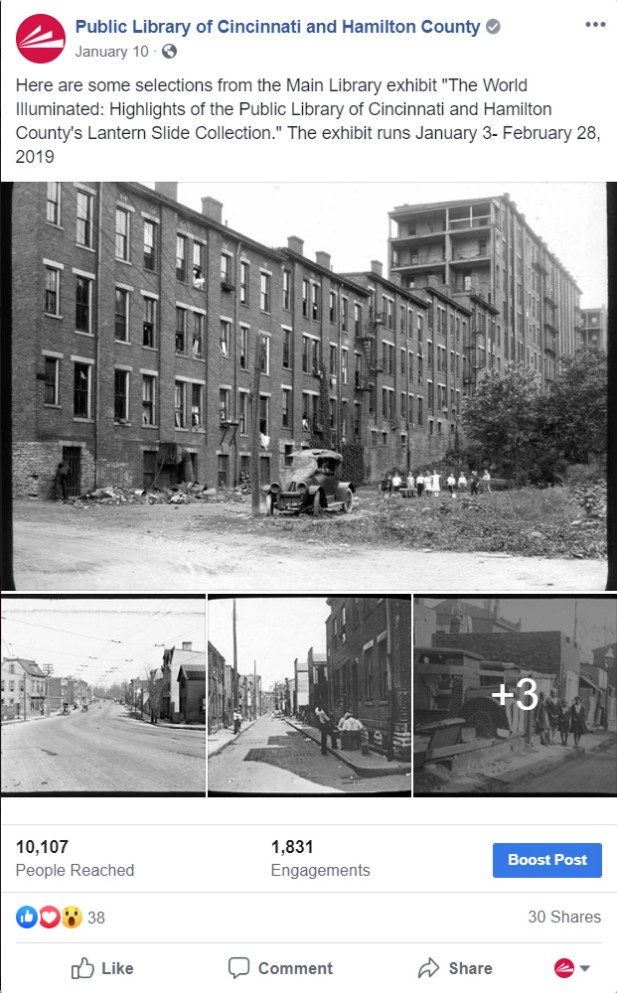
Here’s an example: Earlier this year, my library put a collection of lantern slides on display as part of a specially curated exhibit. These slides were part of our collection. They’d been sitting in a dark storage area for ages.

We do a lot of exhibits at our library, and most feature interesting pieces of our collection. But this one felt special. The librarians who discovered and arranged the slides were psyched. Their managers were psyched. I ran the exhibit idea past some non-library friends to see how they’d react. They used words like “cool”, “unusual”, “interesting,” and “vintage” in describing why they’d want to see the collection.

I decided to promote the exhibit with just four tactics: a press release, posters, wayfaring signage, and social media posts shared with lovers of vintage stuff. I did not promote the exhibit with a slide on the library’s homepage. I did not send an eblast. I did not create digital signage. I did not create a video.

I made these decisions based on my imagined persona of an exhibit guest. They would be a reader of traditional news. They would be someone who like vintage collection items and photos online. They would be someone who might take the time to read printed sign as they walked into the front door of the library.

In the end, the four tactics we chose to use worked well because we spent our time and energy making them really, really good. They fit the target audience. We focused on the content, not the container. We got a ton of press coverage and our social media posts did better than I expected, particularly on Facebook.

Creating four really good pieces of promotion is more effective than creating ten crappy pieces. That’s why choosing the tactics to fit your promotion is important.

Step #3: Leave room in your calendar to remind your cardholders about the services and items they love but might not use daily.

Here’s a good example. My library has a reading recommendation service called Book Hookup. Our cardholders answer three simple questions and they get three reading recommendations back in whatever format they prefer–print, eBooks, or audiobooks. These recommendations are personally selected by a librarian.

I do two campaigns promoting this service every year. I must remind people that it exists because it’s not a service our cardholders use every day. But, those promotions are consistently so successful that, before the promotions begin, we have to assign extra staff to manage the recommendations. That’s because so many people will sign up for personalized reading recommendations through our promotions that we can’t keep up!

Your library has a lot of services that will help people in their everyday lives. Work those into your editorial calendar on a regular basis, even if no one is telling you directly to promote them, particularly if those services are tied to your library’s overall strategy. Your library will thank you.

Step #4: Be flexible. You will want to program blank spaces into your editorial calendar for last-minute promotions. Those holes give you space to make decisions that positively impact your library and your cardholders. And if you don’t end up having anything to fill those holes, they still have a benefit. Space in your calendar will give you and your team time to breathe!

Subscribe to this blog and you’ll receive an email every time I post. To do that, click on “Follow” button in the bottom left-hand corner of the page. Connect with me on Twitter, Instagram, and LinkedIn.  

Part One of the Library Marketer’s Definitive Guide to Creating an Editorial Calendar That Actually Works!

I don’t know about you, but I spend the majority of my day as a library marketer making decisions. I answer probably two dozen or more questions a day from co-workers, staff, and friends about everything from the title of our library’s next blog post to the photo used in an email campaign to the kind of swag we give out at library events. This may be why my poor husband often has to choose the restaurant when we go out to eat. By the end of the day, I’m tired of making decisions!

Library marketing often feels like air traffic control. So how can a library marketer work effectively without losing their ever-loving mind? Organization, my friends. And the best way to get organized is to live and die by a working editorial calendar.

An editorial calendar will define and control the process of creating content, from the creation of an idea through writing and publication. A good editorial calendar will help you decide which content ideas to publish, where to publish, and when to publish. After those decisions are made, the editorial calendar will help you assign tasks and keep up to date on deadlines.

The editorial calendar is literally the heart and soul of the library marketer. Mine is open all the time, as long as I’m at work at my desk. It’s a score card, to-do list, and road map all rolled into one. Without it, I’d be lost.

A number of readers have asked me how they can create an editorial calendar that will lead to effective marketing. I’ve broken it up into two parts. First, let’s go through the steps to setting yourself up for success by funneling your team and tasks into one tool. You need to pick the tool, define your process, and learn how to work your calendar in your role as the project manager.

The Library Marketer’s Definitive Guide to Creating an Editorial Calendar, Part One: How to Pick Your Tool and Use It

Step #1: You need a tool that will help you keep track of everything… and I mean everything! You should consolidate all of your team’s tasks into one place. That means anyone who has anything to do with creating content for your blog, social media, video, email, print, press release, digital signage, or newsletters is on the same tool.

The one tool approach will help everyone to know where each promotion is at any given time. It will also help to maintain a consistent voice and message throughout all of your marketing. Working off the same tool will also maximize the effective use of every piece of content. The one tool approach will also help you, as project manager, to minimize overlap and mistakes.

Set expectations with your team early. Tell them you’ll do your best to pick the right tool for your team. Then make it clear that there will come a point at which everyone will be expected to have transitioned to the new tool.

Step #2: Get your team involved in picking your tool. First, you’ll want to explore how the new system will make their jobs and their lives easier. You can do this by asking your team to list the problems they have right now with content creation. Then, ask them to prioritize them. Which problems cost your team the most time and energy?

How to create an editorial calendar in Google Calendar

Marketing Strategy Bundle from CoSchedule (includes editorial calendar)

Free Excel Spreadsheet-based templates from Smartsheet

Step #3: Enforce compliance. Once you pick the right tool for your team, you have to delete all your other calendars and tools. I’m not being harsh. Your team may need that extra push to use one tool. And it’s likely there may be someone on your team who doesn’t like whatever tool you end up choosing. You cannot allow them to go rogue. In order for this to work, everyone has to use the same base.

Step #4: Make checking your editorial calendar a part of your daily ritual. As the project manager, your job will be to keep everyone on track using your new tool. Some days, this task will take five minutes. Some days it will take longer.

I add promotions into my calendar as soon as I learn about them. I have some promotions planned six months in advance. Advance planning helps me to visualize the promotions I’m doing and make sure everything gets the proper attention it needs. I can still be flexible and change things around as needed. But if I know what my marketing will look like in October during the month of July, I’ll have a better chance of getting everything done in time. That also gives me time to think about what’s coming up and to work on creative and innovative ideas to make those promotions better.

Step #5: Leave plenty of room for data. Measure the results of your content so you can adjust the editorial calendar and improve the effectiveness of future promotions.

Analytics should drive most of the decisions in your editorial calendar. I say most because I believe analytics should be responsible for 75 percent of the decisions. The other 25 percent is experimentation, gut instinct, and a deep knowledge of your audience.

Measuring results has two benefits: It helps you to decide what to do and it helps you decide what to drop. If you find a particular content subject or format isn’t getting the results you want for your library, you have data to back up your decision to drop it. Likewise, when something is working well, you can use data to reinforce your decision to that thing more often!

Read this next!

Part Two of the Library Marketer’s Definitive Guide to Creating an Editorial Calendar That Actually Works!

Subscribe to this blog and you’ll receive an email every time I post. To do that, click on “Follow” button in the bottom left-hand corner of the page. Connect with me on Twitter, Instagram, and LinkedIn.  
The Step-by-Step Method for Figuring Out the Best Time to Send Library Marketing Emails and Why You Should Never Stop Experimenting!

I spend a good portion of my day as a library marketer trying to figure out how my cardholders live their lives. What do they do? When to they do it? What parts of their life are difficult? What parts are enjoyable? When do they have free time?

We do know a lot about the people who use the library, thanks to our own library surveys and great organizations like Pew Research Center. But you can also figure out what your cardholders are doing by email marketing experimentation. And your findings can increase the effectiveness of your marketing.

On the Library Marketing Live Instagram show, Dari from Cook Memorial Public Library District wanted to know how to figure out the best time to schedule marketing email to different audiences. The answer, in general terms, is between 6 p.m. and midnight. But I want to dive a little deeper into how I came to this conclusion and why this might NOT be the case for the people using your library!

If you’re just starting out with email marketing, check with the experts. There are a lot of companies (mostly email marketing software companies) which publish research on the best time of day and the best day of the week to send marketing emails, plus a bunch of other data points. So, start by gathering the latest research from these companies. Some of my favorites are Hubspot, AWeber, and Convertful.

Think about the daily life of your cardholder. If you are sending an email to a group of people who use a particular branch, or who are in a particular age group, try to imagine what they do all day. This generalization method will help you identify points in the day in which your target audience might have time to check their email.

Here’s an example: When I’m sending emails to parents of school-age children, I avoid 7 a.m. to 9 a.m., when parents are usually racing to get their kids ready to go to school. I also avoid 2:30 p.m. to dinner time, because many parents are picking up their kids, running them to extra-curriculars, and tackling homework.  I send marketing emails very early in the morning, like 5 a.m., so they are sitting in their inbox when they wake up but before their kids are up. I also send them after 8 p.m. when most school-age kids are in bed.

When I send emails to teenagers, I never, ever, ever send them in the morning. I exclusively email teenagers at night, and the later the better. That’s because most teens don’t have time to relax until 9:30 p.m. or later, after homework and after-school activities. They will likely check their email right before they fall to sleep at night, and they’re more likely to act on email in the late evenings.

Experiment. Send emails for a 3-6 months period of time. If you’re just starting out, try all hours of the day and night. Keep meticulous records of the results including open, click through, and conversion rates on all your emails.

After your allotted experimentation time, comb through the data and figure out which times of day resulted in the most click-throughs and conversions. Those are your optimum times to send emails! Focus most of your email scheduling on your proven best time of day.

And never stop experimenting. Start another experimentation period of 3-6 months, and then re-analyze data. If you notice a decline in click-through and conversion rates, go back to the drawing board.

My latest six-month analysis shows the best time to send email is between 6 p.m. and midnight, for all age categories and for all card types. This was not always the case. Two years ago, I could send my emails any time of the day EXCEPT between 7 a.m. and noon. But, at the end of 2018, that changed and the only emails that did well were the ones I sent at night.

Why did the effective time change? Because people’s lives change. Your cardholder base changes. The way that email gets delivered by various email providers changes. All of these factors mean that you’ll need to be in a constant state of experimentation. Don’t get married to any one time of day. Have an open mind and be ready to change your email scheduling strategy when the data tells you it’s time to change.

The most important thing is to have good content. If your emails contain stuff that your email audience wants to know about, they will engage with them, no matter what time of day it is. Try and keep your emails short. Focus on a few lines of really compelling text and one or two clear calls to action.

Bonus controversial opinion: I am not a fan of email newsletters. They usually contain too much information and too many calls to action. Their subject matter is usually too broad for their audience. I know a lot of us have to send them because senior leaders love them. But they aren’t an efficient use of email marketing. It would be better to take each section of your newsletter and send it separately to a targeted audience.

Don’t forget to join us for the LIVE LIBRARY MARKETING TALK ON INSTAGRAM every Tuesday at noon ET. We’ll talk about library marketing topics for about 20 minutes each week. My handle is Webmastergirl. You can email questions and topic suggestions ahead of time. Just fill out this form.

Subscribe to this blog and you’ll receive an email every time I post. To do that, click on “Follow” button in the bottom left-hand corner of the page. Connect with me on Twitter, Instagram, and LinkedIn.  

Four Sneaky Ideas to Insert Marketing Tactics Into Your Everyday Work as a Librarian

I need your help! In a few weeks, I’m giving a short online seminar to library directors about marketing! I have 15 minutes to convince them to throw their full support behind library marketing. I really want this talk to impact the way library directors think about your work. So… please let me know what you want library directors to know about library marketing. Fill out the form before you even read this post. It’s anonymous! Thank you!

← Back

Thank you for your response. ✨

Librarians are busy folks. You’re on the front lines, trying to work with cardholders and community members. You’re looking up information. You’re connecting people with social service resources. You’re filling out paperwork, creating curriculum for story time, and putting up displays. And you’re doing about 100 other things that I don’t know about because I’m not a librarian.

I worry about how much libraries lean on librarians to do their own marketing. Senior staff might believe spending money to hire staff for marketing is not a good use of their limited funds. But it’s not good for the librarians and it’s not good for the library.

I also can’t change the world in one blog post. What I can do is help the librarians in my readership to strategize to make marketing part of their regular duties. Here are four things that you can do that are already part of your job. These are marketing tactics, though you may not have thought of them that way before!

Merchandising. Merchandising is a form of marketing that focuses on presenting the items in your branch in the way that will compel people to interact with them. Every display, every sign, every decision on the arrangement space in your branch is a chance to market your library.

I know that the decision many libraries made to switch from using the Dewey Decimal system to a more categorized approach for arranging items pains library purists. But it pays off.  Library visitors are accustomed to browsing in stores by categories. By mimicking that display effect, libraries make it easier for people to find the items they want and need. We want to be as easy to use (or easier) than our for-profit competitors.

It’s a time-consuming process but I’ve put merchandising first on this list because it is the most important and impactful way that librarians can market their branch. If you haven’t thought about re-arranging the materials in your branch, now is a great time to start. And to get some help, I recommend the slides from a presentation from Allison Fiscus of the Toledo Lucas County Public Library. She recently did an online seminar. Her presentation includes data that shows how merchandising positively effects the customer experience. She included a lot of visuals to help you understand her concepts. You can find them here.

Exceptional customer service. A lot of big brands have focused on improving customer service as a marketing tactic. If you are working on the front-line of your library, you have a unique opportunity to interact with cardholders.

The marketing buzz phrase for doing this is “surprise and delight.” We want to surprise our cardholders with service that exceeds their expectations. When we do that, they feel delighted with us! (Isn’t that just a sunny thought?) Delighted cardholders are more likely to spread the word to their friends and family about our system and the services we provide. They may be compelled to talk about us positively on social media, give us great reviews on Google Business, and support our work through donations or volunteerism. These are all marketing wins!

Good customer service is a competitive edge for libraries. If we can create an environment of inclusive and open access where people truly feel supported and cared for, we’ll have the clear advantage over for-profit competitors. One-on-one help is time-consuming, but it will pay off. We’ll build a reputation as a warm and inviting space. When’s the last time you heard Amazon or Best Buy described in those terms?

Library staff must make the commitment to provide good customer service. It’s not a skill that comes naturally to everyone. To help you, I love this free guide from Hubspot. It’s got templates and a ton of great information that you can use to improve your own customer service skills.

I also recommend you read this interview with Dan Gingiss, an expert at customer service. He’s written a great book with tips about customer service in social media and his interview has lots of ideas for improving library customer service to make our industry more competitive.

Word of mouth promotion. I get a lot of requests from librarians in my system who want our marketing department to promote their event or service. Posters and emails and fliers work, but the most effective method of marketing, in my experience, is word of mouth. You need to be telling your cardholders about your branch, events, and services. Talk to them!

Librarians are in a better position to sell people on their services and events than a for-profit business. That’s because you are a trusted member of the community. Librarians are admired and your opinions are valued more than the average person. Use that advantage to help “sell” the things that your branch offers!

I know word of mouth promotion seems time-consuming.  But consider this. Data tells us that you have to get your message in front of your cardholder an average of SEVEN TIMES before they’ll be compelled to act on it. But when you have a direct conversation with a cardholder about your library, you are making a compelling and personal case. 75 percent of people don’t believe the advertisements they read but 92 percent believe brand recommendations they receive from trusted sources. Librarians are trusted! So just talk to people.

Sharing on your personal social media. Yes, you should be sharing posts from your library’s social media channels on your own personal channel. There’s no right or wrong way to do it. Just pick the promotions you feel most personally passionate about. Hit the “share” button and add a line about why this particular event or service is meaningful to you.

Your recommendations are trusted because of your position. It’s not unethical to share your employer’s promotional social posts. I know you feel passionate about the work your library is doing. Don’t be shy. Share your enthusiasm!

Subscribe to this blog and you’ll receive an email every time I post. To do that, click on “Follow” button in the bottom left-hand corner of the page. Connect with me on Twitter, Instagram, and LinkedIn.  

A WordPress.com Website.

Up ↑