Search

Super Library Marketing: Practical Tips and Ideas for Library Promotion

Tag

marketing libraries

Automated Email Marketing Is a Time Saver for Your Library but It May Also Be a Terrible Experience for Your Patrons! Here Are the Pros and Cons.

Photo courtesy Cincinnati and Hamilton County Public Library

My maternal grandfather was small (he stood about 5 feet 3 inches tall) but mighty.

He returned from World War Two to a wife and four children. He made ends meet by farming, driving a milk delivery truck, and working on a road construction crew. He taught me to build fences, crack walnuts with a vise, and drive a tractor and a car.
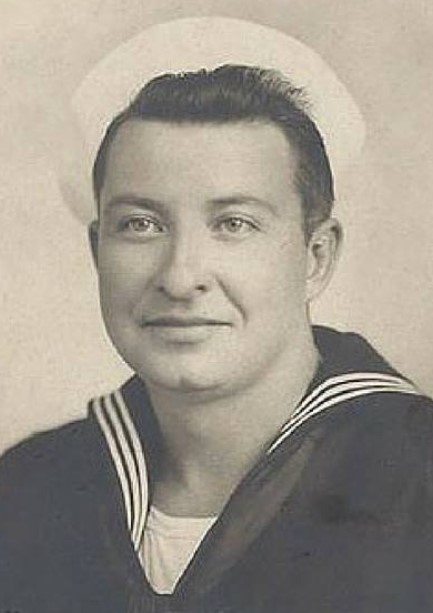
My grandfather

When he died in 2016, I decided I wanted a bouquet of flowers at the funeral as a symbol of all that he meant to me. I ordered an arrangement online.

Imagine my surprise when a few months ago, I received this email.
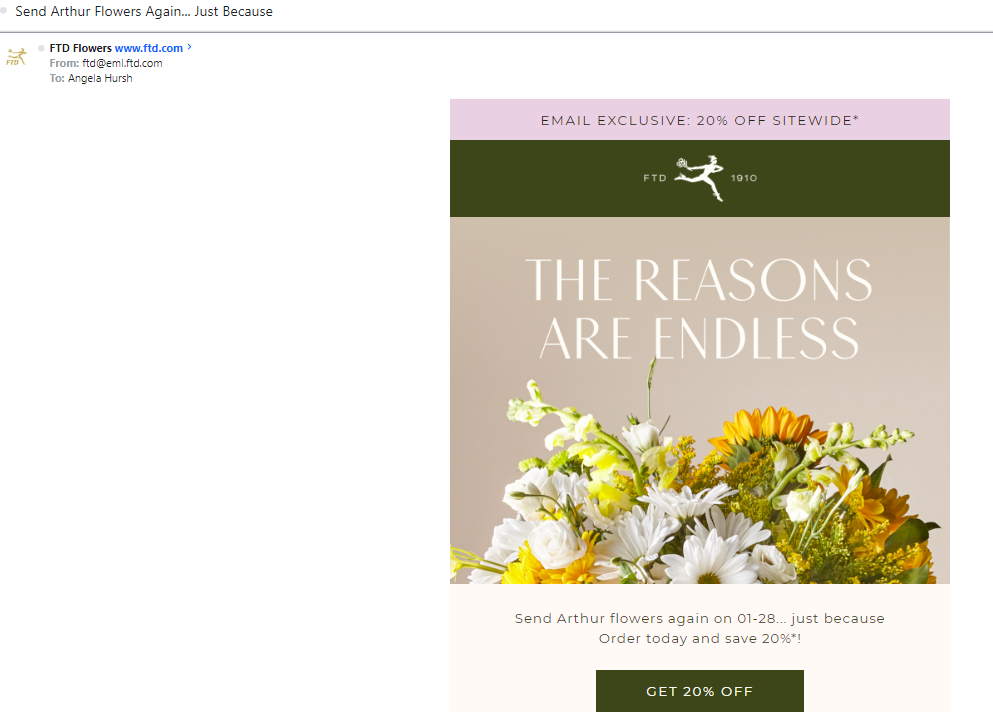
A screenshot of an email showing a photo of flowers and the tagline, "The reasons are endless" urging me to send flowers to my grandfather again, "just because."

I admit, at first, I was shocked and baffled. But I work in marketing, so I understand this email was created using automation. And then, this email made me think about the pros and cons of automation for library email marketing.

The advantages of email automation

Automated email has one big advantage for library staff: It saves time.

Automated onboarding emails, reading suggestions, and program announcements will free up your time for other work. You can create a campaign, set it, and forget it.

Experts also say that open and click rates are higher for automated emails because they are more relevant to the recipient. 

The disadvantage of email automation

There is one big problem with automated emails, in my opinion. The personalization isnโ€™t personal. Itโ€™s inauthentic. And there’s a chance it can go very, very wrong.

The email from the flower company is a perfect example. It has negatively impacted my feelings toward the flower company. If they really cared about me, and not just my business, they would have looked to see that I’d sent flowers to a funeral home. And they wouldn’t have tried to sell me another bouquet to send to my dead grandfather.

Here’s how this snafu relates to library marketing: Most automated email programs created for libraries automatically segment your audience into groups based on factors like previous card use. Those programs use algorithms that look at past card usage or reading history to predict future behavior.

But, as happened with the flower company, those algorithms are not always correct. They donโ€™t allow for changing tastes or lived experiences. And they wonโ€™t expand a cardholderโ€™s use of the library by introducing them to new services.

The bottom line is that past library card usage does not always predict future library card use.

For example, in the last year, my library card use has changed drastically. Iโ€™ve switched from mainly print fiction books to audiobooks. Iโ€™m now a heavy user of downloadable magazines. Iโ€™ve also recently discovered the joy of using my library card to read newspapers online (goodbye paywall!). And Iโ€™ve used my libraryโ€™s Makerspace several times this year.

My life and my habits have changed. But, my home library, which uses automated email, has not sent me any emails that show theyโ€™ve noticed my changing habits. They send emails based on my pre-pandemic use of the library.

What do libraries do best? Personalized service!

Libraries donโ€™t focus on transactions. We donโ€™t rush our visitors. We listen and work until we get them the answer or the service that best solves their problem.

This is particularly true when it comes to book recommendations.

A readerโ€™s interests are never set for life. And the things that are interesting about a bookโ€”the tone, pace, setting, and characters, cannot be managed by an algorithm. Reading suggestions and collection marketing canโ€™t be replicated by robots.

So, as library marketers, we must be cautious to balance our need to save time, with the need to create a connection with our readers. And that means, if you use automated email marketing, you must always be evaluating the emails your library sends.

Ask yourself: Is this email serving my recipient with the content they want and need?

Two more potential pitfalls of automated email marketing

Irrelevant automated emails may be marked as spam by your recipients, hurting your sender reputation. Read more about how that can impact whether your email gets delivered to your recipients here.

Many programs that offer automated emails donโ€™t allow you to add design elements that are specific to libraries. And that can be detrimental to your library’s brand. You want your community to recognize the promotional materials you make, including emails.

The advantages of manual email marketing

Good patron experience means that you encourage your email recipients to choose the content they want to receive from the library.

Your library should make your emails opt-in. This ensures your emails go to community members who want your content, which protects your sender reputation.

The opt-in model allows you to add the content to your emails your audiences have indicated they are interested in, giving your recipients control over what they receive. It also allows for flexibility to account for changing use and taste.

Finally, opt-in emails allow you to send when itโ€™s best for your users, not for your library. All email programs offer scheduling. When you schedule your own emails, you can look at reports to see when your target audience responds best to your emails. You can adjust accordingly.

The disadvantage of manual email marketing

Time is the number one disadvantage of programs that require you to create emails manually. It takes precious time to write copy, choose images, and schedule your emails.

So, next week on Super Library Marketing: Time-saving techniques for creating library marketing emails. These tips will work whether your library chooses automated or manual email marketing!


P.S. You might also find this helpful

4 Simple Ways You Probably Havenโ€™t Thought of To Boost Signups to Your Libraryโ€™s Email Newsletter 

Subscribe to this blog and youโ€™ll receive an email whenever I post. To do that, enter your email address and click on the โ€œFollowโ€ button in the lower left-hand corner of the page. You can also follow me on the following social media platforms:
Google Ad Grants Improve Your Libraryโ€™s Chances of Being Found in Search: How To Apply and Manage This Incredible Opportunity

Photo courtesy Cincinnati and Hamilton County Public Library

Five years ago, I was listening to an episode of a library podcast about Google Ad Grants, which offers $10,000 monthly advertising credit to qualified nonprofits. Thousands of nonprofits use the program. You apply once, and the grant continues indefinitely.

Wow!

Many libraries have taken advantage of this program since it was launched in 2004. Some of those libraries collaborate with a company called Koios, currently run by Maggie Carson and Peter Velikonja.

Koios is a member of Googleโ€™s Certified Ad Grant Professionals group, which has been vetted by Google to manage ad grants. It is the only member of this group specializing in public libraries.

Koios has successfully applied for and managed Google Ad Grants for public libraries since 2017. That grant money has been used to promote catalog items, educational resources, passport services, business and career resources, summer reading programs, and more.

โ€œLibrary marketing professionals know that different online audiences are reached in different ways,โ€ says Peter. โ€œAdvertising with Google reaches everyone. That makes it the best way to reach new people, including, critically, the underserved.โ€ 

Peter says paid search using a Google Ad Grant may represent 25 percent or more of a libraryโ€™s overall website traffic, depending on the size of the libraryโ€™s service population.

โ€œAds appear at the top of search results โ€“ where they are most likely to be seen,โ€ explains Peter. โ€œSince libraries are trusted institutions, people are more likely to click on an ad for a library than a commercial ad.โ€

โ€œAt an average of $2 to $3 per click, a library can potentially bring about 4,000 visitors per month to its website, mostly new people who were not necessarily thinking of a library but were searching for something. It presents a library with an opportunity to show up at the right time with the right information, to the right person.โ€

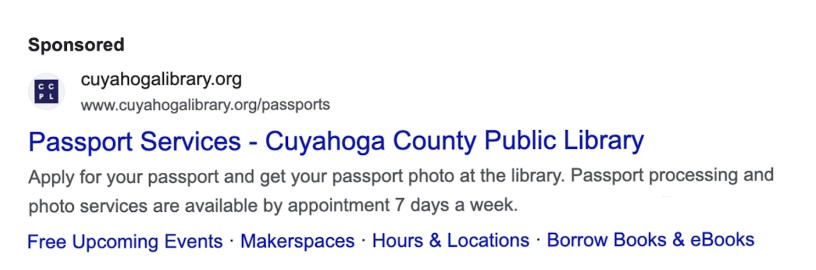
A sample Google ad for Passport Services at Cuyahoga County Public Library in Ohio.

And what does Google get out of this deal?

โ€œGoogleโ€™s primary motivation, we believe, is to perform a social good by helping nonprofits,โ€ says Maggie. โ€œBut the program also helps Google fill unused advertising space. Itโ€™s like having an empty billboard โ€“ better to put something up for free than to leave it blank and potentially leave the impression that the space is not valued.”

A library can apply online here.

โ€œFirst, you create a Google for Nonprofits account,โ€ explains Maggie. โ€œGoogle will verify your foundation or friend’s group nonprofit status through their partnering organization, Percent, after which you can submit an Ad Grants application. The process generally takes a couple of days or a week. For libraries that would like help applying, Koios will gladly guide you for free.”

Google Ad Grants are not competitive grants, but there are some details and requirements to be aware of.

โ€œNonprofits with 501(c)3 status are eligible, so a library should apply through their Friends or Foundation,โ€ suggests Maggie. โ€œGoogle will also review the libraryโ€™s website for quality and security issues; it will reject websites that are not https-enabled or do not meet their quality standards.โ€

Once a library is accepted, someone from the library will need to do ongoing research and keep up to date on compliance.

โ€œGoogleโ€™s policies require active management of advertising accounts, which means they expect you to check the account at least once per month,โ€ explains Maggie. โ€œGoogle has a set of policies to follow, and they regularly issue updates to these policies or create new ones.โ€

According to Peter, it takes some ingenuity and persistence to get the full value from an Ad Grant. Google says the average spent is only 17 percent of the full value of the grant. Google does offer some automated options for account management, which may be the best choice for busy staff. Koios can also manage the grant.

โ€œFirst, we apply for an Ad Grant on behalf of a public library,โ€ says Peter. โ€œIt is not complicated, but we have experience working out glitches that may come up in the application process.โ€

โ€œThen we set up the Google Ads account that comes with the grant โ€“ we do all that for free because we want libraries to use the resource, whether we are involved or not. After that, a library can manage the account themselves, or we can do it for a yearly fee.โ€

โ€œMost libraries choose to have us manage the account because we can exercise it more fully. We promote a libraryโ€™s online catalog, which contains hundreds of thousands of terms and concepts that can match the words and phrases people search for. Itโ€™s a sort of Big Data capability libraries donโ€™t usually have.โ€

Topeka & Shawnee County Public Library GA4 Web Traffic Acquisition Data, March 2024

Like most library vendors, Koios prices its services by the size of a libraryโ€™s service population.

โ€œGiven the potential of receiving up to $120,000 per year in advertising credit, our subscription fee presents an excellent return on investment,โ€ declares Maggie.

A screenshot of the Koios member dashboard for Barrie Public Library in Ontario, Canada, showing a 30-day view of 18 active campaigns.

If youโ€™re interested in learning more about Koios and Google Ad Grants, email Maggie and Peter at info@koios.co.


P.S. You might also find this helpful

The Clever yet Simple Trick One Library Marketer Uses To Remind Her Community of All Her Library Offers Every Day of the Year!

Subscribe to this blog and youโ€™ll receive an email whenever I post. To do that, enter your email address and click on the โ€œFollowโ€ button in the lower left-hand corner of the page. You can also follow me on the following social media platforms:

How To Create a Marketing Plan for an Entire Year Even if Your Libraryโ€™s Strategic Plan Sucks or Is Non-Existent!

Photo courtesy Cincinnati and Hamilton County Public Library

This week, Iโ€™ll be able to see the worldโ€™s largest bottle of catsup. (Ketchup? Catsup? Is there a difference?)

When I learned that Iโ€™d be speaking at Reaching Forward South in Collinsville, Illinois, I Googled the area. Thatโ€™s how I discovered the city is home to a 170-foot water tower shaped like a catsup bottle that just happens to be on the National Registry of Historic Places. Itโ€™s even got its own website and fan club.

If youโ€™re like me, you do some strategic planning when you go on a trip. You decide to rent a vehicle or research public transportation. You purchase airline or train tickets and book a hotel. You pick restaurants to sample and decide which tourist attractions you’ll visit.

Some people just land in a city and let fates carry them where they may. (No shade from me. You do you!) I prefer planning because I donโ€™t want to risk seeing or experiencing the best the area has to offer.

A plan, on vacation or in the library, sets clear goals and outcomes. It ensures your time, money, and energy are spent on the most valuable things. It gives you direction and purpose.

Marketing for a library works best when the promotions are tied to a library’s overall strategic plan. But that’s not always as easy as it sounds.

What is the difference between a strategic plan and a marketing plan?

A strategic plan defines targets and objectives for the entire library organization, including facilities, human resources, reader services, youth services, outreach, and more.

A marketing plan outlines your initiatives to support your libraryโ€™s strategic plan. It clearly defines the collection items, programs, and services youโ€™ll promote, who youโ€™ll target, and how youโ€™ll target them to reach your library’s overall goals.

In a perfect world, every library would have a strategic plan with clearly defined objectives and goals that are specific, measurable, actionable, relevant, and timely (SMART).

But…

If your library lacks a strategic plan, has a strategic plan that’s very vague without clear goals, or is in the middle of creating one (that can be a lengthy process), you may feel stuck and directionless. How do you know what you should be promoting?

What to do when you have very little direction

You can ask your library director or board of directors what they want to accomplish. Without a strategic plan as a guide, you must understand the director’s and the board’s goals.

Even basic statements like “We want to increase program attendance by 25 percent” or “We want to make sure every child has a library card” will guide your marketing.

If you don’t feel comfortable approaching senior leadership, ask your supervisor to step in. Stress the importance of a cohesive plan for moving forward in all areas of your library. This really is the cornerstone of your work.

Once you know the goals of your library, itโ€™s time to create your marketing plan. 

Step 1: Define your marketing goals. 

Lay out exactly how youโ€™ll help those overall library goals be reached.

For example, letโ€™s say your library has a goal to partner with schools to ensure all third graders in your town are reading at grade level. Your marketing goal might be:

Increase the participation in our library’s 3rd-grade reading program by 25 percent within the next 12 months, as measured by the number of 3rd-grade students enrolled and actively engaging with the program materials and resources.

Step 2: Write down what you know about the community you serve.

Marketers call this a โ€œsituation analysis.โ€ This will give you a starting point for your strategy.ย Ask yourself:

  • What does your typical cardholder do with their card?
  • Where do they live?
  • How do they view your competitors?
  • How does your library currently fulfill a unique position in your community?

Step 3: Create a list of all your tactics and assets. 

Write down all the channels you use to promote your library. This list should include everyย social media platform you use, every website your library owns, and every print publication you send out, plus emails, print collateral, influencers, in-person events, press releases, podcasts, and videos.

Step 4: Set goals for each tactic and asset. 

Letโ€™s say one of your goals is to make sure job seekers in your community use career resources at the library. And letโ€™s say you have a print newsletter that you send every quarter to all the residents of your community.

Look at the specific marketing goal you created in step one. Underneath that, you might write:

โ€œIn each issue of our newsletter, we will feature a cardholder who used our libraryโ€™s services to advance their own career, such as by taking our GED course or using our online job resume builder. Weโ€™ll do at least one story on library work as a career. Every quarter, weโ€™ll highlight a service or program that will help our cardholders reach their career goals.โ€

Step 5: Populate an editorial calendar for the next 12 months.   

Now itโ€™s time to plan content topics and themes for each month that will work to reach your goals. Planning a calendar for a full year makes it easy to coordinate promotions across channels. And it will help your supervisor and coworkers to understand what you’ll be doing, when, and why.

You may end up moving things around as you go through the year. That’s okay!

Step 6:  Measure success and failure. 

Accurately document the results of every promotion you do. This will help you to adjust your strategy next year.

Sometimes you wonโ€™t have a clear understanding of whatโ€™s working and whatโ€™s not working until you see the actual results in numbers on a paper in front of your nose.

One final note of encouragement

Don’t be discouraged if you don’t reach all of your goals. Marketing is an experiment. Sometimes the stuff you do will work, sometimes it wonโ€™t. Donโ€™t repeat the things that donโ€™t work! Spend more energy on the things that do work.


P.S. You might also find this helpful

Branding for Your Library: Stand Out From the Crowd With Smart, Strategic Placement of Your Brand

Subscribe to this blog and youโ€™ll receive an email whenever I post. To do that, enter your email address and click on the โ€œFollowโ€ button in the lower left-hand corner of the page. You can also follow me on the following social media platforms:


The Clever yet Simple Trick One Library Marketer Uses To Remind Her Community of All Her Library Offers Every Day of the Year!

Photo courtesy Cincinnati and Hamilton County Public Library

When Donna Forbis graduated from the 8th grade, her parents gifted her a 10-speed bike. Her mother decided she was old enough to ride to the Peoria Public Library‘s Lakeview branch.ย 

โ€œBack then, kids were not allowed in the adult stacks, so I was limited to my โ€˜sideโ€™ of the library,โ€ remembers Donna. โ€œI was very short (under 5′ tall), so even as a teen, I still looked like a kid. My ventures into the adult stacks would sometimes draw โ€˜looksโ€™ from other patrons, but the library staff knew I was in search of mysteries I had not yet read!โ€

Donnaโ€™s love of the library never abated. She now works for the Illinois Prairie District Public Library. The library is small, with rural and suburban areas covering a service population of about 25,000 residents.

โ€œWe have fewer than 25 staff members (including our Director) servicing our six branches,โ€ explains Donna. โ€œMany staff members do double- or sometimes triple-duty.โ€

โ€œMy official title is Marketing & Events Coordinator, but I am also the branch manager for our Germantown Hills branch. I oversee all adult programming at our branches, and I coordinate with our Youth Services Librarian/Assistant Director on teen programming. I am responsible for creating nearly all of our promotional materials.ย What I don’t generate myself is usually shared with me to make sure it fits our style and brand before being shared with the world.โ€

It’s a lot of work, and Donnaโ€™s library still struggles to reach community members, especially regarding their programs and events. But Donnaโ€™s library is doing something that seems old-school yet innovative: A wall calendar!

โ€œThe idea for the wall calendar came from our Director,โ€ explains Donna. โ€œSeveral area outlets like banks and stores used to offer free wall calendars to their customers, but the practice has dropped off in recent years. While the world might be more comfortable with digital calendars, many patrons still want a wall calendar. Since the banks were not offering free calendars anymore, we decided to fill that void.โ€

โ€œWith a wall calendar, we can promote the library every day for a full year inside our patronsโ€™ homes. We want our patrons to think of us as their go-to for research and resources, educational and entertainment opportunities, and a central community gathering spot. The calendar is a daily reminder that we are here for our neighbors.โ€

Donna and the rest of the library staff spent about three months working on the format and layout for the 8.5″ x 11″ wall calendar.

โ€œThe first version was nothing more than a stack of stapled papers, with notes on each page of a suggested layout,โ€ recalls Donna. โ€œThen I created an initial mock-up of the calendar in MS Publisher and shared it with our Director for critique. From her feedback, I shifted some photos around, added, and subtracted date-specific holidays, and determined what other information we wanted to include.โ€

โ€œOne topic of discussion was whether to have the library info pages at the beginning of the calendar or the end. My logic was, that if the info pages were at the end, behind the December calendar, they would be accessible to users all year long without taking the calendar off the wall.โ€  

The final calendar is a mix of fun content and library news. You can see it here.

โ€œOur calendar is set up to highlight our branches, reading challenges, and some of our evergreen programming,โ€ says Donna. โ€œWe also provide ways to connect with the library through a page filled with links and QR codes to get to our website, catalog, calendar, reading challenge platform, and social media channels.โ€

The library printed 725 copies and distributed them beginning the week before Christmas. Calendars were available at each branch and through some of the libraryโ€™s community partners, including nursing homes and daycare centers.

Donna also promoted the availability of the calendars through the libraryโ€™s regular marketing channels. And until just a few weeks ago, she posted a notice of the calendarโ€™s availability in every library email newsletter. They managed to hand out nearly all their copies.

โ€œWe are very pleased with how it came out, and our patrons have been very appreciative,โ€ remarks Donna. โ€œWhen looking at it from a cost-benefit analysis, we spent a little under $2300 (plus shipping) for the calendars. That equates to roughly $200 per month in advertising spread across our community for a full year. And it is in a form that our patrons want and need. Even on a tight marketing budget, the expense was worth it.โ€

If Donna does the calendar again for 2025, she says sheโ€™ll have the final design done by Thanksgiving, so patrons have a longer window of time to pick one up.

And where will her next great library marketing idea come from?

โ€œInspiration can come from anywhere,โ€ declares Donna. โ€œI maintain connections with other library marketers through the Library Marketing Book Club, the regional Heart of Illinois Library Marketing networking group, and professional groups like the Illinois Library Association’s Marketing Forum.โ€

โ€œOne of my all-time favorite pieces of library marketing came from the Invercargill (New Zealand) City Library back in 2017, which was 2 years before I became a library marketer! They did a parody of a Hollywood Reporter magazine cover featuring the Kardashian clan at the height of their Keeping Up with the Kardashians fame. When I look at it today, I still laugh!โ€ย ย 

โ€œI keep an eye on what advertisers in other industries are doing through organizations like Adweek, HubSpot, and other marketing tracking organizations. If someone on one of those platforms is writing or commenting about a particular piece of advertising, it may be worth noting.โ€

โ€œAs far as other libraries go, I am awed daily by my peers! Because of my โ€˜solo marketerโ€™ limitations, whenever I see a library with a catchy video on TikTok, Reels, or Shorts, I am completely jealous! There are not enough hours in the day for me to learn how best to shoot and edit videos, get them uploaded, and do it regularly to build and maintain a following and get all my other stuff done!”

Donna has a piece of advice for anyone working on library marketing.

โ€œRegardless of the situation, whether you have a program or promotion you want to try, need money or materials, or anything else – If you don’t ask, the answer will always be โ€˜No.โ€™”ย  ย 

โ€œPeople generally want to be helpful and be of service, but often they don’t know the best way to do it.ย Tell others what you need and ask them for their help, and you might be surprised at the answer, even for the ‘impossible’ ask!โ€


P.S. You might also find this helpful

Whatโ€™s It Like To Promote a Library With a Non-Circulating Collection? Marketer at a Cultural Institution Takes Us Behind theย Scenes

Subscribe to this blog and youโ€™ll receive an email whenever I post. To do that, enter your email address and click on the โ€œFollowโ€ button in the lower left-hand corner of the page. You can also follow me on the following social media platforms:

Interviewing Techniques Anyone Can Use To Land a Powerful Quote for Your Libraryโ€™s Blog, Video, Social Media, or Press Release

Photo courtesy Cincinnati and Hamilton County Public Library

Interviewing a stranger about their library experience is intimidating for many people. If the thought of having an intentional conversation to elicit a sound bite you can use in a blog, video, social media post, press release, or other content sounds daunting, the post is for you.

Why a powerful quote is important.

Your audience wants to hear directly from the people impacted by your library’s work. Whether that is your staff, director, board members, or patrons, a good quote can drive home your work’s value.

A quote can convey passion or a strong point of view. It can turn a story about statistics or complicated concepts into something understandable and relatable. A quote can also establish an emotional connection with the reader or viewer.

And, if your goal is to catch the attention of local media, a good quote can make your press release, blog post, or email stand out. Because…

The media knows when your quote is fake.

I worked in a local television newsroom for nearly 20 years before I became a library marketer. And Iโ€™m here to tell youโ€ฆ journalists can tell when youโ€™ve made up a quote for a press release.

I understand why it happens. Your director or coworkers may tell you they trust you to put words in their mouths. It seems less time-consuming than doing an interview.

But the media can tell when youโ€™re making it up. Thatโ€™s why an interview, however short, is key to getting an authentic quote. So here are tips to make the interview process smooth and successful.

Prepare as much as possible.

If you are interviewing a co-worker, a board member, or the director of your library, take a few moments to see if there is any documentation that gives you clues about their background. Search their LinkedIn profile and board minutes. Do a Google search to see if theyโ€™ve ever done an interview. You may learn new facts about them and their speaking style.

Think about how you might structure your piece before you even write it.

That structure may lead you to questions to ask.

For example, readers may notice that I often start library profiles on this blog with some facts about my subjectโ€™s life before they worked in marketing. I ask people to tell me about their childhood library and their work before libraries, to build the scene and give a deep background on my subject. Use this technique for any interview leading to a blog post, social media post, or video.

If you are interviewing to get a quote for a press release, I suggest writing the press release before doing the interview. Leave spaces where a quote or two would grab the media’s attention and add context and emotion to the story youโ€™re trying to pitch. Now youโ€™re ready to write your questions.

Craft targeted questions that elicit insightful responses.

  • Use simple sentences and language.
  • Add intention to your questions. If you want someone to share a firsthand experience or observation, craft your sentence to gently lead your interviewee to that answer.
  • Ask open-ended questions. If you must ask a yes or no question, follow up with โ€œWhy?โ€ to give your subject the nudge to elaborate.
  • Still stuck? Use your tools. ChatGPT can help you craft questions for your interview.

To show how this works, I typed into ChatGPT: โ€œI am interviewing my library director about a new partnership that will help community members land a job or advance their careers. Can you give me some sample questions I might use to get a good quote?โ€

Here is the list of questions ChatGPT gave me.

  • Can you please provide an overview of the new partnership aimed at helping community members with job placement and career advancement?
  • What motivated the library to pursue this partnership?
  • How do you envision this partnership benefiting members of our community?
  • Could you elaborate on the specific resources or services that will be made available through this partnership?
  • In what ways will the library be collaborating with the partner organization to deliver these resources and services effectively?
  • How will the library measure the success of this partnership in terms of its impact on community members?
  • Are there any demographics or groups within the community that stand to benefit most from this initiative?
  • How does this partnership align with the library’s broader mission and goals?
  • Can you share any success stories or examples of how similar partnerships have been effective in other communities?
  • What steps will the library take to ensure that community members are aware of and can easily access the resources and services offered through this partnership?

That is a huge list! It’s a great start. All I would need to do is go through and tweak the questions to match the tone I want to set and to sound more like something I would say.

Now comes the fun part: the interview!

6 tips for conducting the interview

  • #1: Record the conversation.
  • #2: Talk a little about yourself to get the conversation started.
  • #3: Ask an easy first question to calm everyoneโ€™s nerves.
  • #4: Encourage elaboration on interesting points.
  • #5: Let the person talk. Donโ€™t be afraid of silence.
  • #6: Paraphrase or summarize key points to nudge the interviewee towards a quotable response.

P.S. You might also find this helpful

Library Marketer Shares Brilliant 4-Step Plan for Getting Press Coverage and Building Personal Relationships With Media

Subscribe to this blog and youโ€™ll receive an email whenever I post. To do that, enter your email address and click on the โ€œFollowโ€ button in the lower left-hand corner of the page. You can also follow me on the following social media platforms:

Whatโ€™s It Like To Promote a Library With a Non-Circulating Collection? Marketer at a Cultural Institution Takes Us Behind the Scenes

Photo courtesy Cincinnati and Hamilton County Public Library

Growing up in Columbia, Missouri, Lili Pangborn visited her local library nearly every day after school.

โ€œThe library staff quickly began to recognize me,โ€ recalls Lili. โ€œThey would offer to help me with homework or chat about whatever books I was reading at the time. I feel like this willingness to help others is common among library staff; libraries truly are a special place for community collaboration!โ€

Lili still spends nearly every day at the library. Sheโ€™s now the Communications Coordinator at the Newberry Library, a non-circulating research and cultural archive library in Chicago.

The library has a diverse collection of rare books, manuscripts, maps, and secondary literature that can help researchers interpret and understand original source materials. It also offers programs and exhibits.

Lili works with the Director of Communications and two graphic designers to promote the Newberry.

โ€œMuch of our marketing is focused on promoting our public events,โ€ explains Lili. โ€œWe frequently collaborate with the Public Programs, Adult Education, and Exhibitions departments to develop marketing strategies specific to each teamโ€™s needs.โ€

โ€œI believe that to successfully promote our institution, it is imperative to fully understand all aspects of how the library functions. For that reason, I try to maintain working relationships with colleagues across all departments at the Newberry, even those with whom we donโ€™t work as closely.โ€

Liliโ€™s library is quite different from that of most of my readers, as are her marketing goals.

โ€œAs an independent library that is free and open to the public, of course, our overarching goal is to get people in the doors, engaging with the collection, learning, reading, and discussing,โ€ says Lili. โ€œHowever, unlike school and public libraries, our focus isnโ€™t necessarily on literacy or early childhood education.โ€

โ€œWe are non-circulatory, which means library users cannot take collection items out of the library. Because of that, we aim to promote how users near and far can engage with the Newberry and promote the message that our collection is for everyone, not just scholars or research fellows at the library.โ€

โ€œThere are so many ways our collection can benefit personal or professional work, so one goal is to make sure our audience is aware of our collection specialties and how they can be utilized.โ€

โ€œFor example, if you are from Chicago and want to learn more about your neighborhood or a certain Chicago event, we have tons of materials on Chicago history, culture, and political movements. If you are curious about the Indigenous communities local to your area, we have a wide breadth of materials from various regions across the American continents. Or, say you are interested in building your family tree, the Newberry has a slew of materials relevant to genealogic research, not just Chicago specific!โ€

โ€œMany of our audience members are interested in learning from the items in our collection but are not interested in conducting formal research. So, we also want to make sure people know about the wide breadth of opportunities available to engage with the collection in a less formal setting, through our public programs, adult education classes, and exhibitions.โ€

I came to know of the Newberry Library through one of my readers, who mentioned that they admired the Newberryโ€™s Instagram account. Indeed, itโ€™s a history and book lovers’ dream, with lots of photos and videos featuring historic books, albums, documents, and more.

Lili shares social media posting duties with the Director of Communications, Bob Dolgan.

โ€œWe prioritize Instagram, Facebook, and Twitter, though we also have content on YouTube, Vimeo, and Threads,โ€ says Lili. โ€œBecause each platform functions differently, I try to tailor the media we share accordingly.

โ€œFor example, because Instagram is visually oriented, Iโ€™ve found that our audience responds positively when we exhibit unique and interesting items from our collection in a visually appealing way.”

“Facebook is a text- and link-oriented site, we focus more on sharing relevant articles, blog posts, and events. Due to the character limit, Twitter falls somewhere in the middle, and YouTube is primarily used as a hosting site for free recordings of our public programs and video tours of our exhibitions.โ€

The Newberry also has an amazing blog, Source Material, which features in-depth articles about interesting sections of the Newberryโ€™s collection. ย ย 

Lili says Source Material is a collaboration between departments. Sheโ€™s never at a loss for blog ideas and sometimes gets to author the articles. For example, Lili wrote this piece about the five most-requested collection items of 2023, which was a huge hit with readers. ย ย 

โ€œWe try to schedule blog posts according to relevant dates or events at the Newberry, which allows us to cross-market each item,โ€ explains Lili. โ€œThis is usually in the form of email campaigns and social media posts.โ€

โ€œOur audience loves to learn more about the behind-the-scenes work at the Newberry and are curious about new ways they can engage with our collection. Our blog posts help inspire this!โ€

The Newberry also has very clear and recognizable branding. The font, the clean outline of their website, and the images they choose all convey that old-world, historical collections connection but in a modern way.

โ€œI think that sometimes, even if people understand the value of studying the humanities, they struggle to connect that value to their everyday lives,โ€ says Lili.

โ€œAs a humanities research institution, a goal of ours has always been to show how the study of art, music, literature, cartography, and history can inform our understanding of the contemporary world.”

“Our website and social media are often peopleโ€™s first impression of the Newberry, so we want our online presence to reflect that.โ€

Lili says the communications team at the Newberry is focused in 2024 on positioning the Newberry collection and staff as resources to the community.

For inspiration, Lili looks to other special libraries, such as the Huntington Library, the Folger Shakespeare Library, and the Morgan Library.

โ€œHowever, I personally admire the Milwaukee Public Libraryโ€™s media presence,โ€ says Lili. โ€œThey do such a wonderful job of tying traditional library goals to lighthearted contemporary media trends. This strategy seems crucial, given the current movement focused on defunding public libraries and limiting access to certain books/subjects. I also love the way they continuously engage with their community members, especially the younger generation of library users.โ€


P.S. You might also find this helpful

Library Marketer Shares Her Ingenious Trick for Making Sure Her Community Sees Her Social Mediaย Posts

Subscribe to this blog and youโ€™ll receive an email whenever I post. To do that, enter your email address and click on the โ€œFollowโ€ button in the lower left-hand corner of the page. You can also follow me on the following social media platforms:
๐Ÿ›‘A Message for You and Your Supervisor on the Most Difficult, Complicated, and Important Step in Library Marketing

Watch this video now

#LibraryMarketing Show, episode 233

There’s a specific library marketing task that I admit I personally struggle to make time to do. It’s complicated and tedious. But it is so important that I dedicate this episode to it. Note: scroll to the 2:00 mark for a special message for managers of library marketers.

Plus, kudos go to a library that got press coverage of a fun event that didn’t involve any “real” visitors to the library!

Do you have a suggestion for a topic for a future episode? Want to nominate someone for kudos? Let me know here. And thanks for watching!โ€‚


Miss the last episode? No worries!

Will I see you soon?

Subscribe to this blog and youโ€™ll receive an email whenever I post. To do that, enter your email address and click on the โ€œFollowโ€ button in the lower left-hand corner of the page. You can also follow me on the following social media platforms:
Is Your Library Struggling With Program Attendance? Here Are 4 Proven Ways To Focus Your Marketing and Boost Your Numbers

Photo courtesy Cincinnati and Hamilton County Public Library

On my first day working in a library, I was handed a calendar of library events. “Here is everything that happens during the library year. You’ll learn what to expect pretty quickly and how to plan to market each of these events as they rotate in the library calendar.” 

My first thought was, “Holy cow, that’s a lot to promote. There are multiple events happening nearly every day of the year.”

And there was one other potential problem that I didnโ€™t dare say aloud.

While Iโ€™ve been a voracious user of library collections all my life, I had never attended a library program outside of taking my kids to storytime when they were little. How was I going to convince someone else to go to one??

Programs at any library, whether public, academic, special, or school are considered a core service. Every library strategic plan includes some language pledging to provide programming to fill a gap in the needs of the community.

In my work at NoveList, the amount and variety of programs Iโ€™ve seen promoted each year is astounding. There is something for everyone. Soโ€ฆ

Why do libraries struggle so much trying to get people to attend these programs?

Here’s what I’ve learned.

The libraries that get a lot of people to attend their programs focus on providing high-quality programs that meet specific community needs at a time and place most convenient for their patrons. They require registration, and they go out of their way to remind registrants to attend.

Many of you are worried about program attendance. For most libraries, it just has not returned to levels seen before the pandemic. In fact, many of you mentioned in the latest Super Library Marketing survey that you particularly struggle to promote adult programming.

So how do we increase program attendance?

I work with a lot of libraries. The ones that are successfully driving program attendance are doing three specific things.

  • Fewer overall programs
  • More quality, community-focused programs
  • More efficient and effective marketing

Your target audiences respond more to your marketing when you are promoting fewer, high-quality programs that meet their needs. And your marketing will be more effective with focus and a little help from friends. It’s truly that simple.

Take these four steps to boost library program attendance.

Ask cardholders what kinds of programs they need.

Conduct a two-question survey to ask your cardholders what they want to do or learn at the library. Resist the urge to ask more questions! You can always conduct a larger survey later.

This survey has a singular focus: to give you a sense of what interests the community.

  • Ask your community members to choose categories of programs that would be valuable and interesting to them.
  • Ask your community members about the format: How long do they want your programs to be? And where do they want it to be?

You may learn that programs at a certain branch would be more convenient for your community. You may discover that the weekdays are inconvenient for your community members. You may learn that your adult community members want you to schedule adult programs at the same time as your children’s programming so they don’t have to get a babysitter.

Research events at related organizations in your community.

Avoid creating programs at your library that compete with other organizations for time and attention.

For instance, if your branch is near a community center that’s already hosting a bunch of knitting and crafting events or groups, then your knitting and crafting programs will be in direct competition.

Instead, create programs that complement what other organizations are doing.

For example, your library might start a knitting or crafting-themed book club where participants read books related to knitting, crafting, or fiber arts. Then you can approach the community center and ask them to help you promote that program to their knitting program attendees!

Gather email addresses and send attendance reminders.

Walk-ins for programs are great. But, requiring registration allows your library to ask for an email address. Then, you can send program reminders like this one from Iredell County Public Library. ย ย ย 

Remind your attendees twice, once one week before the program and once within 24 hours of when the program is going to happen.

Partner to create and market your programming.

My library partnered with a local organization to teach workforce development skills to single parents. We also partnered with a local brewery to do a program on home brewing techniques. Both programs filled up fast (the brewery actually ran out of tables!)

Later, my library created a set of programs with an organization that teaches young girls how to do computer coding. And guess what? Registration was full!

I confess I did a bare minimum amount of marketing for all three programs. The partner organizations did most of the heavy lifting. Youโ€™ll get more people to attend (and have less promotional work to do yourself) because your partner organizations can and will share your marketing materials.

Need more help with program attendance?


P.S. You might also find this helpful

Passport to Success: How One Intrepid Library Marketer Hatched a Plan To Bring People Back to the Library

Subscribe to this blog and youโ€™ll receive an email whenever I post. To do that, enter your email address and click on the โ€œFollowโ€ button in the lower left-hand corner of the page. You can also follow me on the following social media platforms:

๐Ÿค– Let the Robots Help: How ChatGPT Can Make Posting to Social Media Faster and Easier

Watch this video now

#LibraryMarketing Show, episode 232

I have a new trick that I use in my own workday for posting across multiple social media platforms. It helps me stay within best practices in terms of post length. And this is one of those instances in which the robots are very helpful!

I will show you exactly how I do this, in this episode.

Plus, kudos go to an academic library that uses Instagram Live to build excitement and engagement.

Do you have a suggestion for a topic for a future episode? Want to nominate someone for kudos? Let me know here. And thanks for watching!โ€‚


Miss the last episode? No worries!

Will I see you soon?

Subscribe to this blog and youโ€™ll receive an email whenever I post. To do that, enter your email address and click on the โ€œFollowโ€ button in the lower left-hand corner of the page. You can also follow me on the following social media platforms:

A WordPress.com Website.

Up ↑