Search

Super Library Marketing: Practical Tips and Ideas for Library Promotion

Tag

press coverage techniques

Your Library Deserves to Be in the News: Here’s How to Make It Happen

Alt text: A black-and-white historic photo of a woman standing on a rooftop terrace overlooking a city library building marked โ€œPublic Library,โ€ with tall buildings in the background. A translucent gray text box at the top reads, โ€œHow To Get POSITIVE PRESS COVERAGE,โ€ with โ€œPOSITIVE PRESS COVERAGEโ€ in large orange letters.
Photo courtesy Cincinnati & Hamilton County Public Library

You donโ€™t need to be a former journalist to get your library in the news. You just need a good story and a willingness to build relationships with local reporters.


If you work in library marketing, you almost certainly have a long list of responsibilities that have nothing to do with public relations. Adding media relations to that list can feel overwhelming, especially if your library doesn’t have a dedicated PR specialist and you donโ€™t have any experience with the media.

But press releases and media outreach are an important part of your library marketing strategy. And if youโ€™re not thinking of the press as part of your marketing channels, you are missing opportunities to earn meaningful coverage.

The press release isn’t dead. But its use has changed.

Michelle Garrett recently wrote about why press releases are playing a bigger role in PR and marketing. She points out that press releases do more than announce news to journalists. They also provide consistent messaging across an organization’s website and other marketing channels.

I agree with that advice, especially for libraries. A press release can be the starting point for a blog post, an email to community partners, social media content, and more. It gives everyone a reliable source of information and helps ensure that the library is telling the same story wherever people encounter it.

But… your press release must not be the entire PR strategy.

Sending a press release and hoping someone covers it is not a strategy. A release is a tool that helps you communicate the news. And the relationship you build with a reporter and the resources you provide are almost always more important.

I spent nearly 20 years working as a broadcast television journalist before moving into library marketing. I know firsthand that newsrooms have to make difficult decisions about which stories to cover, and they often have limited time and resources to do it. You have to be okay with the fact that not every press release will result in a story.

But you will get more coverage when you start thinking beyond the release itself and consider how you can help a reporter recognize the news value, gather the information they need, and produce something their audience will care about.

The easier you make it for a journalist to understand and tell your story, the better your chances of getting coverage.

Give reporters the materials they need, even when they can’t attend your event.

Let’s say your library is opening a new branch or celebrating a major renovation. You send a press release, invite the media, and hope a reporter shows up to cover the event. Sometimes someone comes, but sometimes nobody does.

That doesn’t mean your story is over.

At my library, when we have a branch opening, we don’t usually get media coverage at the event itself (not that we donโ€™t try!). So, we take photographs, capture B-roll video, and record soundbites that help tell the story. Then we send those materials to the media right after the event, and outlets use them in their coverage. We make it easy for the reporter to download the files, identify the people featured, and contact us with questions.

This approach works for more than branch openings. Consider trying this for author visits, summer reading celebrations, new service launches, community partnerships, and events that demonstrate the library’s impact.

Think about what a local TV station or newspaper might need to put together a story without sending a crew. You could provide a short video of the new space, a few high-quality photos, a quote from your library director, and a brief explanation of what the opening means for the community.

Hereโ€™s an example of a story shot entirely by my team, which appeared on one of our local TV stations after the opening of a library branch.

Build relationships with reporters before you need them.

One of the most valuable things you can do for your library’s media relations is get to know the journalists who cover your community.

You don’t have to become best friends with every reporter in town, and you don’t need to send them a weekly email just to stay on their radar. Start by learning who covers local news, education, family activities, community development, and other subjects that overlap with your library’s work.

At my library, we cultivated a relationship with a reporter from Axios Cincinnati who then came to cover an author visit with R.L. Stine. (Read that story here).

That kind of coverage is valuable because it gives the library room to tell a richer story. Instead of simply announcing that an event happened, a reporter can explore why it matters, who benefits, and what it says about the community.

You can start building these relationships by following local reporters’ work, learning what kinds of stories they cover, and sending them information that genuinely fits their interests. When a journalist contacts you, respond promptly and help them connect with the right staff members, community partners, or library users.

Most importantly, don’t contact a reporter only when you need something. Share useful story ideas throughout the year, even when you aren’t promoting a major event, and respect their deadlines and editorial decisions.

Think about recurring coverage, not just one-time publicity.

Not every successful media relationship starts with a press release. Sometimes the best opportunity is a recurring segment, a regular column, or an ongoing partnership that gives the library a predictable way to reach an audience.

My library has a standing segment called Chapter Chat with Fox 19. That arrangement gives us a recurring opportunity to talk about books and reading with a local television audience.

Think about what your library could offer a local outlet. Could a librarian recommend books for different age groups, share tips for parents during the summer, demonstrate how to use a digital resource, or explain how the library helps people navigate a common challenge?

Local television and radio stations, community newspapers, podcasts, and digital news outlets all need interesting content for their audiences (especially for morning shows!). Your library has knowledgeable staff, useful services, and stories about real people that can help meet that need.

The trick is to pitch an idea that benefits the outlet’s audience rather than simply asking for a chance to promote your library. A segment about helping reluctant readers find books they love is more compelling than a request to advertise your summer reading program.

Once you establish a recurring opportunity, you can plan and share the responsibility across your team. You might rotate librarians, prepare a list of seasonal topics, or create a simple calendar so you aren’t scrambling to come up with an idea every time the segment comes around.

Send the press release when the news is relevant, and be ready to respond.

Sometimes a press release works exactly the way you hope it will. This year,  my library sent out a press release about our summer meals program, and we received calls from the media just 30 minutes later.

That’s a great reminder that journalists are often looking for timely stories that connect to something happening in the community. Summer meals are a natural fit for coverage about food insecurity, family resources, and ways to support children when school is out.

It also illustrates why you shouldn’t dismiss a press release simply because you’ve sent them in the past without getting a response. The right story at the right time can get attention, particularly when it connects to a need that people are already thinking about.

Before you send a release, ask yourself a few questions.

  • Why would someone outside the library care about this news?
  • Is there a timely community issue or a real human story behind it?
  • Which reporters or outlets are most likely to cover it, and what would make the story useful to their audiences?

Then make sure you’re ready when the calls come in. Know who can speak on behalf of the library, have the key facts and contact information ready, and identify staff members or community partners who could offer additional perspectives. If a reporter needs an interview that afternoon, a quick response can make the difference between being included in the story and missing the opportunity.

You can find more practical advice in my earlier article, Breaking News: Make Sure Your Library Gets More Press Coverage with These Six Tips from a Former Journalist.

Okay, so when should your library send a press release about?

You don’t need to send a release for every program on your calendar. If you do, you’ll create more work for yourself and risk making your announcements less meaningful to reporters who receive them.

Instead, look for stories that have a clear connection to the community. A new building, a major service change, an unusual partnership, a significant community need, or a program with a compelling human story may be worth pitching to the media.

You should also consider the timing. A program that seems ordinary to library staff might be especially relevant during back-to-school season, a community crisis, or a time when families are looking for affordable activities. The news value often comes from the connection between what the library offers and what people need right now.

And remember that your library’s story doesn’t have to be about the library itself. A story about a family who found support through a library service, a teen who discovered a passion for reading, or a job seeker who used library resources to find employment can help people understand the library’s impact in a way that a list of services never will.

Don’t let media coverage go to waste.

When your library earns coverage, share it. Post the story on your website, include it in your newsletter, share it on social media, and let staff and community partners know about it. You can also thank the reporter and outlet publicly when appropriate, which helps reinforce the relationship.

You can repurpose the coverage into other content, too. A television interview might become a short video on your website, while a newspaper story could provide material for an email highlighting the impact of a service.

Finally, measure more than the number of stories you earn. Track whether the coverage generates calls, registrations, visits to a service page, program attendance, or conversations with community partners. Those outcomes will help you understand which kinds of stories are worth pitching again.

Where to start if you want to be more strategic with press coverage.

I’m not suggesting you add another complicated process to your workload or spend hours chasing reporters who aren’t interested in your news.

Instead, start small. Identify a handful of local reporters whose audiences overlap with yours, prepare a simple list of story ideas, and make sure you have a process for responding when journalists reach out. When you have a newsworthy announcement, send a concise press release directly to the people most likely to care about it.

You can also build a small library of photos, video clips, staff experts, and community success stories that will make future media outreach easier. Over time, those resources and relationships can become one of your most valuable marketing tools.

The goal isn’t to get your library into the news every week. It’s to help more people understand what your library does, why it matters, and how it makes their community better.


Want more help?

Interviewing Techniques Anyone Can Use To Land a Powerful Quote for Your Libraryโ€™s Blog, Video, Social Media, or Pressย Release

Subscribe to this blog, and youโ€™ll receive an email whenever I post. To do that, enter your email address and click on the โ€œFollowโ€ button in the lower left-hand corner of the page. You can also follow me on the following social media platforms:
How Libraries Can Get Better Press Coverage: Real Tips From Former Journalists

Black and white vintage photo of two women, one in a coat and hat and one in a dress, looking at film reels in a library.
Photo courtesy Cincinnati and Hamilton County Public Library

Ray Holley, the communications manager for Sonoma County Library, is fascinated with economic development and planning. When he took his current job at the library in 2018, one of the first questions he wanted to answer wasโ€ฆ what is the return on investment of a library?

Ray commissioned a respected local economist to conduct an independent study of the library system’s economic impact. The result? A headline-grabbing finding: For every $1 invested in the library, the community received $3.42 in return.

Ray knew this would make for great press coverage. He strategically timed his pitch, used an existing relationship with a reporter, and landed a feature story on the front page of the paper. That story sparked ongoing conversations about the value of libraries and gave the library system a powerful stat they continue to use in marketing and advocacy efforts.

As a former newspaper editor, Ray knows how to frame a story in a way that earns coverage. In a recent panel for the online event โ€œPutting Principles Into Practice,โ€ organized by the Library Marketing Conference Group, he joined me and another former journalistโ€“turnedโ€“library communicator, Leslie Marinelli of Forsyth County Public Library, to share insider tips on how libraries can achieve better media coverage.

Libraries have great stories to tell. But getting the media to listen isnโ€™t always easy. Here are the top 10 practical tips that Leslie, Ray, and I shared for getting your library into the news.

1. Know your media market size, so you can tailor your approach to press coverage.

Knowing whether youโ€™re in a small, medium, or large media market helps you tailor your approach and your expectations.

To determine the size of your media market, you need to identify your Designated Market Area (DMA). DMAs are geographic regions determined by the reach of local television stations and are used to define local television and radio markets.

You can find your DMA by consulting Nielsen’s DMA rankings, which are based on population size and the reach of broadcast signals. The top 25 cities on the list are considered large markets. Medium markets are numbers 25-100 on the list. If your area is listed at number 101 or lower, you are in a small market. Why does this matter?

  • Small markets may be more receptive to informal pitches, good stories, and contributor-written columns.
  • Medium markets might have a mix of overworked reporters and community-focused outlets. Relationship-building and persistence are key in these markets.
  • Large markets typically have more gatekeepers and higher competition for coverage. Youโ€™ll need a strong angle, professional press materials, and sometimes long-term relationship nurturing to break through.

2. Learn whatโ€™s truly newsworthy.

Tip from Ray: โ€œThereโ€™s what library staff think is newsworthy, and then thereโ€™s what reporters think is newsworthy. Your job is to bridge the gap.โ€ How do you do that?

  • Focus on stories that have a community impact, emotional appeal, or broad interest.
  • Think strategically. Donโ€™t pitch everything. Pitch whatโ€™s most likely to get picked up. Look through your local newspaper, magazine, radio, and TV stations to see what stories they normally cover. And check their social media accounts to see which stories receive a lot of engagement. Theyโ€™re more likely to respond to your pitch if they think it will draw attention to their platforms.
  • Highlight grand openings, author visits, new services, renovations, or impactful patron stories. Those are usually sure bets for press coverage.

3. Personalize your pitches.

Tip from Leslie: “I don’t send out very many formal press releases. I prefer casual emailsย โ€”ย sometimes with emojis โ€” and it works better for my small market.โ€ Leslie talked about this approach in depth in this post.

  • Know your market (see tip #1). It can help you decide how best to approach reporters. For example, in smaller communities, informal, friendly outreach can be more effective than polished press releases.
  • Use conversational language.
  • Personalize your email to each journalist, especially if you’re targeting a larger outlet.

4. Build relationships with reporters.

Tips from both Ray & Leslie:

  • Read or watch the media in your market. Know whoโ€™s covering what.
  • Reach out with thanks, praise, or helpful information, even when youโ€™re not pitching a story.
  • Say yes when reporters ask for quotes or information and respond quickly.

Ray reads the paper every day and sends personal follow-ups after he sends his press releases. Leslie has even gotten coffee with the editor of her local paper. And when I worked at a library, I often invited reporters for a personal, behind-the-scenes tour to get to know them and vice versa!

5. Pitch less, but pitch better.

Tip from Ray: โ€œToo many press releases can cause outlets to tune you out. Be strategic.โ€

  • Avoid sending releases for every single event, especially small, localized programs.
  • Always follow mass press releases with personalized outreach to key contacts.

When a brand-new library branch opened at Forsyth County Public Library, Leslie wrote a formal press release, and she packed it with everything a reporter might need: quotes with emotion, accurate stats, and ready-to-use details. That preparation led to multiple front-page stories, including this one, and a professionally produced video by the local government, something Leslie couldnโ€™t have done on her own as a one-person team. 

 6. Time your pitches well.

My rules of thumb:

  • Big events (e.g., author visits, renovations): Send your release 4โ€“6 weeks out, with a reminder a week before.
  • New services: Send your release 1โ€“2 weeks ahead.
  • Awards: Send your release 1 week ahead. If you want to send it earlier, include an โ€œembargo noticeโ€ which specifies that the news outlet canโ€™t publish or air anything about the story until a specific date. Newsrooms will honor embargoes.

And always include:

  • High-resolution images or video that the press can use to add visuals to the story if they canโ€™t get a reporter to the scene.
  • Human-sounding quotes. For example:
    • Corporate-speak quote (what not to do):
      โ€œYou can see our dynamic approach to customer service is essential to our strategic initiatives.โ€
    • Human-sounding quote (what to do instead):
      โ€œWeโ€™re adding an online, real-time reading recommendation service because we wanted to do a better job of helping people find the books they want.โ€
  • Clear, simple language. As you write, youโ€™ll want to avoid jargon, focus on benefits to the public, and make it easy for reporters (and readers) to understand. For example:
    • โ€œThe library is opening a brand-new branch with more space, updated technology, and a dedicated childrenโ€™s area to better serve the community.โ€
    • โ€œThis program gives families a chance to enjoy a free movie night together, right at the library.โ€

7. Write the story yourself.

Media outlets are short-staffed. If you can provide a full article or press-ready content, your chances of getting coverage go up, and you control the message.

Leslie prepares a media packet to distribute at every Library Board meeting, complete with pertinent figures, dates, quotes, and the correct spellings of people’s names so that it’s easier for her local reporters to write stories about the library. This saves her reporters from having to go digging for information, and it leads to much more accurate news stories, which is a win-win for both the library and the newspaper.

Bonus: Offer to write a monthly column for local papers or magazines. Leslie turned her proactive event roundups into a recurring feature!

8. Be your own news channel.

Tip from Ray: โ€œWe break our own news via newsletters and email. It gets our message out without relying on the press.โ€

  • Start a blog or email newsletter and communicate directly with your community. Rayโ€™s library has an entire news page with newsletters and blog posts to make it easy for reporters and stakeholders to see the latest library news.
  • Share bite-sized stories with elected officials, nonprofits, and other community partners.
  • Build a โ€œpartner relayโ€ list to quickly spread info during closures or tech issues.

9. When things go wrong, work to control the narrative.

If negative press is brewing, you’ll need to move quickly.

Ray says that when a change in how content was communicated upset some internal staff, one of them contacted the press, claiming the library was turning its back on DEI values. He immediately pulled together a response team, wrote talking points, coached his colleagues, and scheduled a call with the reporter, who happened to be someone he had previously hired!

Because he acted fast and came prepared, the story was successfully reframed to highlight the libraryโ€™s expanded and ongoing commitment to DEI. It ran as a positive feature instead of a negative exposรฉ. Some other tips include:

  • Have talking points ready, as Ray did.
  • Role-play interviews with your spokespeople.
  • Use your own platforms to clarify or correct the record.

On that last point, while I was working in marketing at the Cincinnati and Hamilton County Public Library, one of our biggest challenges was the lack of accessibility in several of our historic Carnegie-era branches. We knew renovations were needed and were preparing to ask voters to approve a levy to fund them.

Just as we were in the planning stages of the levy, a Vietnam veteran went to a local news station and shared that he couldnโ€™t access his neighborhood branch because it had no elevator or wheelchair ramp. (Hereโ€™s that story.) It was true, but it didnโ€™t mention our plans to renovate the branches.

Instead of ignoring the coverage or going on the defensive, we reached out. I invited the veteran to return to the library for a follow-up story, this time focused on what it would mean to him if he could fully access library services. We recorded an interview and shared it on the libraryโ€™s YouTube channel.

That heartfelt video helped us take control of the narrative and became a key part of our campaign messaging when it came time to ask the community to vote โ€œyesโ€ on the levy.

10. Show gratitude.

Tip from Leslie: โ€œSend thank-you notes. Nobody gets them anymore, and reporters remember.โ€

Praise good stories, thank writers publicly and privately, and copy their bosses when appropriate. It builds goodwill and earns more coverage next time.


Need more inspiration?

Interviewing Techniques Anyone Can Use To Land a Powerful Quote for Your Libraryโ€™s Blog, Video, Social Media, or Press Release

Subscribe to this blog, and youโ€™ll receive an email whenever I post. To do that, enter your email address and click on the โ€œFollowโ€ button in the lower left-hand corner of the page. You can also follow me on the following social media platforms:

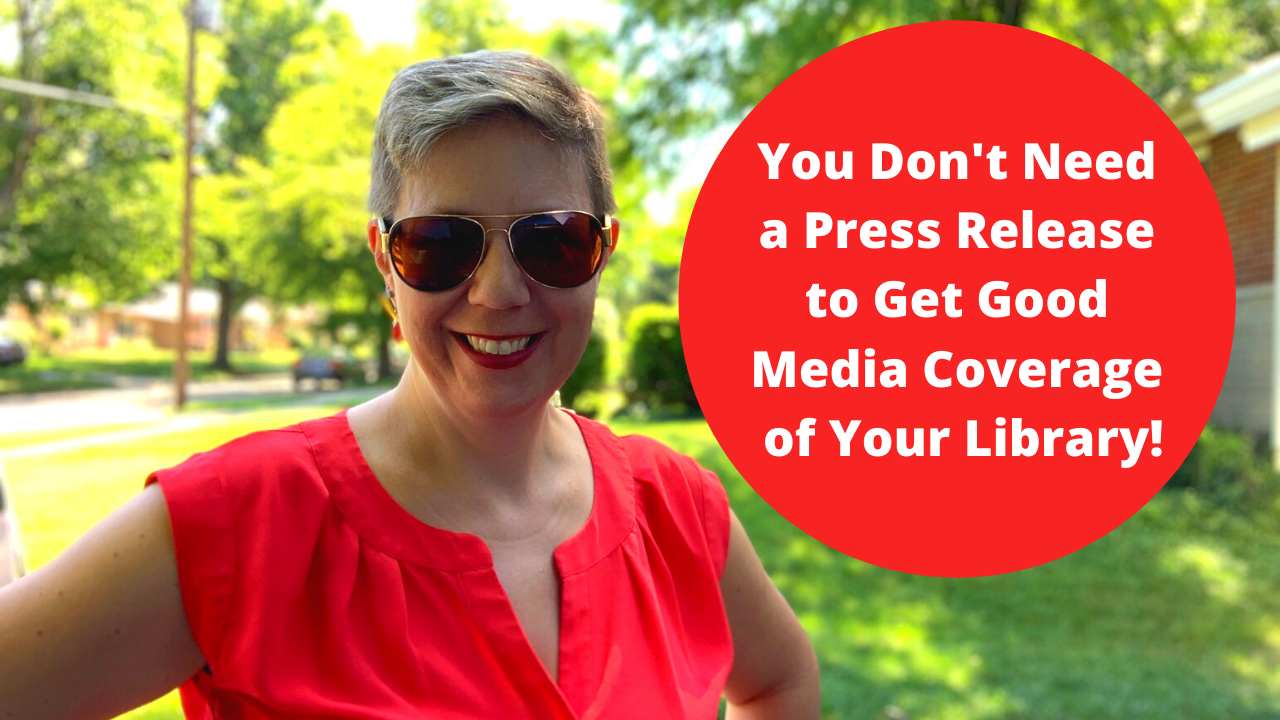
You Don’t Need a Press Release to Get Good Media Coverage of Your Library! Here’s the Secret Trick From a Former Journalist.

Watch Now

The Library Marketing Show, Episode 55

Angela used to work in a TV newsroom and at a library and she shares a secret for getting good press coverage for your library. It doesn’t involve writing a press release!

Also, a reader wants to know if YOU know of any cartoon artists doing library-specific drawings or memes to share on social media. If you do, let her know in the comments!

Also Kudos to the winners of the 2020 PR Xchange Award Winners!

What did you think of this episode? Are you struggling with marketing and promotion right now? Do you have an episode suggestion? Would you like to nominate someone for kudos? Let me know in the comments.

And subscribe to this series to get a new video tip for libraries each week! Thanks for watching.

Subscribe to this blog and youโ€™ll receive an email every time I post. To do that, click on the โ€œFollowโ€ button in the bottom left-hand corner of the page. Connect with me on YouTube, Twitter,ย Instagram, and LinkedIn.ย 

A WordPress.com Website.

Up ↑