
Search

Super Library Marketing: Practical Tips and Ideas for Library Promotion

Tag

project management

The Library Marketerโ€™s Guide to Saying โ€˜Noโ€™ to Promotions Without Burning Bridges

Photo courtesy Cincinnati and Hamilton County Public Library

How many times have you said โ€œnoโ€ to promotional requests in the past week or month, or year? If the answer is “never”, this article is for you.

I bet some of these situations sound familiar to you:

  • A librarian running a small program like a knitting group or a recurring storytime asks you for posters, flyers, social media posts, a press release, and newsletter space, even though the program doesn’t align with the libraryโ€™s big strategic goals. Saying no can feel like you’re not supporting your co-workers.
  • A library director loves a specific service (like the seed library) and wants a big promotional push for it, even though your user data shows it’s a niche interest with low engagement. It’s hard to push back against leadership!
  • ย A department forgot to tell you about a major event until a few days before, and now they want a huge promotional campaign. (This happened to one of my library marketing friends recently!) You want to be a collaborator, but rushing something often leads to poor results.
  • Every year, the library promotes a National Poetry Month event with posters, displays, and social media blasts, even though turnout and interest have been very low for years. Youโ€™ve likely heard the sentence, โ€œBut weโ€™ve always done it this wayโ€ before! It’s hard to change traditional promotional campaigns without seeming like you’re devaluing them or being difficult.
  • Someone suggests you start posting to a new platform, like Threads or TikTok. Even if it doesnโ€™t fit the strategy or audience, thereโ€™s a fear of “falling behind” if you don’t jump in.

As hard as it is to do, itโ€™s important to say “no” sometimes because library marketing is not just about being busy. Itโ€™s about being effective. If you can learn when to push back, youโ€™ll demonstrate to your coworkers and supervisors that your job isnโ€™t just to be a “promotional service desk.” Your work has a strategic purpose.

To help you make those strategic decisions, you’ll find a link at the end of this post to a guide I’ve created. It has a list of questions to ask so you can decide how much promotional support to give to each request.

So, how do you politely say “no” to requests outside of your strategy? Here are some scripts you can use.

Scripts to help you politely say no:

  • “Thanks for thinking of the marketing team! Right now, weโ€™re focusing our resources on initiatives that directly support our libraryโ€™s strategic goals for the year. Unfortunately, we arenโ€™t able to take on additional promotions at this time.”
  • “I really appreciate your enthusiasm! We have a full slate of promotions already planned that align with our libraryโ€™s key priorities. I wonโ€™t be able to add this to the calendar, but Iโ€™m happy to brainstorm ways you could promote it independently.”
  • “Our current marketing plan is tightly focused on [example: increasing card signups among new residents], so we have to prioritize projects tied to that goal. Iโ€™ll keep your event in mind for future opportunities.”
  • “We wonโ€™t be able to offer a full campaign for this event, but hereโ€™s a customizable poster template you can use. We can also share it internally with staff to help spread the word.”
  • “While we canโ€™t do a full feature in the main newsletter, I can add a short mention in our ‘Upcoming Events’ section if you get me the info by [deadline].”
  • “This project doesnโ€™t align with our current focus areas, but it might be a great fit for our [bulletin board / in-branch digital sign / social media story]. Letโ€™s talk about some of those options.โ€

The importance of buy-in from your supervisor

Whenever you find yourself in a situation where you need to say no, itโ€™s a good idea to give your supervisor a heads-up. You can say:

  • “I wanted to let you know that Iโ€™m going to recommend a lighter promotion plan for [person or department]โ€™s [project/event]. Itโ€™s a great initiative, but based on our marketing priorities for [this quarter/this year], it doesnโ€™t align with those priorities. Iโ€™m offering [a few options] instead to support them without pulling too much from our strategic efforts.”

You might also consider asking your boss for guidance and support in managing these requests. This invites your boss into the decision without making it feel like youโ€™re just refusing work or being lazy. You can say:

  • “Iโ€™m seeing more requests come in for promotions that arenโ€™t tied to our current goals. To stay focused, Iโ€™d like to suggest that we prioritize projects based on [brief criteria โ€” like audience reach, strategic importance, or alignment with core services]. Would you be comfortable if I used those filters to decide what we promote fully and for what we offer lighter support?” ย ย 

And what if your boss is the one making these requests? Try saying:

  • “Thatโ€™s a really interesting idea, and I am happy to do it. As you know, our marketing plan is heavily focused on [strategic goal], and Iโ€™m concerned that if we stretch ourselves and our work too thin, we wonโ€™t hit the targets weโ€™ve committed to. Can you help me prioritize this work?”

When you receive pushback from a supervisor, remember to frame your response in terms of impact, like meeting goals and maximizing results. Emphasize that youโ€™re thinking of the big picture and trying to protect library resources. Sometimes, offering alternatives instead of a flat-out “no” is a good way to redirect a request.

Library Marketing Promotion Decision Guide

To help you choose between full promotional support and lighter promotional support, I created a cheat sheet of sorts. The Library Marketing Promotional Decision Guide contains questions that will help you and will help the requestor understand your decision. You can download the guide for free here.


Need more inspiration?

Stressed? Exhausted? Here Are My Top 4 Tips for Handling Library Marketing Burnout

Subscribe to this blog, and youโ€™ll receive an email whenever I post. To do that, enter your email address and click on the โ€œFollowโ€ button in the lower left-hand corner of the page. You can also follow me on the following social media platforms:

5 Time-Saving Tips To Save Your Sanity While Marketing Your Library

Watch this video now

#LibraryMarketingShow, episode 284

Are you marketing and promoting your library by yourself or with a very small team? Do you feel overwhelmed and stressed, like there’s never enough time in the day to do everything that needs to be done?

I have five tips to help you make the most of your time and be efficient with your library marketing without getting stressed. We’re going to talk about it in this episode of The Library Marketing Show.

Plus, kudos goes to a library that managed to work a talking point about the value of libraries into a story about a book returned decades after its due date.

Do you have a suggestion for a topic for a future episode? Do you want to nominate someone for kudos? Let me know here. Thanks for watching!โ€‚

P.S.: If you wish, you may download a transcript of this episode.


Miss the last episode? No worries!

Will I see you soon?

Subscribe to this blog, and youโ€™ll receive an email whenever I post. To do that, enter your email address. Then, click the โ€œFollowโ€ button in the lower left-hand corner of the page. You can also follow me on the following social media platforms:
Want To Boost Your Library Marketing Creativity? Here Are 10 Ways To Reduce Stress so You Can Do Your Best Work

Photo courtesy Cincinnati and Hamilton County Public Library

For my birthday, my 23-year-old daughter gave me a gratitude journal. She told me about her own practice of writing in her journal first thing in the morning and right before bed. She gives herself space to list what sheโ€™s grateful for and sets her mindset for the day.

In fact, sheโ€™s got a whole routine for morning and night thatโ€™s incredibly healthy. She eats well, exercises, and tells me all the time that Iโ€™m worth taking care of. Sheโ€™s my self-care inspiration.

Iโ€™m trying hard to follow her example. I think people of my generation (Gen X) have been trained to overwork. We were told that productivity equals worth. But that philosophy leaves many of us feeling exhausted, overworked, and underappreciated.

Burnout is real, especially for communicators. Nearly 75 percent of people working in marketing and communications say they experience burnout.

I want to help my readers avoid burnout and love their job in library marketing! These are my personal tips for managing stress.

10 tips to manage stress in library marketing

#1: Create a space where you want to work.

When I worked at the library, my office was in a windowless basement. It was lit by fluorescent lights and was incredibly sterile. It looked like a glass cage.

I was happy to have my own workspace, but it was not a space in which I wanted to work. So, I made a few minor changes.

I hung blue twinkling lights around the perimeter and bought a funky blue desk lamp at Goodwill. I papered the glass windows with cards and notes that Iโ€™d received from former interns and co-workers. I bought a tiny portable speaker and played soft music through my iPhone while I worked.

These changes may seem very small. But they worked to create a place where I looked forward to coming each morning.

You can do the same by auditing your current workspace. Is your desk a place that will foster creativity and productive work?

If not, then spend some time working on your workspace. Dim the lighting. Declutter your desk. Store some snacks or your favorite candy in your desk. Bring your favorite mug to work to make coffee or tea time more enjoyable. Hang some artwork.

If youโ€™re working in a shared area, do what you can to add a personal touch to the space. And invest in headphones so you can play music or white noise or whatever you need to help you focus.

#2: Donโ€™t eat at your desk.

Stopping for half an hour to eat gives you a natural boost in productivity and it helps to refresh your mind for the second half of your workday.

Donโ€™t use this time to catch up on emails. Grab a book. Head outside if you can and spend half an hour in the sun.

#3: Donโ€™t try to multitask.

Itโ€™s tempting to try and tackle several tasks simultaneously. That seems like a productive use of time. But itโ€™s the opposite because you do none of them well.

Constantly switching focus makes you less productive and strains your brain. Try your hardest to focus on one task at a time.

Iโ€™ll often close my email and Teams when I know my focus might be pulled away from an important task. When I worked at the library, I would take my laptop into the stacks or into a conference room. A change of scenery can often help you hyperfocus on a task that needs tackling.

#4: Take breaks during the day.

You want to look away from your computer every 20 minutes.  And every hour, give yourself a few moments to take a mindful break. Stretch, look out the window, or go outside and really pay attention to what you see, hear, feel, and smell.

If you need help with this, there are lots of apps for your phone that will remind you to take time for yourself. Or you can use Tomato Timer on your laptop or desktop to nudge you.

#5: Create a shut-down routine.

When youโ€™re done working, create a routine to tell your brain that work time is over. Turn off notifications on your phone if you can. Shut the computer. Resist the temptation to look at your libraryโ€™s social media accounts when youโ€™re not on call. This is an especially important step for those of you who work from home.

#6: Give yourself the grace to be imperfect.

Even though I know it feels like it sometimes, no one will die if your email or social media post doesn’t get the engagement you were hoping for.

So much of what impacts our marketing is out of our control. And all of marketing is an experiment. That’s what drives innovation in your promotions.

If your promotion fails, it doesn’t mean you are a failure. Give yourself permission to try something else!

#7: Celebrate success.

Success is a great motivator, and we often focus too much on what we have to do next. We should spend just as much time celebrating and examining the emails, social media posts, flyers, website graphics, videos… etc. that do well.

Why did a specific promotion work? How did that tactic help your library reach its overall goals? Ask yourself this question for every promotion you do. Pretty soon, you’ll start to see your successes pile up!

Before you leave work each day, write down one thing you did well that day. Share your successes with your co-workers (and keep a running list for your performance review.) You can also share your successes every Friday on the Library Marketing Book Club Facebook page.

#8: Find ways to recharge your creativity

You might have noticed that every time I interview a library marketer, I ask them what they do for inspiration. Thatโ€™s because motivation naturally flags over time. It helps to have sources of inspiration and energy when weโ€™re stuck in a rut.

Go to a conference. Read a book. Listen to a podcast. Watch a TED Talk. Read a blog post. Meet with a mentor. Pick one thing that will get your creativity and productivity flowing again and schedule it as part of your regular work routine.  

#9: Use your vacation and sick time.

If you are having a day where youโ€™re just feeling drained, exhausted, and stressed, use your sick time to take a mental health day.

And plan to take time off from work at least once a year. For me, disconnecting from work for an extended period is the best productivity boost. For the first day, Iโ€™m super tempted to check my email. Then, I go into a period of about 2-3 days where work is the furthest thing from my mind. I have a job?? Then, right around day 5, I start to process new ideas for promotions and posts for this blog! I end up sending emails to myself with those ideas so I can tackle them when I get back.

But I firmly believe that I would never come up with those new ideas if I didn’t give myself permission to not think about work. And for me, that means physical separation from the office. Maybe you’re the same way!

#10: Ask for help.

73 percent of people donโ€™t ask for help on the job when they need it, according to Study Finds. ย The survey also found that 53 percent of people feel held back from achieving certain goals in their lives because they try to go at it alone.

These numbers are incredibly sad. ย And I would hope that you would feel comfortable enough in your library to ask your co-workers and fellow library marketers for help. But if thatโ€™s not something you can do, you can always reach out to me. Iโ€™ll always do my best to get back to you.


More Advice

How to Get Stuff Done Without Losing Your Mind: My Top 6 Time Management Tips for the Busy Library Marketer

Subscribe to this blog and youโ€™ll receive an email whenever I post. To do that, enter your email address and click on the โ€œFollowโ€ button in the lower left-hand corner of the page. You can also follow me on the following social media platforms:

How to Get Stuff Done Without Losing Your Mind: My Top 6 Time Management Tips for the Busy Library Marketer

Photo courtesy Public Library of Cincinnati and Hamilton County

You are pressed for time.

I know it. I have the receipts.

Every time I lead a Learn with NoveList course, I ask a question of my audience. What’s the hardest part of library marketing?

And in every single class, the answer is always the same: Finding the time to do the work.

And yet, you’re expected to crank out library promotion after library promotion. You are asked to increase visitors, program attendance, circulation, and donations to your library. And you are often doing this promotional work while doing other things like answering reference questions, shelving books, filling holds, and cleaning the bathroom.

It’s exhausting. And sometimes, it seems downright impossible.

Time management is hard. But the benefits are well worth it. Time management helps you achieve bigger goals, reduces procrastination, and increases productivity.

I was fortunate, early in my library career, to have a mentor who helped me get control of my schedule and learn how to prioritize my work. It’s now my turn to pass on the six most effective tips for managing your time without losing your mind.

Tip #1: Schedule everything.

My calendar is more than a place to keep track of meetings. It serves as the hub for all my work tasks.

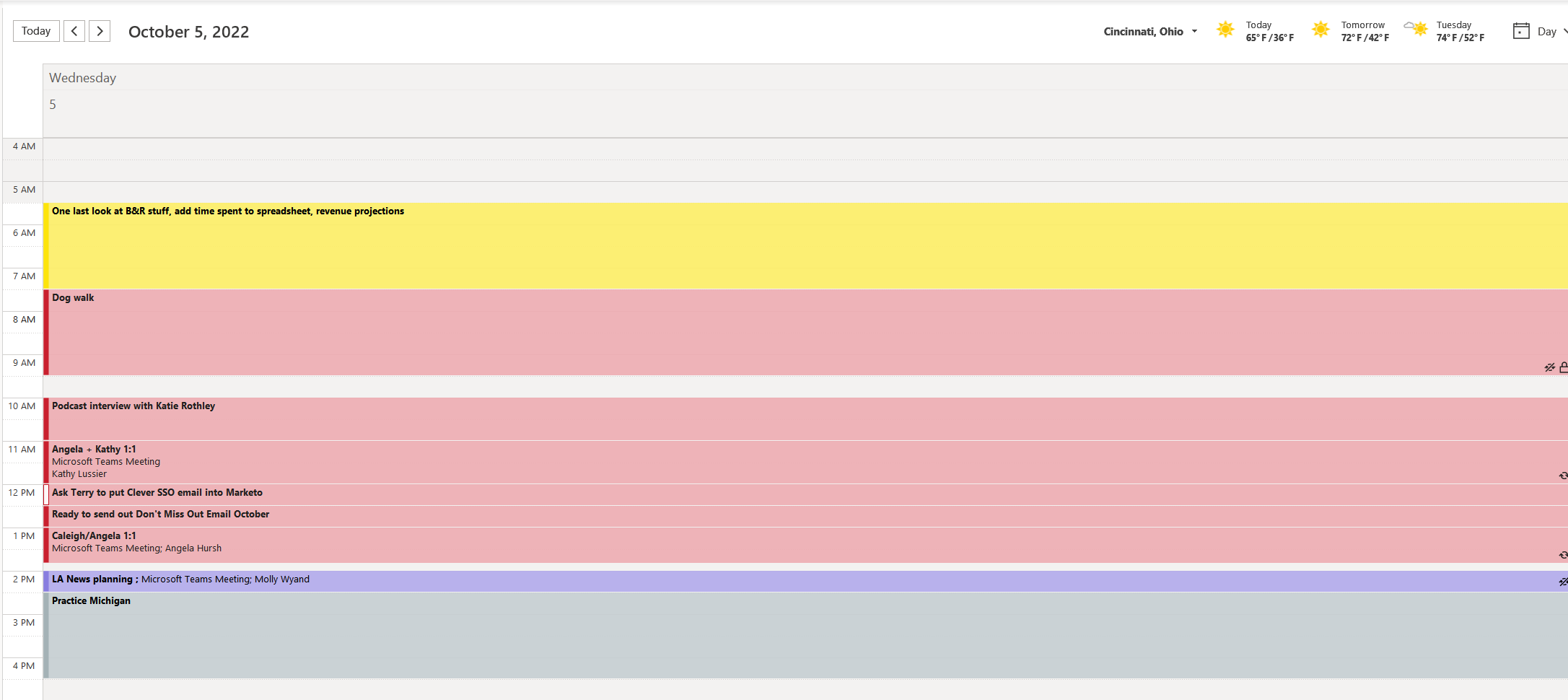
If you need time to focus, research, or think about something, schedule it in your calendar. Schedule the time you’ll be spending at the front desk. Schedule the time it takes you to work on holds or shelve books. Schedule the programs you’ll lead. Schedule time to read your email. Schedule everything.

Here is a screenshot of my calendar. I use color coding to help me keep track of important, ongoing projects. Notice I even schedule my daily walk!

This method makes it clear what you’ll be working on each day. It also keeps you from forgetting tasks. When I’m given an action item from a meeting, I immediately go to my calendar and schedule time to do that work.

I also enter recurring tasks in my calendar, so I can be reminded to add those tasks to my wish list (see tip #6) when the time to do them arrives. This leaves me more time to focus on tasks for today, and not worry that I’ve forgotten to do something important.

Tip #2: Arrange your daily tasks in order of difficulty.

The most difficult or important thing on your to-do list should be the first thing you get done every day. This method creates momentum and frees up the rest of your day so you can do easier tasks or tasks you enjoy more.

Tip #3: Block out distractions.

If you need to concentrate, do whatever you have to do to get focused. A study at the University of California, Irvine found that, once you get distracted, it takes 23 minutes to regain focus. That’s a lot of time.

When you need to remove distractions, you should:

  • Shut down your email.
  • Shut down Microsoft Teams, Skype, or whatever program your library uses for internal messaging.
  • Close your website browser.
  • Turn your phone over so you can’t see the screen and put the ringer on vibrate.
  • Go to another location. This is especially important if your workspace is in a shared office or near patron areas of your library. It is okay to create physical barriers between you and your distractions!

Tip #4: Say “no” to be more efficient.

If you’re asked to add to your library promotional schedule but the addition does not drive the overall strategy of the library or falls outside the boundaries of your documented marketing strategy, say no. Saying no gives you time to really concentrate on the pieces that will help your library the most. Your work will be better the LESS you do.

I understand this is extremely difficult to do. I encourage you to bookmark this short but powerful essay on the power of saying no in marketing from Joe Pulizzi. I re-read this piece when I need a little help saying no!

Tip #5: Take creative breaks.

No one can churn out tasks, one right after the other, all day long. Creative breaks will give your mind a rest and help you focus when you need to. Walk the stacks or go for a walk around the block. Get away from your desk for five minutes to stretch your legs and gather your thoughts.

Tip #6: At the end of every day, celebrate what you got done and make a wish list for tomorrow. 

Many, many years ago, I heard singer Wynonna Judd say something that I think about almost every day. She was discussing her schedule, and how easy it is to get to the end of the day and to feel like a failure. That’s because many of us focus on what we didn’t manage to get done, instead of celebrating what we did accomplish.

I took that to heart. At the end of the day, I spend a few minutes paying homage to the work I did, even if I didn’t make it to all the tasks I intended to do.

Then, I make a “wish list” of tasks for the next day. Notice I don’t call it a “to-do list.” That’s because library staff must be flexible and deal with unexpected work.

As you make out your “wish list,” include every task: meetings, lunches, phone calls, calculations, reports, writing assignments–the whole deal. At the end of today, go through your wish list and highlight three things that absolutely must get done. Those will be the first three things you tackle the next day.

Be protective about your wish list. If someone emails you with a task and it isn’t urgent, put it on tomorrow’s list.

And finally, do not beat yourself up if you don’t finish every task on your list. Move uncompleted items to the wish list for the next day.


More Advice

14 Completely Random and Free Tools You Need in Your Life To Make Your Library Promotional Work Easier

Four Important Project Management Lessons Youโ€™ll Need to Survive the Next Year of Library Work

Subscribe to this blog and youโ€™ll receive an email every time I post. To do that, enter your email address and click on the โ€œFollowโ€ button in the lower left-hand corner of the page.

The Divide and Conquer Method of Library Marketing: How to Realistically Reach Your Library Promotional Goals Without Losing Your Ever-Loving Mind [ARTICLE]

Photo courtesy Cincinnati and Hamilton County Public Library

Have you been in the grocery store cereal aisle lately?

Recently I had a craving for yogurt topped with cereal as a snack. So, I went to the store with the simple plan of buying a box of cereal.

Did you know the average grocery store carries nearly 300 types of cereal? The cereal in my store takes up the length of an ENTIRE AISLE.

Holy Cheerios, Batman.

There is such a thing as too many choices.

When youโ€™re faced with a wide range of selections, you can end up feeling paralyzed and unable to decide. Or, worse yet, you make a decision that turns out to be the wrong one because there were too many factors to take into consideration.

I sometimes feel the same way about working in library marketing.

Many of us have too much work to do. We have multiple goals we are trying to reach. And all that work makes it impossible to do anything well. It’s no wonder our promotions fail. We need to focus on focusing.

Now thatโ€™s youโ€™ve created a promotional strategy and youโ€™ve set up a promotional calendar, you may be tempted to try a whole bunch of new promotional ideas all at once.

But for true library promotional success, you’ll need to pace yourself. You want to be deliberate, intentional, and thoughtful about the library promotions you put out into the world.

Easier said than done, right?

So how do you create your promotions, track the results, and not lose your mind?

By using something I like to call โ€œthe divide and conquer approach.โ€

Iโ€™ve put together a three-step process to help you manage your workflow. This simple plan will help make sure your time is spent wisely. It will ensure you have the time to create your promotions and check the results so you can ensure that youโ€™re reaching your promotional goals.

This method will make your marketing goals feel more manageable to you. You won’t get overwhelmed. And you’ll be able to spend time creating and tracking promotions to make sure the work you’re doing is effective.

Tackle one goal at a time.

People often sing the praises of multitasking, but any time management expert will tell you it kills productivity and leads to burnout.

Instead, you’ll want to prioritize your library marketing goals. Decide which is the most important by asking yourself one simple question: ย Which goal will have the most positive impact on your library? Thatโ€™s the one you should focus on.

This laser focus will actually allow you to reach ALL of your library promotional goals faster. When you focus fully on one goal, you can learn valuable lessons about your community and how they respond to your promotions on your available channels. And those lessons will make it easier for you to reach your future goals.

As you work towards your goal, youโ€™ll learn along the way which work, which donโ€™t, and how to carry them out effectively. You can use this valuable knowledge for future goals.

Create an action plan with list of tasks you need to complete to reach your goal.

In this step, you’ll very specifically lay out what needs to be done to reach your goal. This will make the final goal seem less overwhelming. It will also help you to gauge how much time you need to set aside each day to work on your promotions.

Let’s say that your priority goal is to increase the number of people who come to visit a physical library space. Your initial task list might look something like this.

  • Create a weekly email to promote a service that’s only available inside a library branch.
  • Create one Instagram and Facebook story per week to highlight a service that’s only available inside a library branch.
  • Create two social media posts per week on Facebook, Instagram, and Twitter to promote one in-person event.
  • Create a video that shows people coming into a library branch, focused on the physical space as a place of community and social interaction.

Now that you have your initial list of tasks, you can divide each task further into two or three smaller action items.

For example, your initial task of creating two social media posts per week on Facebook, Instagram, and Twitter to promote one in-person event can be accomplished by making a smaller action item list like this:

  • Choose events (consult with programming department)
  • Write post text
  • Create images
  • Schedule posts

Set a firm timeline for reaching your overall goal. Assign deadlines for each item on the task lists.

For our example, we may decide that we are going to work for the next two months on increasing in-person visits to the library.

Now, we can take our lists of tasks and set deadlines for when each of these tasks needs to be completed and released out into the world. Those deadlines will help you reach your target efficiently by assigning a timeframeโ€”a start and end dateโ€”to every step in the process.

This “divide and conquer” approach gives you and your co-workers a chance to merge this new way of thinking and the new workload into your schedule without stress. It will make it easier to measure results.


Related Posts

How to Create a Social Media Strategy That Actually Works

Call It What It Is: Toledo Public Library Explains Their New Brand Strategy

Subscribe to this blog and youโ€™ll receive an email every time I post. To do that, enter your email address and click on the โ€œFollowโ€ button in the lower left-hand corner of the page.

The Magic Secret To Create Effective Library Marketing: How To Set Up Your Libraryโ€™s Promotional Calendar!

Photo courtesy Cincinnati and Hamilton County Public Library

Now that youโ€™ve created a library promotional strategy, itโ€™s time to take the next step. And that is to create a calendar for all your library promotions.

Three main reasons a library promotional calendar is important

A promotional calendar is vital to success. This is especially true in an organization with many contributors and stakeholders, like a library.

Hereโ€™s why youโ€™ll want to have a promotional calendar, even if your team of content creators or contributors is small.

  • It helps you stay organized and focused on the goals you set as part of your promotional strategy.
  • It helps you to keep track of holidays, seasonal library and literary events, and major annual promotions like summer reading.
  • It keeps everyone at your library up to date on your promotional plans.

How to set up your libraryโ€™s promotional calendar

Scroll down to the bottom of this post for my recommendations of three free calendar templates that you can use to create your libraryโ€™s promotional calendar.

No matter which template you choose, the calendar should be shareable. This will ensure the contributors at your library can see all future promotional plans. It will also make it easy for contributors to add comments and ideas.

Once you choose a template and a location where it will “live,” set up the columns to track the important pieces for library marketing. Your calendar should include spaces to track these things:

  • The name of the event or service you wish to promote
  • The date of the event or service launch if the service is new. If it’s an existing service, you can leave this space blank.
  • The start and end date of the promotion
  • The type of content. For example, blog post, video, etc.
  • The channel(s) in which the promotional content will be published. For example: email, social media platform, digital signs, etc.
  • The topic. For example: you may have two promotions for summer reading. One could be planned for two weeks before summer reading begins with the purpose of promoting registration. Later in the summer, you may launch a second promotion marking the halfway point and encouraging readers to log their reading hours. The “topics” for these two promotions could be “Registration Push” and “Halfway Check-in.”
  • Due dates
  • The date and time for publishing the content
  • The person in charge of each promotion
  • Follow-through. This column is where you will note if the content was published according to schedule or if there were delays. Tracking follow-through will help you spot hurdles in the process of creating and approving promotions, which will lead to more efficient planning of promotions in the future.
  • Links to promotions after they are published. This will be helpful for those times when you’ll need to find and analyze a promotion after itโ€™s out in the world.
  • Success measurements. List the data you gather after the promotion is published to measure engagement and effectiveness. Tracking your promotional success will help you spot the topics, formats, and publishing platforms that yield the best results for your library.

How your promotional calendar will improve your library marketing

The Marketing Rule of 7 states that a prospect needs to hear or see the advertiserโ€™s message at least seven times before theyโ€™ll buy that product or service.

For your library, the Marketing Rule of 7 means itโ€™s important to publish content on various platforms and in multiple formats. This will allow your library to reach your entire target audience.

Your promotional calendar will help you make those decisions by having a list of your channels all in one spot. Your calendar will also help you to spot effective ways to re-purpose your content.

For example, letโ€™s say you created an infographic demonstrating the value of summer reading in preventing the loss of literary skills. Initially, you planned to post the infographic to Instagram.

Using your promotional calendar, it may occur to you that the infographic would be a great starter for a blog post on the dangers of the โ€œsummer slide.โ€ Then, you realize you can promote that blog post and infographic in your next library e-newsletter.

The library promotional calendar helps you to see all your promotions and create a holistic campaign. It can help you decide if you have enough resources to focus on the platforms where your target audience is most likely to see your content.

Use your calendar to prioritize your most important channels. Focus on creating high-quality content instead of aimlessly posting on all available platforms.

Your calendar can also help you set deadlines. You’ll quickly learn how often you can realistically create and release new promotions.

Finally, your library promotional calendar will help you spot the busiest times for your library before they sneak up on you. It will help you plan for those busy times. You’ll be able to ensure that the promotional creation process is finished well before the publishing date!

What to include in your library promotional calendar

  • Holidays, especially ones that affect your libraryโ€™s service hours like Independence Day and Veterans Day.
  • Local holidays. For example, where I live in Cincinnati, Ohio, opening day for the Cincinnati Reds is a holiday.
  • Literary holidays such as Library Lovers Day or Audiobook Appreciation Month.
  • Seasons, like back to school or graduation.
  • Promotions tied to popular culture, like the Superbowl and the Olympics.
  • Building openings/renovations
  • New service releases
  • Summer Reading
  • Author events
  • Fundraising opportunities, like Giving Tuesday and National Library Week.
  • Patron stories
  • Interesting or funny details about your library.
  • Evergreen content, like collection promotion.

Three free promotional calendar templates

Some of these websites make you an offer to try their product, but you can still get these calendars without making a purchase.

  • Smartsheet: I recommend the Marketing Campaign Calendar Template.
  • Aha: I recommend the Integrated Calendar
  • Search Engine Journal: This is a template set up in Google Docs, with instructions on how to copy it for your libraryโ€™s use.

You May Also Want to Read These Posts

Library Blogs are the Best! How to Use Your Website to Amplify Your Library Marketing Message on Your Own Terms

Want To Improve Your Productivity and Feel Pride in Your Work? Here Are the 7 Essential Habits of Highly Effective Library Marketers.

Latest Book Review

Small Pleasures” by Clare Chambers

Subscribe to this blog and youโ€™ll receive an email every time I post. To do that, enter your email address and click on the โ€œFollowโ€ button in the lower left-hand corner of the page.

Three Transformative Tips to Improve Focus and Re-Energize You When Working in the Library Doesn’t Feel Fun Anymore

Blue Ash - Sycamore Branch staff: Mrs. Sonia Bibbs (left) Library Assistant, Douglas Robinson, Corinne Hand (right) Childrenโ€™s Librarian. Courtesy Public Library of Cincinnati and Hamilton County.

I don’t know about you, but I’m exhausted.

The pandemic is exhausting.

Worrying about the health and safety of family and coworkers is exhausting.

Natural disasters, a nation coming to terms with centuries of racial disparity, and a Presidential campaign here in the United States are exhausting.

And yet the library world continues to provide service during this crazy year. Your library probably still did a summer reading program. You’re providing virtual programs. You support students and teachers as they navigate distance learning. You’re promoting books and offering reading recommendations.

The world throws hurdles at you, and your library responds.

Is it any wonder if you feel like you need a nap and a hot bath nearly every day?

Library marketers are expected to be energetic and enthusiastic. More than any other library staffer, you’re expected to have exciting and innovative ideas to promote all these major developments and service changes as well as the smaller services that everyday cardholders rely on.

And you’re expected to produce results, driving people to watch virtual programs, use your curbside pickup service, and follow all the rules for social distancing.

It’s only natural to feel burned out by the speed at which everything happens at your library. And when you get stressed, work stops being fun. The quality of your work suffers.

But your library and your community depend on you. So here are some tips to help you manage your work and avoid burnout.

Prioritize, stay completely focused on your goals, and say “no” to EVERYTHING else.ย  Humans are all weirdly programmed to say yes, to take on more, to squeeze as much out of life as we possibly can.

Busyness feels wonderful. Weโ€™re doing something! Stuff is happening! Progress is being made!

But without space for creative thought, mistakes are going to happen. Your work won’t be what it could or should be. And that means your marketing will be less effective.

So, just like you weed your collection, you need to weed your promotions. This is especially true now, when your audience is suffering from content burnout because of the pandemic.

In my first year at a library, I said “yes” to everything. And nothing I did was any good.

When I realized I was doing too much, I set some ground rules for the goals I wanted my staff to focus on. I aligned these goals with my library’s strategic goals. They were:

  • A promotional tactic (like emails) had to produce a ten percent bump in circulation, program attendance, or usage. If it didn’t, we stopped doing it.
  • A service had to be easy for the cardholder to use to get promotion. Databases are a good example. If a cardholder was required to sign into the library website with their card to get to the database landing page, and then had to create a separate account tied to their email to use the database, we didn’t promote that database.
  • We only did full marketing campaigns for paid presenters. Free presentations got a poster or flyer and a social media mention.
  • All promotional requests had to tie directly to the libraryโ€™s overall strategy. If the branch or library staffer requesting promotion couldn’t demonstrate how the program or service moved the library’s overall goals forward, we didn’t promote it.

I know that sounds harsh. And some of those rules might not work for a smaller library or a different set of library leaders. That’s okay. Set your boundaries to work within your own system.

Weeding your marketing content will allow you to do a better job and be more creative with the promotions you have left. Evaluate your promotions twice a year to keep your marketing lean and reduce the stress on yourself and your co-workers.

The word โ€œnoโ€, while it may be very small, is liberating. Itโ€™s good for you and for your marketing strategy.

Define your workflow and make it the law of your marketing landscape. A defined workflow sounds like the opposite of a creative endeavor. But it ensures that a quality product is created in a timely and efficient manner. It creates space for you to think. And that’s incredibly important for anyone working in a library, especially right now.

There are two options: outward-facing workflow and team workflow. Choose the one that works best for you and your library.

Outward facing workflow means that you approach each job given to you by a senior leader or another library department or partner in the same way.

  • All marketing requests go through one person on your team, who acts as project manager.
  • That person is responsible for looking at the request and determining if it fits into the library’s overall strategic goals.
  • That person sets clear expectations and goals for each project and communicates a plan of action based on realistic timelines and due dates.

This is not to say that your team has no say in the work you do. But the ultimate decision rests with the project manager.

Team workflow is more collaborative.

  • All marketing requests are considered by the team.
  • The team looks at each request and decides what tactics will work, and whether they have the time to complete those tactics.
  • The team sets the goals and determines who will communicate due dates and expectations.

It may take some time to get a smooth workflow in place. Be patient with yourself and with others. Keep reinforcing your expectations. Eventually, your coworkers and supervisors will understand and appreciate your workflow, especially when they start to see results.

Be generous with positive reinforcement. Positive reinforcement is one of the easiest and quickest ways to improve happiness and effectiveness on the job. It bolsters self-confidence and inspires people to do their best work.

If you see a co-worker doing something well, say so, even if the job is small. A kind word can go a long way to boosting morale and creating energy. Don’t just say, “Well done.” Write out a note or an email praising specific actions or portions of work.

And, if you have a staff, give your employees unexpected breaks. When I was a library manager, I took my staff to lunch off-site. We had field trips to libraries outside of our system. Sometimes we had “reading time” where I would read them one chapter a day from a book we all chose together.

It might sound silly, but these little activities are energizing. They create bonds between co-workers. Staff return to work after these little breaks with enthusiasm for their work. And enthusiastic people do a better job… on the job.

You might also want to read these

Four Important Project Management Lessons Youโ€™ll Need to Survive the Next Year of Library Work

COVID-19 is STRESSFUL for Library Workers. Here Are Tips to Help You Feel Better.

Latest Book Reviews

The Bell Jar by Sylvia Plath

All the Broken People by Leah Konen

Find more 60-second Book Reviews here.

Subscribe to this blog and youโ€™ll receive an email every time I post. To do that, click on the โ€œFollowโ€ button in the bottom left-hand corner of the page. Connect with me on YouTube, Twitter,ย Instagram, and LinkedIn.ย 

ย 

How to Manage Your Marketing Without Losing Your Ever-Loving Mind

A library marketer is really a project manager.

That phrase is the best description of our job. We are all planning and managing projects. We are scheduling and executing campaigns. We’re delegating. We manage multiple people who contribute to blog and social media posts.ย And unless you’re a super organized genius, all that coordination can cause you to lose your sanity.

I sometimes walk into my office in the morning feeling fantastic, and by the time I open my email and see a 30-message thread between departments about a piece of content I need for marketing, I can feel the steam rolling out of my ears.

Project management is like waiting tables. You have multiple customers who all want different things from you. They order at different times and their food comes out at unpredictable intervals. In the meantime, you must keep checking back and making sure they have everything they need for the moment. You must also keep them informed about how their meal is progressing.

It’s the same when for library marketing. We are working on multiple campaigns and we have lots of different customers, internally and externally. So how do you make sure you get all your work done without losing track of projects, content, and posts? It’s not easy.

Many of you have said that project management causes you grief and stress. Many of you don’t have a staff. You are doing this job solo. You’re doing branch work in addition to marketing. Your job is hard.

I have a system, developed over five years of trial and error. I thought I’d share it with you. I hope my tips relieve you of some stress.

Train other library staff to plan. I make it a point to stop by once every month or two to talk to all the departments that contribute to my marketing schedule. I ask them to tell me what is coming up in the next one to three months. At the end of each of those meetings, I make it a point to tell them to let me know if they start planning anything at any point.ย These “touch-base meetings” sometimes only last 15 minutes but they are incredibly valuable.

To be honest, it took me about a year of doing this to get my coworkers trained to let me in on their plans early. I realized later that most of them thought it best to wait to tell me about an event until they had all the details worked out. Now, they’ll give me a heads-up even if they only know the general subject of the event and the date. That way, I can work it into my schedule ahead of time and plan.

Share your schedule. I noticed that when I shared my promotional schedule with my coworkers, they got a good sense of the kind of work involved in creating a campaign. They started sharing more info with me because they could see the work involved. Don’t be precious with your schedule. Share it… and let everyone see how much work and planning goes into each piece.

Set deadlines and enforce them.ย I do this for lots of my content, but especially when it comes time for our summer reading program. It’s a massive marketing campaign, the biggest we do all year. I create a schedule by the first week of February. In it, I share the deadlines for each piece of the marketing with everyone involved. This sets clear expectations. I also do this for those who contribute to our quarterly content marketing magazine. I send reminders one month and one week before the submission deadline so it’s clear what I need and when I need it.

Use your calendar. Iย  put appointment reminders in my Outlook calendar to check on the status of certain projects.ย  I can look at my calendar each day and remember that I need to check up on certain things. I even put calendar reminders in for things like changing signs or updating content.

Don’t respond immediately to requests.ย This habit was hard to form but it’s the best discipline I’ve set for myself. When someone comes to be to tell me they need marketing for an event or service, I generally do not drop everything to plan out the marketing. I will put it on my to-do list for the next day, or even the next week. That gives me time to think about the best way to market each request.

Set aside time each week for planning. I have a designated planning day. I set aside a couple of hours on that day to purposefully think through my marketing. I make lists and set deadlines. It makes me more focused and helps me to know I have that time to think about what’s coming down the road.

Say no sometimes. Listen, I know it’s an uncomfortable conversation. I know you want to help everyone. You may feel pressured to do it all. I hate saying no. But sometimes, it is necessary. If the request doesn’t align with the library’s overall strategy, I say no.

Your time is limited. If you try to do everything for everyone, you won’t do anything well. Sometimes, you must say no. It may not make your friends, but it will make you better at your job.ย You were hired to do what’s best for the library.

Subscribe to this blog and youโ€™llย receiveย an emailย every time I post. To do that, click on โ€œFollowโ€ button in the bottom left-hand corner of the page. Connect with me on Twitter,ย Snapchat, and LinkedIn.ย I talk about library marketing on all those platforms!

A WordPress.com Website.

Up ↑