Key Takeaways:
- AI is changing how people search, and libraries are seeing a drop in website traffic as a result.
- Simple formatting changes like clear titles, bullet points, and question-based headings can help your content appear in AI summaries.
- Add credibility cues like staff names, job titles, and internal and external links to boost your site’s authority with AI and search engines.
Have you noticed a slight change in the blog posts here? Most now include a list of three quick takeaways at the top. Here’s why I started doing this, and why your library should consider it too.
AI impacts website traffic
A few months ago, I attended a webinar featuring three of the leading experts on Search Engine Optimization, or SEO. SEO is the practice of improving a website’s visibility and authority in organic search results to attract more visitors.
But AI has introduced a new wrinkle in SEO.
In May 2024, Google introduced AI Overviews (formerly called AI Summaries). These appear at the top of search results and provide a summarized answer to a user’s search, often pulled from multiple sources.
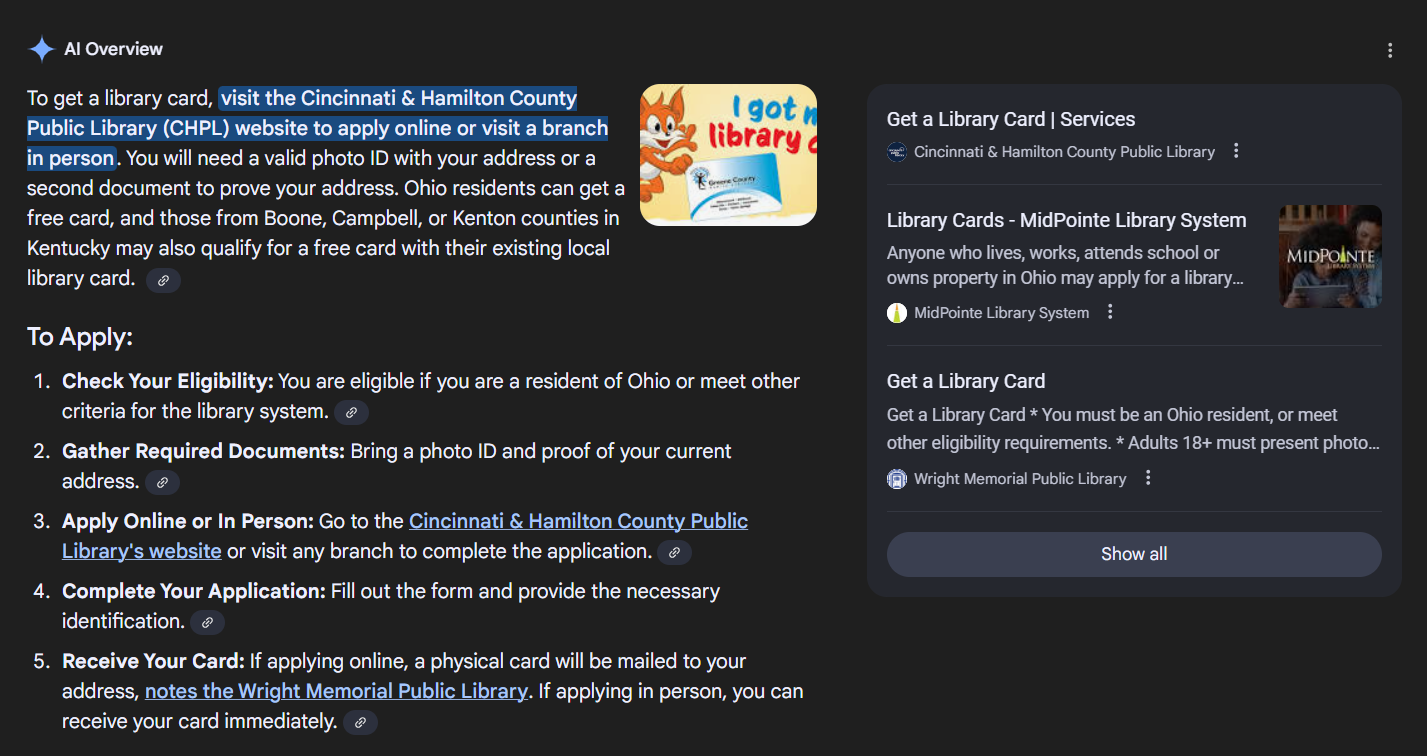
Once AI Overviews were introduced, searchers stopped clicking through to a website because their question was fully answered by the AI Overview. As a result, many libraries (and other websites, including this one) noticed a decrease in their organic web traffic.
In addition, a survey by Adobe Express says 25 percent of people use ChatGPT as their first choice for search over Google. Gen Z is particularly drawn to AI as a search engine. That likely means the popularity of using AI for search will continue to rise.
What does all this mean for your library?
You’ll need to adjust the way you structure your library’s website and blog to surface more often in AI searches and to show up in the AI Overview. It’s not as difficult as it sounds. Here are the changes I’ve implemented. I recommend you try these and monitor your web traffic over several months to see if the changes make an impact.
Titles should be clear, not clever.
Tell readers exactly what they’ll find on the page. For example:
Author Visit
- ❌ Clever Title: “An Evening of Literary Magic”
- ✅ Clear Title: “Meet Author Jasmine Guillory at the Library – October 24”
Why it works: The clear title includes the type of event, the author’s name, and the date. Those are the keywords that AI tools and search engines can easily match with user queries.
Craft Program
- ❌ Clever Title: “Get Your Glue On!”
- ✅ Clear Title: “Fall Craft Workshop for Teens – Make Your Own Bookmarks”
Why it works: It specifies the audience (teens), the season, and the activity.
Educational Workshop
- ❌ Clever Title: “Brain Boost Bonanza”
- ✅ Clear Title: “Free SAT Prep Workshop for High School Students”
Why it works: It uses direct language that matches what a student or parent might search for, like “SAT prep” or “high school test help.”
Wellness Event
- ❌ Clever Title: “Zen in the Stacks”
- ✅ Clear Title: “Free Yoga Class at the Library – All Levels Welcome”
Why it works: It clearly states what the event is, where it’s happening, and who can attend.
Include a bullet list of key takeaways or what you’ll learn at the top of the page.
This helps both readers and AI quickly understand the content. Try this on blog posts and key webpages.
Here’s how you might structure key takeaways at the top of a library card sign-up page.
- A library card is free to all residents of Tree County.
- Applicants need to fill out a form and have one document with proof of residence. The form can be sent to the library via email or presented at any library location.
- Applications presented in person will be processed immediately. Applications sent via email will take 1-2 days to process.
- Once an application is accepted, you’ll be given a card, which you will you to check out items, reserve meeting rooms, and register for programs.
Use well-structured headings.
Phrase them as questions, when possible, like:
- How do I get a library card?
- How can I reserve a meeting room?
Here’s an example of how I did this in a post for NoveList.
Include the right keywords.
Ask ChatGPT to provide you with a list of keywords or frequent questions around your topic. You can also search for your topic on Google and look at the ‘People Also Ask’ section. The website Answer the Public can provide you with some frequently asked questions as well.
Structure your content with bullets, steps, or lists.
Clean formatting makes it easier for AI to scan and summarize your content. You’ve probably noticed this post has been full of bullets and lists. That’s intentional! The bonus benefit is that it makes your blog and website easier to read.
Write in natural, conversational language.
Avoid jargon. Focus on being clear and helpful. Remember that searchers will not use jargon to look for answers to questions that may lead them to your library. Try to imagine what your community would put into the search bar, and then use those words in your blog or landing page.
When possible, include a staff member’s name and job title on a page.
AI looks for expertise or credentials when scanning pages. This is easy for a blog… just include the name of the author and their title in the post. For a landing page, consider adding a line like this: “Need help signing up? Email Maria Lopez, Library Services Manager, with 15+ years of experience helping patrons, at mlopez@treelibrary.org.”
Ask your partners to link to your website and blog.
When other trusted sites link to your content, it signals credibility to AI and search engines.
Use internal links whenever possible.
Link to related blog posts or pages on your site to help AI understand your content’s structure and relevance. That has the added benefit of keeping people on your page longer, which improves your trust and credibility to Google and AI, which means you’ll show up in search more often!
Try to stay within best practice lengths for word count.
BlueHost.com says for blogs, the ideal range is between 1,500 and 2,500 words. This gives readers comprehensive coverage of a topic. It’s also easier to include keywords and internal links for longer posts.
But… here’s something to remember: Google and AI tools prioritize quality over length (and so do most readers!) Don’t try padding your posts, as that can hurt your ranking.
Neil Patel, who is a trusted expert on SEO, says that for landing pages, word count isn’t a direct ranking factor. Rather, you should focus on the user’s experience and provide enough information for a community member to act.
Has your library’s website traffic taken a hit? Are you using any other methods to drive more traffic to your library’s website? Let me know in the comments.
Need more inspiration?
Google Ad Grants Improve Your Library’s Chances of Being Found in Search: How To Apply and Manage This Incredible Opportunity
Subscribe to this blog, and you’ll receive an email whenever I post. To do that, enter your email address and click on the “Follow” button in the lower left-hand corner of the page. You can also follow me on the following social media platforms:
 Super Library Marketing: Practical Tips and Ideas for Library Promotion