Search

Super Library Marketing: Practical Tips and Ideas for Library Promotion

Tag

social media advice

The 2026 Guide to Facebook for Libraries: New Tips to Boost Reach and Visibility

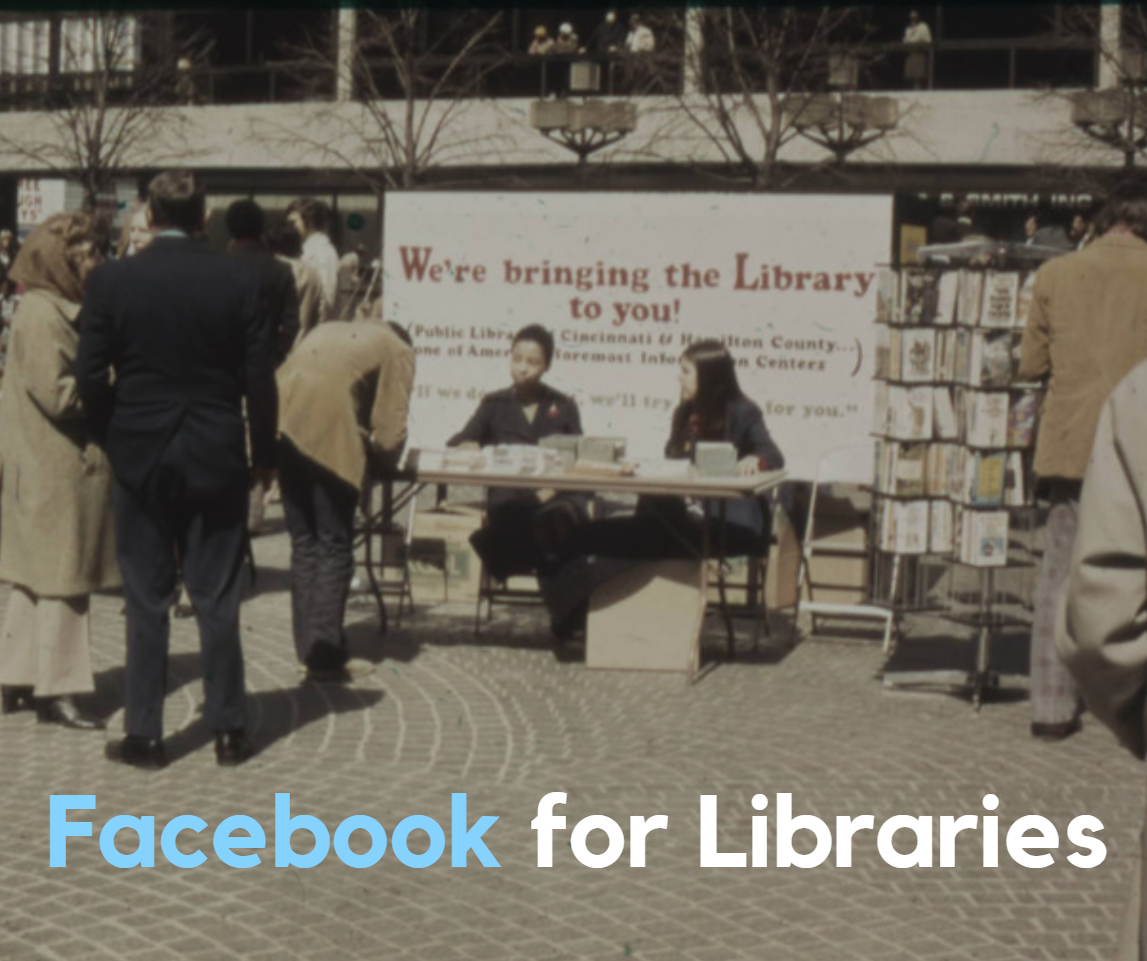
Two women in pantsuits sitting at a table outdoors on Fountain Square in Cincinnati in the 1970s, selling books.
Photo courtesy of the Cincinnati and Hamilton County Public Library

This is the final portion of the 2026 series of library social media guides. In addition to this post, be sure to bookmark these updated guides:

Facebook for libraries

Once again, Facebook remains the single most popular social media platform for libraries, but only by a fraction! According to the 2025 Super Library Marketing Survey, 95 percent of libraries use Facebook for promotions. Libraries use Instagram at nearly the same rate.

Statistically, this makes sense. Facebook is the largest social media platform in the world by number of users. And every day, about 69 percent of those users check their Facebook feed.

How are people using Facebook right now?

Here are some statistics from Demandsage.

  • The average Facebook session length is approximately 10 minutes and 12 seconds.
  • Most Facebook users are male.
  • Most Facebook users in the U.S. (nearly 99 percent) use the mobile version of the platform. That statistic rose by 16 percentage points this year! So, as you create Facebook content, assume everyone who sees your libraryโ€™s Facebook posts is doing so on a mobile device.
  • The largest segment of Facebook users is aged 25 to 34 years. Facebook has a reputation as a social media platform for older generations, which makes this stat somewhat surprising. However…
  • Facebook users aged 55 to 64 years spend the most time on Facebook, an average of 45 minutes a day. I think younger generations are looking at content, but not engaging with it. (This opinion is based on the use of Facebook by my own Gen Z daughters.)

How much success can libraries expect to see on Facebook?

Facebook has, by far, the lowest engagement rate of any of the social media platforms we’ve covered in the series. In fact, these rates are shockingly low.

I want you to look at this list of engagement statistics from Demandsage and really consider whether your time is well-spent when you post on Facebook.

  • Facebook Reels have an average fan engagement rate of 0.26 percent.
  • Images or photos get an average engagement rate of 0.24 percent.
  • A plain status update with text, no video, or no photo gets an average engagement rate of 0.12 percent.
  • And posts that include a link get an average engagement rate of 0.06 percent. OUCH.

Why is the engagement so low? Among the reasons is the motivation of the users: Nearly 75 percent of Facebook users say they use the platform primarily to message their friends and family.

The Facebook Algorithm for 2026

Here are the ranking signals Facebook uses to decide who sees your posts, according to Followeran. These are quite different from other platforms.

  • Facebook AI: As much as half of a user’s feed now features โ€œrecommendedโ€ content from creators or Pages they donโ€™t follow, chosen by Facebookโ€™s AI based on their interests and engagement behavior.
  • Deep conversations: The algorithm heavily favors content that sparks exchanges between users. It also looks to boost posts with longer, more considered reactions. Simple likes and short comments no longer drive reach.
  • Time spent: The algorithm will show your content to more people if the post requires users to spend time reading comments, scrolling through a carousel, or finishing a video. Longer sessions boost its distribution.
  • Video: Facebook still prioritizes short-form video formats (Reels, Facebook Live, Stories), followed by carousels and native videos. Posting consistently also helps, as newer content tends to perform better.
  • Original content: Reposts, duplicate content, or AI-generated content will be penalized with suppressed reach.

Here are 4 ways to get the best organic reach for your libraryโ€™s Facebook account in 2026

#1: Optimize for AI recommendations.

Half of all Facebook feed content now contains posts from pages that the user does not follow. Those recommendations are sourced by Facebook’s AI. The good news is that your library can reach new audiences without paid ads if you play by the algorithm’s rules.

Make sure you create original posts with strong potential for engagement. For example, ask your audience a question. You can also put book covers in a carousel of photos and encourage people to swipe through to the end.

Avoid duplicating or reposting content from other people or organizations. That’s a bummer, because many libraries repost their partner organizations’ content or content from publishers to save time. It’s okay to share that content on your Stories. But for your feed and Reels, make sure your posts are original works from your library account.

#2: Design your posts to maximize dwell time

I know many libraries post a graphic of their event calendar or a graphic promoting an upcoming program to Facebook. And if you’ve been wondering why those posts aren’t getting engagement, this is why. Facebook wants to keep people on the platform as long as possible. And those posts don’t help them achieve that goal.

Every time you post to Facebook, ask yourself, “How can I keep my users engaged longer?” You’ll want to use formats that encourage people to scroll, read, or watch to the end.

What do you do about promoting your programs? Share the graphic and program details on Stories or make a Reel about the program.

To share your calendar and get better results, ask people to sign up for a monthly email to receive a downloadable version. That’s a win for your library’s Facebook account and for your patrons, who will have a copy they can refer to all month long.

#3: Work on building early momentum for posts.

Posts that gain traction in the first 24 to 48 hours are rewarded by the Facebook algorithm. Look at your insights and post when your audience is most active. If your post starts to get comments, make sure you reply as quickly as possible (within 24 hours) to keep engagement flowing.

You can also try to drive traffic to your Facebook feed from your monthly email newsletter. Here’s how:

  • Post something fun and engaging on the day before your newsletter goes out. This “something” should be a piece of content that is NOT in your email newsletter. For example, you can post a carousel of photos of new books that just arrived at your library. Ask people to vote in the comments for the book they’re most excited to read.
  • In your email newsletter, write a tease that suggests people will be missing something if they don’t head over to your Facebook page to check out the post! For the example above, you could say, “Want to see which new arrival everyone is excited to read? Head to our Facebook page to cast your vote before the big reveal!”
  • Wait 1-2 days after your email newsletter goes out to post anything new on your Facebook page so your email users can find your teaser content easily. Or, if you must post more content, pin the teaser post to your profile for 1-2 days.

#4: Lean on authenticity and hyperlocality.

Meta rewards pages that post content that is clearly not generated by AI. This is where libraries can shine! Share patron stories, staff picks, book recommendations, and other highlights that show your library is a vital part of your community. Be sure to use your town or city’s name in the post and write the copy to show that your library is integrated into the community.

When to post on Facebook

Hootsuite says the best time to post is early morning,ย between 5 a.m. and 8 a.m., local time.

How often should you post to Facebook?

  • Post to the Facebook Feed 3-5 times each week.
  • Post at least one slide to Facebook Stories every day.
  • Post a Facebook Reel once a week.

P.S. Want more help?

Can Facebook Events Increase Your Program Attendance? How To Decide if Itโ€™s Worth the Effort

Subscribe to this blog, and youโ€™ll receive an email whenever I post. You can also follow me on the following social media platforms:

Facing the Hard Truth About Organic Reach on Facebook: Is It Worth Your Energy?

Watch this video now

#LibraryMarketingShow, episode 283

I’m not sure this is healthy for me. Still, I’ve been thinking about Facebook organic reach a lot lately. I’ve been wondering: Does it make any sense for libraries to post organically to Facebook anymore?

I think there are some hard truths about Facebook that we need to work through. We’re going to do it in this episode of the Library Marketing Show.

Do you have a suggestion for a topic for a future episode? Do you want to nominate someone for kudos? Let me know here. Thanks for watching!โ€‚

P.S.: If you wish, you may download a transcript of this episode.


Miss the last episode? No worries!

Will I see you soon?

Subscribe to this blog, and youโ€™ll receive an email whenever I post. To do that, enter your email address. Then, click the โ€œFollowโ€ button in the lower left-hand corner of the page. You can also follow me on the following social media platforms:

2 Easy and Extremely Important Steps To Take Every Time Your Library Uploads a YouTube Video!

Watch this video now

#LibraryMarketingShow, episode 279

Every time I upload one of these videos to YouTube, there are two major things that I am sure to do. Both of them helped me build my channel. One of them annoys some of my viewers!

In this episode of The Library Marketing Show, I will explain why I will keep doing these things and why you should follow my lead.

Plus, we’ll give kudos to a library with a spooky service that allows people to explore the library looking for ghosts!

And I have a favor to ask!

NoveList is doing a market survey on how libraries handle professional development training. Would you be willing to take the survey? It should take five minutes or less. Thank you!!

Do you have a suggestion for a topic for a future episode? Do you want to nominate someone for kudos? Let me know here. Thanks for watching!โ€‚

P.S.: If you wish, you may download a transcript of this episode.


Miss the last episode? No worries!

Will I see you soon?

Subscribe to this blog and youโ€™ll receive an email whenever I post. To do that, enter your email address. Then click on the โ€œFollowโ€ button in the lower left-hand corner of the page. You can also follow me on the following social media platforms:

Warning: Fake AI Profiles May Sabotage Your Libraryโ€™s Social Media Engagement

Watch this video now

#LibraryMarketingShow, episode 278

I have a warning about how artificial intelligence may impact the performance of your social media platform metrics. We will get into it and what you should do to prepare for this disruption in this The Library Marketing Show episode.

Plus kudos go to a library with a staff member who is appearing on a popular Netflix show!

And I have a favor to ask: NoveList is doing a market survey on how libraries handle professional development training. Would you be willing to take the survey? It should take five minutes or less. Thank you!!

Do you have a suggestion for a topic for a future episode? Do you want to nominate someone for kudos? Let me know here. Thanks for watching!โ€‚

P.S.: If you wish, you may download a transcript of this episode.


Miss the last episode? No worries!

Will I see you soon?

Subscribe to this blog and youโ€™ll receive an email whenever I post. To do that, enter your email address. Then click on the โ€œFollowโ€ button in the lower left-hand corner of the page. You can also follow me on the following social media platforms:

4 Things To Do Instead of Panicking When Your Social Media Stats Take a Nosedive๐Ÿ“‰

Watch this video now

#LibraryMarketing Show, episode 269

What do you do if you log on to your social media metrics and suddenly notice that your stats are dropping?

Your first instinct is probably to panic, but don’t! We will talk through 4 steps to take when this happens in this episode of The Library Marketing Show.

Plus we’ll give kudos to a library that managed to receive press coverage for a very important event.

Do you have a suggestion for a topic for a future episode? Do you want to nominate someone for kudos? Let me know here. Thanks for watching!โ€‚

For a transcript of this episode, click here.


Miss the last episode? No worries!

Will I see you soon?

Subscribe to this blog and youโ€™ll receive an email whenever I post. To do that, enter your email address. Then click on the โ€œFollowโ€ button in the lower left-hand corner of the page. You can also follow me on the following social media platforms:

โš ๏ธHow Instagram’s Latest Update Could Derail Your Library Marketing Strategy

Watch this video now

#LibraryMarketing Show, episode 268

We have breaking news on the social media front. Instagram is making a huge feature change. This is so big that I upended my entire Library Marketing Show editorial calendar to record this episode.

We will discuss what will happen and how it might impact your library marketing.

Do you have a suggestion for a topic for a future episode? Do you want to nominate someone for kudos? Let me know here. Thanks for watching!โ€‚

For a transcript of this episode, click here.


Miss the last episode? No worries!

Will I see you soon?

Subscribe to this blog and youโ€™ll receive an email whenever I post. To do that, enter your email address. Then click on the โ€œFollowโ€ button in the lower left-hand corner of the page. You can also follow me on the following social media platforms:

8 Key Pieces of Social Media Marketing Advice From a Library Marketer Who Works at One of Scotlandโ€™s Oldest Public Libraries!

Photo courtesy Cincinnati and Hamilton County Public Library

About 10 miles north of the northernmost coast of Scotland lay an archipelago or chain of islands called Orkney. The islands surround Neolithic sites dating back 5,000 years with tall sandstone cliffs and colonies of seals. Archeological evidence shows that humans have lived on the island for nearly 9,000 years.

Thatโ€™s where John Peterson lives and works. He has managed social media for Orkney Library & Archive since 2017.

The library is one of the oldest public libraries in Scotland, dating back to 1683. These days, the Orkney library has two physical locations, a mobile library, and serves a population of about 22,000 people.

โ€œOrkney is a very rural community with a lot of farming and agriculture,โ€ explains John. โ€œAnd of course, weโ€™re an island so weโ€™re surrounded by the sea and have a lot of maritime history, particularly from the 20th Century and the World Wars.โ€

The Orkney library may be remote, but it has fans worldwide. In fact, one of my readers nominated this library for a profile, saying โ€œI love their use of social media and how they got such a small library on the world map.โ€  

โ€œWeโ€™re a very small organization and so we donโ€™t have a marketing team or anything like that,โ€ says John. โ€œWe just try to share what weโ€™re doing with our followers on social media and have a bit of fun as we go along.โ€

โ€œWe use social media as a way of sharing whatโ€™s happening in the library and the archive and what we do every day. Itโ€™s a good way of showing off Orkney and what it is to be a library and archive service in the 21st century.โ€

Orkney Library posts on Facebook, Instagram, and X (formerly known as Twitter). Of the three, John says X is the most effective way to reach his audience.

โ€œIt has its challenges sometimes but itโ€™s probably still our favourite as a way of telling stories and making fun posts or threads,โ€ explains John. โ€œFor us, it has been a great way of communicating an idea with a few words and pictures. Our Twitter following is approximately 4 times the entire population we serve.โ€

โ€œInstagram is our newest platform, but it has a growing audience, and we get a lot of nice feedback.”

“The platforms work differently, so we often have to tweak the posts slightly to suit each. Often, we post on Twitter first and then on to the other two platforms.โ€

When John sees a particularly effective post, he builds on that success by sharing the same kind of content his audience is responding to. But he admits that, like most of you, heโ€™s sometimes baffled by what does and doesnโ€™t work!

โ€œWe post different kinds of content,โ€ explains John. โ€œBut they usually involve books, archives, or old photographs.โ€

 โ€œSometimes a post takes off far better than you expected and other times a post that you thought was interesting or funny doesnโ€™t get much engagement. There is a whole load of reasons for that and itโ€™s important not to get too disheartened if something doesnโ€™t work.โ€

โ€œOf course when a post doesnโ€™t work it could be that the idea wasnโ€™t good or wasnโ€™t communicated well enough. But often it is just a case of timing โ€“ wrong time, wrong day, it didnโ€™t get the retweets to send it further across the platform, etc. You could post the same post at two different times and get totally different responses.โ€

John’s Advice for Social Media Marketing

  1. Try to post good content and try to post regularly โ€“ but not too much. Not every post can be funny or interesting. But try to make sure that some of them are so people have a reason to follow you.
  2. Try to make it interesting. Donโ€™t just do what everyone else is doing, and donโ€™t rely on sharing content from other accounts.
  3. Try to write your own stuff and find your own voice.
  4. Pay attention to what works for you and then do more of it. Listen to feedback, good and bad โ€“ itโ€™ll help you to do more of what people like and less of what they donโ€™t.
  5. Donโ€™t be controversial and try to avoid politics.
  6. Concentrate on what makes your library or organization different from everyone else and try to use those things to build your own presence and identity.
  7. Look around you. Spot opportunities for good content. The more you do it the easier it gets.
  8. Find some libraries on social media and follow them, no matter where they are in the world. They donโ€™t have to be the famous places youโ€™re always hearing about to be worth following. Anybody can be worth following if they post good, interesting content – even small local libraries on remote islands. Find some libraries and archives, museums and galleries, and give them a follow. Youโ€™ll be glad you did.

Johnโ€™s final piece of advice: donโ€™t take your libraryโ€™s social media work too seriously.

โ€œThatโ€™s what itโ€™s all about โ€“ having fun, having a passion for what youโ€™re doing, and sharing it with the world.โ€  


P.S. You might also find this helpful

A Reader Asked for My Ultimate Top Ten Tips for the Most Effective Library Marketing Possible: Hereโ€™s the List

Subscribe to this blog and youโ€™ll receive an email whenever I post. To do that, enter your email address and click on the โ€œFollowโ€ button in the lower left-hand corner of the page. You can also follow me on the following social media platforms:

It’s Okay To Take A Break From Social Media! Here Are the Benefits of a Pause for Your Library

Watch this video now

#LibraryMarketing Show, episode 213

The holiday season is fast approaching. And I want to give libraries a gift this season. The gift is…

A break from social media. ๐Ÿ˜ฎ

Wait, what? Am I advising you to stop library promotions on social?

We’re gonna talk about why it might be good for your library to take a break in this episode of The Library Marketing Show.

Plus someone will receive kudos!

Do you have a suggestion for a topic for a future episode? Want to nominate someone for kudos? Let me know here.

Thanks for watching!


Miss the last episode? No worries!

Will I see you soon?

Subscribe to this blog and youโ€™ll receive an email whenever I post. To do that, enter your email address and click on the โ€œFollowโ€ button in the lower left-hand corner of the page. You can also follow me on the following social media platforms:

Thereโ€™s New Advice for Libraries About Posting to Social Media butโ€ฆ Should You Actually Take It?๐Ÿค”

Watch Now

The Library Marketing Show, Episode 176: A marketing agency has done the research and is unveiling the best days and times to post on social media. But is this the advice your library has been searching for? Or will you end up being less successful on social media if you take it?

We’ll unpack the results and how to interpret them in this episode.

Kudos in this episode go to the Milton Public Library.

Do you have a suggestion for a topic for a future episode? Want to nominate someone for kudos? Let me know in the comments.

And subscribe to this series to get a new weekly video tip for libraries.

Thanks for watching!


Subscribe to this blog and youโ€™ll receive an email whenever I post. To do that, enter your email address and click on the โ€œFollowโ€ button in the lower left-hand corner of the page.

A WordPress.com Website.

Up ↑