As you create content for your library’s website, there is one tiny feature you should consider: how do your links open? Are they in a new tab or open in the same window? This decision will impact the experience of anyone visiting your library’s online presence. I’ll give you my advice… and then tell you why you might want to ignore it (!) in this episode.
Plus we’ll give kudos to a library that has accomplished A LOT in the marketing space in a short time.
Do you have a suggestion for a topic for a future episode? Do you want to nominate someone for kudos? Let me know here. Thanks for watching!
Subscribe to this blog and you’ll receive an email whenever I post. To do that, enter your email address. Then click on the “Follow” button in the lower left-hand corner of the page. You can also follow me on the following social media platforms:
“I went to a new concept charter school in downtown Winston Salem that was housed in the basement of an office building,” explains Megan. “The school didn’t have many amenities, like a gym or library.”
“This meant that we got to go on regular walking field trips to the main branch of the Forsyth County Public Library. We even got to decorate our own cotton tote bags to use carting our book finds back and forth. My dad worked in an office downtown and would often pop into the school or library for fun surprise visits.”
Megan went on to work in corporate marketing before getting her MLIS from the University of Denver. She initially intended to work in an academic setting but was more interested in the public library world. She ended up at the Natrona County Library in March of 2019, working as a part-time Children’s Librarian.
“I found it truly astonishing what all public libraries were able to do for their communities in response to immediate needs and in anticipation of future needs,” recalls Megan. “No other large organization can pivot and change that quickly. Plus, they were doing it all for free and for everyone.”
“As a marketer, I realized there was a major need here. Public libraries are these bastions of creativity, advancement, support, and acceptance, but not enough people know about these free services. I wanted to find a way to put my skillset to use promoting public libraries, and it wasn’t long after I started working at Natrona County Library that their marketer decided to move on to new ventures. In October of 2019, I stepped into my current role as head of Marketing and PR.”
Natrona County is the second-most populous county in Wyoming, with 80,000 residents. The library has a main branch in downtown Casper and a branch about 40 miles away in a small town called Edgerton. They also have a bookmobile.
Megan says nearly a third of Natrona County residents have an active library card, and the library enjoys high visitor and circulation rates and robust program attendance. That may be due in part to the work Megan has done in marketing.
At her library, Megan is a team of one, overseeing all social media, public relations, website development and management, advertising, graphic design, and branding.
“I do ask that our programmers and other library staff try to keep a ‘marketing mindset’ to help capture photographs at programs or throughout the library space that could be used for social media,” shares Megan. “I am all about efficiencies and delegation, so I have licensed programs like LibraryAware and Canva which come pre-populated with professional-looking templates that staff can use to make their own bookmarks, flyers, signs, handouts, and more.”
I reached out to Megan after seeing the Natrona County Library’s website. It’s clean and modern, with a thoughtful layout and what I can only describe as a “cool” vibe. I told Megan it doesn’t really look like a typical library website.
“The website (as I inherited it) was broken and battered. It had been built before mobile devices were a thing,” recalls Megan. “We needed to start fresh with a ‘mobile first’ mindset, simplify the navigation structure, integrate new event software that made our program calendar more visually appealing, and incorporate a blog to position ourselves as thought leaders in our community and the larger Wyoming library community.”
A screenshot of the Natrona County’s website homepage before the rebuild.
Megan partnered with a local creative agency on the website rebuild in 2021, thanks to the generous support of her library Foundation.
“Because of my extensive web background, we had an unusual arrangement where I worked side-by-side with their web guy as we built it out,” explains Megan. “As you know, library websites have a LOT of pages, which can make a new website a costly build. Because I was able to tackle about 75 percent of the pages (using templates, structures, and design influence from the agency-built pages) myself, it cut the cost in half, which is how we ended up with such a professional-looking website on a public library budget.”
Natrona County Library’s website includes real photos of the library, conversational language, call to action buttons, and their newsletter signup is right on the home page.
For some libraries, the website can be a point of contention: everyone has different opinions about what should be featured on the homepage and drop-down menus. Megan needed to make decisions based on her knowledge of her customers. Later, analytics let her know if her instincts were correct.
“There are a couple of items that live in multiple places in the menu, like the Bookmobile, to accommodate multiple thought processes or visitor types,” explains Megan. “My goal, ultimately, is to put things that make the most sense to our staff, because they are the ones referencing the pages the most.”
“But we are all in agreement that the most important pieces of information are to be at the very top of the homepage. Static across the entire site is the search functionality for our catalog, log-in to one’s account, library hours, and our phone number. I treat our website like a database in that sense.”
“Anecdotally, and through analytics, we’ve come to realize that our patrons don’t spend a whole lot of time on our website. They mostly come for hours, contact information, and to get to our catalog. They may also enter through digital ads, social media, or from other places directly to landing pages, but don’t tend the linger.”
The website is also the home of Natrona County Public Library’s blog, Library Stories.
“Our blog is a byproduct of our bygone print newsletter,” explains Megan. “It was important to me that we have a way to not only highlight that content for larger audiences but also share it differently, as blog articles can be interacted with much differently than print pieces.
“The blog is a great place to put press releases or share important library updates without building individual landing pages that disappear over time. Depending on the content, I do find that the blog articles drive traffic, especially if the blog article is about the library itself.”
“For example, we shared a press release about a recent exploration of a bank building as a potential new location for the library, and it got a lot of visitors (as well as a lot of commentary on social media). The same thing happened when we increased the number of security guards and shared that information with the community.”
“The blog is an excellent resource for the media and can be a great way to remind our community of our policies, procedures, and things like funding sources, as these are things that seem to come up often in social dialogue.”
Megan says if your library is considering a website refresh, make sure you make that digital space as welcoming and friendly as your physical locations.
“Also, when you’re talking to your staff, stakeholders, and patrons about the library website, they have no idea that there is often a difference between your website and your catalog,” adds Megan. “I realize that some libraries have their site and catalog combined, but that is not the case for us.”
“Our website is built on WordPress, and our catalog is through ByWater Solutions’ Aspen. We also have integrations with LibCal for our event calendar, room booking, appointments, and Library of Things. Patrons have no idea that these are all separate things, and a patron can shut down during conversation if you start talking about them as such.”
“That’s why it was super important that all these disparate–but integrated–sites feel cohesive so that patrons and end users don’t even realize when they’re navigating away from one and can easily and seamlessly navigate back to where they came from.”
You can read more about the rebuild of the Natrona County Library website here.
Hey library marketing friends: Every promotion you create brings the joy of your library to someone new. That’s something to be proud of!
Subscribe to this blog and you’ll receive an email whenever I post. To do that, enter your email address and click on the “Follow” button in the lower left-hand corner of the page. You can also follow me on the following social media platforms:
Your library’s website is more than a website. It’s actually a digital branch. And it’s an incredibly important way to drive people to your library and to help them find out about your services and items.
I have three big tips for you that you can implement to make your website more discoverable out there on the fast internet. And you do not have to be a fancy website developer to put these tips into practice!
Plus we’ll give kudos to someone doing great work in library marketing.
Do you have a suggestion for a topic for a future episode? Want to nominate someone for kudos? Let me know here.
Subscribe to this blog and you’ll receive an email whenever I post. To do that, enter youremail address and click on the “Follow” button in the lower left-hand corner of the page. You can also follow me on the following social media platforms:
Your library website is getting quite the workout right now. In fact, during this pandemic, your website is the most important connection between your patrons and your services. It’s your digital doorway. It’s your news center. It’s a promotional tool. So, it needs to be welcoming and easy to navigate.
When the pandemic is finally over, your website will still be your most valuable digital asset. In fact, the design and layout of your library website is critical to your library’s ongoing success. Bad web design will make your library look outdated and inefficient. Good web design will keep people coming back. (Scroll down to see some examples of great library websites.)
You don’t have to completely overhaul your website to improve the user experience. There are 11 easy ways to improve your website.
First, you need to enlist the help of people who actually use your website.
Get input from patrons
Create a small focus group. You can do this remotely. Ask for patrons to join your focus group by email or on social media. Set up an email box where they can submit their request to join. Ask them to include their age, their comfort level with technology, and their need for accessible website features. This will ensure you have a well-rounded sample of patrons from different age and ability groups. Choose a larger sample than you will need, keeping in mind that there will be people who will want to join the focus group but won’t complete your feedback survey.
Once you have decided which patrons will be part of your focus group, create your feedback survey using a free platform like Survey Monkey or using a Google Form. Ask your focus group to take a close look at your website and answer these six questions:
What is the first thing your eye is drawn to?
How easy was it to find the items you want most at the library?
Does our current color scheme to draw attention to important services or detract from your experience?
Do the images we use cause you to feel any certain emotions? Do they make you want to use our services?
Do our web pages feel crowded or do they contain the right amount of information?
Can you easily read the text on our website?
Once you compile their feedback, you’ll have a clear picture of what changes you’ll need to make to ensure people keep using your website. And you’ll be ready to make your first six tweaks.
Create a focal point. Identify your library’s number one priority. Make that the first thing people notice when they log onto your site.
Identify the landing pages your patrons most frequently visit on your site. Put links to those pages in the header navigation bar or in a layout that makes it easy for your patrons to find.
Adjust colors to make sure patrons can find what they need. Make sure your website color palette is in line with your brand.
Adjust the images on your website. Do a diversity audit to make sure the images you use accurately represent your community. Look for images that evoke positive emotions like joy or surprise.
Reduce the amount of text, particularly on your homepage. If a service requires a longer explanation, direct patrons to a service landing page with more information.
Increase the font size on your homepage and make sure the font and the colors are accessible. I use this website to check color contrast for Web Content Accessibility Guidelines. And here is the Bureau of Internet Accessibility’s guide to picking an accessible web font.
Five more ways to optimize your library website
Prominently feature your e-newsletter opt-in and social network icons. Email and social media play a critical role in engaging your library patrons. Make sure your community can easily find how to connect with you.
Use easy language. Are you using a lot of library jargon or professional terms on your website? One word can make a huge difference. For example, a simple change from “periodicals” to “magazines” may help many people to find your downloadable magazine collection, which will increase circulation and engagement. So take the time to evaluate what you call things on your website.
Make a landing page for each of your services. Many visitors will not see your home page. They’ll come to your website straight from a Google search or a link you provide on social media or in an e-newsletter. So group your services and create landing pages for each category, like workforce development or educational help.
If you do a good job with your landing pages, you’ll increase the chances that your library will be found in Google search. You’ll also increase the chances that a patron searching for services will find exactly what they need quickly. That’s good customer service! And as you create those landing pages, consider this next step.
Have a domain strategy. A good URL structure is short and includes a target phrase. For example, my former employer, the Public Library of Cincinnati and Hamilton County, created a page for their summer reading program, CincinnatiLibrary.org/Summer. This URL makes promotion easy (people can remember that URL when they see it on print materials or digital signs) and ensures the site is search engine friendly.
Get rid of all your dead-end pages. Make sure that every page leads to an action that takes a cardholder to another page. This increases the chances that someone will spend more time and take more actions on your website.
Great examples of library websites
Saint Paul Public Library: The colorful, clear images and simple text make navigation easy. Notice they’ve placed the things most library lovers search for–catalog, events, and the calendar-right at the top. I love that their FAQs are right on the homepage.
Clinton Macomb Public Library: A great example of how to position your social media icons in a prominent location on your homepage.
Prince George’s County Memorial Library: Icons draw the eye to key areas. Their most important service areas are filed like cards on the homepage, making it easy for users to find exactly what they need.
Ann Arbor District Library: A modern design with friendly, casual language and easy-to-spot newsletter signups and social media icons.
Kalamazoo Public Library: Their community clearly values the collection, and Kalamazoo has put the best titles in all formats front and center on their website.
Qatar National Library: This library’s website reminds me of Pinterest, with their top features displayed in easy-to-navigate squares. Their use of images is top-notch.
Subscribe to this blog and you’ll receive an email every time I post. To do that, click on the “Follow” button in the bottom left-hand corner of the page. Connect with me on YouTube, Twitter,Instagram, and LinkedIn.
I find lately that I’m obsessed of late with library web pages. I’ve set aside time every week to look at how different libraries around the world set up their websites. What do library’s feature or highlight their homepage? How robust is their search engine? What’s in their drop-down menu? How is their library staff set up?
That last question usually ends with me scrolling through a library’s “About Us” page. And it’s there that I really get a sense of that organization, how it views itself, and how it views its relationship to its cardholders. This research brought me recently to this conclusion: Most libraries, including mine, need to update their About Us page.
Your library’s About Us page can be a gateway to all kinds of traffic to your website. Perhaps your analytics show that you aren’t getting any visits to that section of your website and therefore, you might think you don’t need to mess with it. But if you want to increase your market penetration or if you are considering any campaigns or direct marketing messages to increase the number of cardholders you serve, you’re going to want a kick a** About Us page. Likewise, if your library is in the midst of a levy campaign or waging any kind of battle with your city or county over funding, hours, or locations, your About Us page could help you in that battle. And that page will need to look inspire to win new users and funding.
The concept of a revolutionary change in the way About Us web pages are written and formatted is something that gets a lot of discussion in marketing circles for major brands. I hear it all the time at Content Marketing World. Many big companies have moved away from a traditional approach–a long and wordy mission statement in non-conversational language that usually includes goals which have no meaning to the customer. They’re writing in a conversational tone, including specific calls to action for customers, and striving for full transparency. They’re using their About Us page to connect with potential customers, build trust, and communicate what their brand stands for and what the customer can expect from a relationship with that brand. And I think it’s about time for the library world to get on board.
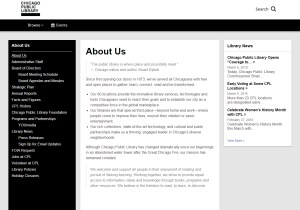
Chicago Public Library’s page is minimalist with clear language and an easy-to-navigate menu.
We should transform our About Us pages into something that really has meaning to our community. This is the web page where decisions are made by all of your stakeholders. You want the page to make potential cardholders feel “at home” and community leaders understand what it is that your library does and why it’s vital.
Here are four ways to transform your About Us page from an abstract section of your website into an amazing marketing tool.
Focus on the cardholder. Here’s a thought that many libraries have a hard time grasping: your About Us page isn’t actually about you. It’s about your cardholders. What is it that your library can do for the cardholder? Take your mission, vision, and values statement, which is likely written in lofty language, and rewrite it in a conversational tone. Or drop it from the page altogether! I know that’s a controversial standpoint but if your mission, vision, values statement is written with a bureaucratic bent, it won’t have any meaning to anyone outside your organization. Instead, think of your About Us page as a conversation between you and a non-library user. How would you, in normal conversation, tell someone about all the things your organization does? That’s what your About Us page should say. You might also take the opportunity to answer the most frequent questions your library gets from new cardholders.
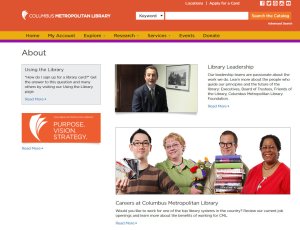
I love how the Columbus Public Library answers the #1 most frequent question right on their About Us page.
Tell your Library’s story. Whether your library has been around for decades or is newly formed, there’s a fantastic story about its birth and its longevity. Tell it on your About Us page, in a paragraph, with inspiring and optimistic language. Keep your bragging to a minimum. If your library has won many awards, you can mention them briefly and put them into the context of how that award translates to better service for your cardholders.
The Perth, Australia library’s About Us page includes all the essentials-how to get a card, sign up for a newsletter, and what is happening today at the library.
Less is more. Many libraries, including mine, have a long list of accomplishments and sub-headers on their About Us page. My library has 19 clickable sub-links! Pare it down. White space is good. Pick the five most important things you’d want people to know and move the rest to another section of your website. Remember, your About Us page isn’t really about you… it’s about your cardholder. What are the five things a person would need to know to convince them to get a library card or to give you more money?
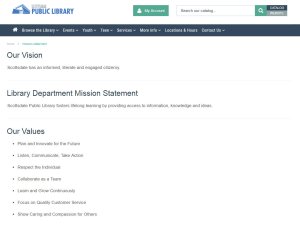
The Scottsdale, Arizona library takes a minimalist approach and it works!
Visuals are key. Great, high-resolution photos that show people using your library and the workers who man the buildings are essential. Photos of faces are scientifically proven to be a more effective communication tool that text. Bold, easy to read fonts and primary colors work best for communicating ideas and drawing the eye to the page. Keep text to a minimum and pare down to five concepts that will tell your story.
I like how the Toledo Public Library’s page is heavy on visuals and includes easy-to-navigate sub links written in plain language.
Subscribe to this blog and you’ll receive an email every time I post. To do that, click on “Follow” button on the bottom left-hand corner of the page. Connect with me on Twitter and Snapchat–it’s where I talk about library marketing! I’m @Webmastergirl. I’m also on LinkedIn, Instagram and Pinterest. Views in this post are my own and do not represent those of my employer.





 Super Library Marketing: Practical Tips and Ideas for Library Promotion