Search

Super Library Marketing: Practical Tips and Ideas for Library Promotion

Month

September 2019

Companies You Can Use to Track Media Mentions of Your Library PLUS the Secret to Make Sure Google Alerts Catches ALL of Your Mentions!

I don’t know about you, but I live in fear of something that I never imagined when I dreamed about working in library marketing.

My library is getting press coverage. I know it is. But am I seeing every article, TV segment, and radio interview? Are we getting credit for all the hard work we put into PR and media outreach? What if we’re missing something?

You can’t watch all the newscasts, listen to the radio 24-7, and read all the newspapers, magazines, online columns, and blogs. It’s just not possible. You probably ARE missing something.

That’s why many libraries pay specialized companies to monitor the media for them. Here are some of the best, from my research and from my own experience.

I’ve divided them into two groups: companies that list their prices on their websites and companies that makes you give them contact info in order to get a price quote (does anyone else find that to be annoying??).

I’ve also included a section on Google Alerts, and how to REALLY use it effectively so you don’t miss a mention!

Media monitoring companies with prices listed on web

Anewstip is basically a giant database. You can search for journalists, news articles, and Tweets. You can monitor your library or any of your partner organizations or competitors. Alerts are sent to you via email whenever the site gets a new “hit” on your search tips. You can sort by relevance or date. I really love this site!  It’s free for one person to use as long as you don’t want to pitch to the media using the site.

I knew BuzzSumo as a platform for content research but I recently learned they added media monitoring. Your library can track mentions by setting up an alert that’s emailed to you. They also tell you which piece of coverage is shared/engaged with the most. There is a free seven-day trial. The cheapest paid version begins at $79 a month.

Critical Mention claims their algorithm can find broadcast news coverage for your library eight times faster than their competitors. They can search more than 2,000 global television and radio sources and claim to capture 40 hours of video content every minute, though I have been unable to test this claim because my library isn’t paying for media mentions. They do come highly rated and have won many industry awards. They ask potential clients to email them and promise they’ll negotiate a package that fits your budget. Most companies pay between $30 and $100 a month.

Talkwalker Alerts is a popular free alternative to Google Alerts. I use it, and I find it to be very helpful. It crawls the web for mentions of any organization you wish, including your library and any competitors (I use it to spy on local museums and nonprofit organizations). It works very much like Google Alerts. You create an account, then set up keywords in the search query. You can focus your search if you like on just blogs or just social media, if you prefer. You can set it up to send you results on a daily or weekly basis. I use this All. The. Time.

Media monitoring companies that don’t list their pricing

Burrells Luce has full-service and self-service monitoring services. The self-service will probably cost less but require more work on the part of you and your staff. They come highly rated.

A lot of for-profit companies use Cision for their marketing and communication needs. But the company has a media monitoring product that allegedly searches more than seven million sources for mentions of your library. A Google search shows that prices are as low as $20 a month for basic services but I can’t verify that price includes media monitoring.

Media Library is the company with which I have the most experience. They can actually get copies of segments you know aired couldn’t record. If you know your library is profiled on the 11 p.m. news, this company can get you a copy of that report for a fee. I can’t find the fees on their website anymore (and their website looks original–like, it was created in 1995 and never updated!) But we used them from 2013 until 2017 and I had no issues with them. Their coverage is limited–they are only in 27 markets in the Midwest, so there are libraries for whom this company is not an option.

The secret to make Google Alerts work really well

One of the first things I did when I sat down at my desk at the library on the first day was to set up Google Alerts. It’s free and easy.

There are drawbacks. It often returns results from my own website. And it sometimes misses results. But for me, it consistently catches the segments on TV, radio, and in local print publications as long as they make it onto the website of the news outlet handling the coverage.

The trick to getting results is to set up Google Alerts for a BUNCH of terms, not just the main name of your library system. I have a Google Alert set up for every branch of our system (41 in all!) plus all of our senior leaders, and the names of our major events, plus our big vendors like Treehouse and Overdrive (The actual alert is for Cincinnati Library Treehouse and Cincinnati Library Overdrive).

Setting up a ton of alerts does mean I catch a lot of mentions that are not related to my library, but I just spend a few minutes a day deleting the stuff that’s irrelevant. In the mix, I always find the mentions I need.

You can set Google Alerts to send you an email when it finds something or you can set it to once a day at a specified time (that’s the option I’ve selected). And you can go in later and modify and delete alerts easily.

Do you use a media monitoring service not listed in this article? If you like it and want to recommend it, please tell us about it in the comments.

Subscribe to this blog and you’ll receive an email every time I post. To do that, click on “Follow” button in the bottom left-hand corner of the page. Connect with me on YouTube, Twitter, Instagram, and LinkedIn.

The Library Marketing Show Episode 13: Best FREE Ways To Reach Non-Cardholders!

Watch Now

In the episode, we answer a viewer question from Melissa of the Dallas Public Library who asked about the best cost-effective methods for reaching non-users – and by cost-effective, she means free! My answers might surprise you. Let me know what you think in the comments and add to the discussion by talking about your own success stories for reaching non-cardholders. Thanks for the question, Melissa! You can submit a question or a discussion topic by going to this page and filling out the form.

Also we extend kudos to Amanda, a librarian with the LaPorte County Library in Indiana, for her taco bookmark Tweet that went viral! You just never know how these things are going to take off. HuffPost even wrote a story about it.

And I review The People We Hate at the Wedding by Grant Ginder. Let’s connect on Goodreads!

Stay in Touch

Check the Upcoming Events page to see where I’ll be soon. Let’s connect! More events are coming soon.

Have an idea for the next Library Marketing Live Show? Submit it now.

Subscribe to this blog and you’ll receive an email every time I post. To do that, click on “Follow” button in the bottom left-hand corner of the page. Connect with me on Twitter, Instagram, and LinkedIn.  
The Library Marketing Show Episode 12: How to Convince People that Flyers ARE NOT the Be All, End All of Library Marketing!!

Watch Now

In this episode, we’ll answer a reader question from Jenny at the Redwood City Public Library about how to address that age-old complaint: WHY CAN’T I HAVE MORE FLYERS? FLYERS ARE AMAZING! from your fellow library staff and how to convince them that digital promotions are worth time and effort. Thanks for the question, Jenny!

You can submit a question or a discussion topic by going to this page and filling out the form.

Also Kudos to Stark County Library in Canton, OH –find out why I think they’re amazing.

And a book review of “Calypso” by David Sedaris PLUS find out which book I couldn’t finish and why!

Stay in Touch

I’m speaking at two conferences this fall and you can register for both on the Upcoming Events page. I just finished the slides for OLC! I’m really excited about that one. Details about the talks at both conferences are on the page and more events are coming soon!

Have an idea for the next Library Marketing Live Show? Submit it now.

Subscribe to this blog and you’ll receive an email every time I post. To do that, click on “Follow” button in the bottom left-hand corner of the page. Connect with me on Twitter, Instagram, and LinkedIn.  

How Your Library Can Use Google Ad Grants to Supercharge Your Website and Reach a Huge Untapped Audience

Note: A newly updated version of this blog post is now published. Read it here.

The Library Marketing Show Episode 11: EVERYONE Wants a Library Marketing Video! How Do You Handle Requests and Stay Sane??

Library Marketing Show Episode 11

Watch now

Reader question: Tiffany Wilson of Chattahoochee Valley Libraries says, “We’ve recently added a Multi-Media Production Specialist position to our Community Engagement Department. As expected, everyone is extremely excited about his skill set. What criteria have you established for video production?”

Thanks for the question, Tiffany! I just added a videographer and I’m having the same problem… er… challenge as you. Everyone wants a video. I talk about how I’m setting boundaries and the form I’ve created to help me channel all marketing promotional requests into the right tactics.

Other helpful articles for video library marketing

The Latest Data on the Biggest Video Library Marketing Questions

What a Firecracker and a Watermelon Have to Do with Library Video Marketing

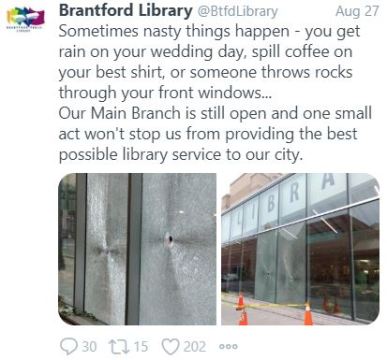
Kudos: Going out to the Brantford Library in Brantford, Ontario, Canada for the classy way they used social media to respond to an act of vandalism at their Main Library.

Brantford Library's twitter response to vandalism

Book review: This week, I reviewed Unlearning God: How Unbelieving Helped Me Believe by Phillip Gulley. Hey, let’s connect on Goodreads because I’m obsessive about keeping track of books and writing reviews and I love getting recommendations from other readers!

Bonus

If a customer has a bad experience, word will spread fast. That’s why the Pioneer Library System in Oklahoma made customer satisfaction a priority for all library staff. Learn how they used Orangeboy, Inc. to build a stronger library during a special webinar on the Net Promoter Score on Sept. 19. Register now.

Stay in Touch

I’m speaking at two conferences this fall and you can register for both on the Upcoming Events page. More events coming soon!

Have an idea for the next Library Marketing Live Show? Submit it now.

Subscribe to this blog and you’ll receive an email every time I post. To do that, click on “Follow” button in the bottom left-hand corner of the page. Connect with me on Twitter, Instagram, and LinkedIn.  


Frustrated with Your Library Marketing Newsletter? Here’s Why You’re Not Getting the Results You Want AND How to Fix It

I hold a controversial opinion. Newsletters are an ineffective tool for library marketing.

I totally understand why libraries create them. Our customers are a wide and diverse audience and our budget is limited. Newsletters are an easy and efficient way to get information to our audience.

But many libraries are frustrated by the lack of demonstrable results from their newsletters, both the print and email versions. And there’s a reason you can’t get good results from a newsletter.

The mistake is: You’re sending the same message to all of your cardholders.

It’s understandable. It feels like the natural thing to do. Your library has great stuff and you want everyone to know about everything.

The problem with that approach is that your cardholders are individuals. One message never fits them all. The needs and interests of your cardholders vary greatly.

I’m not suggesting you ditch your newsletter. By transforming the way you approach your current print and e-newsletter, you can make it actually work! The trick is to make changes that increase your newsletter’s value by refining the message.

Tips that work for both print and e-newsletters

Give your cardholders LOTS more of what THEY want. I know you’ve been keeping track of attendance at events and holds or checkouts of books you promoted in your previous newsletters. If you notice that your newsletter audience turns out for a particular type of event or that they like a particular genre of books or collection items, put MORE of those in your newsletters.

Library marketers are often pressured to promote what their co-workers or bosses think is interesting. Or worse, what their co-workers think the audience NEEDS to hear.

I’ve actually had to gently explain to my colleagues that, while reading classic authors like Ernest Hemingway and Jane Austen are good for the brain, most people are not looking for an intellectual challenge when they reach for a book. It’s like getting kids to eat their vegetables. Veggies are healthy, but if your child doesn’t like them, they’ll clamp their mouth shut and refuse to take a bite.

The newsletter audience is the same. You can’t make people attend events or read books because they’re healthy or intellectual. Library marketers sometimes have to be an advocate for their audience; you have to be persistent in your defense of what your cardholders want.

At my library, we pivoted our newsletter to focus more on our the parts of our collection that our cardholders like. We had the data to back it up. We know that our cardholders really love content about coding and coding classes. We know they love mystery books. We know they love workshops about writing and publishing their own books. We learned all of these nuanced preferences by carefully measuring our audience’s response to marketing in all areas. Patterns emerge. And now, we do a lot of promotion around these areas because we know, for a fact, that our cardholders love this kind of content.

Make your content helpful, not promotional. Your cardholders are regularly bombarded with offers, sales, and promotions, both in their inbox and in your mailbox. To get people to read your newsletter, the content needs to be interesting, useful, or helpful.

Hundreds of studies and surveys about consumer behavior show us that content that is educational or entertaining gets better results that content that is promotional. So how can you promote something while being entertaining or informative? Content marketing in the answer.

Content marketing is a strategic approach focused on creating and distributing valuable, relevant, and consistent content to attract and retain a clearly defined audience–ultimately, to drive profitable consumer action.

Content marketing breaks through the noise and the clutter by providing compelling, useful information for your cardholder–any type of information. It addresses whatever pain points your cardholders have. It positions your library as the go-to place for information. It builds trust.

And through content marketing, your library gets a better and deeper understanding of your cardholders. You can use that understanding to do a better job of addressing your cardholders’ needs. It’s a constant circle of giving and it carries more weight for a longer period than a traditional newsletter promotion.

Stop thinking of your publication as a newsletter. Start creating news magazines. Most library newsletters that come to my inbox or mailbox are long and contain a ton of text and images. There isn’t much white space and scanning them is difficult, because there is so much to scan.

At my library, we increased the effectiveness of our print newsletter by transforming it into a magazine. We trimmed it from 16 to 12 pages. My graphic artists started to give the publication a magazine feel in layout, using bolder visuals and shorter, more engaging articles. We left some white space. We changed the balance of the articles from 100 percent promotional to 50 percent informational and 50 percent promotional (even I have to fight the battle with my library to be less overtly promotional!).

What happened when we made these changes? Our news magazine became a must-read. People started asking when the next issue would be out. We had to order more copies. Library staff and outside partners vie for space in the publication. The news magazine is popular!

Tips specific to e-newsletters

Keep the text short and scannable. Your e-newsletter is a touch point, not the end of a conversation. Readers should get enough to be left with the feeling of wanting to know more about a particular subject. Drive your recipients to your website or another platform where they can get more information with compelling text and enticing calls to action.

Make it easy to share your e-newsletter. Include social share buttons that link directly to your library’s social pages.

Segment your e-newsletters. You can segment your e-newsletter in a number of ways… by age, by interest, and by location. This means you’ll need to create more than one e-newsletter. But each one will be targeted to a specific audience, which increases effectiveness. This step will be more work for you but it’s worth it for better results.

By targeting your message, you are more likely to say something that matters significantly to your cardholders. That individualized message makes them more likely to take an action, which makes it more likely that your newsletter will be successful.

More help for library marketers

How the Best Newsletters Get-and Keep-Reader’s Attention from Content Marketing Institute

NoveList’s Guide to Best Practices for Library Newsletters

7 Tips for Creating Engaging Newsletters from Mailjet

Great examples of targeted library newsletters

Dallas Public Library’s Young Black Readers Newsletter

Indian Prairie Public Library’s DVD Preview

Subscribe to this blog and you’ll receive an email every time I post. To do that, click on “Follow” button in the bottom left-hand corner of the page. Connect with me on Twitter, Instagram, and LinkedIn.


A WordPress.com Website.

Up ↑