Angela Hursh leads an outstanding team of marketing and training professionals at NoveList, a company dedicated to helping libraries reach readers. A 2023 Library Journal Mover & Shaker, she has also created courses on LearnwithNoveList.com designed to help library staff learn how to create effective marketing. Before her job at NoveList, Angela led the content marketing team for the Public Library of Cincinnati and Hamilton County. She also has more than 20 years of experience as an Emmy-award-winning broadcast TV journalist.
In this episode, I explain how Hotjar works to help you understand how people are using your library website… and how you can use that information to improve the user experience for your community. (Hotjar did NOT pay for this video… I just think it’s a cool idea!)
Kudos in this episode go to the Mansfield Richland County Public Library for producing an amazing video.
Do you have a suggestion for a topic for a future episode? Want to nominate someone for kudos? Let me know in the comments. And subscribe to this series to get a new video tip for libraries each week!
In this episode, Angela lays out a step-by-step plan for libraries who may be forced to close their physical buildings again because of rising COVID cases.
Kudos in this episode go to the Manatee County Library system for their incredible Enjoy From Home website section.
Do you have a suggestion for a topic for a future episode? Want to nominate someone for kudos? Let me know in the comments. And subscribe to this series to get a new video tip for libraries each week!
In this episode, Angela answers a viewer question from Debbie Walter, who wanted to know how libraries can get people to attend virtual programs when so many people are suffering from “Zoom Fatigue.”
Kudos in this episode go to the Whatcom County Library System for a piece of user-generated content that they turned into a cute and exciting marketing piece.
Do you have a suggestion for a topic for a future episode? Want to nominate someone for kudos? Let me know in the comments. And subscribe to this series to get a new video tip for libraries each week!
In this episode, Angela answers a viewer question from Lori Hagen, who wanted to see how these videos come together. She’ll take you behind the scenes. It’s a lot easier than you think… in fact, anyone can create videos!
Kudos in this episode go to the Tacoma Public Library for their innovative virtual programming for adults, including tutorials for how to use their digital resources.
Do you have a suggestion for a topic for a future episode? Want to nominate someone for kudos? Let me know in the comments. And subscribe to this series to get a new video tip for libraries each week!
In this episode, Angela explains why she believes that marketing your library’s collection will keep your library afloat during these trying times. She’ll lay out three reasons why at least 50 percent of your marketing should be promoting your collection.
Kudos in this episode go to Stacey Desroisers and Melissa Mannon who launched “The Curious Reader” podcast, a collaboration between the Goffstown Public Library and the local high school.
Do you have a suggestion for a topic for a future episode? Want to nominate someone for kudos? Let me know in the comments. And subscribe to this series to get a new video tip for libraries each week!
If there was ever a time when your library would need to survey your community and cardholders, it’s now.
This year has been wildly difficult for libraries and their communities. And the pandemic will be a factor in the lives of our cardholders into 2021.
To prepare our services, collection, and programs, we need to know exactly who is using the library and how they are using it. We must also anticipate our community needs going into the next year.
A customer feedback survey is the best way to gather this data. Here’s how to put one together.
Before you start
The first step in the survey process is to come up with a plan and answer some important questions.
Why are we doing the survey? You may use a survey to determine how people use your library. You may be testing to see whether there is a tangible need for a particular service before you invest in it.
Perhaps you are looking to gather demographic information about your service population. You might also want to ask questions to get at the psychographic makeup of your cardholders so you can better segment your marketing audiences.
Write down your reasons for creating a survey. You’ll also want to write down what you hope to learn from your community’s answers.
It’s important to put the answers to these two questions in writing to keep yourself accountable. The written answers will remind you of your goals as you write the questions, distribute the survey, and evaluate the results.
How will you distribute the survey? Distribution of surveys can be tricky for libraries because our populations are so diverse.
How do you make sure that people from all communities and demographic populations are represented? What about cardholders who don’t have digital access? Do you hope to have answers from non-cardholders? Create a plan for addressing these points.
What will we do with the results? The final step of this first phase is to plan for how you will work with the results of your survey.
Who will look at the results and aggregate them? Who gets to see the results? And who will be responsible for implementing changes to library services based on the results?
How many questions can you ask?
Survey Monkey analyzed more than 10,000 surveys to make their recommendations. And they found that fewer questions get better results. The more questions you add to your survey, the less time people spend answering each question.
To gather more thoughtful responses, you’ll want to use as few questions as possible. SurveyMonkey says an effective survey will take no more than 7 minutes to complete. Their data shows people will abandon surveys that take longer than that.
A 7-minute survey will be about 10-15 questions long, depending on the type of questions you ask. If you find that you need more than 15 questions, consider doing more than one survey.
Writing the questions
Writing your survey questions is like writing a blog post. For the final product, you’ll want a tightly written and concise set of questions. But to get there, you’ll need to get a little messy.
You should approach the first draft of your questions with no limits. Write down everything you want to ask your community about the library. Use whatever format of question first comes to mind.
This exercise will create an ugly but important first draft which you can mold into an amazing survey. Once you have that draft, go back through, and highlight the questions you absolutely must ask.
Be sure your questions don’t ask two questions at once. Doing so will confuse your respondents and lead to less reliable survey results.
For example, don’t ask “How would you rate our branch cleanliness and the wait time at the checkout counter?” Split those questions to get a more accurate picture of your community needs.
Consolidate questions that are repetitive. You may find you asked the same thing, or very similar things, but in a different way.
Once you have a final list of questions, mix the formats to create the best results. Data suggests that most of your survey questions should be multiple choice or matrix-scale.
Try to ask no more than two open-ended questions in a 10-15 question survey. The more time your respondents must spend composing their answers to open-ended questions, the more likely it is that they won’t complete the survey. While open-ended questions can be very insightful, use great intention when adding them to your survey.
Where to create your survey
With limited budgets, most libraries cannot afford to pay big money for a survey maker.
There are many free options, but most have limitations for how many surveys you can create and how many responses you can collect. Here are a few that have no such limitations.
Google Forms: Google Forms is my preferred free survey tool. You can create surveys and collect unlimited responses. It’s easy to create the survey and easy to export the data as a Google Sheet.
SurveyPlanet: Their free version allows for unlimited surveys, questions, and responses. They also have templates to get you started. Also, you can easily duplicate a survey. You cannot export your response data on their free plan, but you can look at it in a dashboard and use that data to create infographics, graphs, and other reports to communicate the results.
Free Online Surveys: This site has a limited free plan. I’m including it because they offer a substantial discount on their paid plan for non-profits. The paid plan unlocks some great features including unlimited responses and support. Their survey maker also has artificial intelligence to help you build an effective survey.
Launching your survey
Before you send your survey out to the world, be sure to thoroughly test it. You’ll want testers to look for spelling errors, confusing questions, and to make sure the order in which you ask your questions makes sense.
Send your survey to staffers outside of your department and to friends and family. Get as many people to test it as you can before you launch.
Once you’re sure your survey is ready, it’s time to send it out into the world. Email the survey to all cardholders. Place printed versions of the survey at the checkout desk for people who don’t have digital access.
For the duration of the survey, prompt patrons to fill out the survey in every interaction, including at curbside pickup, during virtual programs, and in reference emails and phone calls.
The amount of time you’ll leave your survey open for responses really depends on your community. You’ll need to monitor the results and be flexible.
In initial launch round, be vague with your respondents about how long they have to complete the survey. You might say “Take a few moments now to give us your feedback.” Then watch to see how well your community responds.
Once you start to notice a lag in responses, you may do another round of promotions that sound more urgent. “Complete this survey before Friday to make sure your voice is heard” or “We’re closing this survey in two days so be sure to give us your thoughts!”
In general, don’t leave your survey open for answers for longer than two weeks.
Have you done a library survey? Do you have other tips and suggestions for creating a survey? Share your thoughts in the comments below.
Subscribe to this blog and you’ll receive an email every time I post. To do that, click on the “Follow” button in the bottom left-hand corner of the page. Connect with me on YouTube, Twitter, Instagram, and LinkedIn.
In this episode, Angela answers a question from Emily Orischak, Community Relations Coordinator at Berks County Public Libraries. She wants to know how to gather stories from your library patrons about why they love and use the library! Angela shares some tips that any library can use.
Kudos in this episode comes from Carrie Weaver who nominated the Peters Township Public Library for the work they did promoting books during Banned Books Week.
Carrie said, “I have to nominate the staff members at my library who created an awesome video to explain Banned Book Week and show several examples of books that are banned. We also have a display of all of our banned books in the main lobby for people to check out and celebrate their right to read! I am so proud of them!”
Do you have a suggestion for a topic for a future episode? Want to nominate someone for kudos? Let me know in the comments. And subscribe to this series to get a new video tip for libraries each week!
This is the second in a two-part series on email marketing for libraries. Read part one here.
At the Library Advocacy and Funding Conference in September, a new buzzword seemed to be on the lips of many of the presenters. They were all talking about psychographic segmentation of library audiences for email marketing.
I thought I knew most of the marketing buzzwords, but I confess this was the first time I’d ever heard the term. So, it was time to do some research.
What is psychographics?
Psychographics is the study and classification of people according to their attitudes, aspirations, and other psychological criteria, especially in market research (Oxford Dictionary).
Psychographics go beyond basic demographics: location, age, gender identity, and library card usage. To segment by psychographics is to divide your library audience into groups according to their beliefs, values, and reasons for being. It delves deeper into your cardholder’s values, dreams, desires, and outlook on life.
Psychographics identify motivation. Why does your library community take certain actions? Why do they feel the way they do about the library? How do they see the role of the library in their life? And what activities do they participate in, both inside and outside of the library?
Psychographics lead to compelling email marketing messages because they focus on your community’s unarticulated needs and motivations.
Understanding psychographics
The term is new to me but it’s not new to marketing. In 1964, Harvard graduate and social scientist Daniel Yankelovich wrote that traditional demographic traits—sex, age, and education level—lacked the insights marketers needed to target their audiences.
Around the same time, market researcher Emanuel Demby began using the term ‘psychographics’ to reference variations in attitudes, values, and behaviors within a specific demographic segment.
In the 1980s, the Stanford Research Institute developed the Values Attitudes and Lifestyles (VALS) psychographic methodology. It was hailed as a breakthrough in marketing.
One way to understand this concept is to find your own VALS type by taking this survey. My results show that I like to have historical context, that I buy proven products, and that I’m not influenced by what’s “hot.” I also like to experiment. Share your results in the comments.
The travel industry uses psychographics. Email marketing by hotels, cruise lines, and cities, states, and countries often focuses on why a person wants to travel: adventure, romance, curiosity, and relaxation.
Libraries can do the same thing.
Imagine if we started focusing our library email marketing messages not on what are cardholders want to do… but WHY they want to do it.
Uncover the psychographics of your library audience
How do you figure out what makes your library audience do the things they do? You must ask them! A survey is the best way to drill down on the psychographics of your library audience.
Most library surveys focus solely on demographics like age, location, and income. They generally ask people how they use the library now. They may ask people to predict how they’ll use the library in the future.
By adding psychographic questions, you’ll get a look at your audience’s true motivations. That may include questions like, “The last time you checked out a book, what was the reason?” “How do you feel about the library’s work with people experiencing homelessness?”
You can also use matrix-rated questions to gauge psychographics. For instance, you could include a statement like “The library helps people find a new job” and ask respondents to select an answer from a range of “not important” to “extremely important.”
You can also use outside data sources to get at the psychographics of your library audience. Take a closer look at the comments on your social media posts. Can you uncover any reasons why your followers are interacting with your library on social media? Do they share or comment on a particular type of post?
Check Google analytics on your library’s website. Are visitors taking the same steps to move from one landing page to another on your site? Do they spend a longer amount of time on one type of page?
Your circulation stats are a source of psychographics. Are you seeing a surge in the checkouts or interest of one genre of book, or one format? What language do your cardholders use when they ask for recommendations using your form-based readers’ advisory service?
If your library answers reference questions, what type of problems and language are your cardholders using when they ask for help?
Try to look at any interaction your library has with your cardholders, in any arena, as an opportunity to unlock their motivations and psychology. Then use those new insights to craft compelling email marketing messages.
Using psychographics in library email segmentation
Libraries can segment their email audience without violating CAN-SPAM laws. If your cardholders gave you permission to send them email, you can segment them into psychographic segments. As long as your email includes opt-out language (i.e. “If you no longer wish to receive emails about job services at the library, click here”), you are complying with the law.
Combine your demographic knowledge of your cardholders with the research you’ve done on the psychographics of your cardholders. Then divide your email recipients into new segments and try sending them psychographic messages.
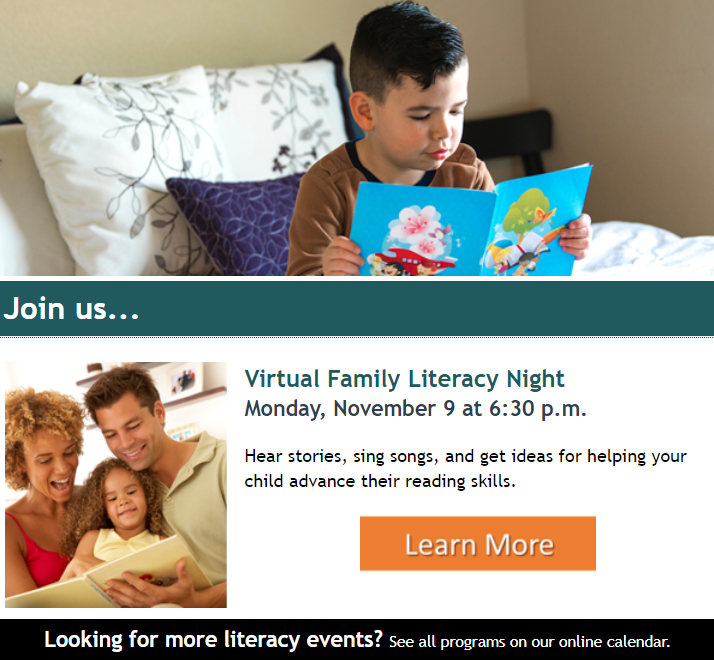
For example, let’s say you are already sending a monthly email to parents about storytime at the library. Now let’s say your library decides to offer a new program, like a virtual family literacy night, to help families whose children are not attending in-person classes during the pandemic.
Without psychographics, your email message may have looked like this:
But, thanks to your survey results, you know that many parents are worried about the effect that virtual learning is having on their child’s education. They believe their child will need extra tutoring and classroom attention to succeed in life because of the impact of virtual learning.
Now you can combine your audience’s motivations for attending with your message about the new program.
This marketing message pivoted from a simple invitation to a message that strikes at the heart of the caregiver’s concern for their child.
Psychographics activate the motivations and aspirations of your cardholders. When you get to know your community better, you’ll do a better job of getting your community to know your library!
Subscribe to this blog and you’ll receive an email every time I post. To do that, click on the “Follow” button in the bottom left-hand corner of the page. Connect with me on YouTube, Twitter, Instagram, and LinkedIn.





 Super Library Marketing: Practical Tips and Ideas for Library Promotion