AI can generate quick answers, but that doesn’t mean it replaces the value of a library collection.
A viewer recently asked how libraries can promote their collections as an alternative to AI, and I thought it was a fascinating question.
In this episode of The Library Marketing Show, we explore ways to position the library’s collection as something deeper, richer, and more trustworthy than an AI summary.
Plus, find out why a project that involves the whole of the United States is getting kudos!
Do you have a suggestion for a future episode’s topic? Do you want to nominate someone for kudos? Let me know here.
Should libraries stick with traditional opt-in email marketing or consider moving to an opt-out model?
A viewer recently asked this question, and it opens up an important conversation about reach, engagement, and email reputation.
In this episode of The Library Marketing Show, I share my perspective on this sometimes controversial topic and offer guidance for libraries that might be considering a change.
Plus, we’ll award kudos to a library using social proof to promote its value across its whole community.
Do you have a suggestion for a future episode’s topic? Do you want to nominate someone for kudos? Let me know here.
What do you do when one format in your library collection just isn’t circulating the way it used to?
A viewer of The Library Marketing Show is facing exactly that challenge and reached out for advice. In this episode, I share a few marketing ideas that could help revive interest and invite you to contribute your own suggestions as well.
Plus, we’re giving kudos to a library that is handing out VERY special, limited edition library cards!
Do you have a suggestion for a future episode’s topic? Do you want to nominate someone for kudos? Let me know here.
I talked to library users. And what they revealed shook me.
The conversation ignited unexpected controversy on LinkedIn and exposed a blind spot many libraries don’t realize they have. In this episode of The Library Marketing Show, I break down what I heard, why it matters, and how libraries can turn this uncomfortable insight into a powerful opportunity.
Plus, kudos go to a library reaching a new section of its community with book recommendations!
Do you have a suggestion for a future episode’s topic? Do you want to nominate someone for kudos? Let me know here.
Have you ever wondered how your community discovers books? Here’s a spoiler alert…
It’s not just on your shelves! A new study explores the discovery habits for books in Canada, the U.S., Australia, and New Zealand. I’ll give you the highlights and three smart marketing tips for each area that you can do to promote your collection in this episode of The Library Marketing Show.
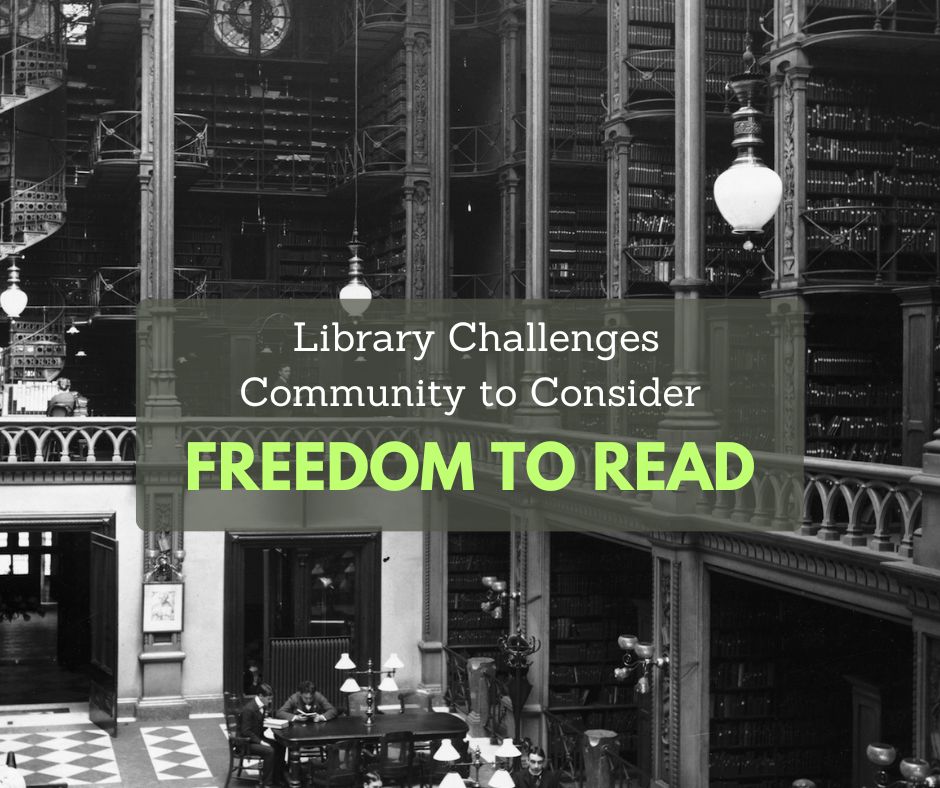
Plus, we’ll give kudos to a library for a program that promotes Freedom to Read without being partisan or political.
Do you have a suggestion for a future episode’s topic? Do you want to nominate someone for kudos? Let me know here. Thanks for watching!
Subscribe to this blog, and you’ll receive an email whenever I post. To do that, enter your email address. Then, click the “Follow” button in the lower left-hand corner of the page. You can also follow me on the following social media platforms:
A new study about books and publishing reveals two concrete action steps you can take to prove the value of your library and increase circulation! Those steps are revealed in this episode.
Plus, kudos go to a library that received coverage for an event on Yahoo News!
Do you have a suggestion for a topic for a future episode? Want to nominate someone for kudos? Let me know here. And thanks for watching!
Subscribe to this blog and you’ll receive an email whenever I post. To do that, enter your email address and click on the “Follow” button in the lower left-hand corner of the page. You can also follow me on the following social media platforms:
Most of us think libraries are a magical place. But the library Patrick Culliton frequented as a child was truly a place of wonder.
It was in the William E. Telling Mansion in South Euclid, Ohio. Built in 1928, the Telling Mansion now houses the Museum of American Porcelain Art. But back when Patrick was a kid, this historic building was home to the South Euclid-Lyndhurst branch of the Cuyahoga County Public Library system.
“I remember going to storytimes with my mother, studying with friends in junior high, and even exploring the wooded area on the back part of the lot,” recalls Patrick.
Nowadays, Patrick works on a marketing team of two at Willoughby-Eastlake Public Library. He and his coworker manage all the digital and print promotion for the library, which serves a population of 67,000 residents with four locations.
A few months ago, Patrick and the team at Willoughby-Eastlake launched a Banned Book Challenge. The idea came from the library’s Collection Services librarian, who was concerned about calls to remove library materials from shelves.
“I noticed other libraries and educational institutions in Ohio conducting their own events about “controversial” materials, including art shows, book discussions, and guest presentations,” says the librarian, who wishes to remain anonymous. “It felt right to involve the Willoughby-Eastlake libraries in the effort to combat book banning and to educate the public about the matter.”
“To promote the Banned Books challenge, I had our four library branches create a display for their building that encouraged patrons to sign up for the challenge and retrieve a small prize from the circulation desk for noticing the display.”
“The primary goal was to engage readers and encourage them to check out library materials. That is always the main prerogative for all reading challenges—to get patrons in the door and circulating those library materials!”
“The second goal was to show the public what materials are up for debate—currently and throughout history. I assembled a list of 450 books that have been challenged at any point in time in the United States. Patrons and staff alike were surprised to see their favorite books from childhood, such as Where the Wild Things Are on the list with A Clockwork Orange and The Bluest Eye. The public had an opportunity to learn why books were challenged, as well as what is challenged.”
Library staff published a blog post to explain the threat that book challenges pose to all readers. The challenge itself was simple: patrons were asked to read 5 books from the banned books list and enter a drawing for a gift card.
Patrick and his team promoted the challenge using a press release, a graphic for our website carousel, scheduled social media posts, and the library’s e-newsletter.
“The experience itself was up and down,” remembers Patrick. “Our local paper ran a story on it from our press release, and they shared their article on their Facebook page, which got a lot of traction. The comments there were mostly positive.”
“Then, when we sent our e-blast the following Monday, with the Banned Books Challenge as the lead, we received a few angry phone calls and emails. While this was concerning, it spurred us to have a good conversation at our Staff Day. Marketing and Administration then updated some policies related to materials challenges and first amendment audits and then supplied staff with the necessary support and documentation, should these issues arise in the buildings.”
“And I should say, we also got a few positive emails from patrons, too, along with positive comments on our posts about the Challenge. That e-blast had a marked increase in clicks, naturally.”
The email had a click-through rate of 6.5 percent. That’s three times higher than Willoughby-Eastlake’s average click-through rate.
163 people of all ages signed up for the challenge and 35 people completed it, reading five banned books. Two of those patrons won Target gift cards.
“We received a lot of positive feedback both online and in-person,” says the collection services librarian. “Patrons enjoyed the displays and shared the social media posts about the challenge.”
“We also received a handful of disputes, which were handled accordingly. Complaints were mainly made over the phone to the director. Willoughby-Eastlake employees also hosted a panel for the staff, in which they learned more about banned books on a larger scale and how to handle argumentative patrons.”
Now Patrick and the staff are turning their promotional attention to their winter reading Warm-up Challenge and the Solar Eclipse in April.
“We have a LOT of eclipse glasses, programs are being planned, and one of our Librarians received Eclipse Ambassador training from the Great Lakes Science Center,” relays Patrick. “It’s going to be a fun, wild day!
For inspiration, Patrick and the team follow lots of other libraries on social media. And one non-library account: the NE Ohio Regional Sewer District’s Twitter account.
Subscribe to this blog and you’ll receive an email whenever I post. To do that, enter your email address and click on the “Follow” button in the lower left-hand corner of the page. You can also follow me on the following social media platforms:
Photo courtesy Cincinnati and Hamilton County Public Library
My co-worker Yaika recently returned from StokerCon with an amazing library marketing story.
Yaika was on a panel. The organizers of the panel brought about 700 Advanced Reader copies, or ARCs, to the session. An ARC is a version of a book that is made available before the official publication date.
The ARCs were set on tables before the presentation. The panelists then talked about the various ARCs during the session, naming them by title and author and discussing the most intriguing things about each book.
Of course, they gave a quick summary of the plot. But, every time they talked about a book, they mentioned the appealing factors that make people want to read a book: the characters, the tone, the setting, the pacing, and the themes.
And once the audience heard the appealing factors, a bunch of people would jump out of their seats and run to the ARC table to see if the book was available.
Why did attendees, who seemed hesitant to pick up a book before the session, feel compelled to grab books during the session?
It’s because the panelists were book-talking.
A book talk is a short presentation about a book to convince other people to read it. Book talking is not a formal book report or review. It’s more of a mini-commercial.
And book talking is one of the most effective ways to promote your collection, especially when you describe the book using those intriguing story elements.
Whether you are a degreed librarian who works on library promotions or a communications professional who works in a library, everyone… and I mean everyone… can talk about books in this way.
Your passion for the collection, not your degree or expertise, is what makes this type of marketing so special. And promoting your collection is incredibly important to the success of your library.
Your collection is the reason most people get a library card. Books are your brand. You should promote your collection all year long.
If you are a front desk worker, you can book talk with patrons during every interaction! But how do you book talk if you aren’t working at the front desk?
Here are 5 promotional tactics that you can use to book talk with readers when you aren’t working directly with the public.
Email
Every month, I get an email from the Jacksonville Public Library that drives me to the catalog EVERY SINGLE TIME I get it. Do you know why? The email is a book talk in digital form!
I don’t even live in Jacksonville. I don’t live in Florida! But this email makes me want to read books.
The email contains a list of books, usually fewer than 10. Next to each book is a summary of the plot, plus a little extra something: a review, or a hint at something appealing about the theme, genre, or characters. It’s intriguing! And it makes me add to my TBR (to-be-read) pile.
I also love this example from Jefferson Public Library. Scroll to the bottom of the email to find a promotion that includes those appealing elements which can be more helpful in describing a book than the plot.
Print
The folks at LibraryReads offer a downloadable PDF flyer each month that is a book talk in print. Each of their selected titles is listed, along with a description of the book that includes not only the plot, but words that describe the book’s genre, intriguing factors, and the author’s style.
On your website
I must confess that every time I visit my library’s website, I am on the hunt for books. Your readers are too. Your job is to make those books sound enticing enough to compel them to place a hold.
Create a page on your website, like Naperville Public Library. They have their book recommendations divided by genre and age group.
And they describe more than the plot. The annotations next to each title help readers decide which of the titles to check out.
Bookmarks
Your library can “upsell” books using bookmarks. Upselling is a sales term in which customers are encouraged to buy a more expensive version of a product than they originally intended.
For libraries, upselling is any action that compels your cardholders to check out more items than they originally intended. And bookmarks are the easiest way to do this.
Start small and manageable. Pick 3 categories to focus on, like cookbooks, horror, and Westerns. You can also choose age-based categories like adults, teens, and early readers.
Once you’ve decided on your categories, make one bookmark for each of your categories. Each bookmark should feature 3-6 books (3 if your bookmarks are one-sided, 6 books if your bookmark is two-sided).
For each book on your bookmark, add a photo of the cover (because book covers can also be enticing!) and the title. Then, write one line about the plot. Write a second line about the characters. Write a third line that describes the book using intriguing language like “quirky,” “thought-provoking,” and “funny.”
Challenge yourself and your staff to hand out a bookmark during every patron interaction. Make it a game to match the bookmark with the patron’s interest using context clues.
For example, if you saw the person browsing your new arrivals display and they’re an adult, you can hand them your adult fiction bookmark.
If someone comes to the drive-through to pick up their holds and you notice they’re checking out a whole stack of picture books, give them one of the early readers’ bookmarks. Heck, give them an adult bookmark too!
If someone checks out a cake pan from your Library of Things, give them a cookbook bookmark. And so on.
Videos
Ask a fellow staff member or patron to talk on camera about a book they read and loved. Challenge them to do it in under 60 seconds, like Thayer Public Library does!
Then, post the video natively to all the social media platforms your library uses with a direct link to the book in the catalog. You know how social media platforms LOVE videos!
Bonus idea
I have to share this infographic created by Lester Public Library. They gathered stats on book talks they provided to local students. It’s such a great way to prove the value of the library to the community, parents, and stakeholders like local legislators and funders!
Subscribe to this blog and you’ll receive an email whenever I post. To do that, enter your email address and click on the “Follow” button in the lower left-hand corner of the page. You can also follow me on the following social media platforms:
Photo courtesy Cincinnati and Hamilton County Public Library
I must be honest. I’ve never seen survey results like this one.
My library marketing friends are ALWAYS trying to figure out which social media platform will give them the best results for their goals.
And if your library is trying to drive circulation, it turns out there is a definitive answer.
TikTok.
The platform now boosts a million posts every two months JUST ABOUT BOOKS. And those posts are having a measurable impact on reading habits.
In May of 2023, Casino.org surveyed 10,000 TikTok users between the ages of 18 and 45 (the Gen Z and Millennial generations) who live in the United States and Canada.
Yes, an organization dedicated to gaming did a survey on reading. 🤷
They asked three reading-related questions.
Are you reading more because of the BookTok community?
If the answer is yes, how much more?
Have you ever read a book as a direct result of a BookTok recommendation?
Hang on to your hat, my friends.
48 percent of the survey respondentsin the United States and 53 percent of Canadian respondents said they are actively reading more books because of their exposure to BookTok.
Americans said the platform resulted in a 60 percent increase in their reading activity, with Canadians reporting an increase of 58 percent.
That means that a member of Gen Z or the Millennial generation who previously read 10 books a year is now reading as many as 16 books a year because they watch #BookTok videos.
Holy Kansas.
Casino.org also collected location data and used that to compare the impact that BookTok had on reading by location.
Here’s another stunning result: every state or province reported an uplift in reading among TikTok users.
In the United States, the impact on reading was the most profound in Maine, Nebraska, Idaho, Utah, and Kentucky. Other states where readers reported reading more because of BookTok were California, Nevada, Texas, Pennsylvania, Michigan, and Illinois.
In Canada, Saskatchewan saw the biggest increase in reading due to BookTok. But 57 percent of TikTok users in Ontario, Quebec, and Alberta also stated they are reading more because of BookTok.
If your library is posting on TikTok, you should 100 percent be creating videos that promote books. Here are five tips on how to drive circulation and promote your collection using this specific social media platform.
Ask a question of your staff.
Troy Public Library asked staff members to name a BookTok book that they think is overrated. The video is short, and it’s shot in a way that builds suspense. That’s the perfect way to get people to watch the entire video.
Use trending audio.
Scranton Public Library used this very popular piece of audio from a popular #BookTokker in this video. Chambers County Library System used audio from the Creepy Book Club account on TikTok to share reading recommendations from two of its library staff.
Using popular audio will boost the organic reach of the video by increasing the chances it will show up on a reader’s For You page. And if you’re running low on ideas about what to post on TikTok, just check out the trending pieces of audio as a place to start.
Use humor.
Vaughn Public Libraries used a short snippet of a popular movie soundtrack to create this hilarious clip. At just under 10 seconds, it perfectly introduces the library to a trigger-happy TikTok scroller.
It also subtly promotes the fact that the library’s BookTok recommendations are popular and nudges readers to follow the library account for great book recommendations.
Do something unexpected.
Most people think a library would only promote books with great reviews. But McHenry Public Library turns that notion on its head to highlight a one-star review of a book that most people would consider a classic. And they used a Taylor Swift song, capitalizing on her popularity to boost their organic reach.
Take advantage of staff creativity.
Perhaps it’s no surprise that the script for this hilarious and creative TikTok came from staff at the Los Angeles Public Library. We’d expect nothing less from a city just seven miles from Hollywood.
I bet there is someone at your library who is brimming over with creative ideas for BookTok videos. Put out a call for the best script or concept from staff and fill your content calendar while getting buy-in for the impact of BookTok from your co-workers. They’ll be more likely to share your videos on their personal accounts when they’re personally invested in the process.
For more tips on how to market your library using BookTok, here’s a great article by my co-worker Yaika Sabat. I must give her credit: she called out the impact of BookTok long before Casino.org did!
Subscribe to this blog and you’ll receive an email whenever I post. To do that, enter your email address and click on the “Follow” button in the lower left-hand corner of the page. You can also follow me on the following social media platforms:


 Super Library Marketing: Practical Tips and Ideas for Library Promotion