The Library Marketing Show, Episode 170: In this episode, I’ll reveal the single most important question that you should ask every library guest. This question is the key to revealing your most effective library marketing tactics.
Do you have a suggestion for a topic for a future episode? Want to nominate someone for kudos? Let me know in the comments. And subscribe to this series to get a new weekly video tip for libraries.
Also, I have a special request: I want to hear your best advice for library marketing in 2023! What did you learn this year? What are you excited to try next year? Share your thoughts for a future Super Library Marketing post.
Thanks for watching!
Subscribe to this blog and you’ll receive an email whenever I post. To do that, enter your email address and click on the “Follow” button in the lower left-hand corner of the page.
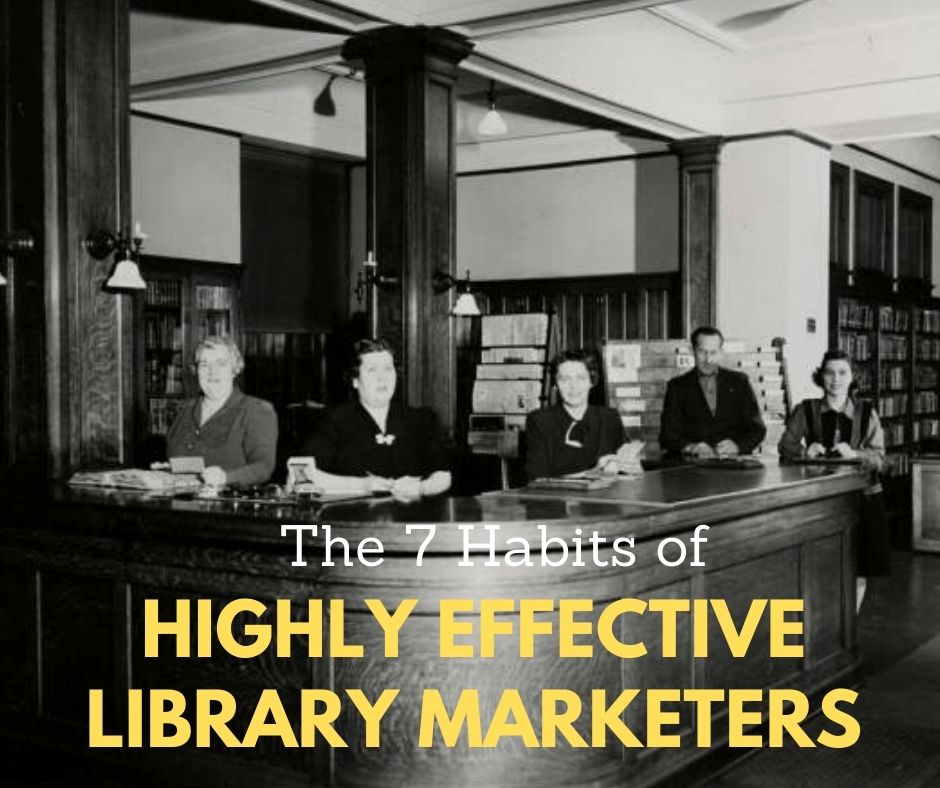
I’m 100 percent certain that everyone who reads this blog has heard of the book, “The 7 Habits of Highly Effective People” by Stephen Covey. Written in 1989, this self-help book has sold more than 25 million copies worldwide.
Covey’s approach to attaining goals is to follow what he calls “true north” principles. Those principles are based on seven character ethics that he says are universal and timeless.
It’s a great book. But, because I’m a weirdo, I read it and thought, “There needs to be a list like this specifically for people who work in library promotion.” No joke. My internal monologue is strange.
We need some true north principles for library marketing now more than ever. We face uncertainty in every corner. Algorithms and budget shortfalls and virus variants can make our job seem impossible.
It may feel like the whole world is working against you and your library. So here are my true north principles for doing your best and most effective work.
Be good to yourself.
This is first on my list because it’s the most important and frankly, most library staffers could use a little morale boost. This year, I want you to celebrate the work you do. Every. Single. Week.
By the way, my boss gets full credit for this idea.
It’s pretty simple: At the end of the week, write down all the things you did. Then, pick a “gold star moment“: one thing that you did that stands out for some extra recognition.
Send your list to your boss or keep it for yourself. It doesn’t matter. What matters is that you take the time to acknowledge all the work you’ve done in the last week.
And, rather than focusing on what you didn’t get done from your to-do list, recognize all the work you did do.
You’ll be surprised at how much better you’ll feel at the end of a workweek. And you’ll be motivated or excited about the work coming in the following week.
Be constantly learning.
I know that most library staffers are incredibly overworked. You’re promoting your library in addition to 100 other tasks, including cleaning the restrooms and acting as security. The idea of spending any time learning more about marketing feels overwhelming.
How does someone fit personal professional development into their schedule?
Set a learning appointment for yourself every single day. All you need is five minutes. Spend that very short but important block of time reading a blog, a book on marketing, or an email newsletter on marketing. If you’re a visual learner, watch a YouTube tutorial on marketing or work on a self-paced marketing course online.
For the typical, full-time library staffer working five days a week with two weeks of vacation, that will add up to 1,150 minutes or 19 hours of learning in a year! That’s plenty of time to stay on top of marketing and social media trends and learn new ways to engage your audience more effectively on all channels.
Best of all, at the end of that year of learning, you’ll feel more confident in your work and of course, your library’s promotional efforts will improve.
Need help finding places to learn about marketing in a short amount of time? Here’s a great list.
Be hyper-focused on your library’s overall goals.
What is your library trying to accomplish right now? Are you hoping to increase your circulation to pre-pandemic numbers? Are you helping to bridge the pandemic educational gap for elementary school students? Are you implementing a step-by-step plan to ensure your library is truly accessible to everyone? Are you undergoing a facilities improvement project?
Your promotions should be centered on whatever your library is trying to accomplish this year.
When you focus your marketing with precision on your library’s strategy, your marketing will be more effective. You will avoid spreading your message thin. You’ll be using your precious time and energy more efficiently.
Every piece of marketing you do needs to be in service of reaching your library’s strategic goals. They are the reason you come to work every morning. Make certain there is a solid connection between your promotional efforts and your library’s overall strategy.
Be a fan of data.
Block off five minutes in every workday to gather or analyze the metrics of your marketing and promotions. Just like with the professional development appointment you’re making each day, schedule this into your calendar.
This simple step will give you a very clear sense of what is working and what isn’t. You’ll have the numbers to back yourself up when you make decisions about which promotions to do and which ones to drop.
Be constantly experimenting.
One of my favorite parts of working in marketing is experimentation. There are so many ways we can test promotions to find the most effective means of communicating with our audiences.
I want you to think of yourself as a kind of scientist. Your experiments don’t have to be complicated.
For example, when you send emails, try sending on different days of the week and different times of the day.
When you want to promote an item in your collection or a service provided by your library, post on all your library’s social media channels. Then look at the insights to see where you get the highest engagement.
When you write blog posts, try experimenting with the length of the post, the length of the title, or the number of images you insert in the piece. Then look at views to see if your metrics are impacted by changing any of those factors.
Experimenting is fun. And it can lead you to create more effective promotions. Need some ideas about where to experiment with your promotions? Here’s a list of things to try.
Be open to change.
How many times have you heard someone say, “But we’ve always done it that way” in your library? Reject this phrase.
I think many times we get stuck promoting our library the same way we always have. Don’t be afraid to look at the data and say to your boss or co-workers, “This isn’t working. Let’s try this instead.”
In library marketing, change isn’t a bad thing. It means you are being responsive to your community’s needs and meeting them where they are as their lives are changing.
Sometimes it takes a while for fellow co-workers, senior staff, and your community members to respond to your ideas.
Effective library marketers set a timeline for how long they think it will take to increase engagement or reach a certain target audience with a message across multiple channels. A good rule of thumb is to give any new promotion about three months to catch on. If it’s not working by then, experiment with something else.
Subscribe to this blog and you’ll receive an email every time I post. To do that, enter your email address and click on the “Follow” button in the lower left-hand corner of the page.
There is a romantic notion attached to wandering the stacks of the library, aimlessly lost in a sea of books for hours on end.
But for a portion of our community, efficiency is the name of the game. They’re hoping to pop into your branch, find what they need, and get out as quickly as possible.
This is especially true in the Next Normal. Some community members just don’t feel comfortable spending a lot of time inside our buildings.
That’s where wayfaring signage comes into play.
Wayfaring signs help direct human traffic, making it easy for people to navigate our buildings. But the signs can do more than move bodies.
Wayfaring signage is a key marketing opportunity for libraries. An efficient and well-planned system of directional signs will make it easier for visitors to discover new or underused portions of your collection or services.
Unfortunately, for many libraries, wayfaring signage is an afterthought. Creating the best signage seems intimidating.
But now, when library buildings are just reopening for full service, we have an opportune time to reimagine and reshape the way the public moves through and uses our physical libraries. And this work doesn’t have to be complicated.
Here are six tips to help you create the traffic flow that is best for your community, your staff, and your library statistics.
Start with a signage audit.
Your first step will be to go through your library and make a list of all the wayfaring signs you currently have. Take photos to go with your list so that you can have an accurate record of your current signage situation.
Next, study how people are using your space. Pick an hour each day for three days and sketch a “heat map” of people entering and exiting your library. You’ll use a blueprint or map of your library. Watch how people enter the building, move through the space, and exit. As they move, trace a line on your map to indicate where they’ve been.
Using your heat map, you’ll be able to see how your current signage is affecting the way people move through your branch. This will help you identify which parts of the building are underused. You can start to imagine how to configure your new signage to move people into those key areas.
For instance, if you have a heat map that shows people are drawn to your computers and your holds shelf but are missing your Makerspace or your fiction collection, you’ll want to consider how you can use wayfaring signage to change the traffic pattern and draw people to those underused spaces.
Less is more.
It seems counterintuitive, but you don’t want to label every single shelf in every single section of your library. Too many signs are a distraction–the eye doesn’t know where to look and the brain gets overloaded.
Use your signs to point customers to underused areas. And consider leaving the other spaces blank. If a space is already popular and your customers know how to reach it, it likely doesn’t need any wayfaring signage.
Rely on a simple, consistent design.
Your library’s brand is your starting point for great wayfaring signage. Your logo use, color selection, font style, and wording should all be within brand guidelines.
Next, decide whether you’ll incorporate symbols, arrows, words, or a mix of all three. Moderation is key, but a well-placed arrow can help ease confusion and build confidence in your timid customers.
If your library has more than one branch, standardize wayfaring signs and signage terminology for all locations. Your customers will know exactly what to look for, no matter which branch they visit.
If your library doesn’t have clear branding, remember this: good signage isn’t fancy. It’s functional. Use a simple, accessible font in a neutral color like white or black with a plain background to make the sign pop. A clean, simple design will also add longevity to your signs and keep them from looking outdated.
You’ll also want to ask yourself whether your signs convey friendliness and helpfulness. Exclamation points, capitalized letters, and red font or a red background may come off as angry or unfriendly.
Ditch the library jargon.
In 2012, a reference librarian at the University of Berkley reviewed more than fifty library usability studies to pinpoint library terms that are generally not understood by the customer. His review uncovered problems with terms like “database”, “e-journals”, “periodical”, “serial”, and “reference.”
Whenever possible, we should be clear when we create our wayfaring signs. Instead of saying “reference”, you can use the word “research.” Instead of “periodicals”, say “magazines.”
Change the sign above your reference desk to say, “Ask us a question here!” The sign at your circulation might read “Check out your books here!”
Train staff to help with wayfaring.
Staff who know to look for signs of confusion in a community member are providing good customer service.
If an employee spots a customer who walks around directionless for a long time or who keeps looking around, staff can delight and surprise the cardholder by gently approaching them and offering to help find what they need.
It sounds simple but there is such an emphasis in our society on self-sufficiency that we often forget, sometimes our customers just need a little extra help.
Be flexible.
Good signage is always a work in progress. Wayfaring signage can be updated, taken down, or added to as your community needs change.
Re-evaluate your signage every 2-3 years. If you find that you need to make some changes, and you began with a simple, consistent design, it will be easy to correct any issues and create new traffic patterns that benefit your library and your community.
Subscribe to this blog and you’ll receive an email every time I post. To do that, enter your email address and click on the “Follow” button in the lower left-hand corner of the page.
Photo courtesy Public Library of Cincinnati and Hamilton County. Click on the image to visit their digital library.
For most libraries, the end of the fiscal year is here. I think this is the perfect time to implement two new areas of focus for library promotions.
As discussed last week, libraries are at a critical moment. As we emerge into the post-pandemic world, we should not go back to doing things the way we were doing them before the crisis. That includes the way we do marketing and promotions.
Libraries need to start thinking beyond simply churning out flyers, posters, emails, and social media posts. We must devote time and energy to two primary areas of marketing focus: customer service and content marketing.
Here’s why.
Excellent customer service as marketing
We can create the truly engaged library cardholder by offering consistent, personal support.
Customer service is an extension of marketing because nothing compares to the first-hand experience of a real person having a great experience with your library, and then sharing that experience with their friends and family.
Customers are comparing you to every other customer experience they have. Expectations are high.
A library with frontline staff who are friendly, courteous, and dedicated to personalized assistance will hold the key to customer retention. You want to retain cardholders because it’s less expensive and takes less resources to retain engaged and active patrons than it takes to get new cardholders.
The good news is that most libraries excel at customer service. There are two ways to take those excellent, basic skills to the next level so you can create those loyal customers.
Respond as quickly as possible to patrons, wherever they interact with your library
Customer service consultant STELLAService released a report a few months ago that found that 62 percent of companies ignore customer service emails. The average wait time for a customer service email is 12 hours! And only 20 percent of companies follow up to see if their original answer was satisfactory for the customer.
This is an area where libraries can do better than for-profit brands.
Make it a priority at your library to answer every email, phone call, and chat request in a timely manner.
Institute a policy to send a follow-up email or make a follow-up phone call to ensure that the original answers you gave to the patron are satisfactory.
For instance, if a parent requests a book bundle for their child, be sure to send them an email or call them a few days after they’ve picked up their hold to see if their child is enjoying the books you provided. Keep a spreadsheet where you can make notes about what the patron liked and disliked.
The next time that person calls the library for help, your front-line staff can consult that database and provide more valuable help to that patron.
That kind of deeply personal customer service is the best kind of marketing you can do because it builds a relationship with the patron that is meaningful and shows that you are deeply committed to creating the best library customer experience possible.
Listen to your community
To provide the most meaningful services, collection, and programs, we need to know exactly who is using the library and how they are using it. We must also anticipate our community needs.
You can do this by enlisting front line staff to ask three simple questions during every patron interaction for a three-week period.
How could the library better help you this year?
What services do you love?
What services do you need?
The answers will give you valuable insight into the services your library can provide that will truly create an engaged community.
If you notice a service that isn’t mentioned by patrons in these interactions, consider dropping that service, even if it’s been something you’ve been doing for a long while. You want to provide what your community wants and needs.
You can also survey patrons by email. If you’ve never created a survey before,this post will help you.
Content marketing deepens community relations
Content marketing is promoting your library, not through advertisements or push promotions, but through education.
By providing answers to your community’s main questions, your library builds trust and loyalty. People will come to see your institution as a valuable resource with services that can’t be replicated by other institutions.
Content marketing breaks through the noise and the clutter by providing compelling, useful information for your cardholder. It addresses whatever pain points your cardholders have. It positions your library as the go-to place for information. It builds trust.
And through content marketing, your library gets a better and deeper understanding of your cardholders. You can use that understanding to do an even better job of addressing your cardholders needs. It’s a constant circle of giving. It carries more weight for a longer period than a flier or a poster.
You don’t have to be a trained marketer to understand how content marketing works. In fact, my contention is this: since more library marketing departments are run by trained librarians, you’ll do better at implementing a content marketing strategy at your library than most people with a marketing degree.
You tell stories. You read stories. You review stories. You love stories. You’re the perfect person to tell stories about your library, its staff, and its users.
Stories stick. A good story will stay in your brain longer than a good ad. And once you’ve told a great story, your cardholders will remember your brand. Stories build a connection which leads to customer loyalty, which leads to customer action.
Next week: Content marketing basics for libraries: easy ideas about how and where to tell stories about your library to deepen community loyalty.
Subscribe to this blog and you’ll receive an email every time I post. To do that, click on the “Follow” button in the bottom left-hand corner of the page.
I mean, you might as well ask me to explain the meaning of life. (I’m kidding. Please don’t ask me that question.)
There are two ways to define engagement in your library promotional efforts.
Transactional Engagement
One way to talk about engagement in library marketing is solely centered on numbers.
How many likes, shares, comments, and direct messages do your social media posts get? What is the open and click through rate of your emails? How many people signed up to attend your program based on the flyer you slipped into their checkout? How many people used a database after you mentioned it at your last program?
These hard numbers are measurable and easy to explain. They demonstrate that your community sees your marketing. They take an action.
Transactional engagement is data that proves people are interacting with your library marketing.
Relationship Engagement
But engagement cannot, and should not, be solely defined by the hard numbers. It must also be the ongoing relationship building that your library does with patrons.
People may be opening your emails and clicking on your social media posts. They’re checking out books and using your services.
But more importantly, how do they feel about your library long term?
Engagement must involve building a deeper relationship with your patrons over time. When that happens, the relationship will manifest itself in ways that go beyond hard numbers.
This is the real value of your library. Your cardholders will not only use the library more, but they’ll also donate more, volunteer more, speak out to support you more often, and influence others to use the library.
If this relationship building has not been in your list of priorities, you’re not alone. A study by Chief Marketing Officer found that most marketers fail to nurture long-term relationships. Instead, they focus more on the transactional nature of engagement.
That’s because transactional engagement is easy to measure. You can take those metrics to your supervisor and to the board. You can prove what you’re doing is effective. And you can feel good about your work.
It’s far more difficult to explain to your library administrators and stakeholders that you are building a lifelong emotional connection and loyalty with your community. It is hard to convince them that this is important. It’s also difficult to measure this work.
And building relationships doesn’t happen overnight. Libraries may feel they don’t have the luxury of devoting time to this work.
But we must. And we must do that right now.
Why this is the moment to focus on relationship building
Libraries are at a crossroads. I cannot stress this strongly enough: as we emerge into the post-pandemic world, we should not go back to doing things the way we were doing them before the crisis.
Libraries were already facing budget cuts, apathy, and accusations of irrelevancy. And that was before the pandemic forced us into lockdown and severed tenuous ties with our community by physically separating us from our customers.
The pandemic forced us to take our service models in a whole new direction. We proved that we can pivot.
We should use this opportunity to move our marketing in a new direction too. We cannot let the fear of doing something different keep us from making the bold changes needed to move into a real position of success.
Libraries should use this time to turn their sights on building loyalty. We’re going to need it to survive in the post-pandemic world.
Relationship engagement is the key. When we focus on building loyalty, we’ll learn more about our communities. We can put those discoveries to use to create services that actually solve problems. We can provide the services our community needs, not the services we *think* they need.
Yes, I know this sounds a little aspirational and far-fetched
Now, when I gave this answers to the folks who asked me do define engagement, I could see the look of skepticism on the faces of some of my peers. And I understand why.
We are just coming out a major life changing event. Most libraries think they must be solely focused on trying to get their circulation and usage numbers back up to pre-pandemic levels.
But I think this is a chance to do something bigger. This moment is an opportunity that comes once in a lifetime.
Library staffers often seek to find the deeper meaning of the work they are doing. They want to know that their jobs are having an impact on the community. If we focus on building sustainable relationships of loyalty and trust with our community, staff will feel like they are contributing to the library’s overall goals in a meaningful way.
How does relationship building work in a real library?
Let’s say your library does personalized reading suggestions. Staff members may view their work as transactional. A reader asks for a suggestion and answers a few questions. The library staffer sends them a list of suggested books based on their reading preferences. Interaction complete.
To turn this from solely a transactional interaction to a relationship building interaction, the library staff member could write a personal email or note to the reader, to explain why they chose these particular books. A few weeks later, the staff member could reach out to the reader to ask for their thoughts about the selections. Did they like them? Which books did they check out? Did they learn anything new about what they like to read?
This interaction takes longer but it’s more meaningful. It shows that the library cares about the person and strives to provide the best customer service possible. And that’s how you build loyalty in your community.
Here are more ideas that will help you take transactional library interactions and turn them into relationship building engagement.
By the way, this weekend, I heard someone say they believe the meaning of life is for us to help each other get to wherever we are going next.
That view has a connection to the work you do at your library, don’t you agree?
Subscribe to this blog and you’ll receive an email every time I post. To do that, click on the “Follow” button in the bottom left-hand corner of the page. Connect with me on YouTube, Twitter, Instagram, Goodreads, andLinkedIn.
If there was ever a time when your library would need to survey your community and cardholders, it’s now.
This year has been wildly difficult for libraries and their communities. And the pandemic will be a factor in the lives of our cardholders into 2021.
To prepare our services, collection, and programs, we need to know exactly who is using the library and how they are using it. We must also anticipate our community needs going into the next year.
A customer feedback survey is the best way to gather this data. Here’s how to put one together.
Before you start
The first step in the survey process is to come up with a plan and answer some important questions.
Why are we doing the survey? You may use a survey to determine how people use your library. You may be testing to see whether there is a tangible need for a particular service before you invest in it.
Perhaps you are looking to gather demographic information about your service population. You might also want to ask questions to get at the psychographic makeup of your cardholders so you can better segment your marketing audiences.
Write down your reasons for creating a survey. You’ll also want to write down what you hope to learn from your community’s answers.
It’s important to put the answers to these two questions in writing to keep yourself accountable. The written answers will remind you of your goals as you write the questions, distribute the survey, and evaluate the results.
How will you distribute the survey? Distribution of surveys can be tricky for libraries because our populations are so diverse.
How do you make sure that people from all communities and demographic populations are represented? What about cardholders who don’t have digital access? Do you hope to have answers from non-cardholders? Create a plan for addressing these points.
What will we do with the results? The final step of this first phase is to plan for how you will work with the results of your survey.
Who will look at the results and aggregate them? Who gets to see the results? And who will be responsible for implementing changes to library services based on the results?
How many questions can you ask?
Survey Monkey analyzed more than 10,000 surveys to make their recommendations. And they found that fewer questions get better results. The more questions you add to your survey, the less time people spend answering each question.
To gather more thoughtful responses, you’ll want to use as few questions as possible. SurveyMonkey says an effective survey will take no more than 7 minutes to complete. Their data shows people will abandon surveys that take longer than that.
A 7-minute survey will be about 10-15 questions long, depending on the type of questions you ask. If you find that you need more than 15 questions, consider doing more than one survey.
Writing the questions
Writing your survey questions is like writing a blog post. For the final product, you’ll want a tightly written and concise set of questions. But to get there, you’ll need to get a little messy.
You should approach the first draft of your questions with no limits. Write down everything you want to ask your community about the library. Use whatever format of question first comes to mind.
This exercise will create an ugly but important first draft which you can mold into an amazing survey. Once you have that draft, go back through, and highlight the questions you absolutely must ask.
Be sure your questions don’t ask two questions at once. Doing so will confuse your respondents and lead to less reliable survey results.
For example, don’t ask “How would you rate our branch cleanliness and the wait time at the checkout counter?” Split those questions to get a more accurate picture of your community needs.
Consolidate questions that are repetitive. You may find you asked the same thing, or very similar things, but in a different way.
Once you have a final list of questions, mix the formats to create the best results. Data suggests that most of your survey questions should be multiple choice or matrix-scale.
Try to ask no more than two open-ended questions in a 10-15 question survey. The more time your respondents must spend composing their answers to open-ended questions, the more likely it is that they won’t complete the survey. While open-ended questions can be very insightful, use great intention when adding them to your survey.
Where to create your survey
With limited budgets, most libraries cannot afford to pay big money for a survey maker.
There are many free options, but most have limitations for how many surveys you can create and how many responses you can collect. Here are a few that have no such limitations.
Google Forms: Google Forms is my preferred free survey tool. You can create surveys and collect unlimited responses. It’s easy to create the survey and easy to export the data as a Google Sheet.
SurveyPlanet: Their free version allows for unlimited surveys, questions, and responses. They also have templates to get you started. Also, you can easily duplicate a survey. You cannot export your response data on their free plan, but you can look at it in a dashboard and use that data to create infographics, graphs, and other reports to communicate the results.
Free Online Surveys: This site has a limited free plan. I’m including it because they offer a substantial discount on their paid plan for non-profits. The paid plan unlocks some great features including unlimited responses and support. Their survey maker also has artificial intelligence to help you build an effective survey.
Launching your survey
Before you send your survey out to the world, be sure to thoroughly test it. You’ll want testers to look for spelling errors, confusing questions, and to make sure the order in which you ask your questions makes sense.
Send your survey to staffers outside of your department and to friends and family. Get as many people to test it as you can before you launch.
Once you’re sure your survey is ready, it’s time to send it out into the world. Email the survey to all cardholders. Place printed versions of the survey at the checkout desk for people who don’t have digital access.
For the duration of the survey, prompt patrons to fill out the survey in every interaction, including at curbside pickup, during virtual programs, and in reference emails and phone calls.
The amount of time you’ll leave your survey open for responses really depends on your community. You’ll need to monitor the results and be flexible.
In initial launch round, be vague with your respondents about how long they have to complete the survey. You might say “Take a few moments now to give us your feedback.” Then watch to see how well your community responds.
Once you start to notice a lag in responses, you may do another round of promotions that sound more urgent. “Complete this survey before Friday to make sure your voice is heard” or “We’re closing this survey in two days so be sure to give us your thoughts!”
In general, don’t leave your survey open for answers for longer than two weeks.
Have you done a library survey? Do you have other tips and suggestions for creating a survey? Share your thoughts in the comments below.
Subscribe to this blog and you’ll receive an email every time I post. To do that, click on the “Follow” button in the bottom left-hand corner of the page. Connect with me on YouTube, Twitter, Instagram, and LinkedIn.
In this episode, answers a viewer question about how to use customer testimonials for library marketing.
Kudos in this episode goes to Madison County in Mississippi for creating a Virtual Library.
Do you have a suggestion for a topic for a future episode? Want to nominate someone for kudos? Let me know in the comments. And subscribe to this series to get a new video tip for libraries each week!
Does it matter what we call people who use the library?
A blog post by Ned Potter that prompted this episode. Watch the video to see my response and get a link to Potter’s post.
Also this week, find out who was nominated by another library in their state for Kudos!!
What did you think of this episode? Are you struggling with marketing and promotion right now? Do you have a suggestion for a topic for a future episode? Want to nominate someone for kudos? Let me know in the comments. And subscribe to this series to get a new video tip for libraries each week!
Angela moved her quarantine from Ohio to Virginia last week. While she was there, she realized two big things and she wanted to share those insights with you.
And she shares kudos this week for all the libraries who managed to pivot super fast and make their Summer Reading work in a pandemic. It was HARD WORK and you deserve kudos! 👏👏
What did you think of this episode? Are you struggling with marketing and promotion right now? Do you have a suggestion for a topic for a future episode? Let me know in the comments. And subscribe to this series to get a new video tip for libraries each week!