Have you ever known exactly what your library should be doing but struggled to convince senior leadership to agree? You’re not alone.
In this episode of The Library Marketing Show, I respond to a viewer facing a tough leadership challenge and share tips for making the case to library leadership with confidence. Even if her situation isn’t identical to yours, the lessons apply to anyone navigating library marketing decisions and internal buy-in.
Plus, we’ll give kudos to a library with a landing page on its website that you should add to yours!
Do you have a suggestion for a future episode’s topic? Do you want to nominate someone for kudos? Let me know here.
What do the big retail giants know about consumer behavior that libraries should also know? I’ll share some brand-new insights with you in this episode of The Library Marketing Show.
Plus, I’ll give kudos to a library with a YouTube playlist that’s causing my TBR to balloon!
Do you have a suggestion for a future episode’s topic? Do you want to nominate someone for kudos? Let me know here. Thanks for watching!
Subscribe to this blog, and you’ll receive an email whenever I post. To do that, enter your email address. Then, click the “Follow” button in the lower left-hand corner of the page. You can also follow me on the following social media platforms:
As you create content for your library’s website, there is one tiny feature you should consider: how do your links open? Are they in a new tab or open in the same window? This decision will impact the experience of anyone visiting your library’s online presence. I’ll give you my advice… and then tell you why you might want to ignore it (!) in this episode.
Plus we’ll give kudos to a library that has accomplished A LOT in the marketing space in a short time.
Do you have a suggestion for a topic for a future episode? Do you want to nominate someone for kudos? Let me know here. Thanks for watching!
Subscribe to this blog and you’ll receive an email whenever I post. To do that, enter your email address. Then click on the “Follow” button in the lower left-hand corner of the page. You can also follow me on the following social media platforms:
Sometimes it can be very difficult to get your library leaders on board with your marketing ideas. I’ve got five tips that I’ve used to persuade senior leaders and supervisors, and I’m going to share them with you in this episode of The Library Marketing Show.
Plus we’ll give kudos to a library that received press coverage for a new outreach initiative at their local airport!
Do you have a suggestion for a topic for a future episode? Do you want to nominate someone for kudos? Let me know here. Thanks for watching!
Subscribe to this blog and you’ll receive an email whenever I post. To do that, enter your email address. Then click on the “Follow” button in the lower left-hand corner of the page. You can also follow me on the following social media platforms:
Photo courtesy Cincinnati and Hamilton County Public Library
I was scrolling through LinkedIn when a post by a librarian named Kaitlyn Carpenter, who works at a high school in Houston, Texas caught my attention. She said:
“One of my favorite things that Houston Independent School District library services implemented this year has been our monthly infographics! I love digging into data and understanding trends in my library like:
Wednesdays are always our busiest days.
Ninth and 10th graders are often the most likely to visit the library.
Comparing how circulation fluctuates throughout the school year.”
“Infographics like these allow libraries to market to their school and district to show impact! I have made it a part of my practice to include marketing images and graphics in every weekly eNews that goes out.”
Kaitlyn knows the power of infographics
The content management company Marq.com has compiled a ton of research on the value of infographics. Among their findings:
About 90 percent of the information transmitted to the brain is visual. Infographics are a perfect way to turn static, boring information into visuals. And that’s important because…
People remember 65 percent of information when it’s paired with an image. In contrast, they remember just 10 percent when they hear it or read it without an image.
Most libraries use infographics to share statistics, like summer reading participation and impact. But your library can use an infographic to demonstrate much more than numbers!
10 innovative ways to use infographics in your library marketing
Storytelling
Use infographics to tell a story about a patron’s journey and how the library affected their life. The visuals can depict all portions of the story.
You can introduce your patron as a main character. Show the problem they face. Illustrate the solution available at the library. And then end with graphics that show how your patron’s life was impacted by their interaction with the library.
Explain Your Strategic Plan
An infographic is an engaging way to easily explain the complex information contained in most library strategic plans.
You’ll want to start with an overview of your mission and vision, followed by specific goals and the steps to achieve them. Use graphics to demonstrate the timeline for the planned work.
Want to share powerful quotes about the importance of a library program or service? Include testimonials from patrons and community members in your infographic. This adds some humanity to the data.
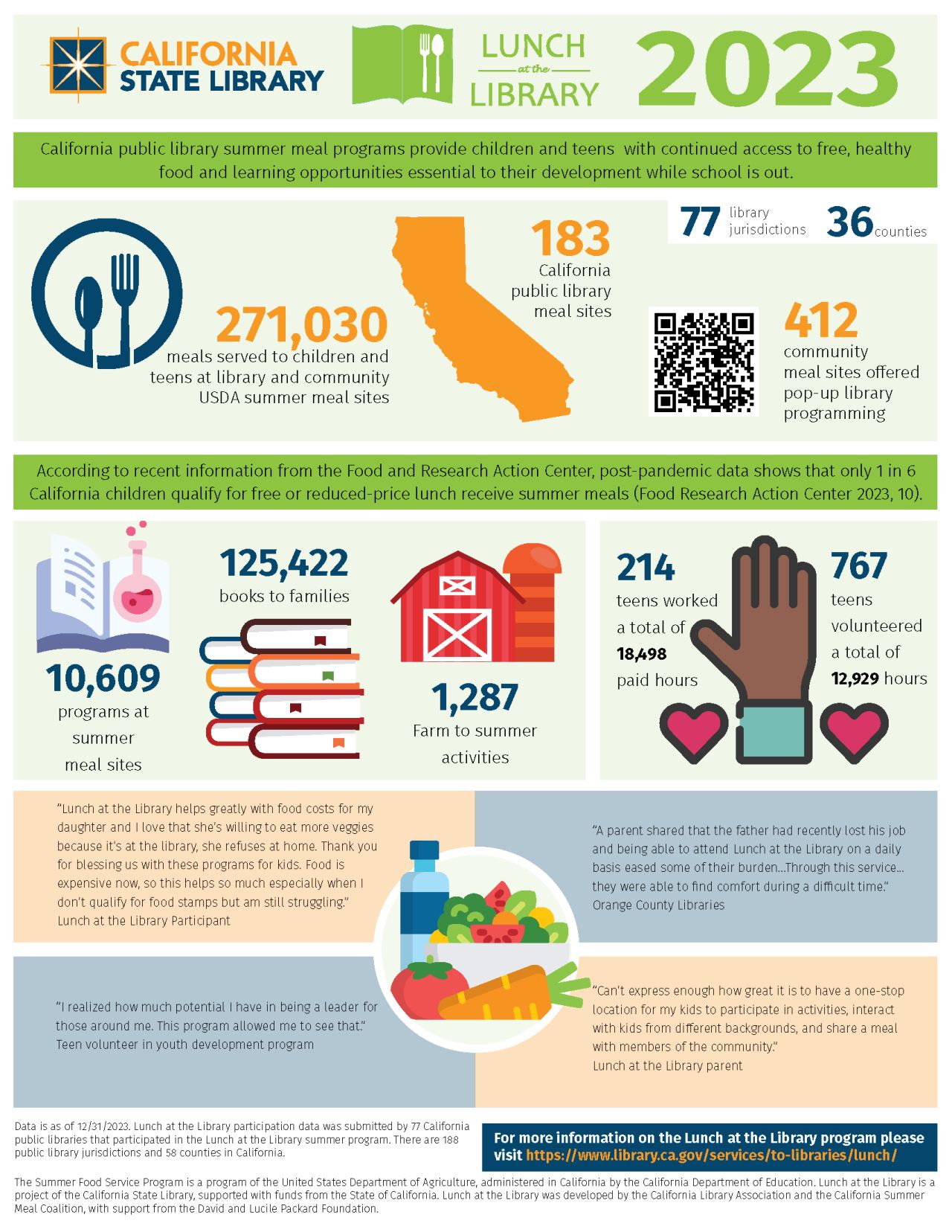
California State Library added testimonials to their infographic explaining the impact of free lunch services.
Tutorials
We know some community members have difficulty using library resources like databases or vendor apps. (Remember how many people struggled with the Libby App?) Some members of the public may find long, text-based tutorials to be to complex.
You can turn those text instructions into a visual how-to guide to help community members ingest the information. Here’s a fun, two-page infographic from Falvey Library at Villanova University. It explains everything a student needs to know about the library as they start a new school year.
Compare and Contrast
Instead of just sharing statistics, use an infographic to compare metrics before and after library interventions. The visuals go a long way to clearly illustrating the impact of your library work.
You can also use an infographic to explain why library services are superior to other resources.
Arkansas River Valley Library System’s infographic shows the free library services that can replace paid subscription services.
Service Bundles
Create a flowchart showing how a patron uses multiple services.
For example, your patrons may start by visiting your library’s website, where they sign up for a cooking program. When they get to the branch to attend the program, they may pick up a cookbook from a book display. Inside the cookbook, they may find a bookmark promoting the library of things.
An infographic illustration of that patron journey helps explain the interconnectedness of library services to board members, lawmakers, and potential partners.
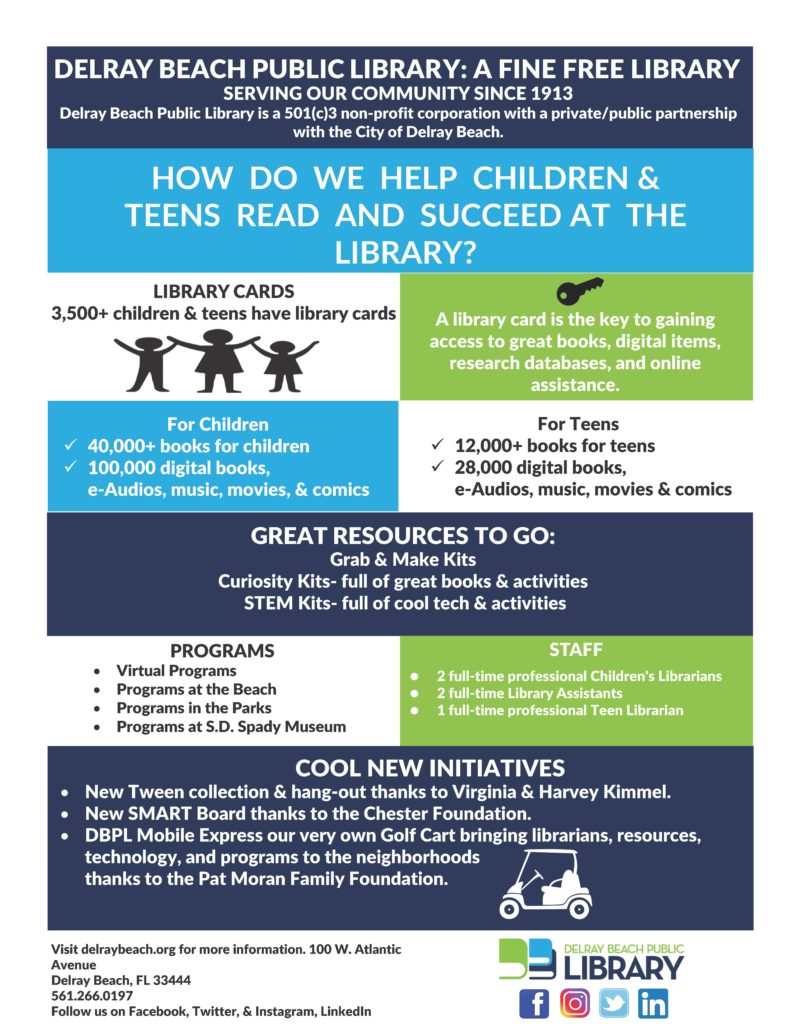
Delray Beach Public Library explains the interconnectedness of its services in this infographic.
Visualizing Partnerships
Use an infographic to show how the library collaborates with other local organizations, schools, and businesses. This will demonstrate how the library actively engages with the community, which builds trust and awareness. It can also highlight additional services and programs available through these partnerships.
Here’s a great example from the Tampa Bay Library Consortium explaining how the Institute of Museum and Library Services Funds help Florida library programs.
Library Accessibility
Your library can use an infographic to illustrate how the library makes resources accessible to different demographics. This includes children, seniors, and non-English speakers.
For example, if your library knows that 95 percent of seniors who attend tech skills programs learn to use tech fluently, you can demonstrate that with graphics.
Bonus tip: For accessibility of your infographic, create a downloadable alt-text document for the infographic. This allows people who use screen readers to consume the infographic. Here’s an example from EBSCO. Scroll to the bottom of the illustration and you’ll see the prompt to download the alt-text version of this infographic.
Environmental Impact
Show the library’s efforts in sustainability and green initiatives. Use visuals to demonstrate eco-friendly programs, such as recycling, energy-saving measures, and community gardening projects.
If your library has undergone a renovation or built a new building and you’re Leed-certified, use an infographic to show your community how that designation saves money and the planet.
Volunteer Contributions
Infographics easily explain the impact of volunteers on a library. The visuals can help you clearly show the number of volunteer hours. They also illustrate the types of activities volunteers assist with. Additionally, they convey the value volunteers add to the library.
Need help creating your infographic?
I am not an artist. I can barely draw stick figures. So creating an infographic is daunting to me. This post explains the process I use to plan and create an infographic.
Hey library marketing friends: I’m teaching a pre-conference workshop at LMCC this year with my amazing coworker Caleigh Haworth. It’s all about marketing your collection. Registration is open now.
Subscribe to this blog and you’ll receive an email whenever I post. To do that, enter your email address and click on the “Follow” button in the lower left-hand corner of the page. You can also follow me on the following social media platforms:
“My office is where the Children’s Department used to be,” recalls Ann. “When I started working here 18 years ago, some of the librarians from my childhood still worked here, and I remember feeling excited to meet them on my first day, almost as if I were meeting celebrities.”
“I consider myself very lucky that I have been able to work in a library. It’s not hard to market a product you love.”
Ann is the library’s Marketing and Public Relations Manager. Her team includes a full-time graphic designer, a part-time writer, and an assistant. Her library has one location, which has a distinct benefit, according to Ann.
“It’s very easy to get information and collaborate with co-workers,” she notes. “I work closely with our director, and fortunately, our library did a strategic plan two years ago. It was quite a process, but it has made my job easier in that there is a clear path forward with our marketing efforts.”
Ann is a rare library marketer in that she and her team have been tracking metrics on her library promotions for nearly two decades!
“The metrics we gather have evolved over time with the advancements in technology,” explains Ann. “We are now able to gather more information about the tools we use to achieve our marketing goals. And the dashboards on targeted emailing, social media performance, and Google Analytics are very telling.”
That data not only informs the promotions that Ann and her colleagues create, but it also helps stakeholders to understand the value and impact of their library marketing.
“We share these reports with the Board of Trustees monthly to inform them about our work and how we make data-driven decisions,” says Ann. “This helps them better understand our department’s operations.”
“I used these reports to justify my department’s size and marketing efforts. Our reports also include the number of printed brochures, rack cards, bookmarks, and more we produce. I used this information to advocate for adding an electric trimmer, folder, banner printer, and our department’s industrial copier. I was able to justify these purchases when I compared them to outside costs and estimated saved staff time.”
Her team uses many tools to create reports and analyze monthly metrics, including their email dashboard, social media scheduling platform, and website analytics dashboard. The whole process takes about 8 hours from start to finish.
“You might think that sounds like a lot, but this is time and effort that’s well spent,” states Ann. “We analyze the results and plan our path forward with this information. We can see what’s working and just as importantly, what’s not. We can quickly adjust to make our time more productive and impactful.”
“Every time your leadership team reads these, you are documenting the value of what you are doing. Their importance cannot be overstated.”
Those metrics come in handy as Ann plans marketing for the rest of the year. Her library recently purchased a bookmobile and is creating a new Outreach department.
“Our department is responsible for creating the bookmobile wrap, which is fun!” exclaims Ann. “We are in the process of a massive parking lot reconfiguration and addition. And we are also doing a tear out and reconfiguration of our circulation department.”
“Keeping our customers informed and up to date with these changes has been our first priority. And it’s our 100th anniversary this year. We have our work cut out for us!”
For inspiration, Ann just keeps her eyes open all the time.
“I’m always looking for great design and marketing,” says Ann. “It’s all around us! And there’s some bad stuff too. The trick is how to incorporate the good in your library efforts.”
Subscribe to this blog and you’ll receive an email whenever I post. To do that, enter your email address and click on the “Follow” button in the lower left-hand corner of the page. You can also follow me on the following social media platforms:
You may wonder, is it possible to over-communicate with my patrons?
Can you send too many emails, do too many social media posts, and put up too many posters and flyers in your library?
There are some telltale signs that you’re overdoing it! I have four tips to help you determine if you are flooding your community with too many messages in this Library Marketing Show episode.
Plus kudos go to a library that received press coverage for the return of a long overdue book with a funny note inside!
Do you have a suggestion for a topic for a future episode? Want to nominate someone for kudos? Let me know here. And thanks for watching!
Subscribe to this blog and you’ll receive an email whenever I post. To do that, enter your email address and click on the “Follow” button in the lower left-hand corner of the page. You can also follow me on the following social media platforms:
A new study about books and publishing reveals two concrete action steps you can take to prove the value of your library and increase circulation! Those steps are revealed in this episode.
Plus, kudos go to a library that received coverage for an event on Yahoo News!
Do you have a suggestion for a topic for a future episode? Want to nominate someone for kudos? Let me know here. And thanks for watching!
Subscribe to this blog and you’ll receive an email whenever I post. To do that, enter your email address and click on the “Follow” button in the lower left-hand corner of the page. You can also follow me on the following social media platforms:
Photo courtesy Cincinnati and Hamilton County Public Library
This week I want you, my dear reader, to make me a promise.
Please, for the love of all that is wonderful and majestic about libraries, add one critical step to your library marketing and promotions.
I want you to start setting goals.
Now, I know this may make you sigh/scream/cry/get angry at me. I know you are incredibly busy. I know you are trying your best every day to create effective library promotions. And I want you to have ALL the success possible.
Which is why I am asking this tiny but incredibly important thing of you.
Goals are an absolute necessity for library marketing success. Full stop.
And they will make your work EASIER for you. I promise.
Why you should set goals for your library promotions
Goals will help you:
Focus your efforts, allowing you to measure your progress and determine whether your promotions are successful.
Establish priorities so you can show your supervisors, your co-workers, your community, your donors, and yourself where your energy is best spent.
Stay motivated. Goals will help you identify your successful promotions so you can repeat them and create more success!
Reach your library’s overall strategic goals more quickly.
Where to start with goal setting for library promotions
Your marketing goals should align with and support your library’s overall strategic goals.
For example, let’s say your library’s strategic plan includes an objective to improve the kindergarten readiness of children in your service area. A goal you could set for your library marketing is:
To increase the circulation of our library’s picture book collection.
But that goal isn’t quite good enough. To turn this from an okay goal to an effective, meaningful marketing goal, you have to add two things:
A number to reach for
A time frame for reaching your goal.
Here’s your new, more meaningful goal:
To increase circulation of our library’s picture book collection by at least 10 percent before June 30, 2024.
Here’s another example from a real library. The Buda Public Library’s strategic plan includes this objective: “Create and circulate Maker Kits, for wider accessibility of the library’s technological resources.”
Their library will likely do all sorts of things to promote the Maker Kits: emails, social media posts, bookmarks, and more.
A meaningful goal they can (and should!) set is:
To get 100 checkouts of our library’s Maker Kits in a 12-month period.
See how easy that is?
The most important thing to remember about goal setting for library marketing is to define what you want to do specifically.
Do you want to increase circulation? By how much? And in what time frame?
Are you looking to boost the use of a certain part of your collection, like your digital materials? By how much? And by when?
Are you trying to get more people to participate in your event? What percentage increase in attendance do you wish to achieve in what amount of time?
You can set both long-term and short-term goals for library marketing success. A long-term goal might be to get 500 downloads of your library’s new app by December 31st. A short-term goal might be to increase Kanopy streams by 25 percent before the end of the month.
One important question to ask yourself
A key element of library marketing goal setting is to make sure your goal is realistic. If your goal is too far-fetched, you and your coworkers may end up feeling demoralized when you fail to achieve it.
For example, if you try to double traffic to your library website in a month, you are likely setting yourself up for failure. Instead, ask yourself this question when you are setting goals: Is this goal ambitious AND achievable?
The final step
Once you’ve set a goal, write it down. Why? Studies show the most successful people write their goals down on paper!
Subscribe to this blog and you’ll receive an email whenever I post. To do that, enter your email address and click on the “Follow” button in the lower left-hand corner of the page. You can also follow me on the following social media platforms:




 Super Library Marketing: Practical Tips and Ideas for Library Promotion