Search

Super Library Marketing: Practical Tips and Ideas for Library Promotion

Category

digital marketing

How King County Library System Made Curiosity Impossible to Ignore

**Alt text:**
A black-and-white historic photo of a library interior with tall windows, hanging light fixtures, bookshelves, and a large wooden service desk where several people are working and browsing. A translucent gray text box at the top reads, โ€œLibrary Share Secrets to SUCCESSFUL BRANDING CAMPAIGN,โ€ with โ€œSUCCESSFUL BRANDING CAMPAIGNโ€ in large yellow letters.
Photo courtesy of Cincinnati & Hamilton County Public Library

โ€œCuriosity Isnโ€™t Quietโ€ helped King County Library System rethink what library marketing can look like. And the results are remarkable!


Libraries spend a lot of time talking to people who already love libraries. King County Library System wanted to do something different.

KCLS serves more than 1.6 million residents through 50 libraries just outside Seattle. But after several leadership changes and turnover within its Communications and Marketing department, the organization saw an opportunity to rethink how it told its story.

The goal wasn’t simply to promote programs or convince existing patrons to attend another event. It was to get people who hadn’t visited a library in years โ€” or perhaps had never visited at all โ€” to reconsider what a public library could offer them.

So KCLS embarked on a campaign built around a deceptively simple idea:

Curiosity Isn’t Quiet.

And the results? Chase Gallager, Director of Communications and Marketing at KCLS, says, โ€œA 22-point jump in brand awareness across non-members. And among our members, they were increasingly convinced that their public investment is worth it.โ€

โ€œFor an institution serving 1.5 million people across King County, those arenโ€™t vanity metrics. Thatโ€™s people rediscovering something theyโ€™ve forgotten was theirs.โ€

Chase was gracious enough to share how his library did it, so you can replicate this at your library.

Starting With a Question

The campaign began in September 2024 with a question that plagues many libraries: What do people who aren’t library users actually know about us?

KCLS wanted to reconnect with its community and “reinvigorate our marketing with a fresh campaign to drive awareness of KCLS and reconnect with our patrons.”

But the team didn’t want to rely on assumptions about what the community knew or didn’t know about the library. So they did some research.

KCLS surveyed both patrons and non-patrons to establish a baseline for brand awareness and awareness of specific library services. That research helped the team identify opportunities to showcase services that people might not associate with a modern public library.

As part of the campaign development process, KCLS brought together leadership and staff from across the organization for brainstorming sessions. The goal was to make a list of everything the library does for its community.

“Starting with leadership and staff from around the organization, we held brainstorming sessions to chart out all the things that our libraries do every day for patrons,” recalls Chase.

Chase says the collaborative process did more than generate ideas. It built trust and support internally for the campaignโ€™s development.

That turned out to be important because KCLS wasn’t simply creating a new advertising campaign. It was changing the way the organization thought about marketing.

Meet “Curiosity Isn’t Quiet”

Eventually, the team landed on “Curiosity Isn’t Quiet.” The line works on several levels.

It plays with the traditional image of the library as a place where everyone is expected to whisper. But it also reframes curiosity as something active, energetic, and even a little disruptive.

Chase says that ultimately, the campaign became “both a playfully tongue-in-cheek reference to the hushed library hallways of the past, and an invitation to our audience to be bold and inquisitive.”

Marketing to People Who Aren’t Already Library Users

One of the biggest strategic decisions Chase and his team made was to focus on people who weren’t already regular library users.

That meant the library couldn’t simply rely on the channels and messages it had traditionally used to communicate with existing patrons. It needed to compete for attention.

Chase said the messaging was designed to reach people “who hadnโ€™t set foot in a branch in years, maybe ever.”

“Surgically Targeted” Advertising

KCLS has historically spent an average of about $327,000 a year on advertising since 2022. That sounds like a lot to many libraries (including mine!), but it comes out to roughly $0.25 per person in its service area.

For “Curiosity Isn’t Quiet,” the team decided to make that money work harder. Rather than primarily boosting organic social media content or relying on broad-reach broadcast advertising, KCLS shifted to a social, video-first strategy.

“We worked to develop thoughtful targeting focused on our service area, as opposed to broadcast mediums that had historically spread our advertising dollars too thin.”

Chase says the library used more efficient ad types that are favored by the algorithms.

The result? KCLS cut the cost of its digital advertising by 66 percent, meaning the library could reach far more people without increasing its advertising budget. That’s a pretty compelling argument for being more strategic about who sees your advertising.

And the campaign wasn’t just about paid media. KCLS also brought in a new social media strategist shortly after the campaign launched.

“She brought fresh thinking and smart strategy to our social content,” says Chase.

The combination of targeted advertising and a stronger organic social strategy helped drive rapid growth in social engagement, including more than 50 percent growth on Instagram during the year.

The Number That Should Get Your Attention

The headline result from the campaign was dramatic: Brand awareness among non-members increased by 22 points.

That number came from comparing the baseline brand survey conducted at the beginning of the campaign with another survey conducted nearly a year later.

Because brand awareness is the central objective, Chase and his team plan to continue monitoring perception, awareness of specific library services, and other measures through additional surveys.

The Library Card Became a Piece of Art

One of the most delightful parts of the campaign was a completely different kind of marketing opportunity: the library card.

Many of KCLSโ€™s library card designs were more than a decade old. So, the library partnered with local artists to create seven new library card designs. The team created video interviews with each artist, giving patrons a chance to hear the stories and perspectives behind the artwork. 

The response was outstanding: The new cards depleted KCLS’s annual supply in just a few months.

New library cards are sometimes treated as a marketing gimmick. But hereโ€™s Chase and his team have to say about that.

“There isn’t always going to be a return on investment on revamping library cards,” says Chase. “Seeing smiling patrons with their new miniature pieces of art will always win us over.”

Curiosity Became a Summer Reading Strategy

The “Curiosity Isn’t Quiet” campaign didn’t stay confined to advertising.

KCLS used one of the concepts developed during the campaign โ€” “Curious Creatures” โ€” as the foundation for a new kids’ summer reading program. The library reconsidered its reading incentives and introduced a branded Welcome Kit box as part of the experience.

The results were striking. In 2024, KCLS had approximately 12,000 summer reading finishers across the system. In 2025, more than 30,000 readers had signed up, with the numbers continuing to grow through the end of July. That’s more than double the previous year’s number.

And it illustrates something important: A strong brand idea can become a platform for many different campaigns and initiatives.

Not Everything Went Smoothly

Of course, even a highly successful campaign comes with challenges. For KCLS, one of the biggest was production.

“Internally producing creative requires a lot of planning, and often we ran up against deadlines,” remembers Chase.

As a small internal team, maintaining the production pipeline remains a challenge. The library is now looking for ways to improve that process and stay ahead of deadlines. 

There was also some internal confusion about the campaign itself. In particular, some staff members thought the “Curiosity Isn’t Quiet” icon was the library’s new logo.

I can relate to that problem, and it highlights an important lesson for libraries considering a major brand campaign: Changing how you market externally can also require significant internal communication.

When you’re introducing a new visual identity for a campaign, staff need to understand what it is, what it isn’t, and how it fits into the larger organizational brand.

โ€œIt’s a challenge to break preconceived notions, internally and externally,” admits Chase. โ€œOften it takes a team working together to show a new path forward for library marketing.โ€ 

“We have learned to think big, lean into the sparks of creativity that come from brainstorming, and give new things a shot.”

The Most Important Result Might Be Hard to Measure

The numbers are impressive. But Chase says some of the best results aren’t numbers at all.

“We’ve seen a rapid increase in social engagement,” he points out. โ€œIt’s getting such amazing feedback and joy from our patrons with their new library cards, or spotting the campaign in the wild.”

To me, thatโ€™s the amazing part. Because itโ€™s one thing for someone to see an ad because you paid to put it in front of them. It’s another thing for them to recognize your campaign when they encounter it in an unexpected place. And that recognition is exactly what brand awareness is supposed to accomplish!

What Other Libraries Can Learn From This Campaign

So what should another library do if it wants to move beyond promoting individual programs and start building a true brand campaign? Chase says, you have to start with the library staff.

“Start internally to build excitement and gain alignment with staff, especially in organizations absent other cohesive marketing campaigns,โ€ he advises.

What I learned from writing this post is: Curiosity isn’t quiet. And neither is a library brand that knows what it wants to say.


Want more help?

Hereโ€™s a 12 Month Promotional Campaign Plan To Skyrocket Database Usage at Your Library

Subscribe to this blog, and youโ€™ll receive an email whenever I post. To do that, enter your email address and click on the โ€œFollowโ€ button in the lower left-hand corner of the page. You can also follow me on the following social media platforms:
Rethinking Library Social Media in the Age of AI

Watch this video now

#LibraryMarketingShow, episode 345

What if the biggest threat to your library’s social media strategy isn’t another algorithm change… but AI?

As we become more reliant on AI tools to create content, the trust that audiences have in their library is eroding. And that’s not good news.

In this episode of The Library Marketing Show, I examine the connection between AI and distrust, and give you my advice for the future.

Plus, kudos go to a library that received recognition for collection promotion.

Do you have a suggestion for a future episode’s topic? Do you want to nominate someone for kudos? Let me know here.

Thanks for watching!โ€‚

P.S.: If you wish, you may download a transcript of this episode.


Miss the last episode? No worries! Watch it now.

Subscribe to this blog, and youโ€™ll receive an email whenever I post. You can also follow me on the following social media platforms:

ADA Accessibility and Short-Form Video: What Libraries Need to Know

Watch this video now

#LibraryMarketingShow, episode 344

As libraries create more content on Instagram Reels, TikTok, and YouTube Shorts, many marketers are asking the same question: How will new ADA accessibility requirements affect short-form video?

It’s an important question, and one that goes beyond simply adding captions.

In this episode of The Library Marketing Show, I answer a viewer’s question and explore what these accessibility requirements could mean for your video strategy, along with practical steps your library can take now.

Plus, kudos go to a library that has won multiple awards for its marketing!

Do you have a suggestion for a future episode’s topic? Do you want to nominate someone for kudos? Let me know here.

Thanks for watching!โ€‚

P.S.: If you wish, you may download a transcript of this episode.


Miss the last installment? No worries! Read it now.

Subscribe to this blog, and youโ€™ll receive an email whenever I post. You can also follow me on the following social media platforms:

Your 2026 Library Marketing Kickstart: The Posts and Tips You Canโ€™t Miss

Library friends, we did it! We made it through 2025. We faced numerous issues and threats to libraries, yet we celebrated many triumphs. I’m proud of you. I’m proud of this community. And if no one has told you this lately, GOOD JOB YOU!

And now, we look forward to a new year and new chances to grow the connection between your library and your community.

Want to make 2026 your best year yet? Let’s start by learning from the content your fellow library marketers found most helpful this year.

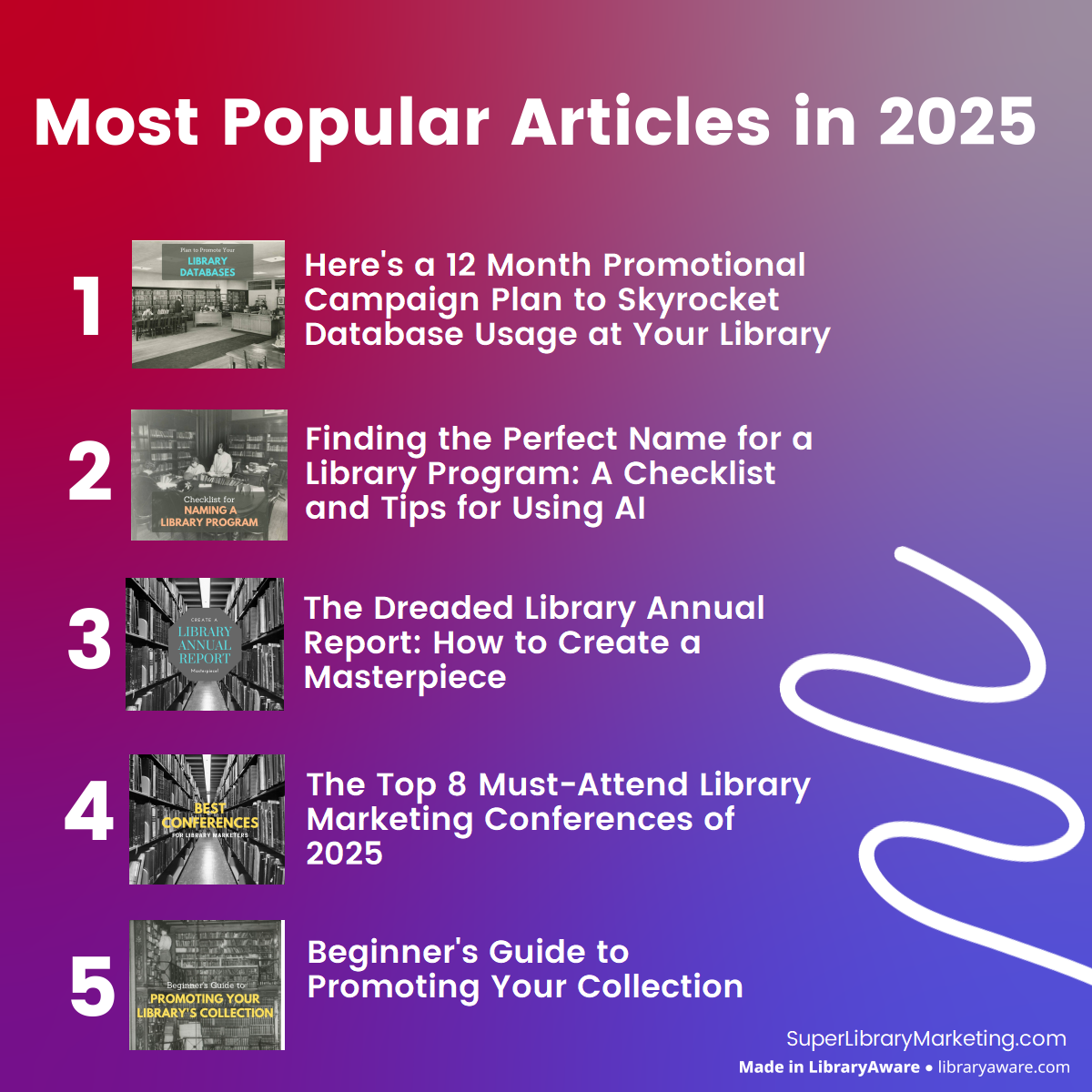
Most Popular Super Library Marketing Articles of 2025

#1: Hereโ€™s a 12 Month Promotional Campaign Plan To Skyrocket Database Usage at Your Library

#2: Finding the Perfect Name for a Library Program: A Checklist and Tips for Using AI

#3: The Dreaded Library Annual Report: How to Create a Masterpiece that Showcases Your Libraryโ€™s Value and Inspires Your Readers

#4: The Top 8 Must-Attend Library Marketing Conferences of 2025 (Note: A new version of this blog will publish in February. Do you have a conference to suggest for the list? Let me know!)

#5: Beginnerโ€™s Guide to Promoting Your Collection: How to Get Started and Drive Circulation at Your Library

Top Episodes of The Library Marketing Show of 2025

#1: Stop Annoying (and Potentially Dangerous) Facebook Messenger Spam in 30 Seconds Flat

#2: 6 Common Library Marketing Mistakes To Avoid in 2025

#3: Is Bluesky the Next Big Thing for Libraries? Expert Weigh In

#4: How to Create a Library Marketing Strategy from Scratch! (Wow, this one is old!)

#5:  Unveiling Facebookโ€™s New Rule on Content: Are Your Posts at Risk?

I hope you are looking forward to 2026 as much as I am. My next post will be on Monday, January 5, when I’ll unveil the State of Library Marketing. I’ve got a calendar full of posts and videos featuring tips to make your work easier, as well as profiles of libraries to inspire you. Happy holidays!


PS: Want more help?

Beginnerโ€™s Guide to Promoting Your Collection: How to Get Started and Drive Circulation at Your Library

Subscribe to this blog, and youโ€™ll receive an email whenever I post. You can also follow me on the following social media platforms:

Grow Your Libraryโ€™s Online Presence and Rank Higher in AI Searches With These Tips

Photo courtesy Cincinnati and Hamilton County Public Library

Key Takeaways:

  1. AI is changing how people search, and libraries are seeing a drop in website traffic as a result.
  2. Simple formatting changes like clear titles, bullet points, and question-based headings can help your content appear in AI summaries.
  3. Add credibility cuesย like staff names, job titles, and internal and external links to boost your siteโ€™s authority with AI and search engines.

Have you noticed a slight change in the blog posts here? Most now include a list of three quick takeaways at the top. Hereโ€™s why I started doing this, and why your library should consider it too.

AI impacts website traffic

A few months ago, I attended a webinar featuring three of the leading experts on Search Engine Optimization, or SEO. SEOย isย the practice of improving a website’s visibility and authority in organic search results to attract more visitors.ย 

But AI has introduced a new wrinkle in SEO.

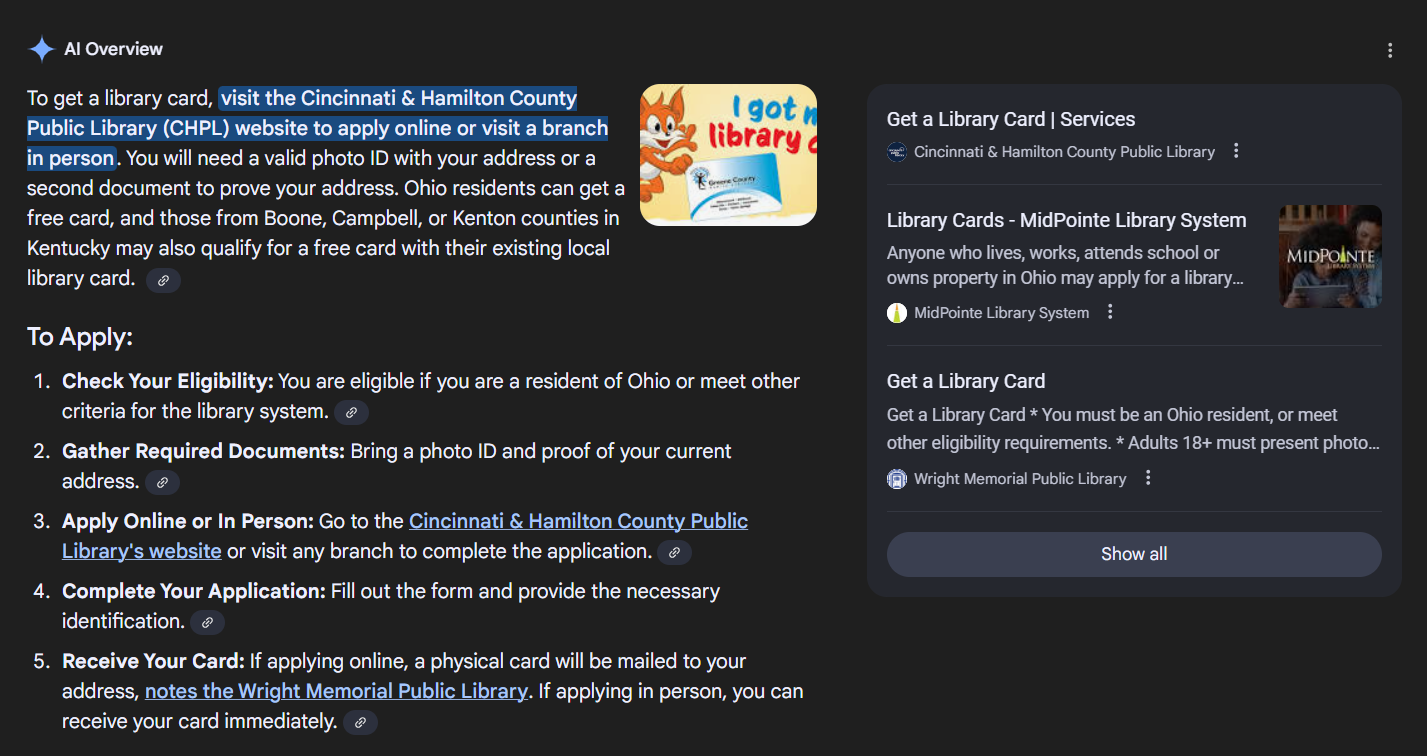
In May 2024, Google introducedย AI Overviewsย (formerly called AI Summaries). These appear at the top of search results and provide a summarized answer to a userโ€™s search, often pulled from multiple sources.

An example of an AI Overview for the search, “How can I get a library card?”

Once AI Overviews were introduced, searchers stopped clicking through to a website because their question was fully answered by the AI Overview. As a result, many libraries (and other websites, including this one) noticed a decrease in their organic web traffic.

In addition, a survey by Adobe Express says 25 percent of people use ChatGPT as their first choice for search over Google. Gen Z is particularly drawn to AI as a search engine. That likely means the popularity of using AI for search will continue to rise.

What does all this mean for your library?

Youโ€™ll need to adjust the way you structure your libraryโ€™s website and blog to surface more often in AI searches and to show up in the AI Overview. Itโ€™s not as difficult as it sounds. Here are the changes Iโ€™ve implemented. I recommend you try these and monitor your web traffic over several months to see if the changes make an impact.

Titles should be clear, not clever.

Tell readers exactly what theyโ€™ll find on the page. For example:

Author Visit

  • โŒ Clever Title: โ€œAn Evening of Literary Magicโ€
  • โœ… Clear Title: โ€œMeet Author Jasmine Guillory at the Library โ€“ October 24โ€

Why it works: The clear title includes the type of event, the authorโ€™s name, and the date. Those are the keywords that AI tools and search engines can easily match with user queries.

Craft Program

  • โŒ Clever Title: โ€œGet Your Glue On!โ€
  • โœ… Clear Title: โ€œFall Craft Workshop for Teens โ€“ Make Your Own Bookmarksโ€

Why it works: It specifies the audience (teens), the season, and the activity.

Educational Workshop

  • โŒ Clever Title: โ€œBrain Boost Bonanzaโ€
  • โœ… Clear Title: โ€œFree SAT Prep Workshop for High School Studentsโ€

Why it works: It uses direct language that matches what a student or parent might search for, like โ€œSAT prepโ€ or โ€œhigh school test help.โ€

Wellness Event

  • โŒ Clever Title: โ€œZen in the Stacksโ€
  • โœ… Clear Title: โ€œFree Yoga Class at the Library โ€“ All Levels Welcomeโ€

Why it works: It clearly states what the event is, where itโ€™s happening, and who can attend.

Include a bullet list of key takeaways or what youโ€™ll learn at the top of the page.

This helps both readers and AI quickly understand the content. Try this on blog postsย andย key webpages.

Hereโ€™s how you might structure key takeaways at the top of a library card sign-up page.

  • A library card is free to all residents of Tree County.
  • Applicants need to fill out a form and have one document with proof of residence. The form can be sent to the library via email or presented at any library location.
  • Applications presented in person will be processed immediately. Applications sent via email will take 1-2 days to process.
  • Once an application is accepted, youโ€™ll be given a card, which you will you to check out items, reserve meeting rooms, and register for programs.

Use well-structured headings.

Phrase them as questions, when possible, like:

  • How do I get a library card?
  • How can I reserve a meeting room?

Here’s an example of how I did this in a post for NoveList.

Include the right keywords.

Ask ChatGPT to provide you with a list of keywords or frequent questions around your topic. You can also search for your topic on Google and look at the โ€˜People Also Askโ€™ section. The website Answer the Public can provide you with some frequently asked questions as well.

Structure your content with bullets, steps, or lists.

Clean formatting makes it easier for AI to scan and summarize your content. You’ve probably noticed this post has been full of bullets and lists. That’s intentional! The bonus benefit is that it makes your blog and website easier to read.

Write in natural, conversational language.

Avoid jargon. Focus on being clear and helpful. Remember that searchers will not use jargon to look for answers to questions that may lead them to your library. Try to imagine what your community would put into the search bar, and then use those words in your blog or landing page.

When possible, include a staff memberโ€™s name and job title on a page.

AI looks for expertise or credentials when scanning pages. This is easy for a blogโ€ฆ just include the name of the author and their title in the post. For a landing page, consider adding a line like this: โ€œNeed help signing up? Email Maria Lopez, Library Services Manager, with 15+ years of experience helping patrons, at mlopez@treelibrary.org.โ€

Ask your partners to link to your website and blog.

When other trusted sites link to your content, it signals credibility to AI and search engines.

Use internal links whenever possible.

Link to related blog posts or pages on your site to help AI understand your contentโ€™s structure and relevance. That has the added benefit of keeping people on your page longer, which improves your trust and credibility to Google and AI, which means you’ll show up in search more often!

Try to stay within best practice lengths for word count.

BlueHost.com says for blogs, the ideal range is between 1,500 and 2,500 words. This gives readers comprehensive coverage of a topic. Itโ€™s also easier to include keywords and internal links for longer posts.

Butโ€ฆ hereโ€™s something to remember: Google and AI tools prioritize quality over length (and so do most readers!) Donโ€™t try padding your posts, as that can hurt your ranking.

Neil Patel, who is a trusted expert on SEO, says that for landing pages, word count isnโ€™t a direct ranking factor. Rather, you should focus on the userโ€™s experience and provide enough information for a community member to act.

Has your library’s website traffic taken a hit? Are you using any other methods to drive more traffic to your library’s website? Let me know in the comments.


Need more inspiration?

Google Ad Grants Improve Your Libraryโ€™s Chances of Being Found in Search: How To Apply and Manage This Incredible Opportunity

Subscribe to this blog, and youโ€™ll receive an email whenever I post. To do that, enter your email address and click on the โ€œFollowโ€ button in the lower left-hand corner of the page. You can also follow me on the following social media platforms:
Accessibility Is Good Marketing: Why Libraries Must Start WCAG 2.2 Prep Now

Watch this video now

#LibraryMarketingShow, episode 310

April 2026 might sound far off, but big accessibility changes are coming โ€” and theyโ€™ll directly affect how you market your library.

The new regulations arenโ€™t just a compliance issue; theyโ€™re an opportunity to make your marketing better for everyone. Yet, Iโ€™m not seeing many libraries getting ahead of this.

So in this episode of The Library Marketing Show, letโ€™s talk about whatโ€™s changing, why it matters, and what you should be doing right now.

Plus, I’ll give kudos to a library with a one-of-a-kind video for National Library Card Sign-up Month.

Do you have a suggestion for a future episode’s topic? Do you want to nominate someone for kudos? Let me know here.

Thanks for watching!โ€‚

P.S.: If you wish, you may download a transcript of this episode.


Miss the last episode? No worries!

Say hello at these future conference appearances!

Subscribe to this blog, and youโ€™ll receive an email whenever I post. To do that, enter your email address. Then, click the โ€œFollowโ€ button in the lower left-hand corner of the page. You can also follow me on the following social media platforms:
๐Ÿ’ŒEasy and Inexpensive Ideas To Show Appreciation to Your Library Patrons

Watch this video now

#LibraryMarketingShow, episode 309

A viewer wants to show appreciation to their library patrons. How can you do this on a budget while still making your community members feel special?

I’ll share some really quick and creative ways to show your community members that you appreciate them in this episode of The Library Marketing Show!

Plus, I’ll share kudos for a library whose short-form video has received tens of thousands of views and tell you why this video was so successful.

Do you have a suggestion for a future episode’s topic? Do you want to nominate someone for kudos? Let me know here.

Thanks for watching!โ€‚

P.S.: If you wish, you may download a transcript of this episode.


Miss the last episode? No worries!

Will I see you soon?

Subscribe to this blog, and youโ€™ll receive an email whenever I post. To do that, enter your email address. Then, click the โ€œFollowโ€ button in the lower left-hand corner of the page. You can also follow me on the following social media platforms:

The Secret To Stock Photos That Actually Work for Your Library Promotions

Watch this video now

#LibraryMarketingShow, episode 308

Are you looking to increase clicks on your library’s emails, social media, and websites? The secret may be the faces that you choose in your promotions!

In this episode of The Library Marketing Show, I’ll reveal the one thing that makes stock photos actually work… and this is backed by science.

Plus, I’ll give kudos to a library that started a basic service but promoted it in a not-so-basic way!

Do you have a suggestion for a future episode’s topic? Do you want to nominate someone for kudos? Let me know here.

Thanks for watching!โ€‚

P.S.: If you wish, you may download a transcript of this episode.


Miss the last episode? No worries!

Will I see you soon?

Subscribe to this blog, and youโ€™ll receive an email whenever I post. To do that, enter your email address. Then, click the โ€œFollowโ€ button in the lower left-hand corner of the page. You can also follow me on the following social media platforms:

How To Make Your Library Content More Helpful and Rank Higher on Google!

Watch this video now

#LibraryMarketingShow, episode 307

Is your libraryโ€™s online content working as hard as it could? Google has released some guidelines to help you create content thatโ€™s not only helpful for your patrons but also gets noticed by search engines, including Google, of course!

I’ll break down the latest advice in this episode of The Library Marketing Show.

Plus, we’ll share kudos with a library that went above and beyond on social media!

Do you have a suggestion for a future episode’s topic? Do you want to nominate someone for kudos? Let me know here.

Thanks for watching!โ€‚

P.S.: If you wish, you may download a transcript of this episode.


Miss the last episode? No worries!

Will I see you soon?

Subscribe to this blog, and youโ€™ll receive an email whenever I post. To do that, enter your email address. Then, click the โ€œFollowโ€ button in the lower left-hand corner of the page. You can also follow me on the following social media platforms:

A WordPress.com Website.

Up ↑