Search

Super Library Marketing: Practical Tips and Ideas for Library Promotion

Category

Expert Advice

Feeling Lost and Uninspired by Library Marketing? Here Are Seven Places to Learn and Improve Your Library Promotional Prowess!

Photo courtesy the Public Library of Cincinnati and Hamilton County

Learning is essential to the existence of humans.

No, this blog hasn’t suddenly turned into a philosophical self-help website. But I do think it’s important to make learning and research a part of your work schedule.

You need to know the latest research on customer experience. You need to be alerted when social media algorithms change. You need to be inspired by creative, encouraging, thoughtful people who know the struggles, hurdles, and frustrations of marketing.

Boy, have I got a list for you!

I’ve followed a lot of marketers over the years. I’ve read a lot of blogs, subscribed (and then unsubscribed) to a lot of email newsletters. I’ve watched videos and listened to podcasts about marketing, in the never-ending search to find the people who could offer the most help to me and my library marketing friends.

Here are the seven best places for library marketers to get advice!

Ann Handley: Author, Marketer, Chief Content Officer at @marketingprofs. 

Ann is at the top of my list because she’s the definitive expert on writing and creating engaging content.

Read her two books, Content Rules and Everybody Writes. Your library likely has a copy of both.

Next, sign up for her newsletter, Total Annarchy. It’s the gold standard for e-newsletters and one of my favorite pieces of email to receive!

Mark SchaeferMarketing strategist, author, and podcaster.

Mark is a human being. I mean, that’s obvious. But what I’ve always loved about him is that he gives advice like he’s your best friend. He’s not afraid to talk about the hard truths of promotional work.

Back in 2014, he started warning marketers about content overload (sometimes also referred to as content shock). This is the idea that people don’t pay attention to marketing because there is just too much stuff bombarding them from all angles.

This was pretty revolutionary for the time, and as I recall, there were a lot of people who thought Mark was nuts.

But he was right. And that’s why he’s written seven best-selling marketing books, launched a podcast, and is a popular speaker.

Read his latest book, Marketing Rebellion. I also recommend his free Pandemic Playbook. Subscribe to his {grow} blog and his podcast Marketing Companion (co-hosted with another marketing expert, Brooke Sellas).

Jay BaerNY Times best-selling author, marketing consultant, keynote speaker. 

Jay is an expert in the content marketing and social media space.

He has two podcasts that contain tips that relate to libraries. Social Pros focuses on real people doing real work in social media. Talk Triggers shares inspirational case studies about businesses succeeding with word of mouth marketing. 

Library Marketing Book Club

What do Ann Handley, Jay Baer, and Mark Schaefer all have in common? They’ve all been guests at the Library Marketing Book Club on Facebook!

Chris Boivin of the Jacksonville Public Library founded the group in the fall of 2020. We meet once a month to discuss a marketing book and to share tips and strategies for library marketing. Chris is usually able to get the author of the books we discuss to come to our meetings!

Learn more about the book club.

Content Marketing Institute

This is the go-to organization for everything related to content marketing. I came to know of the existence of Ann Handley, Jay Baer, and Mark Schaefer because of this organization.

Sign up for Chief Content Officer magazine (its free) and for their email newsletter. You’ll get the heads-up on upcoming seminars, free webinars, eBooks, and white papers.

Follow their Twitter for great advice and alerts when they post new blog articles. CMI also hosts #CMWorld chat on Tuesdays at noon EST on a host of relevant marketing topics.

Social Media Today

This is my go-to website to check for the latest information on changing social media algorithms, new features, and tips on how to get the best organic reach.

The easiest way to consume their plethora of tips is to sign up for their daily newsletter. They also host #SMTLive chats on Twitter on a variety of social media topics. You can find recaps of their past Twitter chats on their website.

Social Media Examiner

This website makes a good companion for Social Media Today. It provides a deeper dive into social media marketing, with expert advice from some of the leading marketers in the space.

They have a variety of ways for you to receive updates. They post articles and have a robust YouTube channel full of tutorials and shows about social media marketing. They also have two podcasts chock full of information about social media and more expert interviews.

Do you have an expert that should be added to this list? Let me know in the comments!

You may also like these posts

Podcast Like a Pro! Amazing Advice from a Library Podcast Expert

Expert Advice on How to Work Diversity into Your Library Marketing

Latest Book Reviews

Finding Dorothy by Elizabeth Letts

Uncomfortable Conversations with a Black Man by Emmanuel Acho

Subscribe to this blog and you’ll receive an email every time I post. To do that, click on the “Follow” button in the bottom left-hand corner of the page. Connect with me on YouTube, Twitter, Instagram, and LinkedIn.

Experts Reveal the Truth About What Your Library Needs to Do Now to Build Support for the Future

Photo Courtesy Public Library of Cincinnati and Hamilton County

For three days this week, more than a thousand library employees took part in the Library Advocacy and Funding Conference, sponsored by EveryLibrary. The organization helps builds support for libraries across the United States. This is the first conference of its kind, designed exclusively to help libraries learn to advocate on the ballot, in the donor arena, and in the hearts of their community.

The conference featured presenters from outside the world of libraries, so attendees got a chance to hear from successful, experienced experts talking about what works in politics and fundraising.

By Wednesday evening, my head was full of new information. Once I finished organizing my notes, I realized that the experts at the conference shared five big ideas specific to library marketing and advocacy. Here is what I learned.

Libraries must target ALL messages

Ashlee Sang, content strategist and copywriter for Ashlee Sang Consulting, said marketing fails when we try to send the same message to all cardholders. You must create marketing that talks to one person, on a level that speaks to their truth, their needs, and their problems.

Sang encouraged libraries to create personas to help with targeting. You can use data like checkouts and holds, as well as in-person interactions at the checkout desk, in the comment section of your social media, and even email, to help you create those personas.

Then, when you create marketing messages, think about targeting those personas. This will help you avoid designing around your own personal biases. Instead, it puts the focus on the people you are trying to serve.

Key quote: “If you create a message for everyone, you are creating a message for no one.”

Your library brand is more than a logo or a color scheme

Anjelica Triola, marketing director for Wethos, wants libraries to understand that your brand is not the colors and fonts that you use. It is the feeling that people get when they think about your library but are not actually in your library or around a librarian. That feeling will lead a cardholder to be an evangelist for the library.

Kimberly Gordon, brand strategist and marketing consultant, added that people crave a library with clear values and a commitment to being good corporate citizens. If your library communicates those two points, you’ll stand out in a positive way and showcase your value.

Gordon pointed out that we are living in a heightened state of emotion (I’m writing this pieces a few hours after the death of United States Supreme Court Justice Ruth Bader Ginsburg so that note really resonates with me!). She wanted libraries to remember that your brand represents a promise to your community.

Key quote:Marketing your brand improves likeability and sets you apart from your competitors. It makes you stand out in a positive way.”–Kimberly Gordon

Librarians connect with their community by finding common ground

Jasmine Worles, trainer for the National Democratic Training Committee, emphasized that the issues that mean the most to library staffers, both on the job and personally, are not unique to you. Other people care about the same issues!

Worles encouraged librarians to talk about why they love the library and why they are passionate about their work. Your “story of self” is the starting place of a connection. It builds genuine relationships and makes you trustworthy and credible.

As a library staffer, you may think that the library is bigger than you or that it’s not about you. But it IS about you.

Key quote: “Tell your story of self all throughout the campaign. It’s the most magical and effective piece of any campaign.” 

Diversity should be a part of your library strategy

Kim Crowder runs a consulting firm dedicated to diversity, equity, and inclusion in the workplace and in marketing. She’s been a guest on this blog before.

Crowder pointed out that diversity is looking at the ways people are different, then celebrating and acknowledging that. It’s not monolithic. And libraries must ask themselves, “How can inclusiveness be centralized in our message on a regular basis?”

She believes libraries must create a strategy about their commitment to inclusiveness and make it available to anyone to see. Crowder asked attendees to be open to feedback, to be willing to be uncomfortable, and to talk about diversity and inclusivity internally, as well as externally.

Key quote: “We all have bias, but we don’t always recognize it. If you fumble, admit your mistake, sincerely apologize, and be authentic in your efforts.”

Libraries should mix content formats for better engagement on Facebook and Instagram

Two representatives from Facebook and Instagram held a joint session with lots of tips for library social media engagement.

They encouraged libraries to share frequently and consistently, especially during important times like the pandemic. They also said the latest research shows a mix of format types (video, carousel images, static images, gifs, etc.) can help boost your page engagement. Avoid one kind of content all the time.

Finally, they encouraged libraries to livestream more often on both platforms, engage more frequently with other pages and profiles, and use Stories on both Facebook and Instagram to share content.

Key quote: “Highlight important announcements, share frequently and consistently, post more frequently during important times, and be informative and timely.”

Did you attend LAFCON? What did you learn? Share your takeaways in the comments.

You may also find these posts helpful

Six Tips to Make the Most of Your Online Experience During Virtual Conference Season

Why Libraries Lost HUGE Parts of Their Patron Base During the Pandemic and How to Fix It

Want to Make the World a Better Place? Tools and Tips for Libraries to Combat Racial Inequity in Their Communities

Latest Book Reviews

The Truths We Told by Kamala Harris

Craigslist Confessionals by Helena Dea Bala

Find more 60-second Book Reviews here.

Subscribe to this blog and you’ll receive an email every time I post. To do that, click on the “Follow” button in the bottom left-hand corner of the page. Connect with me on YouTube, Twitter, Instagram, and LinkedIn. 

Five Relevant Library Marketing Lessons Learned at the American Library Association Annual Conference (#ALAVirtual20)

Photo Courtesy Public Library of Cincinnati and Hamilton County

At my former job at a large metropolitan public library, there was an unspoken rule when it came to library conferences. Librarians got first dibs on training money to attend. I thought that was totally fair. But I also found myself suffering from a serious case of envy every time I saw my coworkers headed to the airport for the American Library Association Annual (ALA) Conference, the Public Library Association (PLA) Conference, or our state library convention.

When I took my new job at NoveList earlier this year, one of the perks was knowing I would see my library friends again at these conferences. I would finally get to attend. I’d be one of the crowd! I’d be in on the action!

Alas, it was not meant to be (thanks, Coronavirus). So, my first ALA Annual turned out to be virtual. That had some advantages. On-demand video meant I could jam more sessions into a day. I could pause sessions to get a drink or take a bathroom break. I could leave sessions if I wanted to without worrying about embarrassing the panelists. And I could attend in my outdoor workspace.

It had some disadvantages too. I got more exhausted than normal. And boy, did I miss the personal interaction with librarians and library staff.

I did end up learning a lot. Here are my key library marketing takeaways from three days of sessions.

Good internal communication reduces workload and duplication of work.

We could all do with a little more internal communication and a less work. In the session Happy Together: Collaboration and Communication between IT and Technical Services, staff from the University of Washington Libraries shared the ways in which a concentrated effort on improving staff communications made their workday easier.

Good internal communication helped them to be less reactionary and more proactive. They were able to put the focus back on the customer, rather than always thinking about how the work was affecting staff.  They found it easier to remember why they wanted to work in a library and to stay excited and positive about their jobs. They felt more empathy for each other, which improved relationships between departments.

The panelists encouraged attendees to focus on their library’s strategic plan to find common ground with coworkers in different departments. They designated a “gatekeeper” or “key contact” for each department, so everyone would know who to go to if they had a question or suggestion.

Key quote: “Remember we are all on the same team even with different deadlines and project objectives.” 

Smart libraries use messaging to advocate for more funding.

Most library staff are under the presumption that the public knows their library is essential. They do not. And past perceptions of the library are a real hurdle. People imagine the library as it was 20 or 30 years ago and have no concept of how much it has changed. 

In the session, Advocating for your Library: The E’s of Libraries and Collecting Stories, Alan Fisher told attendees to use messaging to address those hurdles. He encouraged us to message around activities your supporters will want to fund like story times, meals for kids, and literacy programs. He also told attendees to be intentional about using common language so supporters can understand your message. Finally, he says libraries must make their message memorable.

Key quote: “Use messaging that affectively addresses the hurdles so people can understand that we are essential. Don’t say everything you want to say… say what THEY need to hear.”  

Libraries must share the monetary value of author events with publishers. 

Author events at libraries drive book sales. But publishers have no idea that we are helping them make money.

In the session, How to Measure the Value of Library Marketing on Book Sales and Discovery, Guy Gonzalez said most libraries work with authors, not publishers, to schedule events. As a result,  publishers are often unaware of library event’s positive impact on sales. The people who attend author events at their library are library borrowers who often also become book buyers. So, events are a unique marketing opportunity for the publisher.

Gonzalez encouraged libraries to track, measure, and communicate their full impact on book sales back to publishers. He encouraged attendees to develop a media kit that defines the audience of the event, and the actual monetary value of promotional platforms like email, social media, and press coverage. Once the event is over, send that data to the publisher directly. 

Key quote: “Author events are hyper-targeted with deep engagement. Don’t undervalue how much you provide.”

Library marketing must elevate ideas that can improve our society, not around ideology, but around purpose.

In the Presidential program, politician and author Stacey Abrams gave a remarkable and inspiring interview that covered voter suppression, the census, and the role of libraries in helping disenfranchised communities.

Abrams urged the audience to remember that libraries are essential because they are a trusted source of information. She said that libraries are a microcosm of America and are perfectly positioned to address the inequities that persist in the rest of society.

She also asked libraries to be intentional about placing themselves in the same space and in communion with those who need them the most. Finally, Abrams called on the library industry to name the barriers to diversity, to call them out, and to build strategies to overcome them.

The daughter of a librarian, Abrams slept in the stacks of the college library where her mother worked and often got in trouble with the librarians for checking out too many books! She shared the books she’s currently reading: Evicted by Matthew Desmond and Black Leopard, Red Wolf by Marlon James.

Key quote: “Advertise yourself. We take libraries for granted. We know they exist, but we rarely think about them.” 

Virtual story times may or may not violate copyright laws.

I attended the session, Trouble in Paradise: Are you violating copyright by using social media read alouds? hoping for clarification for my library clients. What I got was more confused, at no fault of the presenters. They did an excellent job laying out the many intepretations of copyright law.

Many publishers gave libraries permission to read their titles aloud at the beginning of the pandemic. That grace period ends tomorrow, June 30.

To help you decide what to do once that deadline passes, I suggest reading these two articles recommended by the session presenters: Online Story Time & Coronavirus: It’s Fair Use, Folks and Do Online Storytimes Violate Copyright?

The presenters suggested you post your virtual story time on YouTube but make the recording private. Your library can send a link to view the video to patrons, making it more a “classroom-type” setting which is not in violation of copyright. They also suggested adding a graphic to your virtual story times to warn viewers not to share or download and store your virtual story time.

Finally, the presenters asked attendees to remember that authors make their living from publishing books. Broadcasting the reading of a book, especially a picture book, is essentially giving the book away.

Key quote: “Fair use is not used to try and get around something. It’s in the law and it’s a right of users.”

You Might Also Find These Articles Helpful

Worries in the Library World: Here are Answers to Your Four Biggest Library Marketing Concerns Right Now!

How to Tackle Library Signage in a Pandemic and Make Visitors Feel Comfortable With Your New Rules

Latest Book Reviews

Year of Wonders by Geraldine Brooks

You Never Forget Your First: A Biography of George Washington by Alexis Coe

Find more 60-second Book Reviews here.

Subscribe to this blog and you’ll receive an email every time I post. To do that, click on the “Follow” button in the bottom left-hand corner of the page. Connect with me on YouTube, Twitter, Instagram, and LinkedIn. 

How Your Library Can Use Google Ad Grants to Supercharge Your Website and Reach a Huge Untapped Audience

Note: A newly updated version of this blog post is now published. Read it here.

The Library Marketing Show Episode 8: Fighting Back Against the Endless Poster-Flyer-Bookmark Cycle!

Alright my friends, you asked for it and I’ve delivered. The Library Marketing Show is now pre-recorded and posted on YouTube! This week’s episode comes to you from the vintage newspaper stacks of my library.

Watch Now

Please subscribe, comment, and share the video. I’d love to be able to grow my channel from nothing to something. This is a great exercise for me. I’m going to learn a ton about YouTube! And there are lots of features I can add if I get a certain amount of views and watch time, as you likely know. Thank you in advance!

What We Talked About

Library news: I discussed the recent decision by four publishing companies to change the lending models for eBook and eAudiobook leases to public libraries. It’s going to affect the way libraries market their collection and cause customer service complaints at libraries to rise. And that makes me angry.

Reader question: Babette from the Licking County Library wrote in to ask me to discuss this: “How to help your ‘traditional’ staff understand and EMBRACE new ways to market. They are so disappointed that we are not doing tons of paper flyers, promoting every program on FB, press releases not being in the newspaper, etc. Staff struggling with the change. Sigh….”

Great question, and thanks Babette! I tried to share how I’ve handled this ongoing issue by explaining (over and over again) to staff that embracing new marketing tactics, particularly digital tactics, is not doing “less” marketing but actually doing more. It’s more efficient, it reaches customers where they are, and it allows us to get our message in front of new customers. I also love to share the marketing statistic that says we have to “touch” our customers 4-7 times with a marketing message before they will “convert” or take an action on any marketing message. If a person doesn’t come into your physical branch, they’ll never see your print marketing materials! I also tried to explain why I’m not ever super worried about press coverage of my library, particularly by newspapers. There are better ways to communicate your message, like a customer-facing blog. And when you’re doing the messaging, you get to control the narrative. For more on that subject, read How to Get Media Coverage Without a Press Release.

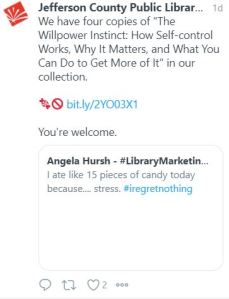
Kudos: Finally, I gave a shout-out to my friends at the Jefferson County Public Library for this hilarious and clever response to my stress-related tweet on Tuesday! I laughed all night!

Stay in Touch

I’m speaking at two conferences this fall and you can register for both on the Upcoming Events page. If you come to OLC, you’ll be able to tour the Downtown Main Library where I work! I’m getting ready to add new events soon so check back.

Have an idea for the next Library Marketing Live Show? Submit it now.

Subscribe to this blog and you’ll receive an email every time I post. To do that, click on “Follow” button in the bottom left-hand corner of the page. Connect with me on Twitter, Instagram, and LinkedIn.  

Seven Podcasts that Will Make You a Better Library Marketer

An exciting thing happened this week! The library marketing profession is now the subject of a podcast. It’s called Library Figures. It’s produced by Piola, a company which designs library websites.

Many smart and strategic library marketing professionals including Kimberly Crowder of the Indianapolis Public Library (featured in this Super Library Marketing post last year) are guests on the pod. Each episode focuses on a successful library marketing strategy. The host and guest dissect the implementation, tools, success measurements, and results. I amhonored to be featured on episodes one and four. Maybe it’s silly, but I’m just beyond thrilled that we’ve got our own podcast corner where we can share and learn.

I’m a huge podcast fan. My podcast player is overflowing with episodes. I’d love to share my list with you and explain a bit about why listening to these shows will make you a better library marketer.

The Science of Social Media

This is a new discovery for me. This show, produced by Buffer, focuses on data, insight, trends, tips, and more. Anyone who works on social media for any library will find value in listening to these episodes, which cover subjects for everyone from beginners to those with advanced social media skills.

Marketing School

I just discovered this podcast last month and I’m catching up on back episodes (there are more than 900!) but I really love it. The creators release one ten-minute episode every day focused on one nugget of great marketing wisdom. Past subjects include blogs, event marketing, crisis communications, and generating great content ideas.

Brand Newsroom

This show, produced by a content marketing agency in Australia, bills itself as “the show for anyone who has a say in how companies are communicating.” The hosts use a round-table discussion format to dissect topics like crisis communications, branding, and networking.  The most interesting episodes involve disagreement between the hosts. They all have a different perceptive on marketing, and I find that they help me to consider issues from different angles. They also have a fun segment at the end of each episode called “On my Desk” where they share something they’re really excited about, from apps to software to new books.

Marketing over Coffee

As its name implies, each weekly show is recorded in a coffee shop. The two hosts talk casually about all kinds of marketing topics including writing, influencer marketing, SEO, and other relevant marketing problems and solutions. They also take listener questions, which I really love. And the episodes are short, so they’re easy to listen to during a typical 20-minute commute.

Social Media Marketing Podcast

Michael Stelzner, who runs the Social Media Examiner website, is the host of this show. His guests have a range of backgrounds and answer questions about all kinds of social media topics and tactics. Mike is really good about digging down and getting the basics about each topic. He also shares a new app at the beginning of each show. Most of his discoveries are free or very inexpensive and they’re all designed to help make marketing easier and more fun.

Unpodcast

I’m going to end in an unconventional spot by recommending this podcast, hosted by husband and wife team Scott Stratten and Alison Kramer. I have seen Scott speak at Content Marketing World several times. He’s hilarious and brutally honest about the faults and triumphs of marketing. Alison is his partner in crime and besides being the cutest couple in marketing,  their observations are always spot on. Some episodes dissect customer service, some talk about marketing mistakes, and sometimes they talk about innovation and entrepreneurship. They really make me think. Just trust me and subscribe.

And of course, we support our fellow library marketers producing podcasts. Read the back stories about how those shows are produced and then subscribe to the library podcasts on this list.

And if you have a podcast you want to recommend, please let me know in the comments!

Subscribe to this blog and you’ll receive an email every time I post. To do that, click on “Follow” button in the bottom left-hand corner of the page. Connect with me on Twitter, Snapchat, and LinkedIn. I talk about library marketing on all those platforms!

How to Create a Social Media Strategy That Actually Works

The most effective, free marketing tactic in the library marketing professional’s toolbox is social media. Personally, I love it. I think it’s fun. And interesting. And despite the trolls, I’ve made some actual friends and professional connections in the social space.

For my library, it’s the easiest way to get our message to the masses. But with so many platforms intended for different audiences, it’s also overwhelming. Should you post on every channel?  What should you post? How often do you have to post? If you work alone, you need to be efficient. You don’t want to spend a lot of time experimenting with social media. You want to know what works, and how to be successful. You need goals.

A few months ago, Marcy Timblin, Public Relations Specialist at East Bonner County Library, sent me this email: You always have such timely, comprehensive advice for getting the most out of social media marketing for libraries. I dream of putting it all together to formulate an amazing social media plan that I can implement – even though I am the “numero uno” social media marketer at my library district.”

I appreciate the vote of confidence. Really, any success in the social media space centers on strategy. A strategy lets you take your library’s overall strategy and use social media to make those goals a reality. But telling you to have a strategy and putting one together are two totally different things.

I am blessed with a social media specialist on my staff. Part of her job is to create and maintain our specific social media strategy. And it’s a big job. We’re a large library system (41 locations, 600,000 cardholders) and we post on multiple channels (Facebook, Twitter, Instagram, Pinterest, LinkedIn, and Tumblr). It takes time to sort out how to make each channel work for us. But we do have a process for creating a strategy. Here is how we do it.

Consider what you already know. Go through each of the social media platforms that your library already uses. Look at the analytics for those platforms. How are people using the platform? Which kinds of posts do they respond to?

Most platforms now offer analytics (Facebook is best by far) so you can evaluate success. And if your library is using a scheduling platform to manage your social media posts, you can use those analytics. For those libraries posting organically on platforms without the use of scheduling software, there are options for free analytics. Read this blog article to find one that works for you.

In this step, you are looking to replicate past success and trim past failures. You may find a platform you are using that is not working for you. Drop it. You may also discover a platform that is working really well for you. Concentrate your efforts there.

What are your library’s goals for the year? As with everything you do in library marketing, your social media work must be in service of advancing your library’s overall goals. So, get that list in front of you for the next two steps.

Create a mission statement for each social media platform. Look at your library’s goals for the year and what you know about each platform. Then write a one to two sentence mission statement for each of the social media platforms, lining up your library’s goals with the current audience for that platform. This mission statement should be something your staff and your cardholders will understand. Here’s an example:

LinkedIn: Discover career advice, business tips, and free resources that will help you succeed at work.

Twitter: Get regular updates on our collection, library events, and the literary and entertainment world.

Instagram: Photos tell the library’s story, one snapshot at a time.

And so on. Once you have created the mission statement for the platforms, you can create a persona for the people who will follow you on that platform. The mission statement and persona will help you visualize your audience every time you post. You’ll be able to connect with them because you’ll know who they are, and what they expect from you.

Experiment with scheduling. Look at your current analytics to see which time of day and day of the week work best for social media posts. Use that as a starting point for deciding when and how often you’ll post. Be consistent with your posts. And set a cadence that you know you can keep up with.

Track metrics and be flexible but not overly reactive. It takes time to achieve your library goals using any kind of marketing. The exception is social media. That’s because the platforms themselves are transforming and changing at a rapid and unpredictable rate. Algorithm adjustments and new features can throw off your strategy.

Here’s my general rule: keep an eye on changes in the social media landscape. When a big change occurs, like when Facebook changes its algorithm, sit tight for a while. Give it a month at least and see how the platform’s change affects your reach. Watch to see how your audience reacts. Watch to see how other brands adjust based on the change. Then, if you see your reach is changing negatively or positively, make the adjustment. Don’t wait until your strategy cycle (six-12 months maximum) is over to make your change. You’ll lose months of audience reach if you wait.

Never stop researching. I follow a couple of websites and podcasts religiously to keep up on social media trends. Of all the marketing tactics, that’s the one that takes the most personal learning upkeep! I rely on the Social Media Examiner Podcast, Social Media Today, Social Media Explorer, and Rebekah Radice.

Subscribe to this blog and you’ll receive an email every time I post. To do that, click on “Follow” button in the bottom left-hand corner of the page. Connect with me on Twitter, Snapchat, and LinkedIn. I talk about library marketing on all those platforms!

Expert Advice on How to Work Diversity Into Your Library Marketing

A few months ago, the Urban Library Council’s Marketing and Communications team organized a conference call with library marketers across the United States. Part of the conversation focused on diversity in library marketing. It’s an important topic and frankly, I had nothing to contribute to the conversation. In fact, I’m embarrassed by my ignorance. Libraries serve a diverse population. Why haven’t we done a better job of working that into our marketing?

This year, my staff began a concerted effort to include more diverse faces and stories in our marketing. But I had this nagging feeling that there was a lot more we could do. I just didn’t know where to begin or how to frame my thoughts. The ULC conference call made me realize I wasn’t alone. It also made me realize that there is an expert in this area; a library marketer who has pushed her team and her library to look for ways to be inclusive on all fronts of marketing.

Kim Crowder established a communications department as Director of Communications for the Indianapolis Public Library. She is the winner of multiple national awards for her work and has spoken on panels and given talks covering a variety of marketing and communications topics. Prior to her role at the library in Indy, she spent 15 years working in marketing and communications for several Fortune 500 companies and was a published journalist for one of the largest newspapers in the United States. Her experience includes working with national and international media on outlets such as Conde Nast, The Oprah Winfrey Show (Yes, she met Oprah!), MTV, BBC London, CBS News, The Learning Channel and more.

Kim believes diverse points of view, flexibility, and creativity are keys to producing the best marketing and communications strategies possible. Kim took a lead role in the conversation on that ULC conference call and afterwards, I asked her to share her thoughts on diversity in library marketing with us.

Libraries inherently serve a diverse population, yet we don’t always include diversity in our marketing. There’s a bit of a disparity there! Why is diversity in marketing important for libraries?  The populations we serve are diverse, and our marketing efforts should be inclusive and truly represent our audiences. This is basic marketing 101. And I’m not talking about only focusing on certain populations for certain services and events. That should happen too, but this is more a conversation about overall strategy. Typically, public funding pays for libraries, which means acknowledging citizens of ALL backgrounds, because it is their dollars that keep our lights on. And we are all (or should be) aware of campaigns such as #weneeddiversebooks. Also, the American Library Association cites equity, diversity and inclusion as key action areas. For us to be unified on this topic, we must embrace it fully.

As our country becomes more diverse in a plethora of ways (not only regarding race) and knowing that it is predicted that in 2040 we will be majority-minority nation, libraries must plan now to stay relevant in the future. To do that, we must demonstrate our necessity and make as many people as possible aware of our benefit to their lives; it makes good business sense to be inclusive. Diversity in marketing is a needed and necessary aspect that must be earnestly examined and executed. And frankly, it’s the right thing to do, period.

Diversity in marketing is more than just making sure we include people of different races, religions, and abilities in our marketing photos and campaigns. What other ways can we market to a more diverse audience? This is a great question! Here’s where nuances matter. For instance, knowing what is important to certain populations and targeting specific programs and services to those markets by using the language, messaging, and imaging that most speaks to them is imperative.

An example of this would be to create marketing campaigns that are translated into different languages and really working with a native speaker (if possible) as well as a translator, to be sure the interpretation is correct, including knowing which regional dialects are most common in your market. Also, being aware of the vernacular that is correct when addressing the LGBTQ+ community, such as using sexual orientation instead of sexual preference. Making sure that you are aware of holidays and times of celebration and using social media to point to those is paramount. These are only a few ways to reach audiences in ways that are respectful and inclusive. It really is about intentionality and research to respect different groups within your service area and to make sure you have a real sense of who those segments are.

Will diversity in library marketing help to change the mindset of communities and how people view their fellow citizens? What an interesting thought! My answer is that it could help, absolutely. Change takes time and a village, and libraries can certainly contribute to the greater conversation. And remembering that diversity includes more than race, disabilities, socioeconomic status, gender, etc., but also includes experiences as well, should be acknowledged and considered. The more commonalities within humanity that are highlighted, the better.

Think on themes such as wanting great educational tools and programs for kids; a place anyone can feel safe to learn freely; and the ability to find books, movies, music, and more that speak to people’s core values. All these are ways to make library services more connected on a human-interest level to the populations in which we serve. The more stories that are shown using real customers, the more engaging. Finding a way to create emotional connection, whether through video, a news story, social media, community partnerships, print materials, blogging, etc., is key, and can certainly create an environment of shared interests. At the end of the day, we are all people, and finding that common thread using diverse representation is the way to go.

How do we convince our library colleagues that diversity in all areas that the library touches, like programming, exhibits, and services is important to our mission and to our cardholders? Everyone receives information differently, so think about the myriad of ways in which this fact can be demonstrated. Whether it is through anecdotes about individuals we serve or looking at pure data to find out the population breakdown in your service area, this case is best won by combining these different forms of information so that people can get a full view of the importance of diversity and inclusion.

And having them think through target audiences as they are planning services, exhibits, programming, etc., allows real dialogue about who these different groups may be so that the conversation of diversity is immediately valuable to the person doing the planning. And convey the message again, and again, and again, throughout your department and the system overall, as well as finding staff who will be ambassadors who speak to this as well. The more managers who are on board and empowered to pass along this information to staff, the better. Particularly, we have an African American History Committee and a LGBTQ+ Committee, run by staff members, who plan events and speak on behalf and are allies of minority groups.

What role does diversity in staffing play in the way libraries market themselves? Let’s start by acknowledging the elephant in the library world. Most of the workforce in libraries only speak English, are women, white, and not considered disabled, so naturally, there are going to be blind spots. Blind spots would be so no matter who the majority were. There are, however, some real statistics about why a diverse workforce is so important. And diversity is at its most valuable when gender, ethnicity and sexual orientation are combined with acquired diversity that is gained from experiences like living and working abroad or regularly interacting with a marginalized group. There are also statistics that state a lack of diverse leadership means women are 20 percent less likely than straight men to receive support of their ideas; LGBTQs are 21 percent less likely; and people of color are the most vulnerable at 24 percent.

The impact is that staff who would notice missteps in the way a group is messaged to or represented in campaigns, including recognizing lack of representation, may go ignored because they do not have the support when they do speak up. Having several points of view in any situation is extremely helpful, and a more diverse staff who can contribute and truly be heard, naturally creates an environment for this.

Can you give us some examples of how you have worked diversity into your marketing at the Indianapolis Public Library? We are constantly working on this, and it isn’t always simple, comfortable, nor easy. In 2018, all my staff participated in a racial equity training given by a third-party community partner that was extremely eye-opening for all of us. I wanted us to have context as to why we were focusing more heavily on this topic and to be able to has some real data on the issues. The first step was to be willing to openly have conversations around this, and to invite others to do so, resulting in bettering our marketing and communications efforts.

Regarding marketing tools, social media is a big part of how we do this; particularly focusing on highlighting diverse materials and topics in posts and event listings. Using kid-focused materials is a great way to introduce diversity to wider audiences, as it tends to disarm people a bit more. Also, making sure that we use videos to tell stories about our patrons being touched by library services is major strategy. We highlight users from all walks of life, knowing that stories connect on a human level, even beyond initial differences.

We are extremely conscious of this when in situations such as building a new branch or closing one in a neighborhood that is largely minority or has high numbers of residents below the poverty line (this is happening currently, and it’s not easy nor pretty). The goal is to always respect and honor people and that community overall, no matter what. And equally as important, being sure to position the Library as a support to those communities, not a savior or a “fixer.” We must be sure we are always viewed as a partner coming alongside those who are already doing great work and living in these communities. We are supporters who are always actively listening. That means our messaging must uphold that secondary position in the most respectful way possible, and if we miss that mark, we are immediately transparent about it and ready to learn however we need to. We are here to serve.

Kim is a native of Houston, TX (and VERY proud of it), and a lover of music and social issues dialogues. When Kim is not enjoying her professional endeavors, you can find her singing at church or jazz at a bar (with the occasional musical and national anthem at a sporting event sprinkled in here and there), listening to podcasts and audiobooks, Latin dancing, brewing tea, attending an artsy event or live concert, shopping, enjoying the sunshine, or laughing hysterically with family and friends. Her Instagram is the bomb! You can also email Kim at Kimberly.Crowder@live.com and say hi!

Subscribe to this blog and you’ll receive an email every time I post. To do that, click on “Follow” button in the bottom left-hand corner of the page. Connect with me on Twitter, Snapchat, and LinkedIn. I talk about library marketing on all those platforms!
The Best Advice for Library Marketing From CMWorld 2018

I wrote this post while sitting in my hotel room at the end of a week in Cleveland, Ohio at Content Marketing World. My brain is packed with ideas. My laptop battery is dead. Everywhere I look, I see orange. My iPhone says I’ve gotten about 13-15,000 steps a day and I didn’t even do my regular morning walk!

Content Marketing World was fantastic. I saw old friends and made new ones. And I’ve got plenty of new material to research and share with my fellow library marketers. But first, I want to share the quick takeaways from the presenters I saw. These are some pieces of advice that you can implement at your library right away.

Robert Rose, Chief Strategy Advisor, Content Marketing Institute: 38 percent of marketers have a documented content marketing strategy, according to the latest research from the Content Marketing Institute and Marketing Profs. That’s up a bit from 2017 but still not very high. Write down a content marketing strategy for your library. A written strategy helps remind you every day of what you are working on. It makes you accountable for results.

Joe Pulizzi, Founder, Content Marketing Institute: It only takes three things to be successful in your career. Step one is to write what you want to do. Set specific dates for when you will achieve those goals. And make sure you are serving others in your life.

Andrew Davis, Author, Brandscaping & Town, INC.: We are always told to keep our content short because our audience has the attention of a goldfish. QUIT BLAMING THE FISH. Our audience is capable of paying attention for as long as we can grab and hold their attention.

Michael Brenner, CEO, Marketing Insider Group, and Chief Marketing Officer, CONCURED: Marketing has a marketing problem. We are the cause of that problem because we create stuff that as consumers we wouldn’t consume, stuff no one wants.

Brian Massey, Conversion Scientist at Conversion Sciences: We must be aware of the bias we have for marketing tactics that have worked in the past. Data will tell you when something isn’t working. Listen to the data!

Cassandra Jowett, Director of Content Marketing, Pathfactory: Services like Netflix, Amazon, and Uber are influencing the way our buyers interact with companies. Everyone expects to have an on-demand experience in all aspects of their lives. We need to accommodate those demands.

Courtney Cox, Manager, Digital Marketing, Children’s Health: By 2020, 30 percent of web browsing sessions will be done without a screen. Voice search will dominate the way we gain information on the internet. That means if you live in the second or third result on Google Searches, you won’t get read out on any voice-activated device. We must place a priority on getting into that first position on Google.

Rachel Schickowski, Employee Engagement Manager, Rockwell Automation: Employee engagement should be a top priority at your library. When employees are engaged, they give a better experience to customers.

Ann Handley, Chief Content Officer, MarketingProfs: The most important part of the newsletter isn’t the news. The most important part is the letter. Editorial content performs way better than straight-up promotional mailings alone.

Dewitt Jones, photographer for National Geographic and other top publications: When passion and creativity exist, discipline and commitment are not an issue. Celebrate what is right with the world.

Kathleen Diamantakis, Managing Director, Strategy, T Brand, The NY Times: Cardholders are looking for something deeper and more meaningful when we engage with brands. They are discontent with content. There is an epidemic of meaninglessness in content.

Andrew and Pete, Founders, Andrew and Pete: There are always going to be bigger marketing teams out there that have bigger audiences, and that dominate search. They have giant budgets. Statistically speaking it’s impossible for your library to be the best. But there is another way to stand out. That’s by being better or different!

Jenny Magic, Senior Digital Strategist, Springbox: When you pitch a new idea or service to your co-workers, you can agree on how to move forward if you involve everyone in the process.  Redefine resistance as a positive thing. Dissent is a source of breakthroughs.

Tim Schmoyer, Founder, Video Creators: YouTube wants you to serve the right video to the right person at the right time. If you craft video content that does that, YouTube will elevate your video and more people will see it.

Margaret Magnarelli, Vice President, Marketing, Monster: In order to really engage our cardholders and get them to be loyal to us, we need to practice empathetic listening. It’s not that we shouldn’t use data to make informed decisions. But if we don’t combine facts with feelings, we’ll sacrifice relationships.

Tina Fey, Actress, Producer, Writer: Trust your gut. It’s always better to put it out there!

Subscribe to this blog and you’ll receive an email every time I post. To do that, click on “Follow” button in the bottom left-hand corner of the page. Connect with me on Twitter, Snapchat, and LinkedIn. I talk about library marketing on all those platforms!

A WordPress.com Website.

Up ↑