Search

Super Library Marketing: Practical Tips and Ideas for Library Promotion

Category

library marketing advice

Three Transformative Tips to Improve Focus and Re-Energize You When Working in the Library Doesn’t Feel Fun Anymore

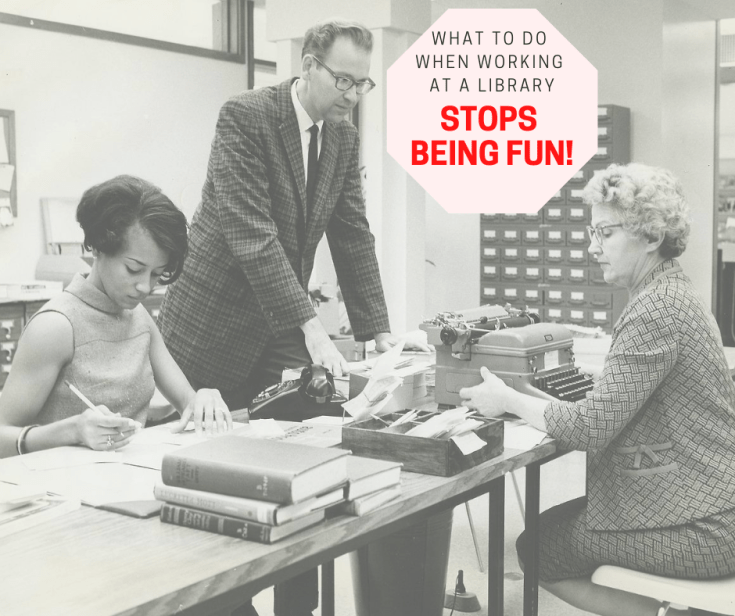
Blue Ash - Sycamore Branch staff: Mrs. Sonia Bibbs (left) Library Assistant, Douglas Robinson, Corinne Hand (right) Children’s Librarian. Courtesy Public Library of Cincinnati and Hamilton County.

I don’t know about you, but I’m exhausted.

The pandemic is exhausting.

Worrying about the health and safety of family and coworkers is exhausting.

Natural disasters, a nation coming to terms with centuries of racial disparity, and a Presidential campaign here in the United States are exhausting.

And yet the library world continues to provide service during this crazy year. Your library probably still did a summer reading program. You’re providing virtual programs. You support students and teachers as they navigate distance learning. You’re promoting books and offering reading recommendations.

The world throws hurdles at you, and your library responds.

Is it any wonder if you feel like you need a nap and a hot bath nearly every day?

Library marketers are expected to be energetic and enthusiastic. More than any other library staffer, you’re expected to have exciting and innovative ideas to promote all these major developments and service changes as well as the smaller services that everyday cardholders rely on.

And you’re expected to produce results, driving people to watch virtual programs, use your curbside pickup service, and follow all the rules for social distancing.

It’s only natural to feel burned out by the speed at which everything happens at your library. And when you get stressed, work stops being fun. The quality of your work suffers.

But your library and your community depend on you. So here are some tips to help you manage your work and avoid burnout.

Prioritize, stay completely focused on your goals, and say “no” to EVERYTHING else.  Humans are all weirdly programmed to say yes, to take on more, to squeeze as much out of life as we possibly can.

Busyness feels wonderful. We’re doing something! Stuff is happening! Progress is being made!

But without space for creative thought, mistakes are going to happen. Your work won’t be what it could or should be. And that means your marketing will be less effective.

So, just like you weed your collection, you need to weed your promotions. This is especially true now, when your audience is suffering from content burnout because of the pandemic.

In my first year at a library, I said “yes” to everything. And nothing I did was any good.

When I realized I was doing too much, I set some ground rules for the goals I wanted my staff to focus on. I aligned these goals with my library’s strategic goals. They were:

  • A promotional tactic (like emails) had to produce a ten percent bump in circulation, program attendance, or usage. If it didn’t, we stopped doing it.
  • A service had to be easy for the cardholder to use to get promotion. Databases are a good example. If a cardholder was required to sign into the library website with their card to get to the database landing page, and then had to create a separate account tied to their email to use the database, we didn’t promote that database.
  • We only did full marketing campaigns for paid presenters. Free presentations got a poster or flyer and a social media mention.
  • All promotional requests had to tie directly to the library’s overall strategy. If the branch or library staffer requesting promotion couldn’t demonstrate how the program or service moved the library’s overall goals forward, we didn’t promote it.

I know that sounds harsh. And some of those rules might not work for a smaller library or a different set of library leaders. That’s okay. Set your boundaries to work within your own system.

Weeding your marketing content will allow you to do a better job and be more creative with the promotions you have left. Evaluate your promotions twice a year to keep your marketing lean and reduce the stress on yourself and your co-workers.

The word “no”, while it may be very small, is liberating. It’s good for you and for your marketing strategy.

Define your workflow and make it the law of your marketing landscape. A defined workflow sounds like the opposite of a creative endeavor. But it ensures that a quality product is created in a timely and efficient manner. It creates space for you to think. And that’s incredibly important for anyone working in a library, especially right now.

There are two options: outward-facing workflow and team workflow. Choose the one that works best for you and your library.

Outward facing workflow means that you approach each job given to you by a senior leader or another library department or partner in the same way.

  • All marketing requests go through one person on your team, who acts as project manager.
  • That person is responsible for looking at the request and determining if it fits into the library’s overall strategic goals.
  • That person sets clear expectations and goals for each project and communicates a plan of action based on realistic timelines and due dates.

This is not to say that your team has no say in the work you do. But the ultimate decision rests with the project manager.

Team workflow is more collaborative.

  • All marketing requests are considered by the team.
  • The team looks at each request and decides what tactics will work, and whether they have the time to complete those tactics.
  • The team sets the goals and determines who will communicate due dates and expectations.

It may take some time to get a smooth workflow in place. Be patient with yourself and with others. Keep reinforcing your expectations. Eventually, your coworkers and supervisors will understand and appreciate your workflow, especially when they start to see results.

Be generous with positive reinforcement. Positive reinforcement is one of the easiest and quickest ways to improve happiness and effectiveness on the job. It bolsters self-confidence and inspires people to do their best work.

If you see a co-worker doing something well, say so, even if the job is small. A kind word can go a long way to boosting morale and creating energy. Don’t just say, “Well done.” Write out a note or an email praising specific actions or portions of work.

And, if you have a staff, give your employees unexpected breaks. When I was a library manager, I took my staff to lunch off-site. We had field trips to libraries outside of our system. Sometimes we had “reading time” where I would read them one chapter a day from a book we all chose together.

It might sound silly, but these little activities are energizing. They create bonds between co-workers. Staff return to work after these little breaks with enthusiasm for their work. And enthusiastic people do a better job… on the job.

You might also want to read these

Four Important Project Management Lessons You’ll Need to Survive the Next Year of Library Work

COVID-19 is STRESSFUL for Library Workers. Here Are Tips to Help You Feel Better.

Latest Book Reviews

The Bell Jar by Sylvia Plath

All the Broken People by Leah Konen

Find more 60-second Book Reviews here.

Subscribe to this blog and you’ll receive an email every time I post. To do that, click on the “Follow” button in the bottom left-hand corner of the page. Connect with me on YouTube, Twitter, Instagram, and LinkedIn. 


Why Your Library Should Have One Social Media Account to RULE THEM ALL!

Watch Now

The  Library Marketing Show, Episode 59

Angela answers a question from a viewer, who wishes to remain anonymous, about whether their library should have one social media account per platform for the entire library system.

It’s a good question, and one that Angela gets all the time. Watch the video to find out what she advises.

Kudos this week to the Public Library of Cincinnati and Hamilton County for unveiling a new website and branding in the midst of a pandemic!  

What did you think of this episode? Are you struggling with marketing and promotion right now? Do you have a suggestion for a topic for a future episode? Want to nominate someone for kudos? Let me know in the comments. And subscribe to this series to get a new video tip for libraries each week! Thanks for watching.

What to Do When Someone Tells Your Library to CALM DOWN on Social Media!

Watch Now

The  Library Marketing Show, Episode 58

Angela is back in her outdoor work space. She answers a question from a viewer who said: “We have gotten a lot of criticism recently for posting too much on social media. We’ve even had people reach out to us and tell us to ‘calm down!’ How do I approach this? I have decreased the amount of posting (1-2/day on FB, 2-3/ week on Insta and Twitter), but I have noticed a plateau in our engagement on social media. Help!!!”

Angela talks about what to do!  

Kudos this week to Mandel Public Library for an amazing post, which you can share if you give them credit.  

What did you think of this episode? Are you struggling with marketing and promotion right now? Do you have a suggestion for a topic for a future episode? Want to nominate someone for kudos? Let me know in the comments. And subscribe to this series to get a new video tip for libraries each week!

Thanks for watching.

I Took a Vacation… and Realized Two Big Things About Libraries and Library Marketing!

Watch Now

The Library Marketing Show, Episode 57

Angela moved her quarantine from Ohio to Virginia last week. While she was there, she realized two big things and she wanted to share those insights with you.

And she shares kudos this week for all the libraries who managed to pivot super fast and make their Summer Reading work in a pandemic. It was HARD WORK and you deserve kudos! 👏👏

What did you think of this episode? Are you struggling with marketing and promotion right now? Do you have a suggestion for a topic for a future episode? Let me know in the comments. And subscribe to this series to get a new video tip for libraries each week!

Thanks for watching.

Four Eye-Opening Library Marketing Lessons I Finally Learned When I Left My Library Job and Became a Regular Patron

Photo Courtesy Public Library of Cincinnati and Hamilton County

It’s been six months since I walked out of the Public Library of Cincinnati and Hamilton County for the last time as an employee. 

You’d think that moving from library staffer to library patron wouldn’t be that big of a revelation. After all, while I worked at the library, I was also a patron.

But there is a mindset shift that happens when you stop working on a library’s communication strategy and start seeing those communications exclusively from the customer side.

Now, when I receive an email from my library, or see a library social media post, or watch a library video, or see a sign at the library branch drive-through window, I don’t know what goal my library is trying to achieve.

I have no idea how long the marketing team worked on those promotional pieces.

I don’t have any insight into the discussion over wording, image selection, and calls to action.

I have no idea how many revisions they went through before they received final approval.

Once I took off my marketing hat and put on my customer hat, I started to see things very differently. I learned some eye-opening lessons.  

Patrons cannot fathom the breadth and depth of your services.

Libraries really do offer an extraordinary number of services. It is impossible for a regular person to understand or remember all of them.

I thought I had a pretty good handle on every service provided by my library. But I would be hard-pressed to list them all if I were forced to, even just six months out from my employment.

With that in mind, library marketing needs to get laser focused. Pick your promotions based on your library goals for the year.

With the pandemic, your goals likely shifted in the past few months. So, focus your promotions on achieving those goals.

Release your promotions consistently over a set period of time and on as many channels as makes sense for your audience. 

Most importantly, resist the urge to promote everything your library offers. It’s overwhelming to your community. Your message will get lost. 

Organic social media is not your friend.

I am a former library employee. I visit the library website at least once a day. I talk about the library on social media.

And yet, I rarely (if ever) get served my library’s Facebook, Twitter, and Instagram posts organically. Most of the time, I must go looking for them.

If I’m not seeing my library’s social media posts, can you imagine how many other people are not seeing them?

In my new job, I talk with a lot of libraries who rely heavily on social media. I’m not saying that you should not post to social. I just want to remind you that social media is also fickle and imperfect.

Be sure to distribute your marketing messages across multiple channels, including email, so you’re sure your whole community will see your message.

In a crisis, more communication is better.

The pandemic and the resulting shutdown came about six weeks after I left the library. And watching it unfold as a customer was interesting.

My honest assessment is that my library did a great job of communicating when it went into shutdown and when it reopened.

However, in the weeks in between those two major events, there was very little communication to patrons.

And I was craving news, even if it was “Our physical buildings are still closed, and we don’t know when we’ll reopen.” In fairness, this is a criticism I had for a lot of organizations, including my church and my kid’s school.

In a crisis, there is no such things as over-communication. Regular updates to your patrons and community are always better than radio silence.

The more you talk to your customer base, the more likely they are to remember you and support you when the crisis is over.

People just want to be informed. Silence feels like abandonment to your patrons. Communicate more often when your library is in crisis.

A well-designed website is a gift to your patrons and essential to your library’s success. 

The main digital entry point for your library is your most important asset.

In my new job, I do a lot of research on libraries of all shapes and sizes. I spend a lot of time looking at library websites.

Some are easy to use and some are not.

It’s no surprise that the libraries with beautiful, easy-to-navigate websites report more engagement from their patron base in the form of circulation, attendance at events (even virtual events), and donations.

If you have any say over your library’s website, it behooves you to spend time making it an amazing portal to your library. 

As a patron, I am grateful when I can find exactly what I need when I visit a library website. Need a place to start? Here are some tips.

You Might Find These Articles Helpful

This Free Tool Will COMPLETELY Change Your Library’s Social Media Posts!

Why the Circle of Promotion is Your Best Bet for Library Marketing

Latest Book Reviews

The Voyage of the Morning Light by Marina Endicott

Find more 60-second Book Reviews here.

Subscribe to this blog and you’ll receive an email every time I post. To do that, click on the “Follow” button in the bottom left-hand corner of the page. Connect with me on YouTube, Twitter, Instagram, and LinkedIn. 


The VERY LATEST Info on Pinterest and What It Means For Library Marketing!

The VERY LATEST Info on #Pinterest and What It Means For Library Marketing!

Watch Now

The Library Marketing Show, Episode 56

Angela reveals the juicy nuggets inside the Pinterest Advertising Guide and explains how this new info applies to libraries doing marketing on Pinterest.

Also Kudos to the Monroe County Public Library in Bloomington, IN for their clever and cute “masks required” video. 

What did you think of this episode? Are you struggling with marketing and promotion right now? Do you have an episode suggestion? Let me know in the comments.

And subscribe to this series to get a new video tip for libraries each week! Thanks for watching.

It’s Not Personal: How to Deal with Negative Comments and Bad Online Reviews of Your Library

How to Deal with Negative Library Reviews and Comments. Photo Courtesy Public Library of Cincinnati and Hamilton County

The lowest moment in my library career came about four years ago, when my library endured a year of bad press.

First, a local TV news station ran a story about drug overdoses at the library. Then, our administration briefly entertained the idea of selling a portion of our main library building to a developer, to raise funds for the renovation of other library branches in our system. You can imagine how the community surrounding the main library reacted.

Our marketing department handled the press coverage well. But, in the fallout, we noticed that the negative press coverage led to negative reviews of our library.

Our services hadn’t changed. Our commitment to the community hadn’t changed. But the negative news stories changed the public’s perception of us.

It played out several times a week when we would post announcements on social media. We were met with comments from people who used those posts to try and steer the conversation to the negative library coverage. I admit, it was exhausting and frustrating.

If you are lucky enough never to be the target of negative press coverage, your library will still have to deal with negative comments, one-star reviews, and NextDoor drama. Even when you are trying to make a difference in the community, you’ll be targeted by complainers.

Negativity is bad for you and bad for your library

Ignoring negative reviews and comments is not an option. They have the power to damage your library’s reputation. A study by Moz.com shows one negative review can drive as many as 30 people away from your library. The more negative reviews and comments you have, the more people you lose, according to the data.

Negative reviews can also hurt your library’s ranking in search. Search engines generally list the highest ranked organizations and businesses first.

What can you do?

It doesn’t matter if your library is giving away $10 bills with every checkout… someone is going to find something to complain about. They’ll probably do it online.

It’s hard to know how to handle the situation when an irate, antagonistic library user posts a negative review on a social media site or website. Your immediate reaction is to jump into firefighter mode, drag out the fully charged hose, and put out the flames… pronto.

But it’s important to take step back and see the opportunity in that negative review. It’s your chance to turn that angry user into an evangelist for your library.

If that sounds like an extreme possibility, I want you to read this post by Jay Baer.  I’ve heard Jay speak at several conferences. He has taught me everything I know about turning negative reviews into positive customer experiences.

Create a process for responding

A plan for responding to negative reviews and comments is a form of a crisis communication plan. If you have a plan in place before you’re confronted with negativity, you can put your emotional reaction aside and respond calmly, rationally, and with empathy.

A thoughtful and measured response to a negative comment makes your library look human. When you respond to critics, you show that you value all your customers and their opinions. Your plan will have four components.

Respond as quickly as possible.  It’s important to address the issue as soon as you can. Talk with staff and senior leaders about monitoring your social media channels and email as closely as you can. There should always be someone who can check the accounts, even at night or on the weekends. If you don’t, you’ll run the risk of other haters hijacking the thread and turning one bad review into a free-for-all.

Don’t censor. Unless the comment violates your social media or website standards of behavior, don’t hide the comment.

If the problem cannot be solved easily online, take it offline. Apologize and address the complainer with empathy, then ask them to contact you by email. You can say, “I’m sorry to hear you are having this problem. We want to make it right. Could you email me at **** and give me some more details about your experience? Then I can make sure your issue gets in front of the right person and is addressed.”

But try to remember that you cannot please everyone. Occasionally, someone will complain about something and you will not be able to fix the problem.  Apologize, explain your library’s side of the situation as best you can, and move on.

Encourage library fans to give positive reviews to outweigh negative reviews and increase your overall search engine rankings. Find ways to solicit reviews from the people who love your library. Amplify those good reviews by sharing them on social media, in emails, and in your print promotional material.

You Might Find These Articles Helpful

Four Daring Ways to Fight Library Haters

Worries in the Library World: Here are Answers to Your Four Biggest Library Marketing Concerns Right Now!

Latest Book Reviews

Oona Out of Order by Margarita Montimore

The Hilarious World of Depression by John Moe

Find more 60-second Book Reviews here.

Subscribe to this blog and you’ll receive an email every time I post. To do that, click on the “Follow” button in the bottom left-hand corner of the page. Connect with me on YouTube, Twitter, Instagram, and LinkedIn. 

Your Website is the MOST Important Gateway to Your Library Right Now. Here Are Eleven Quick Design Tweaks to Make It Amazing.

Photo courtesy Public Library of Cincinnati and Hamilton County

Your library website is getting quite the workout right now. In fact, during this pandemic, your website is the most important connection between your patrons and your services. It’s your digital doorway. It’s your news center. It’s a promotional tool. So, it needs to be welcoming and easy to navigate.

When the pandemic is finally over, your website will still be your most valuable digital asset. In fact, the design and layout of your library website is critical to your library’s ongoing success. Bad web design will make your library look outdated and inefficient. Good web design will keep people coming back. (Scroll down to see some examples of great library websites.)

You don’t have to completely overhaul your website to improve the user experience. There are 11 easy ways to improve your website.

First, you need to enlist the help of people who actually use your website.

Get input from patrons

Create a small focus group. You can do this remotely. Ask for patrons to join your focus group by email or on social media. Set up an email box where they can submit their request to join. Ask them to include their age, their comfort level with technology, and their need for accessible website features. This will ensure you have a well-rounded sample of patrons from different age and ability groups. Choose a larger sample than you will need, keeping in mind that there will be people who will want to join the focus group but won’t complete your feedback survey.

Once you have decided which patrons will be part of your focus group, create your feedback survey using a free platform like Survey Monkey or using a Google Form. Ask your focus group to take a close look at your website and answer these six questions:

  • What is the first thing your eye is drawn to?
  • How easy was it to find the items you want most at the library?
  • Does our current color scheme to draw attention to important services or detract from your experience?
  • Do the images we use cause you to feel any certain emotions? Do they make you want to use our services?
  • Do our web pages feel crowded or do they contain the right amount of information?
  • Can you easily read the text on our website?

Once you compile their feedback, you’ll have a clear picture of what changes you’ll need to make to ensure people keep using your website. And you’ll be ready to make your first six tweaks.

Create a focal point. Identify your library’s number one priority. Make that the first thing people notice when they log onto your site.

Identify the landing pages your patrons most frequently visit on your site. Put links to those pages in the header navigation bar or in a layout that makes it easy for your patrons to find.

Adjust colors to make sure patrons can find what they need. Make sure your website color palette is in line with your brand.

Adjust the images on your website. Do a diversity audit to make sure the images you use accurately represent your community. Look for images that evoke positive emotions like joy or surprise.

Reduce the amount of text, particularly on your homepage. If a service requires a longer explanation, direct patrons to a service landing page with more information.

Increase the font size on your homepage and make sure the font and the colors are accessible. I use this website to check color contrast for Web Content Accessibility Guidelines. And here is the Bureau of Internet Accessibility’s guide to picking an accessible web font.

Five more ways to optimize your library website

Prominently feature your e-newsletter opt-in and social network icons. Email and social media play a critical role in engaging your library patrons. Make sure your community can easily find how to connect with you.

Use easy language. Are you using a lot of library jargon or professional terms on your website? One word can make a huge difference. For example, a simple change from “periodicals” to “magazines” may help many people to find your downloadable magazine collection, which will increase circulation and engagement. So take the time to evaluate what you call things on your website.

Make a landing page for each of your services.  Many visitors will not see your home page. They’ll come to your website straight from a Google search or a link you provide on social media or in an e-newsletter. So group your services and create landing pages for each category, like workforce development or educational help.

If you do a good job with your landing pages, you’ll increase the chances that your library will be found in Google search. You’ll also increase the chances that a patron searching for services will find exactly what they need quickly. That’s good customer service! And as you create those landing pages, consider this next step.

Have a domain strategy. A good URL structure is short and includes a target phrase. For example, my former employer, the Public Library of Cincinnati and Hamilton County,  created a page for their summer reading program, CincinnatiLibrary.org/Summer. This URL makes promotion easy (people can remember that URL when they see it on print materials or digital signs) and ensures the site is search engine friendly.

Get rid of all your dead-end pages. Make sure that every page leads to an action that takes a cardholder to another page. This increases the chances that someone will spend more time and take more actions on your website.

Great examples of library websites

Saint Paul Public Library: The colorful, clear images and simple text make navigation easy. Notice they’ve placed the things most library lovers search for–catalog, events, and the calendar-right at the top. I love that their FAQs are right on the homepage.

Clinton Macomb Public Library: A great example of how to position your social media icons in a prominent location on your homepage.

Prince George’s County Memorial Library: Icons draw the eye to key areas. Their most important service areas are filed like cards on the homepage, making it easy for users to find exactly what they need.

Ann Arbor District Library: A modern design with friendly, casual language and easy-to-spot newsletter signups and social media icons.

Kalamazoo Public Library: Their community clearly values the collection, and Kalamazoo has put the best titles in all formats front and center on their website.

Qatar National Library: This library’s website reminds me of Pinterest, with their top features displayed in easy-to-navigate squares. Their use of images is top-notch.

You might also find these posts helpful

How Your Library Can Use Google Ad Grants to Supercharge Your Website and Reach a Huge Untapped Audience

Four Instant Ways to Improve the Most Valuable Page on Your Library Website

Latest Book Reviews

How to Be an Antiracist by Ibram X. Kendi.

Rodham by Curtis Sittenfeld.

Find more 60-second Book Reviews here.

Subscribe to this blog and you’ll receive an email every time I post. To do that, click on the “Follow” button in the bottom left-hand corner of the page. Connect with me on YouTube, Twitter, Instagram, and LinkedIn. 
Why Libraries Lost HUGE Parts of Their Patron Base During the Pandemic and How to Fix It

WATCH NOW

The Library Marketing Show, Episode 53.

Angela issues a call to action to libraries to join in the movement to create a new utility… one that will ensure everyone in your community truly has access to library.

Also Kudos to the Nashville Public Library for their incredibly creative curbside video. You just have to watch it!  Nominate someone to receive kudos by commenting below or on SuperLibraryMarketing.com.

What did you think of this episode? Are you struggling with marketing and promotion right now? Do you have an episode suggestion? Let me know in the comments.

And subscribe to this series on YouTube to get a new video tip for libraries each week! Thanks for watching.

A WordPress.com Website.

Up ↑