Your library’s video got 5,000 views. Great! But what does that actually mean?
If you’re using video on Facebook, Instagram, TikTok, YouTube, or LinkedIn, you might be surprised by what each platform considers a “view.” And that matters when you’re trying to figure out whether your library’s video marketing is actually working.
In this episode of The Library Marketing Show, I’m breaking down what those view counts really tell you and the metrics you should pay attention to if you want to know whether people are actually watching, paying attention, and taking action.
Plus, kudos go to an entire state of libraries for doing something truly extraordinary.
Do you have a suggestion for a future episode’s topic? Do you want to nominate someone for kudos? Let me know here.
I had a completely different topic planned for today’s Library Marketing Show.
Then Facebook dropped some news that could have a big impact on how libraries use social media: the platform is beginning to charge some libraries to include links in their posts.
If Facebook is one of your library’s primary ways of driving people to your website, events, programs, resources, or online services, this is something you need to understand.
In this episode, I’m breaking down what’s happening, what it could mean for library marketing, and why this may be a sign that we need to rethink how much of our marketing strategy depends on social media platforms we don’t control.
Have you ever looked at your library marketing calendar and said to yourself, “I have to promote story time again. What on Earth am I going to say this time?”
Your library’s evergreen services are really valuable, but it can get tedious promoting them over and over again.
So, how do you do it in a way that keeps that content fresh and interesting, and perhaps brings new people to your library? We’re going to talk about it in this episode of The Library Marketing Show!
Plus, kudos go to a library that combined a pop culture moment with a popular book series for timely, authentic marketing magic.
Do you have a suggestion for a future episode’s topic? Do you want to nominate someone for kudos? Let me know here.
Photo courtesy Cincinnati & Hamilton County Public Library
This week, I got to participate in an informal, impromptu awards ceremony for one of my coworkers.
Andy is a quiet, unassuming guy who loves to fish and has worked for the library longer than I have. He’s one of the people who really make a difference at the Library (so much so that we profiled him on the blog!)
The ceremony took place on the Social Stairs, a colorful event and gathering space in the Atrium. Our director read the award nomination in her trademark booming voice (no mic needed), and the customers around us (who likely came in to cool down in the heat or charge their devices, or have a moment of peace) got a chance to hear about how Andy’s work added value to the library.
Libraries are full of stories like that… stories of how lives are changed within its walls. The problem is that we often tell them one at a time, and they don’t relate to one another at all.
Think of how disjointed this might appear to your community⬇️
This week, we’re promoting Summer Reading.
Next week, it’s a job search workshop.
Then a makerspace program.
Then a new branch.
Then a database.
Then an author visit.
No wonder you and your audience are exhausted.
Granted, individually, each promotion makes sense. But collectively, they can make the library feel like a random place where a bunch of unrelated activities take place.
WHAT DOES IT MEAN?
I’m only four months into this job but… what ifsomeone sees a year of our marketing and never grasps why the library matters?!
That question led me through a messaging exercise that eventually became the foundation for a new communication strategy. In this post, I want to walk through the process.
Step 1: Stop Thinking About Marketing Channels
Most messaging discussions start in the wrong place. Teams start talking about:
Social media
Emails
Billboards
News releases
Videos
None of those things are messaging. They are delivery methods.
Before you decide where a message should appear, you need to decide what you want people to believe. That’s a much harder question!
Step 2: Define the Beliefs You’re Trying to Build
Every marketing message either strengthens public understanding or leaves it unchanged. So start by identifying the beliefs you want your community to hold about the library.
Examples might include:
The library is essential.
The library improves lives.
The library creates opportunity.
The library strengthens communities.
The library deserves support.
These beliefs will be your “north star.” Every future communication will be evaluated against these beliefs.
If a message didn’t help reinforce one of them, you’ll need to ask whether it deserves space in your marketing calendar.
I know that sounds bananas, but you only have so much time in the day. This messaging makes your work matter.
Step 3: Look Beyond Services
Next, make a list of programs, collections, and services. Then ask yourself:
What happens because this service exists?
Not “What is it?” Not “How does it work?”
But why is this service so important? What change does it make?
For example, a storytime isn’t a storytime. It’s an opportunity for early literacy and school readiness.
A job-search class isn’t a class. It’s greater economic stability.
A makerspace isn’t a room full of equipment. It’s skill development and creativity.
This sounds simple, but it dramatically changes how you talk about your library.
Step 4: Search for Common Themes
After examining enough services and outcomes, patterns emerge.
You will begin to notice that the library contributes to the community in several consistent ways. Dozens of seemingly unrelated services begin clustering around a much smaller set of themes.
The details may vary, but the impact is the same.
This step is critical because most organizations have too many messages.
I do not want you to do more work. I do not want you creating more messages. I want you to find the handful of ideas that can connect everything.
Then, brainstorm a phrase that connects the value of those outcomes emotionally. I’m not asking you to find a perfect slogan. But you do need some language that can showcase the impact, simply and clearly, for everything from storytimes and workforce programs to branch renovations and digital access.
Here are some examples you can steal.
Building Stronger Communities.
Where Possibility Begins.
Helping People Thrive.
Opening Doors Every Day.
Connecting People to Possibility.
Turning Curiosity into Opportunity.
Helping Communities Grow.
The Center of Community Life
This part may take a while, because many messages work well for one type of service but become difficult to apply consistently across the entire organization.
A good messaging platform has to work equally well for a child attending storytime, an entrepreneur researching a business idea, a resident borrowing Wi-Fi, or a customer preparing for a job interview.
Step 5: Make It About People
The strongest messaging isn’t about the library. It is about what people accomplish because the library exists.
Libraries often center themselves in their communications. Community members are not as obsessed with us as we are! They’re thinking about their goals. Their challenges. Their children.
They are the center of their universe, not us. (Sorry!)
The most effective messages create a bridge between what the library offers and what people are trying to accomplish.
Step 6: Commit to Repetition
A message doesn’t become powerful because it’s clever. It becomes powerful because people hear it repeatedly, over time, across channels.
Repetition makes your message familiar. People will understand and believe it. They will begin to trust your library because of the consistency. And you’ll change the way the community thinks about your organization!
Final Thought
Libraries often assume they have an awareness problem. I really don’t think that’s the issue.
Most people know the library exists. But what people don’t understand is the role the library plays in helping people learn, work, connect, create, and thrive.
That’s why messaging matters. We can use it to build and shape public belief. We can start making people value the library. And people protect what they value!
Subscribe to this blog, and you’ll receive an email whenever I post. To do that, enter your email address and click on the “Follow” button in the lower left-hand corner of the page. You can also follow me on the following social media platforms:
I had a list of things I thought needed attention. I had ideas. I had opinions. I had years of experience.
But I also knew I was walking into an organization that existed long before me, had been through a tumultuous six years, and will face tough challenges in the not-so-distant future.
So I made a decision. For the first few weeks, I just listened.
And looking back, it was probably the most important thing I did.
Start With People, Not Projects
The temptation in a new leadership role is to make your mark immediately. You want to launch something. Reorganize something. Fix something.
Resist the urge.
Before I touched processes or strategy, I sat down with every member of my team and with every member of senior leadership for one-on-one conversations. I asked questions like:
What do you spend most of your time doing?
What part of your job do you enjoy most?
What are you exceptionally good at?
What drains your energy?
What skills do you wish you had more opportunities to use?
What gets in the way of doing great work?
I wasn’t looking for complaints. I was looking for opportunities, gaps, and patterns. And those things started emerging quickly.
Some people were doing work they loved. Others had talents that weren’t being fully utilized. Some responsibilities seemed to belong to multiple people. Other responsibilities didn’t seem to belong to anyone.
That information was incredibly valuable. It became a roadmap to set up a foundation for success.
Build a Team Map
One thing I’ve learned over the years is that organizational charts don’t tell you much.
A job description tells you what someone is supposed to do. A conversation tells you what they actually do.
As I talked with my staff, I started mapping the team. I asked myself:
Who are the strongest writers?
Who can manage projects?
Who understands data?
Who has strong design skills?
Who is great at relationships and collaboration?
Just as importantly, I looked for gaps. Specifically, I pinpointed the skills that were missing, areas that seemed underdeveloped, and places where work was getting bogged down or stopped altogether.
I wasn’t trying to evaluate people. I was trying to understand the system.
Before you can build a stronger team, you have to understand the team you actually have.
Define the Real Problems
As I observed the department and reviewed existing work, I noticed something that I’ve seen in other organizations too.
People were working incredibly hard. But they were often operating without shared expectations, messaging, or processes.
Projects moved through different review paths depending on who was involved. Marketing requests arrived in different formats. Staff made decisions based on their own understanding of priorities.
Nobody was doing anything wrong. The team simply lacked some foundational systems. That realization shaped my plan for moving forward.
Map Out Your Priorities
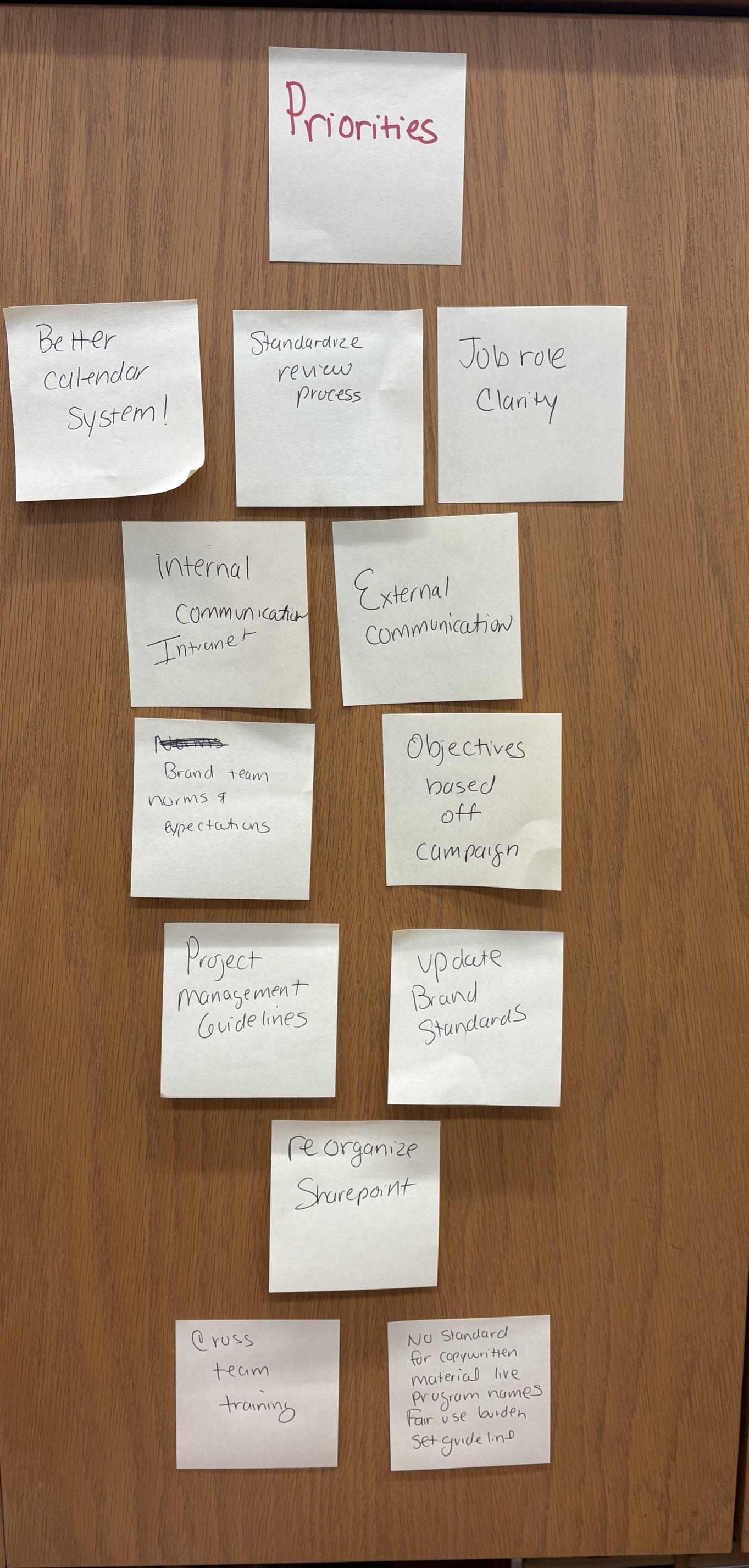
Once I had a clear picture of my team and the larger organization they worked in, I worked on identifying and prioritizing what I needed to do. I created what I call my “Post-It Pyramid of Priorities.”
I wrote down the foundational tasks I needed to tackle, one on each Post-It. Then I arranged them in a pyramid, with the tasks I needed to complete at the top. (Groundbreaking, right?)
I put tasks that were interrelated into a line to signal to myself that I needed to work on them simultaneously.
Post-It Pyramid of Priorities
Using Post-Its makes it easy for me to move and change my priorities as conditions change.
Establish Your Messaging Foundation
One of the biggest priorities during those first 90 days was working through messaging.
What exactly were we trying to say about the library? More importantly, were we all saying the same thing?
Libraries are wonderful at promoting programs, events, and services. We are less consistent when it comes to communicating our larger value.
Ask staff members why the library matters and you might get a bunch of different answers.
Some will talk about books.
Some will talk about literacy.
Some will talk about technology.
Some will talk about community.
None of those answers are wrong.
But if your organization wants to build trust, recognition, and support, there needs to be some shared understanding of the bigger story you’re telling.
In my next post on July 27, I’ll go more in-depth to show you how our library determined a messaging focus and how we’re executing it.
Create a Strategy People Can Actually Use
The word “strategy” seems to scare people. I think it’s because most strategies are created by senior leadership, who then pass them down to the staff without taking the time to get buy-in. (This happens at for-profit companies too!)
I wasn’t interested in creating a document that nobody would read. I wanted a framework that would help people make decisions.
Who are we trying to reach?
What behavior are we trying to influence?
What organizational goals are we supporting?
How do our messages connect to those goals?
How should different channels work together?
Once you have the answers to those questions, you can create a simple strategic framework that you and your staff can follow for the next year.
Standardize the Review Process
When organizations don’t have a clear review process, everyone creates their own.
One project gets five rounds of edits. Another gets none. One person is included in decisions. Another is surprised at the last minute.
Over time, that creates frustration for everyone!
So we built a standard review structure. It helps me and my marketing manager to, well, manage projects!
We worked together to decide:
Who reviews what.
When they review it.
What kind of feedback they’re responsible for providing.
What final approval looks like.
The result is more consistency, fewer surprises, and much less confusion.
Focus on Culture, Not Just Process
The systems matter. The strategy matters. The messaging matters. But the biggest adjustment we need to make is cultural.
Instead of asking, “Can we promote this?” I’m prompting my staff to start asking, “What are we trying to accomplish?”
Instead of thinking about outputs, we are thinking about outcomes. Instead of automatically saying yes to every request, we started discussing priorities. (That is a biggie!)
It definitely is a mindset change. It won’t happen overnight, and you’ll face some bumps and pushback along the way. But getting yourself and your team to work these questions into your daily thought process will lead to better results.
What I Didn’t Do
Here’s what I did not do in my first 90 days!
I didn’t reorganize the team.
I didn’t launch a huge new campaign.
I didn’t overhaul every process.
I didn’t try to solve every problem.
New leaders sometimes feel pressure to demonstrate value immediately.
Ironically, one of the most valuable things you can do is slow down. Ask questions. Gather information. Build trust.
What If You’re Not New?
You don’t have to start a new job to use this approach.
In fact, if you’ve been at your library for years and feel like you’re stuck, this mindset can be even more valuable.
One of the advantages of being new is that you notice things everyone else has stopped seeing. You ask questions because you genuinely don’t know the answers. You challenge assumptions because you haven’t inherited them yet.
After you’ve been somewhere for a while, it’s easy to accept the way things are simply because “that’s how we’ve always done it.”
So borrow a trick from your first-day self.
Schedule listening meetings with colleagues you don’t work with regularly. Ask people what gets in the way of doing great work. Map your team’s strengths and gaps again. Follow a marketing request from start to finish as if you’ve never seen the process before.
Sometimes the biggest breakthroughs come from looking at familiar problems with fresh eyes.
Subscribe to this blog, and you’ll receive an email whenever I post. To do that, enter your email address and click on the “Follow” button in the lower left-hand corner of the page. You can also follow me on the following social media platforms:
Photo courtesy of Cincinnati & Hamilton County Public Library
For years, conventional wisdom in library marketing has been clear: you need to be on Facebook because that’s where your community is.
But what if that’s no longer true?
The staff at Lucius Beebe Memorial Library in Wakefield, Massachusetts, asked themselves that question. And then did something many libraries would consider unthinkable.
They stopped using Facebook altogether.
Several months later, Library Director Catherine McDonald says the results have been surprisingly uneventful.
“After all the work that went into the decision, it didn’t have any effect other than how freeing it is to have one less thing on my plate,” says McDonald.
“I realized I had felt a constant responsibility to protect patrons and staff from harsh words and misinformation about the library and its services. People don’t behave face-to-face as they sometimes might on Facebook.”
A Long Time Coming
Lucius Beebe Memorial Library serves Wakefield, Massachusetts, a community of just under 30,000 residents located north of Boston. The library operates from a single historic building on Main Street.
The library wasn’t an early skeptic of Facebook. In fact, McDonald created the library’s first Facebook page around 2010.
At first, the platform helped the library connect with patrons and promote programs and events. Over time, the library expanded its social media presence and experimented with different content strategies.
Some of the library’s most successful posts featured unexpected moments, including a bunny rescue, removal of a hornet’s nest, and staff retirements.
But as the years passed, McDonald began questioning whether the effort was still worthwhile.
” First, we noticed that the number of followers who were Wakefield residents was about only a third of the list,” recalls McDonald.
“Social media was becoming less social and requiring more work to understand how to game the system.” It became complicated to understand who we were reaching with what information.”
McDonald also saw reports on declining reading-for-pleasure rates, online bullying, misinformation, and increasingly hostile online interactions. The platform also made it difficult for the library to control its own narrative.
“On Facebook, often people type, but don’t read,” McDonald says.
Those concerns prompted a deeper internal discussion about whether Facebook still aligned with the library’s mission.
Testing the Assumptions
One of the most common arguments for maintaining a Facebook presence is that libraries need to “meet people where they are.” McDonald wasn’t convinced that statement should go unquestioned.
Rather than relying on assumptions, the library began comparing Facebook’s effectiveness against other communication channels, including its website, newsletters, blog, and local media outlets. The library also experimented with a social media pause during Summer Reading. The response?
“I received a couple of emails thanking me,” McDonald says.
The experience reinforced what library leadership was beginning to suspect: Facebook might not be as essential as many people believed.
Making the Decision
After an influx of bots appeared on the library’s Facebook page, McDonald decided it was time. With support from the assistant director, the library stopped actively using Facebook.
Not everyone was immediately convinced. Two members of the library’s board questioned the decision, and some staff initially worried the library might be giving up an important communication tool.
“Initially, some staff thought we were missing something important,” McDonald says. “But they accepted the decision and moved on to other things.”
Interestingly, she says stakeholders have been more likely to praise the decision privately than criticize it publicly.
What Happened After Leaving Facebook?
The short answer: not much.
Program attendance remained steady.
Website usage remained strong.
The library’s newsletters and blog continued to perform well.
Community engagement did not decline.
The library still maintains an Instagram presence, which McDonald says allows staff to share photos and connect with the community without many of Facebook’s drawbacks.
In fact, one unexpected benefit involved customer service. When the library was active on Facebook, patrons expected staff to monitor comments and answer questions in real time. During weather closures, for example, patrons would ask questions such as, “Are you open tomorrow?” and expect a response.
Without dedicated staff monitoring the platform, those inquiries often went unanswered. Now there is no confusion about where patrons should go for timely information.
“The expectation is that the place to learn immediate information about the library is the website or the Town website,” McDonald says.
The library also works closely with Wakefield’s communications manager to ensure important messages reach the community.
The Real Benefit
While the library didn’t experience dramatic gains after leaving Facebook, McDonald says the biggest benefit was psychological. For years, she felt responsible for moderating misinformation, managing negative comments, and protecting both patrons and staff from hostile online interactions.
That burden disappeared.
“I realized I had felt a constant responsibility to protect patrons and staff from harsh words and misinformation about the library and its services,” she says.
The experience also eliminated ongoing questions about moderation policies, comment removal, and blocking users, areas where McDonald says she often received conflicting legal advice.
Advice for Other Libraries
McDonald acknowledges that many libraries continue to find value in the platform and use it successfully.
But she does encourage library leaders to examine their assumptions.
“I’m sure lots of communities find Facebook effective and fun,” he says. “But don’t be afraid to question your assumptions or prevailing theories.”
For Lucius Beebe Memorial Library, questioning those assumptions led to a surprising discovery: Leaving Facebook changed far less than they expected.
And sometimes, that’s the most revealing result of all.
Subscribe to this blog, and you’ll receive an email whenever I post. To do that, enter your email address and click on the “Follow” button in the lower left-hand corner of the page. You can also follow me on the following social media platforms:
Photo courtesy Cincinnati & Hamilton County Public Library
In this post, you will learn:
Relevance matters more than frequency. Libraries don’t need to send more messages. They need to send more relevant ones.
Data makes library marketing more newsworthy. Statistics and outcomes can transform promotions into compelling stories.
Trust is a strategic asset. Libraries can stand out by being a reliable source of information and expertise.
I recently downloaded Cision’s State of the Media Report so that my library could adjust our media strategy to get more positive press. But I found myself looking at the report as a larger lesson for my library marketing.
Cision surveyed nearly 1,900 journalists worldwide about how they work, the challenges they face, and what they need from public relations professionals. At first glance, it might seem like a report intended for public relations agencies and large, well-funded corporate communications teams.
But as I read through the findings, I kept thinking about libraries (of course!) That’s because the challenges journalists face look surprisingly similar to those library marketers face every day when reaching our communities.
People are overwhelmed with information. They’re short on time. They’re sorting through more content than ever before. And they are constantly trying to determine which messages deserve their attention.
The things that cause a journalist to ignore a pitch are often the same factors that make a community member ignore a library marketing message.
Here are the top five things I learned from the report about making my library’s message stand out.
Takeaway #1: Relevance Beats Volume
The report found that the number one factor that makes journalists respond to a pitch is relevance. Nearly 80 percent said they are most likely to consider a story when it aligns with their audience and coverage area. Likewise, more than 80 percent said they reject pitches that aren’t relevant.
That should sound familiar. Libraries often assume that getting attention is a volume problem.
“We need to post more.”
“We need to send more emails.”
“We need to promote this event harder.” (What does that even mean, really?)
But attention isn’t usually a volume problem. It’s a relevance problem.
The question isn’t whether your community saw your message. The question is whether they immediately understood why it mattered to them.
A generic announcement about a program might get ignored. But a message that clearly connects to a person’s needs, interests, goals, or challenges has a much better chance of breaking through.
Takeaway #2: People Are Drowning in Messages
Most journalists in the survey reported receiving more than 50 pitches every week. Many receive more than 100! Yet most say only a small percentage of those pitches are actually relevant.
That sounds familiar too! Your patrons are also sorting through dozens of emails, social media posts, text messages, videos, advertisements, flyers, signs, and notifications every day. They don’t have time to figure out why something matters. They need clarity and connection.
I recently implemented a new messaging strategy for my team to address this issue. I told them that we are going to stop leading with what we are doing and start leading with why our community should care. We are now going to be focusing less on announcements and more on why our work matters and the problems it solves for our community.
Here’s a simple way to reframe your library’s message to focus more on the value.
Instead of: “The library is pleased to announce…”
Try: “Parents looking for free summer activities can now register for…”
Or: “The Library is proud to offer resume workshops and mock interviews” becomes “Get the tools and support you need to actually land the job.”
One messaging strategy starts with the organization. The other starts with the audience.
Takeaway #3: Data Makes Stories Stronger
One finding that really stood out to me was that journalists said they want more data and research. Why?
Because data provides context. It helps explain why a story matters.
Libraries have access to more useful data than we often realize.
We know what people are reading.
We know how technology is being used.
We know what programs are growing.
We know where community needs are emerging.
Yet many libraries continue to market programs without sharing the larger story behind them.
So, don’t just announce Summer Reading. Show how participation has grown. Don’t just promote your digital resources. Show how community usage has changed over time.
Data transforms promotion into storytelling. And storytelling is more memorable than push promotions because it activates emotions, which makes the story stick in a person’s mind.
These data stories are particularly impactful for messaging aimed at elected officials and donors.
Takeaway #4: Trust Is Becoming More Valuable
One of the biggest concerns journalists identified was accuracy and misinformation. Credibility matters.
This is an area where libraries have a tremendous advantage. Libraries remain among the most trusted public institutions. But trust is only valuable if we actively use it.
That means sharing accurate information, citing sources, providing context, and helping community members make sense of an increasingly complicated information landscape.
Takeaway #5: Make People’s Lives Easier
Perhaps the most important lesson from the report is that journalists want sources who make their jobs easier. They want clear information, quick responses, and they want their subjects to respect their time. So do our community members!
The best library marketing doesn’t demand attention. It earns attention by being useful.
When your content helps people solve a problem, answer a question, save money, learn a skill, or improve their lives, your library marketing stops feeling like marketing. It becomes a service.
Final Thoughts
The State of the Media Report wasn’t written for library marketers. But it contains an important reminder for all of us.
Whether you’re pitching a reporter or communicating with your community, success doesn’t come from sending more messages. It comes from creating messages that are relevant, trustworthy, useful, and easy to understand.
Subscribe to this blog, and you’ll receive an email whenever I post. To do that, enter your email address and click on the “Follow” button in the lower left-hand corner of the page. You can also follow me on the following social media platforms:
Photo courtesy Cincinnati and Hamilton County Public Library
In this post, you will learn:
Emotion drives action. People are more likely to act on your library marketing if it makes them feel something.
Real stories on video don’t need to be polished. Authentic patron and staff experiences are some of the most effective marketing tools libraries have, and all you need is a cell phone!
Emotional marketing is not manipulation. When done ethically, storytelling helps communities understand the real impact of library services.
A few years ago, a library patron accused my library marketing team of “manipulating emotions.”
Honestly? She wasn’t wrong. We absolutely wanted people to feel something!
At the time, my library was building support for a facilities plan. Several of our historic Carnegie branches were not accessible to people with disabilities, and we knew we needed the community to understand why modernization mattered.
So we told a real story. We interviewed a veteran who physically could not enter the branch library in his own neighborhood.
We shared his experience in a short video campaign designed to help our community see the problem through a human lens instead of through budget spreadsheets and building reports.
After we published the video, one viewer messaged us: “How dare you manipulate my emotions and try to make me feel sorry for this guy?”
My response then — and now — is this:
Libraries should never apologize for telling meaningful stories.
Why Emotional Marketing Works for Libraries
One of the biggest mistakes libraries make in marketing is assuming facts alone will persuade people. We think that if we simply explain our services clearly enough, people will understand our value.
But audiences don’t make decisions based purely on logic. They make decisions based on emotion and then use facts to justify those feelings later. That’s especially true on social media, where algorithms reward content that sparks reactions, conversations, shares, and engagement.
People engage with content when it makes them feel:
Hopeful
Inspired
Seen
Empathy for someone else
Proud of their community
Connected to something bigger than themselves
That emotional response is what moves someone from passive scrolling to active engagement. And here is more good news.
Libraries Already Have Powerful Stories
You do not need a massive budget or a professional production crew to create emotional marketing. You already have the raw material.
Every library has:
A teen who found belonging through programs
A job seeker who got help building a resume
A parent who found support during a difficult season
A senior who depends on library staff for connection
A child who discovered a love of reading
A staff member who went above and beyond for someone
These stories are your most effective marketing!
Too often, libraries default to promotional language like:
“Register now!”
“Check out our new database!”
“Join us Tuesday!”
But audiences connect more deeply with:
“This program helped me make friends after moving here.”
“The library gave me confidence during my job search.”
“I didn’t feel alone anymore.”
That’s the difference between information and impact.
Emotional Marketing Is Ethical When It’s Honest
There’s an important distinction between emotional storytelling and emotional manipulation.
Manipulation relies on exaggeration, fear tactics, or dishonesty.
Ethical emotional marketing tells true stories that help audiences better understand real community needs and real library impact.
Libraries are uniquely positioned to do this well because our work genuinely changes lives every day. If your library helped someone succeed, feel safer, feel connected, or solve a problem, sharing that story is not exploitation. It’s advocacy.
The Best Way to Capture Emotion: Video
Video remains one of the most effective formats for emotional storytelling because audiences can hear tone, see facial expressions, and connect with people “face to face.”
But here’s the good news: your videos do not need to look cinematic! Some of the most effective library videos are filmed on a phone. What counts is not the production. It’s the authentic conversations.
If you want to start gathering emotional stories, try interviewing:
Loyal patrons
Volunteers
Staff members
Program attendees
Community partners
Ask open-ended questions like:
What’s your favorite memory involving the library?
How has the library impacted your life?
What would your community lose if the library disappeared tomorrow?
Tell me about a moment when the library helped you unexpectedly.
Why does this library matter to you personally?
Then stop talking and let them tell the story.
Don’t Forget Your Staff Stories
Library staff are often an untapped source of emotional content.
Staff members witness transformation every day:
helping someone apply for benefits,
finding the perfect book for a struggling reader,
assisting someone through a difficult life transition,
or creating a welcoming space for people who need connection.
Those stories matter.
Some of the best questions to ask staff include:
Tell me about a patron interaction you’ll never forget.
What moment made you proud to work at the library?
What keeps you motivated in this work?
What’s something the public doesn’t always see about library service?
These interviews can become:
Short social videos
Newsletter features
Website testimonials
Annual report stories
Posters and digital signage
Advocacy campaign content
One good story can fuel months of marketing content.
The Hidden Benefit of Emotional Marketing
Something interesting happens when libraries start telling emotional stories consistently: More stories start showing up.
When we launched our own customer impact video series years ago, staff and patrons immediately began sharing additional experiences with us.
People wanted to participate because they felt recognized and connected.
That’s one of the most powerful outcomes of storytelling: It builds community identity. People stop seeing the library as just a building or service provider and start seeing it as something deeply personal and valuable.
Final Thoughts
Libraries are emotional spaces. They represent hope, opportunity, safety, curiosity, nostalgia, belonging, education, and community.
Trying to market libraries without emotion is like trying to market music without sound.
So no, libraries should not feel guilty for creating marketing that makes people “feel all the feels.”
That emotional connection is often exactly what inspires people to support, advocate for, fund, and engage with the library in the first place.
Subscribe to this blog, and you’ll receive an email whenever I post. To do that, enter your email address and click on the “Follow” button in the lower left-hand corner of the page. You can also follow me on the following social media platforms: