Search

Super Library Marketing: Practical Tips and Ideas for Library Promotion

Category

Library Marketing Strategy

The Divide and Conquer Method of Library Marketing: How to Realistically Reach Your Library Promotional Goals Without Losing Your Ever-Loving Mind [ARTICLE]

Photo courtesy Cincinnati and Hamilton County Public Library

Have you been in the grocery store cereal aisle lately?

Recently I had a craving for yogurt topped with cereal as a snack. So, I went to the store with the simple plan of buying a box of cereal.

Did you know the average grocery store carries nearly 300 types of cereal? The cereal in my store takes up the length of an ENTIRE AISLE.

Holy Cheerios, Batman.

There is such a thing as too many choices.

When youโ€™re faced with a wide range of selections, you can end up feeling paralyzed and unable to decide. Or, worse yet, you make a decision that turns out to be the wrong one because there were too many factors to take into consideration.

I sometimes feel the same way about working in library marketing.

Many of us have too much work to do. We have multiple goals we are trying to reach. And all that work makes it impossible to do anything well. It’s no wonder our promotions fail. We need to focus on focusing.

Now thatโ€™s youโ€™ve created a promotional strategy and youโ€™ve set up a promotional calendar, you may be tempted to try a whole bunch of new promotional ideas all at once.

But for true library promotional success, you’ll need to pace yourself. You want to be deliberate, intentional, and thoughtful about the library promotions you put out into the world.

Easier said than done, right?

So how do you create your promotions, track the results, and not lose your mind?

By using something I like to call โ€œthe divide and conquer approach.โ€

Iโ€™ve put together a three-step process to help you manage your workflow. This simple plan will help make sure your time is spent wisely. It will ensure you have the time to create your promotions and check the results so you can ensure that youโ€™re reaching your promotional goals.

This method will make your marketing goals feel more manageable to you. You won’t get overwhelmed. And you’ll be able to spend time creating and tracking promotions to make sure the work you’re doing is effective.

Tackle one goal at a time.

People often sing the praises of multitasking, but any time management expert will tell you it kills productivity and leads to burnout.

Instead, you’ll want to prioritize your library marketing goals. Decide which is the most important by asking yourself one simple question: ย Which goal will have the most positive impact on your library? Thatโ€™s the one you should focus on.

This laser focus will actually allow you to reach ALL of your library promotional goals faster. When you focus fully on one goal, you can learn valuable lessons about your community and how they respond to your promotions on your available channels. And those lessons will make it easier for you to reach your future goals.

As you work towards your goal, youโ€™ll learn along the way which work, which donโ€™t, and how to carry them out effectively. You can use this valuable knowledge for future goals.

Create an action plan with list of tasks you need to complete to reach your goal.

In this step, you’ll very specifically lay out what needs to be done to reach your goal. This will make the final goal seem less overwhelming. It will also help you to gauge how much time you need to set aside each day to work on your promotions.

Let’s say that your priority goal is to increase the number of people who come to visit a physical library space. Your initial task list might look something like this.

  • Create a weekly email to promote a service that’s only available inside a library branch.
  • Create one Instagram and Facebook story per week to highlight a service that’s only available inside a library branch.
  • Create two social media posts per week on Facebook, Instagram, and Twitter to promote one in-person event.
  • Create a video that shows people coming into a library branch, focused on the physical space as a place of community and social interaction.

Now that you have your initial list of tasks, you can divide each task further into two or three smaller action items.

For example, your initial task of creating two social media posts per week on Facebook, Instagram, and Twitter to promote one in-person event can be accomplished by making a smaller action item list like this:

  • Choose events (consult with programming department)
  • Write post text
  • Create images
  • Schedule posts

Set a firm timeline for reaching your overall goal. Assign deadlines for each item on the task lists.

For our example, we may decide that we are going to work for the next two months on increasing in-person visits to the library.

Now, we can take our lists of tasks and set deadlines for when each of these tasks needs to be completed and released out into the world. Those deadlines will help you reach your target efficiently by assigning a timeframeโ€”a start and end dateโ€”to every step in the process.

This “divide and conquer” approach gives you and your co-workers a chance to merge this new way of thinking and the new workload into your schedule without stress. It will make it easier to measure results.


Related Posts

How to Create a Social Media Strategy That Actually Works

Call It What It Is: Toledo Public Library Explains Their New Brand Strategy

Subscribe to this blog and youโ€™ll receive an email every time I post. To do that, enter your email address and click on the โ€œFollowโ€ button in the lower left-hand corner of the page.

The Magic Secret To Create Effective Library Marketing: How To Set Up Your Libraryโ€™s Promotional Calendar!

Photo courtesy Cincinnati and Hamilton County Public Library

Now that youโ€™ve created a library promotional strategy, itโ€™s time to take the next step. And that is to create a calendar for all your library promotions.

Three main reasons a library promotional calendar is important

A promotional calendar is vital to success. This is especially true in an organization with many contributors and stakeholders, like a library.

Hereโ€™s why youโ€™ll want to have a promotional calendar, even if your team of content creators or contributors is small.

  • It helps you stay organized and focused on the goals you set as part of your promotional strategy.
  • It helps you to keep track of holidays, seasonal library and literary events, and major annual promotions like summer reading.
  • It keeps everyone at your library up to date on your promotional plans.

How to set up your libraryโ€™s promotional calendar

Scroll down to the bottom of this post for my recommendations of three free calendar templates that you can use to create your libraryโ€™s promotional calendar.

No matter which template you choose, the calendar should be shareable. This will ensure the contributors at your library can see all future promotional plans. It will also make it easy for contributors to add comments and ideas.

Once you choose a template and a location where it will “live,” set up the columns to track the important pieces for library marketing. Your calendar should include spaces to track these things:

  • The name of the event or service you wish to promote
  • The date of the event or service launch if the service is new. If it’s an existing service, you can leave this space blank.
  • The start and end date of the promotion
  • The type of content. For example, blog post, video, etc.
  • The channel(s) in which the promotional content will be published. For example: email, social media platform, digital signs, etc.
  • The topic. For example: you may have two promotions for summer reading. One could be planned for two weeks before summer reading begins with the purpose of promoting registration. Later in the summer, you may launch a second promotion marking the halfway point and encouraging readers to log their reading hours. The “topics” for these two promotions could be “Registration Push” and “Halfway Check-in.”
  • Due dates
  • The date and time for publishing the content
  • The person in charge of each promotion
  • Follow-through. This column is where you will note if the content was published according to schedule or if there were delays. Tracking follow-through will help you spot hurdles in the process of creating and approving promotions, which will lead to more efficient planning of promotions in the future.
  • Links to promotions after they are published. This will be helpful for those times when you’ll need to find and analyze a promotion after itโ€™s out in the world.
  • Success measurements. List the data you gather after the promotion is published to measure engagement and effectiveness. Tracking your promotional success will help you spot the topics, formats, and publishing platforms that yield the best results for your library.

How your promotional calendar will improve your library marketing

The Marketing Rule of 7 states that a prospect needs to hear or see the advertiserโ€™s message at least seven times before theyโ€™ll buy that product or service.

For your library, the Marketing Rule of 7 means itโ€™s important to publish content on various platforms and in multiple formats. This will allow your library to reach your entire target audience.

Your promotional calendar will help you make those decisions by having a list of your channels all in one spot. Your calendar will also help you to spot effective ways to re-purpose your content.

For example, letโ€™s say you created an infographic demonstrating the value of summer reading in preventing the loss of literary skills. Initially, you planned to post the infographic to Instagram.

Using your promotional calendar, it may occur to you that the infographic would be a great starter for a blog post on the dangers of the โ€œsummer slide.โ€ Then, you realize you can promote that blog post and infographic in your next library e-newsletter.

The library promotional calendar helps you to see all your promotions and create a holistic campaign. It can help you decide if you have enough resources to focus on the platforms where your target audience is most likely to see your content.

Use your calendar to prioritize your most important channels. Focus on creating high-quality content instead of aimlessly posting on all available platforms.

Your calendar can also help you set deadlines. You’ll quickly learn how often you can realistically create and release new promotions.

Finally, your library promotional calendar will help you spot the busiest times for your library before they sneak up on you. It will help you plan for those busy times. You’ll be able to ensure that the promotional creation process is finished well before the publishing date!

What to include in your library promotional calendar

  • Holidays, especially ones that affect your libraryโ€™s service hours like Independence Day and Veterans Day.
  • Local holidays. For example, where I live in Cincinnati, Ohio, opening day for the Cincinnati Reds is a holiday.
  • Literary holidays such as Library Lovers Day or Audiobook Appreciation Month.
  • Seasons, like back to school or graduation.
  • Promotions tied to popular culture, like the Superbowl and the Olympics.
  • Building openings/renovations
  • New service releases
  • Summer Reading
  • Author events
  • Fundraising opportunities, like Giving Tuesday and National Library Week.
  • Patron stories
  • Interesting or funny details about your library.
  • Evergreen content, like collection promotion.

Three free promotional calendar templates

Some of these websites make you an offer to try their product, but you can still get these calendars without making a purchase.

  • Smartsheet: I recommend the Marketing Campaign Calendar Template.
  • Aha: I recommend the Integrated Calendar
  • Search Engine Journal: This is a template set up in Google Docs, with instructions on how to copy it for your libraryโ€™s use.

You May Also Want to Read These Posts

Library Blogs are the Best! How to Use Your Website to Amplify Your Library Marketing Message on Your Own Terms

Want To Improve Your Productivity and Feel Pride in Your Work? Here Are the 7 Essential Habits of Highly Effective Library Marketers.

Latest Book Review

Small Pleasures” by Clare Chambers

Subscribe to this blog and youโ€™ll receive an email every time I post. To do that, enter your email address and click on the โ€œFollowโ€ button in the lower left-hand corner of the page.

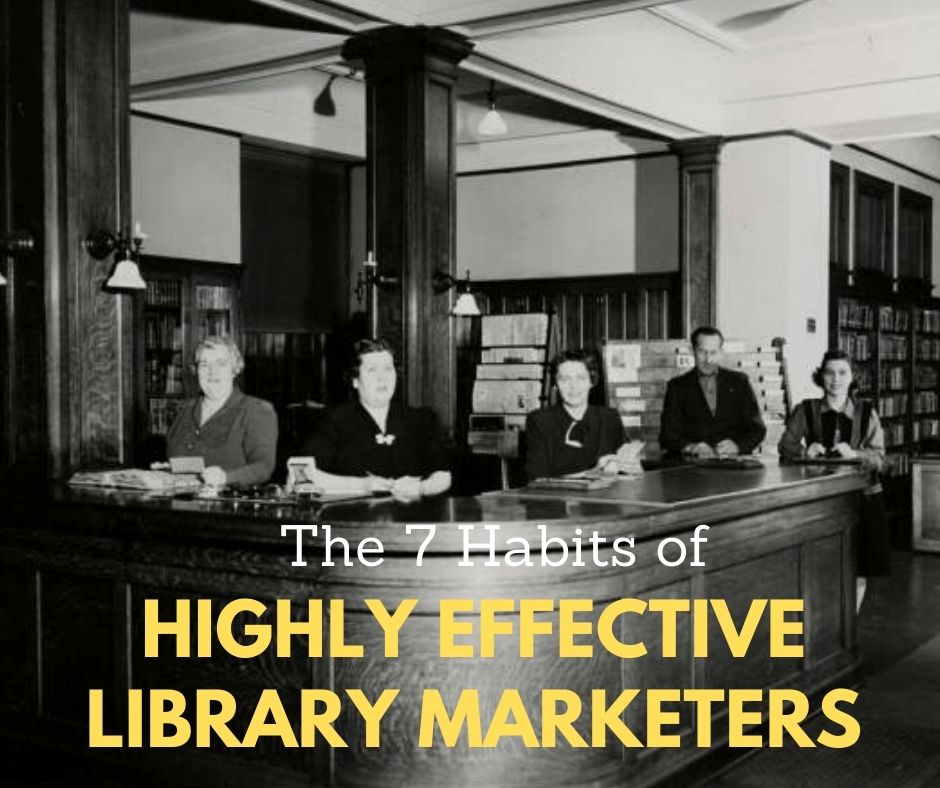
Want To Improve Your Productivity and Feel Pride in Your Work? Here Are the 7 Essential Habits of Highly Effective Library Marketers.

Photo courtesy Public Library of Cincinnati and Hamilton County.  Photo of West End Branch Staff, circa 1940.

I’m 100 percent certain that everyone who reads this blog has heard of the book, “The 7 Habits of Highly Effective People” by Stephen Covey. Written in 1989, this self-help book has sold more than 25 million copies worldwide.

Covey’s approach to attaining goals is to follow what he calls “true north” principles. Those principles are based on seven character ethics that he says are universal and timeless.

It’s a great book. But, because I’m a weirdo, I read it and thought, “There needs to be a list like this specifically for people who work in library promotion.” No joke. My internal monologue is strange.

We need some true north principles for library marketing now more than ever. We face uncertainty in every corner. Algorithms and budget shortfalls and virus variants can make our job seem impossible.

It may feel like the whole world is working against you and your library. So here are my true north principles for doing your best and most effective work.

Be good to yourself.

This is first on my list because it’s the most important and frankly, most library staffers could use a little morale boost. This year, I want you to celebrate the work you do. Every. Single. Week.

By the way, my boss gets full credit for this idea.

It’s pretty simple: At the end of the week, write down all the things you did. Then, pick a “gold star moment“: one thing that you did that stands out for some extra recognition.

Send your list to your boss or keep it for yourself. It doesn’t matter. What matters is that you take the time to acknowledge all the work you’ve done in the last week.

And, rather than focusing on what you didn’t get done from your to-do list, recognize all the work you did do.

You’ll be surprised at how much better you’ll feel at the end of a workweek. And you’ll be motivated or excited about the work coming in the following week.

Be constantly learning.

I know that most library staffers are incredibly overworked. You’re promoting your library in addition to 100 other tasks, including cleaning the restrooms and acting as security. The idea of spending any time learning more about marketing feels overwhelming.

How does someone fit personal professional development into their schedule?

Set a learning appointment for yourself every single day. All you need is five minutes. Spend that very short but important block of time reading a blog, a book on marketing, or an email newsletter on marketing. If you’re a visual learner, watch a YouTube tutorial on marketing or work on a self-paced marketing course online.

For the typical, full-time library staffer working five days a week with two weeks of vacation, that will add up to 1,150 minutes or 19 hours of learning in a year! That’s plenty of time to stay on top of marketing and social media trends and learn new ways to engage your audience more effectively on all channels.

Best of all, at the end of that year of learning, you’ll feel more confident in your work and of course, your library’s promotional efforts will improve.

Need help finding places to learn about marketing in a short amount of time? Here’s a great list.

Be hyper-focused on your library’s overall goals.

What is your library trying to accomplish right now? Are you hoping to increase your circulation to pre-pandemic numbers? Are you helping to bridge the pandemic educational gap for elementary school students? Are you implementing a step-by-step plan to ensure your library is truly accessible to everyone? Are you undergoing a facilities improvement project?

Your promotions should be centered on whatever your library is trying to accomplish this year.

When you focus your marketing with precision on your libraryโ€™s strategy, your marketing will be more effective. You will avoid spreading your message thin. You’ll be using your precious time and energy more efficiently.

Every piece of marketing you do needs to be in service of reaching your libraryโ€™s strategic goals. They are the reason you come to work every morning. Make certain there is a solid connection between your promotional efforts and your libraryโ€™s overall strategy.

Be a fan of data.

Block off five minutes in every workday to gather or analyze the metrics of your marketing and promotions. Just like with the professional development appointment you’re making each day, schedule this into your calendar.

This simple step will give you a very clear sense of what is working and what isn’t. You’ll have the numbers to back yourself up when you make decisions about which promotions to do and which ones to drop.

Be constantly experimenting.

One of my favorite parts of working in marketing is experimentation. There are so many ways we can test promotions to find the most effective means of communicating with our audiences.

I want you to think of yourself as a kind of scientist. Your experiments don’t have to be complicated.

For example, when you send emails, try sending on different days of the week and different times of the day.

When you want to promote an item in your collection or a service provided by your library, post on all your library’s social media channels. Then look at the insights to see where you get the highest engagement.

When you write blog posts, try experimenting with the length of the post, the length of the title, or the number of images you insert in the piece. Then look at views to see if your metrics are impacted by changing any of those factors.

Experimenting is fun. And it can lead you to create more effective promotions. Need some ideas about where to experiment with your promotions? Here’s a list of things to try.

Be open to change.

How many times have you heard someone say, “But we’ve always done it that way” in your library? Reject this phrase.

I think many times we get stuck promoting our library the same way we always have. Don’t be afraid to look at the data and say to your boss or co-workers, “This isn’t working. Let’s try this instead.”

In library marketing, change isn’t a bad thing. It means you are being responsive to your community’s needs and meeting them where they are as their lives are changing.

Be patiently persistent.

Sometimes it takes a while for fellow co-workers, senior staff, and your community members to respond to your ideas.

Effective library marketers set a timeline for how long they think it will take to increase engagement or reach a certain target audience with a message across multiple channels. A good rule of thumb is to give any new promotion about three months to catch on. If it’s not working by then, experiment with something else.


You May Also Want to Read These Posts

Three Easy Ways for the Exhausted Librarian to Figure Out What Your Community Needs AND Find Promotional Inspiration!

Fight for Your Ideas! Four Tips to Help You Get the Green Light for New Library Promotional Ideas

Angela’s Latest Book Review

Going There by Katie Couric

Subscribe to this blog and youโ€™ll receive an email every time I post. To do that, enter your email address and click on the โ€œFollowโ€ button in the lower left-hand corner of the page.
3 Easy Ways to Update Your Library Marketing Plan for the New Year

Watch Now

The Library Marketingโ€‹โ€‹โ€‹โ€‹โ€‹โ€‹โ€‹โ€‹ Show, Episode 125

In this episode, I’ll share three tips to help you update your library marketing plans for 2022. This exercise will help you to promote your library in a way that is strategic and focused but also flexible.

Kudos in this episode go to the Saline County Library. Watch the video to find out why they’re being recognized.

Do you have a suggestion for a topic for a future episode? Want to nominate someone for kudos? Let me know in the comments. And subscribe to this series to get a new video tip for libraries each week.

Thanks for watching!


Subscribe to this blog and youโ€™ll receive an email every time I post. To do that, enter your email address and click on the โ€œFollowโ€ button in the lower left-hand corner of the page.
Conquering Social Media for Your Library: The Seven Decisions You Need To Make Before You Create Your Next Post!

Photo courtesy Public Library of Cincinnati and Hamilton County

I love libraries. I work with libraries. I talk to library staff every single day. I like, share, and comment on library social media posts.

But every time I open my app for any of the platforms, I NEVER see content from libraries.

Why?

The odds are never in our favor, thanks to algorithms.

Itโ€™s a daily battle that libraries face. Social media is free and easy.

But itโ€™s also not free and easy.

Itโ€™s incredibly, insanely difficult to figure out what works on social media when the rules are constantly changing. If you donโ€™t have time or staff to keep up, it can be exhausting and demoralizing.

But like it or not, libraries must use social media to promote their services, collection, and events. We must do our best to work with the algorithms, for better or worse.

Starting next week, Iโ€™ll begin my annual six-part series laying out best practices for the top platforms used for promotion by libraries.

I chose these platforms because of a survey you, dear readers, so graciously answered. Nearly 300 library staffers let me know which social media platforms your library uses for promotion.

Before the platform best practice series begins, itโ€™s important to set your library up for success by creating a social media style guide.

This is different than a social media policy, which lays out guidelines for how your staff will use social media to communicate with the public and sets rules for how the community interacts with you and others on your libraryโ€™s social media accounts.

A social media style guide will ensure your posts are clear and consistent, no matter what platform you post on. It will take the guesswork out of many aspects of posting and make your work more efficient.

A social media style guide has seven parts. Here are the key decisions you should make now to ensure future success on social.

Make a list of all your social media accounts

Include your libraryโ€™s handle on each platform. This will give you get a clear picture of the naming conventions youโ€™ve used for your accounts.

Are the names consistent across channels? If not, choose a style and note it in your style guide.

Then, the next time a new social media platform is launched, you can claim and name your new account in a way that will make it easily discoverable for your existing fans.

Identify your libraryโ€™s demographics for each platform.

Look at the insights for each of the platforms. Who is interacting with your posts? Your audience will be different for every platform. Make a list of the different audiences.

Because of the algorithms, you have very little control over who sees your post on any given platform. But you can get to know your available audiences and create content that will engage them.

If you are struggling with time management and you want to cut down on the number of social media posts you do, you can look at your lists of demographics. Identify the platforms with the audiences that will help you achieve your overall library and marketing goals. Post to those platforms and put the rest on hold.

Create a mission statement for each platform.

Look at your libraryโ€™s goals for the year and what you know about each platform. Then write a one or two sentence mission statement for each of the social media platforms, lining up your libraryโ€™s goals with the currently available audience for that platform.

For example:

  • LinkedIn: Discover career advice, business tips, and free resources that will help you succeed at work.
  • Twitter: Get regular updates on our collection, library events, and the literary and entertainment world.
  • Instagram: Photos tell the libraryโ€™s story, one snapshot at a time.

These platform-specific mission statements, combined with the demographics you identified in the previous step, will help you visualize your audience every time you post. Youโ€™ll be able to connect with them because youโ€™ll know who they are, and what they expect from you.

Decide the voice and tone youโ€™ll use for each platform.

You want to use the same language and tone across platforms for consistency. The goal is to make sure your audience recognizes your posts no matter which platform they are on. Some things to consider include:

  • Whether your library will use formal or conversational text.
  • The words, phrases, and names that are specific to your library and can be used in posts. For instance, does your Maker Space or your Bookmobile have a specific branded name? Include that in your list.
  • Make a list of the acronyms your library commonly uses internally, along with the full spelled-out versions of what they stand for. Decide whether itโ€™s appropriate to use the acronyms on each social channel, or if the full terms should be used.
  • Include parameters for inclusive language that will be standard for your library. For example, will your library remove the use of pronouns to be inclusive to all genders? How will you refer to people living with disabilities?

Choose an expert to make grammar and punctuation choices for you.

You can define whether youโ€™ll use an existing style guide, like the Associated Press Stylebook or the Chicago Manual of Style. Or you may decide to rely on add-ons like Grammarly.

This decision will take the guesswork out of your libraryโ€™s use of serial commas, headline capitalization, dash style, dates and times, and more.

Define the aesthetics.

This section will lay the groundwork for the visual portion of your posts. Decisions to be made here include:

  • Will you use your library’s defined brand colors?
  • Which fonts will your library use in images, cover photos, and for short-form social media posts like Instagram Stories and Reels?
  • How will your libraryโ€™s logo be used on social media? Will it be used as the profile photo for your platforms? Can it be added to images? If so, where will it be placed and how large should it be?
  • Will youย use emojis, GIFs, and memes? Which ones? How many? On what channels? How often?
  • Will you include a call to action in every post? What kinds of action words will you use in your call to action?
  • How often will you include links in your posts? Will you use a URL shortener?
  • Which hashtags will you use? How many hashtags are acceptable on each platform?
  • Will your library use filters and effects in your posts?

Formalize curation

Your library can share the blog posts, infographics, case studies, and interesting posts created by other organizations on your platforms. This is a great way to add value for your available social media audiences without creating new content of your own. Some key decisions to make around curated content include:

  • Which sources will your library share from?
  • Which sources will you not share from?
  • How will you cite third-party content?

You May Also Want to Read These Articles

Three Design Tips For Creating Beautiful Social Media Graphics for Your Library

Why Itโ€™s OKAY for Your Library To Pull Back on Posting on a Social Media Platform!

Subscribe to this blog and youโ€™ll receive an email every time I post. To do that, enter your email address and click on the โ€œFollowโ€ button in the lower left-hand corner of the page.

Listening Is the Key: How One Woman Turned Her Superpower Into a Video Marketing Series That Changed Public Perception of Her Library

Photo of children reading courtesy the Public Library of Cincinnati and Hamilton County's Digital Collection

As you well know, libraries have changed, evolved, and adapted in some remarkable ways, particularly in the past 19 months.

But past perception continues to be a real hurdle for libraries. Plenty of people who would call themselves a fan of the library donโ€™t know all the things the modern library does.

We must make sure our community understands who we are right now. And there is a movement to do that through storytelling.

One of those storytellers is Evelyn Shapiro, Promotions Manager at Champaign Public Library in Illinois. As I was preparing to speak at Content Marketing World, I reached out to Evelyn to ask for details about her content marketing campaign, A Library for Life.

Evelyn graciously shared the story of how she compiled this amazing YouTube playlist of patrons who shared the relevance and importance of the Champaign Library’s work. And sheโ€™s permitted me to share what she wrote with you.

I hope you will find inspiration in her words. But also, I hope you will see how practical and, frankly, easy it is to gather and tell stories about the ways your library is changing lives.

โ€œLibraries are one of the best ideas humans have ever had.โ€

Danielle Borasky, Vice-President, NoveList


“Friends and colleagues have told me that connecting with amazing people is one of my superpowers. It’s funny because I can’t help thinkingโ€”doesn’t everyone feel like they know truly remarkable people?”

“So, part of the genesis of the project came through the #LibraryLove shared by Karin Markovitch, the parent I interviewed. She had been sharing the most fantastic comments and stories with us in social media posts, tagging the library, also in person with the desk staff. She is just a natural library ambassador, brimming with appreciation.”

“I kept thinking about how I wanted to share her enthusiasm and appreciation of what we offer with the world, but especially with local community members who might not know about or use the library, and with staff because we never tire of hearing that our efforts and expertise result in a positive experience and impact for customers.”

“Our Teen Librarian Kathie Kading was keen on introducing me to Mallory Morris, the educator I interviewed. Mallory’s energy is pure magic, and she can speak with authority about the impact the library has on teachersโ€™ and students’ lives. Interviewing her would mean other people would get to hear her stories, in her words. She was able to put together our group of teen interviewees, drawing from students at her school (across the street from the library) which turned out to be powerful testimony as well.”

“Also, a colleague in the children’s department introduced me to an area artist, Stacey Robinson, who was using the study room next to the children’s desk as his studio, coming in regularly and drawing illustrations for a graphic novel he was creating. She had gotten to know him over time and wanted to be sure I knew his story. (He ended up surprising her by thanking her by name in the acknowledgments of his book!)”

“I connected with him, and it turns out we know people in common in town in the art/design/theatre/dance/music worlds. Again, he was passionate about the library and spoke so well about what a treasure this place is. I wanted to be able to share his story. He also teaches on the University of Illinois campus in the Art + Design department and is a lot of fun to follow on social media.” 

“So, momentum had started building and because it was our tenth anniversary in this building, I realized I could propose the project as interviews with ten community members. It was our first video project and not part of my original budget that year, but it was the right timing to ask.”

“Once approved, I needed to build my list of who I would bring on camera. I knew about some of the range I wanted and topics I wanted to highlight including a parent and teen, a Board member, and someone who could speak about the Branch. Our director was able to recommend three of those featuredโ€”Candace, Thom, and Rajiv.”

“While working on developing our strategic plan, we invited a group of community members (around 50) to a retreat here to talk about the library and community needs. In one session I attended, Charlisa spoke up about the Douglass Branch, what libraries meant to her as a child, and how children access literacy in our community. I was so compelled by what she had to say. Charlisa has become a very active participant on our social streams as well.”

“Around this time, I’d met a new-to-the-community social media manager named Huan who worked remotely with an international org in communications and marketing. It turned out she spent a lot of time in our new walk-in co-working space for area entrepreneurs. She used it as her office and was getting involved with supporting the library in a few different waysโ€”through a United Way young professionals project and through serving on the Library Friends Board. We met by chance in the FriendShop Bookstore. At the time, she was volunteering in the shop, and we had a chance to chat. She had an international perspective, having lived, and worked in co-working spaces in London. She could compare what we offered here with co-working amenities in a Big City.”

“I already knew Amanda personally and at this time she was heading up the local Project READ initiative and both our locations were public sites where their group offered tutoring. I love talking with her about making good things happen in our community. She had held the role of liaison for families as part of a school program our daughter participated in. I had seen how fluidly she moved in different worlds and languages and what an effective advocate she is. She turned out to be an ideal example of how the library partners with community groups and how our services help immigrants.”

“I learned to bring a stash of tissues with me each time because someone always started crying. The stories were so heartful. I’ve also thought about additional ways we could share these stories, including in print somehow. I haven’t even transcribed them yet or pulled quotes from them. There may be obvious ways to expand and reuse their stories. The key seems to be selecting people who could talk glowingly about the library, without a lot of prompting from me.”

“As communicators, we focus a lot on our messages, as we need to. However, I see our role as much as a listenerโ€”how else can we share great comments and stories?”

Evelyn Shapiro is Promotions Manager at Champaign Public Library in Illinois. Before that, she worked in graphic design and has more than 75 published books and CDs to her credit, along with numerous awards from Parents’โ€‹ Choice, University College and Designers Association, and the Chicago Book Clinic.

Is your library telling stories about your work and your patrons? I’d love to see and share those stories! Send me an email with more information.


You Might Also Want to Read These Articles

The Top Four Reasons To Use Content Marketing To Promote Your Library on Every Platform

The Dreaded Library Annual Report: How to Create a Masterpiece that Showcases Your Libraryโ€™s Value and Inspires Your Readers

Latest Book Review

Subscribe to this blog and youโ€™ll receive an email every time I post. To do that, enter your email address and click on the โ€œFollowโ€ button in the lower left-hand corner of the page.

What Is โ€œRented Landโ€ and Why You Shouldnโ€™t Build Your Library Promotions on It!

Watch Now

The Library Marketingโ€‹โ€‹โ€‹โ€‹โ€‹โ€‹โ€‹โ€‹ Show, Episode 115

In this episode, in light of last week’s Facebook and Instagram outage, we’ll look at the term “rented land.” And I’ll give you some alternatives to putting library marketing content on “land” that your library owns. ๐Ÿ™‚

Kudos go to Sayville Public Library. Watch the video to see why they’re being highlighted.

Do you have a suggestion for a topic for a future episode? Want to nominate someone for kudos? Let me know in the comments.

And subscribe to this series to get a new video tip for libraries each week.

Thanks for watching!

Fight for Your Ideas! Four Tips to Help You Get the Green Light for New Library Promotional Ideas

Photo of librarians, courtesy Public Library of Cincinnati and Hamilton County

It’s sometimes insanely hard to get any new marketing ideas to pass approval in a library.

If there is a silver lining to the COVID-19 pandemic, it’s that the crisis helped libraries to see that there are new ways to market and promote their library. It’s opened the door for experimentation.

Even so, presenting a new marketing or promotional idea is sometimes challenging and intimidating for library staff. I know this because every time I talk with librarians at conferences or in one-on-one consultations, they ask, “How do I get buy-in for this great promotional idea with my supervisors and co-workers?”

Here are the four things you can do to gather support and approval for your great new marketing and promotional ideas.

Tell me about a time you had to pitch a library promotional idea. What was the idea? Did you get a yes or no? What did you learn from the experience? Share your thoughts in the comments.

Thoroughly research and prepare your pitch.  

Before you pitch a new idea, do your research. You’ll want to present a clear, concise, and strategic case for your idea. Include the following information in your pitch:

  • How the work benefits your community and cardholders.
  • How the work ties into your library’s overall strategy and goals.
  • How the work will get done by staff.
  • The timeline for implementation.
  • What the success measures will be.
  • What the long-term goals of your promotional idea will be.
  • How you will handle problems that may arise.
  • The data to back up your claims.

Here’s an example pitch that includes these points.

You’ve determined that Facebook is not giving you the results you want when you promote individual programs. Registration and attendance at programs have been unchanged or decreasing in the last six months, despite the many posts you create. Instead of using social media, you want to start a targeted e-newsletter sent to the people who frequent each branch in your system. You believe these targeted emails will be more effective because they will reach the audiences most likely to attend these programs.

Your pitch will begin by explaining the problem using data. Include registration, attendance figures, and Facebook engagement figures especially clicks on your registration or event information links. Show how the Facebook posts are getting very little engagement and lead to no increase in registration or attendance.

Next, explain how the move to branch-specific e-newsletters will be better for your community and cardholders because it will offer information about events happening in their neighborhood that are specific to their wants and needs. Look for wording in your library’s strategic plan that will make it clear to senior leaders that you are working to fulfill the strategic goals by offering community-based access to information.

Next, make the case that e-newsletters are a more efficient use of your time because they will be more effective and targeted. Again, be specific when you talk about how long it takes to create a Facebook post versus an e-newsletter.

Now, talk about the ways you’ll measure success for your new e-newsletters: increases in registration and attendance, plus open and click rates on the emails. Be specific and use numbers. This will show that you are confident that your new idea will work.

Spend a few moments talking about your long-term goals: how many new subscribers do you want to get in the first six months or year? How much would you like to see registration and attendance grow? What other library services can you imagine promoting using your e-newsletters?

Layout a timeline: when do you think you can launch your first e-newsletter? How long will it take to grow your subscription list? How often will you send these e-newsletters?

Finally, talk briefly about problems you may encounter and how you’ll handle them. What program will you use to send the e-newsletters? Who will create them if you’re sick or on vacation?

Review and rehearse.

Review your plan several times. It’s a good idea to leave a few days in between each review of the plan, to let your ideas marinate. You may think of new benefits or pitfalls during those breaks. You’ll want to be fully prepared to answer any questions and defend your idea with confidence.

Next, practice presenting your idea to a friend at your organization. Choose someone you trust to give you honest feedback about your idea and your presentation.

You might also consider recording your pitch on Zoom or another video recording program. Check to make sure you are speaking slowly and clearly. Evaluate your tone of voice, eye contact, and body language during your practice pitch.

Pitch strategically.  

Find a time when your supervisor won’t be rushed. They’re more likely to listen to you when they have time to truly consider your idea.

Pick the right day of the week for your pitch. For example, Mondays are often busy and stressful for bosses. Your supervisor may be more negative at the beginning of the week and it’s likely not the best day for your pitch.

When you pitch, be mindful of your body language. If you are sitting in a chair, don’t pivot back and forth nervously or jiggle your legs. Sit still, but upright, and with confidence.

If you are standing, try separating your legs about shoulder-width apart. This is a “power” pose that will help you maintain good posture and will subconsciously give the impression that you know what you are doing… even if you don’t feel that confident!

If the answer is no, don’t necessarily give up. 

A “no” doesn’t have to mean the end of an idea, especially if you think it’s beneficial to your library and customers. There are no bad ideas–just ideas whose time has not yet come.  

Write yourself a note in your work calendar to revisit the idea in six months. Keep your eyes open for new opportunities to present your ideas in a different format.


Subscribe to this blog and youโ€™ll receive an email every time I post. To do that, click on the โ€œFollowโ€ button in the bottom left-hand corner of the page.

You May Also Want to Read These Posts

Prioritize! How to Decide Where To Spend Library Marketing Time and $$$

Five Creative Ideas to Help You Beat the Blues, Get Inspired, and Create Amazing Library Marketing Campaigns Again!

Looking for Guaranteed Email Marketing Success at Your Library? Here Are Four Essential Metrics To Track.

Image courtesy Public Library of Cincinnati and Hamilton County

Use the feedback button to share your most pressing email marketing question. I’ll answer these in a future blog post!

I love opening the “reports” tab on an email platform. There is a second or two of anticipation as the page loads that brings me a thrill.

What will the numbers say? Will they be better or worse than last month? Will they reveal a new trend that I can use to better serve my target audience?

I realize I sound a little nuts. But honestly, I love metrics.

They are clear and concise. They show you what’s working and what’s not working. They give you permission to stop doing promotions that don’t help your library at all. If you try something new, they’ll tell you whether your idea worked or not.

Tracked over time, email metrics will help you to take the 30,000-foot view of your library marketing. You can see if your emails are doing what they are supposed to do… moving your library toward its overall strategic goals.

There is a lot we could measure in terms of email marketing. It would be easy to get lost in the quagmire of numbers and analysis.

So, I want you to focus on four data points that really matter to library email marketing. Use these metrics to determine whether your messages are connecting with your audience and promoting your library’s overall strategic goals. And don’t miss the bonus tip at the end of this list!

“Email is the only place where people, not algorithms, are in control.โ€

Ann Handley, writer, digital marketing pioneer, and Wall Street Journal best-selling author 

1. Increase of raw circulation numbers.ย 

Recordย the number of checkouts and holds before you send the message and then again after the message is sent. You can generally wait about three days to check those numbers. Cardholders who want to act on an email will do so within a three-day period of receiving it.

What this metric will tell you: Raw circulation numbers will likely be of interest to anyone in collection development at your library. They are also the basis for the next two metrics, which will help you compare the effectiveness of your emails.

2. Percentage increase in circulation.

Once you start collecting data on raw holds and checkout increases, you will want to calculate the percentage increase in circulation.  

Let’s say on Monday, you send an email promoting one specific eBook. Before you send the email, you note that there are currently three holds or checkouts of this eBook. When you check on Tuesday, there are four new holds or checkouts placed on the eBook. In total, there are now seven holds or checkouts on this item.

Use percentagecalculator.net to calculate the percentage increase in circulation. For this example, we use the third calculation tool on the page:

That’s a 133 percent increase in circulation.

Now, the next week, you decide to send another email promoting a different eBook. But this time, the eBook you choose to promote has 15 holds or copies before the email is sent. When you check 24 hours after sending the email, there are 10 new holds or checkouts. In total, there are now 25 holds or checkouts on the eBook.

The raw numbers for the second email are bigger (an increase of 4 holds/checkouts vs. an increase of 10 holds/checkouts). But the percentage increase for the second email is actually smaller, at 66%! That means email #1 was more effective.

What this metric will tell you: Percentage increase in circulation lets you compare your promotions more accurately. If you are short on time, this kind of comparison will help you determine which promotions will give you the most success with your limited resources.

3. Conversion rate.

This is the percentage of people who took an action after receiving your email.

Let’s pretend that you’ve sent an email to 1000 people. The email promotes a streaming video on your library website that hasn’t had any views in the past couple of weeks.

When you check the streaming statistics for that video, you see that 25 people watched the video in the days immediately after you sent the email.

Using the second tool on our percentage calculator website, you can calculate the percentage of people who “converted” or took an action after your email.

What this metric will tell you: If you start tracking conversion rates on your emails, over time you’ll have a clear picture of the types of emails your audience responds to. You’ll be able to establish a good base percentage for your audience. This number will be different for every library.

If you are short on time, this metric will help you determine which promotions will give you the most success with your limited resources. When you find a certain type of email promotion works based on conversion rate, you should do it more often.

4. Amount of traffic driven to your website.

Track how much traffic is funneled to your public website by your emails. You can use Google Analytics to analyze how efforts on those platform translates into action by your cardholders. If you’ve never worked with Google Analytics, here is an easy guide to get you started.

What this metric will tell you: This is an important metric to share with administration, because it clearly demonstrates the value of the time and energy you have invested in email marketing.

Special bonus tip!

If you promote the same collection item or booklist on social media, email, and your website, put some space between those three promotions. A week is a good amount of time. That allows you to really pinpoint whether your increase in circulation is coming from email, your placement of the item on your website, or social media.

In fact, that’s a fun experiment to run. Can you drive higher circulation numbers by promoting your collection on your website, email, or social media?

You can even get more granular: which social media platform is best for collection promotion? Which page on your website is best for placing collection promotions? Which email list responds best? See, this is fun!


Subscribe to this blog and youโ€™ll receive an email every time I post. To do that, click on the โ€œFollowโ€ button in the bottom left-hand corner of the page.

You may also like these articles

Are My Library Email Metrics Goodโ€ฆ. or Bad?! Here Are the Latest Stats to Help You Figure It Out.

What Metrics Demonstrate Your Libraryโ€™s Social Media Marketing is Working?

Angelaโ€™s latest book review

Beautiful Things by Hunter Biden

A WordPress.com Website.

Up ↑