Are “marketing” and “promotion” the same thing? We say they are… but should we?
One of my readers challenged me to think more intentionally about our terminology, and it sent me down a fascinating rabbit hole.
In this episode of The Library Marketing Show, I’m making the case for why these words matter more than we think, and how rethinking them can change the way your library connects with your community.
Plus, I’m giving kudos to a library staff member who had a recent brush with fame for their work outside the library!
Do you have a suggestion for a future episode’s topic? Do you want to nominate someone for kudos? Let me know here.
Library friends, we did it! We made it through 2025. We faced numerous issues and threats to libraries, yet we celebrated many triumphs. I’m proud of you. I’m proud of this community. And if no one has told you this lately, GOOD JOB YOU!
And now, we look forward to a new year and new chances to grow the connection between your library and your community.
Want to make 2026 your best year yet? Let’s start by learning from the content your fellow library marketers found most helpful this year.
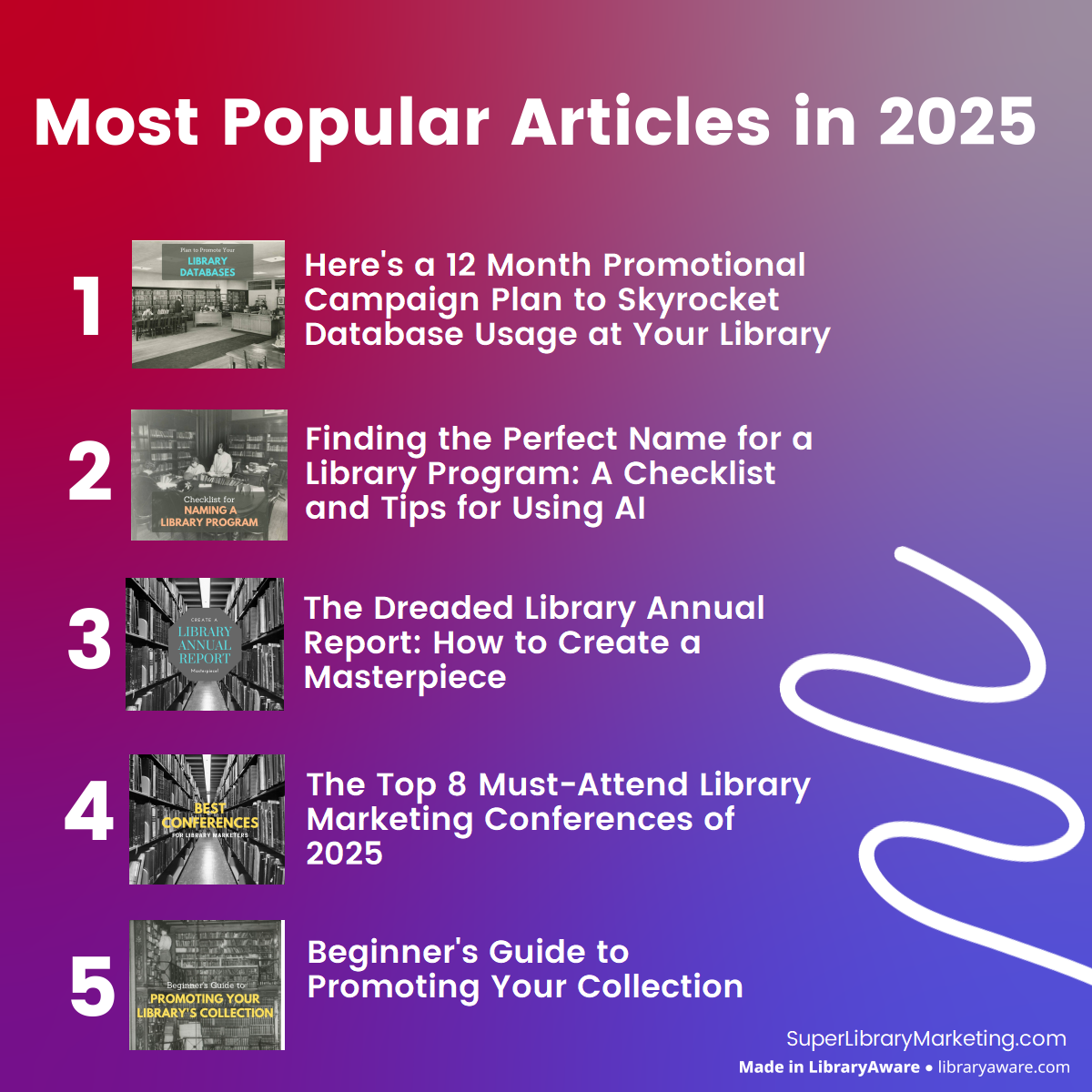
Most Popular Super Library Marketing Articles of 2025
I hope you are looking forward to 2026 as much as I am. My next post will be on Monday, January 5, when I’ll unveil the State of Library Marketing. I’ve got a calendar full of posts and videos featuring tips to make your work easier, as well as profiles of libraries to inspire you. Happy holidays!
Does your library’s marketing ever feel like a patchwork quilt — one person doing social media, another making flyers, someone else juggling program promotion — yet everything is still supposed to look consistent and effective? If that sounds familiar, this episode of The Library Marketing Show is for you!
I’m sharing practical, easy-to-use tips to help your marketing team work better together, even if you’re spread across branches, juggling different tasks, or working without clear leadership or shared expectations.
Plus, I’ll give kudos to a library that got a huge shout-out for its partnership with a local school district.
Do you have a suggestion for a future episode’s topic? Do you want to nominate someone for kudos? Let me know here.
If you’ve ever promoted a library program and quietly wondered whether you’re supposed to be tracking how well it worked… this week’s video is absolutely for you!
In this episode of The Library Marketing Show, I’m tackling something that a lot of library staff avoid because it feels intimidating: Measuring your promotions. Not in a scary, spreadsheets open in 30 tabs way, but in a “here are simple tools you can start using today” way, even if you’re not the person running your library’s full marketing operation.
Plus, kudos go to a social media specialist whose videos are taking the internet by storm!
Do you have a suggestion for a future episode’s topic? Do you want to nominate someone for kudos? Let me know here.
I’ll cover Instagram and Facebook in the following weeks.
YouTube for libraries
The number of libraries that say they post to YouTube dropped 5 percentage points in 2025, according to the Super Library Marketing Survey. About 56 percent of libraries use YouTube for promotion.
I have a few guesses as to why this happened:
TikTok, Instagram Reels, and Facebook Reels are dominating with quick, engaging content. Libraries likely moved resources to these platforms because they offer better reach and engagement for short videos than YouTube.
YouTube’s algorithm increasingly favors creators who post frequently and have high subscriber engagement.
Younger audiences (Gen Z and Millennials) are spending more time on TikTok and Instagram than on YouTube for discovery and entertainment.
However, YouTube remains the third-most-popular social media platform for library marketing. It’s also the second most-visited website in the world. Only Google has more visitors! That’s certainly something to consider.
Plus, YouTube videos are deeply integrated with Google Search and Google’s AI Overviews. That’s why, when you search for nearly anything, YouTube videos are often featured in the summary or results.
And AI platforms like ChatGPT, Google Gemini, and Perplexity cite YouTube content in their results. In fact, according to Search Engine Land, YouTube is mentioned 200 times more than TikTok or Instagram in AI-generated answers. Plus, YouTube transcripts and captions are indexed and used by AI platforms to generate their summaries.
YouTube is one of two social media sites with a majority of users across all age groups. (Facebook is the other site.)
Adults in the U.S. now spend 49 minutes per day on YouTube, a slight increase from previous years.
YouTube accounts for nearly 13 percent of total television usage, more than other streaming platforms.
90 percent of YouTube users watch videos on their mobile devices.
More than 60 percent of YouTube users are between the ages of 18 and 34 years, making it a highly valuable platform for reaching younger readers.
How much success can libraries expect to see on YouTube?
According to Napolify, accounts with fewer than 10,000 followers typically have an average engagement rate of 5.91 percent for YouTube Shorts. Most libraries fall into this category.
For longer YouTube videos, the average engagement rate ranges from 3 to 7 percent, depending on the account size. The good news is that smaller accounts typically have higher engagement!
According to Ventress, most accounts can reach 1,000 subscribers within 12-16 months or around 70-80 videos. That’s a realistic milestone for your library. And, unlike other social media platforms, it pays to focus on building your channel’s subscriber base because YouTube will suggest your content to those subscribers.
The YouTube algorithm for 2026
The YouTube algorithm remains focused on its core mission: Keeping viewers on the platform. It does this by recommending content that maximizes satisfaction and engagement.
The algorithm analyzes billions of signals in real time to predict what each viewer will enjoy next. Here are the updated key ranking factors:
Watch time: This is the most important signal. You need to think about this when crafting your videos. Always ask yourself: How can we keep people watching for as long as possible?
Titles and descriptions: Use natural, searchable phrases that mimic what searchers would use to find videos. This will help your videos rank in YouTube and Google search results.
Likes, comments, and creator replies: That last one is new this year. It means you’ll need to keep an eye on comments and respond as quickly as possible.
Consistency: Consistent publishing is a positive signal to the algorithm and will improve your library’s reach over time.
Session time: The algorithm now also factors in how long viewers stay on YouTube after watching your content. It’s important to add cards and end screens to your videos to boost this signal.
4 ways to get the best organic reach for your library’s YouTube channel in 2026
#1: Create a strategy that includes both Shorts and long-form video.
YouTube’s algorithm rewards channels that balance shorter and longer videos. Shorts will drive quick exposure and channel growth. Longer videos are great for viewer loyalty and longer watch time.
That’s a tall order for libraries. So here’s what you can do: Repurpose your longer videos into 5-10 Shorts. Use the Shorts to attract new viewers and link to the longer video.
#2: Optimize your titles and thumbnails for viewer satisfaction, not just keywords.
The algorithm prioritizes retention and satisfaction. That means videos that deliver on their promise and keep viewers watching rank higher. I have NEVER seen a library use clickbait in any video, so this tip should be easy to follow!
Use clear titles and compelling thumbnails.
#3: Build community engagement by interacting with your viewers.
Engagement signals such as likes, shares, and comments still matter, but as described above in the algorithm section, YouTube now places a heavy emphasis on creator-driven action. If your library’s channel fosters two-way conversations, you’ll get higher reach and recommendation rates.
Here are some ideas for how to engage with your followers:
Reply to comments promptly.
Pin posts and comments. Highlighting top comments signals activity and encourages more participation.
Use the Community Tab. This feature is available to channels with more than 500 subscribers. You can post text updates on programs or share book recommendations, create polls, and share images, GIFs, and more to keep your audience engaged between videos.
#4: Refresh your evergreen videos for an algorithmic boost.
Older videos can regain visibility if they attract new engagement. The algorithm rewards updates, even for previously published videos.
How can you do this? Reshare your evergreen videos in your email newsletters. Or embed a QR code to watch the video on bookmarks that you then slip into holds and checkouts of physical materials.
You can also update the video itself. Edit the keywords and descriptions. Add captions and transcripts if they weren’t included when the video was originally posted.
Bonus tip: Try a live stream!
When your YouTube channel hits 50 subscribers, you’ll be allowed to livestream. This is very enticing for viewers… they’ll see a special red circle around your main channel logo and the word “live”. Whenever I see this, I can’t help but click on it to see what’s going on. Your viewers will have the same reaction, and that will boost engagement and subscribers to your channel.
Here’s a great example: Prince William Public Libraries livestreams their library turtle. I love to watch this when I need a break from work!
Double Bonus Tip: Use HypeAuditor
You can use HypeAuditor to measure your YouTube engagement rate. From there, you can create a new goal and strategy for 2026.
How often and when to post on YouTube
Consistency is a key component of YouTube success. But the latest data says that timing and frequency now play a bigger role in reach. Here is the latest advice from Ventress.
Long-form videos: Start with one video a week. As your channel grows, aim for 2 to 3 weekly videos if your capacity allows.
Shorts: Post at least 3 Shorts weekly to increase your reach.
Viraly says the best days to post are weekdays from 12 p.m. to 4 p.m. local time, and weekends from 9 a.m. to 11 a.m. local time.
Photo courtesy Cincinnati and Hamilton County Public Library
We are now firmly in the second half of the calendar year. I don’t know about you, but when I worked in a library, this was the time I usually started to “drag” a little. I was tired and uninspired. (Hey, that rhymes!) I needed a little boost… someone to remind me to focus on what was important.
I’m here for you. These are the eight things I want you to focus on as you move into the next six months. This is also a great post to share with new hires who work on library promotions. The eight principles listed below are the most valuable tips I can offer to help you center your work and find direction.
And I’m curious… do you think I missed anything in this list? Add your guiding principles to the comments!
8 Tips to Focus Your Library Promotions
1. Plan ahead — don’t just react.
This is my number one tenet because so many of the library staff members I work with say they feel like order takers! They are asked by different departments and branches to promote the things that are important to those people, which allows no time to create a strategic library marketing calendar or campaign that supports the library’s overall goals.
Effective marketing is proactive, not reactive. You want your promotions to be holistic, covering all the channels where your target audience is located (see item #4). List the goals you want to achieve over the next six months, and create holistic campaigns. Before you know it, you’ll have a full editorial calendar.
And I know this might sound scary, but be transparent. Share your calendar with the rest of your coworkers. Inform them of the overall goals and provide them with regular updates on the content you share and the results you are achieving. At the end of the year, let everyone know how you did.
This will help educate your coworkers about marketing! Many of them probably think marketing is reactive. They don’t know how much planning and coordination go into an effective campaign.
2. Promote the benefits, not the features.
Listen, I know this one is hard. But your community is looking for a solution to their problems.
So instead of saying, “Use our personalized reader recommendation service”, highlight how your service solves real problems, like helping readers to find the right books for them (because, let’s be honest, there are SO many good books out there!), or helping readers who feel like they’re stuck in a rut, reading the same things over and over again.
You want your readers to think of the library, not Google or Goodreads, as the best place to find a book.
3. Tell more stories of how the library impacts lives.
User-centered storytelling, like Loyola Marymount’s Library Fans video series, connects emotionally with users and shows the library’s impact on real lives. These stories are more memorable than stats or service lists.
Storytelling helps your community to see how others are using the library and imagine how they might use the library too!
4. Meet your audience where they are.
Use the channels your patrons prefer. And remember, you don’t have to be on every channel. You just need to be on the right ones.
The channels you choose should match the preferences of your primary audience segments.
Teens and college students? Think TikTok and YouTube Shorts.
Parents and caregivers? Facebook groups and email are the best way to reach this audience.
Adults over age 65? In-person outreach and local newspapers or printed newsletters can be most effective.
Most importantly, don’t try to build an audience on the channels your patrons don’t use. How do you know which channels your audience prefers? Use metrics (see #8) and surveys to pinpoint where your energy will be best spent.
5. Consistency builds brand recognition and affinity.
At the Fourth of July parade two weeks ago, I instantly recognized the library’s entry coming down the street, even without my glasses. How? The color scheme of their banner and vehicle! (As an aside, I was sitting right in front of one of the branches, and the cheering that rose from the crowd when the library drove by warmed my heart.)
You can have the same impact. Use your brand logos, color palettes, and tone across channels. Patrons should instantly recognize your library’s content, whether it’s on a digital sign, flyer, or Instagram Story.
I know this seems like a constraint to some of my more creative readers, but the discipline pays off with instant brand recognition.
Beyond your brand colors and logo, remember to name your services clearly and tie all services to your library (e.g., “Consumer Reports from Maple Tree Library”).
6. Empower your advocates.
Your best marketing tool might be your most loyal library users. Feature them in campaigns and encourage user-generated content. When your superfans talk about how much they love the library and how it impacts their lives, people will listen!
Encourage staff to promote programs on their own social media (with branded templates or messaging prompts).
And provide your Friends group or foundation with a marketing kit: shareable graphics, key talking points, and event blurbs.
7. Always be repurposing.
Library marketers are asked to create a lot of content! Just like you may do in your home, you can reuse and recycle some of that content to help ease your workload and ensure your best content is seen on multiple channels. You can do that by:
Repurposing blog posts, newsletters, and program guides into social media snippets, videos, or infographics. Share this content with local media and community partners.
Turning book displays into short videos for social media by adding trending audio and creative elements like stickers.
Clipping moments from author talks or storytimes for Instagram Stories, YouTube Shorts, or TikTok videos.
Breaking down long blog posts into carousel posts or pull quotes for your homepage, digital signs, or social media posts.
8. Measure what matters.
Your metrics are key to guiding your marketing strategy. And listen, I’m the first person to admit I can easily go down the rabbit hole of data and measure everything.
But my boss coaches me to only spend time measuring the things I need to help make the decisions that will guide my future library marketing actions. That means I don’t obsess over likes and followers.
Instead, I track engagement metrics like watch time on videos, shares of social media posts, and read time on blog articles. I also urge you to use UTM codes like Bit.ly and Google Analytics to track campaign sources, so you know which channels are driving traffic to your library and which pieces of content resonate most with your community.
Subscribe to this blog, and you’ll receive an email whenever I post. To do that, enter your email address and click on the “Follow” button in the lower left-hand corner of the page. You can also follow me on the following social media platforms:
I have a hot take on marketing and programming. They are two completely different things. But confusion over the roles is making it difficult for many libraries to do effective marketing.
I’m going to defend my hot take and give you some guidance on why this distinction is important in this episode of The Library Marketing Show.
Plus, we’ll give kudos to a library for their series of onboarding emails and the brilliant way they get people to sign up for targeted email marketing.
Do you have a suggestion for a topic for a future episode? Do you want to nominate someone for kudos? Let me know here. Thanks for watching!
Subscribe to this blog, and you’ll receive an email whenever I post. To do that, enter your email address. Then, click the “Follow” button in the lower left-hand corner of the page. You can also follow me on the following social media platforms:
How can a Friends of the Library group successfully spread the word, attract more donations, and recruit new members? They need marketing and branding! But they often don’t have the expertise or budget. So… then what?
This is a very niche episode that you’ll want to send to your friends of the library group!
Plus, we’ll give kudos to a library with a brilliant idea for a simple library storytelling video.
Do you have a suggestion for a topic for a future episode? Do you want to nominate someone for kudos? Let me know here. Thanks for watching!
Subscribe to this blog, and you’ll receive an email whenever I post. To do that, enter your email address. Then, click the “Follow” button in the lower left-hand corner of the page. You can also follow me on the following social media platforms:
Are you marketing and promoting your library by yourself or with a very small team? Do you feel overwhelmed and stressed, like there’s never enough time in the day to do everything that needs to be done?
I have five tips to help you make the most of your time and be efficient with your library marketing without getting stressed. We’re going to talk about it in this episode of The Library Marketing Show.
Plus, kudos goes to a library that managed to work a talking point about the value of libraries into a story about a book returned decades after its due date.
Do you have a suggestion for a topic for a future episode? Do you want to nominate someone for kudos? Let me know here. Thanks for watching!
Subscribe to this blog, and you’ll receive an email whenever I post. To do that, enter your email address. Then, click the “Follow” button in the lower left-hand corner of the page. You can also follow me on the following social media platforms:

 Super Library Marketing: Practical Tips and Ideas for Library Promotion