Search

Super Library Marketing: Practical Tips and Ideas for Library Promotion

Category

Marketing Basics

Plan for Library Marketing Success! How To Create an Effective Marketing Plan No Matter the Size of Your Library (Plus a Free Downloadable Template!)

Photo Courtesy Public Library of Cincinnati and Hamilton County

The first time I went to a conference, I made a plan.

I decided which sessions I would attend weeks before the conference began. I studied the floor map of the convention center so I could plot the best way to get from room to room. I made a list of local restaurants and tourist attractions within walking distance of my hotel so that I could make the most of my free time.

Am I bonkers? Nope. I am a planner.

A plan provides a guide for action. It ensures goals are met and time and resources are used wisely.

There are times when spontaneity is called for. But library marketing is not one of them. A marketing plan is key for the success of any type of library promotion.

What exactly is a library marketing plan?

A library marketing plan is a tool you use to help to achieve your library’s overall goals. It lays out the steps involved in getting a promotion out into the world. It helps you decide how and when promotional work will be done for a pre-determined time in a specific way.

A library marketing plan also ensures everyone knows the end goal of your marketing efforts. It sets deadlines. It keeps people accountable. And it clarifies how you will measure your results.

You don’t need a plan for everything you promote at your library. You do need a plan if you are creating a campaign that lasts for more than several weeks.

How to put your marketing plan together

Scroll down to the bottom of this post for a list of free project planning websites. They will help you with the execution of your plan. At the bottom of this post, you’ll also find a customizable template to download. It’s based off the library marketing plan spreadsheet I used for years.

Know the thing you are promoting inside and out.

Be sure you can answer every single question about the thing you are promoting. You must become an expert on the event, service, or item you will promote.

Ask yourself, what problem will this solve for my patrons? How easy is it to use? What are the features that canโ€™t be found at any of my competitors?

Clearly define your end goal.

Use the SMART goal framework to ensure you and your co-workers know exactly what you are aiming to achieve. SMART goals are specific, measurable, attainable, relevant, and timely.

So, if you are looking to increase brand awareness, set an actual, measurable end goal like: “Within the next 6 months, we want 50 percent of residents living within a 30-mile radius of our Main Library to know that we have renovated the building and to be able to name at least one new service available at the library.”

Determine your target audience.

Many library marketers say their target audience is “our cardholders.” Be more specific.

Ask yourself:

  • Which cardholders?
  • How old are they?
  • How often do they use the library?

Fill out your picture of your target audience with as many demographic characteristics as you can. This gives you and everyone working on the plan a picture of who you are trying to reach.

Analyze your competitors.

Research anyone providing a similar program, service, or product. Ask:

  • What are they doing well?
  • What are they doing poorly?
  • What are the things that differentiate your library from their business?

These are your marketing advantages. You can use this information to create messaging that tells your target audience why they should use your library service, instead of a competitor.

Create the message.

Get the message or elevator pitch for your promotion set. It’s the most important part of your plan. You need it to create all the tactics you will use to promote your library.

Choose your tactics.

Go through all the available channels at your disposal for marketing and decide which ones will work best to reach your end goals.

You do not have to use everything that’s available to you. Sometimes, a video will work well and sometimes an email will do a better job. Not every promotion needs print materials, a press release, or a digital sign.

You know best how your target audience reacts to each tactic and which will bring you the best results. If you have a budget, decide how you’ll spend it during this step.

Set the schedule.

Every library has a different approach to its promotional schedule. I am a fan of tiered distribution of marketing. The approach takes advantage of a consumer cycle of excitement. Here’s how it works:

  • Release one or two promotional tactics at the beginning of your promotional cycle, like a social media post and a press release. The promotion gets some play, and excitement builds in the consumer base. It gets shared and people talk about itโ€ฆ and then the excitement dies out.
  • Release the second tactic, like an email, and the people who see the email get excited and start talking about it and sharing it, and then their excitement dies out.
  • Release a video, and that builds excitement and gets shared, and the excitement then dies out. And so on!

When you use the tiered distribution approach, you get a longer promotional thread. Your promotions will be more successful because the excitement around them builds over time, not in one big burst.

It is also easier on the person running the marketing! It gives you a small break in between each tactic and creates time for you to measure the success of each tactic individually.

Assign tasks.

Delegate jobs and deadlines for appropriate staff. If you need help from another library department, assign their deadline now so they have plenty of time to get you the information you need.

Measure results.

Don’t forget to measure and record the reaction to each piece of your marketing plan. Analyze what worked and what did not, so you can put that knowledge to use next time.

Free or cheap project management solutions

Clickup: the free plan will work for small libraries. The unlimited plan is very affordable and would work well for medium to large libraries.

SmartSheet: their lowest plan tier is a little more expensive than ClickUp but has more integrations.

Asana: this is what my employer NoveList uses. It makes is easy to assign tasks and deadlines.

Marketing plan template

I’ve created a customizable marketing plan spreadsheet. It includes my suggestions for the timing of promotional tactics for an event or service promotion.

You can delete or add columns based on the tactics available to your library and the size of your library. Download it here.


Related Advice

What the Heck Is the Difference Between Library Statistics and Marketing Metrics? Hereโ€™s the Full Explanation and Why They Are BOTH Important!

Planning for Magic! How To Keep Your Eyes (and Your Schedule) Open for Unexpected Library Promotional Opportunities

Subscribe to this blog and youโ€™ll receive an email every time I post. To do that, enter your email address and click on the โ€œFollowโ€ button in the lower left-hand corner of the page.

What the Heck Is the Difference Between Library Statistics and Marketing Metrics? Hereโ€™s the Full Explanation and Why They Are BOTH Important!

Watch the Video Now

The Library Marketingโ€‹โ€‹โ€‹โ€‹โ€‹โ€‹โ€‹โ€‹ Show, Episode 156: In this episode, we’ll explain the difference between library statistics and library metrics.

We use the terms interchangeably. But the exact definition is really important to the success of your library marketing.

Kudos in this episode go to the Prince George’s County Memorial Library System.

Do you have a suggestion for a topic for a future episode? Want to nominate someone for kudos? Let me know in the comments.

And subscribe to this series to get a new weekly video tip for libraries.

Thanks for watching!


Subscribe to this blog and youโ€™ll receive an email every time I post. To do that, enter your email address and click on the โ€œFollowโ€ button in the lower left-hand corner of the page.

Why Is It So Hard for Libraries To Recruit New Cardholders? Early Research Results May Hold Answers Just in Time for National Library Card Sign-Up Month

Watch This Video

The Library Marketingโ€‹โ€‹โ€‹โ€‹โ€‹โ€‹โ€‹โ€‹ Show, Episode 155: In this episode, I want to share the early results of ongoing research in Poland about how non-library users view the library.

This research is being conducted with the help of mystery shoppers, who are asked to go into a library and perform a specific task. After their experience, they are interviewed.

The results are fascinating. I’ll share some topline findings and ideas for how to counter these results with smart library promotions.

Kudos in this episode go to San Rafael Library.

Do you have a suggestion for a topic for a future episode? Want to nominate someone for kudos? Let me know in the comments. And subscribe to this series to get a new weekly video tip for libraries.

Thanks for watching!


Subscribe to this blog and youโ€™ll receive an email every time I post. To do that, enter your email address and click on the โ€œFollowโ€ button in the lower left-hand corner of the page.
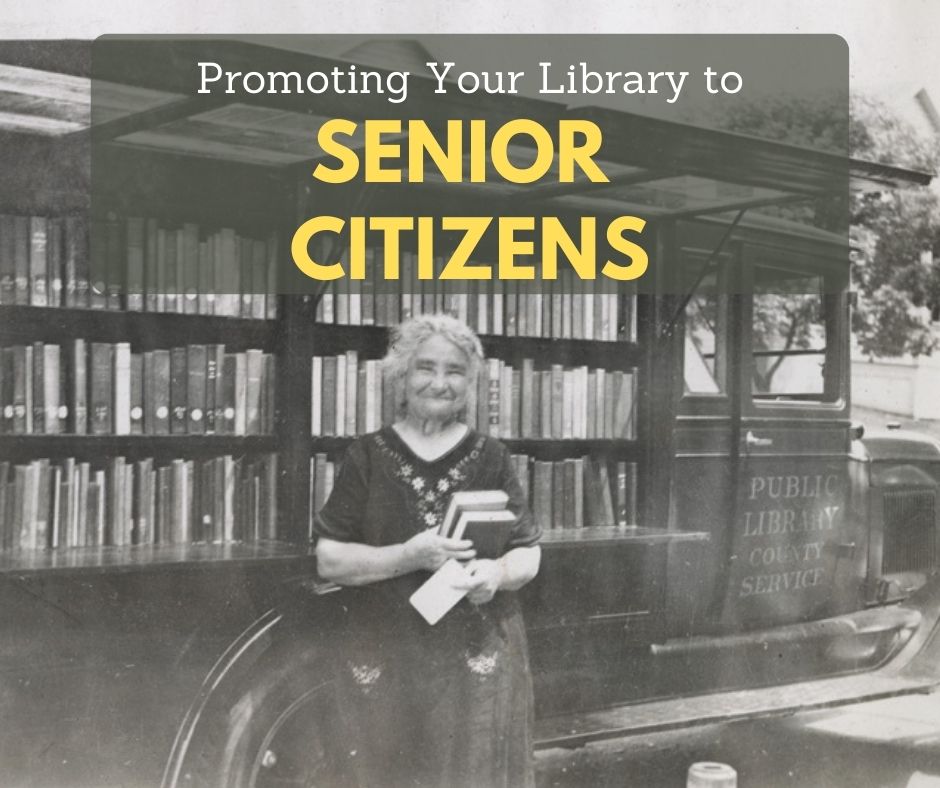
Marketing Your Library to Senior Citizens: How to Circumvent Stereotypes and Authentically Connect With Older Patrons


Photo courtesy Cincinnati and Hamilton County Public Library

A few weeks ago, I learned that, as a 50-year-old, I can technically join the American Association of Retired Persons (AARP).

I have NO INTENTION of retiring for many, many more years (maybe never?!). But in learning about my newfound status, I start to think about how libraries market to senior citizens.

More than 54 million adults ages 65 and older live in the United States, according to the U.S. Census Bureau. That accounts for about 16.5 percent of the nationโ€™s total population. And seniors are expected to outnumber children in the United States by 2035.

Goals focused on seniors require marketing target to seniors

Depending on your library’s overall goals, it may be critical for your organization to focus on attracting and retaining a larger percentage of your community’s older residents.

For example, the Queens Library’s strategic plan specifically says, “The borough is growing older, with its elderly population projected to increase by more than 30% by 2040.” The plan then lists among its goals, a provision for providing a more robust large print collection, as well as a goal to connect the older residents intentionally and strategically with library services.

Todayโ€™s senior citizen is not your stereotypical grandma

If your mental picture of an older person is frail, technologically challenged, and dependent on others, you couldnโ€™t be more wrong.

Older patrons are Interested in keeping healthy so they can stay independent at home. And theyโ€™re active on social media. More than 70 percent have a Facebook account, and more than 40 percent are on Instagram. And The Guardian recently published statistics that show the number of older people on TikTok is growing significantly.

Particularly during the pandemic, seniors learned to embrace technology. They readily engage with video chats and content on mobile devices. In fact, three out of every four seniors say they depend on technology to help them manage their lives and to stay in touch with family and friends.

More than half of older adults still work at least part-time. Theyโ€™re more likely to volunteer their time. And the poverty rate is high among this group. 10.5 percent of white Americans over age 65 live in poverty and rates are three times higher for Hispanic and Black Americans.

Getting to know your older patrons

Of course, the older patrons in your service area may have different wants and needs. You’ll need to do is your own market research. A strategic survey targeted at this age group will help your library get concrete data on the makeup and needs of your older population.

You can also consult data provided by the US Census Bureau to build an accurate picture of your older patrons. Finally, conduct focus groups in partnership with senior community centers. You’ll have the chance to get direct feedback on the ways your library can connect with, and serve, your older residents.

Based on what you learn, you should develop a marketing persona to specifically address segments of your older population. And you may find you need more than one persona to capture the essence of your older patrons.

For example, you may find that you have three key groups of older residents: those approaching retirement, those who are retired and active, and those who require assistance from caregivers. These three groups will all have distinct library service needs. They’ll respond differently to your library promotions.

Highlight the things they value

Older folks love to bargain hunt and save money. This is where price comparison and other promotions that highlight the savings provided by a library card can be advantageous for your library.

For example, if you check out kitchen tools in your library of things, a “try before you buy” message drives home the value of the library. Your marketing piece should include the price of one or two kitchen tools, purchased new, to help your older patrons see they can potentially save money by trying the gadgets out first.

Seniors are looking for advanced tech help. Surveys show that people ages 50 and older want to learn how to manage smart-home technology, stream entertainment from sites like Hulu or Netflix, and video chat with friends and family. Programs at your library should address this need.

Focus on communicating the mission, vision, and values of your library. Seniors are more likely to vote and more likely to believe in investments in institutions.

Have a plan to target your older population with value-oriented messages. Build empathy through storytelling and show how your library provides value. You will be rewarded with the support of your older population.

In-person outreach is critical to targeting your older population. This demographic values personal, face-to-face interaction. Partner with faith-based organizations, meals on wheels, senior clubs, and community centers to distribute promotional material and get a chance for those in-person opportunities with your older community members.

Include testimonials and storytelling as part of your marketing strategy aimed at seniors. Older patrons aren’t influenced by sweeping claims or generalizations. They value personal experience, especially from people they can relate to.

More tips to create effective marketing targeted at seniors

Older people love print marketing materials. Seniors grew up receiving advertisements and physical catalogs in the mail. Print is familiar and even nostalgic to this group. They prefer something tangible they can hold in their hands.

Make digital communications accessible and mobile responsive. The Marketing Rule of 7 applies to this demographic. And they do love to sign up for email newsletters and visit websites. So make sure your digital marketing material is accessible to meet the various physical needs of this age group. Use as little text as possible, surrounded by white space and generous margins. Make fonts on your website, emails, and in print material 16 pt. or larger. Increase the size of your website and email buttons for messages aimed at this demographic.

Facebook posts are especially effective for targeting seniors. Regular readers know I’m not a fan of Facebook for marketing. The exception is this. Senior patrons are still heavy users of Facebook. I would recommend experimenting with a focused Facebook strategy aimed exclusively at connecting with your older population.

Examples of great library marketing aimed at seniors

Montgomery County Public Libraries

Milwaukee Public Libraries

Has your library created marketing targeted at older community members? Add your examples in the comments!


Read These Articles Too!

Re-purposing Content Saves You Time and Reaches Your Whole Audience. Hereโ€™s How to Do It Right.

An Academic Library Increased Their Instagram Reach by 1149% in a Year! Learn Their Secrets for Success

Subscribe to this blog and youโ€™ll receive an email every time I post. To do that, enter your email address and click on the โ€œFollowโ€ button in the lower left-hand corner of the page.
Save Money at the Library! 5 Ideas For Promoting the Cost-Saving Benefits of Your Library

Photo courtesy Public Library of Cincinnati and Hamilton County

My favorite bedtime snack is cereal. Thereโ€™s something comforting about climbing into bed to watch TikTok while munching on Cheerios or Rice Krispies or, God forgive me, Cookie Crisp.

But it costs a lot more now to indulge in my favorite nighttime ritual. The average price of a gallon of milk rose by $1.23 between 2020 and 2022. The price of an average box of dry cereal rose by $1 between 2020 and 2022, according to my research.

Everything is getting more expensive, and not just in the United States. According to the Organization for Economic Cooperation and Development, consumer prices are up 9.2 percent in 2022. Some countries like Turkey and Estonia are seeing double-digit inflation rates.

Your patrons are struggling, as Iโ€™m sure you know. Thatโ€™s why now is the moment to start promoting your library as a money-saving opportunity for your community.

This isnโ€™t a new idea. During the recession of 2008, libraries marketed themselves as a place for free books, DVDs, education, and entertainment. Weโ€™ve expanded our services since then, and we can show our community the value of using their library card to save money.

This approach has benefits for the library too. It will help reconnect community members who may have stopped coming to the library during the pandemic. That will drive circulation, visitors, and attendance.

Specificity is key.

Libraries, in our well-intentioned effort to appeal to everyone, often appeal to no one. So instead of saying, โ€œThe library saves you money,โ€ be specific.

Think about the audiences you have on the platforms where you promote your library. Your Facebook followers have a specific demographic makeup. So do your Instagram followers. Your email newsletter subscribers react positively to certain promotions.

Think about those specific audiences. Write down what you know about them. For example:

Our libraryโ€™s Instagram audience is women between the ages of 25 and 34. We get the most likes, shares, and comments for posts featuring historic photos of our library and book recommendations.

Next, do some research about the financial state of your area. Census statistics from 2020 are a great place to start. You can also search local news articles for more recent reports from your city or county about the state of the economy in your service area. If I were to do this for the city where I live (Cincinnati, Ohio), I would write:

The average household income according to the 2020 census is $65,000 and the poverty rate is 24 percent. Our population is majority white (50 percent) and black (41 percent). Cincinnati was ranked by the Bureau of Labor Statistics in the bottom ten urban areas for job growth. The homeownership rate is only 39 percent. Most households consist of three people. Most residents have at least a high school diploma.

Armed with just those few statistics, I can make a list of the needs my service community has.

  • Finding a job
  • Career growth for better-paying jobs
  • Adult education advancement and the money to pay for higher education
  • Family activities that are cheap or free
  • Entertainment that is cheap or free

Now I can identify the specific library services that fall into those categories. Then, I can make plans to promote each of those library offerings as cost savings to my community.

Here are five ideas for specific promotions. Scroll down to the bottom of the post for examples of libraries that are promoting their services to save money.

Include a price comparison.

How much does a subscription to Netflix, Spotify, Hulu, or Audible cost compared with your library’s free streaming movies and music? How much does it cost to rent a workspace compared to using the library as a remote workspace? How much does it cost to buy a folding table versus checking one out from your library of things? Make the comparison so community members can see how much money they can save.

Always start with your collection.

Books are your library’s brand. In your print collection, focus on bestselling fiction and nonfiction, cookbooks, DIY, and childrenโ€™s books. If youโ€™re worried about growing the holds list, be sure to promote these books in all formats, including digital and audio, to give your patrons access faster.

You should also promote your libraryโ€™s digital magazines and online newspapers. Remember to do a price comparison to show people how much they can save by using your library.

Remember, donโ€™t promote the entirety of your collection. Be specific. Pick one to three titles that match a specific target audience. Your promotions will be more effective.

For example, when I worked at the Cincinnati Library, I promoted Reminisce Magazine to baby boomers on Facebook. Before our promotion, we had only a few downloads of this magazine each month. Afterward, downloads rose by more than 100 percent! Our community also really loved Cincinnati Magazine and whenever I marketed it by itself, downloads spiked. Specificity is the key.

Consumer reports database

This is a huge money saver for your community. Show your fans how they can research the best products and save time and money.

Homework help

Tutoring isnโ€™t cheap. Many libraries offer help for kids struggling with schoolwork, either in person or online. If your homework help is in-person, introduce people to the faces their kids will see at the library. The Cincinnati Library did this in a blog post. You can also make a short video or a series of slides on Instagram or Facebook stores.

Other library services that save money

  • Library of things
  • Free Wi-Fi hotspots
  • Video games
  • Free or cheap classes and testing preparation.
  • The library as a workspace

Real-life examples of libraries promoting their cost-savings

Alma College blog post The Library Can Save You Time and Money–Here’s How

Jefferson Public Library’s Borrow, Donโ€™t Buy Facebook promotion

Bridges Library System talking about money savings on Sorta Green Podcast

Crab Orchard Public Library’s savings comparison Facebook post

Riverhead Free Library’s money savings meme

Bryan Public Library’s money savings receipt post on Instagram

Monmouth County Library’s money savings Instagram post

Jackson Madison County Public Library’s price comparison series on Facebook

Now it’s your turn! Has your library done a money savings promotion? Let me know in the comments.


Read These Articles Too!

How Do We Get People To Come Back to the Library? Four Ideas That Can Help You Rebuild Use of Your Library

Your Library Can Reach Teens With Programming and Marketing! A Look Inside the Lives and Minds of the Elusive Generation Z

Latest Book Reviews

Pack up the Moon by Kristan Higgins

The Virgin’s Lover by Philippa Gregory

Subscribe to this blog and youโ€™ll receive an email every time I post. To do that, enter your email address and click on the โ€œFollowโ€ button in the lower left-hand corner of the page.

I Have NO Library Promotional Goals! How to Set Your Priorities When You’ve Been Given No Direction by Your Library Leadership

Watch This Video Now

The Library Marketingโ€‹โ€‹โ€‹โ€‹โ€‹โ€‹โ€‹โ€‹ Show, Episode 145: In this episode, we’ll answer a question from Leica. She says, “I am a one-gal, part-time show here. I can set my priorities easily, but I’d like to hear your thoughts on working with NO goals or strategic plans? I know it sounds crazy, but I’m not given anything to work TOWARD. So, as much as I *think* I do well, I don’t really have any measurable way to verify.”

Kudos in this episode go to the Garland County Library. Watch the video to see why they’re being recognized.

Do you have a suggestion for a topic for a future episode? Want to nominate someone for kudos? Let me know in the comments. And subscribe to this series to get a new video tip for libraries each week.

Thanks for watching!


Subscribe to this blog and youโ€™ll receive an email every time I post. To do that, enter your email address and click on the โ€œFollowโ€ button in the lower left-hand corner of the page.
Your Library Should COMPLETELY Ignore These 4 Pieces of Promotional Advice! Plus What To Do Instead for Real Results. [ARTICLE]

Photo courtesy Cincinnati and Hamilton County Public Library

We live in a world full of advice.

We get tips (whether we ask for them or not!) on health, fashion, finance, work, and family nearly every day.

According to the Oxford Dictionary, the word advice means “guidance or recommendations offered with regard to prudent future action.” Personally, I will take all the help I can get for prudent future action!

There are a lot of blogs, videos, and newsletters that contain vast amounts of promotional advice. Some of it is valuable. And some of it is hogwash.

I’ve worked with libraries for nine years and in the communications field for another 20 years before that. One good thing about working in this field for so long is I can now identify the marketing advice that simply does not work for my library friends. In some cases, that bad advice has the potential to harm library promotional efforts.

๐Ÿ‘‰Ignore this: “You need to go viral.”ย 

Your library should not pursue the goal of going viral with anything. Libraries are about community. They must focus on making personal connections with the people who use and fund them.

When you focus on going viral, you do so at the expense of creating relationships with the people in your local community who need you. And frankly, you need them too.

Going viral is a fluke, not a real goal. It’s like winning the lottery. It happens rarely and randomly. And your library won’t reap any lasting benefits from the exposure.

๐Ÿ‘Do this instead:ย Create engaging content that speaks to YOUR audience.

If you want to break through the noise and become a subconscious part of your cardholdersโ€™ thought process, you must do two things.

The first is to segment your patrons based on their hopes, dreams, needs, and wants. This works particularly well for promotions by email and for social media posts.

Then, you should weave storytelling into your promotions. Stories create emotion and make your promotions more memorable to readers and listeners. Here’s a great example of how one library staffer used stories to change the public’s perception of her library.

Stories also help your library explain your services in a less clinical way. They demonstrate your value and relevance in real, tangible ways that your audience will relate to.

๐Ÿ‘‰Ignore this: “All you have to do is share good content and your audience will find it.”

Your library is creating engaging, entertaining, and informative videos, blog posts, emails, and print pieces. So why isn’t anyone seeing them?

Creating content is only half the job. This blog is a great example. My posts and videos don’t get much traction until I send an email to my readers and post a link on my social media channels.

๐Ÿ‘ย Do this instead: Have a distribution plan for your promotions.

The Marketing Rule of 7 states that a prospect needs to hear or see your library’s message at least seven times before theyโ€™ll take an action like register for an event, download an eBook, or use a service.

For your library, the Marketing Rule of 7 means itโ€™s important to publish content on various platforms and in multiple formats. This will allow your library to reach your entire target audience.

Marketing expert Andrew Davis gives good advice that you can trust! He taught me how to use a tiered strategy–which means that you publish content and then promote it one area at a time, overlapping your amplification efforts.

For example, let’s say you write and publish a blog. You promote it on Facebook. A few days later, you promote it on Twitter. A few days later, you include a blurb and a link in your email newsletter.

With a distribution plan, the work you put into creating that content will reach a wider audience over a longer period of time and get more engagement.

๐Ÿ‘‰Ignore this: “You must increase your social media follower count.”ย 

It doesn’t matter how many followers your library has on social media. The algorithm decides when and where your libraryโ€™s organic posts are shown.

I know of libraries that have tens of thousands of followers but suffer from lackluster engagement. And I know of libraries with hundreds of followers who get high engagement.

And the difference between those two kinds of libraries is the content of their posts. Successful libraries post content that gets likes, comments, and shares. Those three actions will determine the success of your library on any social media platform, no matter how many followers you have.

๐Ÿ‘ย Do this instead: Focus on creating posts that serve your audience.

Look at your insights on each of the platforms to which your library posts. Your audience will be different for every platform. Make a list of the different audiences.

Then, focus your content on serving that available audience. And this may mean you have to pull back on posting to certain platforms. That’s okay!

Focus your energy and resources on creating engaging posts that help your library reach its overall goals. Quality posts will always be better for your library than a high quantity of posts.

๐Ÿ‘‰Ignore this: “There’s a new social media platform or feature that you HAVE to use!”

Twitter Spaces, Snapchat, Clubhouse, TikTok, Reels… the list of new social media platforms and fancy new features increases every day.

Libraries have limited time and energy. But we feel immense pressure to take advantage of these new features and platforms.

We (understandably) fear missing out on a chance to reach a new audience. And we fear missing out on a chance to prove our modernity and relevance.

๐Ÿ‘ย Do this instead: Claim your domain. Then make decisions based on your library’s goals.

If a new social media platform emerges, it’s important to claim a domain for your library. Make an account and create a handle that matches your other social media platform handles. This prevents nefarious dealers from masquerading as your library.

Next, take a step back and decide if your audience is on the platform. You may need to track the platform for several months to see what kind of audience it builds. Then, you can decide whether that audience is one you need to reach.

You must also think about whether your current library strategy aligns with the platform or feature. For example, if you don’t have the time or resources to shoot and edit short video clips, a platform like TikTok or a feature like Instagram Reels is not an effective use of your time.

Finally, consider your resources. You may not have the staff or time to manage another account or use another feature now. And that’s okay!


Read These Articles Too!

Maybe the Biggest Lesson for Libraries from Content Marketing World: Why Broad isย Flawed!

The Top Four Reasons To Use Content Marketing To Promote Your Library on Everyย Platform

Angela’s Latest Book Review

Let’s Not Do That Again by Grant Ginder

Subscribe to this blog and youโ€™ll receive an email every time I post. To do that, enter your email address and click on the โ€œFollowโ€ button in the lower left-hand corner of the page.

5 Surprisingly Easy Ways to Write Email Subject Lines That People Actually WANT to Read

Courtesy Cincinnati Public Library

First impressions are important.

The subject line of your library marketing email is your first chance to communicate the value of your email to the person receiving it. It may be your ONLY chance to get someone’s attention to engage with the promotional content you’ve worked so hard to create.

A good subject line will drive people to open the email, read whatโ€™s inside, and take action. That will lead to an increase in the use of your library. And that’s the whole point, right??ย  ย 

A bad subject line can lead your email to be marked as spam, which will affect your sender reputation. In fact,ย according to the marketing agency Convince and Convert, 69 percent of email recipientsย report email as spam based solely on the subject line.

Thatโ€™s why I think your subject line might be the most important part of your library marketing email.

I want you to spend the most time thinking about that section. Be very intentional about what you say in the subject line.

There are five best practices to help you create engaging subject lines. Scroll down for some more free tools to help you to test your subject line before you hit “send”.

Tip #1: Use brackets or parentheses in your subject line.

You want your emails to stand out in the inbox. The easiest way is to use these two punctuation symbols as part of your email subject line.

Worldata is a company that analyzes email marketing campaigns and provides free industry metrics based on that data. Their data shows using either brackets or parentheses in your subject line boosts open rates by 31 percent.

That’s because these punctuation marks subconsciously draw the eye to whatever is within the brackets.ย And that small detail can be enough to entice them to open the email.

Some examples are:

  • “Welcome back to the library! (We missed you.)”
  • “Your Library Giving Day donation will be doubled with a matching gift. (Today only!)”
  • “Homework is hard. We can help. [FREE VIDEO].”

Tip #2: Try using all caps on important words in your subject line.

World Data says that including words in all caps in your subject line can increase your open rate by as much as 14 percent.

You should, however, make sure that you use this technique sparingly. Pick one important word to capitalize. It should be a word that you know will call attention to your email when someone is scrolling through their inbox.

Some examples are:

  • “Fans of James Patterson have the chance to talk to the author IN PERSON next Thursday.”
  • “Your resume needs some SERIOUS help. Let your library make it irresistible.”
  • “Being stuck inside on a rainy day with the kids is TORTURE. Get some museum passes from the library and go exploring!

Don’t capitalize your entire headline. You’ll risk making your email recipients feel like you’re yelling at them.

Tip #3: Don’t spell out numbers. 

Yesware, a business communication company, analyzed 115 million emails and found that email open and reply rates are higher when a number is present in the subject line. (For example, “5” instead of “Five”.)

World Dataโ€™s surveys back up that claim. They found that putting a number in the subject line can increase your open rate by as much as 21 percent.

Numerals in your subject line will get your emails noticed. It also saves you in the character count.

For more of a boost, start your subject line with a number. (Example: “5 Great Ways to Get Free Homework Help from Your Library”). Doing that can increase open rates by as much as 18 percent, according to World Data.

Tip #4: Use the “F” word (I meanโ€ฆ Free!) and other power words. 

World Data says spam filters no longer filter out emails with the word free in the subject line.

Their study shows that including the word in the subject line can increase open rates by 37 percent. Plus, there is data to suggest that “free” produces an emotional charge in us.ย 

Speaking of emotion, there are lots of other words you can use in your subject line to get a response. Data shows email recipients respond to subject lines that convey urgency, curiosity, excitement, and joy.

Here is a starter list of words that World Data says are proven to do well in email marketing. Challenge yourself to add one of these words to the emails you send to your library community.

  • Amazing
  • Ultimate
  • Important
  • Challenging
  • Surprising
  • Best
  • Secret
  • Exact
  • Last Chance
  • Now
  • Final
  • Official
  • Free

Tip #5: Use words your audience will understand. 

Drop the acronyms and library industry jargon like periodicals, database, interlibrary loan, reference, serial, audiovisual, abstract, or resource. Use words that regular people understand–magazines, music, online classes, and helpful information.

Avoid reference to a vendor service like Overdrive, Hoopla, Freegal, BookFlix, Zinio, etc. As far as your cardholders are concerned, all material comes from the library.  

If you are using email to promote one of these services, like Overdrive, your subject line could say, “Free e-books are now available at your library!” You can mention the vendor in the body text of the email.

Free tools to make your headlines irresistible

When I craft an email, I spend a lot of time thinking about the subject line. Sometimes I think about it for days.

I use a couple of online headline analyzers. These free online tools all work pretty much the same way. You put your headline in and you get a score, plus tips on how to improve them. My favorites are:

The higher the score, the better your chances of getting people to open the email. I always shoot for a score above 70

I ran the headline for this post through the three analyzers, as if it were an email subject line. Sharethrough gave me a 71, Advanced Marketing Institute gave me a 73.3, and Subject Line gave me a 75. Those are good scores, so I would likely use this headline as a subject line in an email.


You Might Also Want to Read These Posts

Attention! Hereโ€™s How to Write Headlines That People Simply Canโ€™t Ignore for Any Piece of Content

6 Super Easy Tricks to Make Your Library Emails Stand Out in the Inbox AND Get Great Results

Latest Book Review

“You Can’t Be Serious” by Kal Penn

I Need To Replace My Libraryโ€™s Outdoor Banners! Promotional Advice for Your Prime Exterior Marketing Space

Watch Now

The Library Marketingโ€‹โ€‹โ€‹โ€‹โ€‹โ€‹โ€‹โ€‹ Show, Episode 116

In this episode, I’ll answer a question from the Pottsboro Area Library. They are replacing an outdoor promotional banner and wanted some advice about the best things to promote in that very specific space.

Kudos go to the Thayer Public Library. Watch the video to find out why they’ve earned this week’s kudos.

Do you have a suggestion for a topic for a future episode? Want to nominate someone for kudos? Let me know in the comments. And subscribe to this series to get a new video tip for libraries each week.

Thanks for watching!

Subscribe to this blog and youโ€™ll receive an email every time I post. To do that, enter your email address and click on the โ€œFollowโ€ button in the lower left-hand corner of the page.

A WordPress.com Website.

Up ↑