I’m starting a new segment! On the last Wednesday of every month, I’ll be updating you on three headlines related to social media that pertain to library marketing.
In this episode, I’ll update you on news about Instagram Reels and TikTok, Facebook, and a new Pinterest feature.
Kudos in this episode go to the Bristol and South Gloucestershire libraries in the UK for their involvement in the Collect and Drop Surge Testing Service for COVID 19.
Do you have a suggestion for a topic for a future episode? Want to nominate someone for kudos? Let me know in the comments. And subscribe to this series to get a new video tip for libraries each week. Thanks for watching!
It happens more often than you realize. 36 percent of all internet users report they’ve been hacked, and some were victims more than once.
If your library’s accounts are compromised, it’s critical to gain control back as soon as possible. Bookmark this post so you and your fellow staff members will know what to do.
How do you know a hack has happened?
Admins for library social media accounts should be on the lookout for the three main signs of hacking.
You receive an unprompted email that you changed your login email or password when you did no such thing.
You can’t log in to your accounts.
Your account displays posts and direct messages you didn’t create.
Platform-specific steps to take if you determine you’ve been hacked.
You’ll notice I advise you to take screenshots during various steps in this guide. You may need evidence of the hack to get control back of your account. It’s also just good practice to take screenshots and save them to use as you review what happened with your supervisors or staff.
Facebook
Look at your Page Roles to see if unauthorized people have been added as admins to your account. If they have, take a screenshot, and then remove them immediately.
Next, check Page Info to make sure your authorized phone number, email, and website have not been changed. If any unknown or unauthorized numbers are listed, take a screenshot and then delete them.
Go to Page Management History to review changes that may have been made to your page by hackers. Again, take a screenshot of any suspicious activity.
Finally, go to your Activity Log. Log out of any sessions you do not recognize but first, (you guessed it!) take a screenshot.
If you cannot log into your Facebook account, try sending yourself a password reset email, and recover your account through your registered email address.
Check Settings and Privacy to see if unauthorized people or email addresses have been added as admins to your account. If they have, take a screenshot, and then remove them immediately.
Also under Settings and Privacy, check the phone number associated with your account. If any unknown or unauthorized numbers are listed, take a screenshot and then delete them.
If you cannot log into your Twitter account, and a password reset does not give you access, go to the Twitter Help Center and choose Hacked Account from the list of options. Follow the steps to recover control of the authorized email associated with the account.
Check Privacy and Security to see if unauthorized people or email addresses have been added as admins to your account. If they have, take a screenshot, and then remove them immediately.
Check Edit Profile to make sure that your authorized phone number is still associated with your account. If any unknown or unauthorized numbers are listed, take a screenshot and then delete them.
Check Login Activity to see if your account was accessed from any suspicious locations or devices.
You’ll also want to check Contacts and delete any unauthorized synced contacts. Take screenshots of all suspicious activity.
If you still cannot log into Instagram, contact Instagram directly and work with them to recover your account. The steps to do this vary depending on the mobile device you are using. You’ll find those steps on the Instagram Help page.
LinkedIn
Look at your Admin section to see if unauthorized people or email addresses have been added as admins to your account. If they have, take a screenshot, and then remove them immediately.
If you cannot access your LinkedIn account, contact LinkedIn immediately by submitting the Reporting Your Hacked Account form.
Pinterest
Pinterest will place your account on Safe Mode if they suspect suspicious activity. Safe Mode locks your account protecting your pins and preventing any further unauthorized changes or actions. In order to unlock your account from Safe Mode, the password must be reset.
Click on the down arrow next to your profile photo in the upper right-hand corner and select Settings, then Edit Profile. Check to make sure your authorized phone number, email, website, and location have not been changed.
Also under Settings, click on Security to check that there are not unauthorized connected devices.
Notify your followers that your account may have been compromised. This will prevent your fans from clicking on any suspicious posts or messages that appear to be coming from your library’s page, but may contain malware.
Check to see if there are any new apps or connections created with links to your accounts. If so, delete them. Hackers often gain access to social media accounts through third party apps.
Did I miss anything? Has your library been a victim of social media account hacks? Let us know in the comments below.
Subscribe to this blog and you’ll receive an email every time I post. To do that, click on the “Follow” button in the bottom left-hand corner of the page. Connect with me on YouTube, Twitter, Instagram, and LinkedIn.
Next week on the blog: What to do if your library’s social media accounts are hacked!
Two years ago, I listened to two episodes of the Social Media Examiner podcast that gave me nightmares.
The first episode featured an interview with a fitness instructor who lost control of ALL her accounts in the span of an hour. Her quest to gain control back was a saga I don’t ever want to experience.
The second episode featured an interview with the Social Media Examiner team as they recounted the day they lost control of their own Facebook business account.
If it can happen to Social Media Examiner, it can happen to your library.
Here’s the truth: most of us are too trusting. We probably don’t think a social media security breach will never happen to us. But we couldn’t be more wrong. In the first six months of 2020, the data protection company ZeroFOX reported a 95 percent increase in threat activity on social media accounts, compared to the last six months of 2019.
We may be even more vulnerable right now, with staff members working from home and resources stretched thin. One library I know allows more than three dozen staff members to post on their various social media accounts. I’m happy to say they are taking steps to beef up their social media security. But I fear there are too many libraries who operate in this way.
Anti-virus and malware software are essential, but that’s only half the battle. You need to take steps to protect your library’s social media accounts from compromise. Here’s how to do that.
Limit access to your social media accounts.
If you have a large team of people who post for you, consider trimming to no more than five admins for all social media accounts. Most platforms like Facebook or LinkedIn will let you assign roles to people. Limiting access is a good way to protect your full account’s security.
What should you do if you have a large social media team who currently post on your accounts? Ask your team to send pre-written posts with photos, videos, and graphics to a team leader via email or a shared file system like Google Drive, Trello, or Base Camp. Your social media account admins can pull and post that pre-written content.
Create an email exclusively to manage your library’s social media accounts.
This step will prevent your social media accounts from being compromised if one of your admins accidentally opens a suspicious link or file in their own work or personal email.
Use two-step authentication.
Most platforms will ask you to enter a randomly generated code every time you log in. Take the extra step. It’s better to choose safety over convenience.
Pick strong, unique passwords.
According to the digital risk protection company Idagent, 80 percent of data breaches in 2019 were caused by password compromise. That’s why choosing a strong password is critical.
Strong passwords contain:
At least six characters.
A combination of numbers, symbols, and letters.
Letters in both upper and lowercase characters.
No connection to your library. Don’t use the name of your mascot or the numerical portion of your street address in your password.
The easiest way to create strong passwords is to use a secure password generator like Passwordsgenerator.net. You should also consider a process for storing your passwords in a secure location, like a locked file on your Share drive. You could choose to pay a small fee for a password manager like LastPass.com and 1password.com.
Finally, you must also be sure the password you use for each social media platform is unique. Don’t use the same password across all your accounts.
Change your passwords often.
Don’t get too attached to your passwords. Changing them is an inconvenience, but it’s a small price to pay for peace of mind.
A good rule of thumb is to change your passwords at least every quarter, but more often is even better. You should also be sure to change all passwords anytime a staff member who had access to your social media accounts leaves the library’s employment.
Don’t use your library’s public Wi-Fi.
The U.S. Securities and Exchange Commission warns that public Wi-Fi is not secure. Cybercriminals easily gain access to passwords and other data on these types of wireless networks. Use your staff Wi-Fi or a Digital Subscriber Line (DSL) if available.
If you are posting on a mobile device in a location outside the library with public Wi-Fi, use your cell service instead of the public Wi-Fi. Cell service providers use encryption to ensure safety. You may need to consider the purchase of a library-owned device with cell service so staff aren’t using their personal cell service to post for the library.
Did I miss anything? Did your library experience a social media attack and if so, how did you handle it? Let me know in the comments below.
Subscribe to this blog and you’ll receive an email every time I post. To do that, click on the “Follow” button in the bottom left-hand corner of the page. Connect with me on YouTube, Twitter, Instagram, and LinkedIn.
You don’t have to do a whole lot of searching to find stories of public relations nightmares caused by a social media scandal.
All it takes is one slip-up, accidental or intentional. A library employee creates an offensive post on an official account, shares confidential information, or lets their anger get the best of them… and you have a situation on your hands. Libraries have also found themselves the target of social media trolls, who take a thread so far out of control that it catches the attention of the community, the algorithm, and sometimes the press.
Libraries have enough to deal with. You don’t want these potential problems keeping you up at night.
Your library can implement two strong social media policies to help avoid these situations: one that lays out the guidelines for how your staff will use social media to communicate with the public, and the second that sets the rules for how your community interacts with you and others on your official library accounts.
In this post, we’ll make suggestions for what should be included in these two policies.
Internal library social media policy
Are library staff allowed to use social media at work?
Social media access during work hours can be beneficial to your library. A Pew survey found that 20 percent of people use social media to find information that helps them solve problems at work. And you’ll want your staff to feel free to promote their work and advocate for the library, even on their personal accounts.
Your staff social media policy should respect the rights of employees while protecting your library. Here’s what to include in this section.
Staff should be open about who they are and where they work when posting about the library.
Staff should be clear that their opinions are their own. State that you expect them to use good judgement, and be aware that their posts are permanent, retrievable, and public.
Staff should not disclose proprietary information about your library. For instance, they should not publicly disclose service costs, salaries, upcoming service changes, or future initiatives that have not yet been announced.
You will also need to address the use of personal devices for staff who post on the library’s official accounts. You may want to purchase a library-owned mobile device where all apps and content will be produced.
Finally, clearly state the procedures for when a staff member wants or needs to post something to your library’s official accounts during off-hours.
Which library staff members can post on the library’s official accounts?
Specifically outline which staff members will have authorization to create, maintain, and delete official company accounts.
You should also define who keeps track of passwords and where will those passwords be saved.
Include a process for granting access to new employees.
Finally, specify the procedure for securing your library’s social media accounts when a staff member leaves the library’s employment.
What content will be posted on the library’s social media channels?
Clearly state who will be responsible for developing and implementing your organization’s social media strategy.
Decide who will be responsible for making sure all posted content is accurate, how mistakes will be corrected, and what the approvals process will be.
Clearly define all relevant laws and regulations that must be followed for official library posts, including copyright, fair use, financial disclosures, and defamation.
Make sure your policy prohibits the use of plagiarized content, inappropriate jokes, obscene text and images, and discriminatory remarks on your library’s official accounts.
Most library staff are protective of patron privacy. But your policy will still need to include wording that prohibits staff from posting patron information.
How will engagement be handled?
Your policy should make it very clear who will moderate posts and comments. You’ll want to lay out scenarios for responding to customer service messages. For instance, what should a staff member do if someone sends the library a Twitter DM about a problem with their library card? What if someone posts a comment on Instagram complaining about how they were treated by branch staff?
Define the circumstances for when staff will be allowed to remove posts or comments.
Clearly state who will be responsible for recording and analyzing metrics for your various accounts and whose job it will be to adjust strategy or tactics as determined by that data.
Customer-facing social media policy
Your library should define expectations for followers on social media with a short policy which contains a few clear points. I’ve created a policy below which you are free to copy and customize for your library.
The Library encourages participation on all its social media platforms; however, we ask that users keep postings and comments appropriate for all audiences.
The Library reserves the right to remove any content that is deemed, in its sole view, to be inappropriate in nature. That includes posts that contain:
Obscene content or hate speech
Personal attacks, insults, or threatening language
Private or personal information, including phone numbers and addresses, or requests for personal information
Potentially libelous statements
Plagiarized material
Commercial, political, or religious messages unrelated to the Library or its social media postings
Solicitation of funds
The Library also reserves the right to ban or block users who violate this policy. The Library is not responsible for the content posted by others on its social media platforms. User content is the opinion of the specific author and does not necessarily represent the opinions of the Library.
Did I miss anything? Does your library have a social media policy that you are willing to share? Let us know in the comments below.
Subscribe to this blog and you’ll receive an email every time I post. To do that, click on the “Follow” button in the bottom left-hand corner of the page. Connect with me on YouTube, Twitter, Instagram, and LinkedIn.
In this episode, I’ll share the MOST IMPORTANT thing you need to do in library marketing and why you must make time for this step!
Kudos in this episode go to the Madison Library District for their commitment to marketing on Pinterest.
Do you have a suggestion for a topic for a future episode? Want to nominate someone for kudos? Let me know in the comments. And subscribe to this series to get a new video tip for libraries each week.
No, this blog hasn’t suddenly turned into a philosophical self-help website. But I do think it’s important to make learning and research a part of your work schedule.
You need to know the latest research on customer experience. You need to be alerted when social media algorithms change. You need to be inspired by creative, encouraging, thoughtful people who know the struggles, hurdles, and frustrations of marketing.
Boy, have I got a list for you!
I’ve followed a lot of marketers over the years. I’ve read a lot of blogs, subscribed (and then unsubscribed) to a lot of email newsletters. I’ve watched videos and listened to podcasts about marketing, in the never-ending search to find the people who could offer the most help to me and my library marketing friends.
Here are the seven best places for library marketers to get advice!
Next, sign up for her newsletter, Total Annarchy. It’s the gold standard for e-newsletters and one of my favorite pieces of email to receive!
Mark Schaefer: Marketing strategist, author, and podcaster.
Mark is a human being. I mean, that’s obvious. But what I’ve always loved about him is that he gives advice like he’s your best friend. He’s not afraid to talk about the hard truths of promotional work.
Back in 2014, he started warning marketers about content overload (sometimes also referred to as content shock). This is the idea that people don’t pay attention to marketing because there is just too much stuff bombarding them from all angles.
This was pretty revolutionary for the time, and as I recall, there were a lot of people who thought Mark was nuts.
But he was right. And that’s why he’s written seven best-selling marketing books, launched a podcast, and is a popular speaker.
Jay Baer: NY Times best-selling author, marketing consultant, keynote speaker.
Jay is an expert in the content marketing and social media space.
He has two podcasts that contain tips that relate to libraries. Social Pros focuses on real people doing real work in social media. Talk Triggersshares inspirational case studies about businesses succeeding with word of mouth marketing.
What do Ann Handley, Jay Baer, and Mark Schaefer all have in common? They’ve all been guests at the Library Marketing Book Club on Facebook!
Chris Boivin of the Jacksonville Public Library founded the group in the fall of 2020. We meet once a month to discuss a marketing book and to share tips and strategies for library marketing. Chris is usually able to get the author of the books we discuss to come to our meetings!
This is the go-to organization for everything related to content marketing. I came to know of the existence of Ann Handley, Jay Baer, and Mark Schaefer because of this organization.
Sign up for Chief Content Officer magazine (its free) and for their email newsletter. You’ll get the heads-up on upcoming seminars, free webinars, eBooks, and white papers.
Follow their Twitter for great advice and alerts when they post new blog articles. CMI also hosts #CMWorld chat on Tuesdays at noon EST on a host of relevant marketing topics.
This is my go-to website to check for the latest information on changing social media algorithms, new features, and tips on how to get the best organic reach.
The easiest way to consume their plethora of tips is to sign up for their daily newsletter. They also host #SMTLive chats on Twitter on a variety of social media topics. You can find recaps of their past Twitter chats on their website.
This website makes a good companion for Social Media Today. It provides a deeper dive into social media marketing, with expert advice from some of the leading marketers in the space.
They have a variety of ways for you to receive updates. They post articles and have a robust YouTube channel full of tutorials and shows about social media marketing. They also have two podcasts chock full of information about social media and more expert interviews.
Do you have an expert that should be added to this list? Let me know in the comments!
Subscribe to this blog and you’ll receive an email every time I post. To do that, click on the “Follow” button in the bottom left-hand corner of the page. Connect with me on YouTube, Twitter, Instagram, and LinkedIn.
In this episode, I’ll give my suggestions for programming your social media posts so you can get some time back in your schedule for all of the other stuff you do!
Do you have a system for scheduling social media posts ahead of time? Share your thoughts in the comments.
Kudos in this episode go to the Adrian District Library for their “Lit in a Minute” book reviews on YouTube.
Do you have a suggestion for a topic for a future episode? Want to nominate someone for kudos? Let me know in the comments. And subscribe to this series to get a new video tip for libraries each week! Thanks for watching.
In this episode, I talk about whether it’s worth it for libraries to spend budget on social media ads!
Do you agree with my assessment? Have you purchased ads on social media for your library? Let us know in the comments!
Kudos in this episode go to Thomas G. Carpenter Library for their fun meme promoting digital resources.
Do you have a suggestion for a topic for a future episode? Want to nominate someone for kudos? Let me know in the comments. And subscribe to this series to get a new video tip for libraries each week!
I don’t ever want to hear anyone tell me ever again that libraries can’t adapt and be flexible. My friends in the library world have proven their adaptability this year in dozens of ways.
The biggest sea change is around how libraries deliver programs to their community. Librarians shifted on a dime when buildings closed and limited service due to the pandemic.
One of the major changes came in the way libraries deliver programs. Almost every library I’ve worked with is now delivering programs live on Facebook. And they’re doing a fantastic job.
But many librarians say they have a hard time getting people to attend these live programs. They want more people to be a part of the livestreams.
It takes a lot of work to put a livestream virtual program together. And the more people who attend, the more likely they are to recognize the value of your library.
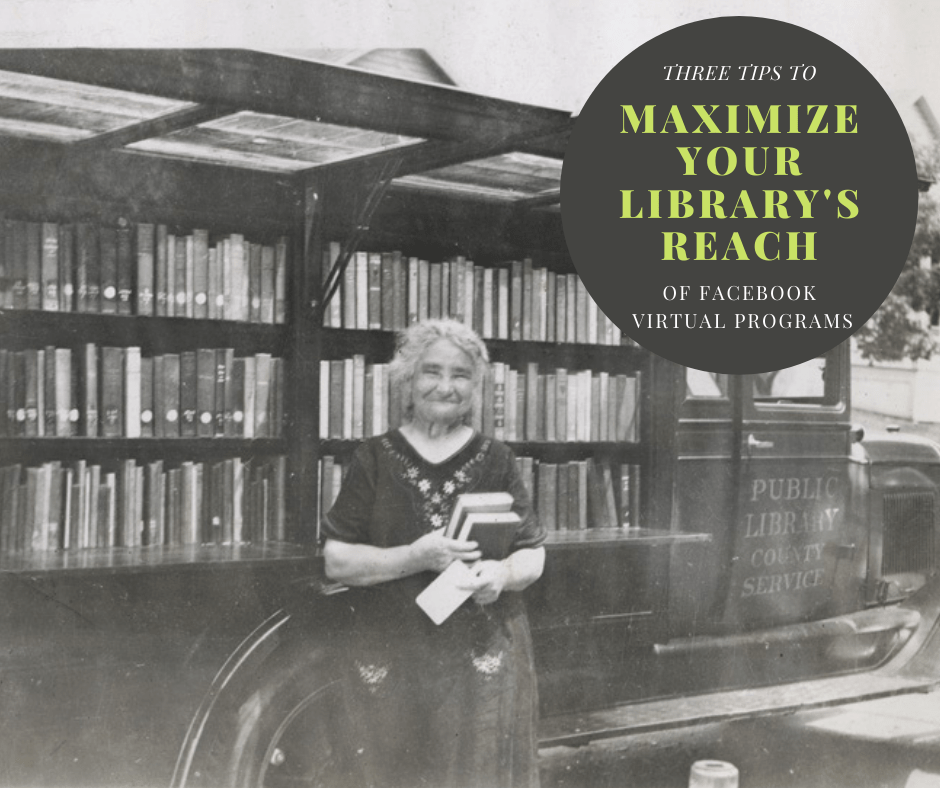
I’ve got some tips that will help you promote your Facebook livestreams to get more viewers.
Plan it out
Before you go live on Facebook, you ask yourself these questions:
What are my goals? Your main goal should be more than “I want to get 20 people to watch the livestream.” Think holistically about what you want your audience to get from your livestream. Be as specific as possible.
Some good goals are “To teach our audience how to search for articles, marriage and death notices, and other information about their families in our newspaper archive” or “To show viewers how to use the new feature updates on the Libby app from Overdrive to better manage their holds.”
A goal or goals for your live video will help you when it comes time to decide how you’ll structure your live and what you’ll say. It also gives you a measurable outcome that you can use to assess the use of live virtual programs.
What will my main message be? The main message is how you translate your overall video goal into a line that you can repeat in your promotion of the video and while you are live.
For example, if your goal is to explain those new features on the Libby app, your main message might be, “You now have more control over the e-books and audiobooks you check out from your library.” Repeating your main message in your video pre-promotion, during the video, and when you post the video on-demand will help drive that message home and make it stick in your viewer’s mind.
Who is my target audience? Readers of this blog know that the best way to have success in marketing is to pick an audience and market to them, rather than marketing to the whole of your cardholder base.
Picking a target audience is important when you’re working in Facebook, because the platform will pick up on any keywords you use in your program description. They’ll help you find those specific viewers by showing your organic post to people who may actually be interested in it.
Once you’ve answered these three questions, you’ll have a good foundation as you head into the stage where you promote your livestream.
Promote before you go live
Facebook suggests that you schedule an announcement post in Live Producer. That feature will automatically create a Facebook preview post. Your library followers can then set up a reminder to join the live broadcast.
You can also set up a Facebook event as a preview to your livestream. If you choose to go this route, be sure to explain that you’ll be going live on your main Facebook page, not within the event.
You can also create organic preview posts. Use an eye-catching graphic or photo and link to your virtual event calendar, where people can register to attend.
Registration for your virtual programs is a great option because it gives your library control over communication. Ask for your potential viewer’s email. Then, send them a reminder to watch from your own email marketing system.
In your reminder email, include other virtual program choices and collection items that compliment your livestream. You should also ask recipients to sign up for other email or newsletter marketing from your library.
Whichever option you go with, be sure to promote your livestream at least two weeks before it happens.
And don’t forget to promote your live program on your other channels, like in your email marketing, on your website’s homepage, or even with fliers or bookmarks that you slip into holds or curbside pickups.
Focus on the conversation
Your promotional efforts don’t end when you hit the “live” button.
Facebook will serve a notification of your live virtual program to people who may be scrolling the news feed while you are live. And the best way to get those notifications to happen is to make sure your audience is having a lively conversation.
To help facilitate the conversation, come up with a list of questions for viewers of your livestream before you go live. If the conversation with viewers lags during your livestream, refer to your list and ask the next question to spark comments again.
Now, that’s hard to do when you’re also the person who is hosting or talking during the livestream! So, ask one of your library co-workers with admin access to your library’s Facebook page to post a comment as the library.
Subscribe to this blog and you’ll receive an email every time I post. To do that, click on the “Follow” button in the bottom left-hand corner of the page. Connect with me on YouTube, Twitter,Instagram, and LinkedIn.


 Super Library Marketing: Practical Tips and Ideas for Library Promotion