Search

Super Library Marketing: Practical Tips and Ideas for Library Promotion

Tag

book promotion

You Don’t Have to Choose Between Print and Digital Books: How to Promote Your Collection to Patrons Who Use BOTH Formats

Image courtesy Cincinnati and Hamilton County Public Library

Dear readers: I have a poll for you to take this week. Thanks in advance!

How many times have you been asked the question: which do you prefer most, print or digital books?

For me, the answer isโ€ฆ yes. Both.

I am not unusual. The Pew Research Center questions Americans about their reading habits and preferred book format every year. The survey for 2021 shows there are plenty of readers just like me who read both print and digital formats. Here are the topline numbers:

  • 75 percent of adults in the United States read a book in some format over the last year.
  • 33 percent say they read both print books and eBooks.
  • Nine percent say they only read eBooks or audiobooks.

And, although libraries don’t sell titles, book sales provide more evidence of our readers’ format preference.

  • Sales of print books increased in 2021 by about 9 percent.
  • eBook sales decreased, but that was to be expected after skyrocketing during the 2020 pandemic.
  • Audiobook sales continue to rise, up six percent in 2021 over the previous year.

The bottom line is that readers love to read. When theyโ€™re searching for a title, many readers want to get their hands on it in whatever format it’s available, as quickly as they can.

Who are these cross-format readers?

One email company I know has a name for people who read both digital and print books. They call them “transitionals”. But I think thatโ€™s not an entirely accurate way to describe cross-format readers.

First, most people are not transitioning from one format to the next. They are using both.

Secondly, that term lends an air of credibility to the notion that your print and digital collection are two separate things that need to be marketed in two separate ways. But they are not.

The collection is the collection, no matter what format our community members use. And the reasons they read both digital and print formats are opportunities for our marketing.

How to promote to cross-format readers

Remember, if your community is checking out books in all formats, circulation numbers will increase for your library. And youโ€™ll be fostering a deeper level of engagement for these readers.

They’ll become dependent on your library for their reading material. And they’re more likely to volunteer, donate, and advocate for your library.

Cross-promote readalikes using context clues during in-person interactions.

Most people who visit your physical library branch are there to check out print. But you can cross-promote readalikes in digital formats to these readers.

To do this, look at your current print circulation statistics. Identify the three genres or topics of physical books most often checked out by your patrons. Next, create a bookmark or a quarter sheet flyer with three readalike suggestions for each of these topics. Specifically suggest your readalikes in a digital format.

Or, instead of suggesting three specific titles on your print piece, create a booklist of readalikes in digital format on your website. Your readalike bookmark or flyer should include a shortened URL link that leads to your online booklist.

When you see someone checking out print materials that might match your digital readalikes, hand them your digital readalike bookmark or flyer. Or slip the bookmark or flyer into holds.

You can also cross-promote print readalikes to your digital readers. Most digital format vendors will let you download the email addresses for your eBook and audiobook users.

Pull those lists and then send an email to those digital users promoting readalike titles, both new and backlist, in print formats.

Remember if you live in the US, you are not breaking any laws by emailing patrons, even if they don’t opt-in to an email. In fact, they expect you to market to them.

If they donโ€™t want to receive emails from your library, they will opt-out. The overwhelming majority will appreciate your reading suggestions.

Libraries outside of the U.S. can add a section to their library news email to promote their digital and print collection. Use a link that allows your readers to check out your book suggestions in whatever format they prefer.

Make sure you track holds and checkouts of the titles you promote in your emails. That will give you data to help you make decisions about what to promote next. It will also be proof of the effectiveness of your work.

In my experience, one collection-based email a month can drive a circulation increase on average from 125 percent to 375 percent!

Include a digital option for your physical library book displays.

A patron who visits your library and sees your display may want to read those books in digital format. You can serve that patron by including a small sign or a bookmark with a QR code that allows readers to check out those same books in digital formats.

Offer titles in the format with a shorter wait list.

A few weeks ago, a staffer at my library was helping me search for a book I’d been wanting to read. She mentioned the holds list for the title was shorter for the audiobook version than for the print or eBook versions.

I honestly appreciated that! It’s a simple thing, but it’s good customer service. It gets books into the hands of your patrons more quickly and drives circulation.

Promote the benefits of each format.

In library marketing, we often focus on the title itself. But the format is a promotional opportunity too.

People find it easier to retain information when they read print. Readers also talk about the tangible experience of a print book: the feel and smell of it.

This is an opportunity for you to create experience-based marketing. Talk about the physical and emotional experiences readers have when they read print materials.

Likewise, you can talk about the benefits of digital formats in your promotions. eBooks let readers adjust font and background color for accessibility. They take up less physical space and they’re automatically returned at the end of a loan period. And audiobooks allow readers to get lost in a book while doing something else like exercising or cleaning.

Incorporate these features into your collection promotion. Your marketing will resonate with readers who feel comfortable jumping between formats.


Further Reading

Subscribe to this blog and youโ€™ll receive an email every time I post. To do that, enter your email address and click on the โ€œFollowโ€ button in the lower left-hand corner of the page.
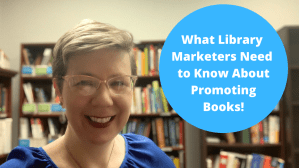
You Can Do It! What Library Marketers Need to Know About Promoting Books

The Library Marketing Show, Episode 34

WATCH NOW

This week, we talk about the work of Becky Spratford from RaForAll.Blogspot.com. She is a reader’s advisory expert. Her seminar made me think about how to improve library book promotion. You’ll learn four things that can help you with your library collection promotion.

Also, KUDOS in this episode go out to Greenfield Public Library in Greenfield, Massachusetts which recently received great press for their pop-up library initiative. Get out of your building and reach out to the community. Thatโ€™s good marketing!

If you have a topic for the show, kudos to share, or want to talk to me about library marketing, email me at ahursh@ebsco.com.

Want more Library Marketing Show? Watch previous episodes!

Check the Upcoming Events page to see where I’ll be soon. Let’s connect!

This blog consistsย of my own personal opinions and may not represent those of my employer. Subscribe to this blog and youโ€™ll receive an email every time I post. To do that, click on โ€œFollowโ€ button in the bottom left-hand corner of the page. Connect with me on Twitter,ย Instagram, andย LinkedIn.ย  Need help with your library marketing? Email me at ahursh@ebsco.com.

Seven Big Revelations I Had About Library Collection Marketing and How You Can Avoid Making the Same Mistakes

Photo Courtesy Public Library of Cincinnati and Hamilton County

Four weeks ago, I started my new job.

In my previous role at a major metropolitan system serving a population of nearly a million people, I thought I knew people who were wild about books. But these folks at my new company love books on a whole new level.

I have learned so much in my first month. And Iโ€™ve come to realize that, as much as I loved collection marketing, I was making mistakes. In fact, I did a lot of things wrong.๐Ÿคท

Because promoting the collection should be the core of any library’s marketing efforts, I want to make sure I pass on what Iโ€™ve learned.

Seven Mistakes to Avoid When Promoting Books

What I did wrong: I recommended books.
What you should do instead: Suggest books.

It sounds like semantics, but there is a real difference between recommending and suggesting books to potential readers.

Readers advisory consultant Becky Spratford of RA for All points out that library anxiety is a real thing. People come into your building or log onto your website to find a book they love. But they have a certain amount of anxiety. They feel like they absolutely must read a book that is recommended to them by a library staff worker. If they donโ€™t finish it, they worry that we will judge them.

So, let your library users know that your book recommendations are just suggestions. No one will judge them for not reading the titles you suggest. And let your customers know it’s okay to return books unread!

What I did wrong: I used plot to promote books.
What you should do instead: Use story elements to promote books.

Most readers advisory experts rely on something called the Vocabulary of Story Appeals to make books suggestions. This is a way of describing the book without talking about the plot.

When picking their next book, readers don’t look for a certain plot line. They are looking for factors that appeal to them, including pacing, characters, tone, style, and the story line. Story line, I have learned, is different from plot in that it focuses on the WAY the story is told, as opposed to what happens in the story. Mind blown.

Library marketers can learn about story elements by requesting a free copy of The Secret Language of Books. I got my copy at the 2019 Library Marketing and Communications Conference. It expanded my vocabulary and gave me new words to use when marketing my library’s collection.

It’s so much more interesting to describe a book in terms of story elements. It intrigues readers and may lead them to place holds on books they would otherwise ignore.

What I did wrong: Promoting only new books.
What you should do instead: Promote new books AND offer a readalike available right now on the shelf to help soften the hold wait.

At my library job, I stopped promoting older books because the data told me that new books were the ones that got the most circulation from my targeted email marketing.

My change in philosophy doesnโ€™t mean that the data was wrong. But there was a piece I was missing.

Sometimes, the most popular books are also the ones with the longest hold list. Most library lovers are, in my experience, okay with waiting awhile for a book they really want to read.

In the meantime, library marketers can do a better job of suggesting a currently available readalikes to our readers.ย This helps to create satisfaction for our readers. It also can expand their worldview. It keeps them engaged with the library while they wait for the new title. And, it helps our circulation numbers!

What I did wrong: Thinking I really didnโ€™t have the skills to suggest books.
What you should do instead: Everyone in your library can suggest books. And I mean everyone!

I had a real hang-up with suggesting books to others. I canโ€™t tell you how many times I said the words, โ€œIโ€™m not a real librarian butโ€ฆโ€

But what I’ve come to learn is that I am a book expert because I love reading! I donโ€™t have a degree, but I do readโ€ฆ a lot.

I also read about books a lot. I listen to podcasts about books. I talk to other book lovers. I have resources at my disposal that I can use like NoveList and Goodreads.

You donโ€™t have to have a degree to be passionate about books or connect with another reader.

What I did wrong: Limiting the book genres I suggest to what I have know or read.
What you should do instead: Use resources to make recommendations from genres you’re not familiar with.

Consciously push yourself to suggest books outside your own comfort zone. Itโ€™s better for you, for your friends, your fellow readers, and for the world in general, when we broaden our horizons to suggest books outside our comfort zone. We should strive for equity, diversity, and inclusion in all areas of our livesโ€”and that includes our reading materials.

What I did wrong: Putting more weight on New York Times bestsllers list for book suggestions.
What you should do instead: Promote books on the USA Today best seller list and on Amazon.

By using more than just one list of bestsellers, I could have gotten a better idea about what was truly a best seller. Lists from USA Today and Amazon include books from every age, genre, and publishing house.

Donโ€™t discount sales of a book. If a book is making money, itโ€™s popular. And your community is full of people who canโ€™t afford to buy those books. But that doesnโ€™t mean that people donโ€™t want to read those books. We need to let them know they have access.

What I did wrong: Not asking my readers often enough what kind of books they like.
What you should do instead: Ask your readers about the books they love!

Survey your patrons. And do it regularly, because their tastes change. Your population changes. You don’t even have to do this using a formal survey. Just ask on social media. People love to talk about what they’re reading or what they want to read!

Subscribe to this blog and youโ€™ll receive an email every time I post. To do that, click on the โ€œFollowโ€ button in the bottom left-hand corner of the page. Connect with me on YouTube, Twitter,ย Instagram, and LinkedIn. For more help with your library marketing, email me at ahursh@ebsco.com.

A WordPress.com Website.

Up ↑