Search

Super Library Marketing: Practical Tips and Ideas for Library Promotion

Tag

content marketing and libraries

Why Print Marketing Still Works for Libraries… and How to Prove It!

Photo courtesy Cincinnati and Hamilton County Public Library

Quick Summary

  1. Print marketing is not dead. When used strategically, it helps libraries cut through digital noise and even strengthens digital marketing.
  2. Measure return on investment of print marketing with opt-ins, QR codes, custom trackable links, and interactive prompts.
  3. Repurpose print content across social, blogs, and email to extend its reach and prove its impact.

Every day, I run with anticipation to the mailbox.

I can’t help myself. As a member of Gen X, snail mail was a significant part of my life when I was growing up. A letter or postcard from a family member or friend brought me such joy. We had phones, of course, but no social media. So if a friend went on vacation, I couldn’t follow each step of their journey on Instagram.

I also love mail because it’s physical. There is something about the feel of paper in your hands that adds to the joy of reading. It’s why I prefer print books to eBooks.

And I know that digital correspondence is also permanent, but there is something different about a stash of letters, held together with ribbon or string, kept to be read again years later.

What does any of this have to do with library marketing?

The 10th Annual Super Library Marketing survey closed a few weeks ago. I’m analyzing the results now and will publish the full report on January 5, 2026.

But one theme has emerged already: Library promotions are getting lost in the constant digital noise.

I work with hundreds of libraries worldwide every day at NoveList. They’re all facing this struggle. And some are beginning to lean on print to cut through the noise.

That’s because print still matters when itโ€™s intentional, measurable, and audience-focused.

Print is not dead. Itโ€™s strategic!

It might feel old-fashioned or even risky to invest staff time and budget in print. After all, email and social media offer instant metrics and quick reach. But hereโ€™s the truth: Print has never been more valuable.

Now, I realize this statement may come as a surprise. Readers of this blog know how much I value email marketing. It is, hands down, the most effective use of your marketing time.

But clever library marketers know that there are some audiences we cannot reach with email. Print helps you connect the dots between those groups. It can spark attention in people who might otherwise overlook your digital promotions. And it can deepen the relationship with those who are already engaged with your library.

Imagine this: Youโ€™ve been on a storeโ€™s email list for years, eagerly clicking through their sales messages. Then one day, a coupon shows up in your mailbox. Suddenly, the brand feels even more present, more valuable, and youโ€™re more likely to act on the next email, too. (BTW, this example is born of my own experience with Bath and Body Works!) And it works because…

Print doesnโ€™t replace digital marketing; it amplifies it.

How do you know if your print marketing is working?

Hereโ€™s the challenge I’ve always faced with print marketing: How do you prove that it’s effective? How do you know itโ€™s worth the investment? Because, let’s face it, print can be costly.

Here are five concrete ways you can measure the effectiveness of print marketing at your library.

1. Start with an opt-in model for longer print publications.

Many libraries print thousands of copies of their print newsletter or magazine. Then they send them out to all the people living in their service area. They might also send copies home with each child in their school district.

I totally understand that strategy. But it’s akin to sending un-targeted email messages. If someone isn’t already engaged with the library, the sad truth is they may throw that print piece in the trash. That’s a waste of money for the library and a waste of time for you.

A better approach is to ask readers to opt in to the publication. There are a couple of ways to do this.

  • Ask people to sign up either when they sign up for a library card or through an email campaign.
  • Send your print publication to anyone who donates to your library’s fundraising groups.
  • Put copies out in your branches. You can also distribute copies to partner organizations with locations that have a lot of foot traffic, like museums and theaters. Be sure to include a QR code so those new audiences can sign up to receive their own copies at home.

2. Make your print marketing interactive.

Ask readers to post a social media comment on a story or an event in your print publication. This works really well for print calendars and fliers.

Add a unique hashtag to the piece, and ask people to use it when they post their comment. Then count how many comments you receive.

You can also ask readers to send an email with an answer to a special prompt, like, “Which storytime is your child’s favorite?” Create a special inbox to receive comments from your print publications. Then you can count the number of emails you receive.

3. Use custom trackable links.

When I worked at the Cincinnati and Hamilton County Public Library, I used Bit.ly to create special trackable links for our website. With a free Bit.ly account, you can edit the back half of a link and then track how many people click on it. This makes it easy to see which traffic is coming directly from your print marketing.

4. Add QR codes.

Add a QR code to your print piece, then track how many scans you get. One library marketer I spoke with takes this a step further by creating a different QR code for each poster, depending on where itโ€™s displayed. That way, she can compare engagement across different locations or departments!

Pro tip: This strategy works for all your libraryโ€™s print pieces, from bookmarks to event flyers. If you ever feel like youโ€™re doing too much print marketing, the data you collect from trackable links and QR codes can help you make the case for (or against) continuing.

5. Repurpose your content across other channels.

Save time and amplify your content by repurposing stories from your magazine or newsletter into social posts, blog articles, or email content. If those repurposed pieces perform well digitally, itโ€™s another signal that your print marketing is resonating.

When I worked at the library, many of the stories we published in our quarterly newsletter or on our blog were repurposed in this way. This helped us to get more traction for the stories and gave us another way to measure whether the story is interesting to our audience.

This trick can also help your community to learn that you have print promotions and give you a reason to solicit sign-ups for the print version!

How is your library using print marketing?

Iโ€™d love to hear how your library is using print. Share your experiences in the comments below.


Need more inspiration?

Libraryโ€™s Print Magazine Is a Community Must-Read! Here Is Their Secret Formula.

Subscribe to this blog, and youโ€™ll receive an email whenever I post. To do that, enter your email address and click on the โ€œFollowโ€ button in the lower left-hand corner of the page. You can also follow me on the following social media platforms:
๐Ÿค”How To Choose Between Short or Long-Form Content Like a Pro

Watch this video now

#LibraryMarketingShow, episode 291

Have you ever stared at a piece of library marketing content and thought, should this be a quick update or a deep dive? Let’s settle that today! Here is how to know if you should use short-form content or when it’s time to go to long-form content in this episode of the Library Marketing Show.

Plus, we’ll give kudos to the subject of a past Super Library Marketing profile who just won a huge award.

Do you have a suggestion for a topic for a future episode? Do you want to nominate someone for kudos? Let me know here. Thanks for watching!โ€‚

P.S.: If you wish, you may download a transcript of this episode.


Miss the last episode? No worries!

Will I see you soon?

Subscribe to this blog, and youโ€™ll receive an email whenever I post. To do that, enter your email address. Then, click the โ€œFollowโ€ button in the lower left-hand corner of the page. You can also follow me on the following social media platforms:

Save Time and Reach Your Whole Audience With an Incredible Trick! (Includes Guide and an Example You Can Steal)

Photo courtesy Cincinnati and Hamilton County Public Library

Last week, we went over the Marketing Rule of 7 and how consistent messaging delivered many times over multiple channels will lead to promotional success.

But that does NOT mean you must create 500 versions of every promotion you do. PHEW!

So, letโ€™s talk about the easiest way to make the Marketing Rule of 7 happen within the constraints of working in a library. We do that by repurposing our content.

Repurposing content

Repurposing content is the practice of reusing elements of existing content to expand that contentโ€™s reach.

Repurposing content makes it easy to fulfill the Marketing Rule of 7 because you donโ€™t need to write every post, shoot every video, and design every infographic from scratch.

Instead, you can use a piece of new content as the basis for lots of other content.

Why repurpose your content?

Your community is diverse. Their preferred methods of receiving information are diverse.

Some of them are visiting your website every day for updates. Some are seeing your social media posts. Some are waiting for your next email to hit their inbox. And some are fans of your Reels, TikTok, or YouTube videos.

Re-purposing content helps you reach more people on the channels they prefer efficiently, so you can go do all the other things you need to do in a day!

I repurpose this blog every week. (Did you notice?!) Hereโ€™s how I do it.

I pull out a few lines, usually from the first one-third of the post. I may use the lines exactly as they are in the post. Or I might rearrange them, adding more humor or emojisโ€ฆ things I wouldnโ€™t necessarily do in my blog post.

Then I take those lines and I post them across my social media channels and in my emails.

I also take parts of a post and use them in other posts, especially if these are key points I really want you to remember. For example, I strongly believe books are your library’s brand. And I say so… often!

Sometimes, I take parts of my blogs and use them in presentations.  I also turn them into an infographic or a 60-second video.

How will this work at your library?

Letโ€™s say youโ€™ve created an infographic to communicate the value of your library in the past year. We know infographics are a great way to present those statistics and give a whole picture of your library’s contribution.

But infographics take time to build. And some people will still need those stats broken down for them, piece by piece, in order to comprehend their meaning.

So you can take each of the points on that infographic and create separate social media posts. This really helps your audience digest the information.

Those separate pieces of breakout information can also serve as a springboard for your library to write blog posts or longer social media posts specifically diving into those key stats and what they mean for your community.

Choose three of the facts on the infographic. Pick a staff member who loves being on camera and ask them to create a 60-second Reel or TikTok video using trending audio and creative elements to explain this serious subject: the value proposition of your library.

Need more help figuring out how to make this work at your library? I created a 4-step guide for you!

Easy 4-step guide to repurposing content

Letโ€™s say your library is publishing a promotional blog post about Book Club Kits. It might look like this.


Get Convenient, Easy Help Leading Your Next Book Club

Are you someone who enjoys discussing books, sharing insights, and hearing different perspectives on a story? Or maybe you’ve been thinking about starting a book club but don’t know where to begin. Well, look no further! Our Book Club Kits are designed to bring people together through the power of literature, and here’s why you should definitely consider checking one out:

  1. Diverse Selection: Our Book Club Kits include a wide range of titles covering various genres, themes, and authors. Whether you prefer classics, contemporary fiction, non-fiction, or even a mix of everything, we have something for everyone. From thought-provoking novels to inspiring memoirs, our collection is carefully curated to spark engaging discussions.
  2. Convenience: Starting and maintaining a book club can be challenging, especially when it comes to sourcing multiple copies of the same book. With our Book Club Kits, we’ve taken care of that for you! Each kit includes multiple copies of the featured book, making it easy for your group to access and read the same title simultaneously.
  3. Discussion Guides: To facilitate meaningful conversations, our kits come with discussion guides. These guides provide questions, prompts, and talking points to help guide your book club discussions, ensuring that everyone gets a chance to share their thoughts and insights.
  4. Cost-Effective: Participating in a book club can sometimes become costly when you have to purchase multiple copies of a book. With our Book Club Kits, you can enjoy reading and discussing a wide variety of books without breaking the bank. It’s a budget-friendly way to explore new literary horizons.
  5. Community Building: Book clubs provide an excellent opportunity to meet new people, make friends, and engage in lively conversations. By checking out one of our Book Club Kits, you can be a part of a vibrant community of readers right here in your own neighborhood.
  6. Flexibility: Whether you prefer in-person meetings or virtual gatherings, our Book Club Kits are designed to accommodate your preferred format. You can use them to start a club with friends, family, or even coworkers, making it easy to connect with others over a shared love of reading.

You can use that post as a base for repurposing.

Step one: Write a two-line version of your blog post.

This is going to be the mini-version of your post… the elevator pitch, so to speak.

For this example, I would say:

Book Club Kits from the library make it easy, convenient, and cost-effective to start a book club. The library provides free book copies and discussion guides that allow everyone to participate and build community.

Step two: Promote in your emails.

Add your two-line version of the blog post to your newsletter and any other email you send over the course of the next month, with a link to the full post.

Step three: Share on your social channels.

Post your two-line version of the blog and include a link to the full post in the comments of your social media post. (Hereโ€™s why you want to put it in the comments instead of the post.)  

Keep the momentum going on different social media channels by creating more two-line versions of your blog. For example, during week one, post this to Instagram and Facebook:

Book Club Kits from the library make it easy, convenient, and cost-effective to start a book club. The library provides free book copies and discussion guides that allow everyone to participate and build community.

In week two, post a new two-line version on Instagram, Facebook, and LinkedIn:

Book Club Kits from the library bring people together through the power of literature. The curated kits are convenient and flexible to help any book club leader.

On week three, you put another two lines on Facebook, LinkedIn, and X:

Meet new people, make friends, and engage in lively conversations about books without breaking the bank. Check out the free library’s Book Club Kits.

And so on. Mix it up to make it sound like new content while driving home the key points you wish to make.

Step four: Use the promotional message on print promotions.

Create a bookmark, flier, and sign, with your favorite two-line pitch from your blog post. Include a QR code linking to the blog post.

Place the bookmarks and fliers in every hold or checkout. Place your sign on a display of books that have been assembled into book club kits.

Re-purposing all content

You can do this with any piece of content, from podcasts to press releases. Break the content down into pieces and spread them across all your available platforms.

In this way, you can make sure everyone in your community sees your message. You also can make sure the work you are doing right now will have maximum impact.

The added benefit to re-purposing: more data.

It won’t take long for you to learn where your audience is getting news about the library. If you notice that engagement is high on one marketing channel, you will know which channel to start with when you are promoting your library.


P.S. Want more advice?

Libraries Have a Huge Competitive Advantage: Customer Service! Here Are 3 Promotional Tips To Drive Home That Message

Upcoming Appearances

Will I see you soon?

Subscribe to this blog and youโ€™ll receive an email whenever I post. To do that, enter your email address and click on the โ€œFollowโ€ button in the lower left-hand corner of the page. You can also follow me on the following social media platforms:

Your Summer Reading Challenge: How Your Library Can Use Big Events To Gather Compelling Content for Promotions During the Rest of the Year

Group of women at the Public Library of Cincinnati and Hamilton County, circa 1947. Photo courtesy Public Library of Cincinnati and Hamilton County.

โ€œThe only way we can differentiate ourselves is in how we communicate.โ€

I heard this quote at a conference six years ago and it’s never left me. I can’t remember who said it, but I remember that it changed the entire way I thought about library marketing.

We do a lot of push promotions in the library world. We try to inform our communities about what our library has to offer. We tell them why they should support the library.

Honestly, we do a lot of talking at people. And we end up sounding like every other advertiser.

When is the last time you asked yourself: how can I differentiate my library from the crowd of competitors?

Content marketing is a good place to start. It is, according to Content Marketing Institute founder Joe Pulizzi, โ€œa strategic approach focused on creating and distributing valuable, relevant, and consistent content to attract and retain a clearly defined audienceโ€“ultimately, to drive profitable consumer action.โ€

But what does that mean for a library?

It means we canโ€™t rely on disruptive marketing to capture the attention of our cardholders. If we want to attract and retain people who will use the library and support the library and convince others of the value of the library, we have to be more strategic.

Think about how you go about interacting with signs, ads, and social media. Do you give every message your full attention… or half of your attention… or even a glance?

Unless something is seriously compelling, you filter it out. So do our cardholders.

Content marketing sticks with your audience because it’s not an ad. It doesn’t push.

It is stories about your library, your staff, or your community. Your cardholders will remember these kinds of promotions because stories make us feel emotions. And emotions are memorable.

Summer Reading, or any large library event or initiative, is the best time to be purposeful about using content marketing to promote your library. It’s also the best time to gather stories for promotion later in the year.

Here’s what I want you to do.

  • Gather stories about how cardholders are using the library. How is your library improving their lives? How is your library helping people get back on their feet or back to normal in this phase of the pandemic? Ask your library workers to be on the lookout for great story ideas.
  • Gather stories about your staffโ€“who are they? What do they like to do in their spare time? What do they love about interacting with cardholders? How their approach to work changed during the pandemic?
  • Gather information about your cardholders. Survey your users or use social listening to create a list of the problems they are facing. Ask your cardholders specific questions like “Tell us about a time when your library helped you find some information you thought you’d never be able to uncover.” Or “Tell us your favorite library memory from your childhood.”
  • Set up a form on your website and solicit cardholder stories on social media, in your email, and printed newsletters. That list will be the basis for further content marketing your library can create down the road that answers those problems.

And then, tell those stories using the platforms you have available. Write them up for your blog. Create social media posts. Add them to your newsletters. Start a landing page on your website. Make videos.

There are three key pieces to look for in a good content marketing library story.

Emotion. The joy of finding a book, the fear of not getting a job, the frustration of another night of homework without any helpโ€ฆ these are all emotions felt by our libraryโ€™s customers. Other people can relate to these experiences and empathize.

A good emotional story activates many portions of the brain, including sensory, memory, and empathy sectors. The more active the brain is while reading, the more likely it is that the listener/reader will remember the story.

Emotion is the most important criteria of a good story. If it makes you feel something, itโ€™s worth pursuing.

Conflict and a resolution. A good story includes some conflict, whether minor or major, and a problem or situation that is resolved.  Without conflict, a story is flat and unmemorable.

Look for stories with a beginning, middle, and end including a story arc that leads to a resolution.

Simplicity. A story thatโ€™s direct, with less adjectives and more heartfelt and straightforward language is more likely to be remembered by the listener than a complex story with a long, winding narrative and lots of details and unnecessary description.

When writing content for marketing purposes, draw a straight line from beginning, middle, and end. Keep the story moving forward with clear language.

Content marketing gives you a chance to tell your library’s story without making a direct pitch. It increases brand awareness and affinity and improves your library’s image. And stories are fun to tell!

We cannot rely on this old disruptive marketing policy to be the driving force behind our library marketing efforts anymore. Weโ€™re better than that.

We work with stories every day. Letโ€™s start telling them.


Do you use content marketing in your library promotions? Do you have some great stories that you’ve gathered about your library and cardholders? Do you have questions about storytelling and how it works for libraries? Share your thoughts and questions in the comments below!

You Might Also Like These Posts

The Biggest Threat to Your Libraryโ€™s Content Marketing

Five Content Marketing Lessons Learned at the Construction Site

Angela’s Latest Book Review

Broken (in the best possible way) by Jenny Lawson

Subscribe to this blog and youโ€™ll receive an email every time I post. To do that, click on the โ€œFollowโ€ button in the bottom left-hand corner of the page. Connect with me on YouTubeTwitter, InstagramGoodreadsand LinkedIn.

The Quest for Perfection May Spoil Your Library Promotions! How To Walk the Line During the Revision Process and Still Create Authentic Messages

I learned a skill as a journalist which has been invaluable to me as a marketer.

As a journalist, I was an expert at knowingย when to let go of a piece of contentย and send it out into space, even though it was imperfect.

It’s the nature of the news business. You have a deadline and when the deadline arrives, you go to air or to print with as much information as you have. You know that youย can revisit the story later to add new details. And that must be enough.

One of the hardest adjustments I had to make when I left the newsroom and went to the library was the constant reshaping of promotional messages and campaigns.

The good and bad of the revision process

When I worked in a library, each blog post, print piece, email, social media post, or video would go through rounds of review by several departments. The record was held by our content marketing magazine, which sometimes went through upwards of 15 edits per issue.

All the scrutiny had its advantages. More edits meant grammatical, punctuation, and spelling errors were found and fixed. The revision process also gave me the chance to see how each message was perceived by different people with different perspectives.

I purposefully chose reviewers who worked with different target cardholder audiences. They told me whether they thought their patron base would respond to the message. I trusted their opinions and took their advice when they told me a phrasing or image change would increase my message’s effectiveness.

But there were also pitfalls to revision process. The message was sometimes reshaped by people who pressured me to add words or phrases that weren’t customer friendly. They might also wish to dilute or change the message altogether, depending on their department’s own goals or agenda.ย 

The point at which your library’s revision process goes from helpful to over-examined is the space I want to focus on in this post.

It’s very easy to start over-thinking text, images, and graphics. The message you’ve carefully crafted may not connect with your audience because it disappears in the search for perfection. It can be crippling.

There is a very thin line between authenticity and perfection. It takes practice to walk that line. Here’s the advice I have for you.

Constant improvement is better than perfection

The best content isn’t perfect. That is what makes it good.

Imperfection shows your library’s human side. When you write from the heart, your message feels more authentic. 

Don’t sabotage your own marketing efforts by waiting for the moment when every single detail is right.ย Give yourself permission to release a piece of marketing content when the time is right, not when it’s perfect.

Creative, honest messaging will be the doorway for your library to connect with consumers in the moment when they are genuinely searching for answers from your library.

I’m a fan of author, speaker, and showrunner Jay Acunzo. I highly recommend his newsletter. His niche is creativity. He inspires others by talking about how creativity intersects with work in the real world.

In this blog post, Jay makes a great point that I think about all the time. He says, “How can we aspire to perfection (even if it’s never something we reach) while still moving forward without delay (even if we aren’t creating amazing work yet)? Well, I think the key is to place perfection where it belongs: away in the distance. Then, we can busy ourselves with marching towards it.”

In the library, that means we must do the work and ship it when it needs to be shipped. But we also must commit to revising it, molding it, and realizing that it is a work in progress.

In your library promotional work, your goal must not be perfection. It must be constant improvement.

But I have a deadline!

You work in a real library with real goals and strategies. And the quest for perfection will sometimes seem like a lofty goal that you don’t have the luxury of achieving.

So how do you know when a piece of content is ready for release, even if it’s not perfect? Ask yourself these three questions.

1. Is your promotion as compelling and authentic as it can be in this moment?

2. Is your promotional piece free of grammatical, punctuation, and spelling errors?

3. Is the information in your promotional piece correct?

If the answer is yet to these three questions, it’s time to let go.

Marketing is one giant experiment. Even when you release a promotion that isn’t perfect, you will still learn plenty from it. Measure and record the results of your promotion. Then use that data to adjust and reconfigure your attempts on the next go-around.

Don’t get bogged down in the quest for perfection. Be human. Be authentic. Be true to your library voice.

And get the message out there! Your imperfect message may lead to some perfect insight into your community.


Do you have an example of a time when an imperfect message brought you some perfect insight into your customers? Share your thoughts in the comments!

You may also like these posts

Hereโ€™s When Itโ€™s Okay for Your Library To Forget Perfection and Just Push Send!

You Donโ€™t Have To Be Cool To Promote Your Library to Teens! Here Are Seven Seriously Easy Ways To Connect With Gen Z

Latest Book Review

The Only Good Indians by Stephen Graham Jones

Subscribe to this blog and youโ€™ll receive an email every time I post. To do that, click on the โ€œFollowโ€ button in the bottom left-hand corner of the page. Connect with me on YouTube, Twitter, Instagram, Goodreads, and LinkedIn.

Feeling Overworked? There’s a Secret Trick to Get More Mileage Out of Your Library Marketing Content!

Photo courtesy Public Library of Cincinnati and Hamilton County

Not long ago, I read the results of a new survey. It kind of blew my mind.

Orbitz Media asked content creators about the amount of time they spend blogging. They found the average blog post now takes 3 hours and 57 minutes to write. That’s up 65 percent from 2014! The same survey shows 52 percent of bloggers report that itโ€™s getting harder to get readers to engage with their content. WOW.

We live in a world dominated by a relentless and never-ceasing stream of content. But libraries can’t just turn off our content communications streams. Our very existence depends on our ability to educate the public about what we offer. We use our content to convince people to use the library.

So, what’s the solution, when your library staff is overworked, and your audience is oversaturated? Be more efficient.

There is a way to make your work stretch further and get your communication into the world. You can do this by republishing your content.

What is republishing content?

When you republish, you take an old press release, blog post, infographic, or video, and update it to include new and relevant information.

If your library has been publishing content for a while, you probably have quite a catalog. Most of it is still useful and relevant! Good content will never go out of style. These “evergreen” pieces of content are opportunities for you to republish.

Republishing content has many advantages for libraries.

  • It saves you time.
  • It improves your library’s chances of being found in search. When you improve content in the republishing process, you optimize it to bring it up to today’s best practices for headlines, tags, keywords, and length. That leads to improved search results.
  • It helps you to fill your editorial calendar when ideas and staff are sparce.
  • Your audience has changed since your original publish date. You’ve gained new cardholders and fans.
  • Your audience needs a reminder that you offer certain services.

How do you decide what pieces of content to republish?

Here are some ground rules.

First, take inventory of what you have already. This is called a content audit. Use a spreadsheet or organizational software to write down the blog posts, videos, and other pieces of content you previously published (and start keeping track of the new additions).

In your audit, make note of the following:

  • The type of content (blog post, press release, video, brochure, etc.)
  • The original publish date
  • The original headline
  • The keywords or tags used in the original piece
  • The word count or length of the content
  • The number of views, likes, comments, and shares the content originally received

Now you’re ready to make some decisions. What are your marketing goals? Are you (or your supervisors) looking to drive more people to your library webpage? Are you trying to increase social media engagement? Once you establish your goals, look at your old posts and determine which ones will help you reach those goals.

For example, if you want to drive more people to your webpage, and you have a video about your genealogy databases that drove a lot of traffic to your website at the time it was published, mark the video to be updated. It will likely have the same effect today, particularly if it’s refreshed.

Here’s another example. Let’s say your library director really wants to see likes, shares, and comments increase on your library’s new Instagram account. In your list of old content, you notice a blog post from two years ago about a uniquely themed story time that drove a lot of engagement when you posted it on Facebook. Mark that post to be updated. Chances are, with some careful recrafting, it will create the same kind of audience reaction when the updated version is promoted on Instagram.

Now what?

Once you identify the pieces of content you wish to republish, it’s time to update those pieces. Here’s a checklist of options for updating your content.

  • Are the statistics still relevant?
  • Are the links and resources still available?
  • Are quotes still relevant?
  • Are there new keywords or tags to add?
  • Can you freshen up the headline?
  • Do you need to adjust the original length of the piece to make it longer or shorter, based on current best practices?
  • Can you add a poll, a survey, or a comment section to enhance the content experience?

If your original piece of content requires no changes, you can republish it in its original form. Make a note at the beginning to let your readers or viewers know that you’ve republished it without changing it. You might say, “Here’s a popular blog post you may have missed” or “Here’s something from our archives.” Include the original post date for full transparency.

Have you republished content? What were the results? Share your experience in the comments.

Bonus tip

A few months ago, I wrote about another way to stretch your content distribution. Here is the article: Re-purposing Content Saves You Time and Reaches Your Whole Audience. Hereโ€™s How to Do It Right.

Latest Book Review

The Dutch House by Ann Patchett.

Find more 60-second Book Reviews here.

Subscribe to this blog and youโ€™ll receive an email every time I post. To do that, click on the โ€œFollowโ€ button in the bottom left-hand corner of the page. Connect with me on YouTube, Twitter, Instagram, and LinkedIn. 

Part One of the Library Marketer’s Definitive Guide to Creating an Editorial Calendar That Actually Works!

I don’t know about you, but I spend the majority of my day as a library marketer making decisions. I answer probably two dozen or more questions a day from co-workers, staff, and friends about everything from the title of our library’s next blog post to the photo used in an email campaign to the kind of swag we give out at library events. This may be why my poor husband often has to choose the restaurant when we go out to eat. By the end of the day, I’m tired of making decisions!

Library marketing often feels like air traffic control. So how can a library marketer work effectively without losing their ever-loving mind? Organization, my friends. And the best way to get organized is to live and die by a working editorial calendar.

An editorial calendar will define and control the process of creating content, from the creation of an idea through writing and publication. A good editorial calendar will help you decide which content ideas to publish, where to publish, and when to publish. After those decisions are made, the editorial calendar will help you assign tasks and keep up to date on deadlines.

The editorial calendar is literally the heart and soul of the library marketer. Mine is open all the time, as long as I’m at work at my desk. It’s a score card, to-do list, and road map all rolled into one. Without it, I’d be lost.

A number of readers have asked me how they can create an editorial calendar that will lead to effective marketing. I’ve broken it up into two parts. First, let’s go through the steps to setting yourself up for success by funneling your team and tasks into one tool. You need to pick the tool, define your process, and learn how to work your calendar in your role as the project manager.

The Library Marketer’s Definitive Guide to Creating an Editorial Calendar, Part One: How to Pick Your Tool and Use It

Step #1: You need a tool that will help you keep track of everything… and I mean everything! You should consolidate all of your team’s tasks into one place. That means anyone who has anything to do with creating content for your blog, social media, video, email, print, press release, digital signage, or newsletters is on the same tool.

The one tool approach will help everyone to know where each promotion is at any given time. It will also help to maintain a consistent voice and message throughout all of your marketing. Working off the same tool will also maximize the effective use of every piece of content. The one tool approach will also help you, as project manager, to minimize overlap and mistakes.

Set expectations with your team early. Tell them you’ll do your best to pick the right tool for your team. Then make it clear that there will come a point at which everyone will be expected to have transitioned to the new tool.

Step #2: Get your team involved in picking your tool. First, you’ll want to explore how the new system will make their jobs and their lives easier. You can do this by asking your team to list the problems they have right now with content creation. Then, ask them to prioritize them. Which problems cost your team the most time and energy?

How to create an editorial calendar in Google Calendar

Marketing Strategy Bundle from CoSchedule (includes editorial calendar)

Free Excel Spreadsheet-based templates from Smartsheet

Step #3: Enforce compliance. Once you pick the right tool for your team, you have to delete all your other calendars and tools. I’m not being harsh. Your team may need that extra push to use one tool. And it’s likely there may be someone on your team who doesn’t like whatever tool you end up choosing. You cannot allow them to go rogue. In order for this to work, everyone has to use the same base.

Step #4: Make checking your editorial calendar a part of your daily ritual. As the project manager, your job will be to keep everyone on track using your new tool. Some days, this task will take five minutes. Some days it will take longer.

I add promotions into my calendar as soon as I learn about them. I have some promotions planned six months in advance. Advance planning helps me to visualize the promotions I’m doing and make sure everything gets the proper attention it needs. I can still be flexible and change things around as needed. But if I know what my marketing will look like in October during the month of July, I’ll have a better chance of getting everything done in time. That also gives me time to think about what’s coming up and to work on creative and innovative ideas to make those promotions better.

Step #5: Leave plenty of room for data. Measure the results of your content so you can adjust the editorial calendar and improve the effectiveness of future promotions.

Analytics should drive most of the decisions in your editorial calendar. I say most because I believe analytics should be responsible for 75 percent of the decisions. The other 25 percent is experimentation, gut instinct, and a deep knowledge of your audience.

Measuring results has two benefits: It helps you to decide what to do and it helps you decide what to drop. If you find a particular content subject or format isn’t getting the results you want for your library, you have data to back up your decision to drop it. Likewise, when something is working well, you can use data to reinforce your decision to that thing more often!

Read this next!

Part Two of the Library Marketerโ€™s Definitive Guide to Creating an Editorial Calendar That Actually Works!

Subscribe to this blog and youโ€™ll receive an email every time I post. To do that, click on โ€œFollowโ€ button in the bottom left-hand corner of the page. Connect with me on Twitter, Instagram, and LinkedIn.  

Five Totally Doable Things That Make Your Library Content More Shareable

Every content creator fears no one will read their work. By contrast, the most exhilarating thing you can do in marketing is to write something that people read, share, and comment on. I speak from experience. There is no better compliment.

Last week, I told you about the upcoming keynote I’m giving on content marketing and shared some reasons why your library should be creating content. The more I write for this blog, the more I learn about the kinds of content my audience will read AND share. That second part is important. You want to reach new people and make them library fans. But what makes your content shareable?

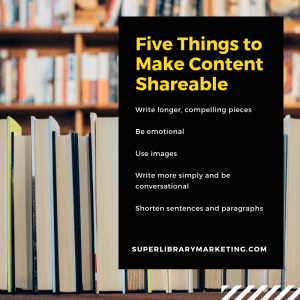
I have five simple ideas for you. Each of these increase the likelihood that your content gets shared.

Write longer, compelling pieces. Seriously, the whole thing about how your audience only has the attention of a goldfish is bunk. They will read a 2,000-word post from you if it’s compelling.ย  People read whole books with 50,000 plus words! I don’t know why this myth of the “too-long content piece” exists when there is literally hundreds of years’ worth of proof that it’s not true.

If you tell a story in long form, with authentic quotes, an emotional arch with conflict and resolution, and a clear beginning, middle, and end, it will not feel like a long read. And a piece of content with all of those characteristics is also likely to be memorable. Great stories stick in our minds long after we read them. And memorable posts get shared!

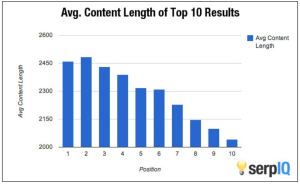
Long form content is also better for your library’s search results. Back in 2012, serpIQ conducted a study involving more than 20,000 keywords. The results showed that the average content length of the top 10 search results was more than 2,000 words.

I have some evidence that this works personally. In 2018, I purposefully started writing longer blog posts here. Most of my posts land at around 1,000 words… not quite up to serpIQ’s standards but about 200-300 more words per post than I wrote in 2017. And guess what happened? My engagement stats increased by nearly 215 percent over 2017!

My library just started a blog two weeks ago. We will experiment with post length. And you can bet that I’ll push our writers to put out longer and more compelling stories, even if that means we have to publish fewer total posts. Write longer, more interesting posts and people will respond.

Be emotional. According to research from the journal Psychological Science, our emotional responses to content play a huge role in our decision to share that content. But all emotions are not created equal. The study shows people will share content that makes them feel fearful, angry, or amused. There is also a ton of evidence to suggest that people like to share content that inspires or contains a surprise.

Conversely, you should avoid creating content with negative emotions like sadness or even contentment, which tend to cause inaction. We don’t want that!

Insert images in your content.ย You may have noticed I’ve started inserting more images into my posts on this blog. That’s because adding images to your content is proven to increase the likelihood that it is seen and shared. My post popular post ever is this one, which contains three images. Those three images are strategically placed to emphasis the meaning of the words. They also break up the text for a visually pleasing read.

You must also use images on social media when promoting your content. This rule applies to all platforms. Your audience is visual and they want to see images in addition to your important words. The right image–one that evokes emotions or really serves to succinctly illustrate whatever you are saying in your content–will also make your content more shareable.

Write simply and conversationally. The more your audience understands what you’re trying to say, the most likely they are to share your posts. Define unfamiliar or difficult words, titles, or services. Go through the draft of your material and highlight words or terms that may confuse your audience. Then, find a better way to say or explain those words.

Never take it for granted that your reader has been a lifelong user or follower of the library. Words used by librarians to describe services, programs, catalogs, and databases may seem common to you and your staff. They are not common to your reader. Always explain. Then, ask a non-library employee to read your work. I often take my stuff home and ask my husband or my teenage daughter to read it. If they find anything to be confusing or convoluted, I know I need to change it.

Shorten your sentences and paragraphs. Shorter sentences will make it easier for your reader to understand and absorb what you are saying. The same is true with paragraphs. A piece of material with lots of long paragraphs looks thick and off-putting. Readers will skip lengthy paragraphs, according to British grammarian H. W. Fowler. In addition, the Poynter Instituteโ€™s Eyetrack Study shows people are more likely to read an entire web page when the paragraphs are short. And if you can get the reader to look at the entire post, it’s more likely that they’ll share the content.

Subscribe to this blog and youโ€™llย receiveย an emailย every time I post. To do that, click on โ€œFollowโ€ button in the bottom left-hand corner of the page. Connect with me on Twitter,ย Snapchat, and LinkedIn.ย I talk about library marketing on all those platforms!

Eight Major Reasons To Add Content To Your Library Marketing {Infographic}

I’m so excited to be the keynote speaker for the Illinois Library Association Marketing Forum Mini-Conference in Chicago in a few weeks. My brain is entirely engulfed in content marketing as I formulate the talk. There are also some big content changes afoot at my library. I’ll talk more about those when we have our campaigns up and running. But, let’s just say that most of my marketing focus in my professional life is on content–why we should do it, how to make it work better, and how to be efficient in our content creation.

The most important part of the speech I’ll give next month is the “why.” Why is content marketing important to libraries? This was actually the focus of one of my early posts here on blog. The argument for content marketing hasn’t changed. You can make all the posters and fliers you want. People don’t pay attention to those push promotional tactics. That’s why marketing seems frustrating.

You want desperately to break through the noise of life and become a subconscious part of your cardholders’ thought process. You want them to think of you every time they face a problem. You want them to remember they can come to you for pretty much anything they need. This is the common struggle for libraries everywhere, no matter their size, staffing, or service area. Honest to goodness, the only way to achieve that is through content marketing. I know this from experience.

There is now a lot of data to back up the assertion that content works. I want to share some of that with you. I’m hoping that, if you are hesitant or nervous about working content marketing into your overall library marketing strategy, these stats will convince you. I truly believe this is an opportunity for libraries that cannot be missed. If we are to survive and thrive as an industry, we need to do more content marketing.

Here are the facts for why content is key to library marketing.

Why Content is Key to Library Marketing

80 percent of people prefer to get information about your library from a series of articles versus an advertisement.

71 percent of people are turned off by content that seems like a sales pitch. Which means, if you are doing mostly traditional promotional marketing, it’s not working.

75ย percent of people who find local, helpful information in search results are more likely to visit a physical building. We want to get more bodies inside our libraries. Content is the key.

Only 45 percent of marketers are using storytelling to create a relationship with their audience. Most big brands are still running ads and push promotion. This is our open door. It’s a huge opportunity for libraries. This is how we sneak in and take away audience share… by telling stories. And who doesn’t love a good positive story about a library?

95 percent of people only look at the first page of search results. Optimized content (that’s content that uses keywords that are likely to be picked up by Google and other search engines) is incredibly helpful. If your library’s content appears on the second page or later, people won’t see it.

Blog posts are the content that get the most shares. And if your post is helpful to others, it’s more likely to be shared. 94 percent of readers share a blog post because they think it can be useful to someone they know. And the more often you publish blog content, the more often your content will show up in search, which increases the likelihood that people will find your library while doing a search. Amazing, right?

90 percent of the most successful marketers prioritize educating their audience over promotion their company’s promotional messages. Education is our main industry. Libraries are perfectly aligned to make this work for us.

But here’s a stat that really surprised me. 78 percent of effective content marketers use press releases as part of their strategy. Yep, press releases can be content marketing too. Use your releases to be informative but to really pitch amazing story ideas to the media. If you have a great story and you can make all the elements available to the media, you can let them tell it and take advantage of their built-in audience to spread the word about your library.

These stats come from a variety of great blogs including Impact, Marketing Profs, OptinMonster, Elite Copywriter, Cision, and Forbes. I hope they’ve convinced you to do content marketing at your library.

Subscribe to this blog and youโ€™llย receiveย an emailย every time I post. To do that, click on โ€œFollowโ€ button in the bottom left-hand corner of the page. Connect with me on Twitter,ย Snapchat, and LinkedIn.ย I talk about library marketing on all those platforms!

A WordPress.com Website.

Up ↑