Search

Super Library Marketing: Practical Tips and Ideas for Library Promotion

Tag

Content Marketing

Your Summer Reading Challenge: How Your Library Can Use Big Events To Gather Compelling Content for Promotions During the Rest of the Year

Group of women at the Public Library of Cincinnati and Hamilton County, circa 1947. Photo courtesy Public Library of Cincinnati and Hamilton County.

โ€œThe only way we can differentiate ourselves is in how we communicate.โ€

I heard this quote at a conference six years ago and it’s never left me. I can’t remember who said it, but I remember that it changed the entire way I thought about library marketing.

We do a lot of push promotions in the library world. We try to inform our communities about what our library has to offer. We tell them why they should support the library.

Honestly, we do a lot of talking at people. And we end up sounding like every other advertiser.

When is the last time you asked yourself: how can I differentiate my library from the crowd of competitors?

Content marketing is a good place to start. It is, according to Content Marketing Institute founder Joe Pulizzi, โ€œa strategic approach focused on creating and distributing valuable, relevant, and consistent content to attract and retain a clearly defined audienceโ€“ultimately, to drive profitable consumer action.โ€

But what does that mean for a library?

It means we canโ€™t rely on disruptive marketing to capture the attention of our cardholders. If we want to attract and retain people who will use the library and support the library and convince others of the value of the library, we have to be more strategic.

Think about how you go about interacting with signs, ads, and social media. Do you give every message your full attention… or half of your attention… or even a glance?

Unless something is seriously compelling, you filter it out. So do our cardholders.

Content marketing sticks with your audience because it’s not an ad. It doesn’t push.

It is stories about your library, your staff, or your community. Your cardholders will remember these kinds of promotions because stories make us feel emotions. And emotions are memorable.

Summer Reading, or any large library event or initiative, is the best time to be purposeful about using content marketing to promote your library. It’s also the best time to gather stories for promotion later in the year.

Here’s what I want you to do.

  • Gather stories about how cardholders are using the library. How is your library improving their lives? How is your library helping people get back on their feet or back to normal in this phase of the pandemic? Ask your library workers to be on the lookout for great story ideas.
  • Gather stories about your staffโ€“who are they? What do they like to do in their spare time? What do they love about interacting with cardholders? How their approach to work changed during the pandemic?
  • Gather information about your cardholders. Survey your users or use social listening to create a list of the problems they are facing. Ask your cardholders specific questions like “Tell us about a time when your library helped you find some information you thought you’d never be able to uncover.” Or “Tell us your favorite library memory from your childhood.”
  • Set up a form on your website and solicit cardholder stories on social media, in your email, and printed newsletters. That list will be the basis for further content marketing your library can create down the road that answers those problems.

And then, tell those stories using the platforms you have available. Write them up for your blog. Create social media posts. Add them to your newsletters. Start a landing page on your website. Make videos.

There are three key pieces to look for in a good content marketing library story.

Emotion. The joy of finding a book, the fear of not getting a job, the frustration of another night of homework without any helpโ€ฆ these are all emotions felt by our libraryโ€™s customers. Other people can relate to these experiences and empathize.

A good emotional story activates many portions of the brain, including sensory, memory, and empathy sectors. The more active the brain is while reading, the more likely it is that the listener/reader will remember the story.

Emotion is the most important criteria of a good story. If it makes you feel something, itโ€™s worth pursuing.

Conflict and a resolution. A good story includes some conflict, whether minor or major, and a problem or situation that is resolved.  Without conflict, a story is flat and unmemorable.

Look for stories with a beginning, middle, and end including a story arc that leads to a resolution.

Simplicity. A story thatโ€™s direct, with less adjectives and more heartfelt and straightforward language is more likely to be remembered by the listener than a complex story with a long, winding narrative and lots of details and unnecessary description.

When writing content for marketing purposes, draw a straight line from beginning, middle, and end. Keep the story moving forward with clear language.

Content marketing gives you a chance to tell your library’s story without making a direct pitch. It increases brand awareness and affinity and improves your library’s image. And stories are fun to tell!

We cannot rely on this old disruptive marketing policy to be the driving force behind our library marketing efforts anymore. Weโ€™re better than that.

We work with stories every day. Letโ€™s start telling them.


Do you use content marketing in your library promotions? Do you have some great stories that you’ve gathered about your library and cardholders? Do you have questions about storytelling and how it works for libraries? Share your thoughts and questions in the comments below!

You Might Also Like These Posts

The Biggest Threat to Your Libraryโ€™s Content Marketing

Five Content Marketing Lessons Learned at the Construction Site

Angela’s Latest Book Review

Broken (in the best possible way) by Jenny Lawson

Subscribe to this blog and youโ€™ll receive an email every time I post. To do that, click on the โ€œFollowโ€ button in the bottom left-hand corner of the page. Connect with me on YouTubeTwitter, InstagramGoodreadsand LinkedIn.

The Quest for Perfection May Spoil Your Library Promotions! How To Walk the Line During the Revision Process and Still Create Authentic Messages

I learned a skill as a journalist which has been invaluable to me as a marketer.

As a journalist, I was an expert at knowingย when to let go of a piece of contentย and send it out into space, even though it was imperfect.

It’s the nature of the news business. You have a deadline and when the deadline arrives, you go to air or to print with as much information as you have. You know that youย can revisit the story later to add new details. And that must be enough.

One of the hardest adjustments I had to make when I left the newsroom and went to the library was the constant reshaping of promotional messages and campaigns.

The good and bad of the revision process

When I worked in a library, each blog post, print piece, email, social media post, or video would go through rounds of review by several departments. The record was held by our content marketing magazine, which sometimes went through upwards of 15 edits per issue.

All the scrutiny had its advantages. More edits meant grammatical, punctuation, and spelling errors were found and fixed. The revision process also gave me the chance to see how each message was perceived by different people with different perspectives.

I purposefully chose reviewers who worked with different target cardholder audiences. They told me whether they thought their patron base would respond to the message. I trusted their opinions and took their advice when they told me a phrasing or image change would increase my message’s effectiveness.

But there were also pitfalls to revision process. The message was sometimes reshaped by people who pressured me to add words or phrases that weren’t customer friendly. They might also wish to dilute or change the message altogether, depending on their department’s own goals or agenda.ย 

The point at which your library’s revision process goes from helpful to over-examined is the space I want to focus on in this post.

It’s very easy to start over-thinking text, images, and graphics. The message you’ve carefully crafted may not connect with your audience because it disappears in the search for perfection. It can be crippling.

There is a very thin line between authenticity and perfection. It takes practice to walk that line. Here’s the advice I have for you.

Constant improvement is better than perfection

The best content isn’t perfect. That is what makes it good.

Imperfection shows your library’s human side. When you write from the heart, your message feels more authentic. 

Don’t sabotage your own marketing efforts by waiting for the moment when every single detail is right.ย Give yourself permission to release a piece of marketing content when the time is right, not when it’s perfect.

Creative, honest messaging will be the doorway for your library to connect with consumers in the moment when they are genuinely searching for answers from your library.

I’m a fan of author, speaker, and showrunner Jay Acunzo. I highly recommend his newsletter. His niche is creativity. He inspires others by talking about how creativity intersects with work in the real world.

In this blog post, Jay makes a great point that I think about all the time. He says, “How can we aspire to perfection (even if it’s never something we reach) while still moving forward without delay (even if we aren’t creating amazing work yet)? Well, I think the key is to place perfection where it belongs: away in the distance. Then, we can busy ourselves with marching towards it.”

In the library, that means we must do the work and ship it when it needs to be shipped. But we also must commit to revising it, molding it, and realizing that it is a work in progress.

In your library promotional work, your goal must not be perfection. It must be constant improvement.

But I have a deadline!

You work in a real library with real goals and strategies. And the quest for perfection will sometimes seem like a lofty goal that you don’t have the luxury of achieving.

So how do you know when a piece of content is ready for release, even if it’s not perfect? Ask yourself these three questions.

1. Is your promotion as compelling and authentic as it can be in this moment?

2. Is your promotional piece free of grammatical, punctuation, and spelling errors?

3. Is the information in your promotional piece correct?

If the answer is yet to these three questions, it’s time to let go.

Marketing is one giant experiment. Even when you release a promotion that isn’t perfect, you will still learn plenty from it. Measure and record the results of your promotion. Then use that data to adjust and reconfigure your attempts on the next go-around.

Don’t get bogged down in the quest for perfection. Be human. Be authentic. Be true to your library voice.

And get the message out there! Your imperfect message may lead to some perfect insight into your community.


Do you have an example of a time when an imperfect message brought you some perfect insight into your customers? Share your thoughts in the comments!

You may also like these posts

Hereโ€™s When Itโ€™s Okay for Your Library To Forget Perfection and Just Push Send!

You Donโ€™t Have To Be Cool To Promote Your Library to Teens! Here Are Seven Seriously Easy Ways To Connect With Gen Z

Latest Book Review

The Only Good Indians by Stephen Graham Jones

Subscribe to this blog and youโ€™ll receive an email every time I post. To do that, click on the โ€œFollowโ€ button in the bottom left-hand corner of the page. Connect with me on YouTube, Twitter, Instagram, Goodreads, and LinkedIn.

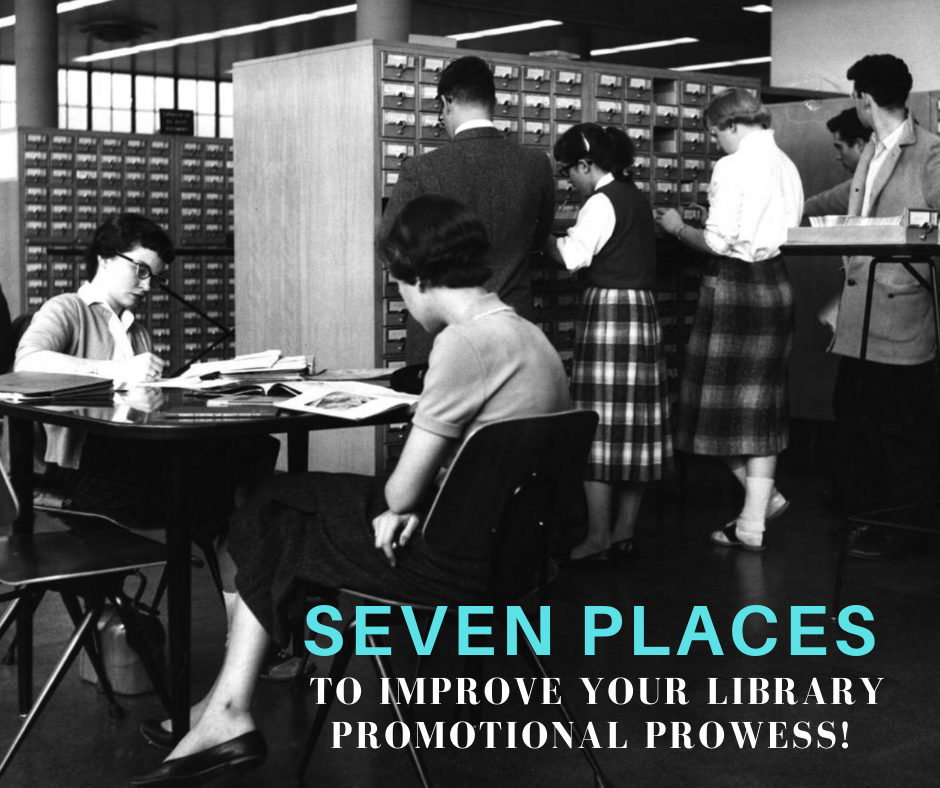
Feeling Lost and Uninspired by Library Marketing? Here Are Seven Places to Learn and Improve Your Library Promotional Prowess!

Photo courtesy the Public Library of Cincinnati and Hamilton County

Learning is essential to the existence of humans.

No, this blog hasn’t suddenly turned into a philosophical self-help website. But I do think it’s important to make learning and research a part of your work schedule.

You need to know the latest research on customer experience. You need to be alerted when social media algorithms change. You need to be inspired by creative, encouraging, thoughtful people who know the struggles, hurdles, and frustrations of marketing.

Boy, have I got a list for you!

I’ve followed a lot of marketers over the years. I’ve read a lot of blogs, subscribed (and then unsubscribed) to a lot of email newsletters. I’ve watched videos and listened to podcasts about marketing, in the never-ending search to find the people who could offer the most help to me and my library marketing friends.

Here are the seven best places for library marketers to get advice!

Ann Handley: Author, Marketer, Chief Content Officer at @marketingprofs. 

Ann is at the top of my list because she’s the definitive expert on writing and creating engaging content.

Read her two books, Content Rules and Everybody Writes. Your library likely has a copy of both.

Next, sign up for her newsletter, Total Annarchy. It’s the gold standard for e-newsletters and one of my favorite pieces of email to receive!

Mark SchaeferMarketing strategist, author, and podcaster.

Mark is a human being. I mean, that’s obvious. But what I’ve always loved about him is that he gives advice like he’s your best friend. He’s not afraid to talk about the hard truths of promotional work.

Back in 2014, he started warning marketers about content overload (sometimes also referred to as content shock). This is the idea that people don’t pay attention to marketing because there is just too much stuff bombarding them from all angles.

This was pretty revolutionary for the time, and as I recall, there were a lot of people who thought Mark was nuts.

But he was right. And that’s why he’s written seven best-selling marketing books, launched a podcast, and is a popular speaker.

Read his latest book, Marketing Rebellion. I also recommend his free Pandemic Playbook. Subscribe to his {grow} blog and his podcast Marketing Companion (co-hosted with another marketing expert, Brooke Sellas).

Jay BaerNY Times best-selling author, marketing consultant, keynote speaker. 

Jay is an expert in the content marketing and social media space.

He has two podcasts that contain tips that relate to libraries. Social Pros focuses on real people doing real work in social media. Talk Triggers shares inspirational case studies about businesses succeeding with word of mouth marketing. 

Library Marketing Book Club

What do Ann Handley, Jay Baer, and Mark Schaefer all have in common? They’ve all been guests at the Library Marketing Book Club on Facebook!

Chris Boivin of the Jacksonville Public Library founded the group in the fall of 2020. We meet once a month to discuss a marketing book and to share tips and strategies for library marketing. Chris is usually able to get the author of the books we discuss to come to our meetings!

Learn more about the book club.

Content Marketing Institute

This is the go-to organization for everything related to content marketing. I came to know of the existence of Ann Handley, Jay Baer, and Mark Schaefer because of this organization.

Sign up for Chief Content Officer magazine (its free) and for their email newsletter. You’ll get the heads-up on upcoming seminars, free webinars, eBooks, and white papers.

Follow their Twitter for great advice and alerts when they post new blog articles. CMI also hosts #CMWorld chat on Tuesdays at noon EST on a host of relevant marketing topics.

Social Media Today

This is my go-to website to check for the latest information on changing social media algorithms, new features, and tips on how to get the best organic reach.

The easiest way to consume their plethora of tips is to sign up for their daily newsletter. They also host #SMTLive chats on Twitter on a variety of social media topics. You can find recaps of their past Twitter chats on their website.

Social Media Examiner

This website makes a good companion for Social Media Today. It provides a deeper dive into social media marketing, with expert advice from some of the leading marketers in the space.

They have a variety of ways for you to receive updates. They post articles and have a robust YouTube channel full of tutorials and shows about social media marketing. They also have two podcasts chock full of information about social media and more expert interviews.

Do you have an expert that should be added to this list? Let me know in the comments!

You may also like these posts

Podcast Like a Pro! Amazing Advice from a Library Podcast Expert

Expert Advice on How to Work Diversity into Your Library Marketing

Latest Book Reviews

Finding Dorothy by Elizabeth Letts

Uncomfortable Conversations with a Black Man by Emmanuel Acho

Subscribe to this blog and youโ€™ll receive an email every time I post. To do that, click on the โ€œFollowโ€ button in the bottom left-hand corner of the page. Connect with me on YouTube, Twitter, Instagram, and LinkedIn.

Why the Circle of Promotion is Your Best Bet for Library Marketing

Watch Now

The #LibraryMarketing Show, Episode 46

Angela explains the Circle of Promotion and how all of your marketing tactics should tie together so we can reach our whole community. Here is the blog post by Angela’s former library that she talks about in this video.

Also Kudos to the Spartanburg County Public Library. They are doing a Pandemic time capsule, which is a fun activity. Their contest rules are also hilarious! Check it out here.ย 

And subscribe to this series to get a new video tip for libraries each week! Thanks for watching.

Want more Library Marketing Show? Watch previous episodes!

This blog consistsย of my own personal opinions and may not represent those of my employer. Subscribe to this blog and youโ€™ll receive an email every time I post. To do that, click on โ€œFollowโ€ button in the bottom left-hand corner of the page. Connect with me on Twitter,ย Instagram, andย LinkedIn.ย  ย 

Five Creative Ideas to Help You Beat the Blues, Get Inspired, and Create Amazing Library Marketing Campaigns Again!

It is hard to believe that in a building filled with the stories, a library marketer would need inspiration.

But alas, we are human. And sometimes we get stuck in a rut.

Library marketers are expected to be energetic and enthusiastic at all times. We must come to all meetings and be able to give a list on the fly of exciting and innovative ideas for promoting major developments and smaller decisions that affect the everyday cardholders.

I don’t know about you, but sometimes, I just too plain exhausted to be the marketing superwoman. The busyness of the library summer reading season seems to melt every year into the busyness of fall. There is little time to rest. And exhaustion makes it even more difficult to find creative inspiration.

We struggle to inspire our cardholders, both old and new. We want our customers to use our collection and enjoy our services every day, but we can’t seem to figure out a way to make them act. The tried and true methods of marketing no longer work and we’re frustrated, angry, and frankly, a little worried.

Here’s what I do when I find myself stuck in a marketing rut.

Define your workflow and make it the law of your marketing landscape. A defined outward-facing workflow sounds like the opposite of a creative endeavor. But in reality, it creates space for you to think. It ensures that you have time to be thoughtful so you can develop and deliver a quality product.

Set an expectation about who will manage workflow. That means all marketing requests go through one person on your team. That person is responsible for looking at the request and determining if it fits into the library’s overall strategic goals. That person sets clear expectations and goals for each project. That person communicates a plan of action based on realistic timelines and due dates.

Let me tell you: a defined workflow is a lifesaver. It reduces stress and anxiety for everyone on your team. When your staff understands what is expected of them, they can focus on the creative parts of the job.

If you are new to your library, it will take time to get a smooth workflow in place. Be patient with yourself and with others. Keep reinforcing your expectations. Eventually, your coworkers will be on board with you, especially when they start to see results.

Be generous with positive reinforcement. Positive reinforcement always creates an emotional experience for individuals or a team working together. Don’t just say, “Well done.” Write a note or a card praising specific actions or portions of work. Give yours staff unexpected breaks: team lunches and surprise treats can lift the spirit of your team and re-energize them.

Use your staff’s strengths to create passion for the work. I highly recommend that you invest in the Gallup Strengths Finders test. It gives you incredible and nuanced insight into yourself and your staff members. It shows you how to recognize the strengths of your team members and how to actually manage them to put those strengths to good use. You can find the book by Tom Rath at Walmart and Target for about $15. It includes a code that each team member uses to take the test online.

Through the Gallup process, I discovered my team members have a strong capacity for collaboration. This wasn’t much of a surprise to me. But the book also gave me suggestions for how to actually use that desire for collaboration to the advantage of my library. It also gave me greater insight and empathy for team members who prefer to work alone or who seem resistant to change. Iย can assign tasks to the best person for each job. It’s really changed the dynamics of my staff and made work easier for everyone.

Observe your customers. It helps me just to take a walk around the library or to visit the branches. I pretend to be browsing the books but really, I’m watching the way the cardholders browse the shelves, interact with staff, work the self-checkout machines and use the public computers. Do they look for a map? Do they look confused? Are they drawn to a particular book display? Do they linger over the new books or do they dash in for their holds and dash out? What questions do they ask? How do people actually move through the branch?

Observing the behavior of customers inside the library can give you an idea of what visitors love and what problems they encounter during their interaction with your system. Then, you can focus on creating new marketing ideas that spotlight the things your cardholders love, and answer the questions they have.

You can also observe online visitors. Spend some time poking around Google Analytics. Figure out which pages get the most visitors. Look for the pages where visitors stay for the longest period of time. Look for the landing pages with a high bounce rate. Page views and read time will help you focus effort on improving the customer experience for your website.

Check your statistics. ย Our library makes circulation and programming stats available on our intranet. This little piece of data inspires me to find ways to help make their interaction with the library more worthwhile.

Sometimes a surprising trend emerges and that gives me a creative marketing idea. Sometimes a service takes a dip in usage, and it becomes clear that we need to shift our marketing focus to re-educating the public about that service. Data is such a valuable inspirational tool. Use whatever stats you can get your hands on!

More inspiration

11 Powerful Quotes for Marketing Inspiration

5 Ted Talks for Marketing Inspiration

Need Marketing Inspiration? It’s All Around You!

Subscribe to this blog and youโ€™ll receive an email every time I post. To do that, click on โ€œFollowโ€ button in the bottom left-hand corner of the page. Connect with me on YouTube, Twitter,ย Instagram, and LinkedIn. ย And check my list of upcoming events so we can connect.

Part One of the Library Marketer’s Definitive Guide to Creating an Editorial Calendar That Actually Works!

I don’t know about you, but I spend the majority of my day as a library marketer making decisions. I answer probably two dozen or more questions a day from co-workers, staff, and friends about everything from the title of our library’s next blog post to the photo used in an email campaign to the kind of swag we give out at library events. This may be why my poor husband often has to choose the restaurant when we go out to eat. By the end of the day, I’m tired of making decisions!

Library marketing often feels like air traffic control. So how can a library marketer work effectively without losing their ever-loving mind? Organization, my friends. And the best way to get organized is to live and die by a working editorial calendar.

An editorial calendar will define and control the process of creating content, from the creation of an idea through writing and publication. A good editorial calendar will help you decide which content ideas to publish, where to publish, and when to publish. After those decisions are made, the editorial calendar will help you assign tasks and keep up to date on deadlines.

The editorial calendar is literally the heart and soul of the library marketer. Mine is open all the time, as long as I’m at work at my desk. It’s a score card, to-do list, and road map all rolled into one. Without it, I’d be lost.

A number of readers have asked me how they can create an editorial calendar that will lead to effective marketing. I’ve broken it up into two parts. First, let’s go through the steps to setting yourself up for success by funneling your team and tasks into one tool. You need to pick the tool, define your process, and learn how to work your calendar in your role as the project manager.

The Library Marketer’s Definitive Guide to Creating an Editorial Calendar, Part One: How to Pick Your Tool and Use It

Step #1: You need a tool that will help you keep track of everything… and I mean everything! You should consolidate all of your team’s tasks into one place. That means anyone who has anything to do with creating content for your blog, social media, video, email, print, press release, digital signage, or newsletters is on the same tool.

The one tool approach will help everyone to know where each promotion is at any given time. It will also help to maintain a consistent voice and message throughout all of your marketing. Working off the same tool will also maximize the effective use of every piece of content. The one tool approach will also help you, as project manager, to minimize overlap and mistakes.

Set expectations with your team early. Tell them you’ll do your best to pick the right tool for your team. Then make it clear that there will come a point at which everyone will be expected to have transitioned to the new tool.

Step #2: Get your team involved in picking your tool. First, you’ll want to explore how the new system will make their jobs and their lives easier. You can do this by asking your team to list the problems they have right now with content creation. Then, ask them to prioritize them. Which problems cost your team the most time and energy?

How to create an editorial calendar in Google Calendar

Marketing Strategy Bundle from CoSchedule (includes editorial calendar)

Free Excel Spreadsheet-based templates from Smartsheet

Step #3: Enforce compliance. Once you pick the right tool for your team, you have to delete all your other calendars and tools. I’m not being harsh. Your team may need that extra push to use one tool. And it’s likely there may be someone on your team who doesn’t like whatever tool you end up choosing. You cannot allow them to go rogue. In order for this to work, everyone has to use the same base.

Step #4: Make checking your editorial calendar a part of your daily ritual. As the project manager, your job will be to keep everyone on track using your new tool. Some days, this task will take five minutes. Some days it will take longer.

I add promotions into my calendar as soon as I learn about them. I have some promotions planned six months in advance. Advance planning helps me to visualize the promotions I’m doing and make sure everything gets the proper attention it needs. I can still be flexible and change things around as needed. But if I know what my marketing will look like in October during the month of July, I’ll have a better chance of getting everything done in time. That also gives me time to think about what’s coming up and to work on creative and innovative ideas to make those promotions better.

Step #5: Leave plenty of room for data. Measure the results of your content so you can adjust the editorial calendar and improve the effectiveness of future promotions.

Analytics should drive most of the decisions in your editorial calendar. I say most because I believe analytics should be responsible for 75 percent of the decisions. The other 25 percent is experimentation, gut instinct, and a deep knowledge of your audience.

Measuring results has two benefits: It helps you to decide what to do and it helps you decide what to drop. If you find a particular content subject or format isn’t getting the results you want for your library, you have data to back up your decision to drop it. Likewise, when something is working well, you can use data to reinforce your decision to that thing more often!

Read this next!

Part Two of the Library Marketerโ€™s Definitive Guide to Creating an Editorial Calendar That Actually Works!

Subscribe to this blog and youโ€™ll receive an email every time I post. To do that, click on โ€œFollowโ€ button in the bottom left-hand corner of the page. Connect with me on Twitter, Instagram, and LinkedIn.  

Five Totally Doable Things That Make Your Library Content More Shareable

Every content creator fears no one will read their work. By contrast, the most exhilarating thing you can do in marketing is to write something that people read, share, and comment on. I speak from experience. There is no better compliment.

Last week, I told you about the upcoming keynote I’m giving on content marketing and shared some reasons why your library should be creating content. The more I write for this blog, the more I learn about the kinds of content my audience will read AND share. That second part is important. You want to reach new people and make them library fans. But what makes your content shareable?

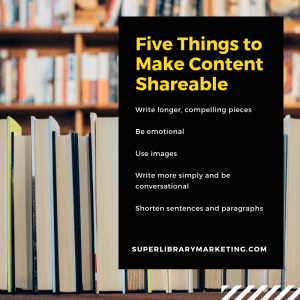
I have five simple ideas for you. Each of these increase the likelihood that your content gets shared.

Write longer, compelling pieces. Seriously, the whole thing about how your audience only has the attention of a goldfish is bunk. They will read a 2,000-word post from you if it’s compelling.ย  People read whole books with 50,000 plus words! I don’t know why this myth of the “too-long content piece” exists when there is literally hundreds of years’ worth of proof that it’s not true.

If you tell a story in long form, with authentic quotes, an emotional arch with conflict and resolution, and a clear beginning, middle, and end, it will not feel like a long read. And a piece of content with all of those characteristics is also likely to be memorable. Great stories stick in our minds long after we read them. And memorable posts get shared!

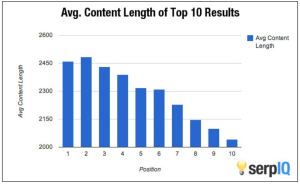
Long form content is also better for your library’s search results. Back in 2012, serpIQ conducted a study involving more than 20,000 keywords. The results showed that the average content length of the top 10 search results was more than 2,000 words.

I have some evidence that this works personally. In 2018, I purposefully started writing longer blog posts here. Most of my posts land at around 1,000 words… not quite up to serpIQ’s standards but about 200-300 more words per post than I wrote in 2017. And guess what happened? My engagement stats increased by nearly 215 percent over 2017!

My library just started a blog two weeks ago. We will experiment with post length. And you can bet that I’ll push our writers to put out longer and more compelling stories, even if that means we have to publish fewer total posts. Write longer, more interesting posts and people will respond.

Be emotional. According to research from the journal Psychological Science, our emotional responses to content play a huge role in our decision to share that content. But all emotions are not created equal. The study shows people will share content that makes them feel fearful, angry, or amused. There is also a ton of evidence to suggest that people like to share content that inspires or contains a surprise.

Conversely, you should avoid creating content with negative emotions like sadness or even contentment, which tend to cause inaction. We don’t want that!

Insert images in your content.ย You may have noticed I’ve started inserting more images into my posts on this blog. That’s because adding images to your content is proven to increase the likelihood that it is seen and shared. My post popular post ever is this one, which contains three images. Those three images are strategically placed to emphasis the meaning of the words. They also break up the text for a visually pleasing read.

You must also use images on social media when promoting your content. This rule applies to all platforms. Your audience is visual and they want to see images in addition to your important words. The right image–one that evokes emotions or really serves to succinctly illustrate whatever you are saying in your content–will also make your content more shareable.

Write simply and conversationally. The more your audience understands what you’re trying to say, the most likely they are to share your posts. Define unfamiliar or difficult words, titles, or services. Go through the draft of your material and highlight words or terms that may confuse your audience. Then, find a better way to say or explain those words.

Never take it for granted that your reader has been a lifelong user or follower of the library. Words used by librarians to describe services, programs, catalogs, and databases may seem common to you and your staff. They are not common to your reader. Always explain. Then, ask a non-library employee to read your work. I often take my stuff home and ask my husband or my teenage daughter to read it. If they find anything to be confusing or convoluted, I know I need to change it.

Shorten your sentences and paragraphs. Shorter sentences will make it easier for your reader to understand and absorb what you are saying. The same is true with paragraphs. A piece of material with lots of long paragraphs looks thick and off-putting. Readers will skip lengthy paragraphs, according to British grammarian H. W. Fowler. In addition, the Poynter Instituteโ€™s Eyetrack Study shows people are more likely to read an entire web page when the paragraphs are short. And if you can get the reader to look at the entire post, it’s more likely that they’ll share the content.

Subscribe to this blog and youโ€™llย receiveย an emailย every time I post. To do that, click on โ€œFollowโ€ button in the bottom left-hand corner of the page. Connect with me on Twitter,ย Snapchat, and LinkedIn.ย I talk about library marketing on all those platforms!

Eight Major Reasons To Add Content To Your Library Marketing {Infographic}

I’m so excited to be the keynote speaker for the Illinois Library Association Marketing Forum Mini-Conference in Chicago in a few weeks. My brain is entirely engulfed in content marketing as I formulate the talk. There are also some big content changes afoot at my library. I’ll talk more about those when we have our campaigns up and running. But, let’s just say that most of my marketing focus in my professional life is on content–why we should do it, how to make it work better, and how to be efficient in our content creation.

The most important part of the speech I’ll give next month is the “why.” Why is content marketing important to libraries? This was actually the focus of one of my early posts here on blog. The argument for content marketing hasn’t changed. You can make all the posters and fliers you want. People don’t pay attention to those push promotional tactics. That’s why marketing seems frustrating.

You want desperately to break through the noise of life and become a subconscious part of your cardholders’ thought process. You want them to think of you every time they face a problem. You want them to remember they can come to you for pretty much anything they need. This is the common struggle for libraries everywhere, no matter their size, staffing, or service area. Honest to goodness, the only way to achieve that is through content marketing. I know this from experience.

There is now a lot of data to back up the assertion that content works. I want to share some of that with you. I’m hoping that, if you are hesitant or nervous about working content marketing into your overall library marketing strategy, these stats will convince you. I truly believe this is an opportunity for libraries that cannot be missed. If we are to survive and thrive as an industry, we need to do more content marketing.

Here are the facts for why content is key to library marketing.

Why Content is Key to Library Marketing

80 percent of people prefer to get information about your library from a series of articles versus an advertisement.

71 percent of people are turned off by content that seems like a sales pitch. Which means, if you are doing mostly traditional promotional marketing, it’s not working.

75ย percent of people who find local, helpful information in search results are more likely to visit a physical building. We want to get more bodies inside our libraries. Content is the key.

Only 45 percent of marketers are using storytelling to create a relationship with their audience. Most big brands are still running ads and push promotion. This is our open door. It’s a huge opportunity for libraries. This is how we sneak in and take away audience share… by telling stories. And who doesn’t love a good positive story about a library?

95 percent of people only look at the first page of search results. Optimized content (that’s content that uses keywords that are likely to be picked up by Google and other search engines) is incredibly helpful. If your library’s content appears on the second page or later, people won’t see it.

Blog posts are the content that get the most shares. And if your post is helpful to others, it’s more likely to be shared. 94 percent of readers share a blog post because they think it can be useful to someone they know. And the more often you publish blog content, the more often your content will show up in search, which increases the likelihood that people will find your library while doing a search. Amazing, right?

90 percent of the most successful marketers prioritize educating their audience over promotion their company’s promotional messages. Education is our main industry. Libraries are perfectly aligned to make this work for us.

But here’s a stat that really surprised me. 78 percent of effective content marketers use press releases as part of their strategy. Yep, press releases can be content marketing too. Use your releases to be informative but to really pitch amazing story ideas to the media. If you have a great story and you can make all the elements available to the media, you can let them tell it and take advantage of their built-in audience to spread the word about your library.

These stats come from a variety of great blogs including Impact, Marketing Profs, OptinMonster, Elite Copywriter, Cision, and Forbes. I hope they’ve convinced you to do content marketing at your library.

Subscribe to this blog and youโ€™llย receiveย an emailย every time I post. To do that, click on โ€œFollowโ€ button in the bottom left-hand corner of the page. Connect with me on Twitter,ย Snapchat, and LinkedIn.ย I talk about library marketing on all those platforms!

Library Marketing Secrets You Can Steal From General Electric

The woman who manages marketing at one of the biggest companies in the United States–and perhaps the world–made a huge impression on me at Content Marketing World. Linda Boff is Chief Marketing Officer at General Electric. You might think a huge brand like GE would be mired in traditional marketing practices and have nothing to teach us about agility and experimentation. You would be wrong.

Boff has led the company into a new realm of marketing, using tactics that libraries have access to, like podcasts and Facebook Live. Her focus is storytelling–finding the stories within your company and sharing them with your audience. She insists you don’t need a big budget to do what she’s doing. She’s a dynamic speaker and her presentation was one of the more memorable moments in the two-day conference because I ended up coming away with so many ideas for my library marketing. I left the room excited and energized!

Boff says there are five reasons to tell your library’s story: To sell (library translation: improve circulation, visits, and attendance), to inspire, to explain strategy, to reach audiences, and to educate. She told the audience that the success of GE with storytelling relies on a simple formula: Be first on platforms + activate unlikely audiences + find the human in the digital times. She laid out exactly what she means in her main brand storytelling tips.

Know who you are.ย GE embraces its nerd identity. The company produced a series of videos showcasing its nerd employees. They are professionally produced but you can do the same thing using your iPhone. Remember, it’s the story that’s important–not the production value of your video. In fact, our library produced a similar series of videos back in April for National Library Workers Week. We shot everything on a DSLR camera and edited it using free software available on the internet. Our fans–and our employees–loved the videos.

Identifyย your secret sauce.ย What is your tone? How do you come to life? Every brand has to figure out what this means to them. This next part is going to sound really familiar. GE has had to fight to be relevant, contemporary, relatable, and modern. Everyone knows who GE was in the company’s past. Everyone is familiar with GE’s legacy. Boff said one of her marketing goals is to teach people what GE is in the present. ย To do this, Boff recommends you need to โ€œshow up as a personโ€–in other words, use real and personal stories about your workers to put a face to your company’s name. GE went to its employeeโ€™s children to ask them what their parents do. They told stories and drew pictures explaining their parent’s work. Then GE took those pieces and used them internally and externally. You can see some of those stories here.

ย Find unexpected audiences.ย At South by Southwest, GE created a BBQ incubation area. They set up a BBQ smoker and had data scientists on hand to smoke the meat with exact precision so it came out right every time. They also had their scientists use data to make BBQ sauce, and they let people taste the sauce while hooked up to a scanner so they could see what their brain responded to via scan. Then took the super smoker to college campuses, so instead of the tent and handouts, they had this cool interactive centerpiece. I think that idea could translate for libraries too. Instead of just having a table at events, let’s bring MakerSpace equipment and traveling library collections so people can interact with our “products.”

Experiment early, experiment often. When a new social media platform or technology emerges, don’t hesitate–jump on board quickly and learn all you can about it, says Boff. The cost barrier to entry is always very low at the beginning of any new trend and the audience has no expectations about what you can or should produce. Boff says it’s important to be on the playing field and really skin your knees; you canโ€™t just read about new trends. I really took this point to heart. We now have permission to move forward on new trends–let’s embrace it!

Good content speaks for itself. Boffย and her team createdย GE Podcast Theater. They create long-form, lightly branded podcasts that are full content marketing platforms. GE’s “The Message” podcast was named as one of the New York Times 11 Fiction Podcasts Worth Listening To and was in the #1 spot on iTunes after its release.ย  Boff says if you are putting great stories out into the world, they’ll do their own marketing with their amazing content.

Stories are right under your nose: The hardest thing is finding stories to tell. GE works had to find stories reach customers, investors, thought leaders, media, AND employees. I’ve talked about finding stories in the library on this blog before in this article and this article. We should always be looking to connect with narratives that inspire all of those audiences. I really loved how Boff emphasized storytelling as a way to grow employee pride. At GE they do this through a YouTube series called In the Wild. It’s entertaining and engaging. Libraries could imitate that on a smaller scale. In fact, my library did that using a GoPro camera! We did time-lapse videos of various jobs and departments in the library and posted them on our YouTube channel. Those videos had more than a thousand views total and continue to draw new people to our YouTube content.

Subscribe to this blog and you’llย receiveย an emailย every time I post. To do that, click on “Follow” button on the bottom left-hand corner of the page. Connect with me on Twitter and Snapchat–it’s where I talk about library marketing! Iโ€™m @Webmastergirl.ย Iโ€™m also on LinkedIn, Instagramย and Pinterest.ย Views in this post are my own and do not represent those of my employer.

A WordPress.com Website.

Up ↑