Search

Super Library Marketing: Practical Tips and Ideas for Library Promotion

Tag

Email Marketing

5 Surprisingly Easy Ways to Write Email Subject Lines That People Actually WANT to Read

Courtesy Cincinnati Public Library

First impressions are important.

The subject line of your library marketing email is your first chance to communicate the value of your email to the person receiving it. It may be your ONLY chance to get someone’s attention to engage with the promotional content you’ve worked so hard to create.

A good subject line will drive people to open the email, read whatโ€™s inside, and take action. That will lead to an increase in the use of your library. And that’s the whole point, right??ย  ย 

A bad subject line can lead your email to be marked as spam, which will affect your sender reputation. In fact,ย according to the marketing agency Convince and Convert, 69 percent of email recipientsย report email as spam based solely on the subject line.

Thatโ€™s why I think your subject line might be the most important part of your library marketing email.

I want you to spend the most time thinking about that section. Be very intentional about what you say in the subject line.

There are five best practices to help you create engaging subject lines. Scroll down for some more free tools to help you to test your subject line before you hit “send”.

Tip #1: Use brackets or parentheses in your subject line.

You want your emails to stand out in the inbox. The easiest way is to use these two punctuation symbols as part of your email subject line.

Worldata is a company that analyzes email marketing campaigns and provides free industry metrics based on that data. Their data shows using either brackets or parentheses in your subject line boosts open rates by 31 percent.

That’s because these punctuation marks subconsciously draw the eye to whatever is within the brackets.ย And that small detail can be enough to entice them to open the email.

Some examples are:

  • “Welcome back to the library! (We missed you.)”
  • “Your Library Giving Day donation will be doubled with a matching gift. (Today only!)”
  • “Homework is hard. We can help. [FREE VIDEO].”

Tip #2: Try using all caps on important words in your subject line.

World Data says that including words in all caps in your subject line can increase your open rate by as much as 14 percent.

You should, however, make sure that you use this technique sparingly. Pick one important word to capitalize. It should be a word that you know will call attention to your email when someone is scrolling through their inbox.

Some examples are:

  • “Fans of James Patterson have the chance to talk to the author IN PERSON next Thursday.”
  • “Your resume needs some SERIOUS help. Let your library make it irresistible.”
  • “Being stuck inside on a rainy day with the kids is TORTURE. Get some museum passes from the library and go exploring!

Don’t capitalize your entire headline. You’ll risk making your email recipients feel like you’re yelling at them.

Tip #3: Don’t spell out numbers. 

Yesware, a business communication company, analyzed 115 million emails and found that email open and reply rates are higher when a number is present in the subject line. (For example, “5” instead of “Five”.)

World Dataโ€™s surveys back up that claim. They found that putting a number in the subject line can increase your open rate by as much as 21 percent.

Numerals in your subject line will get your emails noticed. It also saves you in the character count.

For more of a boost, start your subject line with a number. (Example: “5 Great Ways to Get Free Homework Help from Your Library”). Doing that can increase open rates by as much as 18 percent, according to World Data.

Tip #4: Use the “F” word (I meanโ€ฆ Free!) and other power words. 

World Data says spam filters no longer filter out emails with the word free in the subject line.

Their study shows that including the word in the subject line can increase open rates by 37 percent. Plus, there is data to suggest that “free” produces an emotional charge in us.ย 

Speaking of emotion, there are lots of other words you can use in your subject line to get a response. Data shows email recipients respond to subject lines that convey urgency, curiosity, excitement, and joy.

Here is a starter list of words that World Data says are proven to do well in email marketing. Challenge yourself to add one of these words to the emails you send to your library community.

  • Amazing
  • Ultimate
  • Important
  • Challenging
  • Surprising
  • Best
  • Secret
  • Exact
  • Last Chance
  • Now
  • Final
  • Official
  • Free

Tip #5: Use words your audience will understand. 

Drop the acronyms and library industry jargon like periodicals, database, interlibrary loan, reference, serial, audiovisual, abstract, or resource. Use words that regular people understand–magazines, music, online classes, and helpful information.

Avoid reference to a vendor service like Overdrive, Hoopla, Freegal, BookFlix, Zinio, etc. As far as your cardholders are concerned, all material comes from the library.  

If you are using email to promote one of these services, like Overdrive, your subject line could say, “Free e-books are now available at your library!” You can mention the vendor in the body text of the email.

Free tools to make your headlines irresistible

When I craft an email, I spend a lot of time thinking about the subject line. Sometimes I think about it for days.

I use a couple of online headline analyzers. These free online tools all work pretty much the same way. You put your headline in and you get a score, plus tips on how to improve them. My favorites are:

The higher the score, the better your chances of getting people to open the email. I always shoot for a score above 70

I ran the headline for this post through the three analyzers, as if it were an email subject line. Sharethrough gave me a 71, Advanced Marketing Institute gave me a 73.3, and Subject Line gave me a 75. Those are good scores, so I would likely use this headline as a subject line in an email.


You Might Also Want to Read These Posts

Attention! Hereโ€™s How to Write Headlines That People Simply Canโ€™t Ignore for Any Piece of Content

6 Super Easy Tricks to Make Your Library Emails Stand Out in the Inbox AND Get Great Results

Latest Book Review

“You Can’t Be Serious” by Kal Penn

6 Super Easy Tricks to Make Your Library Emails Stand Out in the Inbox AND Get Great Results

Photo courtesy Public Library of Cincinnati and Hamilton County

Last week, I wrote about the new email marketing data that changed the way I think about email and libraries. This week, I wanted to share more new tips to help you improve the chances your email subscribers will act.

Some of these come from Nancy Harhut, Founder and Chief Creative Officer of HMT Marketing. Nancy is an expert on behavioral science and consumer behavior. She studies how and why humans behave the way they do when they interact with marketing.

Nancy spoke at Content Marketing World. Her talk included a list of tricks to improve the effectiveness of your library promotional emails. I’ve combined her advice with new best practices I recently discovered while doing some deep research on email marketing.

And there’s a bonus in this post! Scroll down for a special free tool you can use to check the “spamminess” of your emails and get suggestions for improvement.

Tip #1: Make your community the focus of your email.

There’s a common mistake we make in library marketing. We often tell our community what we want them to hear.

But your email recipients are interested in how the library can help them. They have needs and wants that are specific to them.

@nharhut says your email recipients are not interested in everything you want to tell them. They want to know about the one thing they are looking for that will improve their lives.

Here’s a quick exercise you can do every time you create an email. Instead of making a list of items your library wants to promote, ask yourself these four questions about the person who receives your email.

  • What are their needs?
  • Whatโ€™s driving their decision-making?
  • What are their goals?
  • What are they feeling?

This exercise will help you to focus on the way your library can help your community member. Once you’ve done that, you’ll want to include text in your email that makes it clear your library puts your community member first. It’s easiest to explain this using an example.

  • Library-focused readers’ advisory message: “We can recommend great books for you to read.”
  • Customer-focused readers’ advisory message: “You love to read. You’re busy. Leave the searching to us and get your reading recommendations fast.”

A few simple tweaks in wording put the patron first.

Finally, the images you choose for your email play a big part in making your community members feel that your library is focused on them. Be sure to choose images that reflect your community.

Here’s a real-life example: A library was creating an email to promote a yoga program. They chose a photo of a young, physically fit white woman in a yoga pose as their accompanying image.

But when they talked a bit about who actually comes to their yoga programs, they realized it’s attended by older, more diverse members of their population. Some of those attendees have physical challenges.

So, they found a new image that more accurately reflected their community. The image change helped drive more attendance to their yoga program!

Tip #2: Use first and second-person pronouns in your call-to- action button.

In all your library marketing text, you must connect with your community and make them feel seen, welcome, and invited. Using first and second-person pronouns like โ€œmeโ€ and โ€œmyโ€ or โ€œyouโ€ and โ€œyoursโ€ will help your email recipients to imagine themselves using your library.

In fact, using a first- or second-person pronoun for your CTA can result in as much as a 90 percent increase in clicks, according to market research conducted by two content marketing companies, Unbounce and ContentVerve.

Again, this is a simple tweak in wording that can lead to big results. Some pronoun-centered CTAs are:

  • Download my book
  • Claim your seat
  • Reserve your spot
  • Get my library card
  • Make your donation

Tip #3: Pair your calls-to-action.

Library emails tend to include many offers. But, according to Harhut, we should put our calls-to-action together, in pairs!

Why? Giving your email recipients a choice between two options will increase the likelihood that your subscriber will take an action, according to Harhut. In fact, she told us that researchers at Tulane University found pairing calls to action will quadruple the chance that someone will make a choice between the two options at the moment.

Here’s an easy example. Let’s say you are sending an email to promote new books in your collection. Simply pair them together, like this:

Pair book covers together to improve the chances that someone will click on a jacket and place a hold.

If you are promoting databases or events, use the same pairing trick. Put two options side-by-side. Doing this will create a “this or that” decision for your email recipient and increase the chances that they will choose one of the two options.

Tip #4: Try a tiny dose of negativity.

Our library promotional emails almost always emphasize the benefits or advantages of using the library. But Harhut says people are twice as motivated to avoid the pain of loss as they are to reap the benefits of gains. 

This happens because of the Loss Aversion Theory. It was formulated by Nobel Prize-winning psychologists Daniel Kahneman and Amos Tversky.

Their research found that people value a loss more than an equivalent gain. Losses are unpleasant and evoke emotions like fear, guilt, regret, and anger. People will do pretty much anything to avoid those negative emotions.

We can take that fear of losing and use it to strengthen our library. How exactly does this work?

Let’s say your library is creating an email to promote your graduate school test preparation resources. You might try some text that says, “More than 50 percent of the students who don’t study for the LSAT can’t get into law school.” (A fact I looked up for this example… feel free to steal!)

Or, for your next ticketed event, emphasize the need to register before all the seats are taken.

These are just two examples of the way you can work a subtle hint of negative emotion into your marketing. For more ideas, I recommend this well-written research article from the Open Journal of Social Science: When and Why Negative Emotional Appeals Work in Advertising.

Tip #5: Include a good testimonial.

Your library emails shouldn’t just include promotions for products and services. Testimonials can help people to make decisions about whether to use your library. They help people to imagine themselves using your services.

Harhut says we should always be collecting and sorting testimonials so that we can use the best of them in our emails. It’s another great way to show that your library is focused on your community.

Use this list to help you pick your best testimonials.

  • Does the testimonial include details?
  • Is the testimonial focused?
  • Is the language natural and conversational?
An example of a great testimonial courtesy of the Oregon Public Library.

Include a few lines from the testimonial in your email. Try putting it at the top of the email, before your promotions. This is especially effective if the testimonial is from someone who benefited from the program, service, or collection item you are promoting in your email.

Tip #6: Proofread. Then do it again. And again.

Spelling, punctuation, and grammar errors will damage the trust your community puts into your library.

Have a process in place for proofing your emails.

  • Use Grammarly.
  • Copy and paste your email text into Word, then run the editorial review.
  • Ask your co-workers to read through your email.
  • Read your email out loud. You’ll be surprised how many mistakes your brain will gloss over when you read silently.

Bonus: Free email testing tool.

There’s a new free tool I just learned about that can help your email. Itโ€™s called Mail Tester.

It was designed by software engineers who wanted a way to test the quality of their own email newsletters. So, they built their own tool and made it free to anyone who wanted to use it.

Hereโ€™s how it works.

Take an email that you plan on sending to your community and send it to Mail Tester first. They generate a random email address every time you go to their website.

Next, you click on the “check your score” button and wait for your results. You can see your results for up to 7 days.

I tried it using an example email I created for a presentation. Here are my results:

Pretty cool, right?

Now read this: LOTS of new tips on how to make your email subject line irresistible!


You May Want to Read These Posts

Try These Two Fun Tests To Improve the Effectiveness of Your Library Promotional Emails!

There is NO SUCH THING as Too Many Library Marketing Emails! Why Libraries are the Exception to the Rule.

Subscribe to this blog and youโ€™ll receive an email every time I post. To do that, enter your email address and click on the โ€œFollowโ€ button in the lower left-hand corner of the page.

๐ŸคฏThe Latest Mind-Blowing Data on Email Marketing That Made Me Rethink Everything I Know AND What That Means for Your Library

Photo courtesy Public Library of Cincinnati and Hamilton County

The most powerful tool you have to reach your community is email.

I know there are some readers who don’t believe me. But here’s a fact that cannot be denied: 90 percent of Americans over the age of 15 use email. In the United Kingdom and Canada, 85 percent of people use email.

That’s a big portion of your community.

The digital divide is real but not as wide as most of us thought. The latest Pew Research Center study released in August 2021 shows:

  • Rural residents have seen a nine percentage point rise in home broadband adoption in the last five years.
  • 72 percent of rural Americans have high-speed internet access.
  • Smartphone ownership also rose nine percentage points among rural residents in the past three years.

For most of my library friends, the percentage of people in your community who can (and should) be receiving email marketing from your library far outpaces the percentage of people who don’t have an email address.

Social media platforms do not care about your library. The press does not care about your library. Google does not care about your library.

Email is the only platform where you have complete control. You build your subscriber list. You create your target audience segments. You get to decide when you send your emails. And you have complete control over the content.

It doesn’t matter how big or small your library is. You have the power in email marketing.

Now, I’ve learned some brand-new information about email marketing. I am not exaggerating when I say this new data has made me re-think the advice I give to my library marketing friends.

This information comes from Michael Barber, who is a brand consultant and marketing strategist. He was the featured speaker of a recent Marketing Profs webinar that frankly blew my mind.

Here are the four big things I learned from his presentation.

Your open rate does not mean what you think it means.

Remember when I said that open rates are a sign of customer loyalty?

My view has changed.

With most email services, the open rate is tracked with the help of a hidden one-pixel image placed in the body of the email message. It used to be that the email counted as being “opened” when the recipient opened the email up.

But now, the email counts as opened when it loads in a recipient’s inbox because that’s when the pixel is now being triggered. Apps like Gmail, Hotmail, Yahoo, and any Apple device with iOS 15 will preload images.

That means a human didn’t necessarily open your email.

What does this mean for your library?

Email marketing expert Jay Schwedelson says your email open rate provides direction for your strategy. It can still serve as a benchmark for testing factors like subject lines and send times.

If you work on your library’s email marketing, you’ll need to really focus on the action created by your email.

Use trackable links inside the body to see what people click on. And then measure what they do after they click.

Do they register for a program? Do they put a book on hold? Do they log into a database? Those are human-triggered actions. Those are the true measure of the effectiveness of your email.

The new iOS update isn’t as bad as it seems… for now.

In September 2021, Apple released the iOS 15 update, which includes more user protection from third-party trackers, including mail privacy protection that stops email senders from collecting data on how a person interacts with email.

The new privacy settings keep marketers from seeing who opened their emails, what time they opened them, where they opened them, and what device they used to open the email.

Marketers reacted as you might imagine, with major publications like DigiDay running headlines like “Why email marketers are calling Apple’s iOS 15 update ‘a proverbial nail in the coffin.'”

Michael says it’s not as bad as it seems. First, the privacy protections only apply to people who have actually downloaded the update, and who use Apple Mail.

About 72 percent of Apple users have upgraded to iOS 15. Statistics on the number of people who use Apple Mail vary according to industry and location. But most email providers say they see around 35% of their recipients use Apple Mail.

And so far, according to Michael, not everyone is opting into the privacy protections offered by iOS 15. Only about 48 percent of Apple Mail users are turning on the new privacy settings.

What does this mean for your library?

As always, be watchful of your metrics so you can spot any downward trends in engagement. But don’t panic. Focus on sending great content to your email list.

Your sender reputation is incredibly important

Email sender reputation is a score that an Internet Service Provider (ISP) assigns to an organization that sends email. The higher the score, the more likely an ISP will deliver emails to the inboxes of recipients on their network.

There are three positive signals of engagement that can raise your library’s sender reputation, according to Michael. They are:

  • Replying to your message.
  • Clicking on links inside the email.
  • Adding you to their contacts.

Conversely, there are three negative signals of engagement that can hurt your library’s sender reputation, according to Michael. You want to prevent your library email recipients from:

  • Moving your library’s email to their junk or spam folders.
  • Deleting your email without opening it.
  • Leaving your email unopened and sitting in their inbox. Michael says this is a stronger negative signal than unsubscribing! (WOW, right?)

What does this mean for your library?

Michael says replies are a “super strong signal of engagement.” He encourages email marketers to stop using the “no-reply” return email address in their emails. Use a real email address for replies.

And you’ll want to go a step further by directly asking recipients to reply to your emails. You could ask for their feedback on a service. Or ask recipients to reply with the name of a book they think should be included in your next booklist or book display. This is a chance for you to be creative! You don’t have to respond to every email reply. But this is an opportunity to improve your sender reputation while gathering information that will help you to better serve your community.

You’ll also want to focus on raising your email click rate. Here are five ideas.

Finally, include great content in your email so your recipients will never let it sit in their inbox unopened.

We need to start thinking about how “dark mode” affects design.

Dark Mode inverts the colors on your device to decrease the amount of light on your screen. Dark mode turns the default white background with black text to a black background with white text.

Dark Mode eases the strain on your eyes, especially at night or in dark conditions. It also helps preserve battery power.

What does this mean for your library?

The way our emails are designed will need to change. Michael recommends that, if your email provider has this data, you may want to start tracking how many of your email recipients look at your emails in dark mode.

You’ll also want to test your emails using dark mode to determine if your library’s brand colors work with the darker background.

Finally, make sure your email provider is mobile responsive. This will ensure your emails will be converted properly.

Next week: 6 super-easy tricks to make your library emails stand out in the inbox and get results!


You May Also Want to Read These Posts

Looking for Guaranteed Email Marketing Success at Your Library? Here Are Four Essential Metrics To Track.

How To Put Together a Promotional Email Drip Campaign for Your Library

Angela’s Latest Book Review

“Almost American Girl” by Robin Ha

Subscribe to this blog and youโ€™ll receive an email every time I post. To do that, enter your email address and click on the โ€œFollowโ€ button in the lower left-hand corner of the page.

Timing Is Everything: How To Determine the Perfect Day and Time To Send Library Emails

Photo of a woman on a computer courtesy Public Library of Cincinnati and Hamilton County

The plain fact is: Next to the face-to-face interaction between librarians and community, an email list is your most effective library marketing tactic.

How do your cardholders learn about new services? How do they find their next great read? How do they figure out how to use parts of the collection they didn’t even know existed, like video streaming or eAudiobooks? You can tell them all about your library’s awesome resources by talking with them in their inbox.

If your library isn’t already collecting cardholder email addresses, please start now.

You’ll create emails with an enticing subject line. Your emails will contain great content that your recipients will want to read. And you’ll be tracking metrics so you can build on your successes.

As your finger hovers over the send button, you may find yourself facing another important decision.

When should I send the email?

Does the timing really matter?

The simple answer is yes.

A great headline and great content are only half the battle for your cardholders’ attention. You’re also competing with their personal schedule, other messages sitting in their inbox, and social media.

Your message is more likely to catch their attention if it lands in their inbox at the right time of day.

Your library is fighting with others for urgency. You want your recipient to say to him or herself, “I need to read this and act on it, right now!”

Getting that message in front of your audience at the right moment increases the open, click-through, and conversion rate becauseย it takes advantage of that sense of urgency.

What the data tells us about the best time to send emails

I’ve done a lot of experimenting with time of day emailing over the course of my library marketing career.

There are three times of day to send messages for the most effective results.

  • Really early in the morning (by 5 a.m.)
  • Lunchtime (11 a.m. to 1 p.m.)
  • Before bed (between 8 and 10 p.m.)

The website Optinmonster calls these “key transition times.” And their research confirms what I learned.

A message sent in the early morning will be sitting in your cardholders mailbox when they first wake up. It’ll be among the first things they check. An email sent at lunch means it’ll be sitting there when they check their messages over their tunaย sandwich. An email before bedtime means it’ll be there when they scroll through their emails while they watch a show or before they get ready for bed.

Optinmonster also recommends sending emails at 4 p.m., when people need a little distraction as they get through the last hours of their workday.

As for day of the week, most libraries should avoid sending emails on Mondays and weekends. The agency Wordstream says their data agrees with that assessment.

Your recipients inbox may be flooded with emails on Mondays. And on weekends, many people are running errands and doing other things with their friends and family. They’re less likely to check their inbox on a Saturday or Sunday. Case in point: I’m writing this on a Saturday. It’s 9 a.m. and I just realized I haven’t checked my email yet today!

But what works for me and what works for Optinmonster and Wordstream might not work for you.

It’s crucial that you do your own experimentation.

Try this Four Email Experiment to narrow down the best day and time for your audience.

For this experiment, use the same email for your test. Perhaps you have a weekly newsletter you send to parents, or a bi-weekly email that you send to people who regularly visit a certain library branch. Those emails will work perfectly for this experiment.

Try to keep the subject line for each of the four emails in your experiment similar. You’re testing for the best day and time, so you want to rule out other factors that may make an email more or less likely to be engaging.

Start by sending your email on Tuesday at 4 a.m. The next time you send it, schedule the email for Tuesday at noon. The following send, try Tuesday at 4 p.m. and finally, Tuesday at 8 p.m.

Track your open, click-through, and conversion rates on all these messages to see which is most effective. Work through each day of the week to see which days get you the most traction.

When you find a day and time that works best for your audience, stick to it for about six months. Continue to track your metrics over that six-month period to ensure you’re not seeing a slip in the numbers.

If, after six months, that day and time continues to be effective for you, you don’t need to run the experiment again.

But the habits of your audience may change during that time. Outside forces (like the pandemic) may affect the daily rituals of your recipients. You may need to run the experiment again if you see numbers slipping.


I have a special request.

I’m putting together a conference presentation and I’m looking for some examples.

  • Libraries that have reopened and have had some success drawing people back into the physical branch.
  • Libraries who believe they’ve figured out the hybrid program model.
  • Libraries who are trying to turn their pandemic digital users on to other services now that the library has reopened.

I’ve created a form so you can brag about your library.

I know you are doing amazing work. I want to highlight you on a national stage! Thank you in advance.


Subscribe to this blog and youโ€™ll receive an email every time I post. To do that, click on the โ€œFollowโ€ button in the bottom left-hand corner of the page.

You May Also Want to Read These Posts

Looking for Guaranteed Email Marketing Success at Your Library? Here Are Four Essential Metrics To Track.

Try These Two Fun Tests To Improve the Effectiveness of Your Library Promotional Emails!

Angela’s Latest Book Review

The Southern Book Club’s Guide to Slaying Vampires by Grady Hendrix

Read Now! Seven Surefire Tips To Create an Effective Call to Action for Any Library Marketing Piece.

Photo courtesy Public Library of Cincinnati and Hamilton County Digital Library. Catalog Department approx. 1946.

If you want your community members to do something, you must tell them what you want them to do. Explicitly.

That means you must add an amazing call to action for every promotional piece you create.

What Is a Call to Action?

A Call to Action, or a CTA, is a phrase that is used to tell the someone exactly what action to take and how to take it. ย It also implicitly provides the motivation for the recipient to take the action.ย 

A CTA can be as simple as two words โ€œRead Now.โ€ It may be longer: โ€œWant to take the next step in your career? Take a free career assessment test on our libraryโ€™s website.โ€

It may be a link to your website, catalog, chat service, or email box. It may tell community members to call a special phone number to speak with a librarian or visit a certain desk at the library to talk with staff.

The call to action gives the person consuming the promotional material the instructions for taking the next step to use library resources. It must be strong, clear, and commanding.

For most of us, the CTA is the last thing we think about when creating a promotional piece. Staff put their time and energy into creating the layout, adding the right image, making sure all the text details are correct, and timing the promotion for the perfect release.

But I encourage you to spend some time thinking through your CTAs early in the process of creating any marketing piece. Here are seven tips to remember when you create a CTA for any piece. Practice going through this list every time you do a promotion. ย 

Use positive, active language in your call to action. 

Think of your CTA like a commandment. If you could order your community member to do something, what would you say?

Some examples of positive, active language which apply to libraries are:

  • Read
  • Watch
  • Download
  • Create
  • Join
  • Learn
  • Donate
  • Explore
  • Discover
  • Enter

You can also add a sense of urgency to your CTAs by adding the word โ€œNowโ€ as in โ€œRead Nowโ€ or โ€œWatch Nowโ€.

Make your call to action as concise as possible.

For emails and digital signage try to keep your CTA between one and three words.

For flyers, bookmarks, posters, and videos, you can add a few more words like:

  • Register for this program
  • Place a hold on this book
  • Reserve your spot
  • Get the details
  • Sign up now
  • Read our step-by-step guide

For social media posts, a full sentence is good. But, on social media, put your sentence-long CTA into the text of your post, not as text inside the graphic or image you are attaching. If your CTA is in the image, use the one-to-three-word rule.

For blog posts, your CTA can be a longform sentence. Consider using bold text to draw the eye to that sentence. Or you can use a button (see the section on buttons below).

Try using the first person.

The marketing agency Unbounce did a fascinating study on CTAs and found that changing the text from the second person (โ€œRegister your child todayโ€) to the first person (โ€œRegister my child todayโ€) resulted in a 90 percent increase in clicks.

Your library can experiment using CTAs that say, โ€œReserve my spotโ€ or โ€œGet my personalized reading recommendations.โ€ You may find that the change makes a difference in the number of people who take an action after seeing your promotional message.   

Put your call to action in a brightly colored box or circle.

There is something psychological about the look of a button that will compel your recipients to click on it.

The color of the button matters. You want something thatโ€™s eye-catching. You may be limited in your color choices depending on your libraryโ€™s brand standards.

But, if you have room to experiment, read this fascinating post from marketing expert Neil Patel on color psychology. Then decide what kind of emotion or energy you want your CTA button to convey and choose the corresponding color.

CTA buttons work best in emails and newsletters. But try them also in promotions where you can’t click on a button, like bookmarks, flyers, posters, and digital sign promotions. The button will still serve the purpose of setting your CTA apart from the rest of the piece.

Put your call to action in the top one-third of whatever piece you are creating.

Moving your CTA โ€œabove the foldโ€ as itโ€™s called in the newspaper and magazine business, calls attention to the action you wish for your recipient to take.ย 

Add white space to the area around your call to action.

The extra white space helps create a visual break and draws the readerโ€™s attention right where you want it. Extra white space is also good for anyone reading your digital library promotional piece on a mobile device. It creates a clear area for fingers to click.

Try to use as few calls to action as possible.ย ย 

Youโ€™ll want to focus the energy of your reader on the next action you wish for them to take. If you offer them too many potential actions, theyโ€™ll be overwhelmed and less likely to do anything!

For most promotional pieces, youโ€™ll want only one CTA. This rule includes CTAs for email, digital signage, flyers, posters, bookmarks, social media posts, and videos.

The exceptions are blog posts and newsletters. For blog posts, my personal experience is that two or three CTAs work best. For newsletters, try to offer no more than five CTAs.

Did you notice where I took my own advice in this blog post?


Subscribe to this blog and youโ€™ll receive an email every time I post. To do that, click on the โ€œFollowโ€ button in the bottom left-hand corner of the page.

You May Also Find These Posts Helpful

Two Key Areas of Marketing Focus That Will Deepen Your Communityโ€™s Loyalty to Your Library and Create the Truly Engaged Library User

Try These Two Fun Tests To Improve the Effectiveness of Your Library Promotional Emails!

How To Put Together a Promotional Email Drip Campaign for Your Library

Watch Now

The Library Marketingโ€‹โ€‹โ€‹โ€‹โ€‹โ€‹โ€‹โ€‹ Show, Episode 98

In this episode, I’ll explain what an email drip campaign is, why you might want to use a drip campaign for library promotions, and then HOW to actually put the campaign together!

Kudos goes to Barbara Swinn of York Libraries for her British Empire Medal!

Do you have a suggestion for a topic for a future episode? Want to nominate someone for kudos? Let me know in the comments. And subscribe to this series to get a new video tip for libraries each week.

Thanks for watching!

Subscribe to this blog and youโ€™ll receive an email every time I post. To do that, click on the โ€œFollowโ€ button in the bottom left-hand corner of the page. Connect with me onย YouTube,ย Twitter,ย Instagram,ย Goodreads,ย andย LinkedIn.

Did you miss Monday’s blog post?

The Truly Engaged Library User: Why Itโ€™s Critical That Libraries Focus Less on Transactions and More onย Relationships

Angela’s latest book reviews

A Children’s Bible by Lydia Millet

Dark Tides by Philippa Gregory

There is NO SUCH THING as Too Many Library Marketing Emails! Why Libraries are the Exception to the Rule.

Watch Now

The Library Marketing Show, Episode 82

In this episode, I respond to the common misconception that a library can send too many emails and annoy their cardholders. Libraries are the exception to the email marketing rule and I’ll explain why that is.

Kudos in this episode go to the Dallas Public Library, who did a branch grand opening in the middle of the pandemic!

Do you have a suggestion for a topic for a future episode? Want to nominate someone for kudos? Let me know in the comments. And subscribe to this series to get a new video tip for libraries each week. Thanks for watching!

Psychographics Are the Key to Powerful Email Marketing: How to Unlock the Motivations and Aspirations of Your Cardholders

Photo courtesy Public Library of Cincinnati and Hamilton County

This is the second in a two-part series on email marketing for libraries. Read part one here.

At the Library Advocacy and Funding Conference in September, a new buzzword seemed to be on the lips of many of the presenters. They were all talking about psychographic segmentation of library audiences for email marketing.

I thought I knew most of the marketing buzzwords, but I confess this was the first time I’d ever heard the term. So, it was time to do some research.

What is psychographics?

Psychographics is the study and classification of people according to their attitudes, aspirations, and other psychological criteria, especially in market research (Oxford Dictionary).

Psychographics go beyond basic demographics: location, age, gender identity, and library card usage. To segment by psychographics is to divide your library audience into groups according to their beliefs, values, and reasons for being. It delves deeper into your cardholder’s values, dreams, desires, and outlook on life.

Psychographics identify motivation. Why does your library community take certain actions? Why do they feel the way they do about the library? How do they see the role of the library in their life? And what activities do they participate in, both inside and outside of the library?

Psychographics lead to compelling email marketing messages because they focus on your community’s unarticulated needs and motivations.

Understanding psychographics

The term is new to me but it’s not new to marketing. In 1964, Harvard graduate and social scientist Daniel Yankelovich wrote that traditional demographic traitsโ€”sex, age, and education levelโ€”lacked the insights marketers needed to target their audiences.

Around the same time, market researcher Emanuel Demby began using the term โ€˜psychographicsโ€™ to reference variations in attitudes, values, and behaviors within a specific demographic segment.

In the 1980s, the Stanford Research Institute developed the Values Attitudes and Lifestyles (VALS) psychographic methodology. It was hailed as a breakthrough in marketing.

One way to understand this concept is to find your own VALS type by taking this survey. My results show that I like to have historical context, that I buy proven products, and that I’m not influenced by what’s “hot.” I also like to experiment. Share your results in the comments.

The travel industry uses psychographics. Email marketing by hotels, cruise lines, and cities, states, and countries often focuses on why a person wants to travel: adventure, romance, curiosity, and relaxation.

Libraries can do the same thing.

Imagine if we started focusing our library email marketing messages not on what are cardholders want to do… but WHY they want to do it.

Uncover the psychographics of your library audience

How do you figure out what makes your library audience do the things they do? You must ask them! A survey is the best way to drill down on the psychographics of your library audience.

Most library surveys focus solely on demographics like age, location, and income. They generally ask people how they use the library now. They may ask people to predict how they’ll use the library in the future.

By adding psychographic questions, you’ll get a look at your audience’s true motivations. That may include questions like, “The last time you checked out a book, what was the reason?” “How do you feel about the library’s work with people experiencing homelessness?”

You can also use matrix-rated questions to gauge psychographics. For instance, you could include a statement like “The library helps people find a new job” and ask respondents to select an answer from a range of “not important” to “extremely important.”

How to Create an Effective Library Survey to Pinpoint the Needs of Yourย Community

You can also use outside data sources to get at the psychographics of your library audience. Take a closer look at the comments on your social media posts. Can you uncover any reasons why your followers are interacting with your library on social media? Do they share or comment on a particular type of post?

Check Google analytics on your library’s website. Are visitors taking the same steps to move from one landing page to another on your site? Do they spend a longer amount of time on one type of page?

Your circulation stats are a source of psychographics. Are you seeing a surge in the checkouts or interest of one genre of book, or one format? What language do your cardholders use when they ask for recommendations using your form-based readers’ advisory service?

If your library answers reference questions, what type of problems and language are your cardholders using when they ask for help?

Try to look at any interaction your library has with your cardholders, in any arena, as an opportunity to unlock their motivations and psychology. Then use those new insights to craft compelling email marketing messages.

Using psychographics in library email segmentation

Libraries can segment their email audience without violating CAN-SPAM laws. If your cardholders gave you permission to send them email, you can segment them into psychographic segments. As long as your email includes opt-out language (i.e. “If you no longer wish to receive emails about job services at the library, click here”), you are complying with the law.

Combine your demographic knowledge of your cardholders with the research you’ve done on the psychographics of your cardholders. Then divide your email recipients into new segments and try sending them psychographic messages.

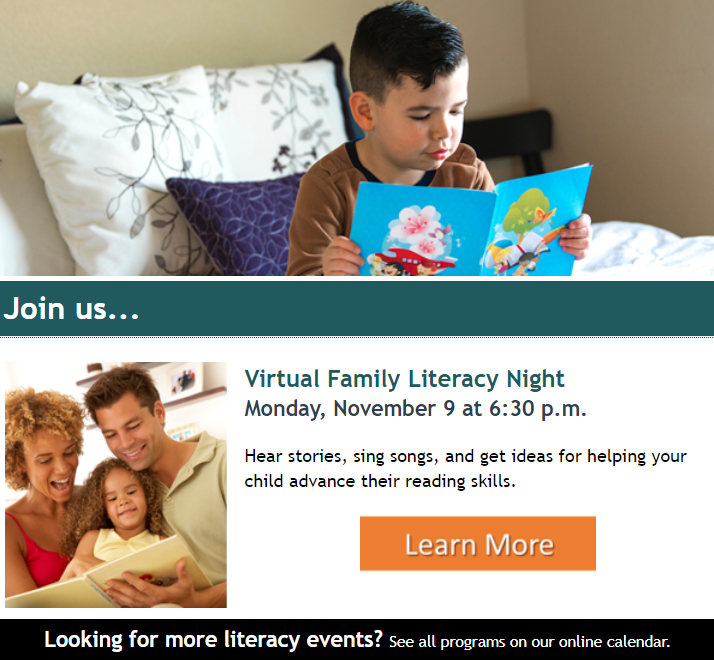
For example, let’s say you are already sending a monthly email to parents about storytime at the library. Now let’s say your library decides to offer a new program, like a virtual family literacy night, to help families whose children are not attending in-person classes during the pandemic.

Without psychographics, your email message may have looked like this:

But, thanks to your survey results, you know that many parents are worried about the effect that virtual learning is having on their child’s education. They believe their child will need extra tutoring and classroom attention to succeed in life because of the impact of virtual learning.

Now you can combine your audience’s motivations for attending with your message about the new program.

This marketing message pivoted from a simple invitation to a message that strikes at the heart of the caregiver’s concern for their child.

Psychographics activate the motivations and aspirations of your cardholders. When you get to know your community better, you’ll do a better job of getting your community to know your library!

You may also find these posts helpful

Are My Library Email Metrics Goodโ€ฆ. or Bad?! Here Are the Latest Stats to Help You Figure It Out.

The Emoji Experiment: The Pros and Cons of Adding Emojis to Your Library Marketing Email Subject Lines

Latest Book Reviews

Nothing to See Here by Kevin Wilson

Find more 60-second Book Reviews here.

Subscribe to this blog and youโ€™ll receive an email every time I post. To do that, click on the โ€œFollowโ€ button in the bottom left-hand corner of the page. Connect with me on YouTube, Twitter, Instagram, and LinkedIn.

Targeted Email Marketing for a New Era: The Pros and Cons of How Most Libraries Segment Their Audiences

Photo courtesy Public Library of Cincinnati and Hamilton County. Bond Hill Branch.

This is the first in a two-part series on email marketing for libraries. Part two is here.

If there is one thing that I know about library promotion, it’s this:

If you want to be successful in library email marketing, you must target your messages.

This isn’t just my personal belief. It is a method which worked, with impressive results, during my years at a public library. And I see it working now for hundreds of libraries around the country and around the world in my day job at NoveList.

Why are libraries hesitant to do targeted email marketing?

There are two big reasons that libraries fear the idea of segmenting their email audiences.

First, libraries are worried about email marketing in general. They feel it’s too promotional and that email messages from the library will be received as spam. They may even believe that people don’t want to receive email marketing from anyone, even a library.

This is not the case. The average consumer is accustomed to giving out their email address in exchange for marketing messages targeted specifically to them. Opt-in Monster research shows 99 percent of people with an email address check their inbox at least once a day.

Why? Because they are looking for messages from friends, family, and places they love. They love the library. Your cardholders and community members feel excitement when they receive an email from you.

Libraries worry that, by sending targeted messages to segmented audiences, they will miss out on the chance to get a message to all their cardholders. 

Many libraries are sending the same message to every cardholder, sometimes hundreds of thousands of people in one burst. It feels like the natural thing to do. “Everyone needs to know about this!”

The problem with that approach is that your cardholders are individuals. One message never fits them all.

This is particularly true if your service area covers a range of incomes and demographics. The needs and interests of your cardholders vary greatly.

By targeting your message, you are more likely to say something that matters significantly to your cardholders, which makes them more likely to take an action, which makes it more likely that your email will be successful.

Targeted email marketing for libraries is effective because it serves the right message to the right group of people. And it works for all kind of messages.

Do not let your fears about email set you up for failure. Your cardholders want to hear from you. There are not very many industries which can say that. Let’s take advantage of it and give the people what they want!

Libraries who do segment their audiences tend to use three main methods. There are benefits and drawbacks for each.

Segmenting by library card use

Some libraries group their cardholders by the type of material they most frequently check out: kids’ books, print books, e-books, etc. Then, they send targeted email messages about those formats or collection types to those specific users.

This was the method we used when I worked a public library. For example, we would send an email promoting three new e-books every month to people who appear to favor e-books.

Benefits: This method is great for collection marketing. Most libraries will notice holds and checkouts increase, sometimes exponentially, when they send messages about items to people who have shown a previous interest in those items.

Drawbacks: The way a person uses their library card may not correspond to their true library interests.

For instance, an adult who frequently checks out children’s books for their kids may also love to read e-books. By focusing solely on the fact that they more frequently check out children’s books, a library may miss a key opportunity to market e-books to that cardholder.

A second drawback is that your library will want to promote things besides your collection, like programs, big events, and advocacy messages. Segmenting audiences solely by their favorite collection format gives you no clue as to your cardholders other potential interests.

Finally, this kind of segmentation often requires sophisticated email marketing programs that are expensive and time-consuming to manage. Smaller libraries without a dedicated marketing department and libraries with limited budgets may find these programs cost prohibitive.

Letting people self-select

Many libraries have an opt-in page on their website listing email interest groups. Visitors can self-select which emails they prefer to receive.

Benefits: When a person chooses to receive an email from you about a certain subject, they are also likely to open and engage with that email. They have already indicated their interest by selecting it.

Most library email opt-in pages do not require a person to be a cardholder to sign up. So, a second benefit of this method is that you can send marketing messages to people who aren’t in your cardholder base but can be enticed to use your library. That’s a fantastic way to expand your cardholder base!

Drawbacks: A library using this method must commit to intentionally market the marketing lists. They must make sure the community knows the opt-in page exists and convince people to sign up.

Segmenting by cardholder location

Some libraries have sent messages to people who have indicated a certain branch is their home branch or to people who live in a certain portion of the community.

Benefits: This is a great method for in-person program promotion. People are more likely to attend events that are near their home. Segmenting your audience by their location is an efficient use of your time for program promotion.

Drawbacks: There is a certain set of library cardholders who are willing to travel to attend programs and events at branches far from their home. They may be interested in hearing from your library about certain types of events, no matter where they are held.

In addition, the branch a person most frequently uses may not actually be near their home! Many people frequent the library branch near their workplace or some other important and frequently visited location.

You may also find these posts helpful

Three SUPER Easy Ways to Get More Results from Your Library Email Marketing!

Are My Library Email Metrics Goodโ€ฆ. or Bad?! Here Are the Latest Stats to Help You Figure It Out.

Latest Book Reviews

The Little Book of Lykke: The Danish Search for the World’s Happiest People by Meik Wiking

The Bear by Andrew Krivak

Find more 60-second Book Reviews here.

Subscribe to this blog and youโ€™ll receive an email every time I post. To do that, click on the โ€œFollowโ€ button in the bottom left-hand corner of the page. Connect with me on YouTube, Twitter, Instagram, and LinkedIn.

A WordPress.com Website.

Up ↑