I had a completely different topic planned for todayโs Library Marketing Show.
Then Facebook dropped some news that could have a big impact on how libraries use social media: the platform is beginning to charge some libraries to include links in their posts.
If Facebook is one of your libraryโs primary ways of driving people to your website, events, programs, resources, or online services, this is something you need to understand.
In this episode, Iโm breaking down whatโs happening, what it could mean for library marketing, and why this may be a sign that we need to rethink how much of our marketing strategy depends on social media platforms we donโt control.
Photo courtesy of Cincinnati & Hamilton County Public Library
For years, conventional wisdom in library marketing has been clear: you need to be on Facebook because that’s where your community is.
But what if that’s no longer true?
The staff at Lucius Beebe Memorial Library in Wakefield, Massachusetts, asked themselves that question. And then did something many libraries would consider unthinkable.
They stopped using Facebook altogether.
Several months later, Library Director Catherine McDonald says the results have been surprisingly uneventful.
โAfter all the work that went into the decision, it didn’t have any effect other than how freeing it is to have one less thing on my plate,โ says McDonald.
โI realized I had felt a constant responsibility to protect patrons and staff from harsh words and misinformation about the library and its services. People donโt behave face-to-face as they sometimes might on Facebook.โ
A Long Time Coming
Lucius Beebe Memorial Library serves Wakefield, Massachusetts, a community of just under 30,000 residents located north of Boston. The library operates from a single historic building on Main Street.
The library wasn’t an early skeptic of Facebook. In fact, McDonald created the library’s first Facebook page around 2010.
At first, the platform helped the library connect with patrons and promote programs and events. Over time, the library expanded its social media presence and experimented with different content strategies.
Some of the library’s most successful posts featured unexpected moments, including a bunny rescue, removal of a hornet’s nest, and staff retirements.
But as the years passed, McDonald began questioning whether the effort was still worthwhile.
” First, we noticed that the number of followers who were Wakefield residents was about only a third of the list,” recalls McDonald.
ย โSocial media was becoming less social and requiring more work to understand how to game the system.โ It became complicated to understand who we were reaching with what information.โ
McDonald also saw reports on declining reading-for-pleasure rates, online bullying, misinformation, and increasingly hostile online interactions. The platform also made it difficult for the library to control its own narrative.
“On Facebook, often people type, but don’t read,” McDonald says.
Those concerns prompted a deeper internal discussion about whether Facebook still aligned with the library’s mission.
Testing the Assumptions
One of the most common arguments for maintaining a Facebook presence is that libraries need to “meet people where they are.” McDonald wasn’t convinced that statement should go unquestioned.
Rather than relying on assumptions, the library began comparing Facebook’s effectiveness against other communication channels, including its website, newsletters, blog, and local media outlets. The library also experimented with a social media pause during Summer Reading. The response?
“I received a couple of emails thanking me,” McDonald says.
The experience reinforced what library leadership was beginning to suspect: Facebook might not be as essential as many people believed.
Making the Decision
After an influx of bots appeared on the library’s Facebook page, McDonald decided it was time. With support from the assistant director, the library stopped actively using Facebook.
Not everyone was immediately convinced. Two members of the library’s board questioned the decision, and some staff initially worried the library might be giving up an important communication tool.
“Initially, some staff thought we were missing something important,” McDonald says. “But they accepted the decision and moved on to other things.”
Interestingly, she says stakeholders have been more likely to praise the decision privately than criticize it publicly.
What Happened After Leaving Facebook?
The short answer: not much.
Program attendance remained steady.
Website usage remained strong.
The library’s newsletters and blog continued to perform well.
Community engagement did not decline.
The library still maintains an Instagram presence, which McDonald says allows staff to share photos and connect with the community without many of Facebook’s drawbacks.
In fact, one unexpected benefit involved customer service. When the library was active on Facebook, patrons expected staff to monitor comments and answer questions in real time. During weather closures, for example, patrons would ask questions such as, “Are you open tomorrow?” and expect a response.
Without dedicated staff monitoring the platform, those inquiries often went unanswered. Now there is no confusion about where patrons should go for timely information.
“The expectation is that the place to learn immediate information about the library is the website or the Town website,” McDonald says.
The library also works closely with Wakefield’s communications manager to ensure important messages reach the community.
The Real Benefit
While the library didn’t experience dramatic gains after leaving Facebook, McDonald says the biggest benefit was psychological. For years, she felt responsible for moderating misinformation, managing negative comments, and protecting both patrons and staff from hostile online interactions.
That burden disappeared.
“I realized I had felt a constant responsibility to protect patrons and staff from harsh words and misinformation about the library and its services,” she says.
The experience also eliminated ongoing questions about moderation policies, comment removal, and blocking users, areas where McDonald says she often received conflicting legal advice.
Advice for Other Libraries
McDonald acknowledges that many libraries continue to find value in the platform and use it successfully.
But she does encourage library leaders to examine their assumptions.
“I’m sure lots of communities find Facebook effective and fun,” he says. “But don’t be afraid to question your assumptions or prevailing theories.”
For Lucius Beebe Memorial Library, questioning those assumptions led to a surprising discovery: Leaving Facebook changed far less than they expected.
And sometimes, that’s the most revealing result of all.
Subscribe to this blog, and youโll receive an email whenever I post. To do that, enter your email address and click on the โFollowโ button in the lower left-hand corner of the page. You can also follow me on the following social media platforms:
As if social media wasnโt already hard enough for libraries, Meta may be about to raise the difficulty level โ again.
A potential change is on the horizon that could significantly impact how libraries reach their communities on Facebook and Instagram. In this episode of The Library Marketing Show, we break down whatโs coming, why it matters, and what libraries should be thinking about now so theyโre not caught off guard later.
Plus, we have a kudos award that proves you can’t always plan for greatness!
Do you have a suggestion for a future episode’s topic? Do you want to nominate someone for kudos? Let me know here.
Library friends, we did it! We made it through 2025. We faced numerous issues and threats to libraries, yet we celebrated many triumphs. I’m proud of you. I’m proud of this community. And if no one has told you this lately, GOOD JOB YOU!
And now, we look forward to a new year and new chances to grow the connection between your library and your community.
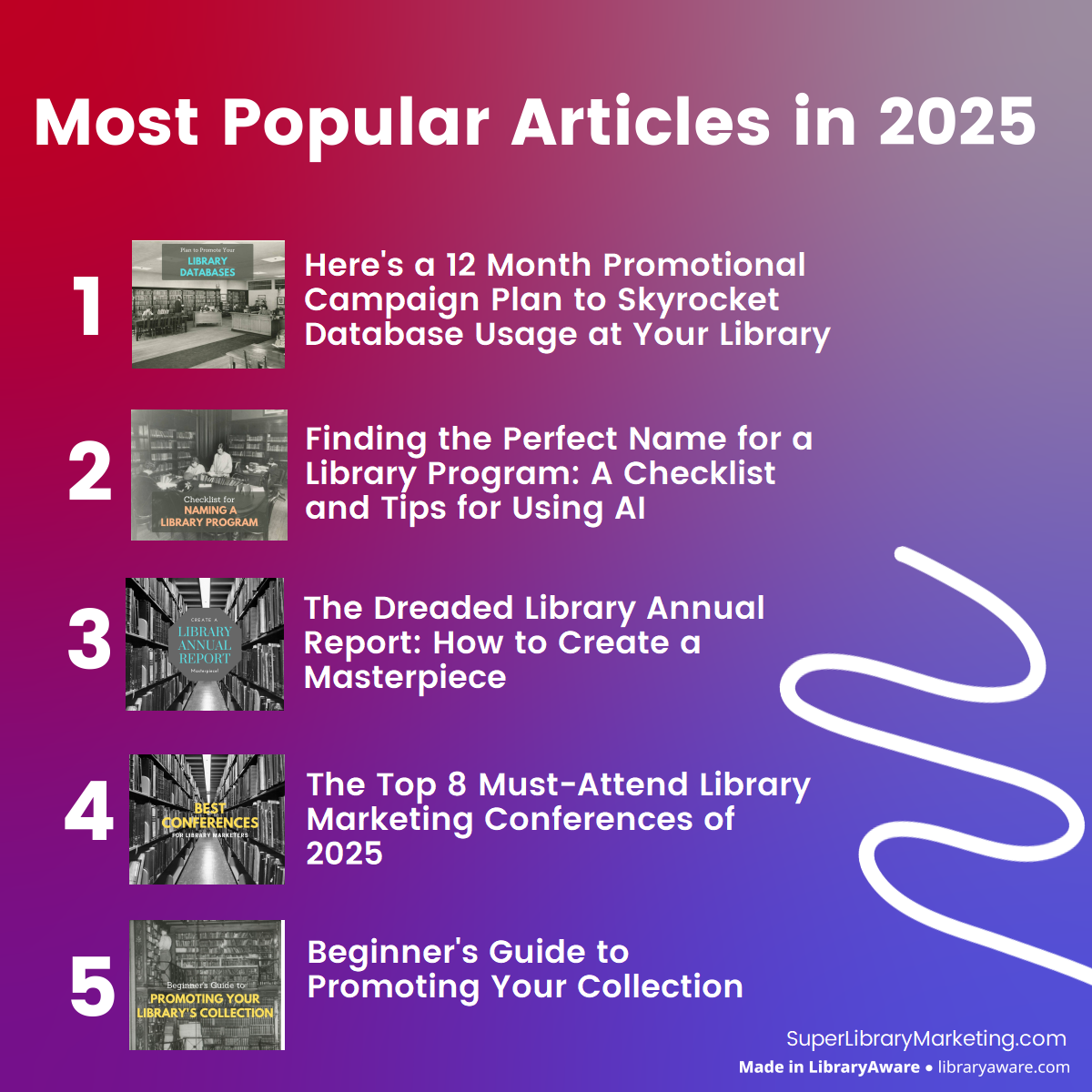
Want to make 2026 your best year yet? Let’s start by learning from the content your fellow library marketers found most helpful this year.
Most Popular Super Library Marketing Articles of 2025
I hope you are looking forward to 2026 as much as I am. My next post will be on Monday, January 5, when I’ll unveil the State of Library Marketing. I’ve got a calendar full of posts and videos featuring tips to make your work easier, as well as profiles of libraries to inspire you. Happy holidays!
Once again, Facebook remains the single most popular social media platform for libraries, but only by a fraction! According to the 2025 Super Library Marketing Survey, 95 percent of libraries use Facebook for promotions. Libraries use Instagram at nearly the same rate.
Statistically, this makes sense. Facebook is the largest social media platform in the world by number of users. And every day, about 69 percent of those users check their Facebook feed.
The average Facebook session length is approximately 10 minutes and 12 seconds.
Most Facebook users are male.
Most Facebook users in the U.S. (nearly 99 percent) use the mobile version of the platform. That statistic rose by 16 percentage points this year! So, as you create Facebook content, assume everyone who sees your libraryโs Facebook posts is doing so on a mobile device.
The largest segment of Facebook users is aged 25 to 34 years. Facebook has a reputation as a social media platform for older generations, which makes this stat somewhat surprising. However…
Facebook users aged 55 to 64 years spend the most time on Facebook, an average of 45 minutes a day. I think younger generations are looking at content, but not engaging with it. (This opinion is based on the use of Facebook by my own Gen Z daughters.)
How much success can libraries expect to see on Facebook?
Facebook has, by far, the lowest engagement rate of any of the social media platforms we’ve covered in the series. In fact, these rates are shockingly low.
I want you to look at this list of engagement statistics from Demandsage and really consider whether your time is well-spent when you post on Facebook.
Facebook Reels have an average fan engagement rate of 0.26 percent.
Images or photos get an average engagement rate of 0.24 percent.
A plain status update with text, no video, or no photo gets an average engagement rate of 0.12 percent.
And posts that include a link get an average engagement rate of 0.06 percent. OUCH.
Why is the engagement so low? Among the reasons is the motivation of the users: Nearly 75 percent of Facebook users say they use the platform primarily to message their friends and family.
The Facebook Algorithm for 2026
Here are the ranking signals Facebook uses to decide who sees your posts, according to Followeran. These are quite different from other platforms.
Facebook AI: As much as half of a user’s feed now features โrecommendedโ content from creators or Pages they donโt follow, chosen by Facebookโs AI based on their interests and engagement behavior.
Deep conversations: The algorithm heavily favors content that sparks exchanges between users. It also looks to boost posts with longer, more considered reactions. Simple likes and short comments no longer drive reach.
Time spent: The algorithm will show your content to more people if the post requires users to spend time reading comments, scrolling through a carousel, or finishing a video. Longer sessions boost its distribution.
Video: Facebook still prioritizes short-form video formats (Reels, Facebook Live, Stories), followed by carousels and native videos. Posting consistently also helps, as newer content tends to perform better.
Original content: Reposts, duplicate content, or AI-generated content will be penalized with suppressed reach.
Here are 4 ways to get the best organic reach for your libraryโs Facebook account in 2026
#1: Optimize for AI recommendations.
Half of all Facebook feed content now contains posts from pages that the user does not follow. Those recommendations are sourced by Facebook’s AI. The good news is that your library can reach new audiences without paid ads if you play by the algorithm’s rules.
Make sure you create original posts with strong potential for engagement. For example, ask your audience a question. You can also put book covers in a carousel of photos and encourage people to swipe through to the end.
Avoid duplicating or reposting content from other people or organizations. That’s a bummer, because many libraries repost their partner organizations’ content or content from publishers to save time. It’s okay to share that content on your Stories. But for your feed and Reels, make sure your posts are original works from your library account.
#2: Design your posts to maximize dwell time
I know many libraries post a graphic of their event calendar or a graphic promoting an upcoming program to Facebook. And if you’ve been wondering why those posts aren’t getting engagement, this is why. Facebook wants to keep people on the platform as long as possible. And those posts don’t help them achieve that goal.
Every time you post to Facebook, ask yourself, “How can I keep my users engaged longer?” You’ll want to use formats that encourage people to scroll, read, or watch to the end.
What do you do about promoting your programs? Share the graphic and program details on Stories or make a Reel about the program.
To share your calendar and get better results, ask people to sign up for a monthly email to receive a downloadable version. That’s a win for your library’s Facebook account and for your patrons, who will have a copy they can refer to all month long.
#3: Work on building early momentum for posts.
Posts that gain traction in the first 24 to 48 hours are rewarded by the Facebook algorithm. Look at your insights and post when your audience is most active. If your post starts to get comments, make sure you reply as quickly as possible (within 24 hours) to keep engagement flowing.
You can also try to drive traffic to your Facebook feed from your monthly email newsletter. Here’s how:
Post something fun and engaging on the day before your newsletter goes out. This “something” should be a piece of content that is NOT in your email newsletter. For example, you can post a carousel of photos of new books that just arrived at your library. Ask people to vote in the comments for the book they’re most excited to read.
In your email newsletter, write a tease that suggests people will be missing something if they don’t head over to your Facebook page to check out the post! For the example above, you could say, “Want to see which new arrival everyone is excited to read? Head to our Facebook page to cast your vote before the big reveal!”
Wait 1-2 days after your email newsletter goes out to post anything new on your Facebook page so your email users can find your teaser content easily. Or, if you must post more content, pin the teaser post to your profile for 1-2 days.
#4: Lean on authenticity and hyperlocality.
Meta rewards pages that post content that is clearly not generated by AI. This is where libraries can shine! Share patron stories, staff picks, book recommendations, and other highlights that show your library is a vital part of your community. Be sure to use your town or city’s name in the post and write the copy to show that your library is integrated into the community.
When to post on Facebook
Hootsuite says the best time to post is early morning,ย between 5 a.m. and 8 a.m., local time.
How often should you post to Facebook?
Post to the Facebook Feed 3-5 times each week.
Post at least one slide to Facebook Stories every day.
Every year, Meta releases its Holiday Playbook. It’s full of strategies designed to boost engagement and sales. And while weโre not selling anything at our libraries, many of these ideas translate really well to the work we are doing!
In this episode of The Library Marketing Show, I pulled out five practical tips from the playbook that you can start using right away on Facebook and Instagram.
Plus, discover how one library’s short-form video garnered over one million views!
Do you have a suggestion for a future episode’s topic? Do you want to nominate someone for kudos? Let me know here.
A viewer wants to know if it’s worth it to make a Facebook Event for every program that the library puts on, or if that strategy is just kind of spammy, busy work. In other words, do Facebook events really drive attendance to library programs?
You might be surprised by the answer! I’ll share that and a checklist to help you decide if you should use a Facebook Event in this episode of The Library Marketing Show.
Do you have a suggestion for a future episode’s topic? Do you want to nominate someone for kudos? Let me know here.
Subscribe to this blog, and youโll receive an email whenever I post. To do that, enter your email address. Then, click the โFollowโ button in the lower left-hand corner of the page. You can also follow me on the following social media platforms:
Here’s some big news: Facebook is cracking down on unoriginal content on its platform. This update will have a significant impact on your engagement and strategy.
In this episode of The Library Marketing Show, we’ll go through the warning from Facebook and discuss how your library should respond to it.
Plus, we’ll share kudos for a library that is posting some incredibly moving patron testimonial videos.
Do you have a suggestion for a future episode’s topic? Do you want to nominate someone for kudos? Let me knowย here.
Subscribe to this blog, and youโll receive an email whenever I post. To do that, enter your email address. Then, click the โFollowโ button in the lower left-hand corner of the page. You can also follow me on the following social media platforms:
Did you know that there’s a trick you can use to increase the number of followers on Facebook and LinkedIn for your library’s page? It’s pretty easy. And it only takes about 10 minutes once a year!
I’m going to show you how to do it in this episode of The Library Marketing Show. Plus, I’ll give kudos to a library for a simple but impactful book display idea.
Do you have a suggestion for a future episode’s topic? Do you want to nominate someone for kudos? Let me know here. Thanks for watching!โ
Subscribe to this blog, and youโll receive an email whenever I post. To do that, enter your email address. Then, click the โFollowโ button in the lower left-hand corner of the page. You can also follow me on the following social media platforms: