Subscribe to this blog and you’ll receive an email whenever I post. To do that, enter your email address and click on the “Follow” button in the lower left-hand corner of the page. You can also follow me on the following social media platforms:
One of my viewers is struggling with consistent messaging. They are wondering how to promote something across multiple channels without rewriting the text every single time!
This is a great question. And there’s a little trick you can use to save time and effort. I’ll share it with you in this episode.
Plus kudos go to a library for press coverage they received for their new RFID checkout stands. I’ll explain.
Do you have a suggestion for a topic for a future episode? Want to nominate someone for kudos? Let me know here. And thanks for watching!
Special note for viewers: The next episode of The Library Marketing Show will be released on Wednesday, June 5.
Subscribe to this blog and you’ll receive an email whenever I post. To do that, enter your email address and click on the “Follow” button in the lower left-hand corner of the page. You can also follow me on the following social media platforms:
Photo courtesy Cincinnati and Hamilton County Public Library
One of the hardest tasks in library marketing is naming programs and events.
The name of a program can significantly impact attendance. The name must capture attention. It needs to be clear and memorable. And it needs to be discoverable for community members searching online.
In this post, I’ve created a checklist. Under each point on the checklist, I’ll give you an example of how to use AI tools like ChatGPT, CoPilot, Perplexity, and Gemini to check that your library program name meets the criteria.
If you’ve already come up with a name, you can check your choice against each of these considerations. If you’re beginning from nothing and have no clue what to name your program, use this checklist to find the best name and drive lots of attendance!
Checklist for Naming Your Library Program
✔️Relevance
The name of your library program should accurately reflect the program’s or event’s content and purpose. It should give attendees a clear idea of what to expect.
Example
I asked Google’s Gemini: “I am putting together an early literacy library program. In this program, babies and caregivers can read books together, but the babies are encouraged to move around during the reading time. I want to name the program “Young and Restless”. Is that a relevant program name?”
Gemini’s answer
“Young and Restless” might not be the best fit for an early literacy program.
“Young and Restless” is the title of a soap opera, and the connotation leans more towards drama and adult themes. It doesn’t immediately convey the idea of early literacy. While “restless” could be seen as a playful reference to a baby’s energy, it might also suggest a negative connotation of being unable to focus.
Here are some alternative program names that better capture the essence of your program:
“Wiggle While We Read”
“Rhyme Time & Playtime”
“Storytime on the Move”
“Littlest Learners & Lively Laps”
“Bookworms in Motion”
✔️Appeal
The name must attract your target audience. Consider that people often scroll online and when they read print. Your library program name must stand out from other programs or events in your community.
Example
I asked Perplexity: “I am putting together a library program where crocheters of all skill levels can come to work on their projects, give help to others, and get help building their skills. I want to call it Hooked on Crochet. Does that program name have enough appeal to capture attention?”
Perplexity’s answer
The name “Hooked on Crochet” for your library program has several appealing qualities that could help capture attention:
Pros:
The name plays on the double meaning of the word “hooked,” referring both to the crochet hook used in the craft and the idea of being enthusiastically engaged or “hooked” on crocheting.
The alliteration and rhyming nature of the name make it catchy and easy to remember, which is essential for a program name to stand out.
By not specifying skill levels in the name, it implies that the program is open to crocheters of all abilities, from beginners to experts.
The word “hooked” has a positive connotation, suggesting a passionate interest or enjoyment in crocheting, which could resonate with enthusiasts of the craft.
Potential Cons
While wordplay can be effective, some may find the “hooked” pun a bit overused or clichéd in the context of crocheting.
The name may be too specific to crochet and could potentially exclude other fiber arts or crafts that you might want to incorporate in the future.
✔️Clarity
The name should be easy to understand and remember. You’ll want to avoid complex, obscure, or cutesy names that might confuse people.
Example
I asked ChatGPT: “I am organizing a library program where people can bring a plant to swap and learn about composting, and sustainable gardening. There will also be crafts and games. This program is for all ages. Can you help me come up with a name that clearly states what will happen at my program?”
ChatGPT’s answer
That sounds like a fantastic and engaging program! For a name that captures the essence of your event while being concise and appealing, consider the following options:
“Sustainable Garden Swap & Fun Day”
“Green Thumb Plant Swap and Activities”
“Eco-Friendly Garden Day”
“Plant Swap and Garden Fun”
“Sustainable Gardening Fair”
✔️Length
The name should be short and concise. Long names can be difficult to remember and may be difficult to fit on your marketing materials.
Example
I asked ChatGPT: “I am putting together a library program at an academic library. The program will be interactive and will help students to better understand the databases and research resources available to them at the library. I want to call the program Interactive Workshop on the Integration of Research and Retrieval Skills, but my manager thinks that name is too long. Is it too long?”
ChatGPT’s answer
Yes, “Interactive Workshop on the Integration of Research and Retrieval Skills” is quite long for a program name. It might be better to shorten it to make it more concise and easier for students to remember. Here are a few shorter alternatives:
“Research Skills Workshop”
“Interactive Research and Retrieval Workshop”
“Library Research Skills Workshop”
“Research Resources Workshop”
“Effective Research Techniques Workshop”
✔️Accessibility
The name of your library program must not exclude any potential participants.
Example
I came up with a name for a technology program called “Advanced Technological Workshop for Digital Natives.” I asked ChatGPT to evaluate the accessibility of the name.
ChatGPT’s answer
“Advanced Technological Workshop for Digital Natives.” is an inaccessible library program name for several reasons.
Community members might interpret the term “Digital Natives” to mean only younger people who they assume are highly proficient with technology. This excludes older adults or those without regular access to technology. It’s also a very obscure term. Did these people live in the digital world??
The term “Advanced” might also deter people who do not consider themselves advanced in technology from attending, even if they are interested in learning more about it!
And the whole tone of the name is very formal, academic, and intimidating.
✔️Searchability
Many of your community members are looking for help online. You want your program name to come up in search! So be sure to include keywords that people might use in search.
Example
I asked Copilot: “I have a library program named “Opera Appreciation.” Are there any keywords or phrases that I need to add to the program name or description to make this more discoverable in search?”
Copilot’s answer
Certainly! To make your “Opera Appreciation” program more discoverable, consider incorporating relevant keywords and phrases in the program name or description. Here are some suggestions:
Opera: This will directly associate your program with the art form.
Music Appreciation: This can help convey the educational aspect and attract those interested in learning about this genre.
Classical Music: Opera is a subset of classical music, so including “classical music” in your program’s description can broaden its reach.
Arias: Highlight that your program explores opera arias—the beautiful solo pieces performed by singers. Mentioning “arias” can attract opera enthusiasts.
Composer Names: Incorporate the names of renowned opera composers.
Subscribe to this blog and you’ll receive an email whenever I post. To do that, enter your email address and click on the “Follow” button in the lower left-hand corner of the page. You can also follow me on the following social media platforms:
There’s some exciting new advice on how to create engagement on your library’s Facebook page. The 8 new tips are in this episode of the Library Marketing Show.
Plus kudos goes to an academic librarian who recently received a huge award!
Do you have a suggestion for a topic for a future episode? Want to nominate someone for kudos? Let me know here. And thanks for watching!
Subscribe to this blog and you’ll receive an email whenever I post. To do that, enter your email address and click on the “Follow” button in the lower left-hand corner of the page. You can also follow me on the following social media platforms:
“My office is where the Children’s Department used to be,” recalls Ann. “When I started working here 18 years ago, some of the librarians from my childhood still worked here, and I remember feeling excited to meet them on my first day, almost as if I were meeting celebrities.”
“I consider myself very lucky that I have been able to work in a library. It’s not hard to market a product you love.”
Ann is the library’s Marketing and Public Relations Manager. Her team includes a full-time graphic designer, a part-time writer, and an assistant. Her library has one location, which has a distinct benefit, according to Ann.
“It’s very easy to get information and collaborate with co-workers,” she notes. “I work closely with our director, and fortunately, our library did a strategic plan two years ago. It was quite a process, but it has made my job easier in that there is a clear path forward with our marketing efforts.”
Ann is a rare library marketer in that she and her team have been tracking metrics on her library promotions for nearly two decades!
“The metrics we gather have evolved over time with the advancements in technology,” explains Ann. “We are now able to gather more information about the tools we use to achieve our marketing goals. And the dashboards on targeted emailing, social media performance, and Google Analytics are very telling.”
That data not only informs the promotions that Ann and her colleagues create, but it also helps stakeholders to understand the value and impact of their library marketing.
“We share these reports with the Board of Trustees monthly to inform them about our work and how we make data-driven decisions,” says Ann. “This helps them better understand our department’s operations.”
“I used these reports to justify my department’s size and marketing efforts. Our reports also include the number of printed brochures, rack cards, bookmarks, and more we produce. I used this information to advocate for adding an electric trimmer, folder, banner printer, and our department’s industrial copier. I was able to justify these purchases when I compared them to outside costs and estimated saved staff time.”
Her team uses many tools to create reports and analyze monthly metrics, including their email dashboard, social media scheduling platform, and website analytics dashboard. The whole process takes about 8 hours from start to finish.
“You might think that sounds like a lot, but this is time and effort that’s well spent,” states Ann. “We analyze the results and plan our path forward with this information. We can see what’s working and just as importantly, what’s not. We can quickly adjust to make our time more productive and impactful.”
“Every time your leadership team reads these, you are documenting the value of what you are doing. Their importance cannot be overstated.”
Those metrics come in handy as Ann plans marketing for the rest of the year. Her library recently purchased a bookmobile and is creating a new Outreach department.
“Our department is responsible for creating the bookmobile wrap, which is fun!” exclaims Ann. “We are in the process of a massive parking lot reconfiguration and addition. And we are also doing a tear out and reconfiguration of our circulation department.”
“Keeping our customers informed and up to date with these changes has been our first priority. And it’s our 100th anniversary this year. We have our work cut out for us!”
For inspiration, Ann just keeps her eyes open all the time.
“I’m always looking for great design and marketing,” says Ann. “It’s all around us! And there’s some bad stuff too. The trick is how to incorporate the good in your library efforts.”
Subscribe to this blog and you’ll receive an email whenever I post. To do that, enter your email address and click on the “Follow” button in the lower left-hand corner of the page. You can also follow me on the following social media platforms:
I’m sure you’ve heard by now that U.S. President Joe Biden has signed a bill banning TikTok in the United States. What would that mean for your library marketing?
Now that the dust has settled a bit on the coverage of the ban, and speculation from experts, we’ll dive into it in this episode of The Library Marketing Show.
Plus kudos goes to a library that received a Peabody Award nomination for their short-form video content!
Do you have a suggestion for a topic for a future episode? Want to nominate someone for kudos? Let me know here. And thanks for watching!
Subscribe to this blog and you’ll receive an email whenever I post. To do that, enter your email address and click on the “Follow” button in the lower left-hand corner of the page. You can also follow me on the following social media platforms:
Photo courtesy Cincinnati and Hamilton County Public Library
Last week, we discussed the pros and cons ofemail marketing automation. If your library chooses a program that requires a more hands-on approach to email marketing, this post is for you. These time-saving tips will let you create high-quality emails that resonate with your audience without spending all day on your emails. (Although, how fun would that be?!)
Time-saving Tip #1: Use templates.
This is the most effective way to save time when creating library marketing emails. If your email program doesn’t offer templates and you must make them yourself, here’s how to do it.
Decide on your buckets.
What kind of emails does your library need to send? Look at your library’s overall strategic goals and your marketing goals. Then, break your emails down into categories, like this:
Promote programs
Promote the collection
Promote services that bring people into our physical branches
Announcements like holiday closures, new services, renovations, service outages, etc.
Email to donors and legislators
Create one template for each category.
The ideal template will have sections with space for text, an image, and a call to action button. Here’s a great example of a library marketing email from Eisenhower Public Library made from a template.
Populate and send.
When it comes time to send the email, make a copy of your template. Insert the copy, images, and appropriate call to action, and hit send!
Time-saving Tip #2: Keep your emails short.
Emails that include no more than 4 topics perform best. If you have more to say, you can always send another email!
Keep the text in your email to a minimum. Think of your text as a tease. You want to write 1-3 enticing lines that compel your recipient to do something, like register for a program or put a book on hold.
Time-saving Tip #3: Target your messages to specific audiences.
It takes time to write copy that’s generic enough to appeal to everyone in your community. By comparison, it’s easier and faster to write text and find images when you know exactly what your audience is looking for in your library emails.
And, by targeting your message, you are more likely to say something that matters significantly to your cardholders, which makes them more likely to act, which makes your email more successful!
Targeted email marketing for libraries is effective because it serves the right message to the right group of people. And it works for all kinds of messages.
Also, your library should make your emails opt-in. This ensures your emails are going to community members who want your content.
Time-saving Tip #4: Let the robots help you with your subject line.
You should never rely on Artificial Intelligence tools like ChatGPT to do all the work for you when it comes to library email marketing. But they are a great starting point! Instead of staring at the wall trying to brainstorm ideas for the best subject line, ask the AI to get you started.
To show you, I ran this example using Microsoft’s Copilot.
Once you have a place to start, you can tweak the subject line to match the tone of your library. Move, change, or remove the suggested emoji. And then, run the subject line through one of the free analyzers below. Each has its own algorithm for predicting the success of a subject line. But all will help you get to a subject line that works for your target audience.
Time-saving Tip #5: Plan as much as humanly possible.
Plan your email campaigns in advance using an editorial calendar. This helps you stay organized and maintain consistency.
And, if you know ahead of time when you are sending emails, you can set aside time in advance to create them and get them approved. Have a few spare minutes at the beginning or end of your shift? Work on emails coming up in the next few months!
Time-saving Tip #6: Reuse and repurpose.
You don’t have to reinvent the wheel every time you create an email. If you wrote a social media post or a blog that did really well, steal the text you’ve already written and insert it into your email. Use the same image or graphics, sized correctly for your email of course, and hit send!
Time-saving Tip #7: Watch your metrics.
If you take an hour each month to analyze the performance of your library emails, you’ll soon start to get a clear picture of what works for your audiences. That will make you more efficient as you create your emails. You won’t waste time creating emails that your recipients won’t read.
Subscribe to this blog and you’ll receive an email whenever I post. To do that, enter your email address and click on the “Follow” button in the lower left-hand corner of the page. You can also follow me on the following social media platforms:
You may wonder, is it possible to over-communicate with my patrons?
Can you send too many emails, do too many social media posts, and put up too many posters and flyers in your library?
There are some telltale signs that you’re overdoing it! I have four tips to help you determine if you are flooding your community with too many messages in this Library Marketing Show episode.
Plus kudos go to a library that received press coverage for the return of a long overdue book with a funny note inside!
Do you have a suggestion for a topic for a future episode? Want to nominate someone for kudos? Let me know here. And thanks for watching!
Subscribe to this blog and you’ll receive an email whenever I post. To do that, enter your email address and click on the “Follow” button in the lower left-hand corner of the page. You can also follow me on the following social media platforms:
Photo courtesy Cincinnati and Hamilton County Public Library
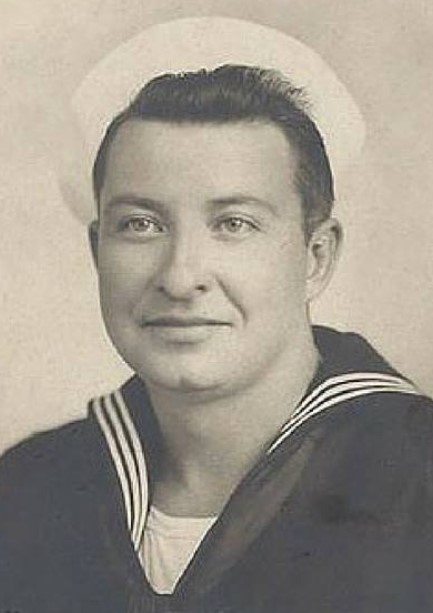
My maternal grandfather was small (he stood about 5 feet 3 inches tall) but mighty.
He returned from World War Two to a wife and four children. He made ends meet by farming, driving a milk delivery truck, and working on a road construction crew. He taught me to build fences, crack walnuts with a vise, and drive a tractor and a car.
My grandfather
When he died in 2016, I decided I wanted a bouquet of flowers at the funeral as a symbol of all that he meant to me. I ordered an arrangement online.
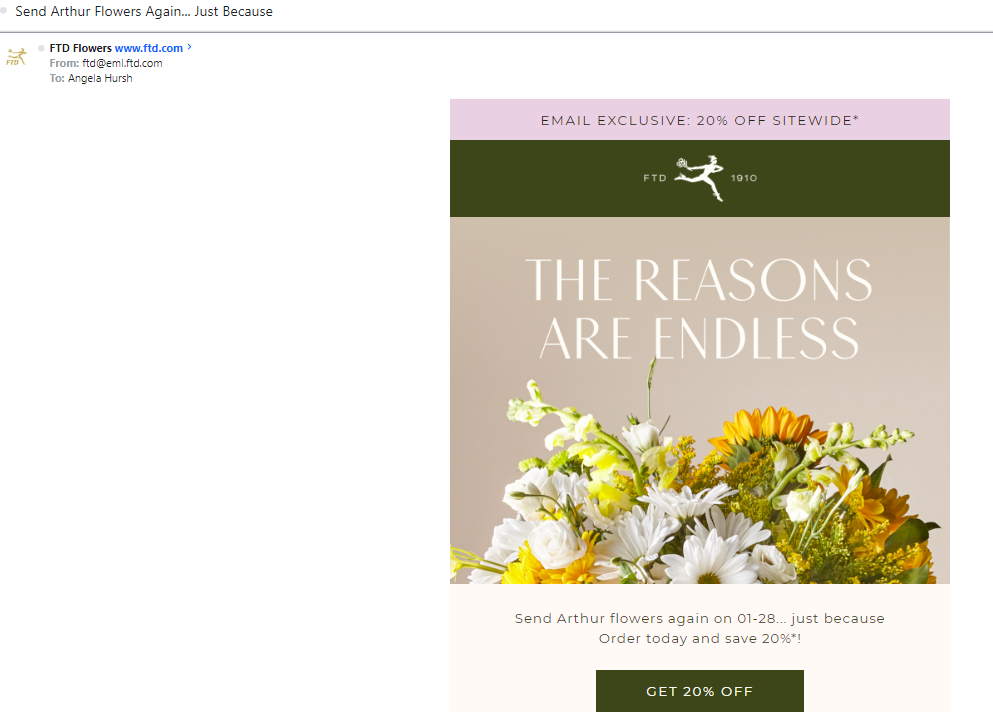
Imagine my surprise when a few months ago, I received this email.
I admit, at first, I was shocked and baffled. But I work in marketing, so I understand this email was created using automation. And then, this email made me think about the pros and cons of automation for library email marketing.
The advantages of email automation
Automated email has one big advantage for library staff: It saves time.
Automated onboarding emails, reading suggestions, and program announcements will free up your time for other work. You can create a campaign, set it, and forget it.
Experts also say that open and click rates are higher for automated emails because they are more relevant to the recipient.
The disadvantage of email automation
There is one big problem with automated emails, in my opinion. The personalization isn’t personal. It’s inauthentic. And there’s a chance it can go very, very wrong.
The email from the flower company is a perfect example. It has negatively impacted my feelings toward the flower company. If they really cared about me, and not just my business, they would have looked to see that I’d sent flowers to a funeral home. And they wouldn’t have tried to sell me another bouquet to send to my dead grandfather.
Here’s how this snafu relates to library marketing: Most automated email programs created for libraries automatically segment your audience into groups based on factors like previous card use. Those programs use algorithms that look at past card usage or reading history to predict future behavior.
But, as happened with the flower company, those algorithms are not always correct. They don’t allow for changing tastes or lived experiences. And they won’t expand a cardholder’s use of the library by introducing them to new services.
The bottom line is that past library card usage does not always predict future library card use.
For example, in the last year, my library card use has changed drastically. I’ve switched from mainly print fiction books to audiobooks. I’m now a heavy user of downloadable magazines. I’ve also recently discovered the joy of using my library card to read newspapers online (goodbye paywall!). And I’ve used my library’s Makerspace several times this year.
My life and my habits have changed. But, my home library, which uses automated email, has not sent me any emails that show they’ve noticed my changing habits. They send emails based on my pre-pandemic use of the library.
What do libraries do best? Personalized service!
Libraries don’t focus on transactions. We don’t rush our visitors. We listen and work until we get them the answer or the service that best solves their problem.
This is particularly true when it comes to book recommendations.
A reader’s interests are never set for life. And the things that are interesting about a book—the tone, pace, setting, and characters, cannot be managed by an algorithm. Reading suggestions and collection marketing can’t be replicated by robots.
So, as library marketers, we must be cautious to balance our need to save time, with the need to create a connection with our readers. And that means, if you use automated email marketing, you must always be evaluating the emails your library sends.
Ask yourself: Is this email serving my recipient with the content they want and need?
Two more potential pitfalls of automated email marketing
Irrelevant automated emails may be marked as spam by your recipients, hurting your sender reputation. Read more about how that can impact whether your email gets delivered to your recipients here.
Many programs that offer automated emails don’t allow you to add design elements that are specific to libraries. And that can be detrimental to your library’s brand. You want your community to recognize the promotional materials you make, including emails.
The advantages of manual email marketing
Good patron experience means that you encourage your email recipients to choose the content they want to receive from the library.
Your library should make your emails opt-in. This ensures your emails go to community members who want your content, which protects your sender reputation.
The opt-in model allows you to add the content to your emails your audiences have indicated they are interested in, giving your recipients control over what they receive. It also allows for flexibility to account for changing use and taste.
Finally, opt-in emails allow you to send when it’s best for your users, not for your library. All email programs offer scheduling. When you schedule your own emails, you can look at reports to see when your target audience responds best to your emails. You can adjust accordingly.
The disadvantage of manual email marketing
Time is the number one disadvantage of programs that require you to create emails manually. It takes precious time to write copy, choose images, and schedule your emails.
So, next week on Super Library Marketing: Time-saving techniques for creating library marketing emails. These tips will work whether your library chooses automated or manual email marketing!
Subscribe to this blog and you’ll receive an email whenever I post. To do that, enter your email address and click on the “Follow” button in the lower left-hand corner of the page. You can also follow me on the following social media platforms:


 Super Library Marketing: Practical Tips and Ideas for Library Promotion