In this episode, I’ll answer a question from Jennifer from Lexington County Public Libraries. She writes, “Keeping in mind fair use guidelines, would it be better to post our virtual pre-recorded story times to our Facebook story rather than to our timeline. My understanding is that stories only appear for 24 hours and can be tailored somehow to only reach certain audiences. Do you have any suggestions?”
Kudos in this episode go to Pottsboro Area Library for hosting telehealth appointments at their library.
Do you have a suggestion for a topic for a future episode? Want to nominate someone for kudos? Let me know in the comments. And subscribe to this series to get a new video tip for libraries each week.
I learned a skill as a journalist which has been invaluable to me as a marketer.
As a journalist, I was an expert at knowing when to let go of a piece of content and send it out into space, even though it was imperfect.
It’s the nature of the news business. You have a deadline and when the deadline arrives, you go to air or to print with as much information as you have. You know that you can revisit the story later to add new details. And that must be enough.
One of the hardest adjustments I had to make when I left the newsroom and went to the library was the constant reshaping of promotional messages and campaigns.
The good and bad of the revision process
When I worked in a library, each blog post, print piece, email, social media post, or video would go through rounds of review by several departments. The record was held by our content marketing magazine, which sometimes went through upwards of 15 edits per issue.
All the scrutiny had its advantages. More edits meant grammatical, punctuation, and spelling errors were found and fixed. The revision process also gave me the chance to see how each message was perceived by different people with different perspectives.
I purposefully chose reviewers who worked with different target cardholder audiences. They told me whether they thought their patron base would respond to the message. I trusted their opinions and took their advice when they told me a phrasing or image change would increase my message’s effectiveness.
But there were also pitfalls to revision process. The message was sometimes reshaped by people who pressured me to add words or phrases that weren’t customer friendly. They might also wish to dilute or change the message altogether, depending on their department’s own goals or agenda.
The point at which your library’s revision process goes from helpful to over-examined is the space I want to focus on in this post.
It’s very easy to start over-thinking text, images, and graphics. The message you’ve carefully crafted may not connect with your audience because it disappears in the search for perfection. It can be crippling.
There is a very thin line between authenticity and perfection. It takes practice to walk that line. Here’s the advice I have for you.
Constant improvement is better than perfection
The best content isn’t perfect. That is what makes it good.
Imperfection shows your library’s human side. When you write from the heart, your message feels more authentic.
Don’t sabotage your own marketing efforts by waiting for the moment when every single detail is right. Give yourself permission to release a piece of marketing content when the time is right, not when it’s perfect.
Creative, honest messaging will be the doorway for your library to connect with consumers in the moment when they are genuinely searching for answers from your library.
I’m a fan of author, speaker, and showrunner Jay Acunzo. I highly recommend his newsletter. His niche is creativity. He inspires others by talking about how creativity intersects with work in the real world.
In this blog post, Jay makes a great point that I think about all the time. He says, “How can we aspire to perfection (even if it’s never something we reach) while still moving forward without delay (even if we aren’t creating amazing work yet)? Well, I think the key is to place perfection where it belongs: away in the distance. Then, we can busy ourselves with marching towards it.”
In the library, that means we must do the work and ship it when it needs to be shipped. But we also must commit to revising it, molding it, and realizing that it is a work in progress.
In your library promotional work, your goal must not be perfection. It must be constant improvement.
But I have a deadline!
You work in a real library with real goals and strategies. And the quest for perfection will sometimes seem like a lofty goal that you don’t have the luxury of achieving.
So how do you know when a piece of content is ready for release, even if it’s not perfect? Ask yourself these three questions.
1. Is your promotion as compelling and authentic as it can be in this moment?
2. Is your promotional piece free of grammatical, punctuation, and spelling errors?
3. Is the information in your promotional piece correct?
If the answer is yet to these three questions, it’s time to let go.
Marketing is one giant experiment. Even when you release a promotion that isn’t perfect, you will still learn plenty from it. Measure and record the results of your promotion. Then use that data to adjust and reconfigure your attempts on the next go-around.
Don’t get bogged down in the quest for perfection. Be human. Be authentic. Be true to your library voice.
And get the message out there! Your imperfect message may lead to some perfect insight into your community.
Do you have an example of a time when an imperfect message brought you some perfect insight into your customers? Share your thoughts in the comments!
Subscribe to this blog and you’ll receive an email every time I post. To do that, click on the “Follow” button in the bottom left-hand corner of the page. Connect with me on YouTube, Twitter, Instagram, Goodreads, and LinkedIn.
In this episode, I’ll share some ideas for promoting the work of your library during National Library Week (April 4-10). These are suggestions you can use even though we’re in the middle of a pandemic.
Kudos in this episode go to the Jackson County Library System for their new animated series, “Lost in a Book.”
Do you have a suggestion for a topic for a future episode? Want to nominate someone for kudos? Let me know in the comments. And subscribe to this series to get a new video tip for libraries each week.
In this episode, I’ll answer a question from Jennifer of the Park Ridge Public Library. She asked, “What advice would you give to a library needing to reboot the way they use YouTube? We have a YouTube account but only used it sporadically in the past. How can we effectively use it to promote programs, host book talks, share big library news?”
Kudos in this episode go to the Sierra Madre Public Library for their amazing work on TikTok!
Do you have a suggestion for a topic for a future episode? Want to nominate someone for kudos? Let me know in the comments. And subscribe to this series to get a new video tip for libraries each week. Thanks for watching!
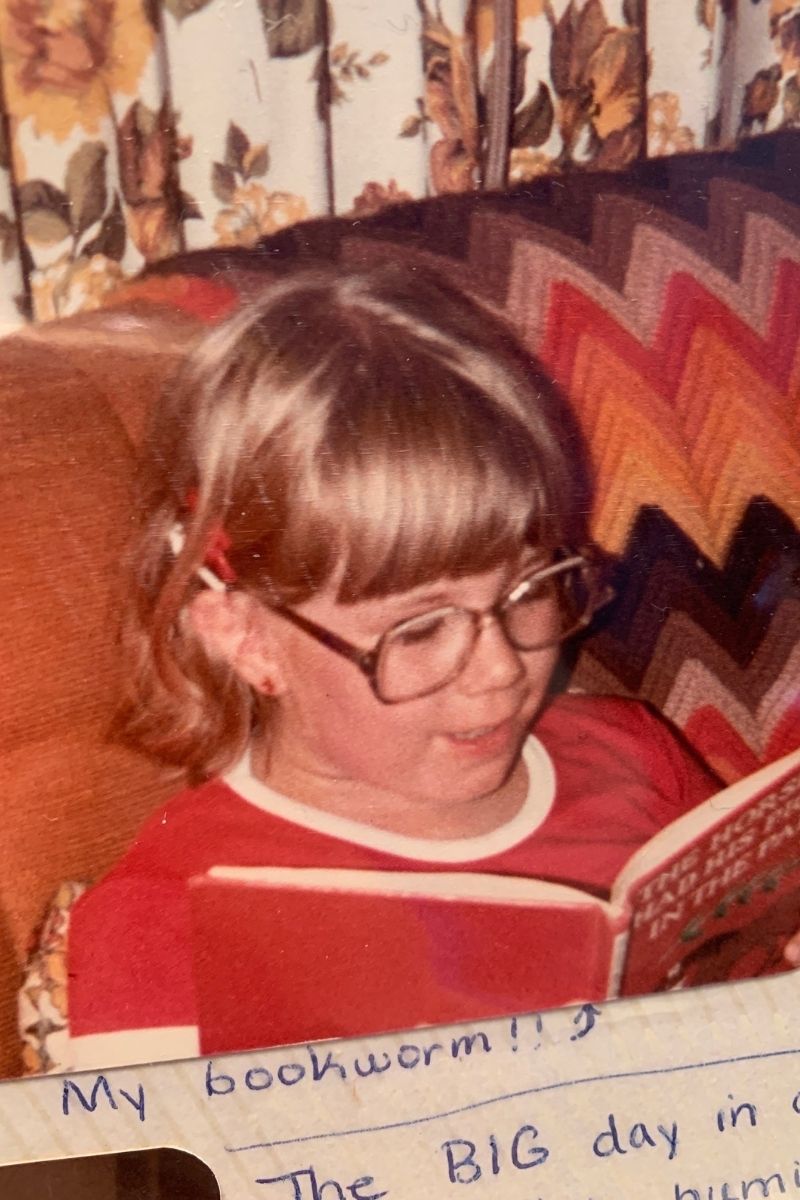
I was recently looking through some old photo albums when I came across this gem.
You can see my mother wrote the words “My bookworm” under this photo of me, age 7, reading “The Horse That Had His Picture in the Paper” by Helen Stone. I have always loved fiction.
Of all the people in the world, I am certain I really don’t have to explain to my readers why fiction is amazing. You work in a building stuffed with fiction!
But, if I were to ask you what you’ve read lately that will help improve your work skills, my guess is that you would not name a work of fiction.
Of course, your work will be improved by reading a great business or career-oriented book. I can think of a few inspiring examples, like Ann Handley’s Content Rules, which literally changed my life, or Unmarketing by Scott Stratten. You can get a chance to read books like these and talk about them with other library staffers if you join the Library Marketing Book Club on Facebook. There is a lot of value in reading advice on marketing.
But reading fiction will also make you a better marketer. Here are the six reasons why reading fiction will improve your ability to promote your library.
Fiction is good for your brain. A study by researchers at Emory University, published in the journal BrainConnect, found that reading a novel can increase connectivity in the brain and improve brain function. Lead researcher Gregory Berns concluded, “At a minimum, we can say that reading stories—especially those with strong narrative arcs—reconfigures brain networks for at least a few days. It shows how stories can stay with us.”
Storytelling requires the work of different areas of your brain in order to help you understand the dialogue, plot, and characters. A work of fiction will train your brain will do a better job of processing complex problems in your library work.
Fiction teaches you to empathize with your community. That same study from Emory University found that reading fiction improved the readers’ ability to view the world from another person’s perspective.
Researchers theorize the act of reading forces the brain to process the emotions and physical actions of the protagonist. That processing leads to a greater compassion.
Activating compassion will cause you to create better service for your community. When you can put yourself in the shoes of your patrons, you are more likely to see their needs and find ways that your library can meet those needs.
Fiction activates your imagination. Reading fiction improved the imagination of the Emory University study subjects. It teaches you to think outside the normal boundaries of your life. It shows you the possibilities that exist when you don’t constrain yourself. It’s also a great way to forget your troubles for a few hours, and we could all use a little of that!
Fiction expands your vocabulary. A novel will expose your brain to a larger variety of words than you might run across in normal conversation or emails. The more your brain is exposed to this increased mass of vocabulary, the more you absorb it and incorporate it into your own work.
That doesn’t mean you have to write in a verbose manner in order to prove how your vocabulary has expanded. Rather, it means you’ll have a greater bank of words in your native vocabulary to choose from when you are trying to convey the perfect sentiment in your marketing pieces.
Fiction teaches you the difference between a great story and a terrible story. When’s the last time you started reading a novel and couldn’t stop? (For me, it was last month.) Now, when’s the last time you started reading a book and had to quit three chapters in because you couldn’t stand it anymore? (Again, this happened to me last month!)
The more fiction you read, the more you understand what a great story looks like. You’ll start to recognize good stories you can use as marketing for your library.
Reading fiction from your own library gives you a sense of your patrons’ experience. In the business world, companies and entrepreneurs are encouraged to go through the buying process for their own products to get a sense of what their customers experience. Library staff should do the same.
Look at the whole experience through the eyes of your community. Is your catalog easy to find on your website? Are there plenty of reading suggestions on your website, in your emails, and social media platforms? Can you find the books you love in the genre you prefer? How long do you have to wait to get your holds? Does your catalog suggest read-a-likes to keep your readers engaged while you wait for your holds? Is the process of checking out a book easy and painless?
Using your own collection can give you valuable insight. Your patrons’ delight and frustrations become your own delight and frustrations. The delights can become promotional tools for you to use in your marketing pieces. And the frustrations will prompt your library to make improvements that will increase circulation.
What are you reading right now? Do you prefer fiction or nonfiction books? Why or why not? Share your thoughts about reading and books in the comments section.
Subscribe to this blog and you’ll receive an email every time I post. To do that, click on the “Follow” button in the bottom left-hand corner of the page. Connect with me on YouTube, Twitter, Instagram, Goodreads, and LinkedIn.
I’m starting a new segment! On the last Wednesday of every month, I’ll be updating you on three headlines related to social media that pertain to library marketing.
In this episode, I’ll update you on news about Instagram Reels and TikTok, Facebook, and a new Pinterest feature.
Kudos in this episode go to the Bristol and South Gloucestershire libraries in the UK for their involvement in the Collect and Drop Surge Testing Service for COVID 19.
Do you have a suggestion for a topic for a future episode? Want to nominate someone for kudos? Let me know in the comments. And subscribe to this series to get a new video tip for libraries each week. Thanks for watching!
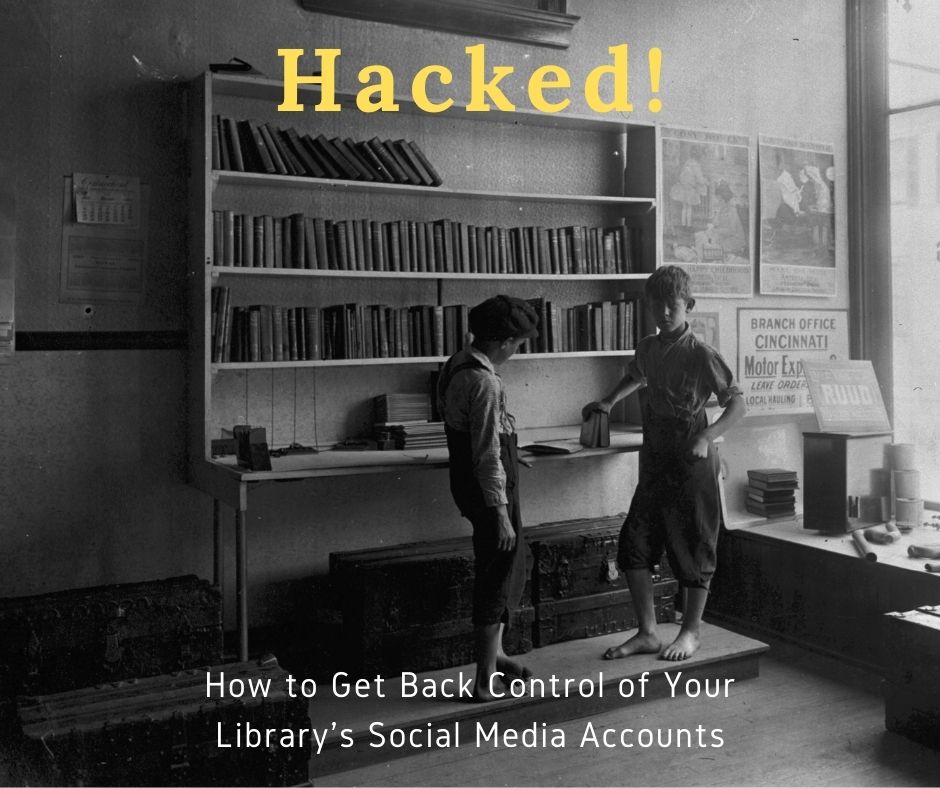
It happens more often than you realize. 36 percent of all internet users report they’ve been hacked, and some were victims more than once.
If your library’s accounts are compromised, it’s critical to gain control back as soon as possible. Bookmark this post so you and your fellow staff members will know what to do.
How do you know a hack has happened?
Admins for library social media accounts should be on the lookout for the three main signs of hacking.
You receive an unprompted email that you changed your login email or password when you did no such thing.
You can’t log in to your accounts.
Your account displays posts and direct messages you didn’t create.
Platform-specific steps to take if you determine you’ve been hacked.
You’ll notice I advise you to take screenshots during various steps in this guide. You may need evidence of the hack to get control back of your account. It’s also just good practice to take screenshots and save them to use as you review what happened with your supervisors or staff.
Facebook
Look at your Page Roles to see if unauthorized people have been added as admins to your account. If they have, take a screenshot, and then remove them immediately.
Next, check Page Info to make sure your authorized phone number, email, and website have not been changed. If any unknown or unauthorized numbers are listed, take a screenshot and then delete them.
Go to Page Management History to review changes that may have been made to your page by hackers. Again, take a screenshot of any suspicious activity.
Finally, go to your Activity Log. Log out of any sessions you do not recognize but first, (you guessed it!) take a screenshot.
If you cannot log into your Facebook account, try sending yourself a password reset email, and recover your account through your registered email address.
Check Settings and Privacy to see if unauthorized people or email addresses have been added as admins to your account. If they have, take a screenshot, and then remove them immediately.
Also under Settings and Privacy, check the phone number associated with your account. If any unknown or unauthorized numbers are listed, take a screenshot and then delete them.
If you cannot log into your Twitter account, and a password reset does not give you access, go to the Twitter Help Center and choose Hacked Account from the list of options. Follow the steps to recover control of the authorized email associated with the account.
Check Privacy and Security to see if unauthorized people or email addresses have been added as admins to your account. If they have, take a screenshot, and then remove them immediately.
Check Edit Profile to make sure that your authorized phone number is still associated with your account. If any unknown or unauthorized numbers are listed, take a screenshot and then delete them.
Check Login Activity to see if your account was accessed from any suspicious locations or devices.
You’ll also want to check Contacts and delete any unauthorized synced contacts. Take screenshots of all suspicious activity.
If you still cannot log into Instagram, contact Instagram directly and work with them to recover your account. The steps to do this vary depending on the mobile device you are using. You’ll find those steps on the Instagram Help page.
LinkedIn
Look at your Admin section to see if unauthorized people or email addresses have been added as admins to your account. If they have, take a screenshot, and then remove them immediately.
If you cannot access your LinkedIn account, contact LinkedIn immediately by submitting the Reporting Your Hacked Account form.
Pinterest
Pinterest will place your account on Safe Mode if they suspect suspicious activity. Safe Mode locks your account protecting your pins and preventing any further unauthorized changes or actions. In order to unlock your account from Safe Mode, the password must be reset.
Click on the down arrow next to your profile photo in the upper right-hand corner and select Settings, then Edit Profile. Check to make sure your authorized phone number, email, website, and location have not been changed.
Also under Settings, click on Security to check that there are not unauthorized connected devices.
Notify your followers that your account may have been compromised. This will prevent your fans from clicking on any suspicious posts or messages that appear to be coming from your library’s page, but may contain malware.
Check to see if there are any new apps or connections created with links to your accounts. If so, delete them. Hackers often gain access to social media accounts through third party apps.
Did I miss anything? Has your library been a victim of social media account hacks? Let us know in the comments below.
Subscribe to this blog and you’ll receive an email every time I post. To do that, click on the “Follow” button in the bottom left-hand corner of the page. Connect with me on YouTube, Twitter, Instagram, and LinkedIn.
In this episode, I respond to the common misconception that a library can send too many emails and annoy their cardholders. Libraries are the exception to the email marketing rule and I’ll explain why that is.
Kudos in this episode go to the Dallas Public Library, who did a branch grand opening in the middle of the pandemic!
Do you have a suggestion for a topic for a future episode? Want to nominate someone for kudos? Let me know in the comments. And subscribe to this series to get a new video tip for libraries each week. Thanks for watching!
Next week on the blog: What to do if your library’s social media accounts are hacked!
Two years ago, I listened to two episodes of the Social Media Examiner podcast that gave me nightmares.
The first episode featured an interview with a fitness instructor who lost control of ALL her accounts in the span of an hour. Her quest to gain control back was a saga I don’t ever want to experience.
The second episode featured an interview with the Social Media Examiner team as they recounted the day they lost control of their own Facebook business account.
If it can happen to Social Media Examiner, it can happen to your library.
Here’s the truth: most of us are too trusting. We probably don’t think a social media security breach will never happen to us. But we couldn’t be more wrong. In the first six months of 2020, the data protection company ZeroFOX reported a 95 percent increase in threat activity on social media accounts, compared to the last six months of 2019.
We may be even more vulnerable right now, with staff members working from home and resources stretched thin. One library I know allows more than three dozen staff members to post on their various social media accounts. I’m happy to say they are taking steps to beef up their social media security. But I fear there are too many libraries who operate in this way.
Anti-virus and malware software are essential, but that’s only half the battle. You need to take steps to protect your library’s social media accounts from compromise. Here’s how to do that.
Limit access to your social media accounts.
If you have a large team of people who post for you, consider trimming to no more than five admins for all social media accounts. Most platforms like Facebook or LinkedIn will let you assign roles to people. Limiting access is a good way to protect your full account’s security.
What should you do if you have a large social media team who currently post on your accounts? Ask your team to send pre-written posts with photos, videos, and graphics to a team leader via email or a shared file system like Google Drive, Trello, or Base Camp. Your social media account admins can pull and post that pre-written content.
Create an email exclusively to manage your library’s social media accounts.
This step will prevent your social media accounts from being compromised if one of your admins accidentally opens a suspicious link or file in their own work or personal email.
Use two-step authentication.
Most platforms will ask you to enter a randomly generated code every time you log in. Take the extra step. It’s better to choose safety over convenience.
Pick strong, unique passwords.
According to the digital risk protection company Idagent, 80 percent of data breaches in 2019 were caused by password compromise. That’s why choosing a strong password is critical.
Strong passwords contain:
At least six characters.
A combination of numbers, symbols, and letters.
Letters in both upper and lowercase characters.
No connection to your library. Don’t use the name of your mascot or the numerical portion of your street address in your password.
The easiest way to create strong passwords is to use a secure password generator like Passwordsgenerator.net. You should also consider a process for storing your passwords in a secure location, like a locked file on your Share drive. You could choose to pay a small fee for a password manager like LastPass.com and 1password.com.
Finally, you must also be sure the password you use for each social media platform is unique. Don’t use the same password across all your accounts.
Change your passwords often.
Don’t get too attached to your passwords. Changing them is an inconvenience, but it’s a small price to pay for peace of mind.
A good rule of thumb is to change your passwords at least every quarter, but more often is even better. You should also be sure to change all passwords anytime a staff member who had access to your social media accounts leaves the library’s employment.
Don’t use your library’s public Wi-Fi.
The U.S. Securities and Exchange Commission warns that public Wi-Fi is not secure. Cybercriminals easily gain access to passwords and other data on these types of wireless networks. Use your staff Wi-Fi or a Digital Subscriber Line (DSL) if available.
If you are posting on a mobile device in a location outside the library with public Wi-Fi, use your cell service instead of the public Wi-Fi. Cell service providers use encryption to ensure safety. You may need to consider the purchase of a library-owned device with cell service so staff aren’t using their personal cell service to post for the library.
Did I miss anything? Did your library experience a social media attack and if so, how did you handle it? Let me know in the comments below.
Subscribe to this blog and you’ll receive an email every time I post. To do that, click on the “Follow” button in the bottom left-hand corner of the page. Connect with me on YouTube, Twitter, Instagram, and LinkedIn.






 Super Library Marketing: Practical Tips and Ideas for Library Promotion