The Library Marketing Show, Episode 134: This episode was born out of a desire to help libraries address the war in Ukraine and other major world events.
There are 3 ways your library can provide context, resources, and support when a crisis breaks out at home or abroad. I’ll outline those tips.
Do you have a suggestion for a topic for a future episode? Want to nominate someone for kudos? Let me know in the comments. And subscribe to this series to get a new video tip for libraries each week.
Thanks for watching!
Subscribe to this blog and you’ll receive an email every time I post. To do that, enter your email address and click on the “Follow” button in the lower left-hand corner of the page.
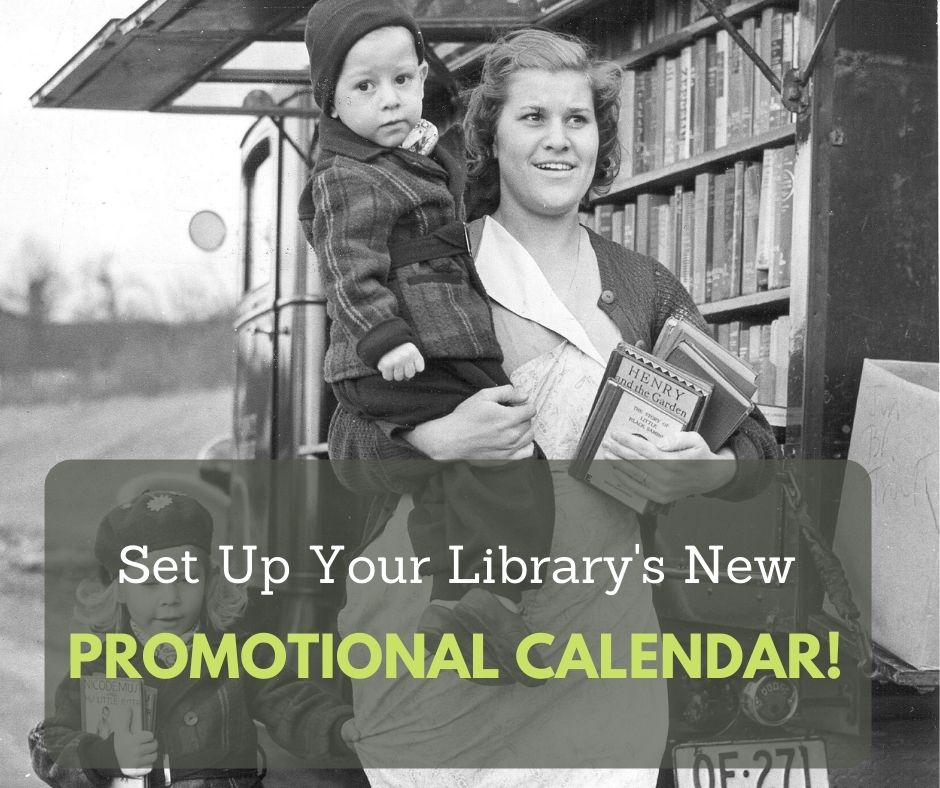
Now that you’ve created a library promotional strategy, it’s time to take the next step. And that is to create a calendar for all your library promotions.
Three main reasons a library promotional calendar is important
A promotional calendar is vital to success. This is especially true in an organization with many contributors and stakeholders, like a library.
Here’s why you’ll want to have a promotional calendar, even if your team of content creators or contributors is small.
It helps you stay organized and focused on the goals you set as part of your promotional strategy.
It helps you to keep track of holidays, seasonal library and literary events, and major annual promotions like summer reading.
It keeps everyone at your library up to date on your promotional plans.
How to set up your library’s promotional calendar
Scroll down to the bottom of this post for my recommendations of three free calendar templates that you can use to create your library’s promotional calendar.
No matter which template you choose, the calendar should be shareable. This will ensure the contributors at your library can see all future promotional plans. It will also make it easy for contributors to add comments and ideas.
Once you choose a template and a location where it will “live,” set up the columns to track the important pieces for library marketing. Your calendar should include spaces to track these things:
The name of the event or service you wish to promote
The date of the event or service launch if the service is new. If it’s an existing service, you can leave this space blank.
The start and end date of the promotion
The type of content. For example, blog post, video, etc.
The channel(s) in which the promotional content will be published. For example: email, social media platform, digital signs, etc.
The topic. For example: you may have two promotions for summer reading. One could be planned for two weeks before summer reading begins with the purpose of promoting registration. Later in the summer, you may launch a second promotion marking the halfway point and encouraging readers to log their reading hours. The “topics” for these two promotions could be “Registration Push” and “Halfway Check-in.”
Due dates
The date and time for publishing the content
The person in charge of each promotion
Follow-through. This column is where you will note if the content was published according to schedule or if there were delays. Tracking follow-through will help you spot hurdles in the process of creating and approving promotions, which will lead to more efficient planning of promotions in the future.
Links to promotions after they are published. This will be helpful for those times when you’ll need to find and analyze a promotion after it’s out in the world.
Success measurements. List the data you gather after the promotion is published to measure engagement and effectiveness. Tracking your promotional success will help you spot the topics, formats, and publishing platforms that yield the best results for your library.
How your promotional calendar will improve your library marketing
The Marketing Rule of 7 states that a prospect needs to hear or see the advertiser’s message at least seven times before they’ll buy that product or service.
For your library, the Marketing Rule of 7 means it’s important to publish content on various platforms and in multiple formats. This will allow your library to reach your entire target audience.
Your promotional calendar will help you make those decisions by having a list of your channels all in one spot. Your calendar will also help you to spot effective ways to re-purpose your content.
For example, let’s say you created an infographic demonstrating the value of summer reading in preventing the loss of literary skills. Initially, you planned to post the infographic to Instagram.
Using your promotional calendar, it may occur to you that the infographic would be a great starter for a blog post on the dangers of the “summer slide.” Then, you realize you can promote that blog post and infographic in your next library e-newsletter.
The library promotional calendar helps you to see all your promotions and create a holistic campaign. It can help you decide if you have enough resources to focus on the platforms where your target audience is most likely to see your content.
Use your calendar to prioritize your most important channels. Focus on creating high-quality content instead of aimlessly posting on all available platforms.
Your calendar can also help you set deadlines. You’ll quickly learn how often you can realistically create and release new promotions.
Finally, your library promotional calendar will help you spot the busiest times for your library before they sneak up on you. It will help you plan for those busy times. You’ll be able to ensure that the promotional creation process is finished well before the publishing date!
What to include in your library promotional calendar
Holidays, especially ones that affect your library’s service hours like Independence Day and Veterans Day.
Local holidays. For example, where I live in Cincinnati, Ohio, opening day for the Cincinnati Reds is a holiday.
Literary holidays such as Library Lovers Day or Audiobook Appreciation Month.
Seasons, like back to school or graduation.
Promotions tied to popular culture, like the Superbowl and the Olympics.
Building openings/renovations
New service releases
Summer Reading
Author events
Fundraising opportunities, like Giving Tuesday and National Library Week.
Patron stories
Interesting or funny details about your library.
Evergreen content, like collection promotion.
Three free promotional calendar templates
Some of these websites make you an offer to try their product, but you can still get these calendars without making a purchase.
Smartsheet: I recommend the Marketing Campaign Calendar Template.
Subscribe to this blog and you’ll receive an email every time I post. To do that, enter your email address and click on the “Follow” button in the lower left-hand corner of the page.
The Library Marketing Show, Episode 133: In this episode, I’ll address a recent discussion in the chat of a virtual conference I attended.
The commenter said, “I struggle with marketing our digital collection when my goal is getting people back in the Library. I am thankful for our digital collection and how it meets the needs of patrons, but when patrons mostly use our digital collection, they don’t come into the library. How should I be rethinking this?”
Kudos in this episode go to Rhone Talsma of the Chicago Public Library. Watch the video to find out why he’s being recognized.
Do you have a suggestion for a topic for a future episode? Want to nominate someone for kudos? Let me know in the comments. And subscribe to this series to get a new video tip for libraries each week.
Thanks for watching!
Subscribe to this blog and you’ll receive an email every time I post. To do that, enter your email address and click on the “Follow” button in the lower left-hand corner of the page.
The subject line of your library marketing email is your first chance to communicate the value of your email to the person receiving it. It may be your ONLY chance to get someone’s attention to engage with the promotional content you’ve worked so hard to create.
A good subject line will drive people to open the email, read what’s inside, and take action. That will lead to an increase in the use of your library. And that’s the whole point, right??
A bad subject line can lead your email to be marked as spam, which willaffect your sender reputation. In fact, according to the marketing agency Convince and Convert, 69 percent of email recipients report email as spam based solely on the subject line.
That’s why I think your subject line might be the most important part of your library marketing email.
I want you to spend the most time thinking about that section. Be very intentional about what you say in the subject line.
There are five best practices to help you create engaging subject lines. Scroll down for some more free tools to help you to test your subject line before you hit “send”.
Tip #1: Use brackets or parentheses in your subject line.
You want your emails to stand out in the inbox. The easiest way is to use these two punctuation symbols as part of your email subject line.
Worldata is a company that analyzes email marketing campaigns and provides free industry metrics based on that data. Their data shows using either brackets or parentheses in your subject line boosts open rates by 31 percent.
That’s because these punctuation marks subconsciously draw the eye to whatever is within the brackets. And that small detail can be enough to entice them to open the email.
Some examples are:
“Welcome back to the library! (We missed you.)”
“Your Library Giving Day donation will be doubled with a matching gift. (Today only!)”
“Homework is hard. We can help. [FREE VIDEO].”
Tip #2: Try using all caps on important words in your subject line.
World Data says that including words in all caps in your subject line can increase your open rate by as much as 14 percent.
You should, however, make sure that you use this technique sparingly. Pick one important word to capitalize. It should be a word that you know will call attention to your email when someone is scrolling through their inbox.
Some examples are:
“Fans of James Patterson have the chance to talk to the author IN PERSON next Thursday.”
“Your resume needs some SERIOUS help. Let your library make it irresistible.”
“Being stuck inside on a rainy day with the kids is TORTURE. Get some museum passes from the library and go exploring!
Don’t capitalize your entire headline. You’ll risk making your email recipients feel like you’re yelling at them.
Tip #3: Don’t spell out numbers.
Yesware, a business communication company, analyzed 115 million emails and found that email open and reply rates are higher when a number is present in the subject line. (For example, “5” instead of “Five”.)
World Data’s surveys back up that claim. They found that putting a number in the subject line can increase your open rate by as much as 21 percent.
Numerals in your subject line will get your emails noticed. It also saves you in the character count.
For more of a boost, start your subject line with a number. (Example: “5 Great Ways to Get Free Homework Help from Your Library”). Doing that can increase open rates by as much as 18 percent, according to World Data.
Tip #4: Use the “F” word (I mean… Free!) and other power words.
World Data says spam filters no longer filter out emails with the word free in the subject line.
Their study shows that including the word in the subject line can increase open rates by 37 percent. Plus, there is data to suggest that “free” produces an emotional charge in us.
Speaking of emotion, there are lots of other words you can use in your subject line to get a response. Data shows email recipients respond to subject lines that convey urgency, curiosity, excitement, and joy.
Here is a starter list of words that World Data says are proven to do well in email marketing. Challenge yourself to add one of these words to the emails you send to your library community.
Amazing
Ultimate
Important
Challenging
Surprising
Best
Secret
Exact
Last Chance
Now
Final
Official
Free
Tip #5: Use words your audience will understand.
Drop the acronyms and library industry jargon like periodicals, database, interlibrary loan, reference, serial, audiovisual, abstract, or resource. Use words that regular people understand–magazines, music, online classes, and helpful information.
Avoid reference to a vendor service like Overdrive, Hoopla, Freegal, BookFlix, Zinio, etc. As far as your cardholders are concerned, all material comes from the library.
If you are using email to promote one of these services, like Overdrive, your subject line could say, “Free e-books are now available at your library!” You can mention the vendor in the body text of the email.
Free tools to make your headlines irresistible
When I craft an email, I spend a lot of time thinking about the subject line. Sometimes I think about it for days.
I use a couple of online headline analyzers. These free online tools all work pretty much the same way. You put your headline in and you get a score, plus tips on how to improve them. My favorites are:
The higher the score, the better your chances of getting people to open the email. I always shoot for a score above 70
I ran the headline for this post through the three analyzers, as if it were an email subject line. Sharethrough gave me a 71, Advanced Marketing Institute gave me a 73.3, and Subject Line gave me a 75. Those are good scores, so I would likely use this headline as a subject line in an email.
In this episode, I’ll answer a viewer question from Hannah at the Johnson City Public Library. She asks, “What criteria would you use to justify retiring/making ‘private’ old blog posts?”
Kudos in this episode go to the Mary Wood Weldon Memorial Public Library. Watch the video to find out why they’re being recognized.
Do you have a suggestion for a topic for a future episode? Want to nominate someone for kudos? Let me know in the comments. And subscribe to this series to get a new video tip for libraries each week.
Thanks for watching!
Subscribe to this blog and you’ll receive an email every time I post. To do that, enter your email address and click on the “Follow” button in the lower left-hand corner of the page.
The most powerful tool you have to reach your community is email.
I know there are some readers who don’t believe me. But here’s a fact that cannot be denied: 90 percent of Americans over the age of 15 use email. In the United Kingdom and Canada, 85 percentof people use email.
That’s a big portion of your community.
The digital divide is real but not as wide as most of us thought. The latest Pew Research Center study released in August 2021 shows:
Rural residents have seen a nine percentage point rise in home broadband adoption in the last five years.
72 percent of rural Americans have high-speed internet access.
Smartphone ownership also rose nine percentage points among rural residents in the past three years.
For most of my library friends, the percentage of people in your community who can (and should) be receiving email marketing from your library far outpaces the percentage of people who don’t have an email address.
Social media platforms do not care about your library. The press does not care about your library. Google does not care about your library.
It doesn’t matter how big or small your library is. You have the power in email marketing.
Now, I’ve learned some brand-new information about email marketing. I am not exaggerating when I say this new data has made me re-think the advice I give to my library marketing friends.
This information comes from Michael Barber, who is a brand consultant and marketing strategist. He was the featured speaker of a recent Marketing Profs webinar that frankly blew my mind.
Here are the four big things I learned from his presentation.
Your open rate does not mean what you think it means.
Remember when I said that open rates are a sign of customer loyalty?
My view has changed.
With most email services, the open rate is tracked with the help of a hidden one-pixel image placed in the body of the email message. It used to be that the email counted as being “opened” when the recipient opened the email up.
But now, the email counts as opened when it loads in a recipient’s inbox because that’s when the pixel is now being triggered. Apps like Gmail, Hotmail, Yahoo, and any Apple device with iOS 15 will preload images.
That means a human didn’t necessarily open your email.
What does this mean for your library?
Email marketing expert Jay Schwedelson says your email open rate provides direction for your strategy. It can still serve as a benchmark for testing factors like subject lines and send times.
If you work on your library’s email marketing, you’ll need to really focus on the action created by your email.
Use trackable links inside the body to see what people click on. And then measure what they do after they click.
Do they register for a program? Do they put a book on hold? Do they log into a database? Those are human-triggered actions. Those are the true measure of the effectiveness of your email.
The new iOS update isn’t as bad as it seems… for now.
In September 2021, Apple released the iOS 15 update, which includes more user protection from third-party trackers, including mail privacy protection that stops email senders from collecting data on how a person interacts with email.
The new privacy settings keep marketers from seeing who opened their emails, what time they opened them, where they opened them, and what device they used to open the email.
Michael says it’s not as bad as it seems. First, the privacy protections only apply to people who have actually downloaded the update, and who use Apple Mail.
About 72 percent of Apple users have upgraded to iOS 15. Statistics on the number of people who use Apple Mail vary according to industry and location. But most email providers say they see around 35% of their recipients use Apple Mail.
And so far, according to Michael, not everyone is opting into the privacy protections offered by iOS 15. Only about 48 percent of Apple Mail users are turning on the new privacy settings.
What does this mean for your library?
As always, be watchful of your metrics so you can spot any downward trends in engagement. But don’t panic. Focus on sending great content to your email list.
Your sender reputation is incredibly important
Email sender reputation is a score that an Internet Service Provider (ISP) assigns to an organization that sends email. The higher the score, the more likely an ISP will deliver emails to the inboxes of recipients on their network.
There are three positive signals of engagement that can raise your library’s sender reputation, according to Michael. They are:
Replying to your message.
Clicking on links inside the email.
Adding you to their contacts.
Conversely, there are three negative signals of engagement that can hurt your library’s sender reputation, according to Michael. You want to prevent your library email recipients from:
Moving your library’s email to their junk or spam folders.
Deleting your email without opening it.
Leaving your email unopened and sitting in their inbox. Michael says this is a stronger negative signal than unsubscribing! (WOW, right?)
What does this mean for your library?
Michael says replies are a “super strong signal of engagement.” He encourages email marketers to stop using the “no-reply” return email address in their emails. Use a real email address for replies.
And you’ll want to go a step further by directly asking recipients to reply to your emails. You could ask for their feedback on a service. Or ask recipients to reply with the name of a book they think should be included in your next booklist or book display. This is a chance for you to be creative! You don’t have to respond to every email reply. But this is an opportunity to improve your sender reputation while gathering information that will help you to better serve your community.
You’ll also want to focus on raising your email click rate. Here are five ideas.
Finally, include great content in your email so your recipients will never let it sit in their inbox unopened.
We need to start thinking about how “dark mode” affects design.
Dark Mode inverts the colors on your device to decrease the amount of light on your screen. Dark mode turns the default white background with black text to a black background with white text.
Dark Mode eases the strain on your eyes, especially at night or in dark conditions. It also helps preserve battery power.
What does this mean for your library?
The way our emails are designed will need to change. Michael recommends that, if your email provider has this data, you may want to start tracking how many of your email recipients look at your emails in dark mode.
You’ll also want to test your emails using dark mode to determine if your library’s brand colors work with the darker background.
Finally, make sure your email provider is mobile responsive. This will ensure your emails will be converted properly.
Next week: 6 super-easy tricks to make your library emails stand out in the inbox and get results!
Subscribe to this blog and you’ll receive an email every time I post. To do that, enter your email address and click on the “Follow” button in the lower left-hand corner of the page.
In this episode, I’ll answer a question from Dianne at the Pottsboro Area Public Library. She has been trying to drive attendance to her library events using Facebook events. It’s not working. So she wondered what else she can do?
Kudos in this episode go to the Nashua Public Library. Watch the video to find out why they’re being recognized.
Do you have a suggestion for a topic for a future episode? Want to nominate someone for kudos? Let me know in the comments. And subscribe to this series to get a new video tip for libraries each week.
Thanks for watching!
Subscribe to this blog and you’ll receive an email every time I post. To do that, enter your email address and click on the “Follow” button in the lower left-hand corner of the page.
In this episode, I’ll share the latest social media updates for January 2022, including a new way to filter analytics on YouTube and a new way to share video clips from Facebook to your stories. We’ll talk about what all of this means for libraries. Plus a study that may make you rethink the way you spent ad $$ for Summer Reading and other big library programs.
Kudos in this episode go to the ten winners of a huge award given by the American Library Association! Watch the video to see why they’re being recognized.
Do you have a suggestion for a topic for a future episode? Want to nominate someone for kudos? Let me know in the comments. And subscribe to this series to get a new video tip for libraries each week.
Thanks for watching!
Subscribe to this blog and you’ll receive an email every time I post. To do that, enter your email address and click on the “Follow” button in the lower left-hand corner of the page.
Do you have a suggestion for a topic for a future episode? Want to nominate someone for kudos? Let me know in the comments.
And subscribe to this series to get a new video tip for libraries each week.
Thanks for watching!
Subscribe to this blog and you’ll receive an email every time I post. To do that, enter your email address and click on the “Follow” button in the lower left-hand corner of the page.





 Super Library Marketing: Practical Tips and Ideas for Library Promotion