Search

Super Library Marketing: Practical Tips and Ideas for Library Promotion

Tag

Marketing Obstacles and Issues

Attention! Here’s How to Write Headlines That People Simply Can’t Ignore for Any Piece of Content

In my former life as a web journalist for a television news station, crafting the best headline for each story was the most challenging part of my day. It was also the most crucial task.

A compelling headline for any piece of content–email, social media posts, blog posts, newsletters, posters, and signage is essential. The right headline will make it impossible for people to ignore your content.

It may seem silly to spend a lot of time, energy, and brainpower on a couple of words. But it’s a critical component of all your marketing efforts. Libraries should spend time crafting the best headline on every piece of content they publish. This applies to their website, blog, social media posts, press releases, and emails, including personal emails and mass emails to customers.

A good headline should give your readers a hint at the copy that lies ahead without giving away the whole story. It should trigger an emotional response that includes an irresistible urge to read more.

Think of your headline as the gateway to all the content you have poured energy into creating. It may seem tall order for a short succession of words but it can be done.

So how do you write a good headline? Here are my tips.

If someone held a gun to your head and demanded you describe the copy in one sentence, what would you say? This is my twisted yet effective technique for getting that first draft of a headline down on paper. It forces you to boil your work down to its main point or big idea. Go for the emotional core of your copy.

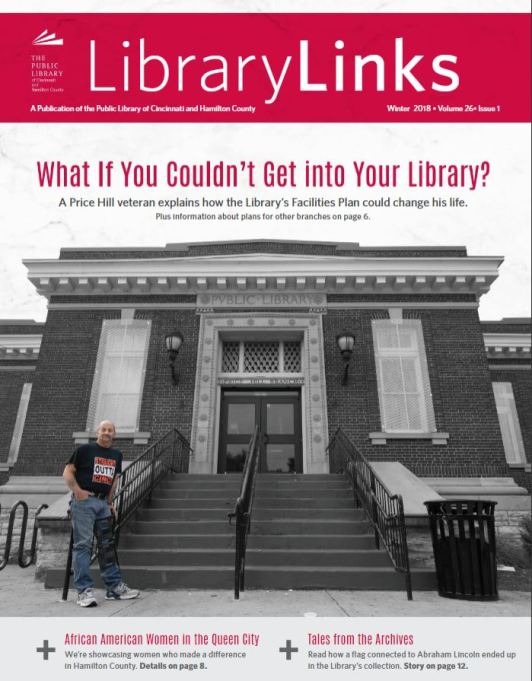
Example:  The title of this issue of our Library Links magazine. The lead story was about a veteran living with a disability. His neighborhood branch is a Carnegie library built in 1909. It’s never been renovated and it’s inaccessible to people living with mobility issues. We were about to ask voters to pass a levy to fund upgrades to this branch and more just like it.

I asked to interview him. He told me the story about how he can’t climb those stairs, and how fellow veteran friends who also live in his neighborhood have to drive their motorized wheelchairs to the next closest branch. The trip sometimes takes three hours. His story invoked a feeling of frustration and injustice. How the heck do you encapsulate that in a short sentence?
Keep the length manageable and the vocabulary conversational. Remember, you want to tease your readers into craving more information, not give away the whole story. You also don’t want to confuse them by using language they don’t understand.

Example: Our library recently made a pivotal switch in the way we market our storytimes. We want to emphasize the educational aspects.

It would be easy to get lost in a lot of technical language and big words to describe our focus on literacy and learning. I decided the best approach would be to write text that sounded like what I would say in person if I were talking to a parent about storytime.

This sounds like an easy step, but I see a lot of libraries and brands that get caught up in the technical language of their products and services. It makes us feel important when we use big words. But headlines and copy need to be simple in order to connect with the audience.

Headlines for press releases deserve as much attention as headlines for emails and blogs.  Library marketers must remember newsrooms are a target audience and journalists crave a good story just as much as the average Joe. You really have to dig deep to grab their attention and evoke your emotional response. You want them to go into their morning meeting and fight for the permission to cover your library’s story. So, give them enough ammunition.

Example:  This release triggered coverage by all the major media outlets in town. Its headline is very simple and straightforward but it got the job done.

Be versatile–it’s okay to change the headline based on the distribution platform. If you have a great blog post you want to share on Twitter, but the headline, when coupled with the URL and a photo, exceed the 280-character limit, re-craft the headline just for Twitter. You might also want to re-craft headlines for different social media audiences. Your Twitter fans may have a different perspective on your article than your LinkedIn fans. You can rewrite it for an email distribution too.

Example: This blog! I often change the headline for the different social media platforms. Sometimes I’ll repost a blog in a month or two with a different headline as well, just to freshen it up and catch viewers who might not have been interested by my first headline. Experimenting is good!

Use the tools. There are lots of fantastic tools to help you fine tune your headline. My absolute favorite is Sharethough’s Headline Analyzer. It’s easy to understand. Since I’ve been using it to craft headlines for this blog, my views have gone up about 10 percent!

For this particular post, Sharethrough gave me a 75 rating, which is above average. It says this headline works because it’s long, it has a human connection, and limited use of positive sentiment. It also gives suggestions on how to improve the headline to get a higher score.

Go with your gut.  Sometimes, all the tools and analysis can cloud your head. If you’ve composed a headline that you feel will do the best job at capturing your audience’s attention, use it. You know your audience best.

Subscribe to this blog and you’ll receive an email every time I post. To do that, click on “Follow” button in the bottom left-hand corner of the page. Connect with me on YouTube, Twitter, Instagram, and LinkedIn.  And check my list of upcoming events so we can connect.
My Big Fat Failure and What I Learned From It

My Big Fat

I have a library marketing routine. Every six months, I go through all the promotions we’ve done and take a hard look at what worked and what didn’t. I adjust my email sending schedule and my promotional plans for the next six months based on the data I’ve gleaned from cardholders who’ve interacted with our messages and promotions.

This time, within about ten minutes of starting this process, I was reminded of what could be considered our library’s biggest promotional failure to date. It was an experiment, so the sting is lessened by the knowledge that we intended for this campaign to be a learning experience.

Yea, Ang, keep telling yourself that.

We have one library in our system with a cardholder cluster distribution that is something of a miracle. This branch is a perfect representative of our entire system as a whole. It makes it an amazing test subject for any promotion.

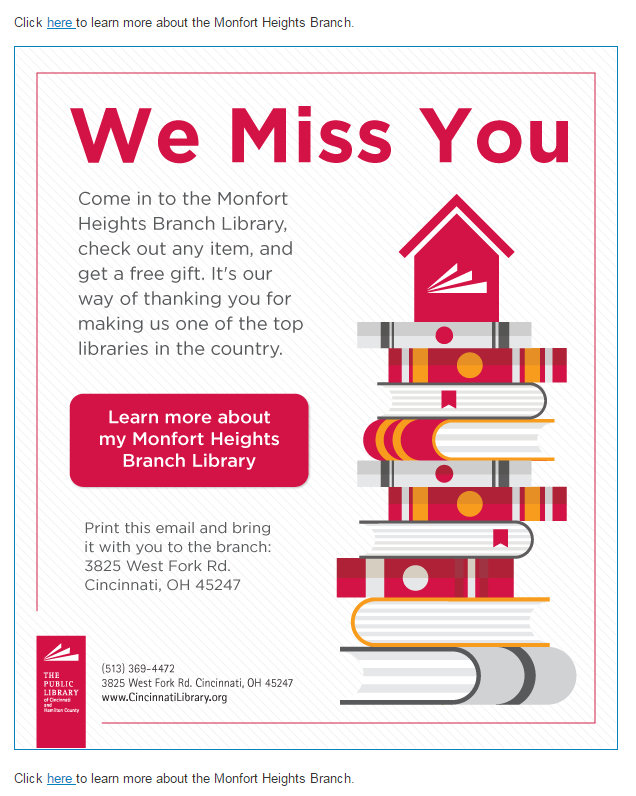
So our idea was to convince occasional users of that branch–people who only come in every couple of months–to come back to the branch by offering them a free gift in exchange for checking out any item. It was January and snow was swirling and we had these amazing library-branded snow scrapers. Maybe that sounds lame to you but trust me, at outreach events, those babies are flying off the table. In any case, we actually did not identify the free gift in the promotion. Our overall library strategic goal this year was to increase physical visits to the branch, and this promotion fell in line with that strategy.

So we identified the target audience with the help of Orangeboy, Inc., the company that manages our email promotions. Through them, we were able to pinpoint occasional users. We took a two-prong approach. We sent those cardholders a postcard, asking them to come into the branch with the postcard for their free gift. We also sent them a targeted email a week after the postcard, which you can see below.

monfort


We sent the email during a time period identified as successful for library emails in our system–on a Wednesday night at 7 p.m. 735 people got the email and the postcard.

The email’s vanity metrics were pretty good…  51.29% open rate and 5.57% click thru rate. But the overall results–getting people to come in and use the branch–was not exciting. 6.6% of recipients came in to claim a prize. Eight were email recipients. 41 people brought in their postcard.

What did we learn from this? Well, a couple of things may have been at play. Perhaps occasionals don’t use the library often because they can’t get to it physically. Perhaps they just don’t want to enter the building. A digital campaign–driving occasional users to our eBranch in exchange for a gift–may be more effective, although we’d have to work out the logistics of getting a gift to someone who doesn’t want to come into a branch.  Perhaps it was the timing. The weather turned out to be pretty miserable, with record-breaking snowfall in the week after the postcard went out.  The week in which the email was sent was mild. However, if we tried it in the spring or summer, we may have better luck.

And although I generally look at this as a failed promotion, I can say that we convinced 49 people who haven’t used the library in a long time to do so!  Circulation at that branch increased by at least 49 items that month. It just seems like a lot of money and effort for a small result.

Still, we’ll keep experimenting with unique ways to draw our old customers back to our branch. Have you done something similar? Tell me about it in the comments. I’d love to hear how your library is working to increase physical visitors.

Subscribe to this blog and you’ll receive an email every time I post. To do that, click on “Follow” button on the bottom left-hand corner of the page. Connect with me on Twitter and Snapchat–it’s where I talk about library marketing! I’m @Webmastergirl. I’m also on LinkedIn, Slideshare,  Instagram and Pinterest. Views in this post are my own and do not represent those of my employer.

The Million-Dollar Reason You Need to Market Your Library’s Collection

THE (1)

$250,000 vs. $8 million.

That’s the spread between the amount my library spends on programming and the amount they spend on collections.

I bet if you checked your library, you’d find a similar story. So why, my dear friends, do library marketers spend the majority of their time and effort promoting programs?

$275,000

Please understand me. I’m not saying that library programming isn’t important or worth promoting. Library programs nourish the soul of our community and offer cultural and educational opportunities for those who might not otherwise have access to them. Most library programs are a valuable and important part of the library’s mission to serve the community. And they deserve to be marketed!

But most library marketing teams spend their energy and resources promoting those programs. And they miss an undeniably important fact about library usage. Library cardholders want the books. They’re checking out books. That’s why they signed up for a library card!

A study by the Pew Research Center published in September 2015 shows 66 percent of library cardholders use their card to borrow books. Only 17 percent attend a library program, class, or lecture. Think about what people say when they sign up a library card. Most are going to tell you they are excited to check stuff out! We take it for granted that people know we have circulation items–books, magazines, music, and more. We need to stop that.

If we want to compete with Amazon and other bookstores, we have to promote our main asset–the collection. People are hungry for information about new stuff in the collection. And every time I talk to someone about the library and I mention that we loan eBooks, eAudiobooks and downloadable music, they look at me like I have two heads. We’re spending a ton of money to build our collection and our customers don’t really know it’s there. When they want a newly released book, who do your cardholders think of first–you or Amazon?

Before I was a library marketer, I worked as a television news producer. That means I put together each night’s newscast, decided which stories were told, in what order, and how they were told. Every year, our news director would bring in a consulting firm whose job it was to help us improve our shows and increase our viewership. I was proud of my work as a journalist. But when I was presented with the feedback from focus groups, it was clear that most viewers were watching my show for the weather. Hearing what was going on in the world was nice, but what they really wanted to know was whether it would rain the next day.

In television news, weather is king. In libraries, the collection is king. Collection marketing is a valuable investment for every library. The best way to market the collection is through targeted emails. In the next few blog posts, I’ll be sharing some secrets for targeted email messaging–things I’ve learned in the 18 months that we’ve done so at my library.

But you can start collections marketing right now through social media–especially Twitter and Pinterest– and by featuring books on the front page of your website.  Create themed book lists–you can enlist your collections development department for help with that task. Talk about new books and popular books in your podcast or on your blog.

For a few minutes every day, spend some time marketing your collection. It will increase circulation and will help reinforce the image of your library as a place of vast resources in the eyes of your cardholders.

Subscribe to this blog and you’ll receive an email every time I post. To do that, click on “Follow” button on the bottom left-hand corner of the page. Connect with me on Twitter and Snapchat–it’s where I talk about library marketing! I’m @Webmastergirl. I’m also on LinkedIn, Slideshare,  Instagram and Pinterest. Views in this post are my own and do not represent those of my employer.

Why Library Marketing Stinks and What to Do About It

I’ve been in the library marketing business for about 18 months now. Here is what I’ve learned:

1. Never call anyone without a Library Sciences degree a “librarian.” Librarians take their degree and their expertise very seriously, and some might be offended.

2. Librarians are passionate, enthusiastic people who have a deep, driving desire to help others and a curiosity for information that is unparalleled in most other businesses.

3. Most library marketing departments are struggling to showcase their wonderful organizations because of out-of-date tactics.

So there it is. In my first post on this new blog, I’m issuing a call to arms for my fellow Library marketers. There are some great examples of forward-thinking marketing happening in libraries all across the U.S. (I’m looking at you, David Lee King. Also see New York Public Library, and Troy Public Library in Michigan.) But most library marketing departments are still doing things the same way they’ve been done for the past 10-15 years. They push programs. They issue press releases. They send out monthly brochures chock full of text, listing every single branch program and story time (do you know how many story times the average library holds?? A lot!).

Libraries are failing to drive more circulation and increase program visits because they lack a marketing strategy. Without a clear-cut plan, you might as well throw spaghetti at the wall. It’s frustrating and unsatisfying, and it won’t increase your circulation numbers or drive more traffic to your buildings or digital services.

Okay, so let’s address the elephant in the room. Change is hard, especially for a library system. We’re not talking about Google here. We’re talking about an organization with a long-standing tradition and a history in the community it serves. The bureaucracy in a library rivals some giant companies I know. Politics can be brutal. New ideas are hard to pitch, slow to catch on, and don’t always have the full backing of the administration or board.

Listen, I’m right there with you.  I know how hard it is.  I took this job so I could sing the praises of my favorite public Library system. I’m inspired by the work that is done here, and I want everyone else to be too! It’s a dream job. But it sure is harder than I thought.

I’m lucky, though. I stepped in during a monumental shift in the greater marketing world. It’s what Content Marketing Strategist Robert Rose calls “The 7th Era of Marketing: Content-Driven Customer Experiences.”  Customers are looking for value from brands (yes, your library is a brand!). They don’t want to just check out items. They want an experience and a connection to the library. They want to feel like their library has their back. We can provide that!

So here’s what I propose. Let’s change the library marketing landscape together. We’ll start small and basic. Here are our first three steps.

1. We should create a strategy now and stick to it! The new year is coming. It’s the perfect time to try something new. Stop creating a promotional schedule based on events. Start creating content that promotes your biggest assets-your collection and your librarians. I’m not saying we should never promote a program again. But create a strategy and promote programs that fit into the strategy. We’ll talk more about this in a future post.

2. We should become content marketing enthusiasts. We work in buildings which are piled from floor to ceiling with the tales of people, animals, and events, both real and imaginary. We are literally surrounded by stories. Of all the industries that have tried to embrace the content marketing model, it should be easiest for us. It’s a natural fit. Our loyal customers are often super enthusiastic fans. Most brands would kill for fans like that. We should be curating their stories and turning them into customer success pieces and marketing them. Again, we’ll talk about this more in a future post.

3. We should learn from our for-profit counterparts. Do not isolate yourself in the library world. I would go so far as to tell you, library marketers, that you do not need to go to PLA or ALA. You should be attending marketing conferences like Content Marketing World and the Social Media Marketing World. You should be attending webinars and following marketing influencers. You should be reading books, white papers, listening to podcasts, and surrounding yourself with all things marketing. We should take the successes and failures that our for-profit friends have made and use them to our advantage. We won’t be able to do everything that Coca-Cola, GM, or Kraft can do with their massive budgets and extensive staff. But we can scale those models and use pieces that will work for us.

We work in the best business in the U.S. Seriously, I believe that. Let’s make sure the rest of the world shares our enthusiasm. It’ll be a journey we’ll take together.

Views in this post are my own and do not represent those of my employer.

A WordPress.com Website.

Up ↑