Search

Super Library Marketing: Practical Tips and Ideas for Library Promotion

Tag

Promotional Ideas

Five Creative Ideas to Help You Beat the Blues, Get Inspired, and Create Amazing Library Marketing Campaigns Again!

It is hard to believe that in a building filled with the stories, a library marketer would need inspiration.

But alas, we are human. And sometimes we get stuck in a rut.

Library marketers are expected to be energetic and enthusiastic at all times. We must come to all meetings and be able to give a list on the fly of exciting and innovative ideas for promoting major developments and smaller decisions that affect the everyday cardholders.

I don’t know about you, but sometimes, I just too plain exhausted to be the marketing superwoman. The busyness of the library summer reading season seems to melt every year into the busyness of fall. There is little time to rest. And exhaustion makes it even more difficult to find creative inspiration.

We struggle to inspire our cardholders, both old and new. We want our customers to use our collection and enjoy our services every day, but we can’t seem to figure out a way to make them act. The tried and true methods of marketing no longer work and we’re frustrated, angry, and frankly, a little worried.

Here’s what I do when I find myself stuck in a marketing rut.

Define your workflow and make it the law of your marketing landscape. A defined outward-facing workflow sounds like the opposite of a creative endeavor. But in reality, it creates space for you to think. It ensures that you have time to be thoughtful so you can develop and deliver a quality product.

Set an expectation about who will manage workflow. That means all marketing requests go through one person on your team. That person is responsible for looking at the request and determining if it fits into the library’s overall strategic goals. That person sets clear expectations and goals for each project. That person communicates a plan of action based on realistic timelines and due dates.

Let me tell you: a defined workflow is a lifesaver. It reduces stress and anxiety for everyone on your team. When your staff understands what is expected of them, they can focus on the creative parts of the job.

If you are new to your library, it will take time to get a smooth workflow in place. Be patient with yourself and with others. Keep reinforcing your expectations. Eventually, your coworkers will be on board with you, especially when they start to see results.

Be generous with positive reinforcement. Positive reinforcement always creates an emotional experience for individuals or a team working together. Don’t just say, “Well done.” Write a note or a card praising specific actions or portions of work. Give yours staff unexpected breaks: team lunches and surprise treats can lift the spirit of your team and re-energize them.

Use your staff’s strengths to create passion for the work. I highly recommend that you invest in the Gallup Strengths Finders test. It gives you incredible and nuanced insight into yourself and your staff members. It shows you how to recognize the strengths of your team members and how to actually manage them to put those strengths to good use. You can find the book by Tom Rath at Walmart and Target for about $15. It includes a code that each team member uses to take the test online.

Through the Gallup process, I discovered my team members have a strong capacity for collaboration. This wasn’t much of a surprise to me. But the book also gave me suggestions for how to actually use that desire for collaboration to the advantage of my library. It also gave me greater insight and empathy for team members who prefer to work alone or who seem resistant to change. I can assign tasks to the best person for each job. It’s really changed the dynamics of my staff and made work easier for everyone.

Observe your customers. It helps me just to take a walk around the library or to visit the branches. I pretend to be browsing the books but really, I’m watching the way the cardholders browse the shelves, interact with staff, work the self-checkout machines and use the public computers. Do they look for a map? Do they look confused? Are they drawn to a particular book display? Do they linger over the new books or do they dash in for their holds and dash out? What questions do they ask? How do people actually move through the branch?

Observing the behavior of customers inside the library can give you an idea of what visitors love and what problems they encounter during their interaction with your system. Then, you can focus on creating new marketing ideas that spotlight the things your cardholders love, and answer the questions they have.

You can also observe online visitors. Spend some time poking around Google Analytics. Figure out which pages get the most visitors. Look for the pages where visitors stay for the longest period of time. Look for the landing pages with a high bounce rate. Page views and read time will help you focus effort on improving the customer experience for your website.

Check your statistics.  Our library makes circulation and programming stats available on our intranet. This little piece of data inspires me to find ways to help make their interaction with the library more worthwhile.

Sometimes a surprising trend emerges and that gives me a creative marketing idea. Sometimes a service takes a dip in usage, and it becomes clear that we need to shift our marketing focus to re-educating the public about that service. Data is such a valuable inspirational tool. Use whatever stats you can get your hands on!

More inspiration

11 Powerful Quotes for Marketing Inspiration

5 Ted Talks for Marketing Inspiration

Need Marketing Inspiration? It’s All Around You!

Subscribe to this blog and you’ll receive an email every time I post. To do that, click on “Follow” button in the bottom left-hand corner of the page. Connect with me on YouTube, Twitter, Instagram, and LinkedIn.  And check my list of upcoming events so we can connect.
My Big Fat Failure and What I Learned From It

My Big Fat

I have a library marketing routine. Every six months, I go through all the promotions we’ve done and take a hard look at what worked and what didn’t. I adjust my email sending schedule and my promotional plans for the next six months based on the data I’ve gleaned from cardholders who’ve interacted with our messages and promotions.

This time, within about ten minutes of starting this process, I was reminded of what could be considered our library’s biggest promotional failure to date. It was an experiment, so the sting is lessened by the knowledge that we intended for this campaign to be a learning experience.

Yea, Ang, keep telling yourself that.

We have one library in our system with a cardholder cluster distribution that is something of a miracle. This branch is a perfect representative of our entire system as a whole. It makes it an amazing test subject for any promotion.

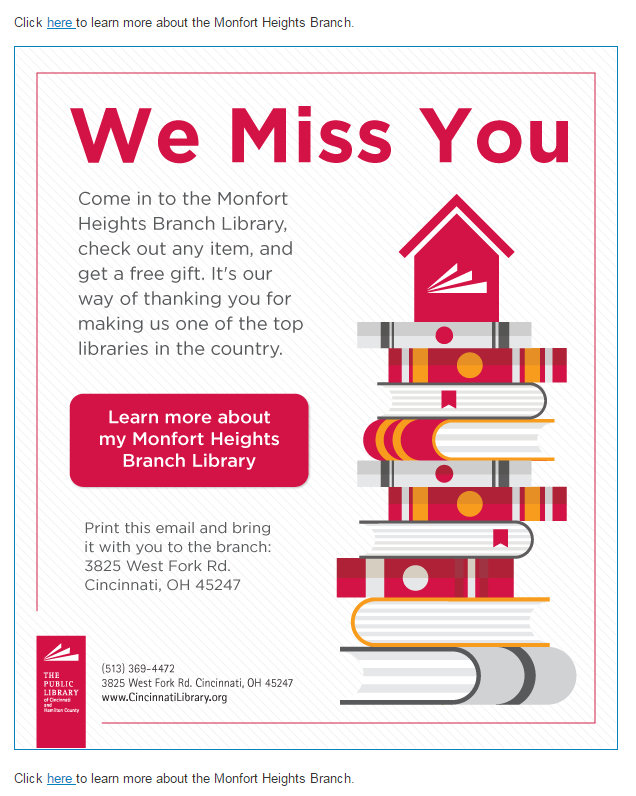
So our idea was to convince occasional users of that branch–people who only come in every couple of months–to come back to the branch by offering them a free gift in exchange for checking out any item. It was January and snow was swirling and we had these amazing library-branded snow scrapers. Maybe that sounds lame to you but trust me, at outreach events, those babies are flying off the table. In any case, we actually did not identify the free gift in the promotion. Our overall library strategic goal this year was to increase physical visits to the branch, and this promotion fell in line with that strategy.

So we identified the target audience with the help of Orangeboy, Inc., the company that manages our email promotions. Through them, we were able to pinpoint occasional users. We took a two-prong approach. We sent those cardholders a postcard, asking them to come into the branch with the postcard for their free gift. We also sent them a targeted email a week after the postcard, which you can see below.

monfort


We sent the email during a time period identified as successful for library emails in our system–on a Wednesday night at 7 p.m. 735 people got the email and the postcard.

The email’s vanity metrics were pretty good…  51.29% open rate and 5.57% click thru rate. But the overall results–getting people to come in and use the branch–was not exciting. 6.6% of recipients came in to claim a prize. Eight were email recipients. 41 people brought in their postcard.

What did we learn from this? Well, a couple of things may have been at play. Perhaps occasionals don’t use the library often because they can’t get to it physically. Perhaps they just don’t want to enter the building. A digital campaign–driving occasional users to our eBranch in exchange for a gift–may be more effective, although we’d have to work out the logistics of getting a gift to someone who doesn’t want to come into a branch.  Perhaps it was the timing. The weather turned out to be pretty miserable, with record-breaking snowfall in the week after the postcard went out.  The week in which the email was sent was mild. However, if we tried it in the spring or summer, we may have better luck.

And although I generally look at this as a failed promotion, I can say that we convinced 49 people who haven’t used the library in a long time to do so!  Circulation at that branch increased by at least 49 items that month. It just seems like a lot of money and effort for a small result.

Still, we’ll keep experimenting with unique ways to draw our old customers back to our branch. Have you done something similar? Tell me about it in the comments. I’d love to hear how your library is working to increase physical visitors.

Subscribe to this blog and you’ll receive an email every time I post. To do that, click on “Follow” button on the bottom left-hand corner of the page. Connect with me on Twitter and Snapchat–it’s where I talk about library marketing! I’m @Webmastergirl. I’m also on LinkedIn, Slideshare,  Instagram and Pinterest. Views in this post are my own and do not represent those of my employer.

The Million-Dollar Reason You Need to Market Your Library’s Collection

THE (1)

$250,000 vs. $8 million.

That’s the spread between the amount my library spends on programming and the amount they spend on collections.

I bet if you checked your library, you’d find a similar story. So why, my dear friends, do library marketers spend the majority of their time and effort promoting programs?

$275,000

Please understand me. I’m not saying that library programming isn’t important or worth promoting. Library programs nourish the soul of our community and offer cultural and educational opportunities for those who might not otherwise have access to them. Most library programs are a valuable and important part of the library’s mission to serve the community. And they deserve to be marketed!

But most library marketing teams spend their energy and resources promoting those programs. And they miss an undeniably important fact about library usage. Library cardholders want the books. They’re checking out books. That’s why they signed up for a library card!

A study by the Pew Research Center published in September 2015 shows 66 percent of library cardholders use their card to borrow books. Only 17 percent attend a library program, class, or lecture. Think about what people say when they sign up a library card. Most are going to tell you they are excited to check stuff out! We take it for granted that people know we have circulation items–books, magazines, music, and more. We need to stop that.

If we want to compete with Amazon and other bookstores, we have to promote our main asset–the collection. People are hungry for information about new stuff in the collection. And every time I talk to someone about the library and I mention that we loan eBooks, eAudiobooks and downloadable music, they look at me like I have two heads. We’re spending a ton of money to build our collection and our customers don’t really know it’s there. When they want a newly released book, who do your cardholders think of first–you or Amazon?

Before I was a library marketer, I worked as a television news producer. That means I put together each night’s newscast, decided which stories were told, in what order, and how they were told. Every year, our news director would bring in a consulting firm whose job it was to help us improve our shows and increase our viewership. I was proud of my work as a journalist. But when I was presented with the feedback from focus groups, it was clear that most viewers were watching my show for the weather. Hearing what was going on in the world was nice, but what they really wanted to know was whether it would rain the next day.

In television news, weather is king. In libraries, the collection is king. Collection marketing is a valuable investment for every library. The best way to market the collection is through targeted emails. In the next few blog posts, I’ll be sharing some secrets for targeted email messaging–things I’ve learned in the 18 months that we’ve done so at my library.

But you can start collections marketing right now through social media–especially Twitter and Pinterest– and by featuring books on the front page of your website.  Create themed book lists–you can enlist your collections development department for help with that task. Talk about new books and popular books in your podcast or on your blog.

For a few minutes every day, spend some time marketing your collection. It will increase circulation and will help reinforce the image of your library as a place of vast resources in the eyes of your cardholders.

Subscribe to this blog and you’ll receive an email every time I post. To do that, click on “Follow” button on the bottom left-hand corner of the page. Connect with me on Twitter and Snapchat–it’s where I talk about library marketing! I’m @Webmastergirl. I’m also on LinkedIn, Slideshare,  Instagram and Pinterest. Views in this post are my own and do not represent those of my employer.

Libraries Need to be Bolder, Braver: Lessons from a Writer

I’m a fan of Ann Handley… that’s not really a secret.

Handley is an inspiration because her approach to marketing centers on creative writing. I spoke to her last year and she was kind enough to do an interview for this blog.

I saw Handley speak at Content Marketing World this year. Her message was full of great advice and there’s one point she made which bounced around in my head ever since it rolled off her tongue.

If the label fell off your product, would your audience still know it belongs to you?

I have looked at everything we do here at my library through new eyes in light of that question. And the honest answer is… no. I think that’s probably the case for most libraries and for most brands, quite frankly.

How do we make sure our writing and our content is truly ours? We’ve all heard experts tell us to “find and use your brand voice” but what does that really mean?

I think it’s particularly hard for a library. Marketing experts warn brands not to try to be all things to all people–to find a niche audience. But that all-inclusiveness is at the core of every public library’s mission statement. We were built by everyone in the community and we serve everyone.

That doesn’t mean your institution can’t find and use its own unique voice. Your voice is about who you are as a library, why you do what you do, and what your customers experience as they deal with your services and staff. Your voice reflects your culture and amplifies your story. It creates empathy in your cardholders and shows you care about them. Here are some tips from Handley’s talk.

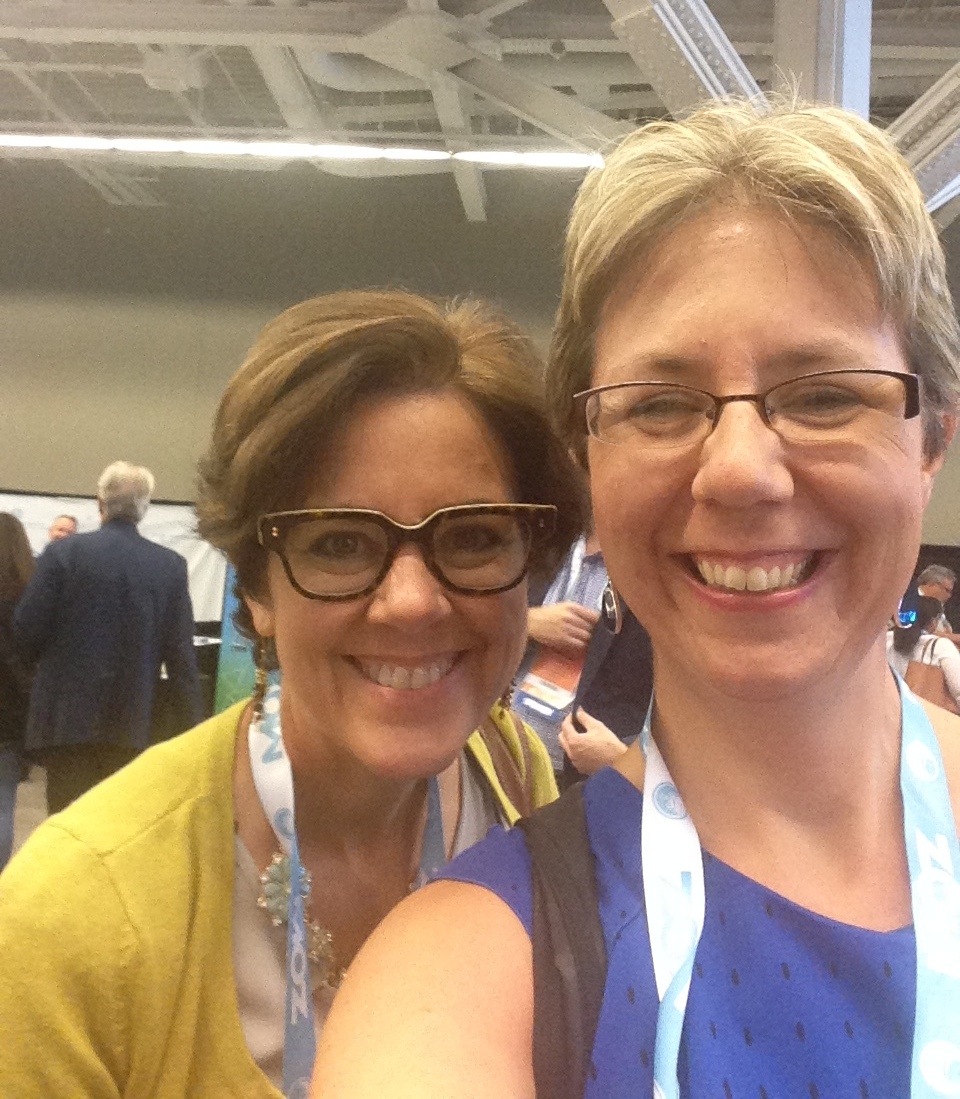
handleyang

Don’t play it safe. Now, don’t get scared right off the bat. I know you are likely taxpayer-funded. You’re conscientious about everything, from how you spend your money to how you word your phrases. Handley isn’t asking you to be racy or provocative. She’s encouraging you to move away from “library lingo”… to speak conversationally, using words that real people use and understand. She’s asking you to stop assuming your cardholders know about all the services your library offers, how to use them, and where to find help. She’s saying you should look for stories from inside your library and from your cardholders and share those stories.

You don’t have to spend a ton of money to create engaging content. Handley says compelling content is more about brains, hearts, and guts than budget.  Handley told us the story of a family member and his quest for the perfect coozy. It led him to the company Freaker USA, which makes unique coozies. Check out their “about” page. No fancy talk, no lingo. I also love their FAQ page. It uses humor to gain interest for a drink insulator. You have to admit that’s genius.  And there’s no reason libraries can use that same approach to make their information more accessible.

Deep value makes your customers smart. Consider how your library is leading your community. How do you make the world a better place? Through questions like this, you’ll find stories that you can tell through heartfelt, engaging writing. Those stories nearly write themselves. And that’s the stuff your cardholders really want to hear about.

Finally, Handley encourages you to disrupt your industry fairy tales. What is it that people think of when they think about your library? What stories and stereotypes has your organization perpetuated? When I tell people I work in a library, they ask me if I work in a Carnegie-designed building full of women wearing glasses and sensible shoes who are constantly telling people to be quiet. That’s so far from the truth! Today’s libraries are noisy, creative, modern places. Let’s start telling those stories and bust those myths.

Subscribe to this blog and you’ll receive an email every time I post. To do that, click on “Follow” button on the bottom left-hand corner of the page. Connect with me on Twitter and Snapchat–it’s where I talk about library marketing! I’m @Webmastergirl. I’m also on LinkedIn, Slideshare,  Instagram and Pinterest. Views in this post are my own and do not represent those of my employer.

A WordPress.com Website.

Up ↑