Search

Super Library Marketing: Practical Tips and Ideas for Library Promotion

Tag

social media

This Library Left Facebook: Here’s What Happened Next.

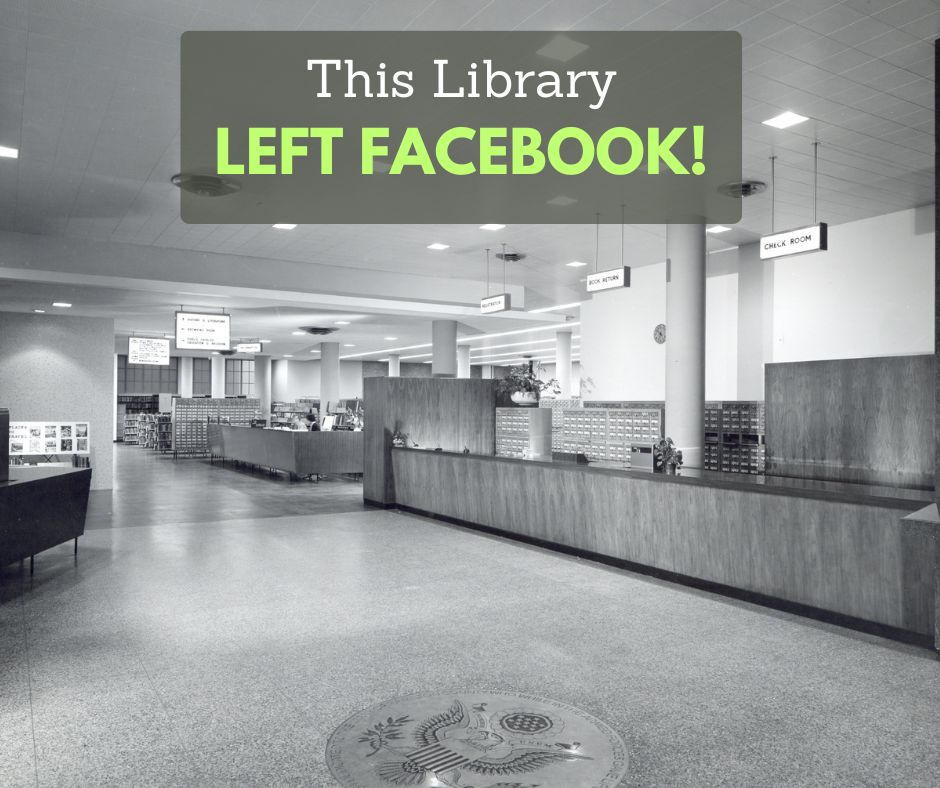
**Alt text:**
Black-and-white photograph of a spacious library interior with service desks, card catalog cabinets, and hanging directional signs. A dark gray banner overlays the top of the image with the text "This Library LEFT FACEBOOK!" in white and bright green lettering.
Photo courtesy of Cincinnati & Hamilton County Public Library

For years, conventional wisdom in library marketing has been clear: you need to be on Facebook because that’s where your community is.

But what if that’s no longer true?

The staff at Lucius Beebe Memorial Library in Wakefield, Massachusetts, asked themselves that question. And then did something many libraries would consider unthinkable.

They stopped using Facebook altogether.

Several months later, Library Director Catherine McDonald says the results have been surprisingly uneventful.

โ€œAfter all the work that went into the decision, it didn’t have any effect other than how freeing it is to have one less thing on my plate,โ€ says McDonald.

โ€œI realized I had felt a constant responsibility to protect patrons and staff from harsh words and misinformation about the library and its services. People donโ€™t behave face-to-face as they sometimes might on Facebook.โ€

A Long Time Coming

Lucius Beebe Memorial Library serves Wakefield, Massachusetts, a community of just under 30,000 residents located north of Boston. The library operates from a single historic building on Main Street.

The library wasn’t an early skeptic of Facebook. In fact, McDonald created the library’s first Facebook page around 2010.

At first, the platform helped the library connect with patrons and promote programs and events. Over time, the library expanded its social media presence and experimented with different content strategies.

Some of the library’s most successful posts featured unexpected moments, including a bunny rescue, removal of a hornet’s nest, and staff retirements.

But as the years passed, McDonald began questioning whether the effort was still worthwhile.

” First, we noticed that the number of followers who were Wakefield residents was about only a third of the list,” recalls McDonald.

ย โ€œSocial media was becoming less social and requiring more work to understand how to game the system.โ€ It became complicated to understand who we were reaching with what information.โ€

McDonald also saw reports on declining reading-for-pleasure rates, online bullying, misinformation, and increasingly hostile online interactions. The platform also made it difficult for the library to control its own narrative.

“On Facebook, often people type, but don’t read,” McDonald says.

Those concerns prompted a deeper internal discussion about whether Facebook still aligned with the library’s mission.

Testing the Assumptions

One of the most common arguments for maintaining a Facebook presence is that libraries need to “meet people where they are.” McDonald wasn’t convinced that statement should go unquestioned.

Rather than relying on assumptions, the library began comparing Facebook’s effectiveness against other communication channels, including its website, newsletters, blog, and local media outlets. The library also experimented with a social media pause during Summer Reading. The response?

“I received a couple of emails thanking me,” McDonald says.

The experience reinforced what library leadership was beginning to suspect: Facebook might not be as essential as many people believed.

Making the Decision

After an influx of bots appeared on the library’s Facebook page, McDonald decided it was time. With support from the assistant director, the library stopped actively using Facebook.

Not everyone was immediately convinced. Two members of the library’s board questioned the decision, and some staff initially worried the library might be giving up an important communication tool.

“Initially, some staff thought we were missing something important,” McDonald says. “But they accepted the decision and moved on to other things.”

Interestingly, she says stakeholders have been more likely to praise the decision privately than criticize it publicly.

What Happened After Leaving Facebook?

The short answer: not much.

  • Program attendance remained steady.
  • Website usage remained strong.
  • The library’s newsletters and blog continued to perform well.
  • Community engagement did not decline.

 The library still maintains an Instagram presence, which McDonald says allows staff to share photos and connect with the community without many of Facebook’s drawbacks.

In fact, one unexpected benefit involved customer service. When the library was active on Facebook, patrons expected staff to monitor comments and answer questions in real time. During weather closures, for example, patrons would ask questions such as, “Are you open tomorrow?” and expect a response.

Without dedicated staff monitoring the platform, those inquiries often went unanswered. Now there is no confusion about where patrons should go for timely information.

“The expectation is that the place to learn immediate information about the library is the website or the Town website,” McDonald says.

The library also works closely with Wakefield’s communications manager to ensure important messages reach the community.

The Real Benefit

While the library didn’t experience dramatic gains after leaving Facebook, McDonald says the biggest benefit was psychological. For years, she felt responsible for moderating misinformation, managing negative comments, and protecting both patrons and staff from hostile online interactions.

That burden disappeared.

“I realized I had felt a constant responsibility to protect patrons and staff from harsh words and misinformation about the library and its services,” she says.

The experience also eliminated ongoing questions about moderation policies, comment removal, and blocking users, areas where McDonald says she often received conflicting legal advice.

Advice for Other Libraries

McDonald acknowledges that many libraries continue to find value in the platform and use it successfully.

But she does encourage library leaders to examine their assumptions.

“I’m sure lots of communities find Facebook effective and fun,” he says. “But don’t be afraid to question your assumptions or prevailing theories.”

For Lucius Beebe Memorial Library, questioning those assumptions led to a surprising discovery: Leaving Facebook changed far less than they expected.

And sometimes, that’s the most revealing result of all.


Want more help?

Library Marketing Case Study: How UVUโ€™s Fulton Library Connects with 47,000ย Students

Subscribe to this blog, and youโ€™ll receive an email whenever I post. To do that, enter your email address and click on the โ€œFollowโ€ button in the lower left-hand corner of the page. You can also follow me on the following social media platforms:


Facing the Hard Truth About Organic Reach on Facebook: Is It Worth Your Energy?

Watch this video now

#LibraryMarketingShow, episode 283

I’m not sure this is healthy for me. Still, I’ve been thinking about Facebook organic reach a lot lately. I’ve been wondering: Does it make any sense for libraries to post organically to Facebook anymore?

I think there are some hard truths about Facebook that we need to work through. We’re going to do it in this episode of the Library Marketing Show.

Do you have a suggestion for a topic for a future episode? Do you want to nominate someone for kudos? Let me know here. Thanks for watching!โ€‚

P.S.: If you wish, you may download a transcript of this episode.


Miss the last episode? No worries!

Will I see you soon?

Subscribe to this blog, and youโ€™ll receive an email whenever I post. To do that, enter your email address. Then, click the โ€œFollowโ€ button in the lower left-hand corner of the page. You can also follow me on the following social media platforms:

8 Key Pieces of Social Media Marketing Advice From a Library Marketer Who Works at One of Scotlandโ€™s Oldest Public Libraries!

Photo courtesy Cincinnati and Hamilton County Public Library

About 10 miles north of the northernmost coast of Scotland lay an archipelago or chain of islands called Orkney. The islands surround Neolithic sites dating back 5,000 years with tall sandstone cliffs and colonies of seals. Archeological evidence shows that humans have lived on the island for nearly 9,000 years.

Thatโ€™s where John Peterson lives and works. He has managed social media for Orkney Library & Archive since 2017.

The library is one of the oldest public libraries in Scotland, dating back to 1683. These days, the Orkney library has two physical locations, a mobile library, and serves a population of about 22,000 people.

โ€œOrkney is a very rural community with a lot of farming and agriculture,โ€ explains John. โ€œAnd of course, weโ€™re an island so weโ€™re surrounded by the sea and have a lot of maritime history, particularly from the 20th Century and the World Wars.โ€

The Orkney library may be remote, but it has fans worldwide. In fact, one of my readers nominated this library for a profile, saying โ€œI love their use of social media and how they got such a small library on the world map.โ€  

โ€œWeโ€™re a very small organization and so we donโ€™t have a marketing team or anything like that,โ€ says John. โ€œWe just try to share what weโ€™re doing with our followers on social media and have a bit of fun as we go along.โ€

โ€œWe use social media as a way of sharing whatโ€™s happening in the library and the archive and what we do every day. Itโ€™s a good way of showing off Orkney and what it is to be a library and archive service in the 21st century.โ€

Orkney Library posts on Facebook, Instagram, and X (formerly known as Twitter). Of the three, John says X is the most effective way to reach his audience.

โ€œIt has its challenges sometimes but itโ€™s probably still our favourite as a way of telling stories and making fun posts or threads,โ€ explains John. โ€œFor us, it has been a great way of communicating an idea with a few words and pictures. Our Twitter following is approximately 4 times the entire population we serve.โ€

โ€œInstagram is our newest platform, but it has a growing audience, and we get a lot of nice feedback.”

“The platforms work differently, so we often have to tweak the posts slightly to suit each. Often, we post on Twitter first and then on to the other two platforms.โ€

When John sees a particularly effective post, he builds on that success by sharing the same kind of content his audience is responding to. But he admits that, like most of you, heโ€™s sometimes baffled by what does and doesnโ€™t work!

โ€œWe post different kinds of content,โ€ explains John. โ€œBut they usually involve books, archives, or old photographs.โ€

 โ€œSometimes a post takes off far better than you expected and other times a post that you thought was interesting or funny doesnโ€™t get much engagement. There is a whole load of reasons for that and itโ€™s important not to get too disheartened if something doesnโ€™t work.โ€

โ€œOf course when a post doesnโ€™t work it could be that the idea wasnโ€™t good or wasnโ€™t communicated well enough. But often it is just a case of timing โ€“ wrong time, wrong day, it didnโ€™t get the retweets to send it further across the platform, etc. You could post the same post at two different times and get totally different responses.โ€

John’s Advice for Social Media Marketing

  1. Try to post good content and try to post regularly โ€“ but not too much. Not every post can be funny or interesting. But try to make sure that some of them are so people have a reason to follow you.
  2. Try to make it interesting. Donโ€™t just do what everyone else is doing, and donโ€™t rely on sharing content from other accounts.
  3. Try to write your own stuff and find your own voice.
  4. Pay attention to what works for you and then do more of it. Listen to feedback, good and bad โ€“ itโ€™ll help you to do more of what people like and less of what they donโ€™t.
  5. Donโ€™t be controversial and try to avoid politics.
  6. Concentrate on what makes your library or organization different from everyone else and try to use those things to build your own presence and identity.
  7. Look around you. Spot opportunities for good content. The more you do it the easier it gets.
  8. Find some libraries on social media and follow them, no matter where they are in the world. They donโ€™t have to be the famous places youโ€™re always hearing about to be worth following. Anybody can be worth following if they post good, interesting content – even small local libraries on remote islands. Find some libraries and archives, museums and galleries, and give them a follow. Youโ€™ll be glad you did.

Johnโ€™s final piece of advice: donโ€™t take your libraryโ€™s social media work too seriously.

โ€œThatโ€™s what itโ€™s all about โ€“ having fun, having a passion for what youโ€™re doing, and sharing it with the world.โ€  


P.S. You might also find this helpful

A Reader Asked for My Ultimate Top Ten Tips for the Most Effective Library Marketing Possible: Hereโ€™s the List

Subscribe to this blog and youโ€™ll receive an email whenever I post. To do that, enter your email address and click on the โ€œFollowโ€ button in the lower left-hand corner of the page. You can also follow me on the following social media platforms:

A WordPress.com Website.

Up ↑