Search

Super Library Marketing: Practical Tips and Ideas for Library Promotion

Tag

Writing

Library Cracks the Code on How To Tell Stories to Stakeholders: They Use Email! Hereโ€™s How Their Targeted Newsletter Works

Photo courtesy Cincinnati and Hamilton County Public Library

During the pandemic, Claudine Bennet was stuck at home, and trying to adjust to her new role as External Relations Manager at Dayton Metro Library, she came up with a fun game.

โ€œAt the time, I had a map next to my desk at home,โ€ remembers Claudine. โ€œI would glance up and see a city and boom! I was searching for their website and social media presence.”

“Not only did I learn a lot about what libraries across the country were doing during a pivotal time in our country, but it helped to affirm we were on the right track with our strategy.โ€

Claudine has come a long way from her childhood days spent in the basement of the Peru Free Library in upstate New York.

โ€œThe childrenโ€™s section felt like a magical hide-out,โ€ recalls Claudine. โ€œAdults were never in that space (a paradise for a kid!) and I could read and look at all the books I wanted!โ€

Nowadays, Claudine oversees media relations and marketing for DML, located in south central Ohio. The system has 17 physical branches, 350,000 active card holders, and a service population of 533,892 residents.

A few months ago, Claudine contacted me to nominate her library for kudos on The Library Marketing Show. She wanted to share a newsletter her library sends to lawmakers and legislators.

Claudine and the External Relations (ER) team realized they needed such a newsletter in 2023.

โ€œNews releases in the local media, flyers in branches, our website and social media platforms โ€“ those are great ways to get information out,โ€ explains Claudine. โ€œWe also have a general digital newsletter that reaches more than 65,000 subscribers. But those methods are broad brushstrokes.โ€

โ€œWhen Austin Railey III joined DML as the new Government Relations and Advocacy Director we started brainstorming how we could strategically tell our stories to decision-makers. After weighing the pros and cons of various methods, we decided the most targeted and economically efficient way was through a quarterly email.โ€

Claudine says the newsletter, Beyond Books, is a collaborative effort. Her department works with others to select stories that reflect how the library collaborates on community initiatives such as economic and workforce development, building regional partnerships, and creating innovative services and programs of value to all community members.

โ€œThe stories we tell in Beyond the Books arenโ€™t about the who, what, when, and where of events and programs, but about the why,โ€ says Claudine. โ€œWhy did we create a program? Why is the program or service helping our patrons? Why should it receive support? Why is DML a valued community partner?โ€

โ€œWe always put photos in the newsletter also. Reading a story is great, but seeing the story is incredibly valuable too!โ€

Claudine says the audience for this specific newsletter is a curated list of 200 elected officials and government sector leaders. DML tailors the information to reflect the topics of utmost importance to these readers.

โ€œBecause the topics are relevant to the readers and we limit the content to two to three stories, it is an easy and digestible way for elected officials and community leaders to stay connected with how the Dayton Metro Library is achieving its mission, vision, and values,โ€ asserts Claudine.

The collaboration involved in Beyond Books is key to its success.

โ€œWhen looking for communication solutions for a niche audience, bring everyone to the table,โ€ advises Claudine.

โ€œFor myself and my team, it is incredibly helpful to understand what is trying to be communicated, to whom, and why. Those answers will help to identify which communication tool we need to optimize and what information should be shared.โ€

โ€œOnce that is explained and expectations are established for everyone, the creativity flows! Now, as a team, we often suggest stories for Books and Beyond because we understand what we are trying to achieve.โ€

Claudineโ€™s team is also working on a new branding campaign called Free to Belong. Working with a nationally recognized local advertising agency, the library sought input from staff and the public about its brand and marketing tools. The new campaign is in its second phase. The library will release television commercials, social media spots, print and radio ads, and billboards.

โ€œThe second set of spots cement DML as a destination where everyone is valued,โ€ explains Claudine. โ€œThey will feature the library meeting people where they are, including the Bookmobile at festivals and our library tent at special events such as the annual Pride celebration in Dayton.”

“The spots will also feature members of marginalized communities as they use library resources including collections and technology. Everyone needs to see themselves in our spaces!โ€

When sheโ€™s looking for inspiration, Claudine turns her eyes to other libraries in the Buckeye State.

โ€œLibraries in Ohio are incredibly inventive and impactful in their marketing efforts,โ€ says Claudine. โ€œIโ€™m always inspired by what they are doing!”

“Weโ€™ve created a state-wide committee of library communications and marketing professionals, and we share our “aha” moments, ideas, resources, challenges, and successes. I have learned that libraries are truly a profession that subscribes to the philosophy of โ€˜When one rises, we all rise.โ€™โ€

Hey library marketing friends: Your work is important and you are making a difference. Keep it up, you’re doing great!


P.S. You might also find this helpful

Finding the Perfect Name for a Library Program: A Checklist and Tips for Using AI

Subscribe to this blog and youโ€™ll receive an email whenever I post. To do that, enter your email address and click on the โ€œFollowโ€ button in the lower left-hand corner of the page. You can also follow me on the following social media platforms:

โฑ๏ธHereโ€™s an Easy Trick To Share a Consistent Message Across Multiple Library Marketing Channels and Save Time!

Watch this video now

#LibraryMarketing Show, episode 242

One of my viewers is struggling with consistent messaging. They are wondering how to promote something across multiple channels without rewriting the text every single time!

This is a great question. And there’s a little trick you can use to save time and effort. I’ll share it with you in this episode.

Plus kudos go to a library for press coverage they received for their new RFID checkout stands. I’ll explain.

Do you have a suggestion for a topic for a future episode? Want to nominate someone for kudos? Let me know here. And thanks for watching!โ€‚

Special note for viewers: The next episode of The Library Marketing Show will be released on Wednesday, June 5.


Miss the last episode? No worries!

Will I see you soon?

Subscribe to this blog and youโ€™ll receive an email whenever I post. To do that, enter your email address and click on the โ€œFollowโ€ button in the lower left-hand corner of the page. You can also follow me on the following social media platforms:
Interviewing Techniques Anyone Can Use To Land a Powerful Quote for Your Libraryโ€™s Blog, Video, Social Media, or Press Release

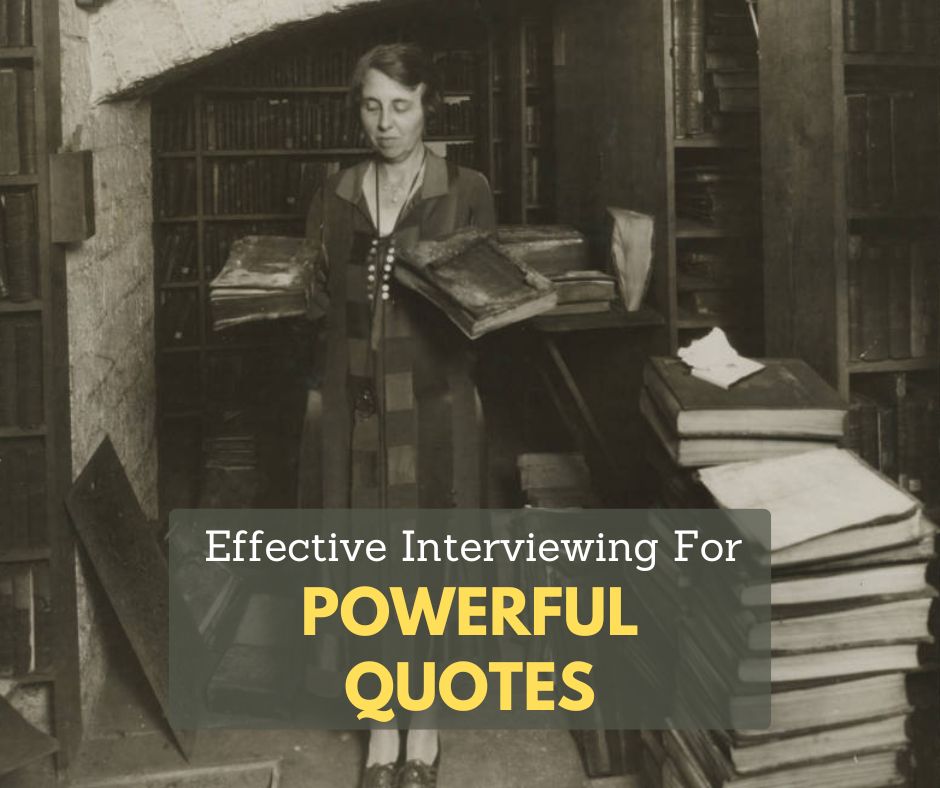
Photo courtesy Cincinnati and Hamilton County Public Library

Interviewing a stranger about their library experience is intimidating for many people. If the thought of having an intentional conversation to elicit a sound bite you can use in a blog, video, social media post, press release, or other content sounds daunting, the post is for you.

Why a powerful quote is important.

Your audience wants to hear directly from the people impacted by your library’s work. Whether that is your staff, director, board members, or patrons, a good quote can drive home your work’s value.

A quote can convey passion or a strong point of view. It can turn a story about statistics or complicated concepts into something understandable and relatable. A quote can also establish an emotional connection with the reader or viewer.

And, if your goal is to catch the attention of local media, a good quote can make your press release, blog post, or email stand out. Because…

The media knows when your quote is fake.

I worked in a local television newsroom for nearly 20 years before I became a library marketer. And Iโ€™m here to tell youโ€ฆ journalists can tell when youโ€™ve made up a quote for a press release.

I understand why it happens. Your director or coworkers may tell you they trust you to put words in their mouths. It seems less time-consuming than doing an interview.

But the media can tell when youโ€™re making it up. Thatโ€™s why an interview, however short, is key to getting an authentic quote. So here are tips to make the interview process smooth and successful.

Prepare as much as possible.

If you are interviewing a co-worker, a board member, or the director of your library, take a few moments to see if there is any documentation that gives you clues about their background. Search their LinkedIn profile and board minutes. Do a Google search to see if theyโ€™ve ever done an interview. You may learn new facts about them and their speaking style.

Think about how you might structure your piece before you even write it.

That structure may lead you to questions to ask.

For example, readers may notice that I often start library profiles on this blog with some facts about my subjectโ€™s life before they worked in marketing. I ask people to tell me about their childhood library and their work before libraries, to build the scene and give a deep background on my subject. Use this technique for any interview leading to a blog post, social media post, or video.

If you are interviewing to get a quote for a press release, I suggest writing the press release before doing the interview. Leave spaces where a quote or two would grab the media’s attention and add context and emotion to the story youโ€™re trying to pitch. Now youโ€™re ready to write your questions.

Craft targeted questions that elicit insightful responses.

  • Use simple sentences and language.
  • Add intention to your questions. If you want someone to share a firsthand experience or observation, craft your sentence to gently lead your interviewee to that answer.
  • Ask open-ended questions. If you must ask a yes or no question, follow up with โ€œWhy?โ€ to give your subject the nudge to elaborate.
  • Still stuck? Use your tools. ChatGPT can help you craft questions for your interview.

To show how this works, I typed into ChatGPT: โ€œI am interviewing my library director about a new partnership that will help community members land a job or advance their careers. Can you give me some sample questions I might use to get a good quote?โ€

Here is the list of questions ChatGPT gave me.

  • Can you please provide an overview of the new partnership aimed at helping community members with job placement and career advancement?
  • What motivated the library to pursue this partnership?
  • How do you envision this partnership benefiting members of our community?
  • Could you elaborate on the specific resources or services that will be made available through this partnership?
  • In what ways will the library be collaborating with the partner organization to deliver these resources and services effectively?
  • How will the library measure the success of this partnership in terms of its impact on community members?
  • Are there any demographics or groups within the community that stand to benefit most from this initiative?
  • How does this partnership align with the library’s broader mission and goals?
  • Can you share any success stories or examples of how similar partnerships have been effective in other communities?
  • What steps will the library take to ensure that community members are aware of and can easily access the resources and services offered through this partnership?

That is a huge list! It’s a great start. All I would need to do is go through and tweak the questions to match the tone I want to set and to sound more like something I would say.

Now comes the fun part: the interview!

6 tips for conducting the interview

  • #1: Record the conversation.
  • #2: Talk a little about yourself to get the conversation started.
  • #3: Ask an easy first question to calm everyoneโ€™s nerves.
  • #4: Encourage elaboration on interesting points.
  • #5: Let the person talk. Donโ€™t be afraid of silence.
  • #6: Paraphrase or summarize key points to nudge the interviewee towards a quotable response.

P.S. You might also find this helpful

Library Marketer Shares Brilliant 4-Step Plan for Getting Press Coverage and Building Personal Relationships With Media

Subscribe to this blog and youโ€™ll receive an email whenever I post. To do that, enter your email address and click on the โ€œFollowโ€ button in the lower left-hand corner of the page. You can also follow me on the following social media platforms:

Another Potentially Controversial Video: 4 More Library-Centric Words To Eliminate From Your Library Promotions ๐Ÿฅบ

Watch this video now

#LibraryMarketing Show, episode 217

A few weeks ago, we talked about eliminating the word “resource” from your library marketing. That video started a conversation that resulted in a whole list of words to eliminate from your library marketing vocabulary.

Get the list and the reason why this change is so important (I promise I’m not trying to be a pain… there is a good reason) in this episode!

Do you have a suggestion for a topic for a future episode? Want to nominate someone for kudos? Let me know here.

Thanks for watching!


Miss the last episode? No worries!

Will I see you soon?

Subscribe to this blog to receive an email whenever I post. To do that, enter your email address and click on the โ€œFollowโ€ button in the lower left-hand corner of the page. You can also follow me on the following social media platforms:

Controversial Opinion: Why Your Library Should Stop Using the โ€œRโ€ Word in Your Promotions (Please!)

Watch this video now

#LibraryMarketing Show, episode 211

This one may be controversial but…

I want you to stop using the “R” word in your library promotions.

What is the “R” word, and what should you say instead? I’m going to explain in this episode.

Plus someone will receive kudos!

Do you have a suggestion for a topic for a future episode? Want to nominate someone for kudos? Let me know here.

Thanks for watching!


(P.S.)

Miss last week’s episode? No worries!

Will I see you soon?

Subscribe to this blog and youโ€™ll receive an email whenever I post. To do that, enter your email address and click on the โ€œFollowโ€ button in the lower left-hand corner of the page. You can also follow me on the following social media platforms:
The Secret to Writing Engaging Copy for Any Library Promotion AND Getting Results Starts With a โ€œKISSโ€!

	
Delivery room (2nd floor of intermediate building) - in 1898-1899 Annual Report. Moved here from first floor in 1898-1899. Photo courtesy Public Library of Cincinnati and Hamilton County.

In 1960, Kelly Johnson was the lead engineer at a division of Lockheed that made spy plans.

One day, he handed a team of design engineers a handful of tools. Then he told the engineers that they must design a jet aircraft that would be repairable by the average mechanic in the field under combat conditions using only those tools.

At that moment, the popular design phrase “Keep it Simple, Stupid” or KISS was born. It describes the idea that most systems will work better if they are designed simply.

I first heard this phrase in journalism school. Reporters, marketers, ad agents, and public relations employees are all taught the power of simplified language in copy.

Simplified copy is easy to read and understand. It sounds authentic. Conversational copy subconsciously signals to your audience that you are a person, and people like communicating with other people.

Librarians are intelligent and sophisticated people. They have a deep understanding and appreciation of complex concepts. They’re driven by accuracy and information. It’s challenging to write clearly when you’re an expert in your field!

But our cardholders may have a difficult time understanding library brochures, posters, blogs, and websites with convoluted and confusing language. They may be tune out if the wording of your promotions isn’t conversational.

Your job as a library marketer is to translate complex thoughts and concepts into a concise and clear language your audience can understand and appreciate.ย You must present information in a way that the cardholder can understand.

It’s easier said than done, but here is some guidance you can put into practice any time you’re asked to write a piece of library marketing.

Identify your target audience and the action you want them to take.  

Before you even write the first draft of any promotion, pinpoint your audience as precisely as possible.

Are you writing for teens ages 13-15? Are you writing for women, ages 25-54, who love to read cozy mysteries? Are you aiming your message at parents of preschoolers who need help finding books to read to their children?

When you’ve settled on your target audience, write a sentence about them at the top of the page. Be as descriptive as possible.

Underneath that, write a sentence that describes the point of your marketing material. Are you trying to persuade someone to try a new service? Do you want to increase participation in a preschool storytime? Are you trying to get teens to enter an art contest?

Once you know precisely who your audience is and what you want them to do after they’re read your marketing material, you’ll have an easier job of writing clearly.

Define unfamiliar or difficult words, titles, or services. 

Go through the draft of your material and highlight words or terms that may confuse your audience. Then, find a better way to say or explain those words.

Never take it for granted that your reader has been a lifelong user or follower of the library. Words used by librarians to describe services, programs, catalogs, and databases, which may seem common and every day to you and your staff, may not be so to your reader.

Shorten your sentences and paragraphs. 

You may have noticed that, about 18 months ago, I started writing shorter sentences and paragraphs here on the blog. Views rose by 118 percent!

That’s because shorter sentences and paragraphs make it easier for your reader to understand and absorb what you are saying. Long paragraphs look thick and off-putting. Multiple studies show readers will skip lengthy paragraphs. And the Poynter Institute’s Eyetrack Study shows people are more likely to read an entire webpage when the paragraphs are short.

There are two rules you can remember to help you get into the habit of shortening sentences and paragraphs.

  • Ziomek’s 1-2-3-4-5 rule: Created by Jon Ziomek, a professor at the Medill School of Journalism. The rule says each paragraph must contain: 1 idea, expressed in 2 to 3 short sentences, taking 4 to 5 lines.
  • Nityesh Agarwal‘s 80-20 rule: You can convey 80 percent of the information in any piece of writing using 20 percent of the words.

Get into the habit of hitting your return key more often. You can also break your writing up using bullet points or lists.

Use online writing tools.

There are lots of free tools that can help you craft sentences that are clear and concise, even when the subject matter is not! They can help you figure out a headline that will draw readers in. They can help you discover just the right word to make your meaning clear.

Here’s a list of my favorite online writing tools. The Grammarly extension for Windows is also extremely helpful.

Ask a non-library employee to read your work.

I often ask my family members to read my writing. If they find anything to be confusing or convoluted, I know I need to change it.

Bonus Tip: Read or listen to the bookย Everybody Writesย by Ann Handley. It’s life-changing. Check your library collection first. If you have Overdrive, you’ll have the audiobook version. You MUST read this. It will make you a better writer.

Do you have tips for writing more clearly or examples where you have taken a complex library concept and simplified it for an audience? Share your experience or questions in the comments.  

Related Posts

Library Blogs are the Best! How to Use Your Website to Amplify Your Library Marketing Message on Your Own Terms

Breaking News: Make Sure Your Library Gets More Press Coverage with These Six Tips from a Former Journalist

Angela’s Latest Book Review

The Office of Historical Corrections by Danielle Evans


Subscribe to this blog and youโ€™ll receive an email every time I post. To do that, enter your email address and click on the โ€œFollowโ€ button in the lower left-hand corner of the page.

Library Marketing Show Episode 16: How to Gently But Firmly Get Any Department to Let You Handle Marketing Messages!

Watch Now

In this episode, we talk about an anonymous question from a reader who has a little problem: The departments in their library get upset when they re-write their text suggestions for marketing messages. I’ll talk about how I handle this situation at my library. We’re all in this boat, right??

As promised, some articles to help convince your skeptical programming co-workers about the importance of writing library marketing text.

Why Marketers Must Learn to Write

KISS Bad Writing Goodbye: How to Save Your Marketing

Why Writing Skills Are Necessary in Marketing

Also kudos to the West Gippsland Libraries in Australia for their hilarious new brand awareness video.

Stay in Touch

Check the Upcoming Events page to see where I’ll be soon. Let’s connect! More events are coming soon.

Have an idea for the next Library Marketing Live Show?ย Submit it now.

Subscribe to this blog and youโ€™llย receiveย an emailย every time I post. To do that, click on โ€œFollowโ€ button in the bottom left-hand corner of the page. Connect with me onย Twitter,ย Instagram, andย LinkedIn.ย ย 

Libraries Need to be Bolder, Braver: Lessons from a Writer

I’m a fan of Ann Handley… that’s not really a secret.

Handley is an inspiration because her approach to marketing centers onย creative writing. I spoke to her last year and she was kind enough to do an interview for this blog.

I saw Handley speak at Content Marketing World this year. Her message was full of great adviceย and there’s one point she made whichย bounced around in my head ever since it rolled off her tongue.

If the label fell off your product, would your audience still know it belongs to you?

I have looked at everything we do here at my library through new eyes in light of that question. And the honest answer is… no. I think that’s probably the case for most libraries and for most brands, quite frankly.

How do we make sure our writing and our content is truly ours? We’ve all heard experts tell us to “find and use your brand voice” but what does that really mean?

I think it’s particularly hard for a library. Marketing experts warn brands not toย try to be all things to all people–to find a niche audience. But that all-inclusiveness is at the core of every publicย library’s mission statement. We were built by everyone in the community and we serve everyone.

That doesn’t mean your institution can’t find and use itsย own unique voice.ย Your voice is aboutย whoย you are as a library, why you do what you do, and what your customers experience as they deal with your services and staff. Your voice reflects your culture and amplifies your story. It creates empathy in your cardholders and shows you care about them. Here are some tips from Handley’s talk.

handleyang

Don’t play it safe.ย Now, don’t get scared right off the bat. I know you are likelyย taxpayer-funded. You’re conscientious about everything, from how youย spend your money to how youย word your phrases. Handley isn’t asking you to be racy or provocative. She’s encouraging youย to move away from “library lingo”… to speak conversationally, using words that real people use and understand. She’s asking you to stop assuming your cardholders know about all the services your library offers, how to use them, and where to find help. She’s saying you should look for stories from inside your library and from your cardholders andย share those stories.

You don’t have to spend a ton of money to create engaging content. Handley says compelling content isย more about brains, hearts, and guts than budget. ย Handley told us the story of a family member and his quest for the perfect coozy. It led him to the companyย Freaker USA, which makes unique coozies. Check out their “about” page. No fancy talk, no lingo. I also love their FAQ page. It uses humor to gain interestย for a drink insulator. You have to admit that’s genius. ย And there’s no reason libraries can use that same approach to make their information more accessible.

Deep value makes your customers smart.ย Consider how your library is leading your community. How do you make the world a better place? Through questions like this, you’ll find storiesย that you can tell throughย heartfelt, engaging writing. Those stories nearly write themselves. And that’s the stuff your cardholders really want to hear about.

Finally, Handley encourages youย to disrupt your industry fairy tales. What is it that people think of when they think about your library? What stories and stereotypes has your organization perpetuated? When I tell people I work in a library, they ask me if I work in aย Carnegie-designed building full ofย women wearingย glassesย and sensible shoesย who are constantly telling people to be quiet. That’s so far from the truth! Today’sย libraries are noisy, creative, modern places.ย Let’s start telling those stories and bust those myths.

Subscribe to this blog and you’llย receiveย an emailย every time I post. To do that, click on “Follow” button on the bottom left-hand corner of the page. Connect with me on Twitter and Snapchat–it’s where I talk about library marketing! Iโ€™m @Webmastergirl.ย Iโ€™m also on LinkedIn, Slideshare, ย Instagramย and Pinterest.ย Views in this post are my own and do not represent those of my employer.

A WordPress.com Website.

Up ↑