Angela Hursh leads an outstanding team of marketing and training professionals at NoveList, a company dedicated to helping libraries reach readers. A 2023 Library Journal Mover & Shaker, she has also created courses on LearnwithNoveList.com designed to help library staff learn how to create effective marketing. Before her job at NoveList, Angela led the content marketing team for the Public Library of Cincinnati and Hamilton County. She also has more than 20 years of experience as an Emmy-award-winning broadcast TV journalist.
In this episode, I’ll answer a question I got from a library staffer: What are the biggest mistakes you see library staff making in their marketing and promotions?
I’ll talk about the three most common boo-boos and give you ideas for avoiding these pitfalls. Don’t worry… you can do it!
Watch to find out who gets kudos!
Do you have a suggestion for a topic for a future episode? Want to nominate someone for kudos? Let me know in the comments.
And subscribe to this series to get a new video tip for libraries each week.
Thanks for watching!
Subscribe to this blog and you’ll receive an email every time I post. To do that, click on the “Follow” button in the bottom left-hand corner of the page.
It’s sometimes insanely hard to get any new marketing ideas to pass approval in a library.
If there is a silver lining to the COVID-19 pandemic, it’s that the crisis helped libraries to see that there are new ways to market and promote their library. It’s opened the door for experimentation.
Even so, presenting a new marketing or promotional idea is sometimes challenging and intimidating for library staff. I know this because every time I talk with librarians at conferences or in one-on-one consultations, they ask, “How do I get buy-in for this great promotional idea with my supervisors and co-workers?”
Here are the four things you can do to gather support and approval for your great new marketing and promotional ideas.
Tell me about a time you had to pitch a library promotional idea. What was the idea? Did you get a yes or no? What did you learn from the experience? Share your thoughts in the comments.
Thoroughly research and prepare your pitch.
Before you pitch a new idea, do your research. You’ll want to present a clear, concise, and strategic case for your idea. Include the following information in your pitch:
How the work benefits your community and cardholders.
How the work ties into your library’s overall strategy and goals.
How the work will get done by staff.
The timeline for implementation.
What the success measures will be.
What the long-term goals of your promotional idea will be.
How you will handle problems that may arise.
The data to back up your claims.
Here’s an example pitch that includes these points.
You’ve determined that Facebook is not giving you the results you want when you promote individual programs. Registration and attendance at programs have been unchanged or decreasing in the last six months, despite the many posts you create. Instead of using social media, you want to start a targeted e-newsletter sent to the people who frequent each branch in your system. You believe these targeted emails will be more effective because they will reach the audiences most likely to attend these programs.
Your pitch will begin by explaining the problem using data. Include registration, attendance figures, and Facebook engagement figures especially clicks on your registration or event information links. Show how the Facebook posts are getting very little engagement and lead to no increase in registration or attendance.
Next, explain how the move to branch-specific e-newsletters will be better for your community and cardholders because it will offer information about events happening in their neighborhood that are specific to their wants and needs. Look for wording in your library’s strategic plan that will make it clear to senior leaders that you are working to fulfill the strategic goals by offering community-based access to information.
Next, make the case that e-newsletters are a more efficient use of your time because they will be more effective and targeted. Again, be specific when you talk about how long it takes to create a Facebook post versus an e-newsletter.
Now, talk about the ways you’ll measure success for your new e-newsletters: increases in registration and attendance, plus open and click rates on the emails. Be specific and use numbers. This will show that you are confident that your new idea will work.
Spend a few moments talking about your long-term goals: how many new subscribers do you want to get in the first six months or year? How much would you like to see registration and attendance grow? What other library services can you imagine promoting using your e-newsletters?
Layout a timeline: when do you think you can launch your first e-newsletter? How long will it take to grow your subscription list? How often will you send these e-newsletters?
Finally, talk briefly about problems you may encounter and how you’ll handle them. What program will you use to send the e-newsletters? Who will create them if you’re sick or on vacation?
Review and rehearse.
Review your plan several times. It’s a good idea to leave a few days in between each review of the plan, to let your ideas marinate. You may think of new benefits or pitfalls during those breaks. You’ll want to be fully prepared to answer any questions and defend your idea with confidence.
Next, practice presenting your idea to a friend at your organization. Choose someone you trust to give you honest feedback about your idea and your presentation.
You might also consider recording your pitch on Zoom or another video recording program. Check to make sure you are speaking slowly and clearly. Evaluate your tone of voice, eye contact, and body language during your practice pitch.
Pitch strategically.
Find a time when your supervisor won’t be rushed. They’re more likely to listen to you when they have time to truly consider your idea.
Pick the right day of the week for your pitch. For example, Mondays are often busy and stressful for bosses. Your supervisor may be more negative at the beginning of the week and it’s likely not the best day for your pitch.
When you pitch, be mindful of your body language. If you are sitting in a chair, don’t pivot back and forth nervously or jiggle your legs. Sit still, but upright, and with confidence.
If you are standing, try separating your legs about shoulder-width apart. This is a “power” pose that will help you maintain good posture and will subconsciously give the impression that you know what you are doing… even if you don’t feel that confident!
If the answer is no, don’t necessarily give up.
A “no” doesn’t have to mean the end of an idea, especially if you think it’s beneficial to your library and customers. There are no bad ideas–just ideas whose time has not yet come.
Write yourself a note in your work calendar to revisit the idea in six months. Keep your eyes open for new opportunities to present your ideas in a different format.
Subscribe to this blog and you’ll receive an email every time I post. To do that, click on the “Follow” button in the bottom left-hand corner of the page.
In this episode, I answer a question from Jenny of Burlington Public Library: “Can you share some ideas for Library Card Sign-up Month in September? I’m especially looking for video ideas and outreach for youth, but I’ll take any ideas!”
Kudos in this episode go to the Saint Louis County Library for offering enrollment in Headspace with a library card.
Do you have a suggestion for a topic for a future episode? Want to nominate someone for kudos? Let me know in the comments.
And subscribe to this series to get a new video tip for libraries each week.
Thanks for watching!
Subscribe to this blog and you’ll receive an email every time I post. To do that, click on the “Follow” button in the bottom left-hand corner of the page.
Instagram is super popular right now, especially with people under the age of 34. That’s a key demographic for library marketers.
According to Web Hosting Rating, 60 percent of users log in daily, and more than half of those people log in more than once a day. Best of all, the average U.S.-based Instagram user spends a whopping 53 minutes a day on the app. (That’s me! 🙋)
If your library posts to Instagram, it’s time to take it up a notch. To drive your engagement stats, there are two things you can do.
Instagram takeovers and Instagram highlights are an easy way to get more reach on your Instagram account.
Instagram takeover
An Instagram takeover is when you arrange for a partner organization, library department, senior leader, or fan to take over your account for a day or during a special event.
A takeover will expose your library to a new audience of potential followers. It will also give your library external credibility.
A takeover can be done without giving your takeover partner the password to your account.
Ask your takeover partner to save each individual story slide to their camera roll.
Next, they’ll email the slides to your library.
Then, you’ll upload them, one by one, to your Instagram story.
Before you agree to a takeover, be sure to establish some guidelines.
Be specific about what you want in terms of content and number of slides.
Set a deadline.
Put all of that in writing.
Here’s a template you can use to set up the guidelines for your own library’s Instagram takeover.
My former library did an Instagram takeover with a nearby library system, with whom we had a reciprocal lending agreement. It gave each participating library access to a new audience. And people loved it! Each story got an average of 605 views.
Patrick Kinsella, Library Communications Coordinator for the library at the University of Salford in Manchester had even more success with his Instagram takeover success story.
He said, “As our Library is in the final stage of a £6.2 million redevelopment, we decided to run a campaign to promote our study spaces outside our main library. We have five main study spaces outside of Clifford Whitworth, our main library, that could give students a place to study and help make up for the reduction in space in Clifford Whitworth.”
“We also decided to take over our university’s main Instagram account to give their followers a tour of what lies beyond Clifford Whitworth. Followers were also invited to send pictures of themselves studying outside Clifford Whitworth in exchange for £5 worth of printer credits.”
“The Instagram story was viewed over 1,200 times and 14 students sent us pictures of themselves studying outside Clifford Whitworth. The cross-promotion of our Instagram account @salfordunilibrary through the story also gained us more than 20 new followers. The user-generated content that we received also allowed us to build a Twitter campaign displaying their images.”
Instagram highlights
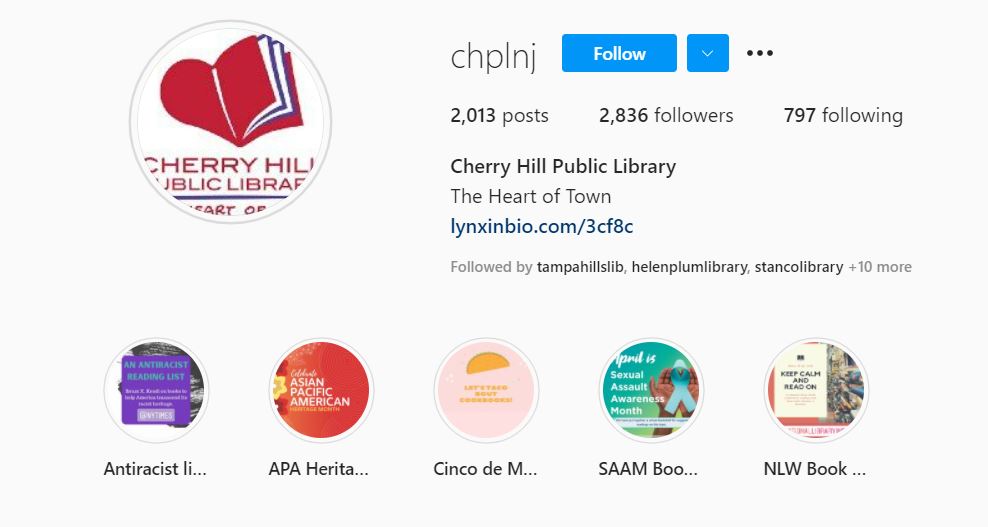
Highlights are custom containers for similarly themed Instagram stories. After you add content to your story, you can choose to highlight that content by saving it to one of these containers.
Unlike regular Instagram stories, which disappear after 24 hours, highlights live on your Instagram profile forever, or until you delete them.
Highlights showcase the best of your previous Instagram content to new followers. And they create an archive of content, especially those stories that contain “evergreen” content that never expires and is always relevant. Instagram highlights are a great place to save library FAQs, book reviews, tutorials, and other wide-ranging topics.
To create a highlight from an active Instagram story:
View the story.
Click on “Highlight” in the bottom tool bar.
Click on the plus icon to create a new highlight container or add to a highlight container you have already created.
Click on “Add”. You’re done!
You can add photos or videos to each of your highlight containers any time you want. There is no limit to how many photos and videos each highlight container can hold.
Springville Library uses highlights, and they’ve created icon-based covers for each container.
You can change the title of your highlights containers at any time. Just open the highlight, and then tap on the name of the highlight container in the upper left-hand corner. You’ll be given the option to edit.
Share your tips for library Instagram success! Click on the Feedback button to tell me about what you’re doing on Instagram. I’ll share your tips with others on Twitter, Instagram, and YouTube!
Subscribe to this blog and you’ll receive an email every time I post. To do that, click on the “Follow” button in the bottom left-hand corner of the page.
In this episode, I answer a question from Tovah Anderson about how to decide how much time and money should be spent on the three buckets of library marketing: programs, services, and the collection.
Kudos in this episode go to the Monroe County Public Library for their new testing kitchen.
Do you have a suggestion for a topic for a future episode? Want to nominate someone for kudos? Let me know in the comments. And subscribe to this series to get a new video tip for libraries each week.
Before I worked in library marketing, I spent nearly 20 years as a broadcast television journalist.
I was a newscast producer for a local TV station. I created a nightly newscast from scratch. I decided which stories would be told, who would tell them, how long they would be, and more.
Every day, I was part of the newsroom decision-making process. I know why certain stories get airtime and others don’t (ratings). I know why important facts end up “on the cutting room floor” (time constraints). I know why online media outlets and newspapers write sensational headlines (clicks).
For the last eight years, I’ve been on the other side of that world. I’ve been the one sending press releases and asking, sometimes begging, for coverage of my library or for the libraries I work with in my current job.
A library blog and a video marketing strategy are the best ways to control the narrative and tell your own library story on your terms.
But let’s be honest… media coverage can be great for your library.
So here are my top six tips to help get more positive press for your library.
Did your library get amazing press coverage? How did you do it? Share your story by clicking on the feedback button in the lower left-hand corner of your screen.
Send news releases early.
For events like author visits, grand openings, and other programs, send press releases four to six weeks before the event. Then, send a reminder to the media again about a week before the event.
If your library is unveiling a new service, send your press release one to two weeks before the new service launches.
For big announcements, like awards, send the press release one week before the official announcement and include a line that embargos the release. That means the news outlet can’t cover the story in print or on air until the day the embargo ends. Put the embargo right in the sub-headline of the press release, to be sure the journalists see it.
Write a news story instead of writing a press release.
If you send the newsroom a publishable piece of content with photos or video, you win on two levels.
First, you’ll increase the chances that your library will get coverage. Second, the narrative is exactly as you want it! You make the important points. You have control.
So, write a story which the media outlet can copy and paste into a script or column. Use Associated Press style and these four basic journalistic principles:
A catchy lead sentence;
The who-what-where-when-why sequence, interspersed with a quote or two;
Clear writing without library jargon or technical terms. If you must use a technical term, explain it clearly. And,
A concise ending.
Make your quotes sound like they come from a real person.
Reporters and editors can spot a manufactured quote a mile away.
I know a manufactured quote is often a necessity in libraries. So, if you must make up a quote from your director, don’t write: “Our dynamic approach to customer service is central to our strategic initiatives. We are scheduled to implement more of these forward-thinking tactics.”
This is so much better: “We are adding an online, real-time reading recommendations service because we wanted to do a better job of answering our patrons’ questions and help them find the books they want. We’re hoping to really shake up the service experience. But mostly, we want to make it easy for people to get personal attention and a great book.”
Don’t send your press release in a mass email.
A reporter is much less likely to follow up with you for a story if they are part of a large group of journalists who’ve all received the same story. Journalists want the “exclusive,” even on small things. So don’t let on that you are also sending your release to other outlets.
When you create your list of media contacts, include information about that outlet’s target audience, the kind of stories they usually cover, and the reporters with whom you have a personal connection.
Then, match your potential story with the right reporter rather than sending your release to every reporter you know. It’s a better use of your time and energy, and you’re more likely to get media coverage.
Find good interview subjects ahead of time.
Reporters are looking for compelling quotes that add depth to a story.
They’ll love a quote or a soundbite from a child who finally catches up in reading because of extra tutoring from a children’s librarian. They’ll jump at the chance for a quote or soundbite from an immigrant who got help at his library filling out a naturalization form.
Arrange diverse interviews, including people from all different backgrounds and walks of life. Most newspapers, TV, and radio stations will tell you their target audience is women, ages 25-54. Your interview subjects should be relatable to people in that demographic.
Pick interview subjects who are comfortable on camera and can “talk in soundbites”. That means they can make a point in three to four sentences.
Respect the reporters’ deadline.
When I was a journalist, it was frustrating to call an organization hoping for an interview or answers to questions only to be told that the person was out of the office or wouldn’t be able to call me back until late in the day.
If a reporter is calling you, chances are that they’re working on the story for today’s edition or newscast, which means they’d really like to have all the elements by early afternoon at the latest, to give themselves time to craft the story. Tomorrow is too late.
Move heaven and earth to accommodate the reporter as much as possible. When you do that, you’re more likely to get coverage every time you ask for it.
Newsrooms often have crews available at odd hours, like 10 a.m. or 8 p.m. Sometimes reporters will squeeze in a story during a very limited window in their day. They may call you and say they can come to the library in 10 minutes. Make sure you and your interview subjects can accommodate those last-minute requests.
I have a special request.
I’m putting together a conference presentation and I’m looking for some examples.
Libraries that have reopened and have had some success drawing people back into the physical branch.
Libraries who believe they’ve figured out the hybrid program model.
Libraries who are trying to turn their pandemic digital users on to other services now that the library has reopened.
I know you are doing amazing work. I want to highlight you on a national stage! Thank you in advance.
Subscribe to this blog and you’ll receive an email every time I post. To do that, click on the “Follow” button in the bottom left-hand corner of the page.
In this episode, I share two social media updates that are relevant for libraries. I’ll tell you about YouTube’s “New to You” feature and Facebook explained how its algorithm works!
Kudos in this episode go to the ten libraries in the UK who participated in the “Creating Space for Kindness” Project.
Do you have a suggestion for a topic for a future episode? Want to nominate someone for kudos? Let me know in the comments. And subscribe to this series to get a new video tip for libraries each week.
Thanks for watching!
Subscribe to this blog and you’ll receive an email every time I post. To do that, click on the “Follow” button in the bottom left-hand corner of the page.
The plain fact is: Next to the face-to-face interaction between librarians and community, an email list is your most effective library marketing tactic.
How do your cardholders learn about new services? How do they find their next great read? How do they figure out how to use parts of the collection they didn’t even know existed, like video streaming or eAudiobooks? You can tell them all about your library’s awesome resources by talking with them in their inbox.
If your library isn’t already collecting cardholder email addresses, please start now.
As your finger hovers over the send button, you may find yourself facing another important decision.
When should I send the email?
Does the timing really matter?
The simple answer is yes.
A great headline and great content are only half the battle for your cardholders’ attention. You’re also competing with their personal schedule, other messages sitting in their inbox, and social media.
Your message is more likely to catch their attention if it lands in their inbox at the right time of day.
Your library is fighting with others for urgency. You want your recipient to say to him or herself, “I need to read this and act on it, right now!”
Getting that message in front of your audience at the right moment increases the open, click-through, and conversion rate because it takes advantage of that sense of urgency.
What the data tells us about the best time to send emails
I’ve done a lot of experimenting with time of day emailing over the course of my library marketing career.
There are three times of day to send messages for the most effective results.
Really early in the morning (by 5 a.m.)
Lunchtime (11 a.m. to 1 p.m.)
Before bed (between 8 and 10 p.m.)
The website Optinmonster calls these “key transition times.” And their research confirms what I learned.
A message sent in the early morning will be sitting in your cardholders mailbox when they first wake up. It’ll be among the first things they check. An email sent at lunch means it’ll be sitting there when they check their messages over their tuna sandwich. An email before bedtime means it’ll be there when they scroll through their emails while they watch a show or before they get ready for bed.
Optinmonster also recommends sending emails at 4 p.m., when people need a little distraction as they get through the last hours of their workday.
As for day of the week, most libraries should avoid sending emails on Mondays and weekends. The agency Wordstream says their data agrees with that assessment.
Your recipients inbox may be flooded with emails on Mondays. And on weekends, many people are running errands and doing other things with their friends and family. They’re less likely to check their inbox on a Saturday or Sunday. Case in point: I’m writing this on a Saturday. It’s 9 a.m. and I just realized I haven’t checked my email yet today!
But what works for me and what works for Optinmonster and Wordstream might not work for you.
It’s crucial that you do your own experimentation.
Try this Four Email Experiment to narrow down the best day and time for your audience.
For this experiment, use the same email for your test. Perhaps you have a weekly newsletter you send to parents, or a bi-weekly email that you send to people who regularly visit a certain library branch. Those emails will work perfectly for this experiment.
Try to keep the subject line for each of the four emails in your experiment similar. You’re testing for the best day and time, so you want to rule out other factors that may make an email more or less likely to be engaging.
Start by sending your email on Tuesday at 4 a.m. The next time you send it, schedule the email for Tuesday at noon. The following send, try Tuesday at 4 p.m. and finally, Tuesday at 8 p.m.
Track your open, click-through, and conversion rates on all these messages to see which is most effective. Work through each day of the week to see which days get you the most traction.
When you find a day and time that works best for your audience, stick to it for about six months. Continue to track your metrics over that six-month period to ensure you’re not seeing a slip in the numbers.
If, after six months, that day and time continues to be effective for you, you don’t need to run the experiment again.
But the habits of your audience may change during that time. Outside forces (like the pandemic) may affect the daily rituals of your recipients. You may need to run the experiment again if you see numbers slipping.
I have a special request.
I’m putting together a conference presentation and I’m looking for some examples.
Libraries that have reopened and have had some success drawing people back into the physical branch.
Libraries who believe they’ve figured out the hybrid program model.
Libraries who are trying to turn their pandemic digital users on to other services now that the library has reopened.
I know you are doing amazing work. I want to highlight you on a national stage! Thank you in advance.
Subscribe to this blog and you’ll receive an email every time I post. To do that, click on the “Follow” button in the bottom left-hand corner of the page.
In this episode, I share some tips for how to use your library’s FAQ’s into marketing opportunities. This idea can be a great way to establish your library as a place of answers.. And it can help you fill holes in your promotional schedule with valuable content.
Kudos in this episode go to Eileen Button of Genesee Public Library who wrote an open love letter to libraries that made me a little teary-eyed!
Do you have a suggestion for a topic for a future episode? Want to nominate someone for kudos? Let me know by clicking on the feedback tab.
And subscribe to this series to get a new video tip for libraries each week. Thanks for watching!





 Super Library Marketing: Practical Tips and Ideas for Library Promotion