Search

Super Library Marketing: Practical Tips and Ideas for Library Promotion

Category

Blog

Grow Your Libraryโ€™s Online Presence and Rank Higher in AI Searches With These Tips

Photo courtesy Cincinnati and Hamilton County Public Library

Key Takeaways:

  1. AI is changing how people search, and libraries are seeing a drop in website traffic as a result.
  2. Simple formatting changes like clear titles, bullet points, and question-based headings can help your content appear in AI summaries.
  3. Add credibility cuesย like staff names, job titles, and internal and external links to boost your siteโ€™s authority with AI and search engines.

Have you noticed a slight change in the blog posts here? Most now include a list of three quick takeaways at the top. Hereโ€™s why I started doing this, and why your library should consider it too.

AI impacts website traffic

A few months ago, I attended a webinar featuring three of the leading experts on Search Engine Optimization, or SEO. SEOย isย the practice of improving a website’s visibility and authority in organic search results to attract more visitors.ย 

But AI has introduced a new wrinkle in SEO.

In May 2024, Google introducedย AI Overviewsย (formerly called AI Summaries). These appear at the top of search results and provide a summarized answer to a userโ€™s search, often pulled from multiple sources.
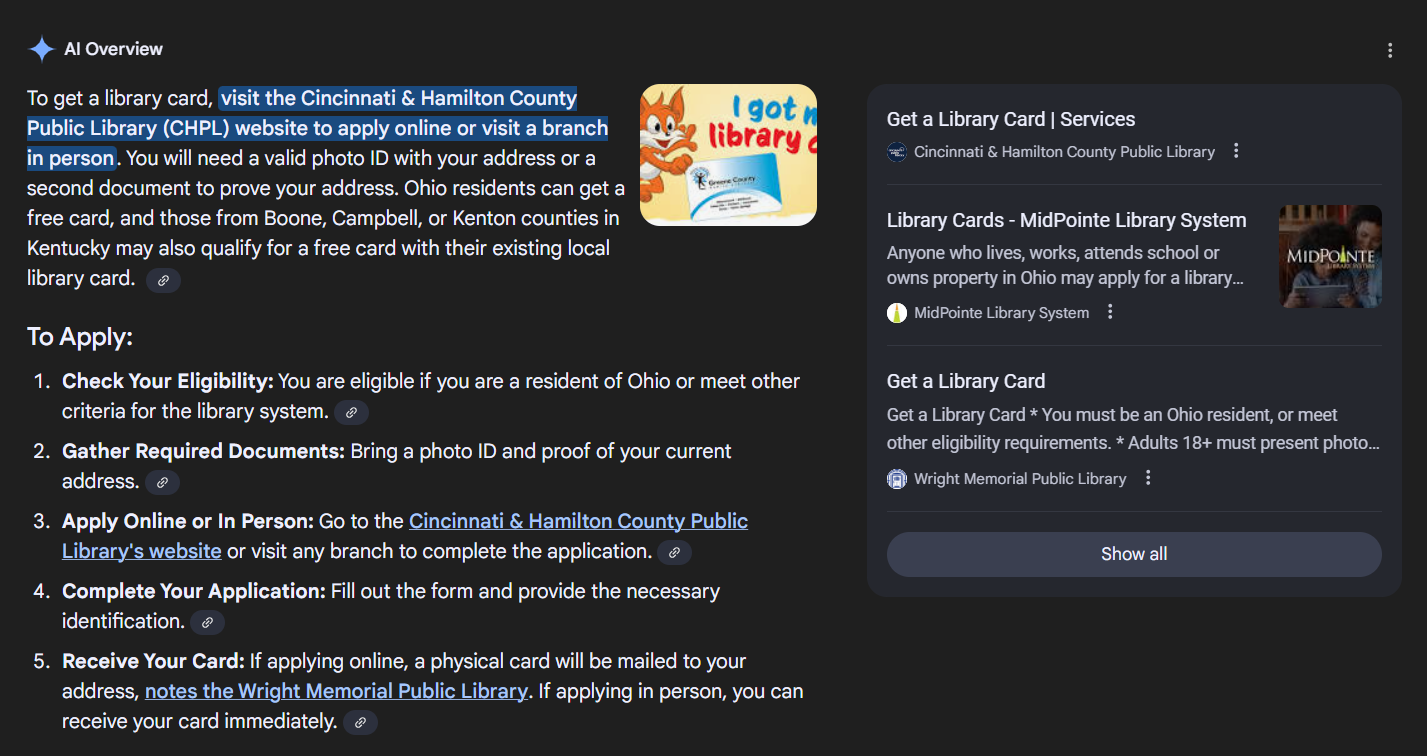
An example of an AI Overview for the search, “How can I get a library card?”

Once AI Overviews were introduced, searchers stopped clicking through to a website because their question was fully answered by the AI Overview. As a result, many libraries (and other websites, including this one) noticed a decrease in their organic web traffic.

In addition, a survey by Adobe Express says 25 percent of people use ChatGPT as their first choice for search over Google. Gen Z is particularly drawn to AI as a search engine. That likely means the popularity of using AI for search will continue to rise.

What does all this mean for your library?

Youโ€™ll need to adjust the way you structure your libraryโ€™s website and blog to surface more often in AI searches and to show up in the AI Overview. Itโ€™s not as difficult as it sounds. Here are the changes Iโ€™ve implemented. I recommend you try these and monitor your web traffic over several months to see if the changes make an impact.

Titles should be clear, not clever.

Tell readers exactly what theyโ€™ll find on the page. For example:

Author Visit

  • โŒ Clever Title: โ€œAn Evening of Literary Magicโ€
  • โœ… Clear Title: โ€œMeet Author Jasmine Guillory at the Library โ€“ October 24โ€

Why it works: The clear title includes the type of event, the authorโ€™s name, and the date. Those are the keywords that AI tools and search engines can easily match with user queries.

Craft Program

  • โŒ Clever Title: โ€œGet Your Glue On!โ€
  • โœ… Clear Title: โ€œFall Craft Workshop for Teens โ€“ Make Your Own Bookmarksโ€

Why it works: It specifies the audience (teens), the season, and the activity.

Educational Workshop

  • โŒ Clever Title: โ€œBrain Boost Bonanzaโ€
  • โœ… Clear Title: โ€œFree SAT Prep Workshop for High School Studentsโ€

Why it works: It uses direct language that matches what a student or parent might search for, like โ€œSAT prepโ€ or โ€œhigh school test help.โ€

Wellness Event

  • โŒ Clever Title: โ€œZen in the Stacksโ€
  • โœ… Clear Title: โ€œFree Yoga Class at the Library โ€“ All Levels Welcomeโ€

Why it works: It clearly states what the event is, where itโ€™s happening, and who can attend.

Include a bullet list of key takeaways or what youโ€™ll learn at the top of the page.

This helps both readers and AI quickly understand the content. Try this on blog postsย andย key webpages.

Hereโ€™s how you might structure key takeaways at the top of a library card sign-up page.

  • A library card is free to all residents of Tree County.
  • Applicants need to fill out a form and have one document with proof of residence. The form can be sent to the library via email or presented at any library location.
  • Applications presented in person will be processed immediately. Applications sent via email will take 1-2 days to process.
  • Once an application is accepted, youโ€™ll be given a card, which you will you to check out items, reserve meeting rooms, and register for programs.

Use well-structured headings.

Phrase them as questions, when possible, like:

  • How do I get a library card?
  • How can I reserve a meeting room?

Here’s an example of how I did this in a post for NoveList.

Include the right keywords.

Ask ChatGPT to provide you with a list of keywords or frequent questions around your topic. You can also search for your topic on Google and look at the โ€˜People Also Askโ€™ section. The website Answer the Public can provide you with some frequently asked questions as well.

Structure your content with bullets, steps, or lists.

Clean formatting makes it easier for AI to scan and summarize your content. You’ve probably noticed this post has been full of bullets and lists. That’s intentional! The bonus benefit is that it makes your blog and website easier to read.

Write in natural, conversational language.

Avoid jargon. Focus on being clear and helpful. Remember that searchers will not use jargon to look for answers to questions that may lead them to your library. Try to imagine what your community would put into the search bar, and then use those words in your blog or landing page.

When possible, include a staff memberโ€™s name and job title on a page.

AI looks for expertise or credentials when scanning pages. This is easy for a blogโ€ฆ just include the name of the author and their title in the post. For a landing page, consider adding a line like this: โ€œNeed help signing up? Email Maria Lopez, Library Services Manager, with 15+ years of experience helping patrons, at mlopez@treelibrary.org.โ€

Ask your partners to link to your website and blog.

When other trusted sites link to your content, it signals credibility to AI and search engines.

Use internal links whenever possible.

Link to related blog posts or pages on your site to help AI understand your contentโ€™s structure and relevance. That has the added benefit of keeping people on your page longer, which improves your trust and credibility to Google and AI, which means you’ll show up in search more often!

Try to stay within best practice lengths for word count.

BlueHost.com says for blogs, the ideal range is between 1,500 and 2,500 words. This gives readers comprehensive coverage of a topic. Itโ€™s also easier to include keywords and internal links for longer posts.

Butโ€ฆ hereโ€™s something to remember: Google and AI tools prioritize quality over length (and so do most readers!) Donโ€™t try padding your posts, as that can hurt your ranking.

Neil Patel, who is a trusted expert on SEO, says that for landing pages, word count isnโ€™t a direct ranking factor. Rather, you should focus on the userโ€™s experience and provide enough information for a community member to act.

Has your library’s website traffic taken a hit? Are you using any other methods to drive more traffic to your library’s website? Let me know in the comments.


Need more inspiration?

Google Ad Grants Improve Your Libraryโ€™s Chances of Being Found in Search: How To Apply and Manage This Incredible Opportunity

Subscribe to this blog, and youโ€™ll receive an email whenever I post. To do that, enter your email address and click on the โ€œFollowโ€ button in the lower left-hand corner of the page. You can also follow me on the following social media platforms:
The 5 Best Free Keyword Research Tools To Find the Perfect Keywords for Your Library Promotions (With Video Tutorials)

Photo courtesy Cincinnati and Hamilton County Public Library

A war is being waged 10 feet from my office window.

I love watching birds feed and listening to them chirp, squawk, and sing. I have a feeder that I’ve positioned so I can see the birdies enjoying their meal as I work.

But something is ruining my relationship with my feathered friends.

Some mornings, I come outside to find my oversized bird feeder, which I always fill the night before, COMPLETELY EMPTY. The seed is scattered all over the ground. And a scurry of squirrels are gorging themselves on the spoils.

The first time this happened, I did what anyone does in this modern era. I turned to the internet for help.

I typed “how to keep squirrels off my bird feeder” into Google. Suddenly I found myself down a rabbit hole (pun intended) with all the squirrel battle content you could ever want.

Repellant. Special bird feeders. Tips for installing slinkies on the pole to prevent climbing. SPIKES. Videos, advice, and products galore.

Why is it so hard to find tips on fighting squirrels?

The internet is a giant swirling vortex of content. According to Master Blogging, there are 7.5 million blog posts published every single day. (Thanks for reading this one!)

When you factor in social media posts, videos, website content, emails, etc., it’s no wonder your library has a hard time breaking through the noise. A search by anyone for anything is likely to turn up hundreds of results.

So how do you make sure your library content reaches the people who need it most?

Keywords are the key

When a community member is online, trying to find the source that will help them write a research paper, add branches to their family tree, or make a decision about whether to purchase a car, they need us to speak their language.

That’s where keywords come into play.

Keywords help search engines and social media algorithms understand what your content is about. They use those keywords to categorize your content and then match your content to people who are searching for it.

The right keywords make it more likely that the content you write will end up on the computer or mobile phone screen of the person who needs it most.

But you don’t have to guess at what keywords to use! There are tools to help find keywords to weave into your content. Here are my five favorites. They’re reliable, efficient, and free. I’ve made a video tutorial for each to show you exactly how to use them.

Spyfu

This website has a robust, free keyword research tool. You can use it without setting up an account or handing over your email.

Google Search Bar

The Google search bar allows you to see what content is rising to the top of Google’s algorithm. You can work keywords or phrases from those top-performing content pieces into your promotions.

Don’t forget to scroll to the bottom to see “people also search for,” which I find to be extremely valuable as a source of more keywords.

Google Keyword Planner

You can also use Google’s more robust Keyword Planner to search for keywords. The Keyword Planner is intended as a tool for buying Google ads but I find it to be an insightful way to find keywords for my website and social media.

Here’s a quick video to show you how both the regular Google search bar and the Google Keyword Planner work for sourcing keywords for library promotions.

Wordstream

This free tool gives you 25 keywords… more if you’re willing to provide them with your email. They’ll also show you the search volume for the phrase and the level at which you’ll compete with other content for attention. Type in your opening phrase and choose “All industries” for the best results.

Moz

This free keyword tool shows top suggestions, monthly volume, organic click-to-open rate, and difficulty ranking for any key phrase you search. You can get more robust suggestions if you hand over your email.

Whatever tool you use, the keywords you uncover should be placed in your blog headlines, in the text on your website, and in your social media posts.

But Angela, did you defeat the squirrels?

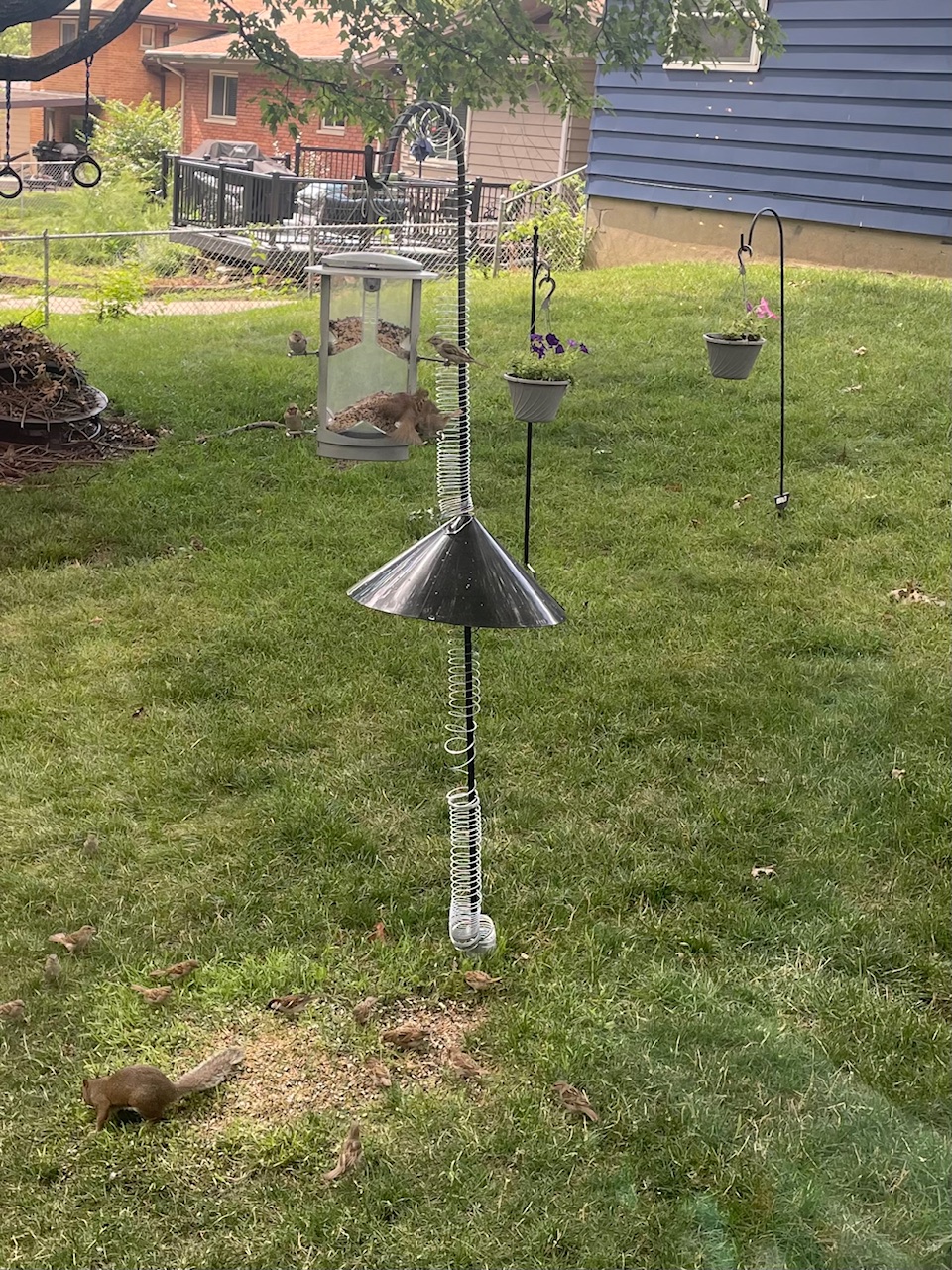
Yes, I did with the help of three slinkies, a 7-foot pole, and a baffle, which is a cone-shaped device that stops the squirrel from climbing up your pole to your feeder. I knew of the existence of baffles, but I had no idea that’s what it was called. But thanks to keyword research and placement by the vendor, I found it. Now my birds can eat in peace.

Note Mr. Squirrel, who is now relegated to picking up seeds from the ground.


P.S. You might also find this helpful

Finding the Perfect Name for a Library Program: A Checklist and Tips for Using AI

Subscribe to this blog and youโ€™ll receive an email whenever I post. To do that, enter your email address and click on the โ€œFollowโ€ button in the lower left-hand corner of the page. You can also follow me on the following social media platforms:
The State of Library Marketing in 2024: Survey Reveals Major Shift in Goals and Struggles for Many Libraries

Photo courtesy Cincinnati and Hamilton County Public Library

You asked for it and this week, Iโ€™m sharing the results of the latest Super Library Marketing Survey.

Surveys are an effective form of market research. They illuminate the services that are needed to help a target audience. And you, my dear readers, are my target audience.

For the past 8 years, Iโ€™ve asked questions that help me get a better sense of who you are, and how this blog and The Library Marketing Show can be as helpful to you as possible. The Monday posts and Wednesday videos are direct responses to the questions and concerns you share in the survey.

The struggles and goals of libraries shifted in some major ways. As we begin 2024, here is the state of library marketing.โ€‚

Basic methodology

The survey was conducted for two weeks in early September 2023. The survey response rate rose this year by a whopping 32 percent. The survey was a mix of multiple-choice and open-ended questions.

Type of library

Respondents to the survey consist mainly of public library workers.

  • 86.6 percent of respondents work in a public library.
  • 7.1 percent work in an academic library.
  • The remaining 6.3 percent of respondents work in school, special, or state libraries.

Marketing experience

Most of the respondents are experienced marketers.

  • 69.3 percent of respondents say theyโ€™ve been managing promotions for 3 years or longer.
  • 19.7 percent have been doing marketing for 1-2 years.
  • The remaining 11 percent said they have been in promotions for less than 12 months.

Time spent on library marketing

The average respondent estimated they spent about 60 percent of their daily work time on marketing and promotions. This means that many of you are also managing other job duties, such as programming and collection development.

Marketing as a priority

Every year, I ask respondents to tell me if their library has a dedicated marketing department. A marketing department can consist of one or more people, whose sole job role is marketing. The presence of a marketing department is a clear indication of whether marketing is a priority for senior leaders.

This year, the results were:

  • 50.4 percent said no.
  • 49.6 percent said yes.

The number of libraries with a dedicated marketing department fell two percentage points this year. Thatโ€™s not enough to call it a trend but I will keep an eye on this.

The most pressing question or concern

Last year, the top concerns of my readers were how to reach new users, storytelling for marketing, email marketing best practices, and budgeting.

This year, the answers can be broken down by five categories.

How to reach new users

Respondents said they struggled to promote to community members through traditional means, like newspapers, as well as on social media. Several named specific target audiences they hope to reach, including young adults, parents and caregivers of young children, and non-English speaking communities.

One respondent said, โ€œHow do we make sure we are effectively reaching patrons and members of the community without overdoing it or over-communicating? I am a one-person marketing team for my library.โ€

Time

Respondents shared frustration over a lack of time to adequately plan, create, and analyze their marketing. They struggle with the coordination of tasks, especially when working with other library staff. Balancing priorities and goals is difficult.

Said one respondent, โ€œWe’re a progressive system that’s constantly adding new things (which is great) but it seems like there’s never enough time or space to share it all and get real awareness out there.โ€

Buy-in and strategy

Many of the respondents said they are struggling to get supervisors and co-workers to understand their jobs: the difficult parts of marketing, the time this work takes, and the value of doing it right.

โ€œThere are not enough marketers for everything Admin wants us to do,โ€ said one respondent. โ€œOthers don’t understand how many priorities we’re trying to balance or how time-consuming our work is. I feel like some coworkers think we’re doing our jobs badly, but they don’t understand our jobs.โ€

Another respondent asked, โ€œHow can I best unify staff? My biggest challenge is encouraging everyone to follow our style guide or at least inform themselves about marketing best practices.โ€

Social media

Respondents shared frustration with changing social media algorithms and the burnout that can happen. โ€œTheyโ€™re showing more Reels, then they are showing still pictures, then they arenโ€™t showing unless there are commentsโ€ฆyou know what I mean?โ€ asked one respondent.

Other concerns

Content creation, audience segmentation, reaching volunteers, burnout, budgeting, metrics, competing with nearby libraries for attention, and AI all round out the list of concerns this year for library marketers.

These topics will all be addressed this year.

Social media use

Here is the percentage of libraries using specific social media platforms, according to the survey respondents. Of note was the jump in Facebook and Instagram use this year, as many libraries moved away from Twitter/X.

  • Facebook: 97 percent
  • Instagram: 92 percent
  • YouTube: 54 percent
  • Twitter/X: 38 percent
  • LinkedIn: 21 percent
  • TikTok: 16 percent
  • Pinterest: 9 percent
  • Threads: 6 percent

In the open-ended questions, many of you said you rely on this blog for social media news and analysis. And I will continue to provide that this year.

However, I have made the decision not to promote the blog on Twitter/X anymore and will not cover any best practices for that platform this year, unless something drastic changes.

Email marketing

I asked my respondents how often their library sends promotional emails.

The big takeaway: more of you are sending emails. Only 9 percent of respondents said their library doesnโ€™t send any email at all. Thatโ€™s down ten percentage points from 2022!

Here is how the rest of the sending breaks down:

  • Once a month: 38 percent
  • Once a week: 36 percent
  • Several times a week: 12 percent

The most important library goals

Last year, I asked respondents if they set goals. This year, I got more specific. I asked respondents to check all that applied. Here is how the results break down.

  • Driving visitors to your physical location, website, or catalog: 76 percent.
  • Increasing program attendance: 67 percent.
  • Reaching non-patrons: 63 percent.
  • Getting current cardholders to use the library more often: 60 percent.
  • Driving the use of services like databases, Makerspace, Library of Things, etc.: 57 percent.
  • Advocating for the freedom to read: 18 percent.

Facing book challenges

This year, I added a question asking respondents if theyโ€™d faced a book challenge in the past 12 months.

  • 55 percent said no.
  • 30 percent said yes.
  • 15 percent were not certain.

And though most readers said they hadnโ€™t been targeted; this issue does loom large over the work you are doing for promotions.

โ€œOur library is choosing to keep our head down on the book-banning issue, hoping no one will notice or bring it up,โ€ reports one respondent.

Says another, โ€œWeโ€™ve had to be careful about how we promote everything. For example, we used to hand out these fun rainbow-colored pens to kids but stopped because we were called groomers during the book challenges. We have also been having a rash of bomb threats to the libraries in our area which has also affected the feeling of security with our staff. I feel like my job is less about promoting programs and services and more about crisis management these days and how to communicate feelings of safety etc. This is not something I was really trained to do so it can feel overwhelming.โ€

More changes for Super Library Marketing this year

Readers asked for posts about how to create interactive and impactful community presentations to outside groups and tips for print promotions. Iโ€™ll cover these in the next year.

Some want the videos to be released as podcasts on Spotify. I will consider that if time and money allow.

Many of you requested more advanced subject matter in the blog posts and videos. I will try to do more of that this year.

Iโ€™m also hoping to more profile school libraries and special libraries this year. Do you work at a school or special library and have a library marketing success story to share? Contact me here.

I always try to share tips and strategies for library marketers who wear multiple hats, and that will continue in 2024.

Finally, someone asked for subtitles for the videos. This year, I started providing captions for all my videos on YouTube and LinkedIn. Click the โ€œCCโ€ icon on the screen to see the captions.

The CC button circled in white is where you click for captions on YouTube.

PS Want more help?

How to Create an Effective Library Survey to Pinpoint the Needs of Your Community

Subscribe to this blog and youโ€™ll receive an email whenever I post. To do that, enter your email address and click on the โ€œFollowโ€ button in the lower left-hand corner of the page. You can also follow me on the following social media platforms:

A Viewer Asks: Should You Go Back and Rewrite Your Library’s Old Social Media and Blog Posts?

Watch this episode now

#LibraryMarketing Show, episode 213

A viewer wants to know: “Do I need to go back in time and update all my social media posts and my blog posts”

That’s a great question! Is it a good practice or a waste of your time? I’ll give my best advice in this episode.

Plus someone will receive kudos!

Do you have a suggestion for a topic for a future episode? Want to nominate someone for kudos? Let me know here.

Thanks for watching!


Miss the last episode? No worries!

Will I see you soon?

Subscribe to this blog and youโ€™ll receive an email whenever I post. To do that, enter your email address and click on the โ€œFollowโ€ button in the lower left-hand corner of the page. You can also follow me on the following social media platforms:

The Complete List of the Most Ideal Length for Each of Your Library Promotional Tactics

Photo courtesy Cincinnati and Hamilton County Public Library

For many of us, a hamburger is a delicious sandwich, no matter where you get it. No one can mess them up.

But there are things you can do to make your hamburger exceptional. For me, that means the addition of bacon, cheese, and avocado. I’ll still eat and thoroughly enjoy the hamburger if those ingredients aren’t available. But they make the hamburger go from good, to memorable.

Hamburgers are like marketing. Much of the work you do to promote your library is already good (because I know you’re doing good work!) Now, you’re on the path to maximizing the effectiveness of your marketing.

One of the ways you can ensure success is to make certain your marketing content is the perfect length. It may seem insignificant. But the right number of characters or words for a piece of content can make all the difference.

How do you know how long your tactics should be? I did the research, so you donโ€™t have to.

Ideal length of a Facebook post: 100-259 characters

Research from experts on this one is mixed. Some studies suggest you keep captions at 50 characters or less.

But in my work with libraries, I try to pay attention to engagement rates and post length. And I personally think 50 characters is too short. So, I would suggest you try to write between 100 and 259 characters.

Ideal length of a Tweet: 240-259 characters

Most experts agree that using slightly less than 280 character limit on Twitter is ideal. That gives people the room to quote Tweet your library.

But you can do two other things to improve your library’s Twitter engagement.

  • Include rich media in your post, like photos, graphics, and video. In fact, multiple photos or a mix of photos and a video will help your Tweet get more engagement.
  • Use emojis at the beginning of your Tweet to capture attention and stop people from scrolling past your messages.

Ideal length of an Instagram post: 138-150 characters

Fun posts should have shorter captions. Information or educational posts should have longer captions.

There are other caption tricks that help with Instagram post engagement.

  • Add spaces between your sentences, so they look like paragraphs. Here’s an example from Amherst Town Library.
  • Weave in plenty of emojis. You can even substitute emojis for words to add character to your post.
  • Include multiple kinds of rich media, like photos and videos all in the same post, to increase the value. ย ย 

Ideal length of a TikTok video or Instagram Reel:  between 7 and 34 seconds

There is not a lot of data or research surrounding TikTok videos or Instagram Reels. It does appear that, even though the platforms allow you to create videos that are several minutes long, shorter videos lead to maximum engagement.

Ideal length of a LinkedIn post: Less than 210 characters

There is lots of dispute around this recommendation. Iโ€™ve picked the median number. And to help with engagement, I have a formula thatโ€™s worked well for me.

Construct a good, first teaser sentence, and then put a space between it and the rest of your post caption. This will cause your reader to have to click on โ€œsee more.โ€ It works!

Good content on LinkedIn is also important. Videos natively uploaded to the platform get lots of engagement. Also, try polls to increase engagement.

Ideal length of an email: 100 words

Different types of emails should have different lengths. If youโ€™re sending someone an onboarding email, youโ€™re going to need to write more than if youโ€™re sending an email promoting an upcoming event.

There are some scenarios where a couple of sentences is plenty to capture your cardholderโ€™s attention and others where youโ€™ll need several paragraphs to get your full point across.

In general, keep your email text as simple as possible. Be straightforward about the benefit of your library service or collection item or event. And drive recipients to your website for more information.

Ideal length of an email newsletter: 3-4 pieces of information

In my experience advising libraries, email newsletter recipients never click anything past the first 3-4 pieces of content in an email. I always recommend sending shorter, more frequent email newsletters rather than one long monthly version.

If you donโ€™t have control over how long your email newsletter is, you can help engagement by placing the 3-4 most important things at the beginning of the email. If your email provider has a table of contents feature, use that to drive interest to content further down in the email.  

Ideal length of an email subject line: either very short (30 characters) or very long (90 characters or more)

It appears that the extreme ends of length catch the attention of the inbox scroller.

Longer subject lines boost response rates, according to Adestra, a U.K.-based email service provider. Its analysis of more than one billion emails showed that subject lines of 90 characters and more produced the highest response rates. They theorize the added characters increase engagement because they can communicate more value to the recipient.

But their research also found that subject lines at 30 characters or less performed well. That’s because the full subject line can usually be seen by the recipient, both in desktop and mobile versions of mail provider apps.

Experiment with both ends of the length spectrum to see which your audience responds to. And keep in mind the other factors that can impact subject line effectiveness.

Ideal length of a YouTube video: Between 7 and 15 minutes

This stat comes from several sources, including Social Media Examiner.

It’s important to let your content dictate video length. A how-to video may need five minutes or more to show the process. An unboxing video can be shorter. If your video is interesting to watch, the length won’t really matter. 

Ideal length of a podcast: 22 minutes

Your target audience will really dictate the perfect length for your library. Most research I found recommended 20 minutes for podcasts aimed at listeners who are doing chores or taking short walks, 40 minutes for people commuting or doing longer chores, or 60 minutes for those who want an extended listen.

Ideal blog post length:  2,000 words

Thatโ€™s a lot of words! For context, the Monday articles here on Super Library Marketing run between 1,000 and 1,500 words each.

So, before you get anxious about word length, remember that quality blog posts will always do well, no matter how long.  If your post contains valuable or interesting information that your reader wants and needs, it will do well.

If your blog is less than 2,000 words, there are some things you can do to make it feel meaty to the reader. You may have noticed these tricks in my blog posts.

  • Present information using bullet points or lists.
  • Write longer paragraphs at beginning of the article.
  • Insert scannable headlines.
  • Include images, especially those that explain concepts or demonstrate your point.

Finally, itโ€™s important to include keywords in your title and frequently within your post. You may notice I use the terms library marketing and library promotion in almost every title and throughout my articles. Thatโ€™s because I know those are used by library staff searching for help with their marketing.

The most important thing to remember

Pay attention to your metrics. Your audience will tell you about the perfect length for any one of your tactics.


Related Posts

Maybe the Biggest Lesson for Libraries from Content Marketing World: Why Broad is Flawed!

The Top Four Reasons To Use Content Marketing To Promote Your Library on Every Platform

Subscribe to this blog and youโ€™ll receive an email every time I post. To do that, enter your email address and click on the โ€œFollowโ€ button in the lower left-hand corner of the page.

Should You Delete Old Library Blog Posts? A Viewer Questioned Answered!

Watch Now

The Library Marketingโ€‹โ€‹โ€‹โ€‹โ€‹โ€‹โ€‹โ€‹ Show, Episode 131

In this episode, I’ll answer a viewer question from Hannah at the Johnson City Public Library. She asks, “What criteria would you use to justify retiring/making ‘private’ old blog posts?”

Kudos in this episode go to the Mary Wood Weldon Memorial Public Library. Watch the video to find out why they’re being recognized.

Do you have a suggestion for a topic for a future episode? Want to nominate someone for kudos? Let me know in the comments. And subscribe to this series to get a new video tip for libraries each week.

Thanks for watching!


Subscribe to this blog and youโ€™ll receive an email every time I post. To do that, enter your email address and click on the โ€œFollowโ€ button in the lower left-hand corner of the page.

Library Blogs are the Best! How to Use Your Website to Amplify Your Library Marketing Message on Your Own Terms

Photo courtesy Public Library of Cincinnati and Hamilton County

One of the hardest and most rewarding things I ever did while working for the Public Library of Cincinnati and Hamilton County was to start a blog. It took me five years to get it off the ground. I wrote about that experience in this blog post.

I worked hard to get a library blog because I knew it would be a transformative and powerful communication asset.

A blog allows your library to tell your own story, create brand awareness, and promote your library to your own audience for free, without having to deal with the rules of someone else’s platform.

If your library has a blog, you will want to make sure you are doing everything in your power to grow your audience. In this post, I want to share the best practices Iโ€™ve learned from years of blogging.

Before you post

Create an editorial calendar for your library promotions that includes your blog post ideas. I wrote a two-part guide to help you through this step.

A calendar will let you see all the promotions your library is doing in one glance. It will help you schedule posts that amplify your other marketing messages.

You can use your calendar to formulate due dates and publication dates for blog posts. You can also plan the promotion of your library blog posts on other channels, like your email newsletters and social media platforms.

The three main genres of library blog posts

The best blogs are a mix of these three types of blog posts.

Promotional posts: Most library blog posts are promotional. They focus on telling readers about an event, service, or collection item available at the library.

Promotional posts tend to be shorter. They also need to be frequently updated as services and collection items change.

Example: Jacksonville Public Library uses their blog to help their community find information on their website without having to create special landing pages for events and services.

Opinion posts: These posts demonstrate what the library stands for. They center on questions people have about libraries but are afraid to ask. Opinion posts also celebrate the strengths of libraries and the opportunities for improvement.

Opinion posts are compelling and allow your library to cement your voice and your position in a way that your readers and cardholders will remember. Itโ€™s great when a library takes a stand. People will respect you for it.  

Example: The Stark Library CEO and Executive Director took a clear stand against racism in this recent blog post.

Authoritative posts: These posts demonstrate your libraryโ€™s expertise in a subject. For instance, a post that highlights your library’s award-winning family history department is an authoritative post.

Example: Check out the My Librarian(s) Favorite Resources series on the Chapman University: Leatherby Libraries blog.

The Ugly First Draft

If youโ€™ve been asked to write a post on your libraryโ€™s blog, your journey begins with what my favorite marketer Ann Handley calls The Ugly First Draft (UFD).

Your first job is to get all your ideas down in whatever format they escape from your brain. Write your draft without worrying about spelling, grammar, punctuation, or phrasing.

Open a Word document and try to keep typing until you canโ€™t think of anything else to say on a subject. If you are a skilled typist, look away from the screen so you’re not tempted to focus on spelling or grammatical errors.

Revise to create the perfect library blog post

Write short paragraphs, not short posts. Itโ€™s a myth that short blog posts will attract more readers. If your blog post is long but compelling, youโ€™ll have no problem holding the attention of your readers. A longer post that is well written and contains keywords will do better in Google search than a shorter post.

However, you should break up your blog post into shorter paragraphs. Short paragraphs are easier to read and understand. They open white space on your blog, which makes your post more inviting.

Writing experts recommend paragraphs of no more than 150 words. I started writing shorter paragraphs about two years ago and saw a big boost in my metrics.

Be deliberate with your keywords. In the blog text, you need to include keywords for search.

Youโ€™ll notice I use the phrase โ€œlibrary marketingโ€ and โ€œlibrary promotionโ€ frequently in this blog. Thatโ€™s because people searching for help with library marketing use those two phrases most often. Try Keywordtool.io. It does an amazing job of helping you to narrow your target phrase.

Put your keyword phrase in title, header, and body of blog post at least two times but more often if it makes sense.

Include images. Images can help you craft your message and tell your story. They also help to break up the text of your blog posts.

Use images to explain concepts or enforce the emotion you are trying to create.

Link to other content from your library. Your blog post can funnel your readers into engaging with your library. If you are talking about a specific service or a part of your libraryโ€™s collection, include links embedded in your text to help readers find more information.

Make sure your links open in a new tab. Thereโ€™s nothing more annoying that clicking on an embedded blog post link in the middle of a post and then having to tab backwards to read the rest of a blog post.

Create engagement opportunities for your reader. Use your blog posts to start a conversation with your readers. Ask a question and invite readers to post their answers in the comment.

Your library can also embed a social media post in your blog so readers can post a key point to their social media. This gives your post the potential to reach new readers.

Spend a lot of time on your headline.  A good headline should give your readers a hint at the copy that lies ahead without giving away the whole story. It should trigger an emotional response that includes an irresistible urge to read more.

You can get lots of tips for headline writing in this blog post.  

Incorporate several rounds of edits for spelling, grammatical, and punctuation errors. Run your blog posts through an online editor to catch errors. Ask your co-workers to edit your blog as well.

Print your blog post out and read through it, word for word, out loud. Doing this will force your brain to pay attention to the extra attention to what you’ve written. Your brain will often fill in or gloss over errors when you silently read. But if you read your post out loud, those errors become obvious and can be fixed before publication.

Four more tips for library blog success

Use your blog as a networking tool. Ask community leaders to write guest posts. Reach out to school administrators, policy makers, influencers, and other nonprofit organizations. Or use your blog to interview someone.

Once you publish, send a link to the contributors or interviewees. Ask them to share your post with their audience. This will amplify your message and expose your blog to a new audience of readers.

Example: The National Library of Australia interviewed fashion designer Nicky Zimmermann in this blog post that led to lots of media exposure for the library.ย 

Post consistently. The best way to maintain web traffic to your blog is to make sure people are always waiting for an article to go live.

Decide how many posts you can create a week and which days youโ€™ll post on. Then stick to your schedule.

Promote your blog posts on other platforms. Most of your readers will not just stumble upon your post by accident. You need to make sure they know that your library has published a post.

Promote your posts on your social media platforms, in your emails, and in patron interactions.

Your blog can also be used instead of a press release to pitch a story to a member of the media.

Evaluate your post metrics. Check in once a month and enter your metrics on a spreadsheet so you can track results over time.

Compare views, watch time, and bounce rate for your posts. You can also compare post length.

Your metrics will help you to continue to improve and update your blog based on your audienceโ€™s needs and wants.


Does your library have a blog? I’d love to see it! Share a link in the comments!

Subscribe to this blog and youโ€™ll receive an email every time I post. To do that, click on the โ€œFollowโ€ button in the bottom left-hand corner of the page. Connect with me on YouTube, Twitter, Instagram, Goodreads, and LinkedIn.

Attention! Here’s How to Write Headlines That People Simply Can’t Ignore for Any Piece of Content

In my former life as a web journalist for a television news station, crafting the best headline for each story was the most challenging part of my day. It was also the most crucial task.

A compelling headline for any piece of content–email, social media posts, blog posts, newsletters, posters, and signage is essential. The right headline will make it impossible for people to ignore your content.

It may seem silly to spend a lot of time, energy, and brainpower on a couple of words. But it’s a critical component of all your marketing efforts. Libraries should spend time crafting the best headline on every piece of content they publish. This applies to their website, blog, social media posts, press releases, and emails, including personal emails and mass emails to customers.

A good headline should give your readers a hint at the copy that lies ahead without giving away the whole story. It should trigger an emotional response that includes an irresistible urge to read more.

Think of your headline as the gateway to all the content you have poured energy into creating. It may seem tall order for a short succession of words but it can be done.

So how do you write a good headline? Here are my tips.

If someone heldย a gun to your head and demanded you describe the copy in one sentence, what wouldย you say? This is my twisted yet effective technique for getting that first draft of a headline down on paper. It forces you to boil your workย down to its main point or big idea. Go for the emotional core of your copy.

Example: ย The title of this issue of our Library Links magazine. The lead story was about a veteran living with a disability. His neighborhood branch is a Carnegie library built in 1909. It’s never been renovated and it’s inaccessible to people living with mobility issues. We were about to ask voters to pass a levy to fund upgrades to this branch and more just like it.

I asked to interview him. He told me the story about how he can’t climb those stairs, and how fellow veteran friends who also live in his neighborhood have to drive their motorized wheelchairs to the next closest branch. The trip sometimes takes three hours. His story invoked a feeling of frustration and injustice. How the heck do you encapsulate that in a short sentence?

Keep the length manageable and the vocabulary conversational. Remember, you want to tease your readers into craving more information, not give away the whole story. You also don’t want to confuse them by using language they don’t understand.

Example: Our library recently made a pivotal switch in the way we market our storytimes. We want to emphasize the educational aspects.

It would be easy to get lost in a lot of technical language and big words to describe our focus on literacy and learning. I decided the best approach would be to write text that sounded like what I would say in person if I were talking to a parent about storytime.

This sounds like an easy step, but I see a lot of libraries and brands that get caught up in the technical language of their products and services. It makes us feel important when we use big words. But headlines and copy need to be simple in order to connect with the audience.

Headlines for press releases deserve as much attention as headlines for emails and blogs. ย Library marketers must remember newsrooms are a target audience and journalists crave a good story just as much as the average Joe. You really have to dig deep to grab their attention and evoke your emotional response. You want them to go into their morning meeting and fight for the permission to cover your library’s story. So, give them enough ammunition.

Example: ย This release triggered coverage by all the major media outlets in town. Its headline is very simple and straightforward but it got the job done.

Be versatile–it’s okay to change the headline based on the distribution platform. If you have a great blog post you want to share on Twitter, but the headline, when coupled with the URL and a photo, exceed the 280-character limit, re-craft the headline just for Twitter. You might also want to re-craft headlines for different social media audiences. Your Twitter fans may have a different perspective on your article than your LinkedIn fans. You can rewrite it for an email distribution too.

Example: This blog! I often change the headline for the different social media platforms. Sometimes I’ll repost a blog in a month or two with a different headline as well, just to freshen it up and catch viewers who might not have been interested by my first headline. Experimenting is good!

Use the tools. There are lots of fantastic tools to help you fine tune your headline. My absolute favorite is Sharethough’s Headline Analyzer. It’s easy to understand. Since I’ve been using it to craft headlines for this blog, my views have gone up about 10 percent!

For this particular post, Sharethrough gave me a 75 rating, which is above average. It says this headline works because it’s long, it has a human connection, and limited use of positive sentiment. It also gives suggestions on how to improve the headline to get a higher score.

Go with your gut. ย Sometimes, all the tools and analysis can cloud your head. If you’ve composed a headline that you feel will do the best job at capturing your audience’s attention, use it. You know your audience best.

Subscribe to this blog and youโ€™ll receive an email every time I post. To do that, click on โ€œFollowโ€ button in the bottom left-hand corner of the page. Connect with me on YouTube, Twitter,ย Instagram, and LinkedIn. ย And check my list of upcoming events so we can connect.

The Library Marketing Live Show Episode 6: Figuring out Evergreen Content for a Library Blog

Watch Now

What We Talked About

Shandi from the Illinios Heartland Library System sent me this question: ย I just read your blog article “How to Launch a Library Blog.” I would love to hear more about this! Specific question: Our new website won’t be ready for maybe 8 months (at our current rate). I want to add a blog with the introduction of our new site. When do you suggest beginning to curate articles? I’m thinking I could start now with evergreen pieces, right? Thanks!

So I talked through my answer to that question and gave some advice for creating evergreen content for a library marketing blog. I’m excited to see what Shandi’s blog looks like and to read the content she curates.

If you’ve got a library blog that you really love, please let me know in the comments. I’m curating a list of great library blogs to share in a future post so get your nominations in! Thanks for the question, Shandi.

Stay in Touch

Thanks to everyone who attended the webinar with Library Journal and Recorded Books on July 25. I am going to answer all the questions either on the live show, on my blog, or via email so be watching for that!

I’m speaking at two conferences this fall and you can register for both on the Upcoming Events page. The OLC released their full agenda this week and it looks like a great conference. Plus, you’ll be able to tour my library!

Have an idea for the next Library Marketing Live Show? Submit it now.

Weโ€™ll chat on Instagram on Tuesday at noon EST for about 15 minutes. My handle is @Webmastergirl so follow me to see the show live!

A WordPress.com Website.

Up ↑