How can a Friends of the Library group successfully spread the word, attract more donations, and recruit new members? They need marketing and branding! But they often don’t have the expertise or budget. So… then what?
This is a very niche episode that you’ll want to send to your friends of the library group!
Plus, we’ll give kudos to a library with a brilliant idea for a simple library storytelling video.
Do you have a suggestion for a topic for a future episode? Do you want to nominate someone for kudos? Let me know here. Thanks for watching!โ
Subscribe to this blog, and youโll receive an email whenever I post. To do that, enter your email address. Then, click the โFollowโ button in the lower left-hand corner of the page. You can also follow me on the following social media platforms:
Does it make sense for your library to have separate logos for your main services? It’s a fascinating question sent in by a viewer. I will give you some things to think about before you create a new logo in this episode of the Library Marketing Show.
Plus we’ll give kudos to a library doing something exciting, educational, and informative this election cycle.
Do you have a suggestion for a topic for a future episode? Want to nominate someone for kudos? Let me know here. And thanks for watching!โ
Subscribe to this blog and youโll receive an email whenever I post. To do that, enter your email address. Then click on the โFollowโ button in the lower left-hand corner of the page. You can also follow me on the following social media platforms:
Photo courtesy Cincinnati and Hamilton County Public Library
The best customer service experience I ever had was with a cell phone provider. No kidding.
I was having issues getting my contacts to transfer to a new phone. The providerโs website offered no solutions. So, with great trepidation, I called the customer service line.
The woman who answered was a delight to work with. She welcomed me in a friendly manner and assured me she wouldnโt hang up until sheโd solved my problem. She was patient with me as I explained my issue. She was friendly, asking me questions about my day as she worked. And she thanked me with sincerity when our call is over.
A successful and delightful customer service interaction is rare. And itโs increasingly difficult for people to contact a human customer service agent. Earlier this year, Vox published a story about the death of customer service lines. Companies like Frontier Airlines, Facebook, and Amazon are cutting costs by eliminating their phone-based customer service lines in favor of email forms and chatbots.
When I read that, I thought, โThatโs a huge opportunity for libraries!โ
Our community is our customers. And our unique value proposition is that we offer personalized service provided by a real-life person, always.
Library staff is not chatbots. Weโre not email forms.
We listen, and we help solve problems. In fact, weโre proud of our problem-solving skills.
So why donโt we spend more time marketing our unique, valuable customer service experience?
Good customer service is a competitive edge for libraries. We can build a reputation as a warm and inviting space. When was the last time you heard Amazon or Best Buy described in those terms?
Building your library’s reputation for customer service will increase visits and use of your library. And for many of you, that can be valuable in budget and funding discussions.
And delighted community members are more likely to spread the word to their friends and family about our system and the services we provide. They are compelled to talk about us positively on social media, give us great reviews on Google Business, and support our work through donations or volunteerism.
Here are 3 ways to use your libraryโs customer service as a marketing tool. Scroll to the bottom of the post for a great real-world example of customer service guidelines for staff from the University of Illinois.
Make it incredibly easy for people to contact you.
Your libraryโs address, phone number, and email address should be easy to find on our website. Iโd recommend adding it to your pageโs footer, as well as your โaboutโ section. You might also add a โContact usโ page to your website.
Itโs okay to have your contact information in more than one location! Don’t make your community members jump through hurdles to reach you. Remember, your competitive advantage is the ease of using the library.
You must also keep your libraryโs information updated on Google. And add your contact information to your bio or โaboutโ page on all your social media accounts.
Finally, consider sharing your contact information at the top of your email newsletters, at the beginning of each video you produce, and even at the beginning of each program you hold. A simple statement like, “Our library is here to help you! Ask us any question, anytime by calling 555-5555 or emailing us at questions@mylibrary.org” is sufficient.
And if you do this anytime you interact with a group of community members, over time your concerted and consistent effort to share your contact information will convey the message that your library is a place where community members can seek help.
Promote your library as a place that helps people solve problems.
In your marketing, emphasize that your library is on the communityโs side.
Your promotions should drive the following messages:
That your staff works collaboratively with users.
That you take your time to listen to problems and find the best solutions.
That your community members’ problems are your problems!
That you care about the outcome of your interactions.
One way to do this is to collect stories of the library solving patron problems. You might have to get out of your comfort zone to ask after a casual conversation but itโs worth it. Most people will be more than happy to allow you to use their feedback as a jumping-off point for a story. People love to talk about themselves. Use that to your advantage!
Youโll likely need to train your staff on how to do this. It sounds complicated, but here is an easy framework for staff to keep in mind.
If you think there is an opportunity for a patron to share a story with you, donโt wait until the end of your interaction to ask. Ask questions when the moment presents itself, even if thatโs toward the beginning of your interaction. Listen for the community member to say something like, “Oh that was helpful!” That’s your cue to ask permission from the community member to share the story of your interaction.
Avoid broad questions that can be answered with a simple yes or no, like โWould you recommend the library to friends and family?โ or โDid you benefit from our work together?โ
Instead, ask the patron specific questions that require a bit of engaging explanation.
โWhat are some reasons youโd recommend the library to your friends and family?”
โHow is your life different now that youโve received help from the library?โ
When you ask these more specific questions, youโre setting up your patron to offer a bit of narrative and a back story. Remember that hearing more about another personโs journey can help a potential library user visualize the difference their life could have if came to the library for help.
Look for stories everywhereโฆ in emails to your library, in social media comments or messages, and of course, in person. When you actively look for stories, it will get easier and become second nature.
Finally, create a story bank. Collected stories have little value if they canโt be molded into something you can. Use whatever technology your budget will allow.
You can keep track of all the major details with a simple spreadsheet in Excel or Google Docs. Some libraries even use Trello, which is free, to gather and share patron stories.
Promote your staff as problem solvers
Other companies have employees. Libraries have experts who truly care about the work they are doing and the impact they have on the community.
Thatโs why your staff is one of your most valuable resources. They are what makes your library stand out from your competitors. ย Augusta Public Library did this in a fantastic Facebook post.
And when you highlight specific staff, your community members will begin to feel as if they know the employees. They’ll be more comfortable coming into your physical buildings because they’ll recognize the face at the desk or in the stacks. They’ll feel more open about asking you for help!
Subscribe to this blog and youโll receive an email whenever I post. To do that, enter your email address and click on the โFollowโ button in the lower left-hand corner of the page. You can also follow me on the following social media platforms:
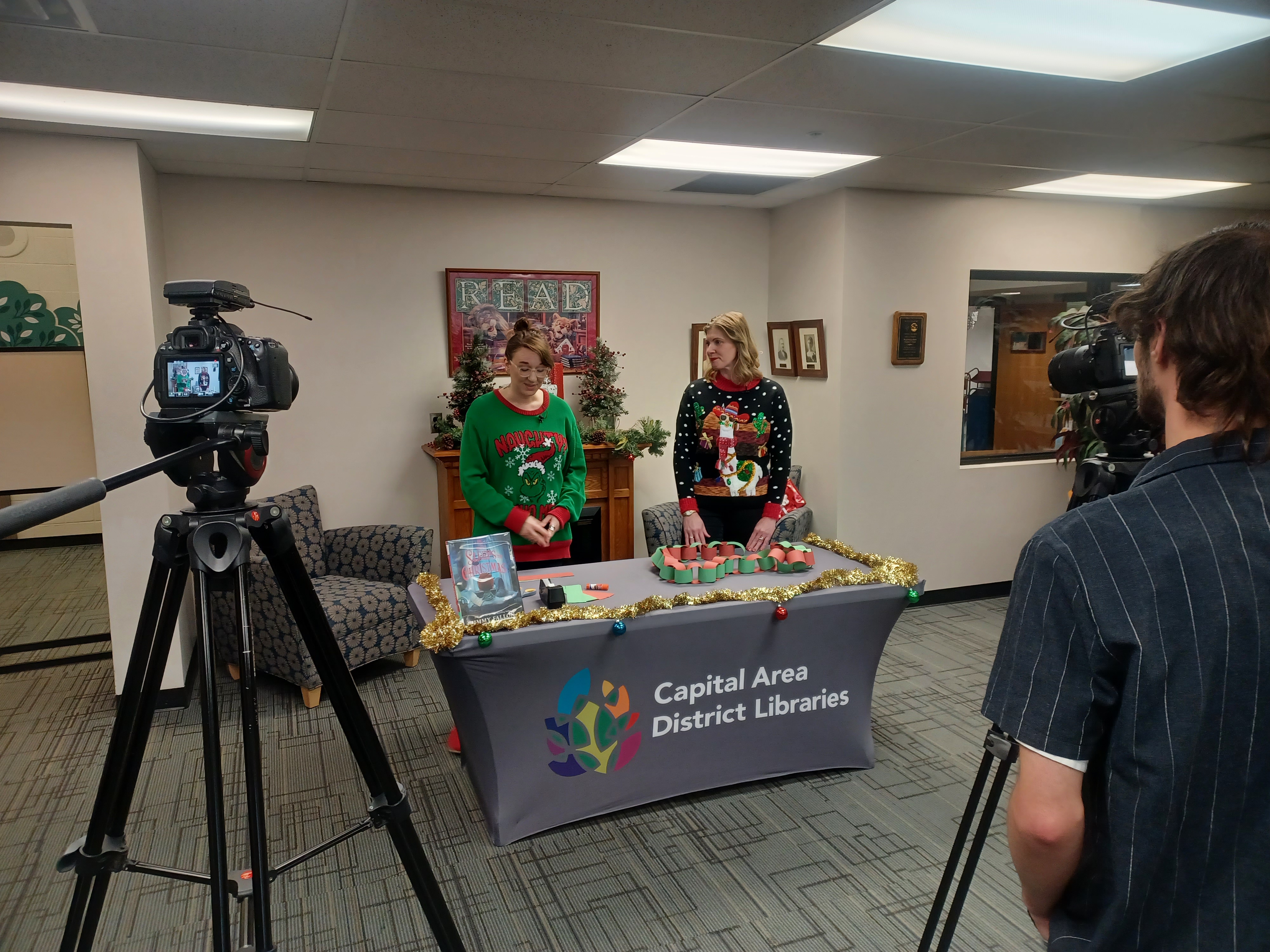
Photo courtesy Cincinnati and Hamilton County Public Library
Trenton Smileyโs job in a library is what you might call a full-circle moment.
At the age of 21, Trenton went to the library with his future wife to research careers. While inside the library, he decided to study communications in college.
Years later, he is working in communications for a library, specifically as Director of Marketing and Communications for Capital Area District Libraries (CADL). Located in Lansing, Michigan area, the library encompasses a service area of approximately 230,000 residents.
Every year, CADL does something extraordinary to reach new audiences. Beginning in 2020, the library launched a Christmas Eve Radio Storytime in partnership with 99.1 WFMK, one of the top radio stations in the Lansing market, especially among female listeners. During the holiday season, the station switches to an all-Christmas Music format, which provides a nice fit for storytime.
โWe decided to read Clement Mooreโs 1837 poem โTwas the night before Christmas because it was part of the public domain,โ said Trenton. โEach year, we select one of our youth librarians to read the poem over a wonderfully produced music bed (done by the radio station) that also included special sound effects.โ
โA holiday greeting from our executive director Scott Duimstra is always included along with a message from a special guest. Michigan Governor Gretchen Whitmer appeared in 2020 and 2022, while a cast member of Disneyโs Broadway Show Frozen appeared in 2021 to promote the show, which was coming to our community a couple of weeks after the storytime aired.โ
The radio storytime, which is about six minutes in length, aired twice on Christmas Eve. Listeners could also hear the storytime on sister station 1240 WJIM every hour until midnight. To become more inclusive, CADL launched a Spanish version of the storytime which airs on two NPR radio stations and a Spanish podcast owned by WKAR.
The cost is about $500 to air the storytime, but the station helps promote the special through free commercials and placement on the website and social media.
In addition to promotion on the radio, CADL began working with a local TV station WILX TV-10 to promote their reindeer visits and other holiday events.
โIn addition to on-air ads, we also run homepage takeovers of WILX.com,โ said Trenton. โA homepage takeover allows us to have 100 percent share of voice by using all available ad positions for a 24-hour period. We use this practice often to generate a great deal of web traffic over a short period of time.โ
The library has taken that one step further by sponsoring the stationโs broadcast of How the Grinch Stole Christmas and 5 More Sleeps Til Christmas. Itโs a fantastic opportunity to reach people who never interact with the library.
โThe idea to sponsor the holiday block of specials is really based on the homepage takeover concept,โ explained Trenton. โWe would secure all the available local ad positions during the hour block of holiday specials, which translated to two minutes. We would use this ad time to air 2, one-minute segments featuring a duo of librarians demonstrating a craft that was related to one of the holiday specials.โ
It only took one day for the library to receive clearance from station management. The station also offered to help produce the library segments and promotional ads, as well as help create awareness of this special program the week leading up to the air date. It took another hour to shoot the segments and promos for the event.
Trenton said his library had specific goals for this paid partnership: to find ways to share the library experience. Specifically, Trenton had three main goals.
Increase marketing reach and frequency. โWe focus on a more outward approach to our marketing. The larger pool of people we can engage with the greater chance we have to convert them to users of the library. The same is true of how they are seeing and hearing our messages and content. โ
Strengthen brand awareness. โThese programs provide us with an opportunity to highlight our expertise, create awareness of CADL, and position the library differently in the minds of the viewers and listeners.โ
Expand promotional inventory. โCreation of programs like these provide CADL with content in which to promote other services and generate sponsorships.โ
โSince the specials aired during primetime on Friday evening, December 23, we were confident that there would be a large viewing audience and worthy of the $800 price tag,โ shared Trenton. โThe total planning time on our part was about an hour.โ
The television and radio events were marketed via email, social media, branch digital signage, press releases, a holiday guide, and promos on radio and television stations. โAll the tactics helped spread the word about the specials,โ said Trenton. โBut I favor the digital ones because they provide real-time reporting on engagement.โ
And, the partnership was indeed a success. โBased on the audience sizes of both our television and radio programs, we were able to accomplish our goal of increased marketing reach,โ shared Trenton.
โThrough the partnerships with both the television station and three radio stations, we received free promotional ads which helped with our goals of increased frequency, strengthened brand awareness, and more content in which to use to cross-promote services and use for sponsorships. Discussions have also begun about expanding the number of radio stations airing our special storytime.โ
Trenton says his library marketing inspiration comes from the for-profit world including Disney and retail outlets.
He has advice for library marketers looking to leverage events to promote their libraries.โNegotiate from a position of strength,โ he said. โLibraries have so much they can leverage including their expertise, content, goodwill, footprint (digital & physical), and customer base.โ
Subscribe to this blog and youโll receive an email every time I post. To do that, enter your email address and click on the โFollowโ button in the lower left-hand corner of the page.
The Library Marketingโโโโโโโโ Show, Episode 171: In this episode, I’m going to share an example of a marketing campaign from the makers of the game Monopoly.
This campaign uses a very specific technique to get at the emotional motivation for playing the game. What does that have to do with library promotions? Watch the video to find out!
Kudos in this episode go to a group of Alabama libraries.
๐ I do a lot of bragging about libraries. But I can’t see everything everywhere, and I’m certain I’m missing some of the best #LibraryMarketing examples. SoI need your help! You can share anonymously if you like. Thank you!
Do you have a suggestion for a topic for a future episode? Want to nominate someone for kudos? Let me know in the comments.
And subscribe to this series to get a new weekly video tip for libraries.
Thanks for watching!
Subscribe to this blog and youโll receive an email whenever I post. To do that, enter your email address and click on the โFollowโ button in the lower left-hand corner of the page.
Photo courtesy Public Library of Cincinnati and Hamilton County
My favorite library marketing season is about to begin.
The last two months of the year are when a library marketer must do in-depth work that will strengthen your libraryโs position for the coming year.
Every other business and competitor will be ramping up their sales and discounts as we go into the holiday season. You may be worried that any promotions your library does will get lost in the shuffle.
You should be worried! According to Sprout Social, your audience receives about 2,477 messages per month from retailers between January through October. But in November and December, that number goes up 13 percent to 2,804 messages per month.
Thatโs why I advocate pulling back on your โregularโ push promotions during the last two months of the year. Instead, you can stand out by doing something different: focus on using this time to create a deeper connection with your community.
Youโll do that by strategically building library brand awareness and affinity.
What arebrand awareness and brand affinity?
In its simplest terms, brand awareness is the extent to which your community can recall or recognize your library brand, no matter where they run across it. It means your community members know what you stand for and what you have to offer. Brand affinity, by contrast, is building an emotional connection between your library and your community.
Brand awareness and brand affinity are critically important to your library’s success. We want your community to recognize your content. And we want to create a lasting relationship between your library and your community.
When your library has strong brand awareness and brand affinity, your community members will choose to use your library over your competitors. Theyโll recommend your services to friends and family. And theyโll support you with funding and volunteerism.
In fact, a study from eMarketer showed that 64 percent of people cite brand values as the primary reason they have a relationship with a particular brand. (BTW, your library is a brand!)
Thatโs why itโs crucial to make brand awareness a top priority for your library marketing over the next two months. Here’s how to do that.
Step #1: Inform, educate, and entertain your community.
The most effective way to build brand awareness and affinity is to position your library as a place that adds value to your community. You do this by helping people solve problems.
For this to work, youโll spend 8 weeks strategically educating and informing your audiences. This is called content marketing. It’s a strength that libraries have, and we don’t do this kind of marketing often enough.
Create and release a series of tips for your cardholders on how they can use your library to make their lives a little easier during the holiday. Brainstorm a list of ways your library helps ease the rush and craziness of the holiday season. Then decide on a sequence and schedule for releasing those ideas.
Create the promotional collateral to go with it: bookmarks, graphics for your website, email, social media, and short videos. Then, tell your cardholders you’re going to be helping them out this holiday. Reveal your plans and tell them exactly when you’ll be releasing each tip and on what platform. Create excitement and anticipation, then pay it off with your content.
Your tips can include:
Ideas for holiday gifts, recipes, and more–especially if they are literary-themed or items in your library of things that can be tested out before they make a purchase.
A special phone line or email inbox where you can take questions from community members who need help picking out a gift, cooking a big meal, or figuring out etiquette questions like which fork to use.
Curated lists of collection items for decorating, entertaining, wrapping gifts, and cooking.
A quick video tutorial on how to use their card to get free access to Consumer Reports.
Step #2: Promote your mission, vision, and values.
Libraries spend so much time marketing what we do that we donโt often talk about why we do it. In fact, Iโd argue that we take it for granted that our community members know the importance of our work. So, during your two-month brand awareness and affinity campaign, make it a point to talk and promote your libraryโs mission, vision, and values.
Have a staff member or patrons (or both) write a blog post on the impact of the library. Here is a great example. Repurpose those stories for social media posts and print pieces like bookmarks featuring quotes from real-life library users.
You can gather patron stories by asking email subscribers to share how your libraryโs work has impacted their lives. When I worked for the Cincinnati Library, I sent an email to a portion of my cardholder base and asked them to share such a story. Our library received more than 900 responses! I was then able to pick a few of the best stories. Those patrons were more than happy to share them with the world at large.
Step #3: Show the contrast between your library and your competitors.
Start checking your competitors’ websites and ads as soon as they begin their holiday marketing. Figure out what their offers are and how you can counteract those offers with free stuff!
Other companies have employees. Libraries have experts who truly care about the work they are doing and the impact they have on the community.
That’s why your staff is one of your most valuable resources. They are what makes your library stand out from your competitors. Spend the next two months making sure your community understands the value of your staff.
Interview staff about their work, and why they got into this industry. Ask them to share the story of a time when they helped a community member. Then share those stories on your blog, on social media, and in emails. The Lane Library at Stanford University is a great example of how to write a profile.
You can also ask staff members to name their favorite book of the year. Release that as a special end-of-the-year booklist. You can cross-promote these staff picks on your social platforms and include an email message to cardholders. Make sure you ask all staff members to participate… even the cleaning staff!
Step #5: Re-educate your cardholders about all your library has to offer.
Your library should create a series of emails sent to cardholders once a week for the next eight weeks. Those emails will re-introduce your cardholders to the best features of your library. It will inspire them to use their cards again.
To create this campaign, youโll make two lists. The first will be for the most popular resources at your library. This could include things like your Makerspace, popular storytimes, laptop terminals, or your extensive e-book collection.
Next, make a list of your libraryโs hidden treasures. These may be items or services that you know will solve problems for your community. This list should include things that are unique to your library, like online Homework Help, your small business resources, your vast historical resources, or your Library of Things.
Finally, look at the two lists youโve created and narrow your focus. You want to highlight the best and most helpful things at your library without overwhelming your recipients. Choose to promote one resource from your list of popular items and one from your list of hidden library treasures for each of the emails you send.
Subscribe to this blog and youโll receive an email every time I post. To do that, enter your email address and click on the โFollowโ button in the lower left-hand corner of the page.
The Library Marketingโโโโโโโโ Show, Episode 157
In this episode, I want to share some good news for libraries about something called Perfection Fatigue.
This is the idea that people don’t want to see your library in its most perfect form. They’re looking for something much more authentic. And that’s good news for libraries! I’ll explain why.
Kudos in this episode go to Escanaba Public Library. Watch the video to see why they’re being recognized.
Do you have a suggestion for a topic for a future episode? Want to nominate someone for kudos? Let me know in the comments.
Subscribe to this series to get a new weekly video tip for libraries.
Thanks for watching!
Subscribe to this blog and youโll receive an email whenever I post. To do that, enter your email address and click on the โFollowโ button in the lower left-hand corner of the page.
The Library Marketingโโโโโโโโ Show, Episode 150
In this episode, we will answer a viewer’s question.
Margaret Luedke is Programs and Marketing Coordinator at Juneau Public Library in Juneau, AK. She writes, “I am new to library marketing and do not have a marketing background. My library did not have a marketing plan or brand style guide when I started so I am working to develop them now. I’ve found your guides on both topics very helpful! I wanted to ask though, how far do you suggest we take our branding?”
Kudos in this episode go to the winners of the Library Science Tuition Scholarship in Kentucky.
Do you have a suggestion for a topic for a future episode? Want to nominate someone for kudos? Let me know in the comments. And subscribe to this series to get a new video tip for libraries each week.
Thanks for watching!
Subscribe to this blog and youโll receive an email every time I post. To do that, enter your email address and click on the โFollowโ button in the lower left-hand corner of the page.
Photo courtesy Cincinnati and Hamilton County Public Library
Every time I see a misaligned pink square on top of blue and white plaid, my heart skips a beat.
I realize that may be the weirdest sentence I’ve ever posted to this blog but hear me out.
I am a die-hard fan of Bath and Body Works.
The bath gels, the body lotions, the candles, the hand soap. There is a scent for every season, every mood, every situation.
No, they did not pay me to say this. (But if anyone from Bath and Body Works ever reads this blog, I am willing to work as an influencer.๐)
Bath and Body Works has a strong, recognizable brand. They don’t want you to just buy their products one time. They want you to come back, again and again. They know a strong brand style that is recognizable across all platforms is key to creating a relationship with their customers.
You want that for your library. You want your community to recognize the promotional materials you make. When someone sees a sign or a social media post or a video, you want them to know that it comes from your library without having to see your libraryโs name or logo anywhere in the brand.
Building a library brand takes consistency. And to remain consistent when multiple departments and staff members create graphics, social media posts, posters, and other promotional materials, your library needs to create a brand style guide.
A brand style guide will clearly define the look and tone of marketing materials. It saves staff time. It will be used by staff when creating graphics and writing text. Most importantly, it will ensure your libraryโs marketing is recognizable.
Hereโs a step-by-step guide for creating your library’s brand style guide. Scroll to the bottom of this post for examples of library brand style guidelines.
Grounding statements
Begin your document by centering your libraryโs brand on the guiding principles of your organization. Remind your staff of your core mission. You want to explain the importance of this work and create buy-in for your style guide.
Set the tone with your mission, vision, and values statement.
Include a sentence or two that positions your libraryโs strategy, personality, and customer service principles.
Define your libraryโs personality. Do you want people to think of you as authoritative and resilient? Whimsical and conversation? Warm and welcoming?
List the perceptions your library is trying to avoid, like boring, traditional, formal, or pretentious.
Logo use
Emphasize the proper use of your logo across all platforms, including print and digital.
Define space rules, including the use of white space in relation to the logo.
Set the acceptable color variations for your logo.
List the minimum logo sizes, including pixels, print proportions, and aspect ratios.
Colors
Your color palette is the tangible component of your brand that people notice first. Color increases brand recognition up to 80 percent. Your colors also play a significant role in how your library’s brand is perceived.
Include the RGB, CMYK, Hex Code, and Pantone versions of your color palette.
List the shades of your color palette which are acceptable for use, including those variations required for accessibility on digital screens.
Include color contrast requirements for print and digital screens, keeping accessibility in mind.
Typography
Like color, the fonts your library chooses are a visual cue about your brand. Your fonts should tie all communications together, from your website to print promotions. It’s important to set clear guidelines for the use of fonts.
List the styles, sizes, and weights that can be used. Be sure to include instructions on acceptable fonts for headers, copy, and footers or fine print.
Include acceptable variations on fonts, if the font is unavailable in a particular piece of creative software.
Set guidelines concerning spacing to maintain a consistent style when font size changes.
Tone and text
This section is important to maintain a consistent brand through all the text written for your library promotions. These guidelines will ensure people recognize the copy is coming from your library, no matter who is doing the writing.
Outline your preferred word and sentence length. Shorter words and sentences are easier to read and will speed up the tempo of your message. Longer words and sentences will require your audience to do more in-depth thinking but may also be more nuanced.
List the jargon or library terms that staff members should use. This includes terminology for how you will refer to patrons, non-cardholders, staff, branches, and your branded names for services.
Determine the acceptable terminology for equity, diversity, and inclusion. Set guidelines for the use of gendered pronouns, ability, and references to racial and ethnic groups within your community.
Set your grammar guidelines. Will you use contractions? Will you allow prepositions? What grammar rules will you keep sacred, and which can be broken?
Images
In this section, youโll give anyone creating promotional materials for your library the rules they need to find graphics, photos, and artwork that represent your library.
Set standards for the proper size, style, and composition of images for social media, email, digital signs, print, video, and your libraryโs website.
List approved image sources, including a list of websites that provide free stock photos and images. Here are ten websites to help build out your list.
Include clear guidelines on diversity representation to ensure staff use images that accurately represent your community.
Incorporate guidance on the use of graphics, GIFs, and memes.
Subscribe to this blog and youโll receive an email every time I post. To do that, enter your email address and click on the โFollowโ button in the lower left-hand corner of the page.