
Search

Super Library Marketing: Practical Tips and Ideas for Library Promotion

Category

Diversity

Libraries Face a Crisis: Why You Should Throw Out a Full One-Third of Your Planned Promotions To Fight Back

Watch this video now

#LibraryMarketing Show, episode 209

I am proposing that you throw out one-third of your planned marketing and promotions for the next 12 months! I know it’s a big ask.

But I want you to use that space to create marketing and promotions that fight back against the biggest existential threat libraries have ever faced in their existence. I’ll explain why this is absolutely necessary in this episode.

Do you have a suggestion for a topic for a future episode? Want to nominate someone for kudos? Let me know here.

Thanks for watching!


Miss last week’s episode? No worries!

Will I see you soon?

Subscribe to this blog and you’ll receive an email whenever I post. To do that, enter your email address and click on the “Follow” button in the lower left-hand corner of the page. You can also follow me on the following social media platforms:

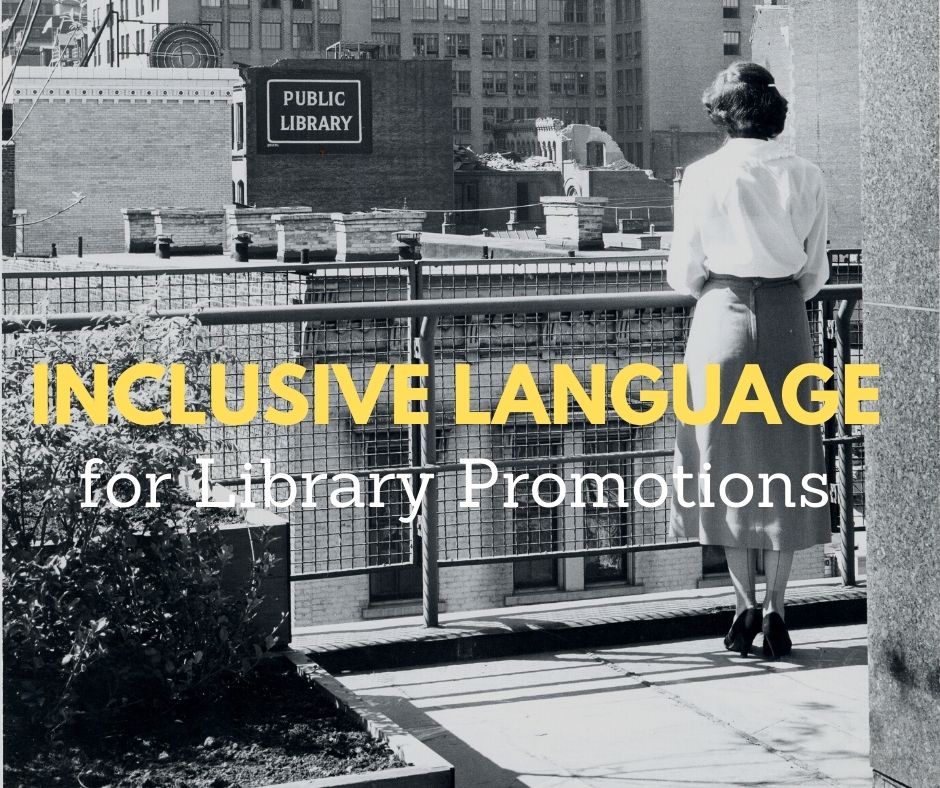
Does Your Community Feel Welcome At Your Library? Why Inclusive Language Is a Critical Part of Your Promotions.

Photo courtesy Public Library of Cincinnati and Hamilton County

“Language is one of the most important parts of any culture.  It is the way by which people communicate with one another, build relationships, and create a sense of community.”

Kelsey Holmes, Greenheart Club Program Assistant.

One of the ways we can best make all our community members feel welcome and safe is to use inclusive language in our library marketing and promotions.

What is inclusive language?

The University of Oregon has the best definition of inclusive language that I’ve found. In their editorial guidelines, they say “For communication to be effective, it needs to appropriately address all audiences for which it is intended. Inclusive language acknowledges diversity, conveys respect to all people, is sensitive to differences, and promotes equitable opportunities.”

Why inclusive language is important to your library

When your library uses inclusive language in print and digital marketing materials, on your website, and in conversation at the front desk, you are fulfilling the library’s core mission. You are giving people the signal that your library is a safe space.   

A lack of inclusivity reflects negatively on your library and values. It affects library staff morale. Worst of all, it can hurt the community’s perception of your library, affecting donations and fundraising efforts.

You must make time to check all your promotions for inclusive language. Every email, social media post, blog post, digital sign, bookmark, and brochure must be examined. You must make sure you aren’t excluding someone in your patron base.

The latest on inclusive language

Inclusive language changes and evolves. Since this post was originally published, I’ve written an update on the NoveList blog which you can read here.


You May Also Want to Read These Posts

Give Your Digital Library Marketing an Accessibility Overhaul and Make Access to Your Library TRULY Open and Equal for All. Here’s Your Starter Kit.

How to Convince Your Library Staff That Library Marketing Materials MUST Be Accessible!

Subscribe to this blog and you’ll receive an email whenever I post. To do that, enter your email address and click on the “Follow” button in the lower left-hand corner of the page.

How to Convince Your Library Staff That Library Marketing Materials MUST Be Accessible!

Watch Now

The Library Marketing​ Show, Episode 80

I recently learned that there are some library marketers who face push back when they try to make sure their marketing materials are accessible.

Accessibility is a library mission. One in five people around the globe live with a disability. Libraries will never be truly inclusive until they design services, programs, and marketing with this group in mind. And so, in this episode, I’ll share some strategies to help you make sure this goal becomes a reality at your library.

Kudos in this episode go to the Hutchinson Public Library for their advocacy idea that they deploy during Library Lovers Week.

Do you have a suggestion for a topic for a future episode? Want to nominate someone for kudos? Let me know in the comments. And subscribe to this series to get a new video tip for libraries each week. Thanks for watching!

Experts Reveal the Truth About What Your Library Needs to Do Now to Build Support for the Future

Photo Courtesy Public Library of Cincinnati and Hamilton County

For three days this week, more than a thousand library employees took part in the Library Advocacy and Funding Conference, sponsored by EveryLibrary. The organization helps builds support for libraries across the United States. This is the first conference of its kind, designed exclusively to help libraries learn to advocate on the ballot, in the donor arena, and in the hearts of their community.

The conference featured presenters from outside the world of libraries, so attendees got a chance to hear from successful, experienced experts talking about what works in politics and fundraising.

By Wednesday evening, my head was full of new information. Once I finished organizing my notes, I realized that the experts at the conference shared five big ideas specific to library marketing and advocacy. Here is what I learned.

Libraries must target ALL messages

Ashlee Sang, content strategist and copywriter for Ashlee Sang Consulting, said marketing fails when we try to send the same message to all cardholders. You must create marketing that talks to one person, on a level that speaks to their truth, their needs, and their problems.

Sang encouraged libraries to create personas to help with targeting. You can use data like checkouts and holds, as well as in-person interactions at the checkout desk, in the comment section of your social media, and even email, to help you create those personas.

Then, when you create marketing messages, think about targeting those personas. This will help you avoid designing around your own personal biases. Instead, it puts the focus on the people you are trying to serve.

Key quote: “If you create a message for everyone, you are creating a message for no one.”

Your library brand is more than a logo or a color scheme

Anjelica Triola, marketing director for Wethos, wants libraries to understand that your brand is not the colors and fonts that you use. It is the feeling that people get when they think about your library but are not actually in your library or around a librarian. That feeling will lead a cardholder to be an evangelist for the library.

Kimberly Gordon, brand strategist and marketing consultant, added that people crave a library with clear values and a commitment to being good corporate citizens. If your library communicates those two points, you’ll stand out in a positive way and showcase your value.

Gordon pointed out that we are living in a heightened state of emotion (I’m writing this pieces a few hours after the death of United States Supreme Court Justice Ruth Bader Ginsburg so that note really resonates with me!). She wanted libraries to remember that your brand represents a promise to your community.

Key quote:Marketing your brand improves likeability and sets you apart from your competitors. It makes you stand out in a positive way.”–Kimberly Gordon

Librarians connect with their community by finding common ground

Jasmine Worles, trainer for the National Democratic Training Committee, emphasized that the issues that mean the most to library staffers, both on the job and personally, are not unique to you. Other people care about the same issues!

Worles encouraged librarians to talk about why they love the library and why they are passionate about their work. Your “story of self” is the starting place of a connection. It builds genuine relationships and makes you trustworthy and credible.

As a library staffer, you may think that the library is bigger than you or that it’s not about you. But it IS about you.

Key quote: “Tell your story of self all throughout the campaign. It’s the most magical and effective piece of any campaign.” 

Diversity should be a part of your library strategy

Kim Crowder runs a consulting firm dedicated to diversity, equity, and inclusion in the workplace and in marketing. She’s been a guest on this blog before.

Crowder pointed out that diversity is looking at the ways people are different, then celebrating and acknowledging that. It’s not monolithic. And libraries must ask themselves, “How can inclusiveness be centralized in our message on a regular basis?”

She believes libraries must create a strategy about their commitment to inclusiveness and make it available to anyone to see. Crowder asked attendees to be open to feedback, to be willing to be uncomfortable, and to talk about diversity and inclusivity internally, as well as externally.

Key quote: “We all have bias, but we don’t always recognize it. If you fumble, admit your mistake, sincerely apologize, and be authentic in your efforts.”

Libraries should mix content formats for better engagement on Facebook and Instagram

Two representatives from Facebook and Instagram held a joint session with lots of tips for library social media engagement.

They encouraged libraries to share frequently and consistently, especially during important times like the pandemic. They also said the latest research shows a mix of format types (video, carousel images, static images, gifs, etc.) can help boost your page engagement. Avoid one kind of content all the time.

Finally, they encouraged libraries to livestream more often on both platforms, engage more frequently with other pages and profiles, and use Stories on both Facebook and Instagram to share content.

Key quote: “Highlight important announcements, share frequently and consistently, post more frequently during important times, and be informative and timely.”

Did you attend LAFCON? What did you learn? Share your takeaways in the comments.

You may also find these posts helpful

Six Tips to Make the Most of Your Online Experience During Virtual Conference Season

Why Libraries Lost HUGE Parts of Their Patron Base During the Pandemic and How to Fix It

Want to Make the World a Better Place? Tools and Tips for Libraries to Combat Racial Inequity in Their Communities

Latest Book Reviews

The Truths We Told by Kamala Harris

Craigslist Confessionals by Helena Dea Bala

Find more 60-second Book Reviews here.

Subscribe to this blog and you’ll receive an email every time I post. To do that, click on the “Follow” button in the bottom left-hand corner of the page. Connect with me on YouTube, Twitter, Instagram, and LinkedIn. 

Give Your Digital Library Marketing an Accessibility Overhaul and Make Access to Your Library TRULY Open and Equal for All. Here’s Your Starter Kit.

Women working in library on computers. Photo courtesy Public Library of Cincinnati and Hamilton County.

Libraries all over the world have one thing in common (besides books).

If you look at the mission statement of most any library, you will likely find a sentence about equal access to information for all.

I believe most libraries truly want to provide equal access. Libraries work hard to make sure information is available to people living in disenfranchised communities. They translate brochures into native languages. They provide resources to combat economic disparity. They play a role in distributing information on mental health, addiction, and housing inequity.

But to truly live up to that mission, we need to use the same amount of energy and focus to make the library accessible to people living with disabilities.

One in five people around the globe live with a disability. Libraries will never be truly inclusive until they design services, programs, and marketing with this group in mind.

Angie Brunk changed my life, and the way I think about marketing and inclusivity. Her popular presentation at the 2019 Library Marketing and Communication Conference made me re-evaluate everything I do. I follow many of her suggestions now as I blog and post on social media.

She made me realize that many people live with hidden disabilities, and that libraries have a long way to go to be truly inclusive. For your library to be accessible, you’ll need to do more than add ramps and elevators in a building. You’ll need to make sure your digital offerings, your website, and your social media are all accessible to your patrons with disabilities.

Here are some suggestions on where to start.

Accessibility on your library website

Everything you create on the web must comply with Web Content Accessibility Guidelines. Bookmark that site because it’s your guidebook for all your online projects.

Web Content Accessibility Guidelines (WCAG) are developed with individuals and organizations around the world. The goal is to provide a single shared standard for text, images, sound, codes, and more… basically, everything that appears on the internet.  Here is the quick reference guide for the latest version of the guidelines.

Consider how easy or difficult it is for patrons with disabilities to find information about your library’s accessibility on your website. You’ll also want to create an accessibility statement, which should be as easy for people to find as your circulation policy or standards of library behavior policy.

Your statement should include information on the accessibility of your physical buildings, the accessibility of your vendor-provided services like eBooks and databases, and your library’s stance on service animals, support personnel, and assistive technology. Include contact information so community members can report a concern or ask a question about accessibility.

Some great examples of library accessibility statements include the policy of the University of Birmingham and this policy from the Toronto Public Library.

Accessibility in design and marketing

Create personas with disabilities, just as you would for other demographic groups. This will help you to imagine how those users will interact with your events, services, and promotions.

As you consider this, ask yourself these questions:

  • What does the persona have to do to find the information about your library?
  • What senses or physical tasks are involved in using your library services and how does that impact patrons with disabilities?
  • What barriers will disabled community members encounter?

Next, seek out patrons with disabilities and ask them to provide feedback on your website and social media marketing. Incorporate what you learn about accessibility from your patrons into your library marketing style guide.

Accessibility in written library marketing content

As you create content, you should check four main components to ensure accessibility.

  • Cognitive: How much time must a user spend with my content to truly interpret and understand it?
  • Dexterity: What kind of physical movement must a user perform to interact with my library’s website or with the content I’m creating on other digital platforms, like email and social media?
  • Hearing: What sound does my content produce that are required for a user to consume my content?
  • Vision: What shapes, colors, text, and graphics must a user understand to consume my content?

Once you’ve tackled those four questions, there are a few other small accommodations you can make to ensure everyone can have access to your library marketing content.

First, descriptive text is a must for all images on your website, social media, and in email. Make that text meaningful. Really describe what is happening in the image. I confess I often skipped this step before Brunk’s session. Now, I add descriptive text on all social media posts and on my blog images.

Next, check to see if your graphics are screen reader compatible. Avoid using anything that can’t be shared with the vision impaired through a screen reader. This article does a really good job of explaining screen readers and how they work.

The best way to check your graphics is to install a screen reader for yourself. Run your visual promotions through the screen reader before you release them and adjust when you find incompatibility issues.

Finally, make sure all videos on social media, YouTube, and your website are captioned. And just like with the descriptive image text, really take the time to explain what is happening in the video.

If you are posting a video on Facebook or Instagram, describe what will happen in the video in your post! This will help patrons with visual disabilities to fully understand your video content.

Additional resources for libraries

The latest version of Microsoft Office includes an accessibility checker!  Here’s the guide for how to use it.

Usability.gov has a wealth of information, templates, tools, and advice.

The American Library Association has a special section of their website dedicated to accessibility with a host of helpful tools and tips.

The Library Marketing Show: Make Your Library Website Accessible!

Latest Book Reviews

Hollow Kingdom by Kira Jane Buxton

Dear Edward by Ann Napolitano

Find more 60-second Book Reviews here.

Subscribe to this blog and you’ll receive an email every time I post. To do that, click on the “Follow” button in the bottom left-hand corner of the page. Connect with me on YouTube, Twitter, Instagram, and LinkedIn. 

Want to Make the World a Better Place? Tools and Tips For Libraries to Combat Racial Inequity in Their Communities

Photo Courtesy Public Library of Cincinnati and Hamilton County

In the United States, a week of riots and violence protesting racial inequities was enough to send me in paralysis of inaction. It was soul-crushing. Like many of you, I sat at my computer or scrolled through my phone. I felt anger and despair. I felt hopeless and helpless.

I’m just a library marketer. What can I do to help?

Equality, inclusion, and diversity are social justice issues. Social justice aligns with the core values of library work. Equal access, educational equality, free service, and safe spaces are all essential and valuable library missions.

Many of the librarians I work with have hearts bent for social justice. They may not be aware of it. But their empathy, compassion, and drive to pass on information and ideas make the world a better place.

Every time a library staffer teaches someone to read or feeds someone or helps someone to get a job or offers a space for a group to meet in safety and peace, they are doing social justice work. Every time a library staffer recommends a diverse book or helps someone fax an unemployment claim to job services or helps a minority-owned business owner secure a grant or a patent or a trademark, they are doing social justice work.

If you feel that the problems of the world are too numerous or too difficult, that your job is too small, that no one cares about what you do or say, YOU ARE WRONG. You do make a difference working in a library. And you have the power to change lives.

This week, I want to share a list of resources and ideas to respond to racial inequity. I believe that libraries can help our communities to be more equal, inclusive, and diverse. Here is advice I’ve learned from experts, and tools to help you make changes in your collection, your marketing, and ultimately, your community.

What is your #1 library marketing worry or concern right now?

Go back

Your message has been sent

Warning

Warning.

Be aware of your own bias. I was raised to be prejudiced. I must consciously work on my own mind. And so should you. We must all make a habit of constantly questioning our own beliefs and reactions.

It’s not easy. It’s work we must do every single day. It starts with educating yourself. I’ve found several resources to help me with this. The best is this fantastic list of anti-racism resources for white people. There is also this great list of resourcesto help with racial division and the ongoing COVID crisis on the Facebook page Libraries Step Up (in times of crisis).

I also turn to friends like Kim Crowder. Kim is a former library marketer who now runs her own consulting firm aimed at helping organizations like libraries to make sure they are diverse, equal, and inclusive in their marketing, workforce, and services. She’s written for this blog on diversity in library marketing.

Kim is offering an anti-racism course on how to live an inclusive life. Inclusive leaders and professionals live diverse lives. She says, “Anti-racism and silence cannot inhabit the same space. Find out tools you can take with you and ways to grow and influence those around you. Let’s get comfortable with being uncomfortable. Humanity must lead.”  Sign up for her newsletter now for more details.

Recommend diverse books. One of a librarian’s main jobs is to recommend books to readers. This is your chance to create empathy in your community.

There are SO MANY resources to help you find diverse titles, including the website for the social movement We Need Diverse Books and The Children’s Book Council. My friends at the Public Library of Cincinnati and Hamilton County responded this week by quickly pulling together a list of books about race and anti-racism, which they displayed at the top of their Overdrive page. Your library can replicate that.

You can also turn to the Own Voices movement to find diverse books. Own Voices is an adjective that describes a book about diverse characters written by authors from that same diverse group.

If you aren’t familiar with diverse titles, there are two great places to find these books. The first is NoveList. (Note: I work for NoveList.) I have found many library staffers have no idea that their library is a subscriber. Check your library’s website. If you have NoveList, you can use it to find diverse and Own Voices books to recommend.

The other place is Pinterest. Searching “diverse books” and “Own Voices” on Pinterest will lead you to a host of booklists created by librarians, publishers, and other book industry websites.

Lift up diverse voices on your platforms. If you have a blog or a newsletter, ask patrons and community leaders from diverse backgrounds to write for you about their experiences at the library and beyond in the wider world. The library is built on stories. Those stories can be a way to affect change in the world. There is no more powerful way to do this than to amplify diverse voices.

Be intentional about adding diversity to story time and programs. Children’s librarians, you have the power to influence the next generation of readers. Read diverse books and share songs and crafts from diverse cultures at your story time. My favorite example is happening on the DC Library Facebook page, where they’ve posted bi-lingual story time videos.

The DC Library is also leading the way with diverse presenters for their programs. Be intentional about including presenters and experts from a variety of backgrounds, abilities, and perspectives. Your library is a safe space where ideas and information are shared. Let’s make sure we include all voices in discussions about all subjects, large and small.

Use diverse images in all your marketing. Representation matters. The library is a place where everyone in your community feels welcomed and included. Studies show that younger library users are more likely to respond to marketing that includes visual representations of diversity.

It is difficult, but not impossible, to find free diverse stock photos. Some good choices are Pexels diversity photo collection, Nappy, Women in Tech, and Unsplash.

Use social media for good. I know your social media feeds feel like a cesspool of hell. It doesn’t have to be that way. Libraries can help by curating content on diversity, equity, and inclusion.

You should, of course, share library resources to help your community learn about diversity and inclusion. But also look outside the library for content to share. Share posts by readers and people in your community from diverse backgrounds. Start a conversation with your followers about diversity. You can even do this live on Facebook or Instagram. And share posts from local organizations about events or educational opportunities tied to diversity and inclusion.

Do you have more ideas for how libraries can help their communities deal with racial inequalities and promote diversity? Please leave a comment below. Thank you for reading this.

Subscribe to this blog and you’ll receive an email every time I post. To do that, click on the “Follow” button in the bottom left-hand corner of the page. Connect with me on YouTube, Twitter, Instagram, and LinkedIn.  


Expert Advice on How to Work Diversity Into Your Library Marketing

A few months ago, the Urban Library Council’s Marketing and Communications team organized a conference call with library marketers across the United States. Part of the conversation focused on diversity in library marketing. It’s an important topic and frankly, I had nothing to contribute to the conversation. In fact, I’m embarrassed by my ignorance. Libraries serve a diverse population. Why haven’t we done a better job of working that into our marketing?

This year, my staff began a concerted effort to include more diverse faces and stories in our marketing. But I had this nagging feeling that there was a lot more we could do. I just didn’t know where to begin or how to frame my thoughts. The ULC conference call made me realize I wasn’t alone. It also made me realize that there is an expert in this area; a library marketer who has pushed her team and her library to look for ways to be inclusive on all fronts of marketing.

Kim Crowder established a communications department as Director of Communications for the Indianapolis Public Library. She is the winner of multiple national awards for her work and has spoken on panels and given talks covering a variety of marketing and communications topics. Prior to her role at the library in Indy, she spent 15 years working in marketing and communications for several Fortune 500 companies and was a published journalist for one of the largest newspapers in the United States. Her experience includes working with national and international media on outlets such as Conde Nast, The Oprah Winfrey Show (Yes, she met Oprah!), MTV, BBC London, CBS News, The Learning Channel and more.

Kim believes diverse points of view, flexibility, and creativity are keys to producing the best marketing and communications strategies possible. Kim took a lead role in the conversation on that ULC conference call and afterwards, I asked her to share her thoughts on diversity in library marketing with us.

Libraries inherently serve a diverse population, yet we don’t always include diversity in our marketing. There’s a bit of a disparity there! Why is diversity in marketing important for libraries?  The populations we serve are diverse, and our marketing efforts should be inclusive and truly represent our audiences. This is basic marketing 101. And I’m not talking about only focusing on certain populations for certain services and events. That should happen too, but this is more a conversation about overall strategy. Typically, public funding pays for libraries, which means acknowledging citizens of ALL backgrounds, because it is their dollars that keep our lights on. And we are all (or should be) aware of campaigns such as #weneeddiversebooks. Also, the American Library Association cites equity, diversity and inclusion as key action areas. For us to be unified on this topic, we must embrace it fully.

As our country becomes more diverse in a plethora of ways (not only regarding race) and knowing that it is predicted that in 2040 we will be majority-minority nation, libraries must plan now to stay relevant in the future. To do that, we must demonstrate our necessity and make as many people as possible aware of our benefit to their lives; it makes good business sense to be inclusive. Diversity in marketing is a needed and necessary aspect that must be earnestly examined and executed. And frankly, it’s the right thing to do, period.

Diversity in marketing is more than just making sure we include people of different races, religions, and abilities in our marketing photos and campaigns. What other ways can we market to a more diverse audience? This is a great question! Here’s where nuances matter. For instance, knowing what is important to certain populations and targeting specific programs and services to those markets by using the language, messaging, and imaging that most speaks to them is imperative.

An example of this would be to create marketing campaigns that are translated into different languages and really working with a native speaker (if possible) as well as a translator, to be sure the interpretation is correct, including knowing which regional dialects are most common in your market. Also, being aware of the vernacular that is correct when addressing the LGBTQ+ community, such as using sexual orientation instead of sexual preference. Making sure that you are aware of holidays and times of celebration and using social media to point to those is paramount. These are only a few ways to reach audiences in ways that are respectful and inclusive. It really is about intentionality and research to respect different groups within your service area and to make sure you have a real sense of who those segments are.

Will diversity in library marketing help to change the mindset of communities and how people view their fellow citizens? What an interesting thought! My answer is that it could help, absolutely. Change takes time and a village, and libraries can certainly contribute to the greater conversation. And remembering that diversity includes more than race, disabilities, socioeconomic status, gender, etc., but also includes experiences as well, should be acknowledged and considered. The more commonalities within humanity that are highlighted, the better.

Think on themes such as wanting great educational tools and programs for kids; a place anyone can feel safe to learn freely; and the ability to find books, movies, music, and more that speak to people’s core values. All these are ways to make library services more connected on a human-interest level to the populations in which we serve. The more stories that are shown using real customers, the more engaging. Finding a way to create emotional connection, whether through video, a news story, social media, community partnerships, print materials, blogging, etc., is key, and can certainly create an environment of shared interests. At the end of the day, we are all people, and finding that common thread using diverse representation is the way to go.

How do we convince our library colleagues that diversity in all areas that the library touches, like programming, exhibits, and services is important to our mission and to our cardholders? Everyone receives information differently, so think about the myriad of ways in which this fact can be demonstrated. Whether it is through anecdotes about individuals we serve or looking at pure data to find out the population breakdown in your service area, this case is best won by combining these different forms of information so that people can get a full view of the importance of diversity and inclusion.

And having them think through target audiences as they are planning services, exhibits, programming, etc., allows real dialogue about who these different groups may be so that the conversation of diversity is immediately valuable to the person doing the planning. And convey the message again, and again, and again, throughout your department and the system overall, as well as finding staff who will be ambassadors who speak to this as well. The more managers who are on board and empowered to pass along this information to staff, the better. Particularly, we have an African American History Committee and a LGBTQ+ Committee, run by staff members, who plan events and speak on behalf and are allies of minority groups.

What role does diversity in staffing play in the way libraries market themselves? Let’s start by acknowledging the elephant in the library world. Most of the workforce in libraries only speak English, are women, white, and not considered disabled, so naturally, there are going to be blind spots. Blind spots would be so no matter who the majority were. There are, however, some real statistics about why a diverse workforce is so important. And diversity is at its most valuable when gender, ethnicity and sexual orientation are combined with acquired diversity that is gained from experiences like living and working abroad or regularly interacting with a marginalized group. There are also statistics that state a lack of diverse leadership means women are 20 percent less likely than straight men to receive support of their ideas; LGBTQs are 21 percent less likely; and people of color are the most vulnerable at 24 percent.

The impact is that staff who would notice missteps in the way a group is messaged to or represented in campaigns, including recognizing lack of representation, may go ignored because they do not have the support when they do speak up. Having several points of view in any situation is extremely helpful, and a more diverse staff who can contribute and truly be heard, naturally creates an environment for this.

Can you give us some examples of how you have worked diversity into your marketing at the Indianapolis Public Library? We are constantly working on this, and it isn’t always simple, comfortable, nor easy. In 2018, all my staff participated in a racial equity training given by a third-party community partner that was extremely eye-opening for all of us. I wanted us to have context as to why we were focusing more heavily on this topic and to be able to has some real data on the issues. The first step was to be willing to openly have conversations around this, and to invite others to do so, resulting in bettering our marketing and communications efforts.

Regarding marketing tools, social media is a big part of how we do this; particularly focusing on highlighting diverse materials and topics in posts and event listings. Using kid-focused materials is a great way to introduce diversity to wider audiences, as it tends to disarm people a bit more. Also, making sure that we use videos to tell stories about our patrons being touched by library services is major strategy. We highlight users from all walks of life, knowing that stories connect on a human level, even beyond initial differences.

We are extremely conscious of this when in situations such as building a new branch or closing one in a neighborhood that is largely minority or has high numbers of residents below the poverty line (this is happening currently, and it’s not easy nor pretty). The goal is to always respect and honor people and that community overall, no matter what. And equally as important, being sure to position the Library as a support to those communities, not a savior or a “fixer.” We must be sure we are always viewed as a partner coming alongside those who are already doing great work and living in these communities. We are supporters who are always actively listening. That means our messaging must uphold that secondary position in the most respectful way possible, and if we miss that mark, we are immediately transparent about it and ready to learn however we need to. We are here to serve.

Kim is a native of Houston, TX (and VERY proud of it), and a lover of music and social issues dialogues. When Kim is not enjoying her professional endeavors, you can find her singing at church or jazz at a bar (with the occasional musical and national anthem at a sporting event sprinkled in here and there), listening to podcasts and audiobooks, Latin dancing, brewing tea, attending an artsy event or live concert, shopping, enjoying the sunshine, or laughing hysterically with family and friends. Her Instagram is the bomb! You can also email Kim at Kimberly.Crowder@live.com and say hi!

Subscribe to this blog and you’ll receive an email every time I post. To do that, click on “Follow” button in the bottom left-hand corner of the page. Connect with me on Twitter, Snapchat, and LinkedIn. I talk about library marketing on all those platforms!
A WordPress.com Website.

Up ↑