The Library Marketing Show, Episode 171: In this episode, I’m going to share an example of a marketing campaign from the makers of the game Monopoly.
This campaign uses a very specific technique to get at the emotional motivation for playing the game. What does that have to do with library promotions? Watch the video to find out!
Kudos in this episode go to a group of Alabama libraries.
👏 I do a lot of bragging about libraries. But I can’t see everything everywhere, and I’m certain I’m missing some of the best #LibraryMarketing examples. SoI need your help! You can share anonymously if you like. Thank you!
Do you have a suggestion for a topic for a future episode? Want to nominate someone for kudos? Let me know in the comments.
And subscribe to this series to get a new weekly video tip for libraries.
Thanks for watching!
Subscribe to this blog and you’ll receive an email whenever I post. To do that, enter your email address and click on the “Follow” button in the lower left-hand corner of the page.
The Library Marketing Show, Episode 170: In this episode, I’ll reveal the single most important question that you should ask every library guest. This question is the key to revealing your most effective library marketing tactics.
Do you have a suggestion for a topic for a future episode? Want to nominate someone for kudos? Let me know in the comments. And subscribe to this series to get a new weekly video tip for libraries.
Also, I have a special request: I want to hear your best advice for library marketing in 2023! What did you learn this year? What are you excited to try next year? Share your thoughts for a future Super Library Marketing post.
Thanks for watching!
Subscribe to this blog and you’ll receive an email whenever I post. To do that, enter your email address and click on the “Follow” button in the lower left-hand corner of the page.
The Library Marketing Show, Episode 169: We have news that could have an impact on your library’s social media strategy.
First, TikTok is testing audience insights, which give you a deeper look into your audience. We’ll talk about the features that could be a regular part of your data very soon.
Plus a new study from Pew Research Center uncovers how teens view social media use. And there are lots of takeaways for libraries.
Do you have a suggestion for a topic for a future episode? Want to nominate someone for kudos? Let me know in the comments.
And subscribe to this series to get a new weekly video tip for libraries.
Thanks for watching!
Subscribe to this blog and you’ll receive an email whenever I post. To do that, enter your email address and click on the “Follow” button in the lower left-hand corner of the page.
The Library Marketing Show, Episode 168: This episode is another must-watch for any library that posts on Twitter.
Elon Musk’s takeover of the social media platform has thrown Twitter into chaos. And many libraries are seriously thinking about deactivating their accounts.
I’ll share three things to consider before you make that decision. PLUS: I’ll share an alternative to deactivating your Twitter account.
Do you have a suggestion for a topic for a future episode? Want to nominate someone for kudos? Let me know in the comments.
And subscribe to this series to get a new weekly video tip for libraries.
Thanks for watching!
Subscribe to this blog and you’ll receive an email whenever I post. To do that, enter your email address and click on the “Follow” button in the lower left-hand corner of the page.
The Library Marketing Show, Episode 167: This episode is a must-see for any library that posts on Twitter.
Elon Musk’s takeover of the social media platform has put accounts at risk. I’ll explain the threat and the four steps your library can take right now to reduce the chances your library’s account will be cloned or hacked.
Do you have a suggestion for a topic for a future episode? Want to nominate someone for kudos? Let me know in the comments. And subscribe to this series to get a new weekly video tip for libraries.
Thanks for watching!
Subscribe to this blog and you’ll receive an email whenever I post. To do that, enter your email address and click on the “Follow” button in the lower left-hand corner of the page.
The Library Marketing Show, Episode 166: This episode is all about click-thru rates for digital promotions!
This topic was suggested by a viewer named Lily who says, “We have a super high open rate and super low click-through rate. Could you talk CTRs?” I sure can!
Do you have a suggestion for a topic for a future episode? Want to nominate someone for kudos? Let me know in the comments. And subscribe to this series to get a new weekly video tip for libraries.
Subscribe to this blog and you’ll receive an email whenever I post. To do that, enter your email address and click on the “Follow” button in the lower left-hand corner of the page.
Photo courtesy Public Library of Cincinnati and Hamilton County
The house I grew up in was surrounded by cornfields.
The nearest town was four miles away. It featured a grain elevator, a tiny country store, a barber shop, and a post office. A traffic light was installed after a tractor damaged the bridge from the town to the surrounding area.
Photo of the old bridge, courtesy BridgeHunter
I’m a product of small-town America. So small towns fascinate me. So do small libraries.
According to the Institute of Museum and Library Services’ annual Public Library Survey, 57 percent of libraries in the United States have five or fewer staff members. 27 percent have one or fewer full-time employees!
If you are working in a small library, you are doing everything, from working with readers to cleaning the bathrooms. Promoting your library is likely just one more thing on your to-do list, something you’ll get to if you get time.
But of course, we want people in our community to use our library. We need them to use it. So how do you market your library when you are pressed for time or staff resources?
Marketing is really not a job for one person. But that’s the reality for so many of my readers.
So here are the very focused, strategic steps you should take to consistently and effectively promote your library if you are working alone or with a tiny staff.
Set one, SMART goal.
You will need to be hyper-focused in your promotional efforts. Pick one thing you want to work on. Then set a Specific, Measurable, Attainable, Relevant, and Time-bound goal for that work.
The village of Wayne, Ohio has a population of about 900 people. It is very much like the small town I grew up in, with one notable exception: it has a library!
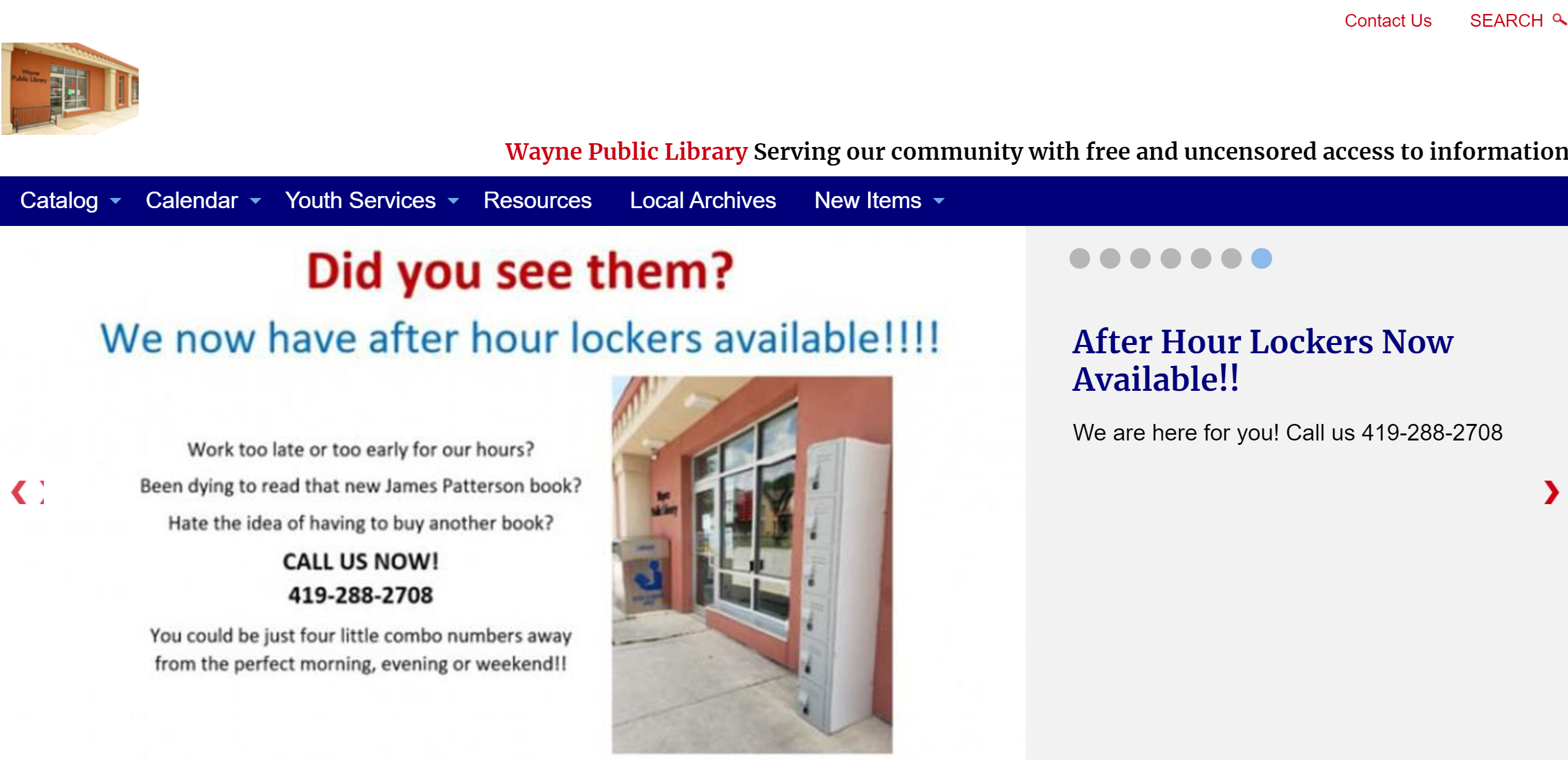
Driving through town a few weeks ago, I noticed the library has purchased an outdoor locker so patrons can pick up holds when the library isn’t open. They want people to use the locker, of course. So, they’ll want to promote it.
I don’t know anyone on the 7-person staff of the Wayne Library. But, if I were working with them, I would encourage them to set a SMART goal like this:
We will get 30 people a month to request their holds pickup via the outdoor locker. We’ll do this by promoting the locker on our website and by specifically asking patrons if they’d prefer to pick up their holds via the locker when we place holds for them. This goal is important because it will prove the value of this investment and will increase circulation. We’ll track and record the total the number of locker users at the end of each month.
You can see this goal contains specific numbers. It sets the context for why this promotion is important. And it lays out how the staff will measure success.
A SMART goal will help you organize your promotions and keep you accountable. It will give you a sense of direction for your work.
Focus on tactics that work best to reachsmall communities.
Make a list of all the ways you can promote your library: your website, email lists, social media, in-person interactions, print, partners, signs… etc. Then take a highlighter and pick the 2-3 things that work best for your community. Those are the tactics you should use to reach your SMART goal.
Every library community is different. And small libraries often find promotional success in places that are different from their larger counterparts.
For example, if your library is located by a major road, use outdoor signage to attract the attention of passing motorists. If your school is a significant community hub, ask teachers to send home promotional bookmarks and fliers in kids’ backpacks. If your town has a little restaurant where residents come for breakfast every Saturday, ask the restaurant owners to give out a promotional print piece like a bookmark or flier with the check.
Wayne Public Library uses its website to promote its lockers.
Live and die by an editorial calendar.
An editorial calendar will help you decide what, where, and when to publish. After those decisions are made, the editorial calendar will help you assign tasks and keep up to date on deadlines.
First, you’ll create your calendar. Then you’ll decide how to populate it with content that will ensure you reach your promotional goals.
Repurpose content.
When your staff is small, you’ll need to work smarter, not harder. A smart way to maximize your time and efforts is by repurposing content.
Repurposing content is the act of finding new ways to recycle your existing content. It’s basically taking one piece of content, say an email newsletter, and re-formatting it for different mediums like social media, a blog post, and an email
You can do this with any piece of content, from your website graphics to your annual report. Break the content down into pieces and spread them across all your available platforms. In this way, you can make sure everyone in your community sees your message. You also can make sure the work you are doing right now will have maximum impact.
Technology can be your best friend if you are working on promotion all by yourself. Schedule your emails, blog posts, and social media posts as far in advance as possible.
There are several great social media schedulers that have free plans. This post is an excellent list of each of those options.
For blogs, I recommend WordPress. You can get a free account and you can schedule posts to go out whenever you like. Plus, patrons who follow your blog will get an automatic email every time you post. That means you don’t have to create an email to let them know you’ve published new content.
You will have to invest in an email platform. But once you do, you can create and schedule emails to go out to your patrons as far in advance as you like.
Learn from larger libraries but don’t compare your success.
The success or failure of a library’s marketing has nothing to do with the size of its staff. In fact, I would argue it might be easier for a small library to create successful library promotions.
Small libraries have more freedom to experiment. Their staff tends to be personally connected with patrons. They have a deeper understanding of what their community wants and needs from their library.
So, follow those large library systems on social media. Sign up for their emails. Look at their websites. Visit large libraries when you travel. Make a list of ideas that you want to try at your smaller library.
But remember, the key to success is a library’s ability to connect with its own community. Any library can do that, no matter how large or small the staff.
I was recently the guest on a new podcast called Library Marketing for Library Marketers. Listen to that episode here.
Subscribe to this blog and you’ll receive an email every time I post. To do that, enter your email address and click on the “Follow” button in the lower left-hand corner of the page.
The #LibraryMarketing Show, Episode 162: This episode is my response to a recent comment by a library staffer. They believe that marketing emails aren’t worth their time because people receive too many emails from brands.
That’s a common misconception. I’ll explain why it’s not true and share some tips for making sure your library marketing emails get opened and clicked on!
Kudos in this episode go to Kathy Zappitello. Watch to find out why she’s being recognized.
Do you have a suggestion for a topic for a future episode? Want to nominate someone for kudos? Let me know in the comments.
And subscribe to this series to get a new weekly video tip for libraries.
Thanks for watching!
Subscribe to this blog and you’ll receive an email whenever I post. To do that, enter your email address and click on the “Follow” button in the lower left-hand corner of the page.
Photo courtesy Public Library of Cincinnati and Hamilton County
You are pressed for time.
I know it. I have the receipts.
Every time I lead a Learn with NoveList course, I ask a question of my audience. What’s the hardest part of library marketing?
And in every single class, the answer is always the same: Finding the time to do the work.
And yet, you’re expected to crank out library promotion after library promotion. You are asked to increase visitors, program attendance, circulation, and donations to your library. And you are often doing this promotional work while doing other things like answering reference questions, shelving books, filling holds, and cleaning the bathroom.
It’s exhausting. And sometimes, it seems downright impossible.
Time management is hard. But the benefits are well worth it. Time management helps you achieve bigger goals, reduces procrastination, and increases productivity.
I was fortunate, early in my library career, to have a mentor who helped me get control of my schedule and learn how to prioritize my work. It’s now my turn to pass on the six most effective tips for managing your time without losing your mind.
Tip #1: Schedule everything.
My calendar is more than a place to keep track of meetings. It serves as the hub for all my work tasks.
If you need time to focus, research, or think about something, schedule it in your calendar. Schedule the time you’ll be spending at the front desk. Schedule the time it takes you to work on holds or shelve books. Schedule the programs you’ll lead. Schedule time to read your email. Schedule everything.
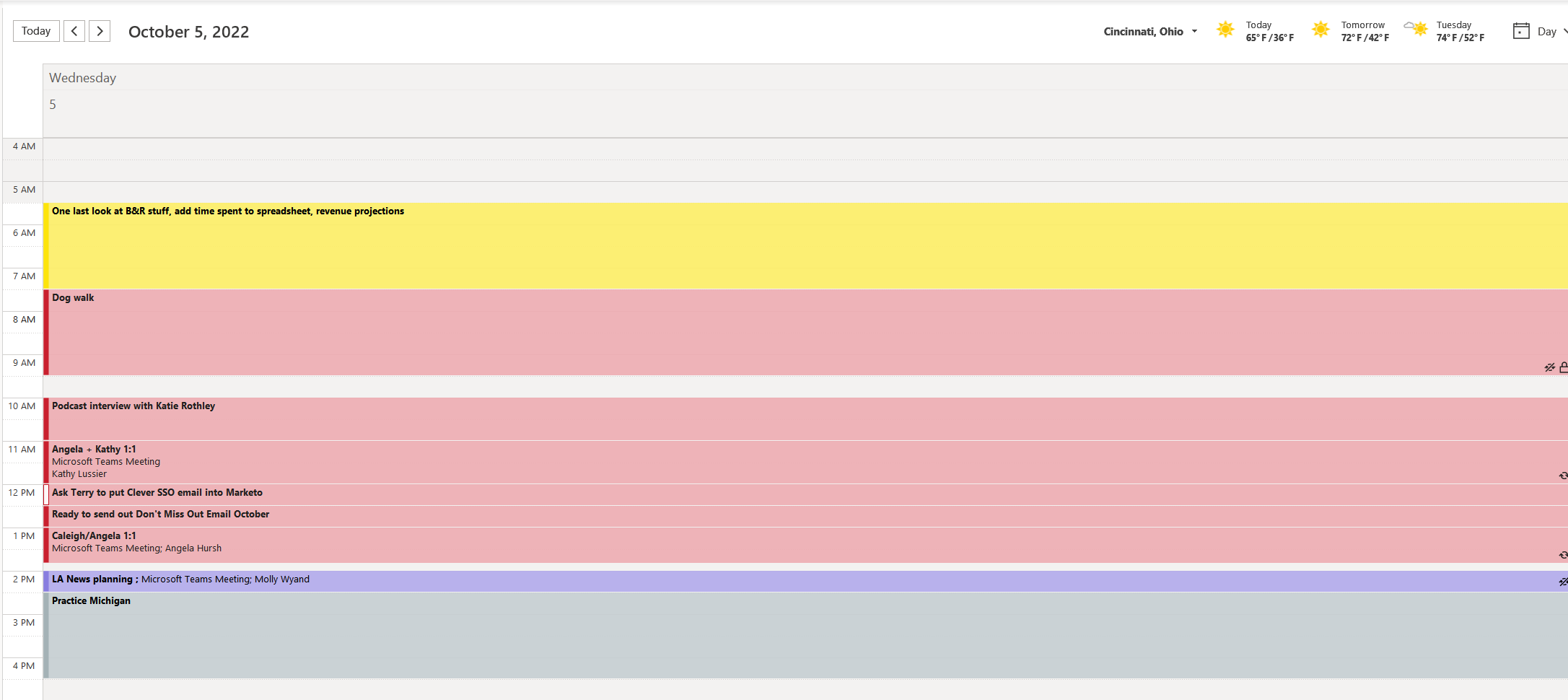
Here is a screenshot of my calendar. I use color coding to help me keep track of important, ongoing projects. Notice I even schedule my daily walk!
This method makes it clear what you’ll be working on each day. It also keeps you from forgetting tasks. When I’m given an action item from a meeting, I immediately go to my calendar and schedule time to do that work.
I also enter recurring tasks in my calendar, so I can be reminded to add those tasks to my wish list (see tip #6) when the time to do them arrives. This leaves me more time to focus on tasks for today, and not worry that I’ve forgotten to do something important.
Tip #2: Arrange your daily tasks in order of difficulty.
The most difficult or important thing on your to-do list should be the first thing you get done every day. This method creates momentum and frees up the rest of your day so you can do easier tasks or tasks you enjoy more.
Tip #3: Block out distractions.
If you need to concentrate, do whatever you have to do to get focused. A study at the University of California, Irvine found that, once you get distracted, it takes 23 minutes to regain focus. That’s a lot of time.
When you need to remove distractions, you should:
Shut down your email.
Shut down Microsoft Teams, Skype, or whatever program your library uses for internal messaging.
Close your website browser.
Turn your phone over so you can’t see the screen and put the ringer on vibrate.
Go to another location. This is especially important if your workspace is in a shared office or near patron areas of your library. It is okay to create physical barriers between you and your distractions!
Tip #4: Say “no” to be more efficient.
If you’re asked to add to your library promotional schedule but the addition does not drive the overall strategy of the library or falls outside the boundaries of your documented marketing strategy, say no. Saying no gives you time to really concentrate on the pieces that will help your library the most. Your work will be better the LESS you do.
I understand this is extremely difficult to do. I encourage you to bookmark this short but powerful essay on the power of saying no in marketing from Joe Pulizzi. I re-read this piece when I need a little help saying no!
Tip #5: Take creative breaks.
No one can churn out tasks, one right after the other, all day long. Creative breaks will give your mind a rest and help you focus when you need to. Walk the stacks or go for a walk around the block. Get away from your desk for five minutes to stretch your legs and gather your thoughts.
Tip #6: At the end of every day, celebrate what you got done and make a wish list for tomorrow.
Many, many years ago, I heard singer Wynonna Judd say something that I think about almost every day. She was discussing her schedule, and how easy it is to get to the end of the day and to feel like a failure. That’s because many of us focus on what we didn’t manage to get done, instead of celebrating what we did accomplish.
I took that to heart. At the end of the day, I spend a few minutes paying homage to the work I did, even if I didn’t make it to all the tasks I intended to do.
Then, I make a “wish list” of tasks for the next day. Notice I don’t call it a “to-do list.” That’s because library staff must be flexible and deal with unexpected work.
As you make out your “wish list,” include every task: meetings, lunches, phone calls, calculations, reports, writing assignments–the whole deal. At the end of today, go through your wish list and highlight three things that absolutely must get done. Those will be the first three things you tackle the next day.
Be protective about your wish list. If someone emails you with a task and it isn’t urgent, put it on tomorrow’s list.
And finally, do not beat yourself up if you don’t finish every task on your list. Move uncompleted items to the wish list for the next day.
Subscribe to this blog and you’ll receive an email every time I post. To do that, enter your email address and click on the “Follow” button in the lower left-hand corner of the page.



 Super Library Marketing: Practical Tips and Ideas for Library Promotion