Search

Super Library Marketing: Practical Tips and Ideas for Library Promotion

Category

library marketing advice

The Very Latest Research on Social Media and How It Affects Library Marketing

Watch Now

The #LibraryMarketing Show, Episode 45

Angela goes over the latest study from Sprout Social which lays out the latest research on how people are using social media, plus how they view social media use by brands. The same study then compares how marketers *think* people use social media and how they view brands. The difference is fascinating, and there is a lot of great insights for libraries.

Also Kudos to the Monroe County Public Library. They released a video called “A Cautious Path to Phasing In Services” which manages to be formal and light-hearted at the same time.

What did you think of this episode? Are you struggling with marketing and promotion right now? Do you have tips for handling this crisis that you can share with other libraries? Do you have a nominee for the Kudos segment? Drop a comment below! And subscribe to this series on YouTube to get a new video tip for libraries each week!

Want more Library Marketing Show? Watch previous episodes!

This blog consists of my own personal opinions and may not represent those of my employer. Subscribe to this blog and you’ll receive an email every time I post. To do that, click on “Follow” button in the bottom left-hand corner of the page. Connect with me on Twitter, Instagram, and LinkedIn.   

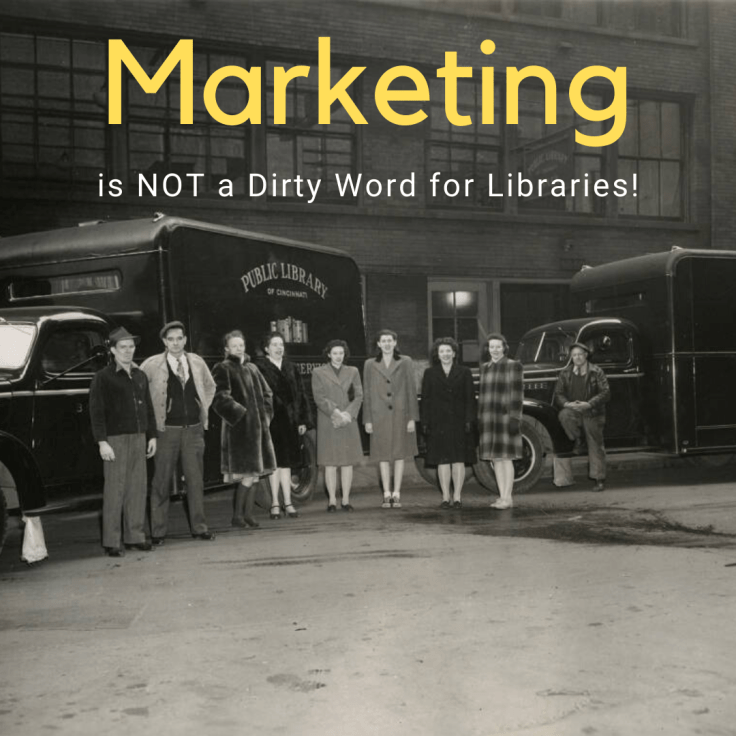
Marketing is Not a Dirty Word! Why Libraries Need to Promote Themselves Now, More Than Ever

Photo courtesy Public Library of Cincinnati and Hamilton County

Back in February, I had the great pleasure of attending and speaking at the Edge 2020 conference in Edinburgh, Scotland. While there, I heard from librarians across the United Kingdom as they shared stories about the fantastic work happening in their libraries. You can now see video of all the sessions on their web page.

Scott Simpson, Head of Library & Information Services, and Paul Martin, Systems Development & Support Officer, East Renfrewshire, discussed their library’s program, “Do Your Bucket List at Your Library.” Attendees can visit places they’ve always wanted to see, pretty much anywhere in the world, using a VR headset and guidance from a library staffer. Simpson and Martin told us that many older people use VR to revisit places they haven’t seen in years or to show their families where they grew up.

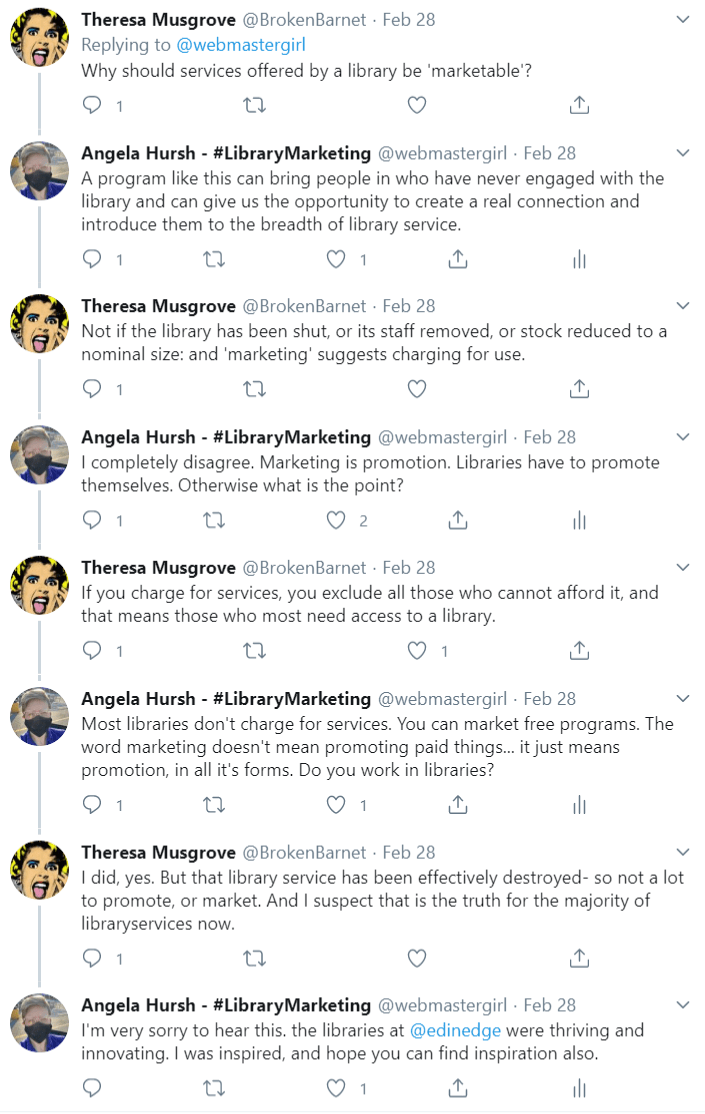
I think this is brilliant. And marketable. And I said so on Twitter.

That’s when this back and forth happened.

The discussion has been on my mind ever since. I thought about it last week, when I recorded an episode of The Library Marketing Show about the need for libraries to keep communicating their value. I want to expand on that point.

The debate surrounding the word “marketing” in libraries is not new. When I worked for a large metropolitan public library system, my department was often met with skepticism or wary looks from librarians.

Most staffers wanted me to promote their programs and events. But many told me they felt weird or icky about promoting the non-program library work, like the collection or summer reading or homework help or online resources.

Library staff was more than happy to talk one-on-one about how great their library was. But there was something off-putting about loudly proclaiming the value of the library in mass library promotions.

Frankly, we must get over it. We must stop being humble. We must talk more about the work we do in our libraries, as loudly as we can, to as many people as will listen. Our very existence depends on it.

I don’t mean to be overly dramatic. But I am deeply worried about the future of libraries.

Marketing is not a dirty word. The importance of library marketing is the reason I started this blog five years ago. It is my mission to help library staff communicate their value to the public.

I love the library industry. I truly believe that libraries are the key to building a fair, educated, and empathetic society.

We’re not very good at marketing libraries, to be honest. In 2018, OCLC released this report on the marketing approach of public libraries in the United States. According to the data, 96 percent of US libraries said they use social media. I bet that number is much higher now. 70 percent send emails (also probably higher now, due the pandemic).

Here is the bad news. At the time of this report, only 40 percent of public libraries had a communications strategy. Only 17 percent said their strategy was current.

Why?  75 percent of libraries say they don’t have the necessary staff resources to do marketing. They don’t even have a marketing professional on their staff. That’s a big red flag, my friends.

I’ve been frustrated by the lack of focus on library marketing for years. But now, amid a pandemic, when library buildings are closed and when libraries face imminent budget cuts, it’s become a serious problem.

Many library staffers make an assumption that the community knows what they do in the library. But I am certain your community does not know the full extent of your impact.

They don’t know how you help craft the resume of the single parent looking to get a better job so he or she can provide a better future for their family. They don’t see how you help a terrified cancer patient research the latest treatment option. They don’t have any idea that you provide after-school homework help or teach young children to love reading. They don’t have a clue that your building is the only safe space a teenager has to hang out. They don’t know that the library is sometimes the only place where a child in their community gets a meal. Heck, half the time, they don’t realize you have eBooks.

It’s important to talk about all your work–loudly, openly, and all the time. It’s more than pride. It’s survival.

If you educate your community about the work of your library, it’s going to be painful for leaders to make budget and staff cuts. Your community will come to defense if they understand the loss that those cuts will mean for their community.

This is a change in mindset for libraries. This is not something that you’ll talk about once at a staff meeting and forget it. This is something we need to do every day, without fail.

Now is the time to make marketing one of the main focal points of your library’s outreach. It’s our duty to advocate for our own professional services and expertise.

Your patrons don’t want you to remain neutral. They want you to take a stand.

If your library isn’t centered on marketing, you might well face more problems than just getting people to your programs.

The very survival of your library depends on marketing.

Subscribe to this blog and you’ll receive an email every time I post. To do that, click on the “Follow” button in the bottom left-hand corner of the page. Connect with me on YouTube, Twitter, Instagram, and LinkedIn.  
 

Virtual Library Programmers–Heads Up! Here’s a Super Easy, Step-by-Step Plan to Establish a Style Guide for Your Library Videos

Photo Courtesy Public Library of Cincinnati and Hamilton County

There’s a trend in library marketing now. It’s born out of necessity and determination.

More libraries are producing videos. They’re using the format to deliver programs to their community. They’re using video to explain the value of their library, as they brace for the economic impact of the pandemic.

I’ve long been a fan of video library marketing. And, even before COVID-19, there was mounting evidence that video is an effective and engaging way to communicate.

Video is easy to produce, really. Anyone with a smartphone and some editing software can make cool videos that look professional. My 19-year-old taught herself to edit this week in about two days’ time. I imagine many of you are doing the same thing.

But there’s one step in the process you may have missed. And for this, I must thank Mary from Evergreen Park Library. She asked me to talk about creating a video style guide. 

Why you need a video style guide

Any content coming out of your library will need to look like it’s coming from your library!

It’s the same philosophy you may have for any print material you create. You likely have rules and specifications about the look of the text, the placement of the logo, the use of colors, and more. Even if your guidelines are just a few sentences, someone along the line has likely laid out the rules.

Your videos need a similar set of guidelines. We want people to be able to recognize your work on all platforms.

And once you create a video style guide, it’s important to make sure everyone who creates content adheres to it. It’s incredibly important that we reinforce your library’s brand to your community. We want them to immediately know the video was produced by your library. Later, when we need support for funding, they’ll remember your work and the value you provide.

Creating your video style guide

In your style guide, answer these questions.  

  1. Logo: How often will your logo be used in the video? Where does it need to appear on the screen? How big should it be? What color should it be? If you have several versions of your logo, which one will be used in videos?
  2. Fonts: What font should be used for onscreen text? What color does it need to be? How large should it be? When should it appear?
  3. Graphics: If your video creators are adding additional graphics, what colors are allowed? What style of graphic should they use? What program should they use to create them? 
  4. Video: How should shots be framed? What resolution do you want recorded? What aspect ratio will be allowed? Do shots need to be focused? Does video need to be stable or will you allow shaky shots?    
  5. Audio: How loud should audio be in your videos? Should on camera talent use a microphone, headsets, or camera audio? If they edit music into the final product, how loud should the music be versus spoken words?  
  6. Talent: Which library staff members are permitted to record, edit, and upload videos? Should on-camera library staff wear something specific, like your library’s uniform shirt or a library branded t-shirt?
  7. Process: Is there a senior staff member who must give final approval for your video? How will the video be transferred between staff members at various stages of editing, approval, and posting?  
  8. Patron privacy: How do you go about getting permission from everyone who appears on camera, even in the background? This is especially important when library buildings reopen, and we start capturing video of patrons. It’s likely part of your library’s overall privacy policy. So, check to see what kind of permission you need to get from participants and set guidelines to make sure your video creators know that’s part of their responsibility.
  9. Liability and copyright issues: What music can your video creators legally use? What still photos can they legally use?  What extra footage can they legally use? Be explicit about fair use standards. 

Examples of video style guides

Pepperdine University

Oxford Brooks University

Washington University School of Medicine

You might also want to read these

Butts in Seats: Which Video Metrics Count as Attendance in the New World of Virtual Library Programming?

Videos Can Reach Library Users at Home Now and in the Future. Here’s Your Starter Kit.

Subscribe to this blog and you’ll receive an email every time I post. To do that, click on the “Follow” button in the bottom left-hand corner of the page. Connect with me on YouTube, Twitter, Instagram, and LinkedIn.  
The One Social Media Shortcut That Can Tank Engagement and Cost Your Library in a Pandemic–or Anytime!

I know work is hard right now. But there is one time-saving social media marketing technique that libraries should avoid at all costs.

Libraries should avoid cross-posting on social media. Cross-posting is when you post the same text and graphics in a message across multiple social media networks.

I get why many libraries cross-post. Cross-posting is easy. It saves time and energy. And library staff have a lot of work to do. Even when there is no pandemic to deal with, librarians are often asked to take care of marketing along with their regular duties. But the detrimental effects of cross-posting outweigh any time you might save doing it.

Why cross-posting is a bad idea

Cross-posting is a bad idea because social media platforms are different. They have different standards for post length, image size, hashtags, links, and captions.

For example, LinkedIn is more copy-heavy and formal. Instagram is more visual and informal. Twitter is more suited to short quotes, threads, and GIFs. Pinterest is graphic-heavy. One post with the same text and photo can’t be all those things.

An image you post on one platform may not be sized for another platform. It may end up stretched, pixelated, or squished. This will hurt your ranking and engagement.

Speaking of engagement, the metrics are different for each platform. On Facebook, you’re aiming for likes, comments, and shares. On Twitter, you want retweets and replies. On Pinterest, you want comments and re-pins. One post can’t generate all those things.

Your followers are also different depending on the platform. Twitter users are overwhelming between the ages of 18 and 44. LinkedIn users are more likely to have a college degree than users of other platforms. 70 percent of Pinterest users are women. Every platform has a unique demographic with different needs.

When you cross-post, you risk looking inauthentic and spammy. Your posts will feel like they’re auto generated and robotic. It may look like you don’t care about what you post on your account or worse, that you don’t know you to use social media.

Your audience will respond negatively by not responding at all. That hurts your standing in the algorithm. It can have a negative effect on your reach.

What to do instead

Cross-promotion is better! Take your message and adjust it slightly to suit each social media platform. It’s much easier than it sounds.

First, you need a base message. What is the basic info you wish to convey? What is the action you want your followers to take? Answer these two questions in a two or three sentence nugget. This is your base message.

Then take that base message and adjust it for each of the social media platforms you wish to use. A tweak of a word or phrase here and there, an adjustment of an image, and a unique call to action are all you need to be authentic.

Westerville Public Library in Westerville, Ohio did a great job of tweaking this promotion for Twitter…

…and Facebook.

Here’s another good example of cross-promotion from Barlett Public Library District in Illinois. This is their Twitter post…

..and the same message tweaked for Facebook.

Decide how much time your library is willing to invest on social media. Smaller libraries will want to concentrate on the platform or platforms that will give their library the most benefit. If you are pressed for time, pick the platforms that perform best for you or the platforms where the audience you wish to target is using. If that means you only post on one social media network, it’s okay. Quality is better than quantity.

Use a scheduling tool. There are plenty of free scheduling tools that will help you to share your social media messages without cross-posting. I have used the free version of TweetDeck for my personal social media for years. You can schedule lots of posts in advance and the metrics are great. I recommend it for libraries without the budget for scheduling software.

At my former library job, we had a paid account with Sprout Social. It was easy to use and had more cross promotion capabilities than TweetDeck. I recommend it if you have money for a paid scheduling platform.

More library social media advice

How #COVID-19 is Impacting Social Media Marketing and What That Means for Libraries

Self-Care for Library Social Media Staff in the Midst of a Crisis like #COVID-19

What Metrics Demonstrate Your Library’s Social Media Marketing is Working?

How to Reverse Engineer Your Library Marketing Social Media Audiences!

Subscribe to this blog and you’ll receive an email every time I post. To do that, click on the “Follow” button in the bottom left-hand corner of the page. Connect with me on YouTube, Twitter, Instagram, and LinkedIn.  
Library Marketing During a Pandemic: Tips for Working from Home or the Office and Dealing with the Stress of a Crisis

This week has been super crazy.

Many libraries have closed their doors to help quell the spread of COVID-19. Some have chosen to remain open.

I’m not here to judge one way or another. I’m here to help you work efficiently during this crisis, whether you’ve been allowed to work from home or whether you are compelled to report to the office.

Even before the pandemic struck, remote work was growing in popularity in the library world. At the Public Library of Cincinnati and Hamilton County, administrative staff could work from home up to two days a week.

That’s a trend in workplaces across the nation. The amount of people working from home has tripled in the past 15 years, according to the Federal Reserve.

But if you’ve never worked from home, the transition can be a little tricky. And there are things you can do to set yourself up for success and weather this strange time in library land.

Working from Home

Treat your morning routine the same as you would if you were heading into an office. Have breakfast, shower, and get dressed, even if it’s not in fancy clothing.

Keeping a consistent schedule will help you get in the right head space for work. It will also make the transition back to the office easier (once this is all over).

Make yourself a designated workspace. It is super tempting to set up shop on your couch or bed. Resist the urge. In fact, never do work in your bed. Your sleeping space is sacred. If you are working in your bed, you mind will start to associate that space with work and its stresses. It can mess with your sanity.

Set up at your desk, kitchen table, the kitchen counter, or some other non-sleeping space. Have all the supplies you normally have at hand. Set up your photos, your plants, and your trinkets. Make it feel as much like your normal workspace as possible.

Be careful what you download. Ask your library’s IT team which platform they prefer you use to work remotely. Google, Slack, Facetime, and Teams are the most popular tools. If you do need to download a new tool or app, stick to well-known companies or ones that have been vetted and approved by your library.

Ask your library about a VPN. A virtual private network can give you access to shared drives at your home library and protect your privacy.

Watch out for scammers. Already, there are reports of coronavirus scammers calling employees. They claim they’re with the help desk, They try to get you to download software or go to a certain webpage. Don’t fall for it.

If you get an email or a phone call from someone claiming to be from IT, especially if the email contains links or documents, send a new email to your IT deparmtnet (so you’re not using the address the possible scam came from). Or call your IT department to make sure it’s legitimate.

Scammers also sometimes claim you library has set up special new call centers and the regular corporate IT phone numbers won’t work. Don’t buy it. Hang up and call your IT department.

Leave healthy food within easy reach. It’s hard to avoid the chips when you can just open the cupboard door. To help combat the constant urge to munch on junk food, I usually wash fruit and veggies in the morning and place them in bowls on my kitchen counter. That way they’re within easy reach when I get hungry.

Don’t fall into a Netflix/YouTube/Twitter/whatever hole. It’s hard for some work-at-home employees to avoid distractions. The best way to keep from binge-watching shows when you should be working is not to start.

I try to have the same mindset in my home office that I had at the library: if my boss walked in right now and saw what I was doing, would she approve?

Over-communicate. The distance created by working from home sometimes can hamper communications. Ask co-workers to tell you the best way to reach them… by text, or chat, or email, or video. Then try your best to respect their preferences.

Ask for clarity on projects from your boss. Get instructions and deadlines in writing.

And don’t be afraid to ask questions. Clarity will help get the work done faster and without mistakes.

Mute yourself if you’re on a conference call. As many of us move to virtual meetings and working from home during this strange time, we need to remember to respect meeting time as we would in the office. That means protecting your fellow workers from the sound of your dishwasher/barking dog/loud neighbor during a conference call.

Create a wrap-up routine for the end of your day. This will signal to your brain that your work has ended.

It sounds silly, but it works. Put away your laptop, pack up your pens, straighten your desk, and maybe talk a walk or lite a scented candle to signal to yourself that it’s time to relax and readjust to non-work life in your home.

If You Must Still Report to the Library

Talk to your boss about what to do if you get sick. Make sure you know who to call if you fall ill and what your rights are in terms of medical leave. Having a plan in place will help ease some of the anxiety of working in a public building.

Clean your workspace before you touch anything. This is particularly true for workers sharing desks. Clean the phone, the desk, the keyboard and the monitor buttons, the copy machine keypad, and any other shared surface with an antibacterial wipe.

Wash your hands or sanitize frequently. No need to be specific here. You’ve seen the recommendations from experts. Sing your 20-second song of choice and do it frequently.

Advice for Everyone

Remember it’s a global crisis. If you feel less productive, it’s natural and you’re not alone.

Managers: please remember that your staff are dealing with issues. They may not be sharing everything with you. Concerns about the health of loved ones, daycare situations, and generalized anxiety may lead to less productivity. Please be patient and generous with your employees.

Our cardholders and community may also be working through anxieties and taking out their stresses on staff. Please support your employees. Make sure they know it’s okay to talk about the additional stresses this situation creates for them.

And if you are feeling anxious, seek professional help. There is no shame in talking with a licensed medical professional about these extraordinary circumstances and the fears they may cause.

Try to get enough sleep. Exercise. Limit your exposure to the news. Talk with friends and family about how you feel. Read a good book.

We will all get through this. Let’s be kind and patient with ourselves and others as we navigate these uncharted waters.

Read More: How Libraries Are Responding to the Coronavirus Threat and How Your Library Can Prep for Any Crisis

Subscribe to this blog and you’ll receive an email every time I post. To do that, click on the “Follow” button in the bottom left-hand corner of the page. Connect with me on YouTube, Twitter, Instagram, and LinkedIn.  

How Libraries Are Responding to the Coronavirus Threat and How Your Library Can Prep for Any Crisis

Photo courtesy Public Library of Cincinnati and Hamilton County

This past week, many public libraries found themselves grappling with a real and unexpected threat. The 2019 Novel Coronavirus, also known as COVID-19, is causing many libraries to consider how they can best share information about the disease and protect their patrons.

Public library staff and patrons may be particularly vulnerable. The library is one of the last places in the world where people of all ages, economic backgrounds, and social standings are welcome to gather without judgment or prejudice. We hold public programs, share equipment, and conduct business face-to-face. We have lots of surfaces touched by thousands of hands. We help the elderly, those experiencing homelessness, and the young.

Libraries are also a vital source of truthful information about many subjects, including the spread of COVID-19. It’s no surprise that there are already lots of rumors and false safety tips circulating on the internet. Libraries must help make sure the public has accurate information about how to protect themselves.

I want to share some resources to help your library as you grapple with COVID-19. These are gathered from official sources and from librarians working in libraries across the U.S.

This is also a good time for library marketers to consider how they respond in a crisis and to update their crisis communication plans. Scroll down for more help with that.

Coronavirus Resources for Libraries

Official CDC site for Coronavirus. Bookmark this page so you can provide information to the public. Library social media managers should post facts about the illness taken from the CDC site. A once-a-day Coronavirus fact check post is a good way to counteract the effects of false internet rumors. It will establish your library as a trusted source for the truth about the illness.

CDC Communications Resources for Coronavirus. This section of the CDC site includes videos and print materials to share with your patrons. In addition, the section for public health communicators should be shared with your senior staff.

CDC provided Coronavirus graphic

EveryLibrary guide. EveryLibrary has created an extensive resource page for libraries. They’re also holding a free webinar on Thursday, March 26, on pandemic preparations for libraries. You don’t have to register but you do have to be a member of Library 2.0, which is free.

Comic for kids from NPR. Library social media managers are passing around this piece by NPR education reporter Cory Turner. He asked some experts what kids might want to know about the Coronavirus. You can print and fold the comic, which also comes in Chinese.

BrainPOP video for kids. You can share this video with teachers and caregivers or play it at story times or children’s events to help educate kids and alleviate their fears. The site also has lots of other resources for kids including related reading, games, and lesson plans.

Blog post from North Central Regional Library, Washington. This is a great example of how to communicate the facts about the illness to a broad audience. This library used state and federal authorities to answer key questions. They also addressed concerns about visiting their public library. If you have a blog, I recommend a similar post to help spread facts and assuage fears.

Blog post from Bucks County Free Library, Pennsylvania. Their post includes a special section of information for kids that would be particularly helpful for caregivers and teachers.

Oregon City, Oregon resource guide. This version includes documents that anyone can print or download and share.

Clemson Libraries Guide. The Clemson library included a Google news feed with stories from trusted stories, which is a great idea.

UC San Diego Guide. The University of California San Diego post includes a graphic from John Hopkins that updates the number of cases around the world, making it easy for people to get updated information about the spread of Coronavirus.

Libraries 2020 article. If your library doesn’t have resources for a blog or a page on your website, you can share this fantastic article from Libraries 2020 to help customers recognize rumors and false information about Coronavirus.

Kimberly Barker, Librarian for Digital Life at Claude Moore Health Sciences Library – University of Virginia, created this printable PDF for libraries to post. She gave me permission to share it with you.

Preparing for a Crisis

At some point your library will face a crisis. It might be a transmittable disease, like COVID-19. It might be a non-lethal but worrisome issue–black mold found in study rooms. It might be a power outage that lasts several days and closes several branches (that happened to my former library!) Perhaps it will be more severe–a fire that destroys a branch, a violent argument between customers, or an administrator caught doing something illegal.

As upsetting as it is to contemplate, it will happen–this I can promise you. Your response to the crisis in your role as the library spokesperson can make or break an organization. In my earlier life as a journalist, I watched it happen dozens of times. It’s heartbreaking to watch an organization fall apart during a crisis.

On the flip side, I’ve witnessed communicators who keep their organization afloat with amazing and inspiring work during scary and emotionally trying times.

The best thing you can do right now is to prepare. Here’s how.

Have a frank conversation with the administration about disaster preparedness. They might feel uncomfortable having this conversation but make it clear that it’s necessary so that you can perform your job in the best way possible. Make decisions about how you’ll handle a crisis while you are calm and rational because rationality and calm will fly out the window the minute a serious crisis threatens your library.

Create a system-wide disaster communications plan. If your library doesn’t have one in place yet, now is the time to decide how a crisis will be handled.  Your library should assign employees to serve on a crisis communications team. This team will be responsible for gathering and disseminating information to internal and external audiences, including staff and the media.

Decide who will be authorized to speak to the media on behalf of the library. Ideally, you’ll have one main spokesperson and a backup. Try to limit it to two people, or you’ll risk losing control of your message. The spokespeople need to be comfortable in front of a TV camera, credible, knowledgeable about the library, articulate, calm, and able to work with other agencies to coordinate responses.

When it happens, be sure to communicate with your staff first, then the media. But do so quickly. Don’t wait until you know all the facts about your situation. By then, rumors will spread through social media by your customers and your co-workers and you’ll lose control of your narrative. If you don’t talk first and fast, reporters will start looking for workers and customers to interview.

Don’t be afraid to say “we don’t know yet” and refer questions to the investigating authorities. This is particularly true in criminal investigations. Send reporters to the investigating agency for answers.

Prepare your staff for ambush interviews.  Warn your staff that they will likely be approached by a reporter wanting information. Train them to funnel all such requests through your designated spokesperson.

Always having someone watching social media.  Designate one person to watch for any mention of your organization on social media channels. Have clear guidelines in place for how this person can respond to those mentions and comments.

Subscribe to this blog and you’ll receive an email every time I post. To do that, click on the “Follow” button in the bottom left-hand corner of the page. Connect with me on YouTube, Twitter, Instagram, and LinkedIn.  

Seven Big Revelations I Had About Library Collection Marketing and How You Can Avoid Making the Same Mistakes

Photo Courtesy Public Library of Cincinnati and Hamilton County

Four weeks ago, I started my new job.

In my previous role at a major metropolitan system serving a population of nearly a million people, I thought I knew people who were wild about books. But these folks at my new company love books on a whole new level.

I have learned so much in my first month. And I’ve come to realize that, as much as I loved collection marketing, I was making mistakes. In fact, I did a lot of things wrong.🤷

Because promoting the collection should be the core of any library’s marketing efforts, I want to make sure I pass on what I’ve learned.

Seven Mistakes to Avoid When Promoting Books

What I did wrong: I recommended books.
What you should do instead: Suggest books.

It sounds like semantics, but there is a real difference between recommending and suggesting books to potential readers.

Readers advisory consultant Becky Spratford of RA for All points out that library anxiety is a real thing. People come into your building or log onto your website to find a book they love. But they have a certain amount of anxiety. They feel like they absolutely must read a book that is recommended to them by a library staff worker. If they don’t finish it, they worry that we will judge them.

So, let your library users know that your book recommendations are just suggestions. No one will judge them for not reading the titles you suggest. And let your customers know it’s okay to return books unread!

What I did wrong: I used plot to promote books.
What you should do instead: Use story elements to promote books.

Most readers advisory experts rely on something called the Vocabulary of Story Appeals to make books suggestions. This is a way of describing the book without talking about the plot.

When picking their next book, readers don’t look for a certain plot line. They are looking for factors that appeal to them, including pacing, characters, tone, style, and the story line. Story line, I have learned, is different from plot in that it focuses on the WAY the story is told, as opposed to what happens in the story. Mind blown.

Library marketers can learn about story elements by requesting a free copy of The Secret Language of Books. I got my copy at the 2019 Library Marketing and Communications Conference. It expanded my vocabulary and gave me new words to use when marketing my library’s collection.

It’s so much more interesting to describe a book in terms of story elements. It intrigues readers and may lead them to place holds on books they would otherwise ignore.

What I did wrong: Promoting only new books.
What you should do instead: Promote new books AND offer a readalike available right now on the shelf to help soften the hold wait.

At my library job, I stopped promoting older books because the data told me that new books were the ones that got the most circulation from my targeted email marketing.

My change in philosophy doesn’t mean that the data was wrong. But there was a piece I was missing.

Sometimes, the most popular books are also the ones with the longest hold list. Most library lovers are, in my experience, okay with waiting awhile for a book they really want to read.

In the meantime, library marketers can do a better job of suggesting a currently available readalikes to our readers. This helps to create satisfaction for our readers. It also can expand their worldview. It keeps them engaged with the library while they wait for the new title. And, it helps our circulation numbers!

What I did wrong: Thinking I really didn’t have the skills to suggest books.
What you should do instead: Everyone in your library can suggest books. And I mean everyone!

I had a real hang-up with suggesting books to others. I can’t tell you how many times I said the words, “I’m not a real librarian but…”

But what I’ve come to learn is that I am a book expert because I love reading! I don’t have a degree, but I do read… a lot.

I also read about books a lot. I listen to podcasts about books. I talk to other book lovers. I have resources at my disposal that I can use like NoveList and Goodreads.

You don’t have to have a degree to be passionate about books or connect with another reader.

What I did wrong: Limiting the book genres I suggest to what I have know or read.
What you should do instead: Use resources to make recommendations from genres you’re not familiar with.

Consciously push yourself to suggest books outside your own comfort zone. It’s better for you, for your friends, your fellow readers, and for the world in general, when we broaden our horizons to suggest books outside our comfort zone. We should strive for equity, diversity, and inclusion in all areas of our lives—and that includes our reading materials.

What I did wrong: Putting more weight on New York Times bestsllers list for book suggestions.
What you should do instead: Promote books on the USA Today best seller list and on Amazon.

By using more than just one list of bestsellers, I could have gotten a better idea about what was truly a best seller. Lists from USA Today and Amazon include books from every age, genre, and publishing house.

Don’t discount sales of a book. If a book is making money, it’s popular. And your community is full of people who can’t afford to buy those books. But that doesn’t mean that people don’t want to read those books. We need to let them know they have access.

What I did wrong: Not asking my readers often enough what kind of books they like.
What you should do instead: Ask your readers about the books they love!

Survey your patrons. And do it regularly, because their tastes change. Your population changes. You don’t even have to do this using a formal survey. Just ask on social media. People love to talk about what they’re reading or what they want to read!

Subscribe to this blog and you’ll receive an email every time I post. To do that, click on the “Follow” button in the bottom left-hand corner of the page. Connect with me on YouTube, Twitter, Instagram, and LinkedIn. For more help with your library marketing, email me at ahursh@ebsco.com.

Stats to Consider Before Your Library Dumps Facebook!

The Library Marketing Show: Episode 33

WATCH NOW

In this episode, we talk about a hot button issue: deleting your library’s Facebook account.

Many libraries are thinking about quitting Facebook for a variety of reasons. In this episode, we go over a few key Facebook statistics to consider before you make a decision. NO JUDGEMENT HERE! Stats are courtesy of Social Media Today.

Also kudos to the Evanston Public Library for their brand-new podcast. It’s getting great buzz and I can’t wait to listen. Read more about the podcast here. And, if you want to start your own, here’s some advice from a library podcast expert.

If you have a topic for the show, kudos to share, or want to talk to me about library marketing, email me at ahursh@ebsco.com.

Want more Library Marketing Show? Watch previous episodes!

Check the Upcoming Events page to see where I’ll be soon. Let’s connect!

Subscribe to this blog and you’ll receive an email every time I post. To do that, click on “Follow” button in the bottom left-hand corner of the page. Connect with me on Twitter, Instagram, and LinkedIn.  

What Metrics Demonstrate Your Library’s Social Media Marketing is Working?

The Library Marketing Show: Episode 32

WATCH NOW

In this episode, we answer a question from Tiffani from the St. Charles City-County Library. She asked, “What analytics are the most helpful to determine if social media is working?”

Angela shares the three big measures of success and ONE metric that doesn’t mean much anymore!

Also kudos go out to libraries taking part in the Dolly Parton meme. Find out why this fun project is so important to library marketing.

If you have a topic for the show, kudos to share, or want to talk to me more about library marketing, email me at ahursh@ebsco.com.

Want more Library Marketing Show? Watch previous episodes!

Check the Upcoming Events page to see where I’ll be soon. Let’s connect!

Subscribe to this blog and you’ll receive an email every time I post. To do that, click on “Follow” button in the bottom left-hand corner of the page. Connect with me on Twitter, Instagram, and LinkedIn.  

A WordPress.com Website.

Up ↑