Search

Super Library Marketing: Practical Tips and Ideas for Library Promotion

Category

library marketing ideas

You Donโ€™t Have To Be Cool To Promote Your Library to Teens! Here Are Seven Seriously Easy Ways To Connect With Gen Z

Photo courtesy Public Library of Cincinnati and Hamilton County

Once you have taken a look inside the minds and lives of Gen Z, you can focus energy on teens as a target promotional audience. Here are seven tips to create effective promotions that reach your teen audience.

Create personas that reflect your diverse teen audience.

Teens have widely different tastes in just about everything-music, movies, clothesโ€ฆ the list goes on and on. That makes it hard for a library to market to them. But, if you can pinpoint exactly what kind of teen will be interested in the program or service you want to promote, you can do a better job of marketing.

Before you write any copy or create any graphics, build a persona to help you imagine the exact teen you wish to reach. How old is the teen you’re targeting? What kind of student are they? What do they like to do in their free time? Are they a regular library user or do they barely ever interact with the library?

These questions will help you decide what to write, what graphics to use, and where to put your promotions. For example, a poster is not effective for reaching an older teen who is an ambitious and college-focused student, who has very little free time, and who mainly interacts with the library online. For that teen, you’ll want to create digital promotions with photos or graphics that accurately reflect that specific population.

Build relationships with people who can help you.ย 

Adults who regularly interact with teens, including teachers and teen librarians, will be your library’s secret promotional weapon. These adults can give you insight on your specific teen audience, including their interests, transportation situation, and struggles in school. Use these insights to build those targeted personas.

Of course, you’ll want to keep your teen librarians and the teachers in your local school district informed about new programs and services. You can also ask them to recruit teen influencers to help spread the word. Kids put more trust into recommendations from other teens as well as from adults they trust.

Ask teens what they want.

In my former library job, I was asked to promote our homework help service. I created a target persona and wrote some marketing messages.

Then, I went to a group of teens I know and I asked them for feedback. That led to a fascinating and enlightening conversation. Not only did they share their thoughts on my proposed marketing, they also provided feedback on the homework help service itself.

They thought it would be even more helpful to have homework help late at night. They also suggested that libraries schedule teen programs later to accommodate their schedule. And the teens all said that they prefer to do things in groups with other teens, so they wanted us to do more group-oriented programming.

That conversation left a lasting impression on me. I came to understand that teens are not often asked for their opinions by adults. Doing so makes them feel engaged and connected to the library. The conversation itself was a form of marketing! I also gained some insight that helped my library improve it’s services to teens.

If you don’t have access to a group of teens yourself, ask your teen librarians and teacher friends to run ideas by their patrons and students to get preliminary feedback on your services and your marketing.

Let teens market to other teens.

Teen Read Week happens every year here in the U.S. For the first few years in my former job at a library, I was very general with my marketing message. โ€œHey teens, itโ€™s Teen Read Week. You shouldโ€ฆ read.โ€ You won’t be surprised when I tell you that never worked very well.

One year, I decided to create aย specific reading recommendation list for teens created by other teens. I recruited the help of our teen librarians. They asked teens to write down their favorite book along with a one-sentence explanation of why they would recommend that book to other kids their age.

We compiled the responses into a book list which was our main promotional focus during Teen Read Week. We did social media posts. Then, we created an email that we sent to our teen cardholders with a direct link to the list.

The results were fantastic. We saw a 29 percent increase in circulation for the books on that list during Teen Read Week. And we had more teens than normal who shared the social media posts about the booklist because they had helped to create it.

This list worked because teens love to be asked for their opinions about books. And theyโ€™re more likely to read something suggested to them by another teenager.

You can recreate this success for all kinds of promotions. Ask your teen librarians to recruit teens who love the library and who are willing to talk about it with other teens. Let them create TikTok videos, Instagram Stories, and Instagram Reels talking about your library. Encourage them to tag your library when they’re at the library, posting selfies on social media. Teen influencers are the most effective marketing tactic for other teens.

Market to teens’ parents and adult caregivers. ย 

In my former job, my library received a grant for a financial literacy program. During the first year of this two-year program, we tried targeting our message directly at teens. That tactic was only marginally successful. Attendance was never at the level we wanted.

So, when it came time to plan for year two of the program, we changed course. We started targeting our message to the teens’ parents and teachers. We used the same promotional tactics-fliers, posters, emails, social media posts, and a paid ads. But we changed the message to appeal to adults who are worried about the financial literacy of their teens. We encouraged teachers to offer extra credit to students who attended.

And it worked–attendance rose significantly during that second year. You can replicate that success by taking the same approach at your library.

Emphasize the social value of your library.

Research shows teens appreciate companies and products that support good causes. They want to be involved in organizations that help to transform the world. Your library can tap into teen activism by emphasizing the social value of your library.

Create content marketing for teens to educate them about the work you do. If you have programs and services for underserved populations, let your teens know. If your library is actively involved in social justice causes, let your teens know that too. Then, make sure there are ways for the teens in your community to volunteer their time to help you!

Donโ€™t forget the collection!

Kids still love to read. Donโ€™t let anyone tell you any differently. They want reading suggestions. They want to know when new books are added to your collection.

Ask teens if they want to sign up for an e-newsletter so you can send them reading suggestions directly to their inbox. (Yes, teens read email!) Market your readers’ advisory service to teens. And ask teens to help you compile reading lists to send to other Gen Z patrons.


Did I miss anything? Has your library had success marketing to teens? Share your ideas in the comment section.

You may also like these posts

Your Library Can Reach Teens With Programming and Marketing! A Look Inside the Lives and Minds of the Elusive Generation Z

Zoom Fatigue is RUINING My Library Programming! How the Heck Should Libraries Deal With That?

Latest Book Review

The Cold Vanish by Jon Billman

Subscribe to this blog and youโ€™ll receive an email every time I post. To do that, click on the โ€œFollowโ€ button in the bottom left-hand corner of the page. Connect with me on YouTube, Twitter, Instagram, Goodreads, and LinkedIn.

Five Easy Fixes for the Little Mistakes That Threaten to Sabotage Your Library Marketing!

Photo courtesy Public Library of Cincinnati and Hamilton County, showing a librarian and a boy interacting at the reference desk in the Children's Department circa 1925.

Itโ€™s been one year since I started working for NoveList.  

I donโ€™t often talk about my day job here on the blog. But the work I do gives me a unique perspective on library marketing.

I get to meet (virtually, of course) with library staffers from all over the world and spend time talking about marketing. It’s a privilege to learn from the people who are kind enough to share their insights, problems, and dreams with me.

Part of my job includes offering advice to help strengthen the position of libraries. And one thing I’ve noticed is that libraries of all sizes and shapes are making some small but common marketing mistakes. All of these little mistakes are fixable!

What’s the most common mistake you think libraries make in marketing and promotions? Share your thoughts in the comments.

Little mistake #1: Trying to promote everything your library has to offer, all at once and all the time.

Libraries are amazing. They quite literally have a service or collection item that is perfect for every single person in their community. The difficulty libraries face in marketing their breadth and depth of service is centered in matching each community member to the right service or collection item.

In the quest to make that match, many libraries will try to market everything they offer, hoping that the person who needs that item the most will see it. I had a boss who would have called this โ€œan error of enthusiasm.โ€

Promoting everything you offer all at once waters down your message. It makes your marketing come off as noise to the community you are trying to reach. And it’s less effective.

How to fix it: Focus with precision on your libraryโ€™s overall strategy.

What goal is your library trying to accomplish right now? Are you hoping to increase your circulation to pre-pandemic numbers? Are you helping to bridge the pandemic educational gap for elementary school students? Are you implementing a step-by-step plan to ensure your library is truly accessible to everyone? Are you undergoing a facilities improvement project?

Your promotions should be centered on whatever your library is trying to accomplish this year. When you focus your marketing with precision on your libraryโ€™s strategy, your marketing will be more effective. You will avoid spreading your message thin.

Little mistake #2: Sending every email to all your cardholders.

This happens as a result of mistake #1. Sending an email to all your cardholders feels like common sense. When you are hoping to get people to check out an item, use a database, or attend a program, you want as many people as possible to know about it for maximum success.

But imagine if you had the entirety of your library service community all gathered in the same place, like a large stadium. If you stood on a platform to survey the crowd, what would you see?

There would be all kinds of people, from different backgrounds, with different economic statuses, of different ages. And if asked just ten people in that crowd to tell you a little about themselves, you would hear ten different stories from people with ten different wants, needs, and interests.

Your service community is diverse. One email isnโ€™t going to inspire action in all your community members. Think of your emails as magazines โ€“ is there a magazine that includes every interest? Even general topic magazines like Better Homes & Gardens have a target audience and covers matters of the home and garden โ€“ not political news or sports or celebrity gossip. (My thanks to my boss, Kathy Lussier, for this brilliant analogy).

How to fix it: Target your email marketing.

There are dozens of ways to segment your audience. To help you get started, read this two part series on targeted email marketing: Targeted Email Marketing for a New Era: The Pros and Cons of How Most Libraries Segment Their Audiences and Psychographics Are the Key to Powerful Email Marketing: How to Unlock the Motivations and Aspirations of Your Cardholders.

Little mistake #3: Assuming your community will see your marketing.  

Remember back before the pandemic when we were all exasperated every time we talked with someone about all the services we offer besides books? We were constantly asking ourselves how it was that there were still people in the community who had no idea their library had e-books or homework help or small business resources. We were certainly marketing them! But it kept happening because our community was not always seeing our marketing messages.

Think back again to your community, gathered in the stadium. Each person in that crowd has a different preference for how they consume marketing. Some are signed up for your emails. Some come into the branch and see your posters. Some have never been in a branch before and only interact with your websiteโ€ฆ and they may have the catalog bookmarked on their computer, so they never even see your homepage promotions!

How to fix it: Target your promotional tactics.

Tactics are the specific methods you use to market your library. They include social media, emails, your website, your catalog, your digital signs, your print promotions, and more.

You don’t need to market each of your library’s overall goals using every tactic. Instead, think about where your target audience is interacting with your library. Then, choose the tactics that your target audience is most likely to see during those interactions.

For example, if you are promoting your new themed storytime, your target audience will be parents, caregivers, and educators. They may interact with your library in emails, on social media, and when they pick holds or use your curbside service.

You can target your promotional tactics specifically to this audience in the places where they are! You’ll want to send them a targeted email message, create social media posts that speak directly to them with wording that focuses on skills their children will learn in the storytime, and slip a flyer or bookmark promoting the storytime into holds or curbside pickups that contain picture books or books about parenting.

Little mistake #4: Letting fear prevent you from implementing a great promotional idea.

The ability to trust your own marketing instincts takes time to nurture. You may be worried that your great promotional ideal will fail. Or you may face difficulty in convincing others that a new promotional idea has merit.

I speak from experience. It took me five years to convince senior staff at my former library to let my department start a blog. It was frustrating. But my good idea did finally see the light of day.

How to fix it: Don’t give up.

Five years is a long time to advocate for a blog. But I did it because I knew it would be good for my library and good for my community.

Iโ€™m not advocating insubordination. But, if you truly believe in your idea, donโ€™t give up. Be patiently persistent.

Your supervisors are a target audience, so use what you know about their priorities, motivation, and work beliefs to build your case. Keep gathering data to back up your idea. Recruit like-minded co-workers or peers to advocate for you.

Keep trying. The real winners will be your service community.

Little mistake #5: Thinking you must be an expert to be a good library marketer.

Itโ€™s a bonus to have formal training in communications and marketing. It gives you extra confidence. But for many of my readers, the role of promotions was handed to them as part of โ€œother duties as assigned.โ€ Itโ€™s hard to do good work when you feel unqualified.

How to fix it: You are already doing it.

If you read this blog or spend any time researching marketing trends, youโ€™re already adding to your expertise. Keep seeking out advice from websites, videos, professional development courses, and conferences. No one understands the importance of lifelong learning better than librarians! 

Remember, the more promotional work you do, the more you will learn about your audience and what works for them. The better you will get at marketing. And the stronger your library will be.

You may also like these posts

The Virtual Library Conference is Over and Now the Work Begins! Hereโ€™s What to do Once Youโ€™ve Closed Your Laptop

The Ultimate Library Marketing Checklist: How to Decide When and Where to Promote Your Library

Latest Book Review

The Wright Sister by Patty Dann.

Subscribe to this blog and youโ€™ll receive an email every time I post. To do that, click on the โ€œFollowโ€ button in the bottom left-hand corner of the page. Connect with me on YouTube, Twitter, Instagram, and LinkedIn.

The Ultimate Library Marketing Checklist: How to Decide When and Where to Promote Your Library

I am a list maker.

This is going to sound crazy but one of the most enjoyable parts of my day is the moment when I get to check something off my to-do list.

Recently, one of my readers asked me if I have a checklist for library marketing. She wanted to make sure she wasn’t missing any opportunities to promote her library.

Of course I do! Scroll down for the master checklist for library marketing.

But just because there are so many tactics available to market your library doesn’t mean that you should use every one. There is a bit of science involved in deciding when and where to run a library promotion.

To help you make these decisions, there is a series of questions you need to ask yourself. Do this every time you create a marketing campaign for anything at your library. This will ensure your promotions are effective and you are working efficiently.

How does this event, service, or item serve your library’s strategy?

Every piece of marketing you do needs to be in service of reaching your library’s strategic goals. They are the reason you come to work every morning. So make certain there is a solid connection between your promotional efforts and your library’s overall strategy.

What do you know about your current cardholders and the people who live in your community? 

A clear image of the person who will consume your marketing messages will help you do a better job of marketing to them.

Where do these cardholders live? How do they engage with your competitors like Amazon and other bookstores? Where do they get their news? Do they have access to Wi-Fi? Do they have children? What is their living situation like? Do they work? What is their transportation situation?

The answers to these questions will help you create promotions that resonate with your intended audience.

Click here to download the master checklist for library marketing.

Now it’s time to decide what to promote, how to promote, and when to promote. Here are three rules to live by when figuring out the best channel for your library marketing.

Don’t feast at the buffet of tactics.

You don’t have to use every tactic available to you. Choose which ones will work best for each promotion. It’s a smarter use of your time and energy.

For example, my library held a teen poetry contest in April every year. We know that teens are typically considered to be a really hard audience to reach. So I went after their parents and teachers!

I marketed the contest on our website, in social media, on the digital signs in branches, with posters, and with email. Notice all the categories I didnโ€™t use!

I didn’t send a press release because I had no evidence from past years to show that promoting this contest in the news would get us more entries. I didn’t use all the signage options available to me because teens donโ€™t pay attention to signs. And I didnโ€™t include the contest in our content marketing publication because the average reader of that publication was an older empty-nester–not the right audience for that promotion.

For each promotion, use only the tactics that work best for the intended target audience. You’ll be more efficient and effective!

Determine how you will measure success.

You must make sure that you accurately document the results of every promotion you do. This will help you to adjust your promotions to improve effectiveness. Keep meticulous records of data as it comes in.

As a starting point, you can measure every promotional request against two basic rules.

If the promotion doesn’t result in higher circulation, program attendance, or usage, donโ€™t do it.
If the promotion is not tied directly to the libraryโ€™s overall strategy, cut it.

When I worked at the Public Library of Cincinnati and Hamilton County, my marketing team conducted a year-long experiment to see if we could drive attendance at events. We hypothesized that emails sent to targeted cardholders would result in higher attendance.

We were wrong.

We did 118 branch promotional emails that year and only half were effective in boosting attendance AT ALL. With that data, we decided to cut way back on email branch promotions.

The next year, we sent only 34 emails promoting attendance at branches. Our effectiveness level increased to 68 percent. More than half of the programs saw a significant increase in attendance–at least ten percent–after their cardholders received an email. 

Why did the emails work the second year? When we cut down on the number we were sending, we were able to create messages that did a better job of resonating with people. Turns out, our audience responded to quality, not quantity!

At some point, you may realize there is an tactic that just doesnโ€™t seem to work. You have my blessing to drop anything that fails. Use only the things that can help you to achieve your goals and cut the rest.

Share your results.

Talk about the results with your colleagues and share your results with other departments. Transparency in marketing is a good thing. It helps your co-workers and administrators have a clearer understanding of what you do. And they may look at the results and find some new insight that you missed.

Failure is okay, by the way. Marketing is an experiment! Sometimes the stuff you do will work, sometimes it wonโ€™t. If something doesn’t work, don’t do it again. Spend your energy on the things that do work.

You may also like these posts

Going Live on Facebook? Here are Three Tips to Maximize the Reach of Your Libraryโ€™s Virtualย Programs

The Virtual Library Conference is Over and Now the Work Begins! Hereโ€™s What to do Once Youโ€™ve Closed Yourย Laptop

Latest Book Review

Caste: The Origin of Our Discontents by Isabel Wilkerson

Subscribe to this blog and youโ€™ll receive an email every time I post. To do that, click on the โ€œFollowโ€ button in the bottom left-hand corner of the page. Connect with me on YouTube, Twitter, Instagram, and LinkedIn.

Six Years Later, Library Marketing No Longer Stinks! Here are Four Forward-Thinking Things Libraries Must Do Now.

Text of Four Forward Thinking Things Libraries Must Do Now over a vintage photo of library shelves. Photo courtesy Public Library of Cincinnati and Hamilton County.

I started this blog six years ago. Can you believe it?

When I published my first post, I really had one goal: To help other library workers. I believed that sharing tips, strategies, ideas, and best practices for library marketing would strengthen the whole library industry and help secure the future of libraries.

I still believe that.

And we’ve come a long way in library marketing. Many libraries are promoting their collection and services in ways they would have never imagined six years ago. They’re focused on strategy and innovation. They’re not afraid to try new things. They’re experimenting. They’re putting cardholders first.

Library marketing no longer stinks! Now it’s time to advance library marketing to the next level. Here are the four things libraries should do now to move successfully into the future.

Put your collection front and center on your website.

When I visit a library website, the first thing I notice is how prominently they promote their books, movies, and streaming content. When I must search for these things, it causes me real grief. It’s like going to the grocery store and finding the milk and eggs hidden in a back room accessible only to the most intrepid shoppers.

Most of the folks who interact with your library online are there for the collection. If you don’t believe me, check your website statistics. Look at Google Analytics. I’ll bet you the most visited pages of your website are the homepage, your catalog, and any page that showcases your collection items.

Donโ€™t hide your collection on your website.

If you have a personalized reading recommendation service, put it right in the middle of your homepage. If you have reading recommendation newsletters, put your opt-in link right in the middle of your homepage. Post about your collection on social media at least 50 percent of the time.

Books are your brand. If your library wants to have a part in making the world more informed, more educated, and more empathetic, put your collection right where people can find it on your website.  

Shift your energy from library programs to library services.

I have shared many conversations in the past few years with library workers who express frustration over program promotion.

This reached a fever pitch in 2020, as the pandemic forced programs to move online. Library workers couldn’t measure attendance as they once did. And attendance and registration numbers dropped off.

The frustration is palpable. We put all this work into quality programs, and no one shows up. Doesn’t that bother anyone else? Why are we doing this?

Libraries need to have a hard conversation with themselves. Programming gets too much emphasis in libraries.

We should spend our energy instead on developing and promoting our unique services, like homework help, adult education courses, genealogy research, and small business support.

No one else in our community does these things for free. They are so important to our communities. These are the hidden treasures of libraries. And they are underused because people don’t know they exist.

So, let’s spend this year shifting our focus to strategically and systematically promoting these services. Add mentions of these services in your email newsletters. Post about these services on social media at least 25 percent of the time.

And use those precious in-person interactions to market your services. If you see someone picking up curbside items on topics like career, education, or family history, let the patron know about the appropriate matching service.

Use data to make current library cardholders happy.

Many libraries spend an awful lot of time focused on trying to get new customers. But once a person signs up for a library card, we take it for granted that this cardholder will use their card again.

It takes a lot of time and energy to get a cardholder signed up in the first place. That time and energy is better spent working to make current library users realize everything their magical library card can offer them. Because what would you rather have… lots of library cardholders or lots of library users?

This year, I want libraries to spend less time chasing new cardholders and more time gathering data about our current cardholders. Then target current cardholders with marketing messages that keep them coming back to the library.

We can create surveys to gather demographic data and psychographic data. Then we can use that data to ask ourselves: what do our current cardholders want and need from us? Focus on those things this year for maximum effectiveness in your library marketing.

Make it easier for people to use your library.

Let’s be honest: people must clear a lot of hurdles to use the library.

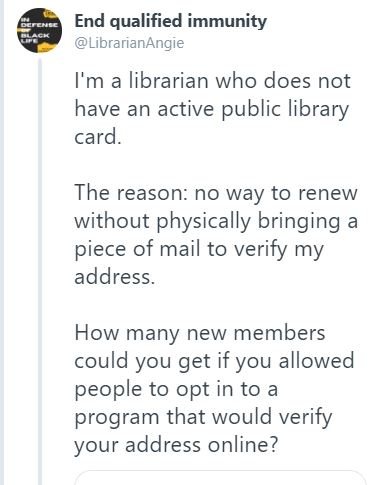
It’s hard to get a library card. Community members must provide proper identification. If they apply online, they must show up at a branch to claim their card, often within a specific amount of time. I was reminded of this just a few days ago, when I received this Tweet.

Library users also must have separate logins and passwords to use services like Hoopla, Overdrive, Kanopy, and Freegal.

And if cardholders don’t return items on time, they get fined. If a library user accumulates too many fines, they lose the ability to use their card.

All these things may seem like little inconveniences. But it is these little hurdles that stand in the way of advancing our libraries in the future.

I know some of these hurdles are not the fault of the library. We’re often at the mercy of our vendors. But our communities don’t know that and, frankly, I don’t think it matters. People expect easy access to library services. And they receive easy and convenient services from other companies.

Libraries need to make a concerted and deliberate effort to make it easier for people to use the library in 2021. We’ll have to do this to compete with convenient services that threaten to take away our market share.

First, let’s fix the things that are in our control. We can make it easy for anyone to get a library card online without ID. And we can eliminate fines and fees that serve as a barrier to many of our patrons.

Next, let’s band together to demand vendors create integration that allows library users to access their services from our website with one-step authentication: their library card number. Demanding this change as an industry will be one of the best ways to advocate on behalf of our cardholders this year.

You may also like these posts

The New Year is Here! Here are Five Things for Your Library to Promote in 2021.

Zoom Fatigue is RUINING My Library Programming! How the Heck Should Libraries Deal With That?

Latest Book Reviews

The Invisible Life of Addie Larue by VE Schwab

Find more 60-second Book Reviews here.

Subscribe to this blog and youโ€™ll receive an email every time I post. To do that, click on the โ€œFollowโ€ button in the bottom left-hand corner of the page. Connect with me on YouTube, Twitter, Instagram, and LinkedIn.

Library Programming and Promotions SHOULD Be BFFs! Here’s Why They Must Work Together.

Watch Now

The Library Marketing Show, Episode 68

In this episode, Angela shows you three reasons why you must keep promotions in mind while you create your library programming.

Kudos in this episode came from Evelyn Shapiro from the Champaign Public Library for their series of Library Love videos.

Do you have a suggestion for a topic for a future episode? Want to nominate someone for kudos? Let me know in the comments.

And subscribe to this series to get a new video tip for libraries each week!

Thanks for watching.

How to Create an Effective Library Survey to Pinpoint the Needs of Your Community

Photo courtesy Public Library of Cincinnati and Hamilton County

If there was ever a time when your library would need to survey your community and cardholders, itโ€™s now.

This year has been wildly difficult for libraries and their communities. And the pandemic will be a factor in the lives of our cardholders into 2021.

To prepare our services, collection, and programs, we need to know exactly who is using the library and how they are using it. We must also anticipate our community needs going into the next year.

A customer feedback survey is the best way to gather this data. Hereโ€™s how to put one together.

Before you start

The first step in the survey process is to come up with a plan and answer some important questions.

Why are we doing the survey? You may use a survey to determine how people use your library. You may be testing to see whether there is a tangible need for a particular service before you invest in it.

Perhaps you are looking to gather demographic information about your service population. You might also want to ask questions to get at the psychographic makeup of your cardholders so you can better segment your marketing audiences.

Write down your reasons for creating a survey. Youโ€™ll also want to write down what you hope to learn from your community’s answers.

Itโ€™s important to put the answers to these two questions in writing to keep yourself accountable. The written answers will remind you of your goals as you write the questions, distribute the survey, and evaluate the results.

How will you distribute the survey? Distribution of surveys can be tricky for libraries because our populations are so diverse.

How do you make sure that people from all communities and demographic populations are represented? What about cardholders who donโ€™t have digital access? Do you hope to have answers from non-cardholders? Create a plan for addressing these points.

What will we do with the results? The final step of this first phase is to plan for how you will work with the results of your survey.

Who will look at the results and aggregate them? Who gets to see the results? And who will be responsible for implementing changes to library services based on the results?

How many questions can you ask?

Survey Monkey analyzed more than 10,000 surveys to make their recommendations. And they found that fewer questions get better results. The more questions you add to your survey, the less time people spend answering each question.

To gather more thoughtful responses, youโ€™ll want to use as few questions as possible. SurveyMonkey says an effective survey will take no more than 7 minutes to complete. Their data shows people will abandon surveys that take longer than that.

A 7-minute survey will be about 10-15 questions long, depending on the type of questions you ask. If you find that you need more than 15 questions, consider doing more than one survey.

Writing the questions

Writing your survey questions is like writing a blog post. For the final product, youโ€™ll want a tightly written and concise set of questions. But to get there, youโ€™ll need to get a little messy.

You should approach the first draft of your questions with no limits. Write down everything you want to ask your community about the library. Use whatever format of question first comes to mind.

This exercise will create an ugly but important first draft which you can mold into an amazing survey. Once you have that draft, go back through, and highlight the questions you absolutely must ask.

Be sure your questions donโ€™t ask two questions at once. Doing so will confuse your respondents and lead to less reliable survey results.

For example, donโ€™t ask โ€œHow would you rate our branch cleanliness and the wait time at the checkout counter?โ€  Split those questions to get a more accurate picture of your community needs.

Consolidate questions that are repetitive. You may find you asked the same thing, or very similar things, but in a different way. 

Once you have a final list of questions, mix the formats to create the best results. Data suggests that most of your survey questions should be multiple choice or matrix-scale.

Try to ask no more than two open-ended questions in a 10-15 question survey. The more time your respondents must spend composing their answers to open-ended questions, the more likely it is that they wonโ€™t complete the survey. While open-ended questions can be very insightful, use great intention when adding them to your survey.

Where to create your survey

With limited budgets, most libraries cannot afford to pay big money for a survey maker.

There are many free options, but most have limitations for how many surveys you can create and how many responses you can collect. Here are a few that have no such limitations.

Google Forms: Google Forms is my preferred free survey tool. You can create surveys and collect unlimited responses. Itโ€™s easy to create the survey and easy to export the data as a Google Sheet.  

SurveyPlanet: Their free version allows for unlimited surveys, questions, and responses.  They also have templates to get you started. Also, you can easily duplicate a survey. You cannot export your response data on their free plan, but you can look at it in a dashboard and use that data to create infographics, graphs, and other reports to communicate the results.

Free Online Surveys: This site has a limited free plan. Iโ€™m including it because they offer a substantial discount on their paid plan for non-profits. The paid plan unlocks some great features including unlimited responses and support. Their survey maker also has artificial intelligence to help you build an effective survey.

Launching your survey

Before you send your survey out to the world, be sure to thoroughly test it. Youโ€™ll want testers to look for spelling errors, confusing questions, and to make sure the order in which you ask your questions makes sense.

Send your survey to staffers outside of your department and to friends and family. Get as many people to test it as you can before you launch.

Once youโ€™re sure your survey is ready, itโ€™s time to send it out into the world. Email the survey to all cardholders. Place printed versions of the survey at the checkout desk for people who donโ€™t have digital access.

For the duration of the survey, prompt patrons to fill out the survey in every interaction, including at curbside pickup, during virtual programs, and in reference emails and phone calls.  

The amount of time youโ€™ll leave your survey open for responses really depends on your community. Youโ€™ll need to monitor the results and be flexible.

In initial launch round, be vague with your respondents about how long they have to complete the survey. You might say โ€œTake a few moments now to give us your feedback.โ€ Then watch to see how well your community responds.

Once you start to notice a lag in responses, you may do another round of promotions that sound more urgent. โ€œComplete this survey before Friday to make sure your voice is heardโ€ or โ€œWeโ€™re closing this survey in two days so be sure to give us your thoughts!โ€

In general, donโ€™t leave your survey open for answers for longer than two weeks.

Have you done a library survey? Do you have other tips and suggestions for creating a survey? Share your thoughts in the comments below.

You may also like these posts

Your Website is the MOST Important Gateway to Your Library Right Now. Here Are Eleven Quick Design Tweaks to Make It Amazing.

Seven Cheap and Clever Ways to Bridge the Digital Divide and Promote Your Library to People Who Donโ€™t Have Internet Access

Latest Book Review

The Daughters of Erietown by Connie Schultz

Find more 60-second Book Reviews here.

Subscribe to this blog and youโ€™ll receive an email every time I post. To do that, click on the โ€œFollowโ€ button in the bottom left-hand corner of the page. Connect with me on YouTube, Twitter, Instagram, and LinkedIn.

How to Gather Patron Stories for Library Promotion!

Watch Now

The Library Marketing Show, Episode 67

In this episode, Angela answers a question from Emily Orischak, Community Relations Coordinator at Berks County Public Libraries. She wants to know how to gather stories from your library patrons about why they love and use the library! Angela shares some tips that any library can use.

Kudos in this episode comes from Carrie Weaver who nominated the Peters Township Public Library for the work they did promoting books during Banned Books Week.

Carrie said, “I have to nominate the staff members at my library who created an awesome video to explain Banned Book Week and show several examples of books that are banned. We also have a display of all of our banned books in the main lobby for people to check out and celebrate their right to read! I am so proud of them!”

Do you have a suggestion for a topic for a future episode? Want to nominate someone for kudos? Let me know in the comments. And subscribe to this series to get a new video tip for libraries each week!

Thanks for watching.

Targeted Email Marketing for a New Era: The Pros and Cons of How Most Libraries Segment Their Audiences

Photo courtesy Public Library of Cincinnati and Hamilton County. Bond Hill Branch.

This is the first in a two-part series on email marketing for libraries. Part two is here.

If there is one thing that I know about library promotion, it’s this:

If you want to be successful in library email marketing, you must target your messages.

This isn’t just my personal belief. It is a method which worked, with impressive results, during my years at a public library. And I see it working now for hundreds of libraries around the country and around the world in my day job at NoveList.

Why are libraries hesitant to do targeted email marketing?

There are two big reasons that libraries fear the idea of segmenting their email audiences.

First, libraries are worried about email marketing in general. They feel it’s too promotional and that email messages from the library will be received as spam. They may even believe that people don’t want to receive email marketing from anyone, even a library.

This is not the case. The average consumer is accustomed to giving out their email address in exchange for marketing messages targeted specifically to them. Opt-in Monster research shows 99 percent of people with an email address check their inbox at least once a day.

Why? Because they are looking for messages from friends, family, and places they love. They love the library. Your cardholders and community members feel excitement when they receive an email from you.

Libraries worry that, by sending targeted messages to segmented audiences, they will miss out on the chance to get a message to all their cardholders. 

Many libraries are sending the same message to every cardholder, sometimes hundreds of thousands of people in one burst. It feels like the natural thing to do. “Everyone needs to know about this!”

The problem with that approach is that your cardholders are individuals. One message never fits them all.

This is particularly true if your service area covers a range of incomes and demographics. The needs and interests of your cardholders vary greatly.

By targeting your message, you are more likely to say something that matters significantly to your cardholders, which makes them more likely to take an action, which makes it more likely that your email will be successful.

Targeted email marketing for libraries is effective because it serves the right message to the right group of people. And it works for all kind of messages.

Do not let your fears about email set you up for failure. Your cardholders want to hear from you. There are not very many industries which can say that. Let’s take advantage of it and give the people what they want!

Libraries who do segment their audiences tend to use three main methods. There are benefits and drawbacks for each.

Segmenting by library card use

Some libraries group their cardholders by the type of material they most frequently check out: kids’ books, print books, e-books, etc. Then, they send targeted email messages about those formats or collection types to those specific users.

This was the method we used when I worked a public library. For example, we would send an email promoting three new e-books every month to people who appear to favor e-books.

Benefits: This method is great for collection marketing. Most libraries will notice holds and checkouts increase, sometimes exponentially, when they send messages about items to people who have shown a previous interest in those items.

Drawbacks: The way a person uses their library card may not correspond to their true library interests.

For instance, an adult who frequently checks out children’s books for their kids may also love to read e-books. By focusing solely on the fact that they more frequently check out children’s books, a library may miss a key opportunity to market e-books to that cardholder.

A second drawback is that your library will want to promote things besides your collection, like programs, big events, and advocacy messages. Segmenting audiences solely by their favorite collection format gives you no clue as to your cardholders other potential interests.

Finally, this kind of segmentation often requires sophisticated email marketing programs that are expensive and time-consuming to manage. Smaller libraries without a dedicated marketing department and libraries with limited budgets may find these programs cost prohibitive.

Letting people self-select

Many libraries have an opt-in page on their website listing email interest groups. Visitors can self-select which emails they prefer to receive.

Benefits: When a person chooses to receive an email from you about a certain subject, they are also likely to open and engage with that email. They have already indicated their interest by selecting it.

Most library email opt-in pages do not require a person to be a cardholder to sign up. So, a second benefit of this method is that you can send marketing messages to people who aren’t in your cardholder base but can be enticed to use your library. That’s a fantastic way to expand your cardholder base!

Drawbacks: A library using this method must commit to intentionally market the marketing lists. They must make sure the community knows the opt-in page exists and convince people to sign up.

Segmenting by cardholder location

Some libraries have sent messages to people who have indicated a certain branch is their home branch or to people who live in a certain portion of the community.

Benefits: This is a great method for in-person program promotion. People are more likely to attend events that are near their home. Segmenting your audience by their location is an efficient use of your time for program promotion.

Drawbacks: There is a certain set of library cardholders who are willing to travel to attend programs and events at branches far from their home. They may be interested in hearing from your library about certain types of events, no matter where they are held.

In addition, the branch a person most frequently uses may not actually be near their home! Many people frequent the library branch near their workplace or some other important and frequently visited location.

You may also find these posts helpful

Three SUPER Easy Ways to Get More Results from Your Library Email Marketing!

Are My Library Email Metrics Goodโ€ฆ. or Bad?! Here Are the Latest Stats to Help You Figure It Out.

Latest Book Reviews

The Little Book of Lykke: The Danish Search for the World’s Happiest People by Meik Wiking

The Bear by Andrew Krivak

Find more 60-second Book Reviews here.

Subscribe to this blog and youโ€™ll receive an email every time I post. To do that, click on the โ€œFollowโ€ button in the bottom left-hand corner of the page. Connect with me on YouTube, Twitter, Instagram, and LinkedIn.

My Favorite ๐Ÿ’œWays to Use Customer or Patron Testimonials for Library Marketing!

Watch Now

The Library Marketing Show, Episode 65

In this episode, answers a viewer question about how to use customer testimonials for library marketing.

Kudos in this episode goes to Madison County in Mississippi for creating a Virtual Library.

Do you have a suggestion for a topic for a future episode? Want to nominate someone for kudos? Let me know in the comments. And subscribe to this series to get a new video tip for libraries each week!

Thanks for watching.

A WordPress.com Website.

Up ↑