Search

Super Library Marketing: Practical Tips and Ideas for Library Promotion

Category

Library Marketing Strategy

How to Create a Library Marketing Strategy from Scratch! The Library Marketing Show: Episode 20

Watch now!

Your library has no strategic marketing plan in place! What do you do? Emily from Berks County Public Library System in Pennsylvania asked: “I’m the Community Relations Coordinator for the Berks County Public Library System. Our headquarters provides support services to the 19 member libraries in our county. As someone who stepped into this role two years ago where there was no strategic marketing plan in place, could you give some suggestions on best practices when creating a plan from scratch?”

Plus KUDOS go out to the Evanston Public Library in Illinois for their free book distribution centers. Find out why this is a great way to reach non-cardholders and get them introduced to the your library! Read all about their efforts here.

Stay in Touch

Check the Upcoming Events page to see where I’ll be soon. Let’s connect! I’m doing a webinar soon, so be sure to sign up… it’s free!

Have an idea for the next Library Marketing Live Show? Submit it now.

Subscribe to this blog and you’ll receive an email every time I post. To do that, click on “Follow” button in the bottom left-hand corner of the page. Connect with me on Twitter, Instagram, and LinkedIn.  

You Can Fix It! If Your Library Marketing Is Failing, Here are the Top Eight Solutions

Do you remember when you learned to read?

I was in the first grade. The school was holding a contest to find a student to deliver a public service announcement about education on a local radio station. I was determined to win.

My mother, who was a first-grade teacher, was incredulous when I shared my plan for my broadcast debut. How could a kid who hadn’t learned to read yet get good enough to get that radio spot? She thought I was crazy.

And maybe I was. But I proved my mother wrong through sheer will and determination, and with a little help from the “Dick and Jane” series. By the end of first grade, I was reading well enough to tackle Laura Ingalls Wilder’s Little House in the Big Woods. And I was on the radio.

Twenty years later, I was working weekends as a newscast producer at a television station. That meant every Saturday and Sunday, I had to 8 hours to produce two shows… the 6 p.m. news and the 11 p.m. news. On a good night, it was a fast-paced and stressful proposition.

One day, the television station suffered a huge power failure. The station had backup generators that were supposed to kick on to keep us on the air. But a surge had fried the wiring and we were dead… really most sincerely dead. We had no way to get on the air. And the newscast had to get on the air.

Failure was not an option. We needed to get the show on the air because thousands of homes were also without power and those people looked to us for information. We also needed to get on the air because when the ads that are supposed to be a part of the newscast don’t air, the station loses money.

With airtime fast approaching, we came up with a plan. We would broadcast live from the parking lot using our live truck. It was crude but it worked. We felt like heroes. Journalism won the day and after that, I felt like there was no problem that I could not solve.

We all face obstacles during our work every day. Some are big, some are small. Your attitude plays a huge role in determining whether you overcome them, particularly for those of us working in the library marketing space. Many of our problems are unique to this industry. But trust me when I tell you that you are smart and you can figure anything out!

To prove it, here are the top five problems we face in Library Marketing along with eight solutions… because there are always more solutions than problems!

Problem: we simply don’t have enough time to do all the stuff we’re asked to do. The library year is kind of like the “lazy river” at my local YMCA… a constant swirling movement of events that keeps pushing us forward. It takes some force and a change of direction to break free. When you’re under pressure to promote each big event, it can leave you feeling like you never have enough time for your collection or services. You might feel like you don’t even have enough time to think or be creative.

Solution: a strategy gives you freedom. It not only helps you drive your marketing for the year in a measurable way, it will also provide a concrete reason the next time you have to say “no.”

Say “no” to promotions that don’t serve to drive your library’s strategic mission. Say “no” to promoting every exhibit, program, and author visit at your branches. Empower your branches to do some of their own promotion by providing them with simple guidelines for doing their own community marketing and set them free so you can focus on the big picture… your library as a whole.

Problem: we don’t have enough money. Tiny budgets really separate us most from the for-profit marketers. I do see more libraries spending big budgets but they’re doing it in smart and strategic ways, for re-branding and full production media ad buys, slick content marketing magazines, and direct mail to non-cardholders.

If you don’t have a big media budget, you can spend a little money to boost the effectiveness of your social media posts. Honestly, you can’t get much social media reach without a little spending.

Solution: social media advertising is cheaper than traditional ad buys. Your administrators might not realize how super effective targeted ads can be. You can easily prove that you can make a good return on their investment.

Solution: partnership opportunities to promote more than the big programs. At my library, we created media sponsorship guidelines which list the action items we’d like our potential sponsors to fulfill and what benefits we can offer them in return. Why not pitch a media sponsorship to promote your digital collection or your fantastic database resources?

Solution: find super library fans or influencers in your marketplace and invite them to write about your organization. At my library, when we opened our new MakerSpace and got lots of publicity outside the traditional media (this article is a good example).

Problem: we don’t have enough staff. If your handling a one-person marketing department, trying to take on marketing can be a scary proposition. You probably feel like you’re already just hanging on by the skin of your teeth.

Solution: use the talents of non-marketing co-workers. There are likely a number of librarians who have an interest and a proficiency for social media, writing, video, and design. Ask around and recruit those staff members to help you create content. Ask for permission to recruit interns. You’ll have someone to handle the grunt work and you’ll have the joy that comes with mentoring and encouraging the career of young marketers.

Problem: we don’t know enough about our cardholders to target them effectively with messages they will love. I suffer from this and many of my library marketing friends do too! It’s not a hard one to solve.

Solution: create a new cardholder survey to gauge the interests of people just entering your library system.

Solution: a yearly satisfaction survey for all cardholders is also extremely helpful, particularly when you can take the results and split them into your different persona groups. From there, you can map your customer’s journey. When they get a card, how long does it take them to use it? Are they checking out books or using your digital collection or your computers, or do they simply let it languish? Do you have some customers who got a card years ago, used it a specific way, and then stopped altogether? Do you have some customers who are making the transition from print items to digital materials? Do you have some customers who are only interested in one particular kind of item–DVDs, audio books, or computers?

Break your customers into groups based on what they do with the card and start creating pieces of content that target those groups. Maybe you’ll want to focus your efforts at first on one group in particular. At my library, we’re targeting a persona we call “Occasionals” which are people who use their cards once every six months. We focus on moving people from that cluster into a more active user persona, by targeting them with messages about the convenience of our digital collection.

Problem: we are resistant to change. This problem is the biggest, in my opinion. We are too set in our ways. How many times have you heard someone in your library say, “But that’s the way we’ve always done it!” It’s the phrase I dread most.

It takes an enormous amount of effort and energy to change the minds of our fellow library staff members and our administration. It seems like it would just be easier to stay the course.

Do. Not. Give. In. Marketers have a reputation for being talkative, a little eager, a bit bold, and maybe a tad whacky, and these are all GOOD traits! We have to remember our main objective–to get customers to move through the cardholder journey and engage with the library. Without that engagement, the people who argue that libraries are obsolete will win! We can’t have that.

Solution: with patience and persistence, you can thoughtfully steer your library into the future. It works best when you start small. Think of it like a staircase. On the bottom step, you make a small argument and you try a new thing. You see results. You report the results and chances are, you’ll get to climb to the next step.

The more you do this, the faster you’ll get up the stairs–at some point, you might even be allowed to take the stairs two at a time. Keep the end goal in mind but set smaller goals that help you to get there.

Subscribe to this blog and you’ll receive an email every time I post. To do that, click on “Follow” button in the bottom left-hand corner of the page. Connect with me on YouTube, Twitter, Instagram, and LinkedIn.
The Secret of the 60-Minute Meeting: Six Tips to Keep Your Library Marketing Team On Track and Stay Productive!

I dread Wednesdays.

On that day of the week, I usually have between five and seven meetings. I basically spend the day hopping from one conference room to another.

Not so long ago, most of those meetings would last beyond 60 minutes. Tangents were pursued. Ideas were dissected in great detail. My team and I were often blind-sided by requests to come up with an entire marketing campaign for an idea we’d only learned of moments before. It was unproductive.

As a marketing manager responsible for proving the bottom-line benefits of your marketing, it can be tempting to rely on recurring team meetings and regular check-ins to make sure you know exactly what’s going on with your team. But when long meetings evolve into habit, their value tends to plummet.

No meeting should ever last beyond 60 minutes. There are a couple of reasons for this. After 60 minutes of intense discussion, participants begin to lose interest. Their creativity and energy wanes. And the more time you spend in meetings, the less time you and your team have to do ACTUAL work.

Obviously you can’t control every meeting. But when you’re running the agenda, you can create an atmosphere of productivity and creativity while setting an example of efficiency for the rest of the library staff.

I don’t remember how it started but someone in my library’s senior leadership team took the initiative to institute a more efficient meeting structure. Suddenly, everyone was following this person’s lead. It was amazing and liberating.

I started instituting the 60-minute or less meeting rule about a year ago in my department and it’s worked so well that I recently introduced it in another setting.

I’m the chair of my school district’s bond issue campaign and our core committee meetings are 60 minutes or less. It was funny how many people from that group have commented about my 60-minute meeting pledge! It had never occurred to them that meetings, even ones where important decisions are made, could last less than an hour.

If you want to increase productivity in your library, here’s how to execute a 60-minute meeting.

Super prioritize your agenda.  For my library team, I divide action items into categories: the weekly schedule, immediate concerns, future concerns, and individual tasks. These four categories appear on the agenda every single week. Under each category, I list the items that need to be discussed in order of their priority. Next to each item, I list the name of the person in charge of that item or project. For the bond issue committee meetings, I simply list items in order of their priority without categories.

Time it out ahead of time. Try to estimate how much time you’ll need to discuss each item. If your total discussion time is more than 60 minutes, do some more prioritizing with your agenda. Once your agenda is set, make sure everyone attending the meeting has a copy so they can follow along and stay focused.

Set expectations at the beginning of the meeting. As the leader, set the example and start on time. Remind the team that the meeting will last 60 minutes and that you’ll be working to keep discussions on track. Assure them that if further discussions are needed on a particular item, you will schedule a side meeting. Off-topic discussions will be tackled outside of the formal meeting time.

The first time I made this announcement at the bond issue meeting, everyone looked shocked. I was worried that people would start watching the clock and timing me, thus cutting the productivity. But because I set firm expectations, the group trusts me to stick to them. They end up focusing more on the items we need to discuss. It’s funny how that works!

Watch your agenda word choices. Use words like “update” rather than “discussion” to help frame the conversation and give mental cues to attendees that work for the meeting will need to be done before the meeting actually happens. If a key decision needs to be made in the meeting, use the word “decision” in your action item to cue the attendees that you plan to come to a consensus at this meeting.

Take notes. Make note of who is assigned to each project. Give clear deadlines and expectations for each action item and include those in the notes. After the meeting, send out a copy of the meeting notes so everyone is clear about what they’re responsible for and when it’s due.

Continue to give time updates throughout the meeting. It’s OK to say, “We have 15 minutes left so we’re going to discuss one more item that is a priority to us. The rest of the items on this agenda will be discussed at a later meeting.” This will help keep discussions on track.

The LIVE LIBRARY MARKETING TALK ON INSTAGRAM is changing format. I have decided to pre-record my segments and post them to YouTube! I still want your email questions and topic suggestions ahead of time. Just fill out this form. If I pick your topic, I’ll send you a personal link to the video after it’s posted. I’m going to start posting my video segments on Thursdays so watch your email for that. Thank you to everyone who weighed in on the video decision!

And check out these upcoming events and webinars where we can connect and discuss library marketing. Registration links included.

Subscribe to this blog and you’ll receive an email every time I post. To do that, click on “Follow” button in the bottom left-hand corner of the page. Connect with me on Twitter, Instagram, and LinkedIn.  

The Step-by-Step Method for Figuring Out the Best Time to Send Library Marketing Emails and Why You Should Never Stop Experimenting!

I spend a good portion of my day as a library marketer trying to figure out how my cardholders live their lives. What do they do? When to they do it? What parts of their life are difficult? What parts are enjoyable? When do they have free time?

We do know a lot about the people who use the library, thanks to our own library surveys and great organizations like Pew Research Center. But you can also figure out what your cardholders are doing by email marketing experimentation. And your findings can increase the effectiveness of your marketing.

On the Library Marketing Live Instagram show, Dari from Cook Memorial Public Library District wanted to know how to figure out the best time to schedule marketing email to different audiences. The answer, in general terms, is between 6 p.m. and midnight. But I want to dive a little deeper into how I came to this conclusion and why this might NOT be the case for the people using your library!

If you’re just starting out with email marketing, check with the experts. There are a lot of companies (mostly email marketing software companies) which publish research on the best time of day and the best day of the week to send marketing emails, plus a bunch of other data points. So, start by gathering the latest research from these companies. Some of my favorites are Hubspot, AWeber, and Convertful.

Think about the daily life of your cardholder. If you are sending an email to a group of people who use a particular branch, or who are in a particular age group, try to imagine what they do all day. This generalization method will help you identify points in the day in which your target audience might have time to check their email.

Here’s an example: When I’m sending emails to parents of school-age children, I avoid 7 a.m. to 9 a.m., when parents are usually racing to get their kids ready to go to school. I also avoid 2:30 p.m. to dinner time, because many parents are picking up their kids, running them to extra-curriculars, and tackling homework.  I send marketing emails very early in the morning, like 5 a.m., so they are sitting in their inbox when they wake up but before their kids are up. I also send them after 8 p.m. when most school-age kids are in bed.

When I send emails to teenagers, I never, ever, ever send them in the morning. I exclusively email teenagers at night, and the later the better. That’s because most teens don’t have time to relax until 9:30 p.m. or later, after homework and after-school activities. They will likely check their email right before they fall to sleep at night, and they’re more likely to act on email in the late evenings.

Experiment. Send emails for a 3-6 months period of time. If you’re just starting out, try all hours of the day and night. Keep meticulous records of the results including open, click through, and conversion rates on all your emails.

After your allotted experimentation time, comb through the data and figure out which times of day resulted in the most click-throughs and conversions. Those are your optimum times to send emails! Focus most of your email scheduling on your proven best time of day.

And never stop experimenting. Start another experimentation period of 3-6 months, and then re-analyze data. If you notice a decline in click-through and conversion rates, go back to the drawing board.

My latest six-month analysis shows the best time to send email is between 6 p.m. and midnight, for all age categories and for all card types. This was not always the case. Two years ago, I could send my emails any time of the day EXCEPT between 7 a.m. and noon. But, at the end of 2018, that changed and the only emails that did well were the ones I sent at night.

Why did the effective time change? Because people’s lives change. Your cardholder base changes. The way that email gets delivered by various email providers changes. All of these factors mean that you’ll need to be in a constant state of experimentation. Don’t get married to any one time of day. Have an open mind and be ready to change your email scheduling strategy when the data tells you it’s time to change.

The most important thing is to have good content. If your emails contain stuff that your email audience wants to know about, they will engage with them, no matter what time of day it is. Try and keep your emails short. Focus on a few lines of really compelling text and one or two clear calls to action.

Bonus controversial opinion: I am not a fan of email newsletters. They usually contain too much information and too many calls to action. Their subject matter is usually too broad for their audience. I know a lot of us have to send them because senior leaders love them. But they aren’t an efficient use of email marketing. It would be better to take each section of your newsletter and send it separately to a targeted audience.

Don’t forget to join us for the LIVE LIBRARY MARKETING TALK ON INSTAGRAM every Tuesday at noon ET. We’ll talk about library marketing topics for about 20 minutes each week. My handle is Webmastergirl. You can email questions and topic suggestions ahead of time. Just fill out this form.

Subscribe to this blog and you’ll receive an email every time I post. To do that, click on “Follow” button in the bottom left-hand corner of the page. Connect with me on Twitter, Instagram, and LinkedIn.  
The Five Most Pressing Social Media Problems Faced by Every Library Marketer

This may mean I’m weird but one of my favorite things to do is check for information about social media on the Social Media Today website. And I’m a little obsessed with their monthly statistics report, which they publish in easy-to-digest infographic form. I spend a few minutes each month looking that report over just to make sure my library is still justified in posting on social media. I can also get new ideas for library marketing engagement on social media based on trends. This is fun for me. So yeah, I’m weird.

Data is always helpful. But social media is moving target. And many library marketers are busy doing other tasks as part of their job descriptions. We want to use our time efficiently.  And we want to be effective.

I’ve gathered the most pressing questions about social media from some of my readers. Let’s lay out some answers and resources to help make your job easier.

What social media platforms should we post on? The answer to this really comes down to your strategy. What is your library trying to accomplish? Who is your target audience?

I love that monthly report from Social Media Today because it tells me why people use each social media platform. You can use that report to decide where you should post based on your library’s strategy and goals.

You must also consider how much time your library is willing to invest on social media. My library posts on Twitter, Facebook, Instagram, LinkedIn, and Pinterest because each of those platforms aligns with some portion of our library’s overall strategy. But I am not going to lie to you: that’s a lot of work. I’m lucky to have several staffers who work together to post. And it’s still really hard for us to keep up.

Smaller libraries will want to concentrate on the platform or platforms that will give their library the most benefit. Quality is better than quantity. It’s okay to only post on one platform!

Further reading

The Top 21 Social Media Sites to Consider

How often should I post on social media? Posting on social media is a scientific attempt. You should set a reliable cadence. You’ll want to be consistent with your posts. Track the results and adjust your posting schedule based on the results.

Based on our experience at my library, here’s what I recommend as a starting point:

Facebook: No more than once a day

LinkedIn: Once or twice a day

Instagram stories: At least once a day

Instagram feed: Two to three times a week

Twitter: Five to 12 Tweets a day, plus retweets and responses. On Twitter, you should repeat tweets at intervals. The feed is a moving target and unless someone is scrolling through at the exact moment your tweet goes out, they’ll miss it. Users rarely go to a page to see a library’s full schedule of Tweets!  It’s also okay to post 24 hours a day. There are people who are awake at 2 a.m. scrolling through Twitter!

Pinterest: Several organic Pins each day (something created by you and leading to your library’s website) plus as many curated Pins as you need to stay aligned with your strategy. An easy way to get those organic Pins onto your boards is to Pin the best new books from your collection. If you have a blog, you can also post content from that.

Further reading

How Often to Post on Social Media

The Truth about How Often to Post on Social Media

Does our library need to buy a Facebook ad to get any organic reach and, if so, how much should we spend? The short answer to this is yes. You’ll need to spend money on Facebook ads or boost your Facebook posts to see any significant organic traffic for your other Facebook posts. That’s the sad fact of it. (can you tell my enthusiasm for Facebook is waning?)

That said, you don’t have to spend much money at all. Most libraries can spend about $2-3 a day to boost a post or promote an event and see results. Facebook gives you a lot of control and help in choosing a target audience. As always, you’ll have to look at your library’s overall strategy to determine which posts to spend money on.

Further reading

Facebook for Nonprofits-10 Tips

Why Facebook is a Waste of Time and Money for Nonprofits

How can I get more followers on my social media accounts? Please stop focusing on follower counts. I want libraries to focus instead on engagement. It’s kind of like speaking at a conference. You might be thrilled at the prospect of talking to a huge group of people. But if half of your audience is yawning or looking at their phones, what is the point? It’s much more meaningful to speak in front of a small room of people who are riveted by what you have to say.

That’s how I look at social media followers. I don’t care how many followers my library has on any social account. I want people who want to engage with our content. Focus on shares, likes, and comments for posts and not the number of followers.

Further reading

Why You Social Media Follower Count Doesn’t Matter

Should we have a team of people posting to social media or should we take a centralized approach? I am an advocate of centralized social media posting. If you have one or two staffers who post to all your social media accounts, you can preserve the brand voice and protect the security of your accounts. However, one or two people cannot know everything that’s going on in your library system. So create a team of contributors, who send post suggestions, photos, and videos.

Further reading

Protect Your Library Social Media Accounts From a Security Breach

Subscribe to this blog and you’ll receive an email every time I post. To do that, click on “Follow” button in the bottom left-hand corner of the page. Connect with me on Twitter, Instagram, and LinkedIn. I talk about library marketing on all those platforms!
Eight Major Reasons To Add Content To Your Library Marketing {Infographic}

I’m so excited to be the keynote speaker for the Illinois Library Association Marketing Forum Mini-Conference in Chicago in a few weeks. My brain is entirely engulfed in content marketing as I formulate the talk. There are also some big content changes afoot at my library. I’ll talk more about those when we have our campaigns up and running. But, let’s just say that most of my marketing focus in my professional life is on content–why we should do it, how to make it work better, and how to be efficient in our content creation.

The most important part of the speech I’ll give next month is the “why.” Why is content marketing important to libraries? This was actually the focus of one of my early posts here on blog. The argument for content marketing hasn’t changed. You can make all the posters and fliers you want. People don’t pay attention to those push promotional tactics. That’s why marketing seems frustrating.

You want desperately to break through the noise of life and become a subconscious part of your cardholders’ thought process. You want them to think of you every time they face a problem. You want them to remember they can come to you for pretty much anything they need. This is the common struggle for libraries everywhere, no matter their size, staffing, or service area. Honest to goodness, the only way to achieve that is through content marketing. I know this from experience.

There is now a lot of data to back up the assertion that content works. I want to share some of that with you. I’m hoping that, if you are hesitant or nervous about working content marketing into your overall library marketing strategy, these stats will convince you. I truly believe this is an opportunity for libraries that cannot be missed. If we are to survive and thrive as an industry, we need to do more content marketing.

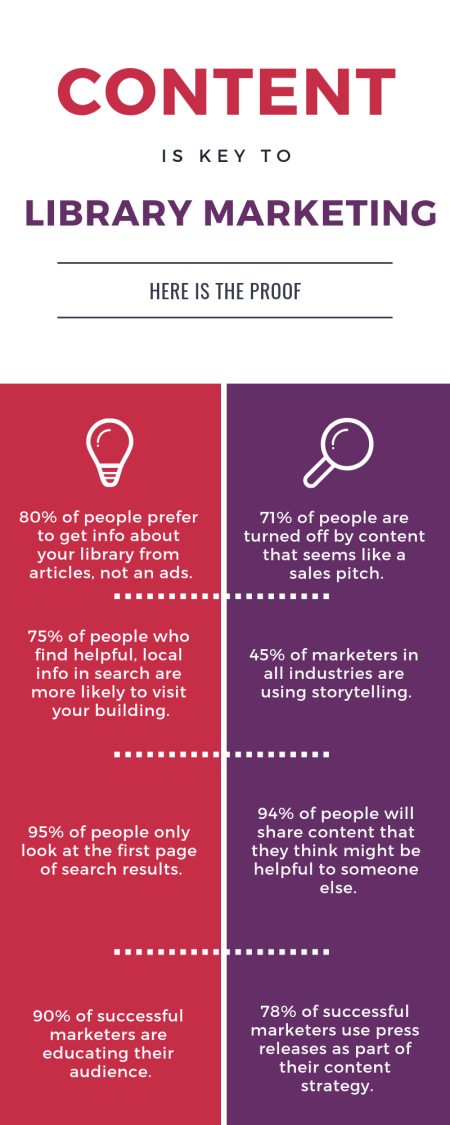
Here are the facts for why content is key to library marketing.

Why Content is Key to Library Marketing

80 percent of people prefer to get information about your library from a series of articles versus an advertisement.

71 percent of people are turned off by content that seems like a sales pitch. Which means, if you are doing mostly traditional promotional marketing, it’s not working.

75 percent of people who find local, helpful information in search results are more likely to visit a physical building. We want to get more bodies inside our libraries. Content is the key.

Only 45 percent of marketers are using storytelling to create a relationship with their audience. Most big brands are still running ads and push promotion. This is our open door. It’s a huge opportunity for libraries. This is how we sneak in and take away audience share… by telling stories. And who doesn’t love a good positive story about a library?

95 percent of people only look at the first page of search results. Optimized content (that’s content that uses keywords that are likely to be picked up by Google and other search engines) is incredibly helpful. If your library’s content appears on the second page or later, people won’t see it.

Blog posts are the content that get the most shares. And if your post is helpful to others, it’s more likely to be shared. 94 percent of readers share a blog post because they think it can be useful to someone they know. And the more often you publish blog content, the more often your content will show up in search, which increases the likelihood that people will find your library while doing a search. Amazing, right?

90 percent of the most successful marketers prioritize educating their audience over promotion their company’s promotional messages. Education is our main industry. Libraries are perfectly aligned to make this work for us.

But here’s a stat that really surprised me. 78 percent of effective content marketers use press releases as part of their strategy. Yep, press releases can be content marketing too. Use your releases to be informative but to really pitch amazing story ideas to the media. If you have a great story and you can make all the elements available to the media, you can let them tell it and take advantage of their built-in audience to spread the word about your library.

These stats come from a variety of great blogs including Impact, Marketing Profs, OptinMonster, Elite Copywriter, Cision, and Forbes. I hope they’ve convinced you to do content marketing at your library.

Subscribe to this blog and you’ll receive an email every time I post. To do that, click on “Follow” button in the bottom left-hand corner of the page. Connect with me on Twitter, Snapchat, and LinkedIn. I talk about library marketing on all those platforms!

Seven Podcasts that Will Make You a Better Library Marketer

An exciting thing happened this week! The library marketing profession is now the subject of a podcast. It’s called Library Figures. It’s produced by Piola, a company which designs library websites.

Many smart and strategic library marketing professionals including Kimberly Crowder of the Indianapolis Public Library (featured in this Super Library Marketing post last year) are guests on the pod. Each episode focuses on a successful library marketing strategy. The host and guest dissect the implementation, tools, success measurements, and results. I amhonored to be featured on episodes one and four. Maybe it’s silly, but I’m just beyond thrilled that we’ve got our own podcast corner where we can share and learn.

I’m a huge podcast fan. My podcast player is overflowing with episodes. I’d love to share my list with you and explain a bit about why listening to these shows will make you a better library marketer.

The Science of Social Media

This is a new discovery for me. This show, produced by Buffer, focuses on data, insight, trends, tips, and more. Anyone who works on social media for any library will find value in listening to these episodes, which cover subjects for everyone from beginners to those with advanced social media skills.

Marketing School

I just discovered this podcast last month and I’m catching up on back episodes (there are more than 900!) but I really love it. The creators release one ten-minute episode every day focused on one nugget of great marketing wisdom. Past subjects include blogs, event marketing, crisis communications, and generating great content ideas.

Brand Newsroom

This show, produced by a content marketing agency in Australia, bills itself as “the show for anyone who has a say in how companies are communicating.” The hosts use a round-table discussion format to dissect topics like crisis communications, branding, and networking.  The most interesting episodes involve disagreement between the hosts. They all have a different perceptive on marketing, and I find that they help me to consider issues from different angles. They also have a fun segment at the end of each episode called “On my Desk” where they share something they’re really excited about, from apps to software to new books.

Marketing over Coffee

As its name implies, each weekly show is recorded in a coffee shop. The two hosts talk casually about all kinds of marketing topics including writing, influencer marketing, SEO, and other relevant marketing problems and solutions. They also take listener questions, which I really love. And the episodes are short, so they’re easy to listen to during a typical 20-minute commute.

Social Media Marketing Podcast

Michael Stelzner, who runs the Social Media Examiner website, is the host of this show. His guests have a range of backgrounds and answer questions about all kinds of social media topics and tactics. Mike is really good about digging down and getting the basics about each topic. He also shares a new app at the beginning of each show. Most of his discoveries are free or very inexpensive and they’re all designed to help make marketing easier and more fun.

Unpodcast

I’m going to end in an unconventional spot by recommending this podcast, hosted by husband and wife team Scott Stratten and Alison Kramer. I have seen Scott speak at Content Marketing World several times. He’s hilarious and brutally honest about the faults and triumphs of marketing. Alison is his partner in crime and besides being the cutest couple in marketing,  their observations are always spot on. Some episodes dissect customer service, some talk about marketing mistakes, and sometimes they talk about innovation and entrepreneurship. They really make me think. Just trust me and subscribe.

And of course, we support our fellow library marketers producing podcasts. Read the back stories about how those shows are produced and then subscribe to the library podcasts on this list.

And if you have a podcast you want to recommend, please let me know in the comments!

Subscribe to this blog and you’ll receive an email every time I post. To do that, click on “Follow” button in the bottom left-hand corner of the page. Connect with me on Twitter, Snapchat, and LinkedIn. I talk about library marketing on all those platforms!

How to Hook New Cardholders and Make Them Loyal with Email

We talk a lot about emailing our cardholders with information about new products, services, and collection items. But you can also use your email list in a powerful way to reach people who have just signed up for a library card.

Most libraries take a minimalist approach to “on-boarding” a new cardholder.  Once a person fills out a library card application, we hand them a card, a welcome brochure, and send them on their way. We’re friendly and we’re genuinely excited to welcome them to our system. But we make a mistake that’s common for a lot of businesses and organizations. We know our system inside and out and we often forget that our new cardholders know nothing about what we offer. We assume they can find their way to the things they need.

It’s important to help those cardholders learn to navigate the behemoth number of resources and items available at the library. A solid on-boarding campaign retains new cardholders and turns them into lifelong loyal users of the library. The first 90 days of a new library cardholder’s experience is crucial to determining their feelings of connection and loyalty to the library.

It also makes good business sense. Studies show it costs five times as much to gain a new customer than it does to retain them. A library marketer practicing good stewardship will want to do their best to keep new cardholders coming back to use the library.

The most effective way to on-board a new cardholder is through email marketing. Many libraries create a campaign with specific emails sent to new cardholders at a pre-determined pace. Those emails slowly introduce them to new features and inspire them to try out all the library has to offer. It’s easy to do this using some mail systems, like OrangeBoy and MailChimp.

My library has a 90 day on-boarding campaign set to run automatically through OrangeBoy. Creating it was a bit of process. But the effort was worth it. In addition to retaining customers, the on-boarding emails reduce unsubscribes for future targeted promotional emails. Here’s how we did it and what we learned about doing it well.

First, make a list of the services, events, and collection types that get the most use at your library. You’ll want to include information about the most popular features you offer in your emails to new cardholders.

Then, make a list of the services, events, and collection types that are interesting or unique to your library but don’t get a lot of use. These are the gold nuggets of your on-boarding campaign. You’ll have the attention of your new cardholder. The relationship is fresh. Why not use that to showcase the hidden treasures at your library.

Finally, create an outline of your campaign, mapping out each message, when it will be sent, and what it will say. Look at the two lists you’ve created and narrow your focus. Try to promote no more than four things per on-boarding message. You don’t want to overwhelm your new cardholder. Rather, you’ll want to introduce people to the library in small doses. Pick a theme for each message with a specific call to action. Keep the language simple, conversational, and free of industry jargon.

Create, test, and release the messages. This part took me nearly as long as creating the plan did! But you’re almost there.

Track results. Of course, you’ll want to use a Google URL tracker or Bitly link to see which services and items get the most interest from your new cardholders. You can also track unsubscribe rates, and if you have the ability to divide cardholders into clusters, you can see where your new cardholders land after they finish the on-boarding process.

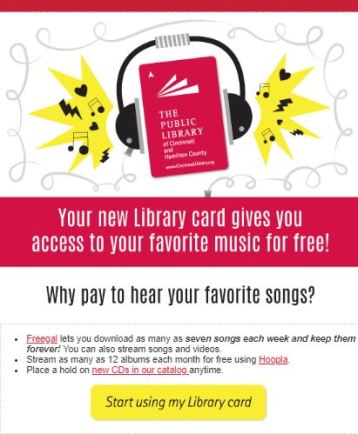
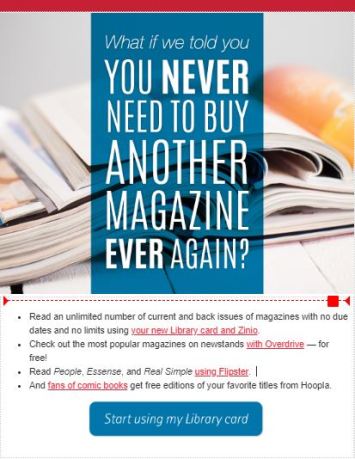
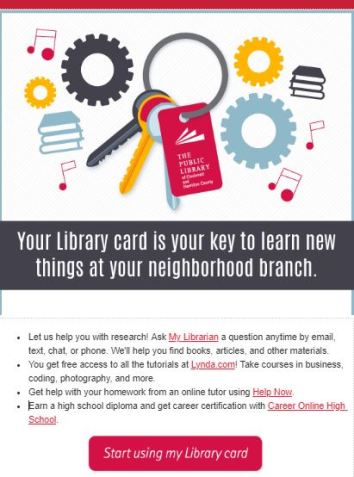
Here are a couple of examples of my library’s on-boarding emails so you can see what we do.

How do new cardholders react to these messages? They definitely don’t hate them. Our unsubscribe rate is 0%. We’re a large system and we’ve sent these for several years to thousands of new cardholders. Over the course of our campaign, we’ve had a couple of hundred people unsubscribe.

We send six emails over 90 days. The first email gets a lot of engagement, which is not a surprise.  The fifth email about using your neighborhood branch (see the image above) is the second most engaging email for us. Overall, about half of the new cardholders we sign up end up becoming loyal library customers. Most use our computers but the rest are checking out physical and digital items or using our MakerSpace.

If your library is doing something to on-board cardholders, I’d love to hear about it. Please take this poll and tell me about what you are doing in the comments.

Subscribe to this blog and you’ll receive an email every time I post. To do that, click on “Follow” button in the bottom left-hand corner of the page. Connect with me on Twitter, Snapchat, and LinkedIn. I talk about library marketing on all those platforms!


How to Create a Social Media Strategy That Actually Works

The most effective, free marketing tactic in the library marketing professional’s toolbox is social media. Personally, I love it. I think it’s fun. And interesting. And despite the trolls, I’ve made some actual friends and professional connections in the social space.

For my library, it’s the easiest way to get our message to the masses. But with so many platforms intended for different audiences, it’s also overwhelming. Should you post on every channel?  What should you post? How often do you have to post? If you work alone, you need to be efficient. You don’t want to spend a lot of time experimenting with social media. You want to know what works, and how to be successful. You need goals.

A few months ago, Marcy Timblin, Public Relations Specialist at East Bonner County Library, sent me this email: You always have such timely, comprehensive advice for getting the most out of social media marketing for libraries. I dream of putting it all together to formulate an amazing social media plan that I can implement – even though I am the “numero uno” social media marketer at my library district.”

I appreciate the vote of confidence. Really, any success in the social media space centers on strategy. A strategy lets you take your library’s overall strategy and use social media to make those goals a reality. But telling you to have a strategy and putting one together are two totally different things.

I am blessed with a social media specialist on my staff. Part of her job is to create and maintain our specific social media strategy. And it’s a big job. We’re a large library system (41 locations, 600,000 cardholders) and we post on multiple channels (Facebook, Twitter, Instagram, Pinterest, LinkedIn, and Tumblr). It takes time to sort out how to make each channel work for us. But we do have a process for creating a strategy. Here is how we do it.

Consider what you already know. Go through each of the social media platforms that your library already uses. Look at the analytics for those platforms. How are people using the platform? Which kinds of posts do they respond to?

Most platforms now offer analytics (Facebook is best by far) so you can evaluate success. And if your library is using a scheduling platform to manage your social media posts, you can use those analytics. For those libraries posting organically on platforms without the use of scheduling software, there are options for free analytics. Read this blog article to find one that works for you.

In this step, you are looking to replicate past success and trim past failures. You may find a platform you are using that is not working for you. Drop it. You may also discover a platform that is working really well for you. Concentrate your efforts there.

What are your library’s goals for the year? As with everything you do in library marketing, your social media work must be in service of advancing your library’s overall goals. So, get that list in front of you for the next two steps.

Create a mission statement for each social media platform. Look at your library’s goals for the year and what you know about each platform. Then write a one to two sentence mission statement for each of the social media platforms, lining up your library’s goals with the current audience for that platform. This mission statement should be something your staff and your cardholders will understand. Here’s an example:

LinkedIn: Discover career advice, business tips, and free resources that will help you succeed at work.

Twitter: Get regular updates on our collection, library events, and the literary and entertainment world.

Instagram: Photos tell the library’s story, one snapshot at a time.

And so on. Once you have created the mission statement for the platforms, you can create a persona for the people who will follow you on that platform. The mission statement and persona will help you visualize your audience every time you post. You’ll be able to connect with them because you’ll know who they are, and what they expect from you.

Experiment with scheduling. Look at your current analytics to see which time of day and day of the week work best for social media posts. Use that as a starting point for deciding when and how often you’ll post. Be consistent with your posts. And set a cadence that you know you can keep up with.

Track metrics and be flexible but not overly reactive. It takes time to achieve your library goals using any kind of marketing. The exception is social media. That’s because the platforms themselves are transforming and changing at a rapid and unpredictable rate. Algorithm adjustments and new features can throw off your strategy.

Here’s my general rule: keep an eye on changes in the social media landscape. When a big change occurs, like when Facebook changes its algorithm, sit tight for a while. Give it a month at least and see how the platform’s change affects your reach. Watch to see how your audience reacts. Watch to see how other brands adjust based on the change. Then, if you see your reach is changing negatively or positively, make the adjustment. Don’t wait until your strategy cycle (six-12 months maximum) is over to make your change. You’ll lose months of audience reach if you wait.

Never stop researching. I follow a couple of websites and podcasts religiously to keep up on social media trends. Of all the marketing tactics, that’s the one that takes the most personal learning upkeep! I rely on the Social Media Examiner Podcast, Social Media Today, Social Media Explorer, and Rebekah Radice.

Subscribe to this blog and you’ll receive an email every time I post. To do that, click on “Follow” button in the bottom left-hand corner of the page. Connect with me on Twitter, Snapchat, and LinkedIn. I talk about library marketing on all those platforms!

A WordPress.com Website.

Up ↑