In this episode, I share two social media updates that are relevant for libraries. I’ll tell you about YouTube’s “New to You” feature and Facebook explained how its algorithm works!
Kudos in this episode go to the ten libraries in the UK who participated in the “Creating Space for Kindness” Project.
Do you have a suggestion for a topic for a future episode? Want to nominate someone for kudos? Let me know in the comments. And subscribe to this series to get a new video tip for libraries each week.
Thanks for watching!
Subscribe to this blog and you’ll receive an email every time I post. To do that, click on the “Follow” button in the bottom left-hand corner of the page.
The plain fact is: Next to the face-to-face interaction between librarians and community, an email list is your most effective library marketing tactic.
How do your cardholders learn about new services? How do they find their next great read? How do they figure out how to use parts of the collection they didn’t even know existed, like video streaming or eAudiobooks? You can tell them all about your library’s awesome resources by talking with them in their inbox.
If your library isn’t already collecting cardholder email addresses, please start now.
As your finger hovers over the send button, you may find yourself facing another important decision.
When should I send the email?
Does the timing really matter?
The simple answer is yes.
A great headline and great content are only half the battle for your cardholders’ attention. You’re also competing with their personal schedule, other messages sitting in their inbox, and social media.
Your message is more likely to catch their attention if it lands in their inbox at the right time of day.
Your library is fighting with others for urgency. You want your recipient to say to him or herself, “I need to read this and act on it, right now!”
Getting that message in front of your audience at the right moment increases the open, click-through, and conversion rate because it takes advantage of that sense of urgency.
What the data tells us about the best time to send emails
I’ve done a lot of experimenting with time of day emailing over the course of my library marketing career.
There are three times of day to send messages for the most effective results.
Really early in the morning (by 5 a.m.)
Lunchtime (11 a.m. to 1 p.m.)
Before bed (between 8 and 10 p.m.)
The website Optinmonster calls these “key transition times.” And their research confirms what I learned.
A message sent in the early morning will be sitting in your cardholders mailbox when they first wake up. It’ll be among the first things they check. An email sent at lunch means it’ll be sitting there when they check their messages over their tuna sandwich. An email before bedtime means it’ll be there when they scroll through their emails while they watch a show or before they get ready for bed.
Optinmonster also recommends sending emails at 4 p.m., when people need a little distraction as they get through the last hours of their workday.
As for day of the week, most libraries should avoid sending emails on Mondays and weekends. The agency Wordstream says their data agrees with that assessment.
Your recipients inbox may be flooded with emails on Mondays. And on weekends, many people are running errands and doing other things with their friends and family. They’re less likely to check their inbox on a Saturday or Sunday. Case in point: I’m writing this on a Saturday. It’s 9 a.m. and I just realized I haven’t checked my email yet today!
But what works for me and what works for Optinmonster and Wordstream might not work for you.
It’s crucial that you do your own experimentation.
Try this Four Email Experiment to narrow down the best day and time for your audience.
For this experiment, use the same email for your test. Perhaps you have a weekly newsletter you send to parents, or a bi-weekly email that you send to people who regularly visit a certain library branch. Those emails will work perfectly for this experiment.
Try to keep the subject line for each of the four emails in your experiment similar. You’re testing for the best day and time, so you want to rule out other factors that may make an email more or less likely to be engaging.
Start by sending your email on Tuesday at 4 a.m. The next time you send it, schedule the email for Tuesday at noon. The following send, try Tuesday at 4 p.m. and finally, Tuesday at 8 p.m.
Track your open, click-through, and conversion rates on all these messages to see which is most effective. Work through each day of the week to see which days get you the most traction.
When you find a day and time that works best for your audience, stick to it for about six months. Continue to track your metrics over that six-month period to ensure you’re not seeing a slip in the numbers.
If, after six months, that day and time continues to be effective for you, you don’t need to run the experiment again.
But the habits of your audience may change during that time. Outside forces (like the pandemic) may affect the daily rituals of your recipients. You may need to run the experiment again if you see numbers slipping.
I have a special request.
I’m putting together a conference presentation and I’m looking for some examples.
Libraries that have reopened and have had some success drawing people back into the physical branch.
Libraries who believe they’ve figured out the hybrid program model.
Libraries who are trying to turn their pandemic digital users on to other services now that the library has reopened.
I know you are doing amazing work. I want to highlight you on a national stage! Thank you in advance.
Subscribe to this blog and you’ll receive an email every time I post. To do that, click on the “Follow” button in the bottom left-hand corner of the page.
In this episode, I share some tips for how to use your library’s FAQ’s into marketing opportunities. This idea can be a great way to establish your library as a place of answers.. And it can help you fill holes in your promotional schedule with valuable content.
Kudos in this episode go to Eileen Button of Genesee Public Library who wrote an open love letter to libraries that made me a little teary-eyed!
Do you have a suggestion for a topic for a future episode? Want to nominate someone for kudos? Let me know by clicking on the feedback tab.
And subscribe to this series to get a new video tip for libraries each week. Thanks for watching!
If you want your community members to do something, you must tell them what you want them to do. Explicitly.
That means you must add an amazing call to action for every promotional piece you create.
What Is a Call to Action?
A Call to Action, or a CTA, is a phrase that is used to tell the someone exactly what action to take and how to take it. It also implicitly provides the motivation for the recipient to take the action.
A CTA can be as simple as two words “Read Now.” It may be longer: “Want to take the next step in your career? Take a free career assessment test on our library’s website.”
It may be a link to your website, catalog, chat service, or email box. It may tell community members to call a special phone number to speak with a librarian or visit a certain desk at the library to talk with staff.
The call to action gives the person consuming the promotional material the instructions for taking the next step to use library resources. It must be strong, clear, and commanding.
For most of us, the CTA is the last thing we think about when creating a promotional piece. Staff put their time and energy into creating the layout, adding the right image, making sure all the text details are correct, and timing the promotion for the perfect release.
But I encourage you to spend some time thinking through your CTAs early in the process of creating any marketing piece. Here are seven tips to remember when you create a CTA for any piece. Practice going through this list every time you do a promotion.
Use positive, active language in your call to action.
Think of your CTA like a commandment. If you could order your community member to do something, what would you say?
Some examples of positive, active language which apply to libraries are:
Read
Watch
Download
Create
Join
Learn
Donate
Explore
Discover
Enter
You can also add a sense of urgency to your CTAs by adding the word “Now” as in “Read Now” or “Watch Now”.
Make your call to action as concise as possible.
For emails and digital signage try to keep your CTA between one and three words.
For flyers, bookmarks, posters, and videos, you can add a few more words like:
Register for this program
Place a hold on this book
Reserve your spot
Get the details
Sign up now
Read our step-by-step guide
For social media posts, a full sentence is good. But, on social media, put your sentence-long CTA into the text of your post, not as text inside the graphic or image you are attaching. If your CTA is in the image, use the one-to-three-word rule.
For blog posts, your CTA can be a longform sentence. Consider using bold text to draw the eye to that sentence. Or you can use a button (see the section on buttons below).
Try using the first person.
The marketing agency Unbounce did a fascinating study on CTAs and found that changing the text from the second person (“Register your child today”) to the first person (“Register my child today”) resulted in a 90 percent increase in clicks.
Your library can experiment using CTAs that say, “Reserve my spot” or “Get my personalized reading recommendations.” You may find that the change makes a difference in the number of people who take an action after seeing your promotional message.
Putyour call to action in a brightly colored box or circle.
There is something psychological about the look of a button that will compel your recipients to click on it.
The color of the button matters. You want something that’s eye-catching. You may be limited in your color choices depending on your library’s brand standards.
But, if you have room to experiment, read this fascinating post from marketing expert Neil Patel on color psychology. Then decide what kind of emotion or energy you want your CTA button to convey and choose the corresponding color.
CTA buttons work best in emails and newsletters. But try them also in promotions where you can’t click on a button, like bookmarks, flyers, posters, and digital sign promotions. The button will still serve the purpose of setting your CTA apart from the rest of the piece.
Put your call to action in the top one-third of whatever piece you are creating.
Moving your CTA “above the fold” as it’s called in the newspaper and magazine business, calls attention to the action you wish for your recipient to take.
Add white space to the area around your call to action.
The extra white space helps create a visual break and draws the reader’s attention right where you want it. Extra white space is also good for anyone reading your digital library promotional piece on a mobile device. It creates a clear area for fingers to click.
Try to use as few calls to action as possible.
You’ll want to focus the energy of your reader on the next action you wish for them to take. If you offer them too many potential actions, they’ll be overwhelmed and less likely to do anything!
For most promotional pieces, you’ll want only one CTA. This rule includes CTAs for email, digital signage, flyers, posters, bookmarks, social media posts, and videos.
The exceptions are blog posts and newsletters. For blog posts, my personal experience is that two or three CTAs work best. For newsletters, try to offer no more than five CTAs.
Did you notice where I took my own advice in this blog post?
Subscribe to this blog and you’ll receive an email every time I post. To do that, click on the “Follow” button in the bottom left-hand corner of the page.
In this episode, I answer a viewer question from Natasha Buran of Thousand Oaks Library. She asked, “I was curious if you’ve seen other libraries use ‘Revue’ – Twitter’s newsletter tool for writers and publishers. I thought it would be interesting to add monthly programs or resources and pin it to our profile. I haven’t seen libraries use this feature before and thought I’d ask.”
I gave my answer in the video. This is just my opinion of course!
Kudos in this episode go to the Topeka-Shawnee County Public Library. They recently opened a resource center for community members without a computer or internet access.
Do you have a suggestion for a topic for a future episode? Want to nominate someone for kudos? Let me know by clicking on the feedback button. And subscribe to this series to get a new video tip for libraries each week.
This is the 100th episode of the Library Marketing Show. It’s a celebration of YOU… the person who does marketing and promotions at your library.
I think you are amazing and awesome, and I’m sharing the five reasons why library marketing is the best job at the library.
And Kudos in this episode go to… you! Thank you for your comments, feedback, ideas, and support. The library marketing community is gracious and warm and wonderful, and I’m proud to be a part of it.
Do you have a suggestion for a topic for a future episode? Want to nominate someone for kudos? Let me know in the comments. And subscribe to this series to get a new video tip for libraries each week.
Thanks for watching!
Subscribe to this blog and you’ll receive an email every time I post. To do that, click on the “Follow” button in the bottom left-hand corner of the page.
In this episode we cover three top social media stories that affect library marketing.
The stories includes a Twitter function allows you to un-tag your library from a thread, a story about how Instagram is testing “fanclub” stories, and news about a new Facebook features that tests public comments on Facebook stories.
Kudos goes to Karen Jensen of Teen Librarian Toolbox for speaking out against the narrative of “the library is more than just books!”
Do you have a suggestion for a topic for a future episode? Want to nominate someone for kudos? Let me know in the comments. And subscribe to this series to get a new video tip for libraries each week.
Subscribe to this blog and you’ll receive an email every time I post. To do that, click on the “Follow” button in the bottom left-hand corner of the page.
In this episode, I’ll explain what an email drip campaign is, why you might want to use a drip campaign for library promotions, and then HOW to actually put the campaign together!
Kudos goes to Barbara Swinn of York Libraries for her British Empire Medal!
Do you have a suggestion for a topic for a future episode? Want to nominate someone for kudos? Let me know in the comments. And subscribe to this series to get a new video tip for libraries each week.
Thanks for watching!
Subscribe to this blog and you’ll receive an email every time I post. To do that, click on the “Follow” button in the bottom left-hand corner of the page. Connect with me on YouTube, Twitter, Instagram, Goodreads, andLinkedIn.
I mean, you might as well ask me to explain the meaning of life. (I’m kidding. Please don’t ask me that question.)
There are two ways to define engagement in your library promotional efforts.
Transactional Engagement
One way to talk about engagement in library marketing is solely centered on numbers.
How many likes, shares, comments, and direct messages do your social media posts get? What is the open and click through rate of your emails? How many people signed up to attend your program based on the flyer you slipped into their checkout? How many people used a database after you mentioned it at your last program?
These hard numbers are measurable and easy to explain. They demonstrate that your community sees your marketing. They take an action.
Transactional engagement is data that proves people are interacting with your library marketing.
Relationship Engagement
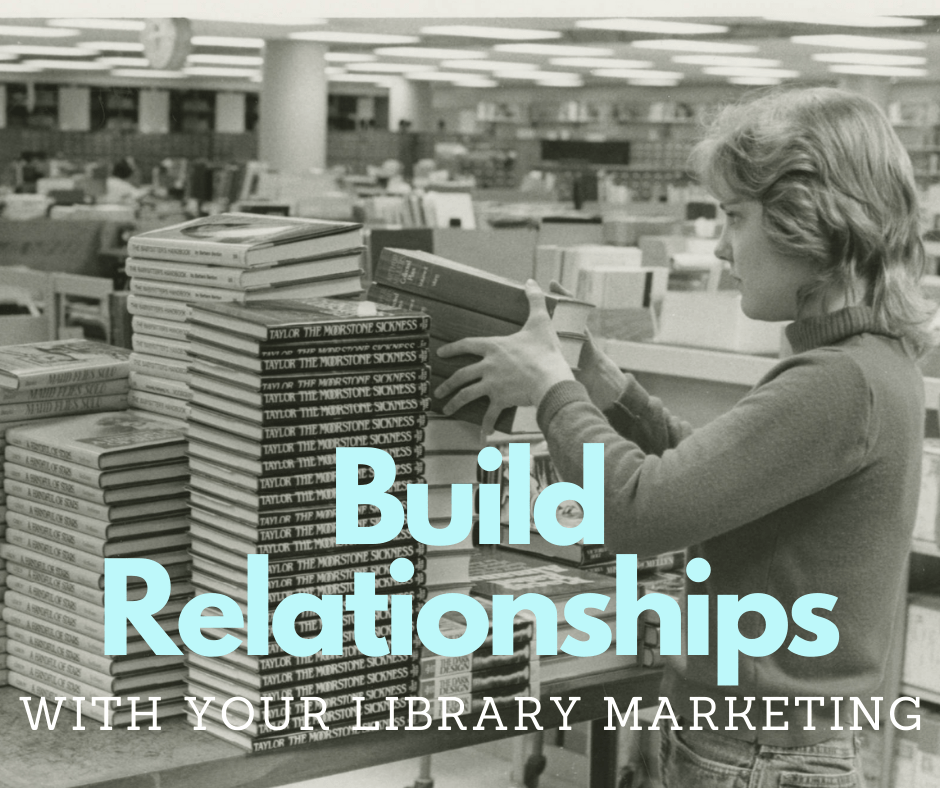
But engagement cannot, and should not, be solely defined by the hard numbers. It must also be the ongoing relationship building that your library does with patrons.
People may be opening your emails and clicking on your social media posts. They’re checking out books and using your services.
But more importantly, how do they feel about your library long term?
Engagement must involve building a deeper relationship with your patrons over time. When that happens, the relationship will manifest itself in ways that go beyond hard numbers.
This is the real value of your library. Your cardholders will not only use the library more, but they’ll also donate more, volunteer more, speak out to support you more often, and influence others to use the library.
If this relationship building has not been in your list of priorities, you’re not alone. A study by Chief Marketing Officer found that most marketers fail to nurture long-term relationships. Instead, they focus more on the transactional nature of engagement.
That’s because transactional engagement is easy to measure. You can take those metrics to your supervisor and to the board. You can prove what you’re doing is effective. And you can feel good about your work.
It’s far more difficult to explain to your library administrators and stakeholders that you are building a lifelong emotional connection and loyalty with your community. It is hard to convince them that this is important. It’s also difficult to measure this work.
And building relationships doesn’t happen overnight. Libraries may feel they don’t have the luxury of devoting time to this work.
But we must. And we must do that right now.
Why this is the moment to focus on relationship building
Libraries are at a crossroads. I cannot stress this strongly enough: as we emerge into the post-pandemic world, we should not go back to doing things the way we were doing them before the crisis.
Libraries were already facing budget cuts, apathy, and accusations of irrelevancy. And that was before the pandemic forced us into lockdown and severed tenuous ties with our community by physically separating us from our customers.
The pandemic forced us to take our service models in a whole new direction. We proved that we can pivot.
We should use this opportunity to move our marketing in a new direction too. We cannot let the fear of doing something different keep us from making the bold changes needed to move into a real position of success.
Libraries should use this time to turn their sights on building loyalty. We’re going to need it to survive in the post-pandemic world.
Relationship engagement is the key. When we focus on building loyalty, we’ll learn more about our communities. We can put those discoveries to use to create services that actually solve problems. We can provide the services our community needs, not the services we *think* they need.
Yes, I know this sounds a little aspirational and far-fetched
Now, when I gave this answers to the folks who asked me do define engagement, I could see the look of skepticism on the faces of some of my peers. And I understand why.
We are just coming out a major life changing event. Most libraries think they must be solely focused on trying to get their circulation and usage numbers back up to pre-pandemic levels.
But I think this is a chance to do something bigger. This moment is an opportunity that comes once in a lifetime.
Library staffers often seek to find the deeper meaning of the work they are doing. They want to know that their jobs are having an impact on the community. If we focus on building sustainable relationships of loyalty and trust with our community, staff will feel like they are contributing to the library’s overall goals in a meaningful way.
How does relationship building work in a real library?
Let’s say your library does personalized reading suggestions. Staff members may view their work as transactional. A reader asks for a suggestion and answers a few questions. The library staffer sends them a list of suggested books based on their reading preferences. Interaction complete.
To turn this from solely a transactional interaction to a relationship building interaction, the library staff member could write a personal email or note to the reader, to explain why they chose these particular books. A few weeks later, the staff member could reach out to the reader to ask for their thoughts about the selections. Did they like them? Which books did they check out? Did they learn anything new about what they like to read?
This interaction takes longer but it’s more meaningful. It shows that the library cares about the person and strives to provide the best customer service possible. And that’s how you build loyalty in your community.
Here are more ideas that will help you take transactional library interactions and turn them into relationship building engagement.
By the way, this weekend, I heard someone say they believe the meaning of life is for us to help each other get to wherever we are going next.
That view has a connection to the work you do at your library, don’t you agree?
Subscribe to this blog and you’ll receive an email every time I post. To do that, click on the “Follow” button in the bottom left-hand corner of the page. Connect with me on YouTube, Twitter, Instagram, Goodreads, andLinkedIn.


 Super Library Marketing: Practical Tips and Ideas for Library Promotion