I’m not sure this is healthy for me. Still, I’ve been thinking about Facebook organic reach a lot lately. I’ve been wondering: Does it make any sense for libraries to post organically to Facebook anymore?
I think there are some hard truths about Facebook that we need to work through. We’re going to do it in this episode of the Library Marketing Show.
Do you have a suggestion for a topic for a future episode? Do you want to nominate someone for kudos? Let me know here. Thanks for watching!
Subscribe to this blog, and you’ll receive an email whenever I post. To do that, enter your email address. Then, click the “Follow” button in the lower left-hand corner of the page. You can also follow me on the following social media platforms:
One of the hardest parts about working in a library is the bureaucracy! It can slow everything down, including approval for your marketing materials.
I’ve been there. I might not be able to fix it completely, but I have five things you can do to help make that approval process a little less painful, and that’s in this episode of The Library Marketing Show.
We’ll also give kudos to a library that got an unusual and exciting patron testimonial during Library Lovers Month.
Do you have a suggestion for a topic for a future episode? Do you want to nominate someone for kudos? Let me know here. Thanks for watching!
Subscribe to this blog, and you’ll receive an email whenever I post. To do that, enter your email address. Then, click the “Follow” button in the lower left-hand corner of the page. You can also follow me on the following social media platforms:
A viewer wants to know how you get people who have a library card but haven’t used it in a long time to return to the library and use the library! That’s a very common question that has stumped library marketers for years.
In this episode of The Library Marketing Show, I share my top four tips for re-engaging inactive cardholders.
Also, I’ll give kudos to a library that received press coverage for an event this year by telling the story of a patron who attended the event last year!
Do you have a suggestion for a topic for a future episode? Do you want to nominate someone for kudos? Let me know here. Thanks for watching!
Subscribe to this blog and you’ll receive an email whenever I post. To do that, enter your email address. Then click on the “Follow” button in the lower left-hand corner of the page. You can also follow me on the following social media platforms:
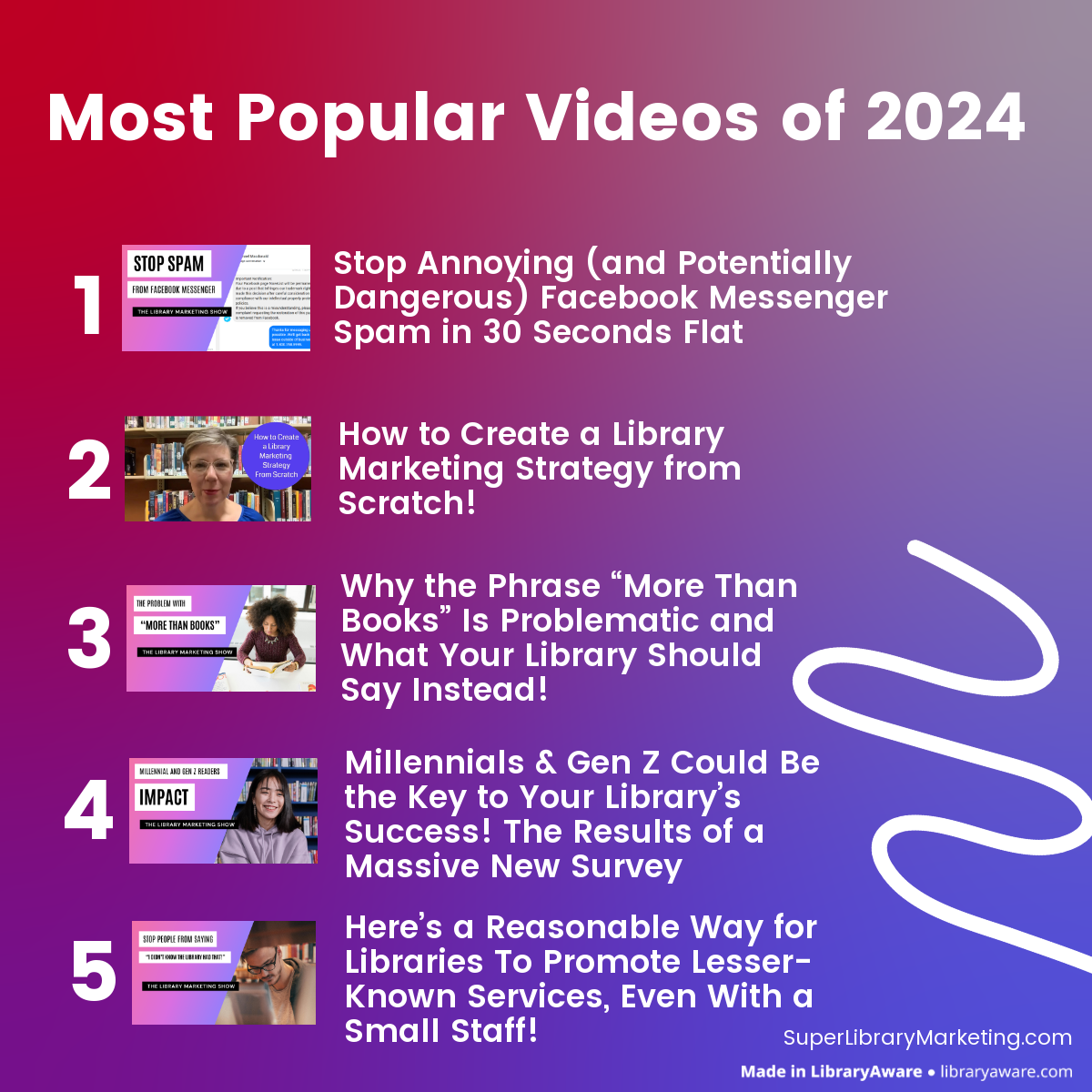
This holiday week, I wanted to ensure you are set up for success in promoting your library in 2025. These are the most popular Super Library Marketing posts from the past year that you may have missed. (We’re all so busy!)
Most Popular Super Library Marketing Articles of 2024
I hope you are looking forward to 2025 as much as I am. We’ll be tackling new library marketing and promotion subjects. Plus I have lots of library profiles on the calendar. You’ll be hearing advice from libraries just like yours. As always, I welcome your suggestions about topics you want to cover. Happy New Year!!
Subscribe to this blog and you’ll receive an email whenever I post. To do that, enter your email address and click on the “Follow” button in the lower left-hand corner of the page. You can also follow me on the following social media platforms:
Photo courtesy Cincinnati and Hamilton County Public Library
Amanda Weakley was pursuing a master’s degree in English when a comment from a professor changed the course of her career.
“I took an elective in Library Science,” recalls Amanda. “The class went well, and the professor commented that I would be a great librarian. Shortly after that, I noticed a vacancy at a local library and applied. Once I started working in libraries, I knew it was where I wanted to be.”
Amanda grew up in Rappahannock County, Virginia, located in the foothills of the Blue Ridge Mountains. She’s been a cardholder of the Rappahannock County Library since she was a preschooler.
Now she serves as director of the library, where she started working 14 years ago. Rappahannock County Library is a small, rural library that serves a population of just over 7,000 people.
“Currently, we have 3.5 FTE employees, me included, so we all do a bit of everything,” explains Amanda. “If there is an idea, we work together to see it through, usually a person or two handling every detail from planning to presentation and assessment. It is a lot of work, but the reward of successful library services and programs is immeasurable.”
With such a small staff, the library must get the most out of every tactic they use to promote their library. Rappahannock County excels in two areas: their word-of-mouth promotions and their partnership promotions.
Partnership marketing involves collaborating with other organizations, businesses, or influencers in the community to achieve mutual goals. Word-of-mouth marketing is all about building a buzz through community members, staff, and volunteers. It encourages people to spread positive stories, experiences, and testimonials about the library.
Staff members are often the key to both strategies. They are trained to spread news about new services and upcoming events and look for partnership opportunities.
“It really is a way of optimizing resources,” says Amanda. “Especially with a small staff and a small community, it helps to have as many happy patrons as possible and community partners advocating for you and spreading your news. We have friends of friends, clients, and members of partner organizations attending our events, using, and recommending our materials and services.”
“For as long as I have worked in libraries, and even prior, my focus has been on positive experiences and connections. I want everyone to have a positive experience or association with the library, be it through participating in a program, staff interaction with individuals, or staff collaboration with community partners.”
“We know people talk, so let’s give them wonderful things to say about the library and library staff! In a small community, I think word travels faster, and our organic tactics have evolved into strategic decisions.”
Amanda says libraries of all sizes should focus on what they do best in their community. Then, build and maintain healthy relationships with patrons and community partners around those key resources.
And don’t be surprised if it takes time to see the results from word of mouth and partnership marketing.
“There is a reality that you can work hard to get the word out and make connections, but there will always be people who will not receive your message,” explains Amanda. “It’s frustrating when you do everything to share information and someone says, ‘I did not know you offered that!’”
“If you have the opportunity, talk to the person, and see where they seek or find out information. Learn from each interaction and try to meet people where they are with a positive library or library staff experience. After a positive experience, your mentions will stand out and have more impact.”
The strategy’s success is easy to see if you look at Rappahannock County Library’s Facebook page. They are often tagged in photos and posts by their partnership organizations. That gives their library exposure to a whole new audience of potential patrons.
“We want our patrons and partners to tell people about us, send people our way, and even send us or our services to people. It’s a cycle of working for people, and if all goes well, they seem to work for us by continuing to market for us without even realizing it!”
Subscribe to this blog and you’ll receive an email whenever I post. To do that, enter your email address and click on the “Follow” button in the lower left-hand corner of the page. You can also follow me on the following social media platforms:
Photo courtesy Cincinnati and Hamilton County Public Library
I’ll never forget the first time I spoke in front of a community group on behalf of the library.
I was a nervous mess. The pressure was high. So much was riding on my five minutes in front of this group. I wanted to connect with my audience, transfer some of my passion for the library to their souls, and inspire them to action.
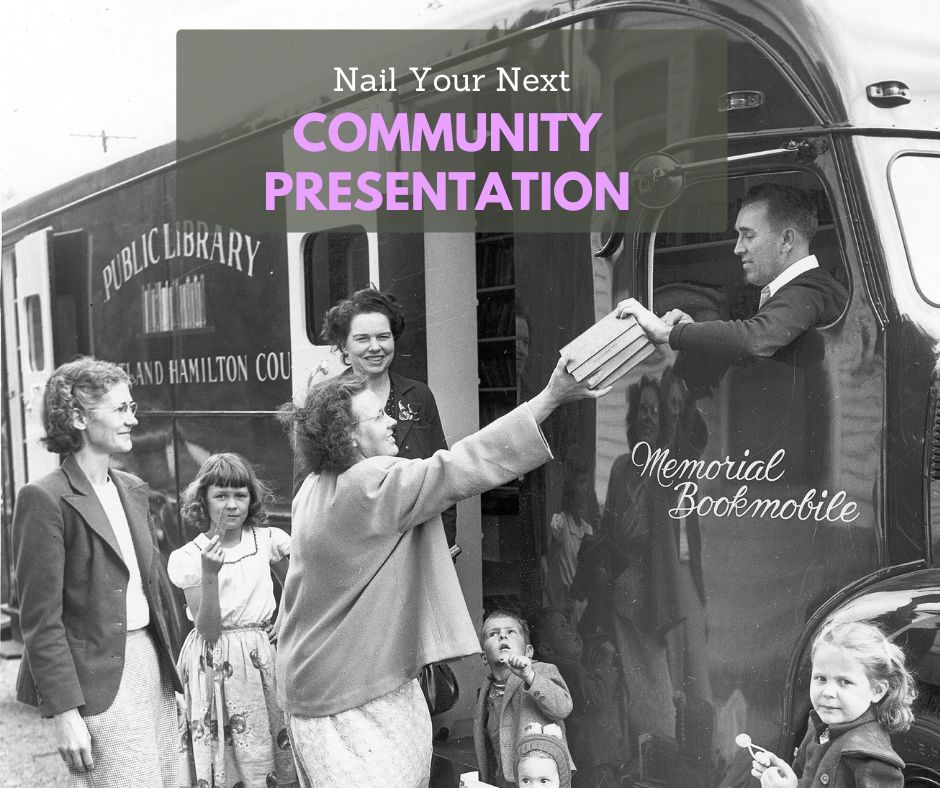
A community presentation is a unique opportunity to talk directly about the value of your library. What you say in those moments will stick with people longer than any flyer or sign ever will. But for maximum impact, you must take a strategic approach to your presentation.
And, although I know that five minutes doesn’t seem like a lot of time, it is! If you don’t believe me, stop reading this blog, set a five-minute timer, and just sit there with your eyes closed trying to predict when the timer will ring.
Five minutes is a LOT of time. And you can do a lot in five minutes!
Here are seven tips to make any presentation engaging and impactful. Scroll down to see a sample outline I’ve created to walk you through creating a presentation that hits the mark, even when you only have five minutes to share.
Refer to the library as “your library.”
Many people in your audience may haven’t visited or used the library in a long time. They may not think of the library as belonging to the community, and they certainly won’t think of the library as belonging to them personally.
So, in your presentation, refer to “your library” as many times as makes sense. This is a subtle way to let your audience know that the success of the library affects everyone in the room.
Start with a hook.
You want your audience to be interested and attentive, and the best way to do that is to start right off, not by introducing yourself, but with a surprising fact or statistic about your library.
For example, “Your library sees about 20,000 people who come into the physical building every year—that’s enough to fill our high school football stadium four times over! I’m Jane Doe, and I’m here to show you how your support of the library impacts those 20,000 people.”
You could also begin with a short, compelling story about how the library positively impacted someone in the community.
For example, “I want to begin by introducing you to Susan. Susan was laid off about 6 months ago, after spending more than 20 years at her company. She came to your library for help finding a new job. We spent time updating her resume, searching for jobs that fit her experience, and practicing interview techniques. Susan landed a new job and is now making more money than she was at her former position, all thanks to the staff at your library.”
Choose one main message and repeat it throughout the presentation.
It will be tempting to try and talk about everything the library has to offer during your five minutes. However, listing all library services will overwhelm and confuse your audience. Instead, focus on one message you want this audience to remember.
For example, if you are speaking to the school PTA, you will want to focus your message on resources available to students and parents to help with schoolwork. Your main message would be: “Your public library takes the stress out of schoolwork.”
Or, if your library is getting ready for a major construction project, you’ll want to talk about how the renovations or new construction will provide better service to the community. Your main message would be: “These new library spaces will be vibrant, accessible places where everyone in our community can thrive.”
Whatever your main message is, try to work that into your presentation at least three times. Repeating it will help it stick in the minds of your audience.
Use visual aids.
You can put together a short slide deck to help drive home your key message. Be sure to keep your slide text short. Add infographics, photos, or short video clips that reinforce your message.
If the room setup does not include a screen for a slideshow, bring handouts with you! Add your key message points to the top of the handout, and then some visuals like charts, photos, or infographics.
Add an interactive element.
You may be tempted to talk for your entire five-minute slot. But your audience is more likely to remember what you say if you involve them in the presentation in some way.
Launch a poll. Several free sites like Slido and Mentimeter let you embed a poll question in your slide deck with a QR code. Or just ask for a show of hands.
You could also ask a question of your audience, like, “How many of you have visited our library in the past month? What is the first thing you remember seeing when you walked into the building?”
Or try a mini-activity. For example, you could ask everyone to take out a piece of paper and write down as many library services as they can think of in 30 seconds.
End with a call to action.
Give your audience something to do after your presentation. You can invite them to visit the library for a special prize. You can ask for volunteers or donations. One library staff member I’ve spoken with did a presentation on intellectual freedom and handed out talking points, encouraging the audience to use them in conversation with friends at family.
Practice your speech.
A practice session or two can help identify parts of your speech that are less engaging and can ensure you stay within your time limit.
Ask a few coworkers to play the audience and then ask them for feedback on your presentation. Or record yourself giving your speech so that you can evaluate the timing, pace, and content.
Sample Outline for a Five-Minute Presentation
To help get you started, I’ve created this outline template for a community presentation. By following this structure, you can deliver an engaging and persuasive message about the benefits of the library within a short time frame.
Introduction (30 seconds)
Start with a hook: Share a surprising fact about your library or a testimonial or patron story.
Main Message (3 minutes)
State the main message you want this audience to remember.
Talk about the service you are highlighting.
Share how this service impacts your community, and how the community would be impacted if the service were NOT available.
Engagement (1 minute)
Ask rhetorical questions.
Insert an interactive element.
Conclusion (30 seconds)
Call to action: Leave your audience with a task that reinforces your key message.
Subscribe to this blog and you’ll receive an email whenever I post. To do that, enter your email address and click on the “Follow” button in the lower left-hand corner of the page. You can also follow me on the following social media platforms:
A viewer says they’re getting a lot of requests from library staff for signage. But, they’re a little worried about walking that line between good customer service and too many signs.
I know this issue well, and in this episode of The Library Marketing Show, I have some tips to help you achieve that balance.
We’ll also give kudos to a library that clearly and beautifully communicated the value and impact of its summer reading program.
Do you have a suggestion for a topic for a future episode? Do you want to nominate someone for kudos? Let me know here. Thanks for watching!
Subscribe to this blog and you’ll receive an email whenever I post. To do that, enter your email address. Then click on the “Follow” button in the lower left-hand corner of the page. You can also follow me on the following social media platforms:
“I went to a new concept charter school in downtown Winston Salem that was housed in the basement of an office building,” explains Megan. “The school didn’t have many amenities, like a gym or library.”
“This meant that we got to go on regular walking field trips to the main branch of the Forsyth County Public Library. We even got to decorate our own cotton tote bags to use carting our book finds back and forth. My dad worked in an office downtown and would often pop into the school or library for fun surprise visits.”
Megan went on to work in corporate marketing before getting her MLIS from the University of Denver. She initially intended to work in an academic setting but was more interested in the public library world. She ended up at the Natrona County Library in March of 2019, working as a part-time Children’s Librarian.
“I found it truly astonishing what all public libraries were able to do for their communities in response to immediate needs and in anticipation of future needs,” recalls Megan. “No other large organization can pivot and change that quickly. Plus, they were doing it all for free and for everyone.”
“As a marketer, I realized there was a major need here. Public libraries are these bastions of creativity, advancement, support, and acceptance, but not enough people know about these free services. I wanted to find a way to put my skillset to use promoting public libraries, and it wasn’t long after I started working at Natrona County Library that their marketer decided to move on to new ventures. In October of 2019, I stepped into my current role as head of Marketing and PR.”
Natrona County is the second-most populous county in Wyoming, with 80,000 residents. The library has a main branch in downtown Casper and a branch about 40 miles away in a small town called Edgerton. They also have a bookmobile.
Megan says nearly a third of Natrona County residents have an active library card, and the library enjoys high visitor and circulation rates and robust program attendance. That may be due in part to the work Megan has done in marketing.
At her library, Megan is a team of one, overseeing all social media, public relations, website development and management, advertising, graphic design, and branding.
“I do ask that our programmers and other library staff try to keep a ‘marketing mindset’ to help capture photographs at programs or throughout the library space that could be used for social media,” shares Megan. “I am all about efficiencies and delegation, so I have licensed programs like LibraryAware and Canva which come pre-populated with professional-looking templates that staff can use to make their own bookmarks, flyers, signs, handouts, and more.”
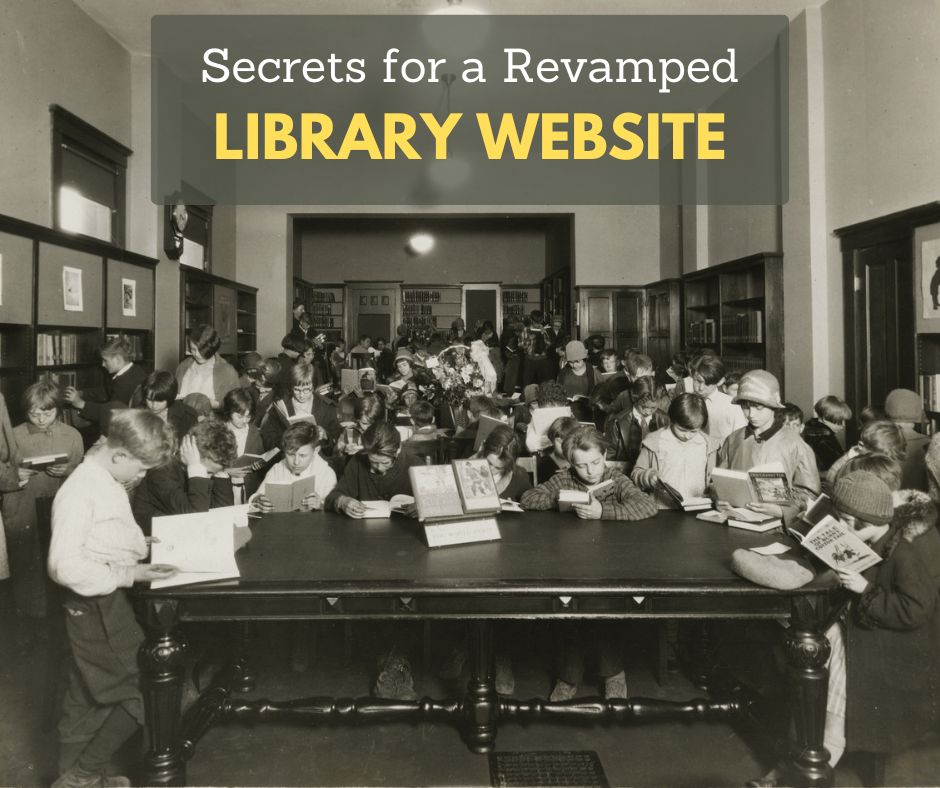
I reached out to Megan after seeing the Natrona County Library’s website. It’s clean and modern, with a thoughtful layout and what I can only describe as a “cool” vibe. I told Megan it doesn’t really look like a typical library website.
“The website (as I inherited it) was broken and battered. It had been built before mobile devices were a thing,” recalls Megan. “We needed to start fresh with a ‘mobile first’ mindset, simplify the navigation structure, integrate new event software that made our program calendar more visually appealing, and incorporate a blog to position ourselves as thought leaders in our community and the larger Wyoming library community.”
A screenshot of the Natrona County’s website homepage before the rebuild.
Megan partnered with a local creative agency on the website rebuild in 2021, thanks to the generous support of her library Foundation.
“Because of my extensive web background, we had an unusual arrangement where I worked side-by-side with their web guy as we built it out,” explains Megan. “As you know, library websites have a LOT of pages, which can make a new website a costly build. Because I was able to tackle about 75 percent of the pages (using templates, structures, and design influence from the agency-built pages) myself, it cut the cost in half, which is how we ended up with such a professional-looking website on a public library budget.”
Natrona County Library’s website includes real photos of the library, conversational language, call to action buttons, and their newsletter signup is right on the home page.
For some libraries, the website can be a point of contention: everyone has different opinions about what should be featured on the homepage and drop-down menus. Megan needed to make decisions based on her knowledge of her customers. Later, analytics let her know if her instincts were correct.
“There are a couple of items that live in multiple places in the menu, like the Bookmobile, to accommodate multiple thought processes or visitor types,” explains Megan. “My goal, ultimately, is to put things that make the most sense to our staff, because they are the ones referencing the pages the most.”
“But we are all in agreement that the most important pieces of information are to be at the very top of the homepage. Static across the entire site is the search functionality for our catalog, log-in to one’s account, library hours, and our phone number. I treat our website like a database in that sense.”
“Anecdotally, and through analytics, we’ve come to realize that our patrons don’t spend a whole lot of time on our website. They mostly come for hours, contact information, and to get to our catalog. They may also enter through digital ads, social media, or from other places directly to landing pages, but don’t tend the linger.”
The website is also the home of Natrona County Public Library’s blog, Library Stories.
“Our blog is a byproduct of our bygone print newsletter,” explains Megan. “It was important to me that we have a way to not only highlight that content for larger audiences but also share it differently, as blog articles can be interacted with much differently than print pieces.
“The blog is a great place to put press releases or share important library updates without building individual landing pages that disappear over time. Depending on the content, I do find that the blog articles drive traffic, especially if the blog article is about the library itself.”
“For example, we shared a press release about a recent exploration of a bank building as a potential new location for the library, and it got a lot of visitors (as well as a lot of commentary on social media). The same thing happened when we increased the number of security guards and shared that information with the community.”
“The blog is an excellent resource for the media and can be a great way to remind our community of our policies, procedures, and things like funding sources, as these are things that seem to come up often in social dialogue.”
Megan says if your library is considering a website refresh, make sure you make that digital space as welcoming and friendly as your physical locations.
“Also, when you’re talking to your staff, stakeholders, and patrons about the library website, they have no idea that there is often a difference between your website and your catalog,” adds Megan. “I realize that some libraries have their site and catalog combined, but that is not the case for us.”
“Our website is built on WordPress, and our catalog is through ByWater Solutions’ Aspen. We also have integrations with LibCal for our event calendar, room booking, appointments, and Library of Things. Patrons have no idea that these are all separate things, and a patron can shut down during conversation if you start talking about them as such.”
“That’s why it was super important that all these disparate–but integrated–sites feel cohesive so that patrons and end users don’t even realize when they’re navigating away from one and can easily and seamlessly navigate back to where they came from.”
You can read more about the rebuild of the Natrona County Library website here.
Hey library marketing friends: Every promotion you create brings the joy of your library to someone new. That’s something to be proud of!
Subscribe to this blog and you’ll receive an email whenever I post. To do that, enter your email address and click on the “Follow” button in the lower left-hand corner of the page. You can also follow me on the following social media platforms:
In a few weeks, kids in your community will head back to school. This time of year is a marketing opportunity for all libraries! Lucky for us, one of the major social media platforms just published a guide for marketing to back to school. I’ll share the top three takeaways for library marketing during back-to-school time in this episode.
Plus we’ll share kudos for a library that did something extraordinary by harnessing the power of their loyal library fans.
Do you have a suggestion for a topic for a future episode? Want to nominate someone for kudos? Let me know here. And thanks for watching!
Subscribe to this blog and you’ll receive an email whenever I post. To do that, enter your email address and click on the “Follow” button in the lower left-hand corner of the page. You can also follow me on the following social media platforms:




 Super Library Marketing: Practical Tips and Ideas for Library Promotion