Search

Super Library Marketing: Practical Tips and Ideas for Library Promotion

Category

Marketing Basics

The Top 13 Places To Find Library Content To Share When Youโ€™re Tired and Overworked (Bookmark This Post!)

Courtesy Cincinnati and Hamilton County Public Library

Promoting your library can feel a lot like feeding a very hungry, very demanding giant.

You want your community to know that your library is the source of rich and valuable information. But, let’s be honest. When you are doing the entire job of promoting your library by yourself or with a small staff, keeping up with the audience’s expectations can be exhausting.

Heck, doing it with a big staff is exhausting. Marketing is tiring.

And the more exhausted and overworked you get, the more your original content suffers. You can’t put your best work out into the world when you are weary.

Your original content, like blog posts, videos, newsletters, and social media posts that talk about what your library offers and how your library helps your community, must be as engaging as possible. Those pieces of content take precedence. You should devote your energy to making those shine.

But there are so many content holes to fill! That’s where a little trick called content curation can be super helpful.

Content curation is sharing articles, infographics, case studies, videos, and other content created by other organizations on your library’s platforms.

Now, I know this sounds counter-intuitive to promoting your library. Why would you share the work of someone else with your audience? Shouldn’t you take every opportunity to engage your followers with your library’s stuff?

That would be ideal. But I know darn well you don’t have a staff of 20 writers to fill your content needs every day. And besides helping you fill your editorial calendar, content curation has other benefits.

Sharing content that aligns with your library’s mission, vision, and values will strengthen your library’s brand. It does this by building trust in your library as an institution of knowledge and inspiration. And it helps you to drive home important messages, like the joy of reading.

Before you begin sharing

The library I used to work for was huge: 600,000 plus cardholders and 41 locations. However, I had a small marketing staff. We often shared content from other sources to fill gaps in our social media and email calendars.

We set a focus for this shared content: anything we shared from outside sources had to be related to books and the literary world. This aligned with one of our library’s overall goals to drive circulation.

That focus was both simplistic and broad. It allowed us to fill our content needs with posts about authors, new books, books being made into movies, health news related to reading, beautiful libraries around the world, historic libraries (including our own), and a lot more.

Our library’s curated content led to higher organic reach on social media. Those pieces of shared content were intriguing additions to our emails. The curated content got a high click rate.

This strategy positioned us as a news source for all things related to the book world. Our followers and fans thought of us as more than a library. They turned to us for information on all topics related to literature.

So, I advise you to set a focus: one that is simple and aligns with your libraryโ€™s strategic goals.

For example, Hennepin County Public Libraryโ€™s strategic plan includes the line:  โ€œOffering free access to essential technology and connectivity.โ€ Their curated content focus can be on technology and the benefits of open access to a community.

Here’s another example. One of Montgomery County Public Library’s strategic goals is to make sure all children ages 5 and younger are ready for kindergarten. Their curated content focus might be on shared literacy tips for caregivers of young children, as well as any content that helps caregivers prepare their kiddos for school.

Once youโ€™ve set your focus, you can start sharing. Here is a list of 13 websites where you can find library-related content to share with your audience.

Do you know of a website I should add to the list? Comment below the post to let me know!

BuzzFeed Books

This fantastic BuzzFeed spin-off is a rich source of fun content related to books, authors, and celebrities.

reddit Books

This list of user-generated content on books, libraries, and the literary world is invaluable. Use the discussion boards to give your ideas for fun, and interactive polls to create for your social media followers or email subscribers.   

NPR Books

A good source of more high-brow literary news and lots of book reviews. Use this site to help you decide which books to highlight for individual promotions on social media and through email.

HuffPost Books

Like NPR Books but with a lot of news about politics, book challenges, and diverse authors.

Book Riot

Find in-depth articles and interesting angles on literary themes. Scroll down to the bottom for links to a host of podcasts on every kind of literary subject.  

Electric Lit

A high-brow website with a fun, cultural perspective on literature.

NoveList

My team is responsible for the blog and newsletters, and we work hard to make sure they are a rich source of content curation or promotional ideas for your library. Steal away!

Library Journalโ€™s technology section

Periodic stories about how technology can impact libraries and their patrons. They publish about once a week.

School Library Journal

A great source for posts about books and other library-adjacent services for young readers.

The Princh blog

This company is based in the UK and sells printing options for libraries. Their blog is rarely about printing. Instead, they cover library topics like the impact of early literacy strategies and the joy of volunteering at a library.

American Library Association Office of Intellectual Freedom blog

Need help curating content that educates your community about the dangers of book challenges? This is the premier spot to find it.

Content Prompt

This daily email from Megan Kowalski (profiled here) will give TONS of great, daily ideas for content. Sheโ€™s a whiz at following those little-known holidays that can make for great fun on social media (Hello, Fish Tank Floorshow Night!)

Any blog from another library or one of your partners!

If you type “library blog” into Google these days, you’ll come up with a whole list of libraries that are publishing content on a variety of subjects. They’ll appreciate you if you share their content. And you’ll know those content pieces are well-researched and written from the library’s perspective.

Your partner organizations will also be flattered if you share their content. For example, if the town yoga instructor who occasionally holds a class at your branch posts about how yoga helps relieve stress, and your content curation focus is on mental health, share that post!


P.S. Want more advice?

Empathy Marketing: How To Use Greed, Fear, Love, and Hope To Motivate Your Audience

Subscribe to this blog and youโ€™ll receive an email whenever I post. To do that, enter your email address and click on the โ€œFollowโ€ button in the lower left-hand corner of the page. You can also follow me on the following social media platforms:

๐Ÿš— 3 Easy and Proven Ways To Drive More Traffic to Your Library Website

Watch this video

The #LibraryMarketing Show, Episode 199

Your library’s website is more than a website. It’s actually a digital branch. And it’s an incredibly important way to drive people to your library and to help them find out about your services and items.

I have three big tips for you that you can implement to make your website more discoverable out there on the fast internet. And you do not have to be a fancy website developer to put these tips into practice!

Plus weโ€™ll give kudos to someone doing great work in library marketing.

Do you have a suggestion for a topic for a future episode? Want to nominate someone for kudos? Let me know here.

Thanks for watching!


Will I see you soon?

Subscribe to this blog and youโ€™ll receive an email whenever I post. To do that, enter your email address and click on the โ€œFollowโ€ button in the lower left-hand corner of the page. You can also follow me on the following social media platforms:
I’m Issuing a Challenge! 3 Key Phrases I Want Library Marketers To Say More Often

Watch this video

The #LibraryMarketing Show, Episode 198

I would like to issue a challenge to my library marketing friends. I have three phrases that I want to hear you say more often: to each other, to your coworkers, and to the world in general.

I’m going to explain why these three phrases are so important to the success of your work in this episode.

Plus weโ€™ll give kudos to someone doing great work in library marketing.

Do you have a suggestion for a topic for a future episode? Want to nominate someone for kudos? Let me know here.

Thanks for watching!


Will I see you soon?

Subscribe to this blog and youโ€™ll receive an email whenever I post. To do that, enter your email address and click on the โ€œFollowโ€ button in the lower left-hand corner of the page. You can also follow me on the following social media platforms:

3 Reasons Why Your Library Should Focus on Promoting Only ONE Thing at a Time!

The #LibraryMarketing Show, Episode 191

Here is a bonkers idea: what if your library fully and completely committed to promoting JUST ONE THING for a concerted amount of time? What would be the advantages? Would it be risky?

I’ll explain why it’s a good idea (and how I know it works because you’re already doing it!!) in this episode.

Plus we give away kudos. Watch the video to find out which library or group of libraries is being recognized.

Do you have a suggestion for a topic for a future episode? Want to nominate someone for kudos? Let me know in the comments.

Thanks for watching!


Subscribe to this blog and youโ€™ll receive an email whenever I post. To do that, enter your email address and click on the โ€œFollowโ€ button in the lower left-hand corner of the page. You can also follow me on the following social media platforms:
I Spent 3 Hours in a Room Full of Curious and Committed Library Staff: Here Are the 4 Things I Learned From Them!

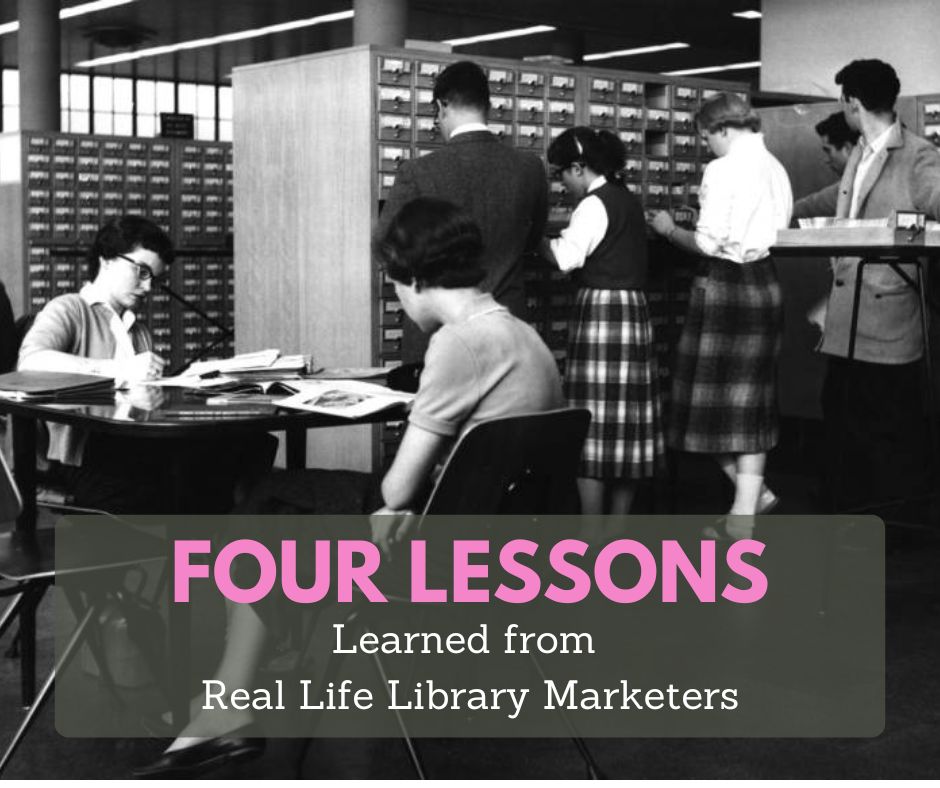
Teenagers and young people in the 1950s in a library. Some are sitting at a table looking at magazines, while others search through the card catalog.
Photo courtesy Public Library of Cincinnati and Hamilton County

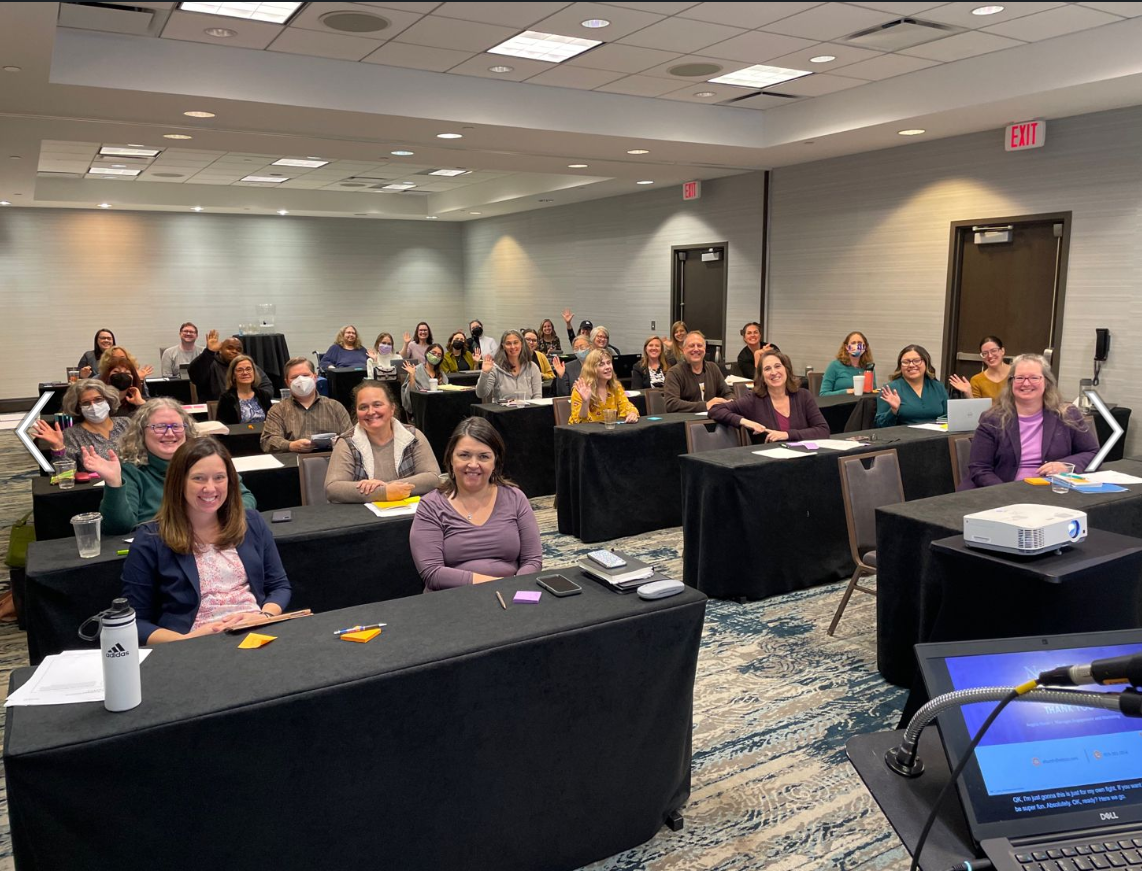
This past week, I spent three-plus hours in a room with 38 library marketers.

We worked together on all those pieces of library marketing that we donโ€™t normally have time for.

We identified our librariesโ€™ strengths and weaknesses. (My weakness: spelling).

We named our libraries opportunities and threats. We set SMART goals.

We identified our target audiences (hint: your audience is not everyone!). And we talked about measuring promotions to replicate success.

These are the fundamentals of library marketing. These are the building blocks that ensure your marketing will be successful.

This was the first-ever pre-conference workshop for the Library Marketing and Communications Conference, which returned in all its in-person glory. Shoutout to the dozens of readers who took the time to say hello to me!

I told the group that I knew, without a doubt, that I would learn something from them. And I did.

A room full of library marketers, sitting at tables and waving at the camera.
My 38 new best friends

Here are the four things I learned from this fantastic, dedicated, intelligent, creative, and curious set of library marketers.

Library marketers need time to think.

We are all doing too much.

We must make print collateral, send emails, schedule social media posts, attend meetings, make press releases, do outreach events, and then attend more meetings.

I asked almost everyone I met at LMCC how things are going at their library. And I lost track of the number of times the response was, โ€œItโ€™s been a little nuts.โ€

The idea ofย setting aside time to consider what is to be done, how it will be done, who will do it, and how it can be more effective, is an entirely foreign concept to most libraries.ย 

We donโ€™t give our employees the time to work through strategic planning. There is no rest. At many libraries, the marketing is done by librarians who also have other duties. There’s never any time to breathe.

And then we wonder why itโ€™s so difficult to create successful library marketing and communications.

That happens because we never take the time to do all the fundamental work that is necessary to ensure our marketing is effective. Weโ€™re building houses without foundations.

So, the workshop gave these library marketers permission to ignore email, text messages, chats, and outside distractions. They got three hours to focus solely on building the foundations for strong library marketing.

Itโ€™s important to create that space for yourself as a library marketer. I know itโ€™s difficult. If you canโ€™t attend a workshop, you can set aside time on your calendar, like you would for a meeting, to do this important background work.

Put your phone in a locked drawer. Turn off your chat program. You can even leave your physical workspace if you need to. When I worked at the Cincinnati Library, I would hide in the stacks when I needed to do this work.๐Ÿ˜‰

Library marketers face the same struggles.

We did a SWOT analysis exercise, where each library marketer identified their libraryโ€™s strengths and weaknesses, opportunities, and threats. And then we shared as a group.

How many of these do you recognize as your library’s weaknesses and threats?

  • A marketing team made up of one person, trying to do ALL the promotions
  • Difficulty getting people to take an action, like place a hold or register for a program after they engage with marketing
  • Having too much to do
  • Having no identifiable library branding
  • The approvals process
  • Threats to funding

The list goes on.

During this exercise, the library marketers in the room began to realize that they are not working alone on an island. There are thousands of library staffers out there who understand their struggles because they face those same difficulties. They felt truly seen.

Library marketers have a lot to celebrate.

As much as we struggle to do effective library marketing, we also have many, many, many wins to celebrate. We should be proud of:

  • Our social media engagement
  • Our impactful partnerships
  • The fact that people open and read our emails more than they do for any other industry!
  • We have so much great content to promote.

We donโ€™t do enough celebrations in library marketing. Thatโ€™s one of the reasons I started giving out Kudos in The Library Marketing Show and began recognizing libraries via #LibraryoftheDay.

You can help. When you see a library doing great marketing work, give them a shoutout on social media. Better yet, email them to let them know you noticed their amazing promotion. You can also nominate a library for Kudos on The Library Marketing Show.

A little bit of celebration goes a long way to boosting morale for library marketing. We can be each otherโ€™s cheerleaders!

Library marketers thrive when they have a friend.

Most of the attendees of the pre-conference session told me they are introverts. But when I asked this room full of strangers to pair up, the room got super noisy!

There were smiles. There was laughter. There were conspiratorial looks and nods of understanding. It was magical.

And it occurred to meโ€ฆ sometimes we just need someone who understands our work.

You may be wondering how you can find a library marketer to be friends with. One way is to join the LMCC Discussion Group. You can also join the Library Marketing Book Club.

Or you can message me on LinkedIn. Tell me a little about yourself and Iโ€™ll introduce you to a library marketing buddy.

Let’s support and encourage each other. When we work together, we strengthen the library industry and, most importantly, do a better job of providing service to our communities.


More Advice

Stop What You Are Doing! Before You Launch Another Library Event or Service, Take These 5 Steps to Define Your Promotional Strategy

Call It What It Is: Toledo Public Library Explains Their New Brand Strategy

Subscribe to this blog and youโ€™ll receive an email every time I post. To do that, enter your email address and click on the โ€œFollowโ€ button in the lower left-hand corner of the page.

Make Sure Your Library Promotional Emails Get Noticed in the Inbox! Here Are Some Tips That Actually Work.

The #LibraryMarketingโ€‹โ€‹โ€‹โ€‹โ€‹โ€‹โ€‹โ€‹ Show, Episode 162: This episode is my response to a recent comment by a library staffer. They believe that marketing emails aren’t worth their time because people receive too many emails from brands.

That’s a common misconception. I’ll explain why it’s not true and share some tips for making sure your library marketing emails get opened and clicked on!

Kudos in this episode go to Kathy Zappitello. Watch to find out why she’s being recognized.

Do you have a suggestion for a topic for a future episode? Want to nominate someone for kudos? Let me know in the comments.

And subscribe to this series to get a new weekly video tip for libraries.

Thanks for watching!


Subscribe to this blog and youโ€™ll receive an email whenever I post. To do that, enter your email address and click on the โ€œFollowโ€ button in the lower left-hand corner of the page.

How to Get Stuff Done Without Losing Your Mind: My Top 6 Time Management Tips for the Busy Library Marketer

Photo courtesy Public Library of Cincinnati and Hamilton County

You are pressed for time.

I know it. I have the receipts.

Every time I lead a Learn with NoveList course, I ask a question of my audience. What’s the hardest part of library marketing?

And in every single class, the answer is always the same: Finding the time to do the work.

And yet, you’re expected to crank out library promotion after library promotion. You are asked to increase visitors, program attendance, circulation, and donations to your library. And you are often doing this promotional work while doing other things like answering reference questions, shelving books, filling holds, and cleaning the bathroom.

It’s exhausting. And sometimes, it seems downright impossible.

Time management is hard. But the benefits are well worth it. Time management helps you achieve bigger goals, reduces procrastination, and increases productivity.

I was fortunate, early in my library career, to have a mentor who helped me get control of my schedule and learn how to prioritize my work. It’s now my turn to pass on the six most effective tips for managing your time without losing your mind.

Tip #1: Schedule everything.

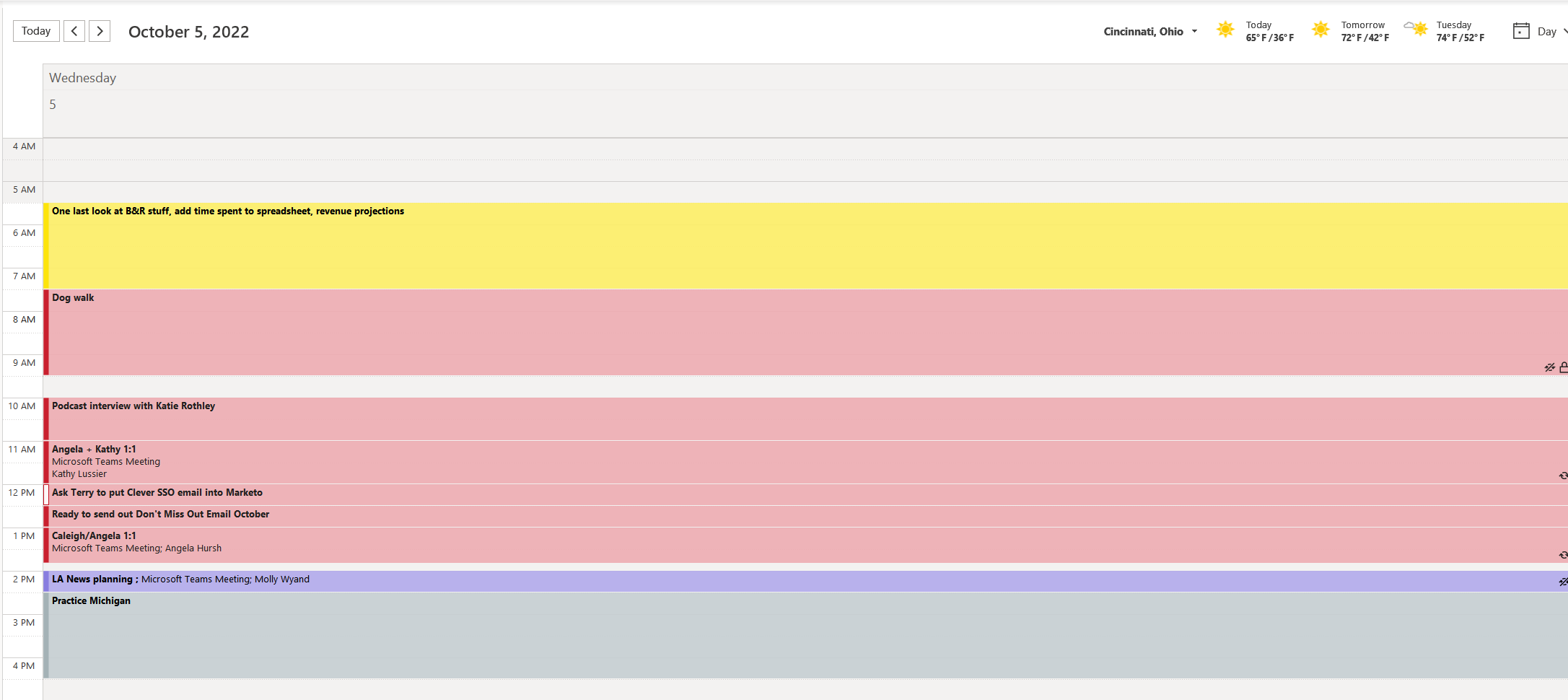
My calendar is more than a place to keep track of meetings. It serves as the hub for all my work tasks.

If you need time to focus, research, or think about something, schedule it in your calendar. Schedule the time you’ll be spending at the front desk. Schedule the time it takes you to work on holds or shelve books. Schedule the programs you’ll lead. Schedule time to read your email. Schedule everything.

Here is a screenshot of my calendar. I use color coding to help me keep track of important, ongoing projects. Notice I even schedule my daily walk!

This method makes it clear what you’ll be working on each day. It also keeps you from forgetting tasks. When I’m given an action item from a meeting, I immediately go to my calendar and schedule time to do that work.

I also enter recurring tasks in my calendar, so I can be reminded to add those tasks to my wish list (see tip #6) when the time to do them arrives. This leaves me more time to focus on tasks for today, and not worry that I’ve forgotten to do something important.

Tip #2: Arrange your daily tasks in order of difficulty.

The most difficult or important thing on your to-do list should be the first thing you get done every day. This method creates momentum and frees up the rest of your day so you can do easier tasks or tasks you enjoy more.

Tip #3: Block out distractions.

If you need to concentrate, do whatever you have to do to get focused. A study at the University of California, Irvine found that, once you get distracted, it takes 23 minutes to regain focus. That’s a lot of time.

When you need to remove distractions, you should:

  • Shut down your email.
  • Shut down Microsoft Teams, Skype, or whatever program your library uses for internal messaging.
  • Close your website browser.
  • Turn your phone over so you can’t see the screen and put the ringer on vibrate.
  • Go to another location. This is especially important if your workspace is in a shared office or near patron areas of your library. It is okay to create physical barriers between you and your distractions!

Tip #4: Say “no” to be more efficient.

If you’re asked to add to your library promotional schedule but the addition does not drive the overall strategy of the library or falls outside the boundaries of your documented marketing strategy, say no. Saying no gives you time to really concentrate on the pieces that will help your library the most. Your work will be better the LESS you do.

I understand this is extremely difficult to do. I encourage you to bookmark this short but powerful essay on the power of saying no in marketing from Joe Pulizzi. I re-read this piece when I need a little help saying no!

Tip #5: Take creative breaks.

No one can churn out tasks, one right after the other, all day long. Creative breaks will give your mind a rest and help you focus when you need to. Walk the stacks or go for a walk around the block. Get away from your desk for five minutes to stretch your legs and gather your thoughts.

Tip #6: At the end of every day, celebrate what you got done and make a wish list for tomorrow. 

Many, many years ago, I heard singer Wynonna Judd say something that I think about almost every day. She was discussing her schedule, and how easy it is to get to the end of the day and to feel like a failure. That’s because many of us focus on what we didn’t manage to get done, instead of celebrating what we did accomplish.

I took that to heart. At the end of the day, I spend a few minutes paying homage to the work I did, even if I didn’t make it to all the tasks I intended to do.

Then, I make a “wish list” of tasks for the next day. Notice I don’t call it a “to-do list.” That’s because library staff must be flexible and deal with unexpected work.

As you make out your “wish list,” include every task: meetings, lunches, phone calls, calculations, reports, writing assignments–the whole deal. At the end of today, go through your wish list and highlight three things that absolutely must get done. Those will be the first three things you tackle the next day.

Be protective about your wish list. If someone emails you with a task and it isn’t urgent, put it on tomorrow’s list.

And finally, do not beat yourself up if you don’t finish every task on your list. Move uncompleted items to the wish list for the next day.


More Advice

14 Completely Random and Free Tools You Need in Your Life To Make Your Library Promotional Work Easier

Four Important Project Management Lessons Youโ€™ll Need to Survive the Next Year of Library Work

Subscribe to this blog and youโ€™ll receive an email every time I post. To do that, enter your email address and click on the โ€œFollowโ€ button in the lower left-hand corner of the page.

Libraries: It’s Time to Update Your Crisis Communication Plan! Here’s What You Need to Revise.

The Library Marketingโ€‹โ€‹โ€‹โ€‹โ€‹โ€‹โ€‹โ€‹ Show, Episode 161: In the wake of Hurricane Ian, libraries around the world should take the time to update their crisis communication plans.

Most libraries put a crisis plan into place during the pandemic. But if you haven’t revisited and revised the document since then, you could be in trouble.

Disaster strikes every library. We’ll talk through the things you need to update in your plan.

Kudos in this episode go to the Boone County Library. Watch the video to find out why they’re being recognized.

Do you have a suggestion for a topic for a future episode? Want to nominate someone for kudos? Let me know in the comments.

And subscribe to this series to get a new weekly video tip for libraries. Thanks for watching!


Subscribe to this blog and youโ€™ll receive an email whenever I post. To do that, enter your email address and click on the โ€œFollowโ€ button in the lower left-hand corner of the page.

Plan for Library Marketing Success! How To Create an Effective Marketing Plan No Matter the Size of Your Library (Plus a Free Downloadable Template!)

Photo Courtesy Public Library of Cincinnati and Hamilton County

The first time I went to a conference, I made a plan.

I decided which sessions I would attend weeks before the conference began. I studied the floor map of the convention center so I could plot the best way to get from room to room. I made a list of local restaurants and tourist attractions within walking distance of my hotel so that I could make the most of my free time.

Am I bonkers? Nope. I am a planner.

A plan provides a guide for action. It ensures goals are met and time and resources are used wisely.

There are times when spontaneity is called for. But library marketing is not one of them. A marketing plan is key for the success of any type of library promotion.

What exactly is a library marketing plan?

A library marketing plan is a tool you use to help to achieve your library’s overall goals. It lays out the steps involved in getting a promotion out into the world. It helps you decide how and when promotional work will be done for a pre-determined time in a specific way.

A library marketing plan also ensures everyone knows the end goal of your marketing efforts. It sets deadlines. It keeps people accountable. And it clarifies how you will measure your results.

You don’t need a plan for everything you promote at your library. You do need a plan if you are creating a campaign that lasts for more than several weeks.

How to put your marketing plan together

Scroll down to the bottom of this post for a list of free project planning websites. They will help you with the execution of your plan. At the bottom of this post, you’ll also find a customizable template to download. It’s based off the library marketing plan spreadsheet I used for years.

Know the thing you are promoting inside and out.

Be sure you can answer every single question about the thing you are promoting. You must become an expert on the event, service, or item you will promote.

Ask yourself, what problem will this solve for my patrons? How easy is it to use? What are the features that canโ€™t be found at any of my competitors?

Clearly define your end goal.

Use the SMART goal framework to ensure you and your co-workers know exactly what you are aiming to achieve. SMART goals are specific, measurable, attainable, relevant, and timely.

So, if you are looking to increase brand awareness, set an actual, measurable end goal like: “Within the next 6 months, we want 50 percent of residents living within a 30-mile radius of our Main Library to know that we have renovated the building and to be able to name at least one new service available at the library.”

Determine your target audience.

Many library marketers say their target audience is “our cardholders.” Be more specific.

Ask yourself:

  • Which cardholders?
  • How old are they?
  • How often do they use the library?

Fill out your picture of your target audience with as many demographic characteristics as you can. This gives you and everyone working on the plan a picture of who you are trying to reach.

Analyze your competitors.

Research anyone providing a similar program, service, or product. Ask:

  • What are they doing well?
  • What are they doing poorly?
  • What are the things that differentiate your library from their business?

These are your marketing advantages. You can use this information to create messaging that tells your target audience why they should use your library service, instead of a competitor.

Create the message.

Get the message or elevator pitch for your promotion set. It’s the most important part of your plan. You need it to create all the tactics you will use to promote your library.

Choose your tactics.

Go through all the available channels at your disposal for marketing and decide which ones will work best to reach your end goals.

You do not have to use everything that’s available to you. Sometimes, a video will work well and sometimes an email will do a better job. Not every promotion needs print materials, a press release, or a digital sign.

You know best how your target audience reacts to each tactic and which will bring you the best results. If you have a budget, decide how you’ll spend it during this step.

Set the schedule.

Every library has a different approach to its promotional schedule. I am a fan of tiered distribution of marketing. The approach takes advantage of a consumer cycle of excitement. Here’s how it works:

  • Release one or two promotional tactics at the beginning of your promotional cycle, like a social media post and a press release. The promotion gets some play, and excitement builds in the consumer base. It gets shared and people talk about itโ€ฆ and then the excitement dies out.
  • Release the second tactic, like an email, and the people who see the email get excited and start talking about it and sharing it, and then their excitement dies out.
  • Release a video, and that builds excitement and gets shared, and the excitement then dies out. And so on!

When you use the tiered distribution approach, you get a longer promotional thread. Your promotions will be more successful because the excitement around them builds over time, not in one big burst.

It is also easier on the person running the marketing! It gives you a small break in between each tactic and creates time for you to measure the success of each tactic individually.

Assign tasks.

Delegate jobs and deadlines for appropriate staff. If you need help from another library department, assign their deadline now so they have plenty of time to get you the information you need.

Measure results.

Don’t forget to measure and record the reaction to each piece of your marketing plan. Analyze what worked and what did not, so you can put that knowledge to use next time.

Free or cheap project management solutions

Clickup: the free plan will work for small libraries. The unlimited plan is very affordable and would work well for medium to large libraries.

SmartSheet: their lowest plan tier is a little more expensive than ClickUp but has more integrations.

Asana: this is what my employer NoveList uses. It makes is easy to assign tasks and deadlines.

Marketing plan template

I’ve created a customizable marketing plan spreadsheet. It includes my suggestions for the timing of promotional tactics for an event or service promotion.

You can delete or add columns based on the tactics available to your library and the size of your library. Download it here.


Related Advice

What the Heck Is the Difference Between Library Statistics and Marketing Metrics? Hereโ€™s the Full Explanation and Why They Are BOTH Important!

Planning for Magic! How To Keep Your Eyes (and Your Schedule) Open for Unexpected Library Promotional Opportunities

Subscribe to this blog and youโ€™ll receive an email every time I post. To do that, enter your email address and click on the โ€œFollowโ€ button in the lower left-hand corner of the page.

A WordPress.com Website.

Up ↑